
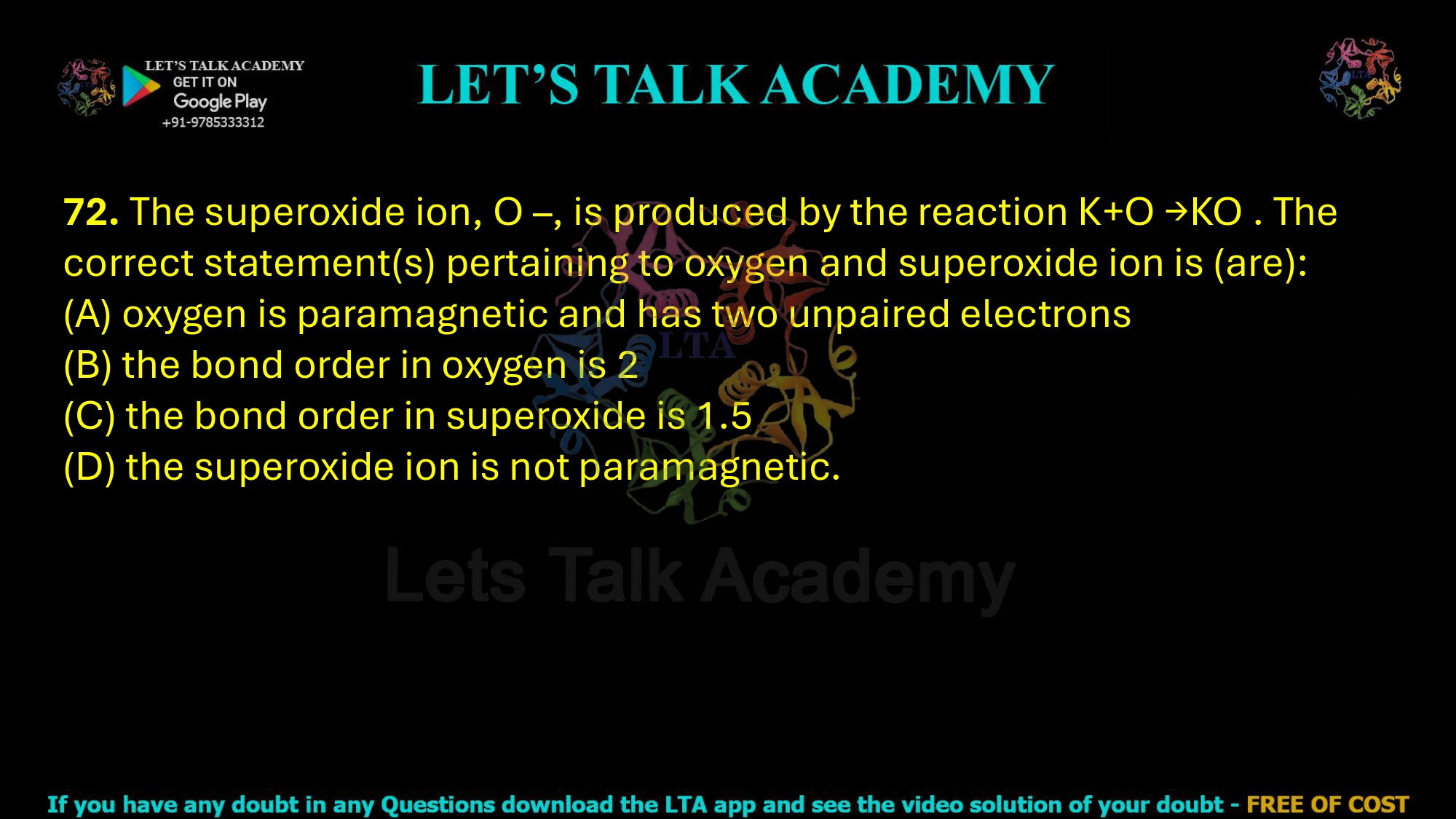
![73. Among the following pairs of co-ordination compounds, the pair(s) which represent(s) a case of “ionization isomerism” is (are): (A) [Pt(en)2Cl2]Br2 and [Pt(en)2Br2]Cl2 (B) [Cr(NH3)4ClBr]NO2 and [Cr(NH3)4ClNO2]Br (C)[Co(NH3)6][Cr(CN)6] and[Cr(NH3)6][Co(CN)6] (D)[Co(NH3)5Br]SO4 and [Co(NH3)5 SO4]Br](https://www.letstalkacademy.com/wp-content/uploads/2026/07/1-23-6.jpg)
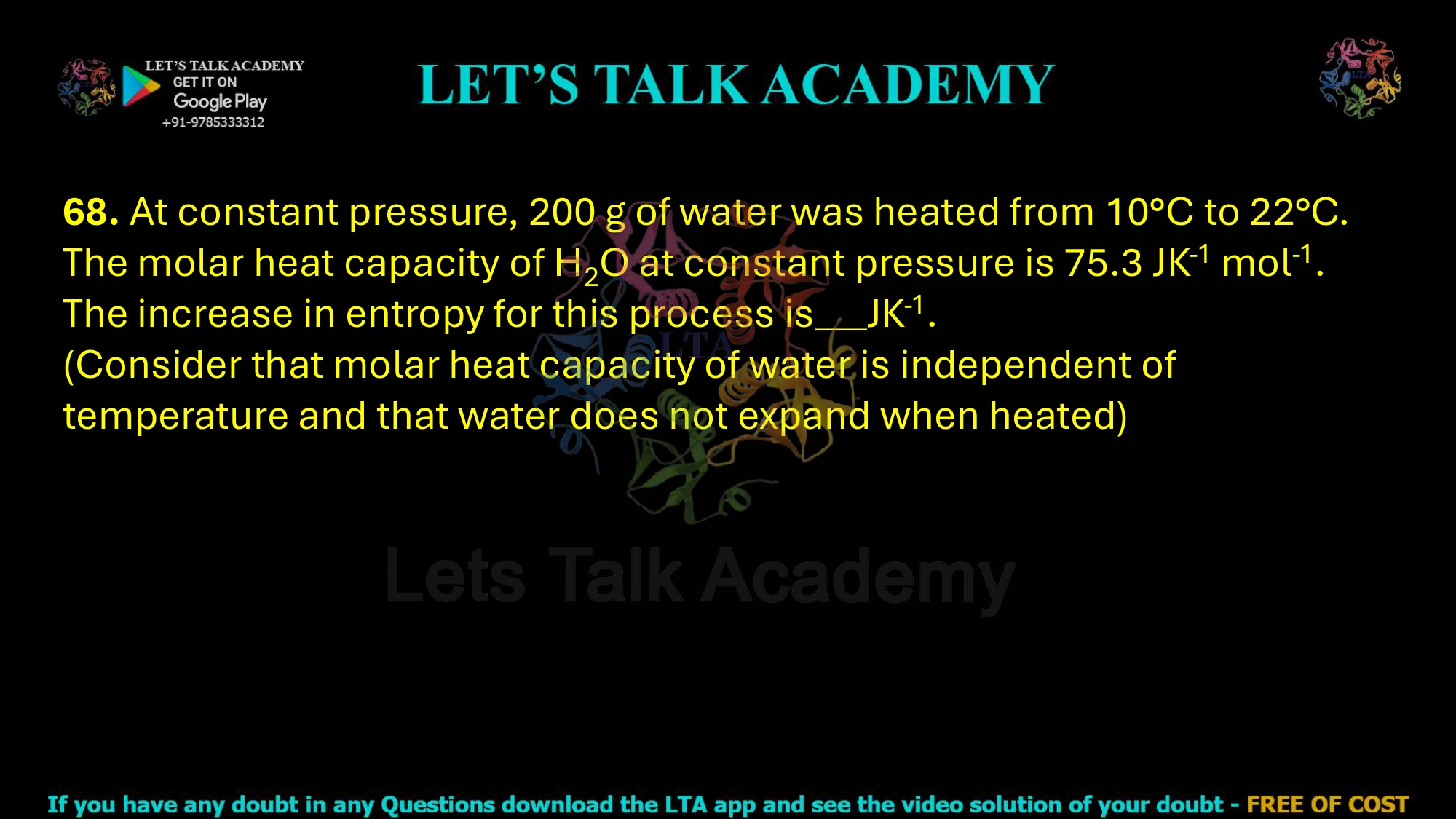
![69. The number of optically inactive geometrical isomers of [Pt(NH3)2(py)2Cl2]2+ is_______ . (where, ‘py’ is pyridine)](https://www.letstalkacademy.com/wp-content/uploads/2026/07/1-19-6.jpg)
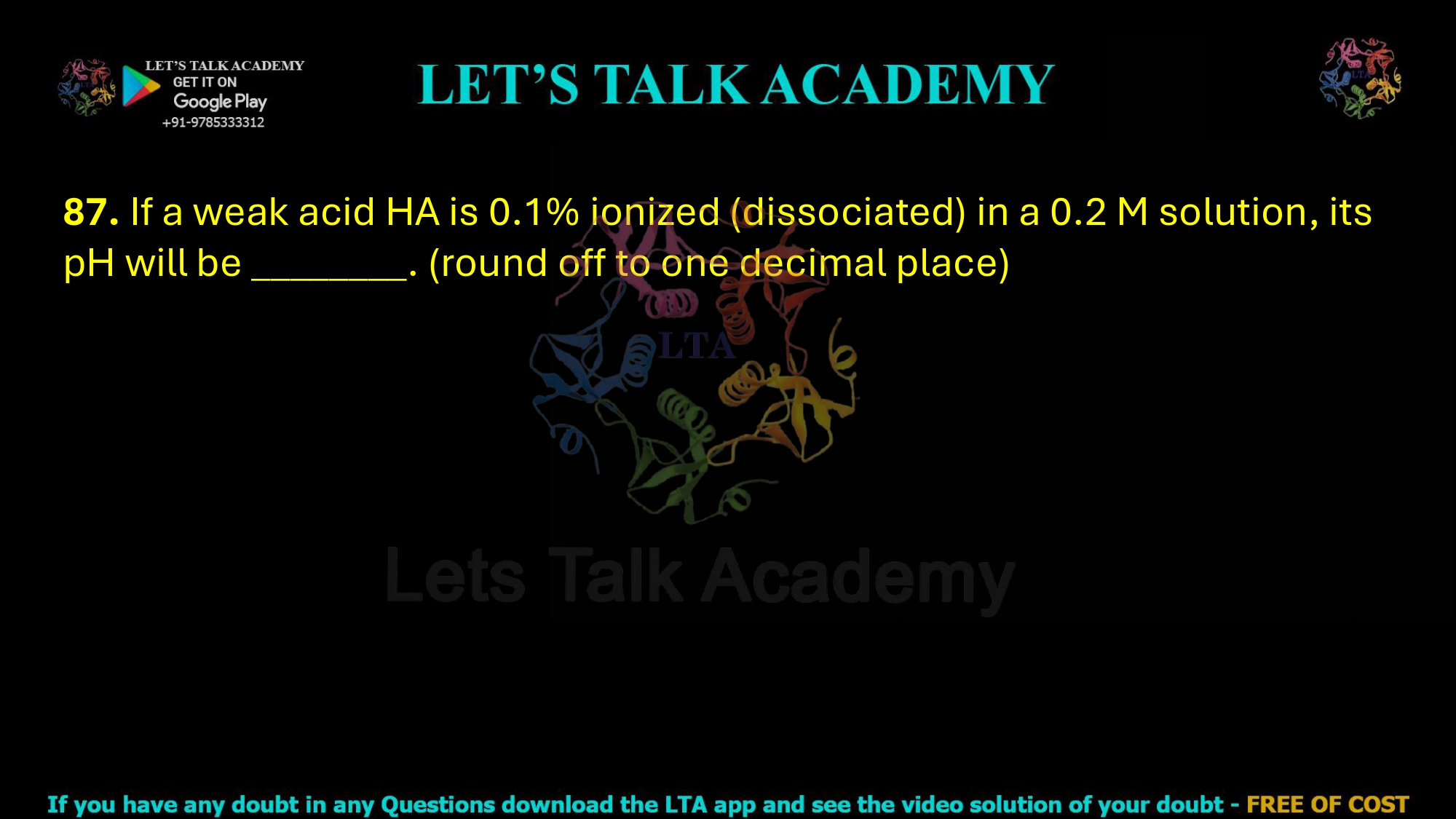
![59. The [H+] of 0.1 N acetic acid solution is 1.33 × 10⁻³. The pH of the solution (correct to two decimal places) is .](https://www.letstalkacademy.com/wp-content/uploads/2026/07/1-9-6.jpg)
![55. For an autocatalytic second order reaction R → P, the rate law is [where v is rate of the reaction and k is the rate constant] (A) v = k[R] (B) v = k[R][P] (C) v = k[R]2 (D) v = k[P]2](https://www.letstalkacademy.com/wp-content/uploads/2026/07/1-5-6.jpg)
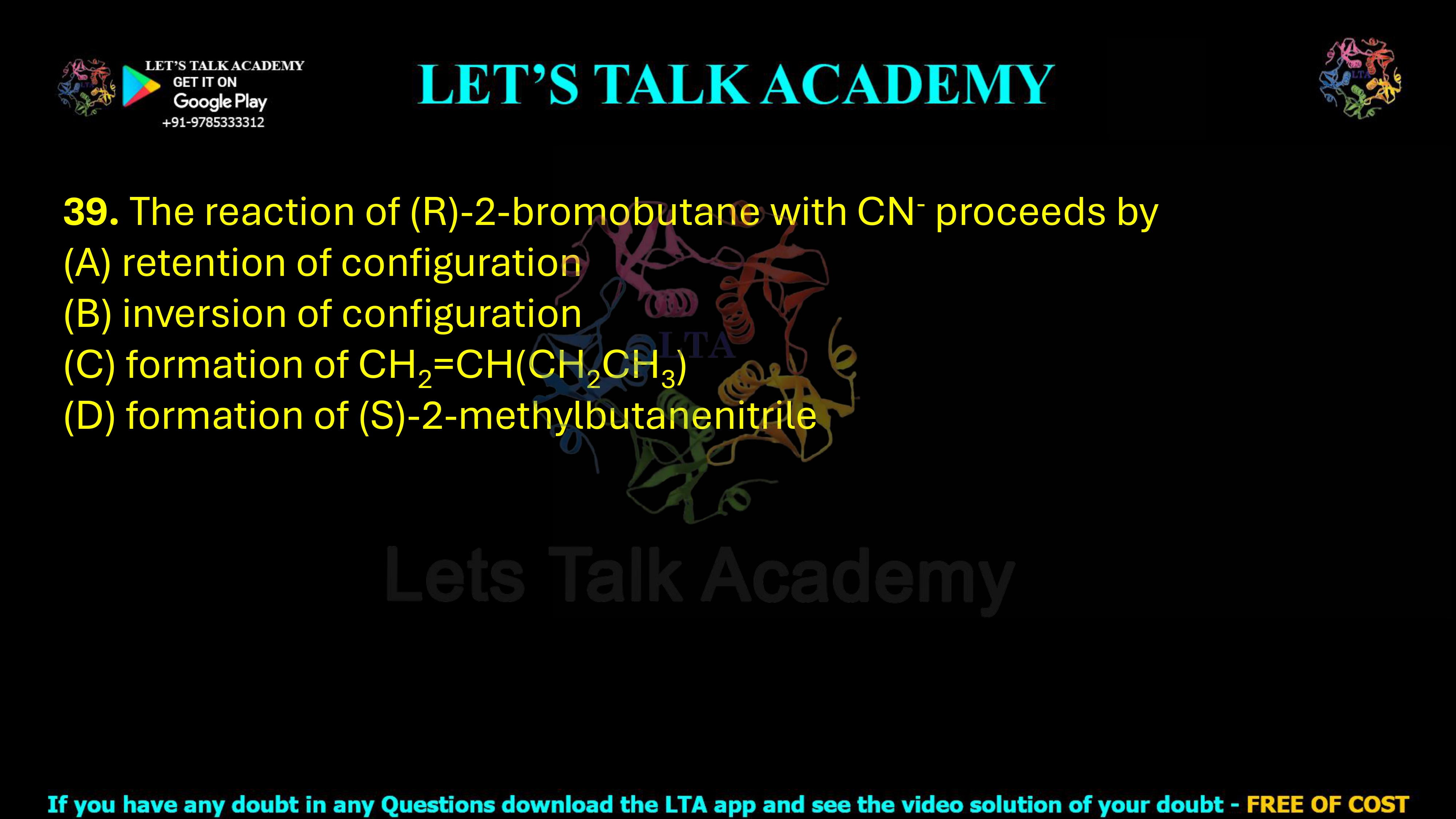
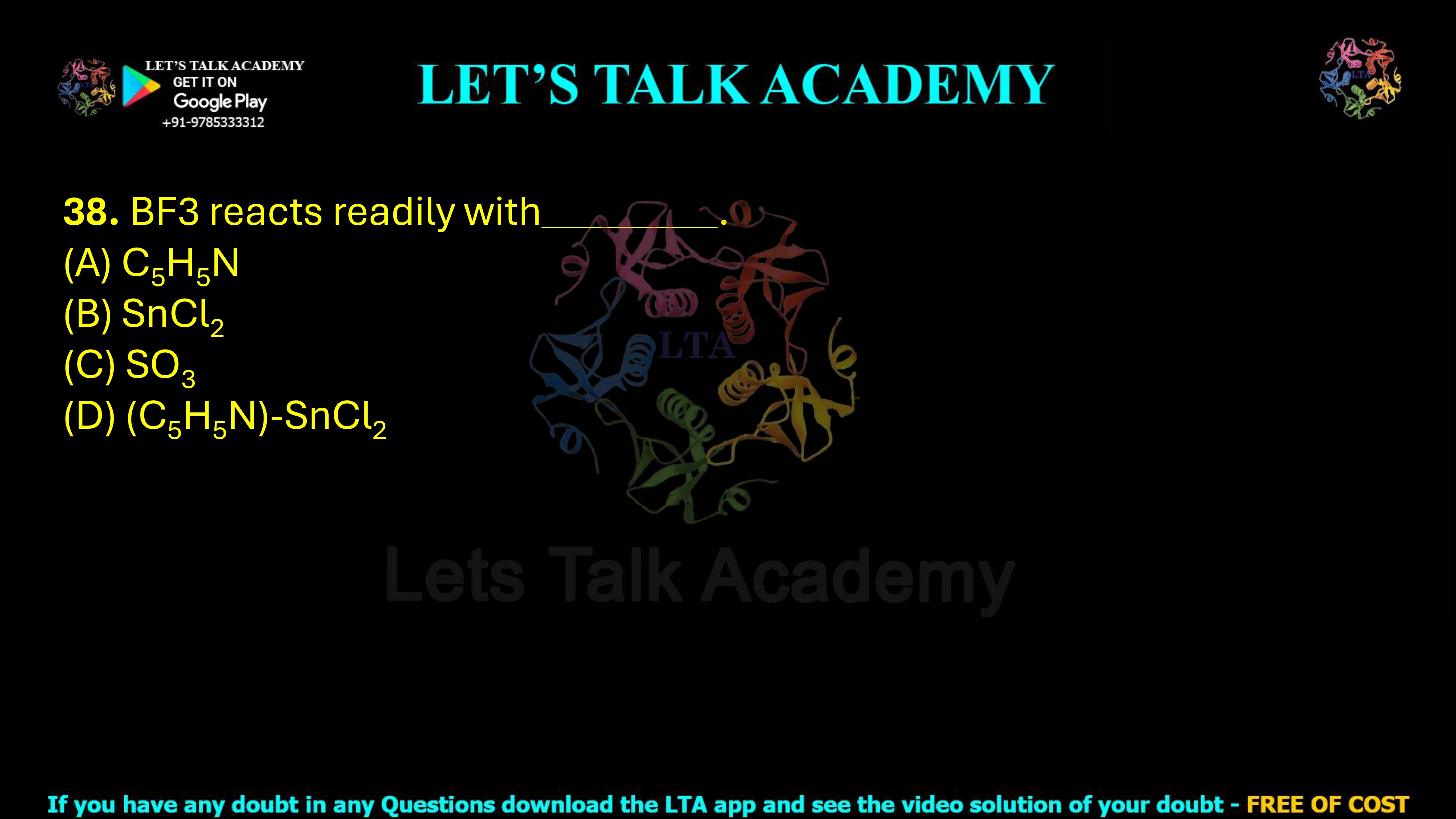
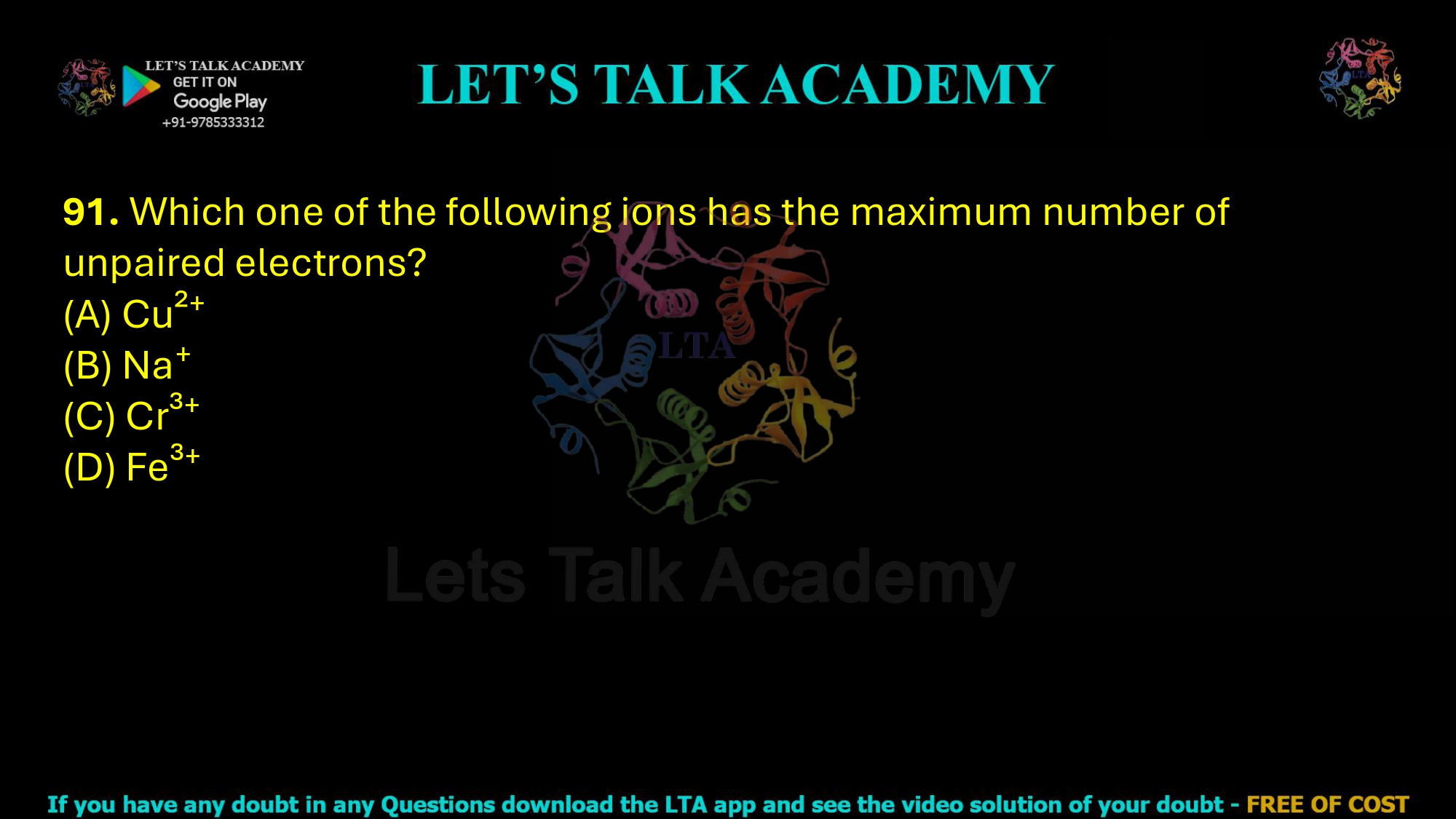
![37. Among the following species, the metal center that has the highest number of unpaired electrons is _____. (A) VCl4 (B) Ni(CO)4 (C) [AuCl4]− (D) [CdBr4]2−](https://www.letstalkacademy.com/wp-content/uploads/2026/07/1-37-4.jpg)
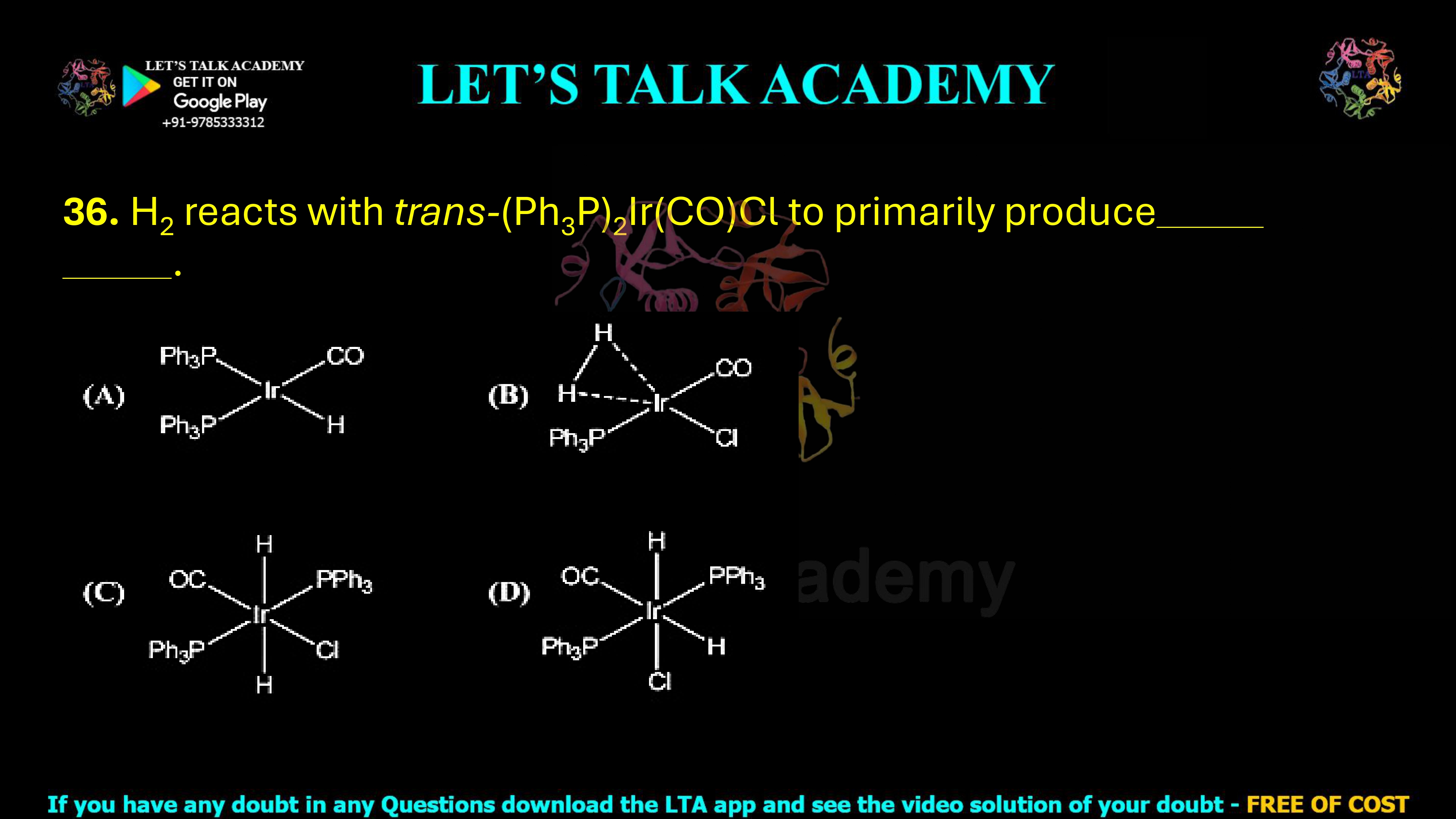
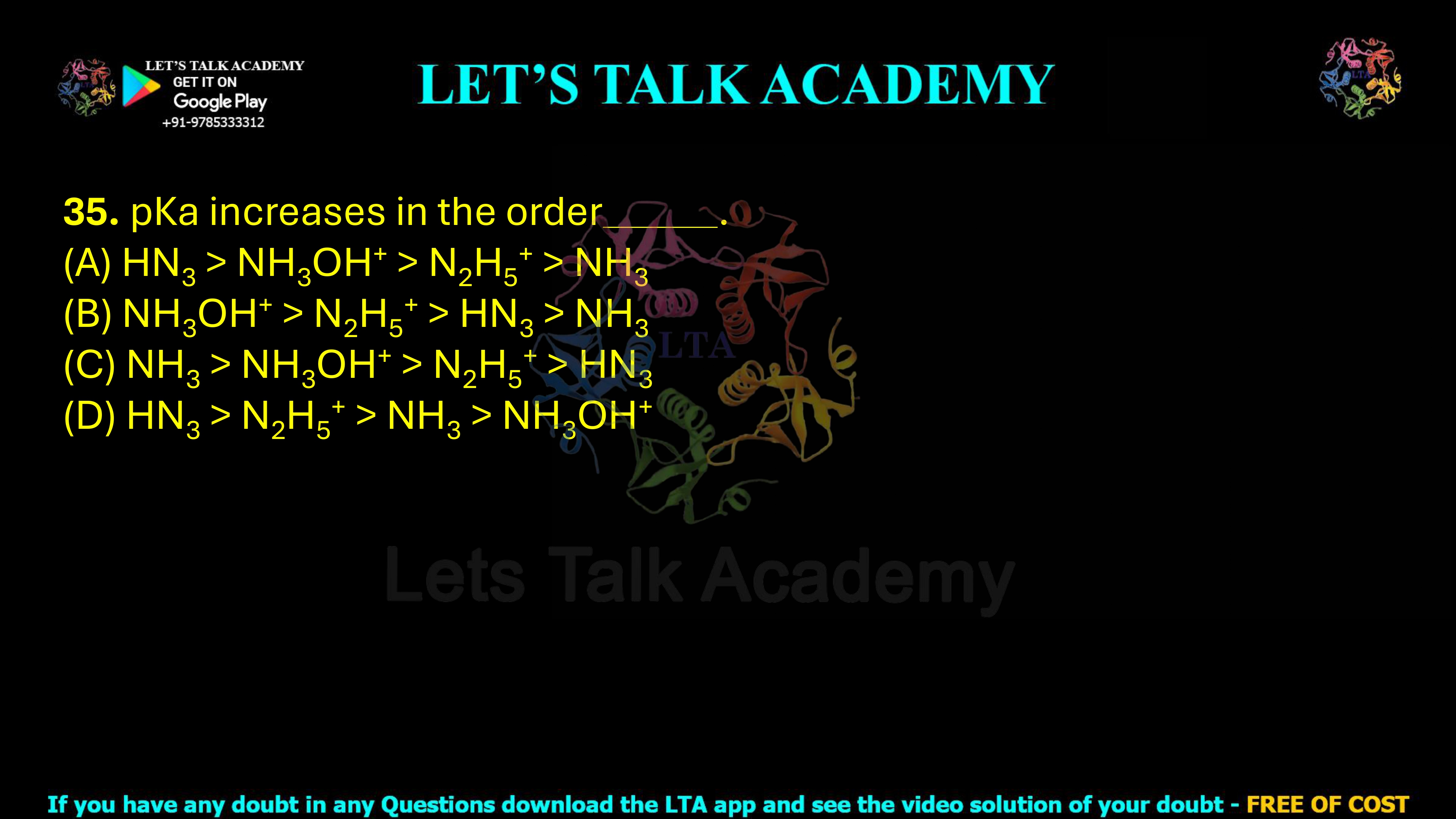
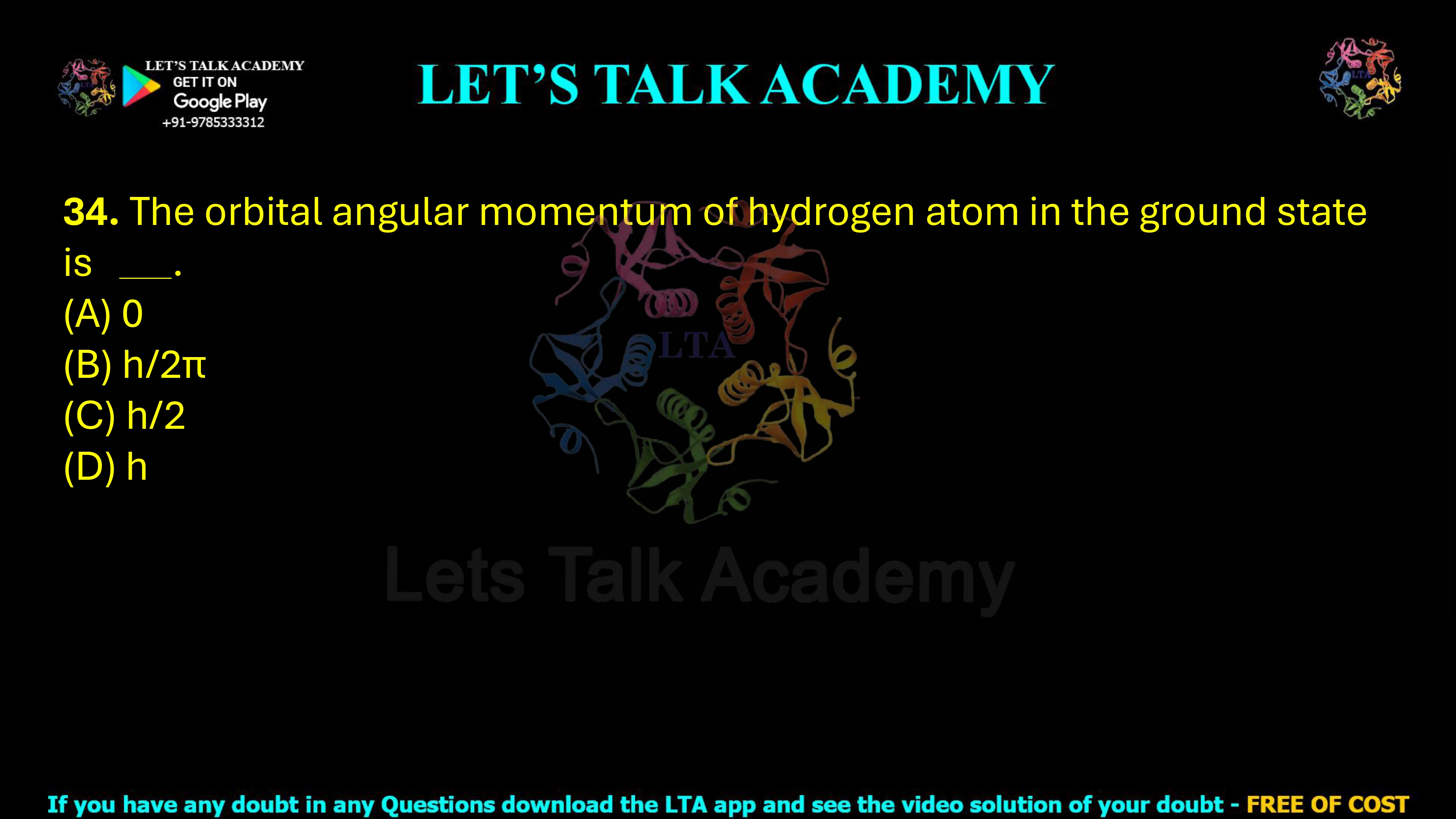
![33. In a reaction A + B → C, the initial rate of formation of C at 25°C was measured for different initial concentrations of A and B. The overall order of the reaction with respect to both A and B is _____ (answer in integer). Experimental Data: Experiment Initial [A] (mol L−1) Initial [B] (mol L−1) Initial Rate of Formation of C (mol L−1 s−1) 1 0.4 0.3 0.078 2 0.8 0.3 0.312 3 0.4 0.6 0.156 4 0.8 0.6 0.624](https://www.letstalkacademy.com/wp-content/uploads/2026/07/1-33-4.jpg)
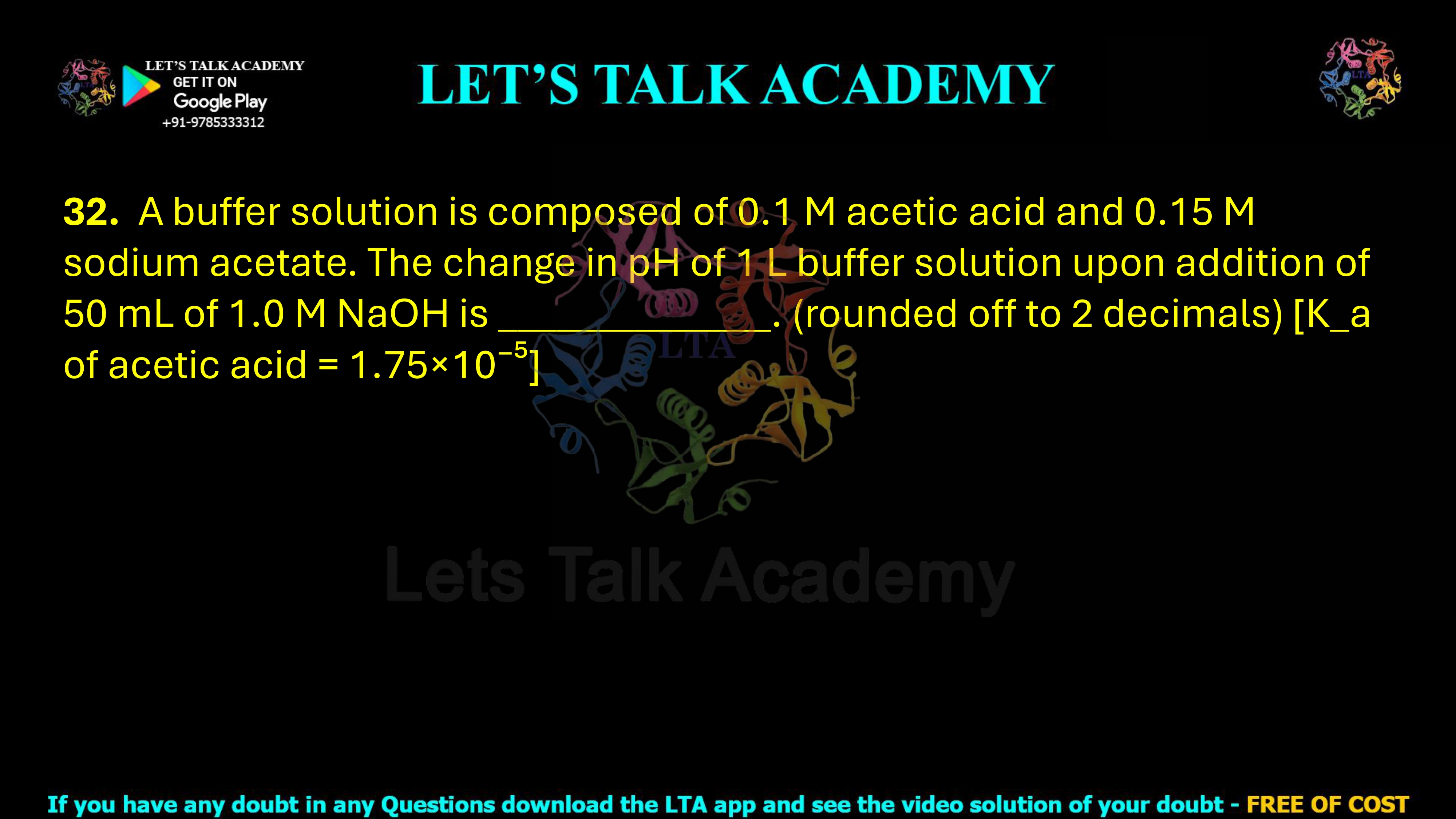
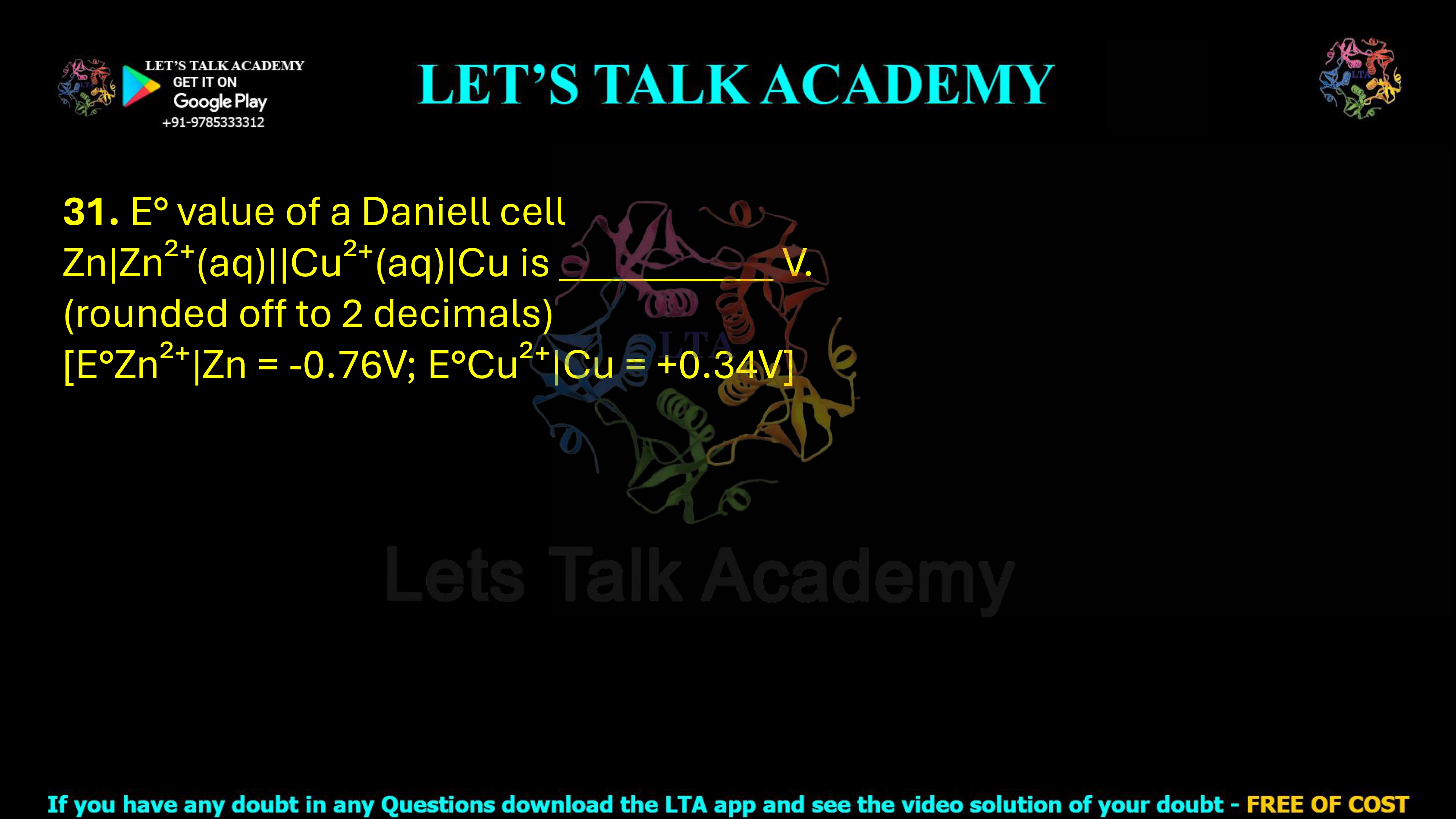
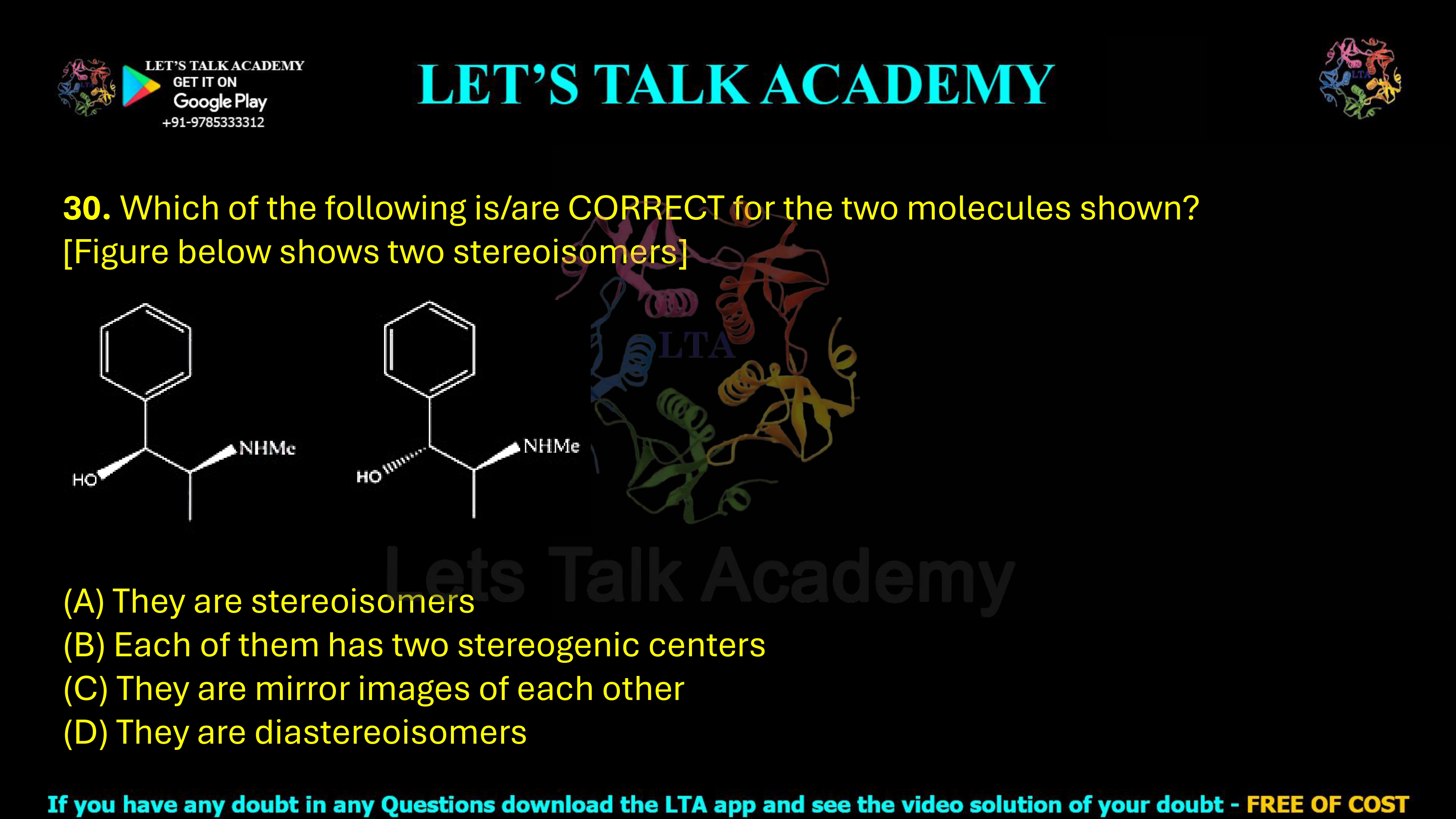
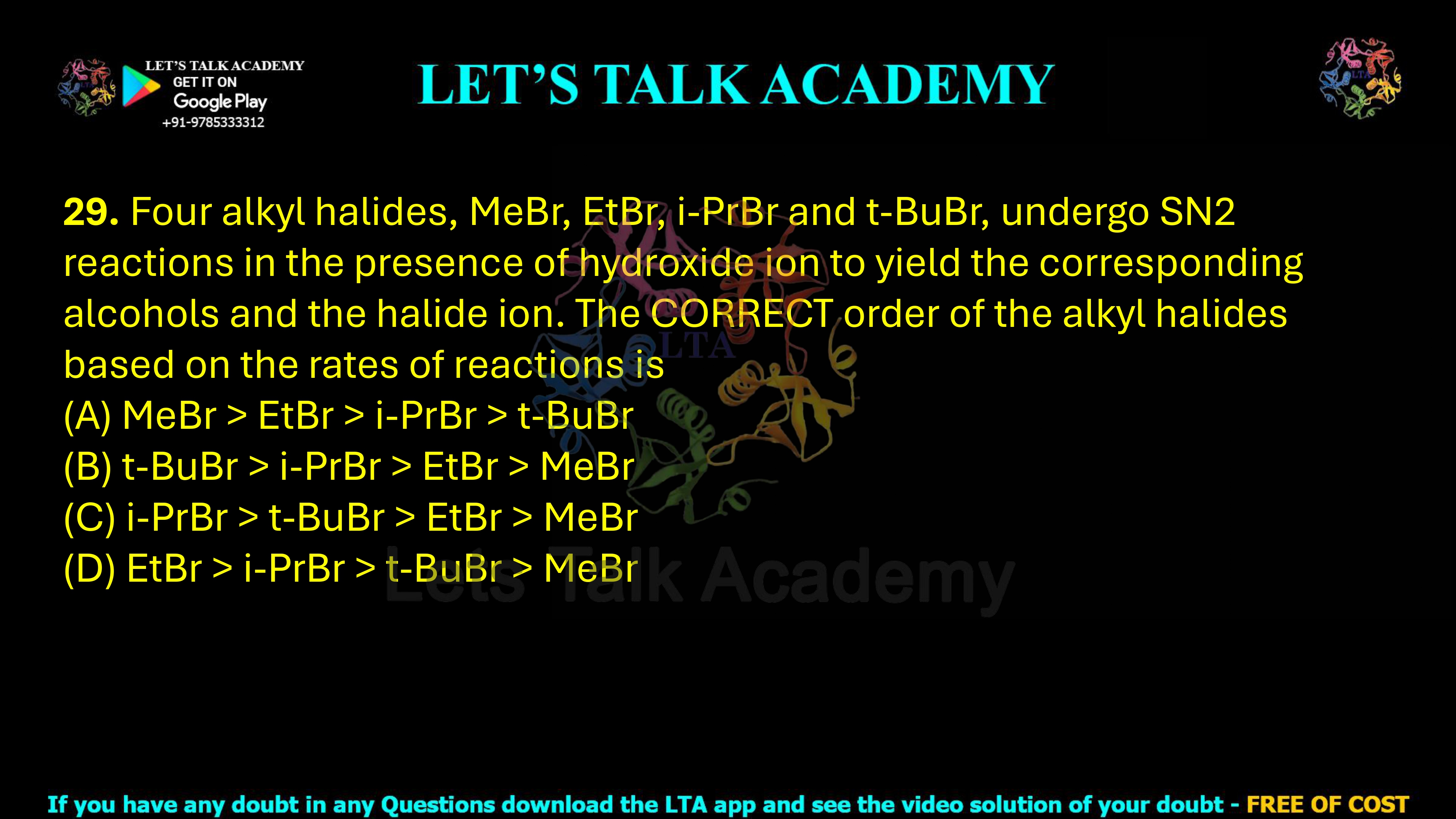
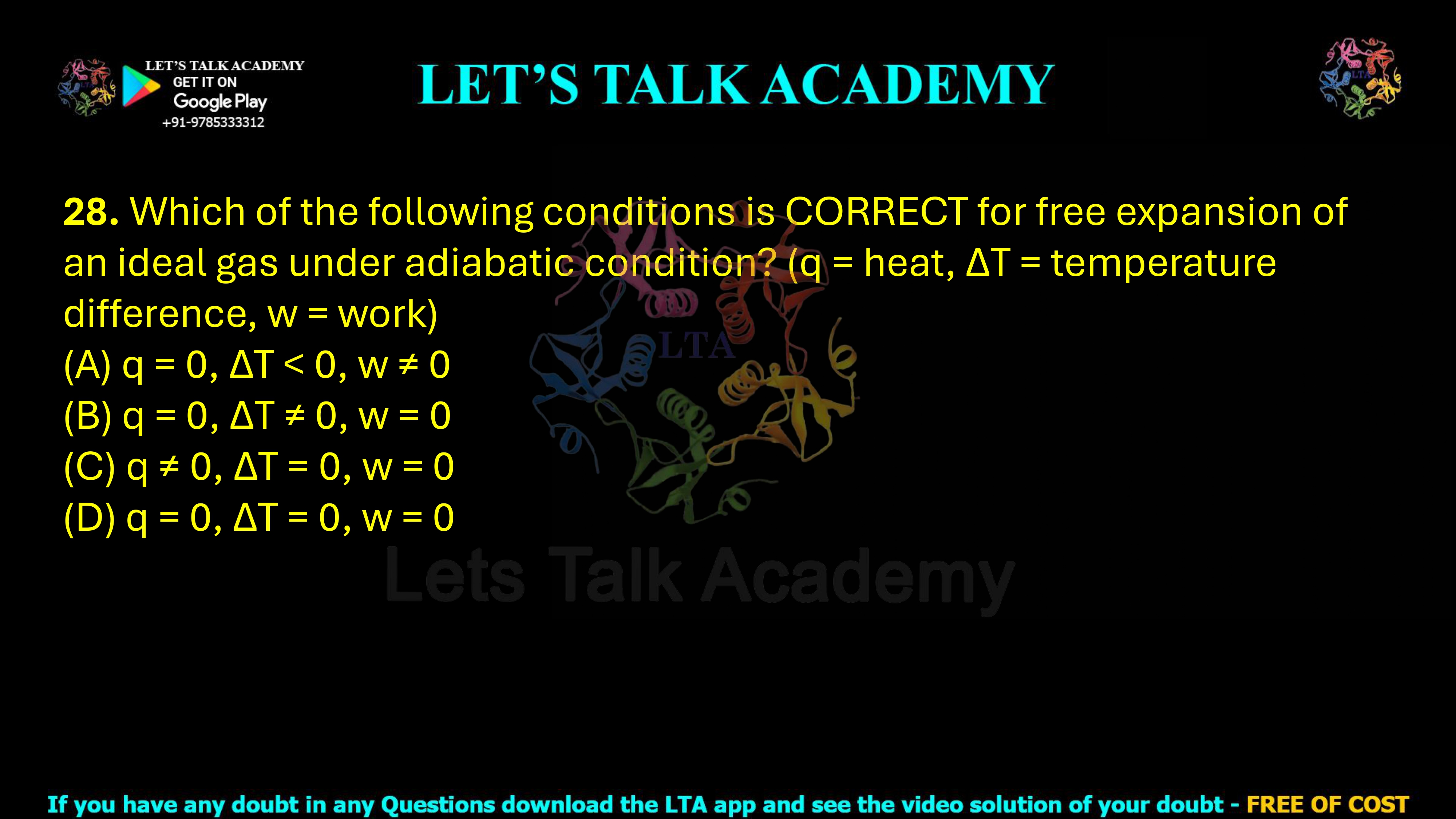
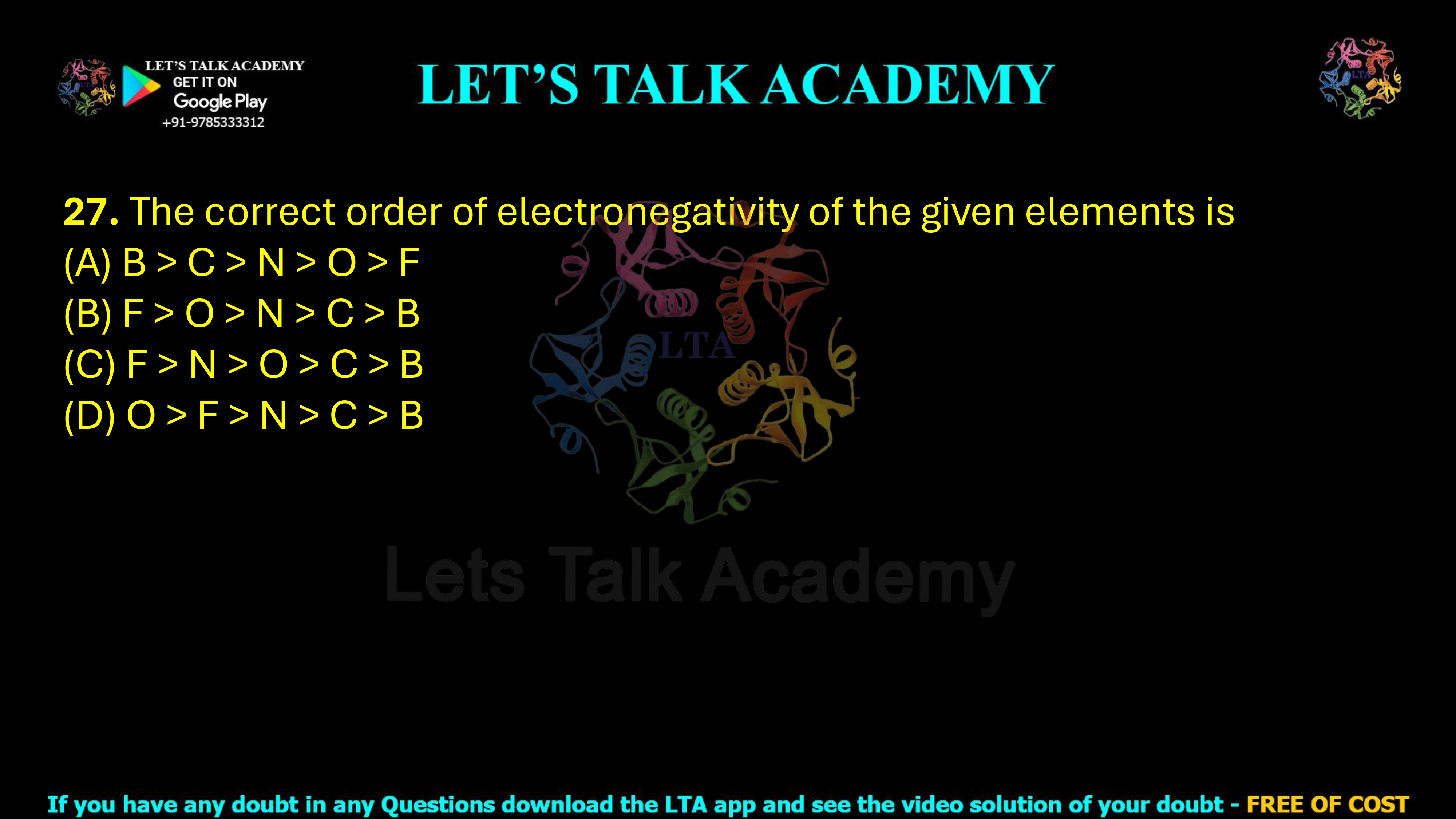
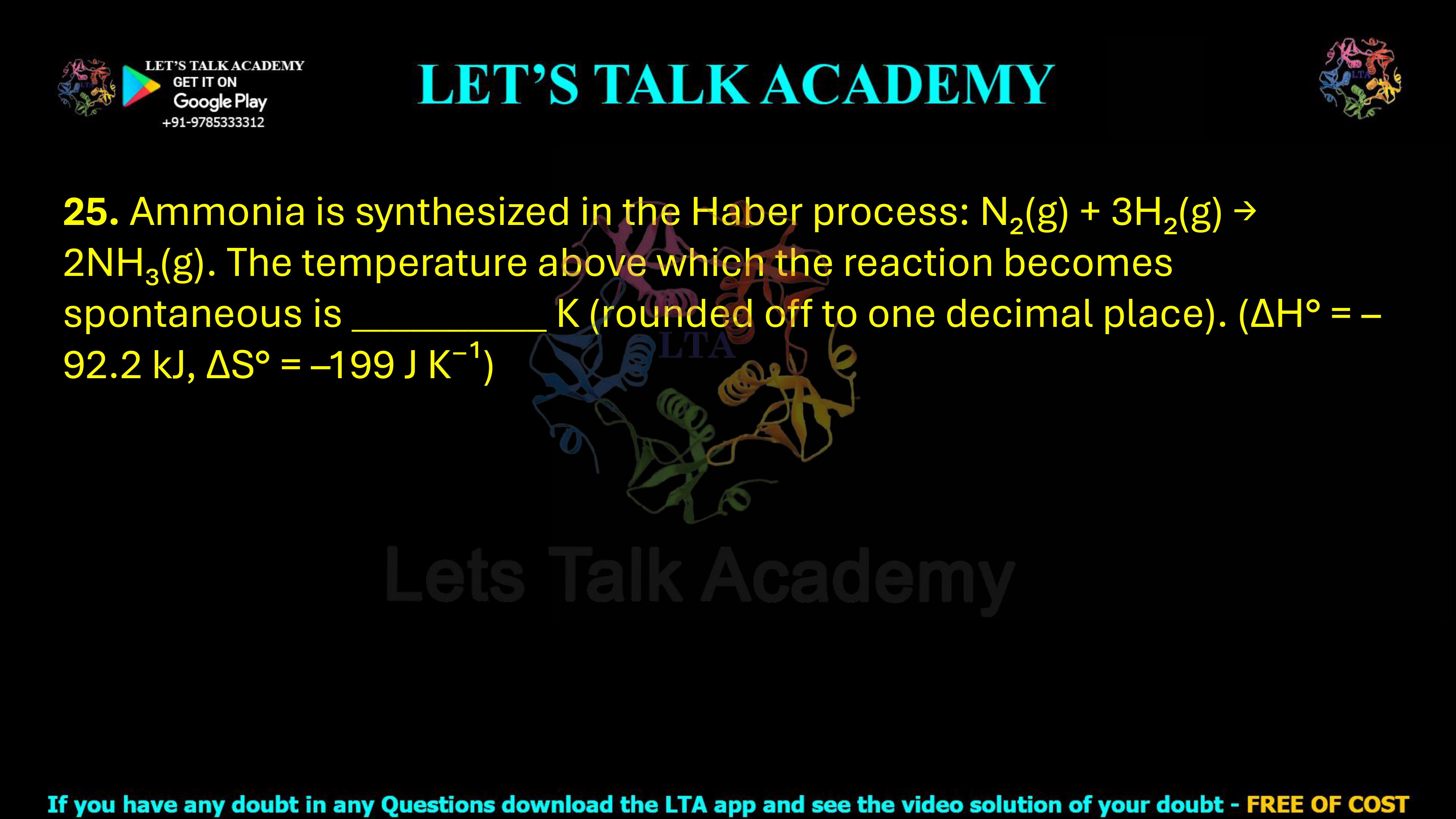
![24. The data provided in the table were obtained for the following reaction carried out at 273 K: A + B → C The experimental data are: Experiment 1: [A] = 0.2 mol L−1, [B] = 0.2 mol L−1, Initial rate = 0.3 mol L−1 s−1 Experiment 2: [A] = 0.4 mol L−1, [B] = 0.2 mol L−1, Initial rate = 0.6 mol L−1 s−1 Experiment 3: [A] = 0.4 mol L−1, [B] = 0.4 mol L−1, Initial rate = 2.4 mol L−1 s−1 The order of the reaction with respect to A is _____.](https://www.letstalkacademy.com/wp-content/uploads/2026/07/1-24-4.jpg)
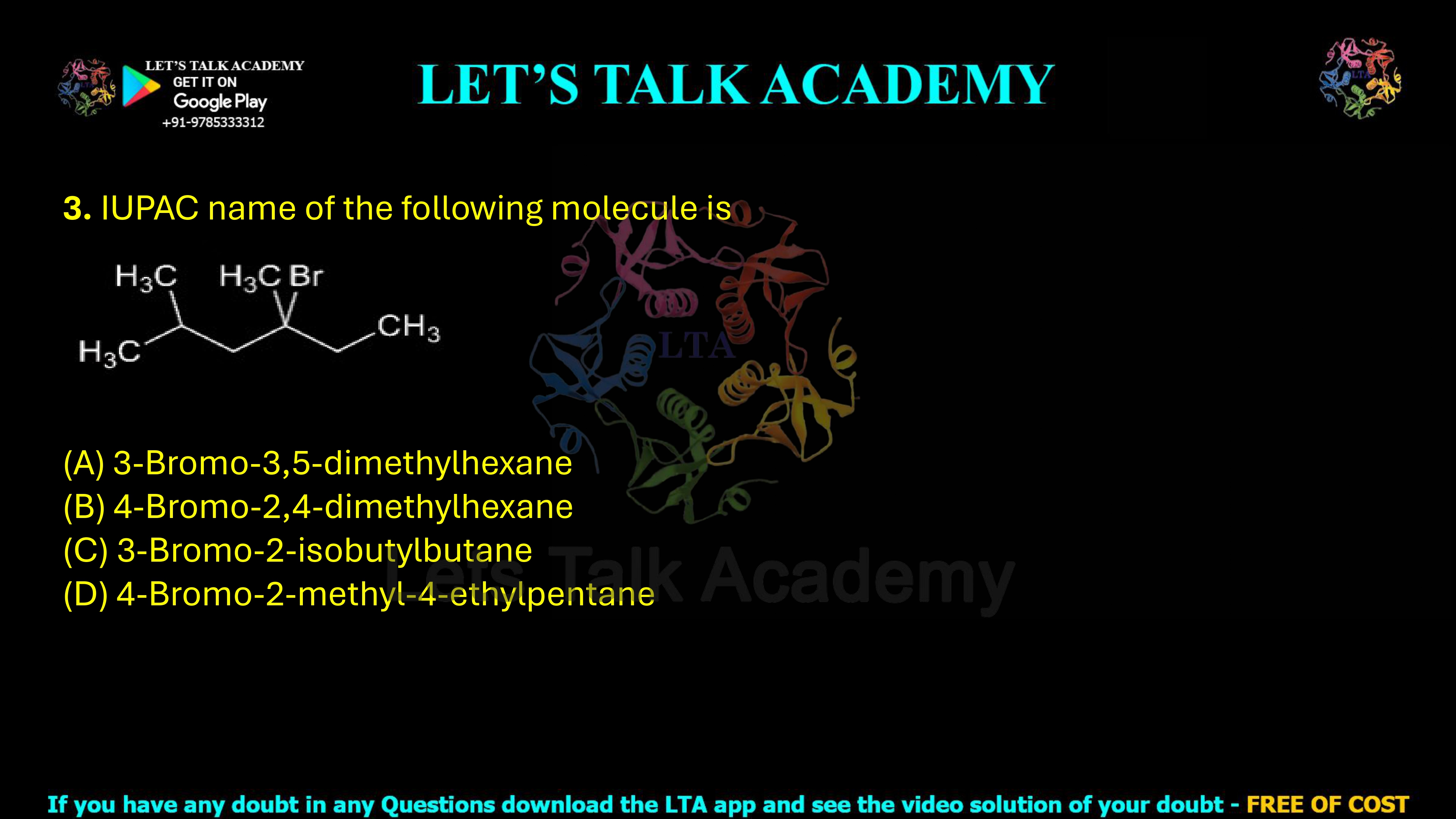
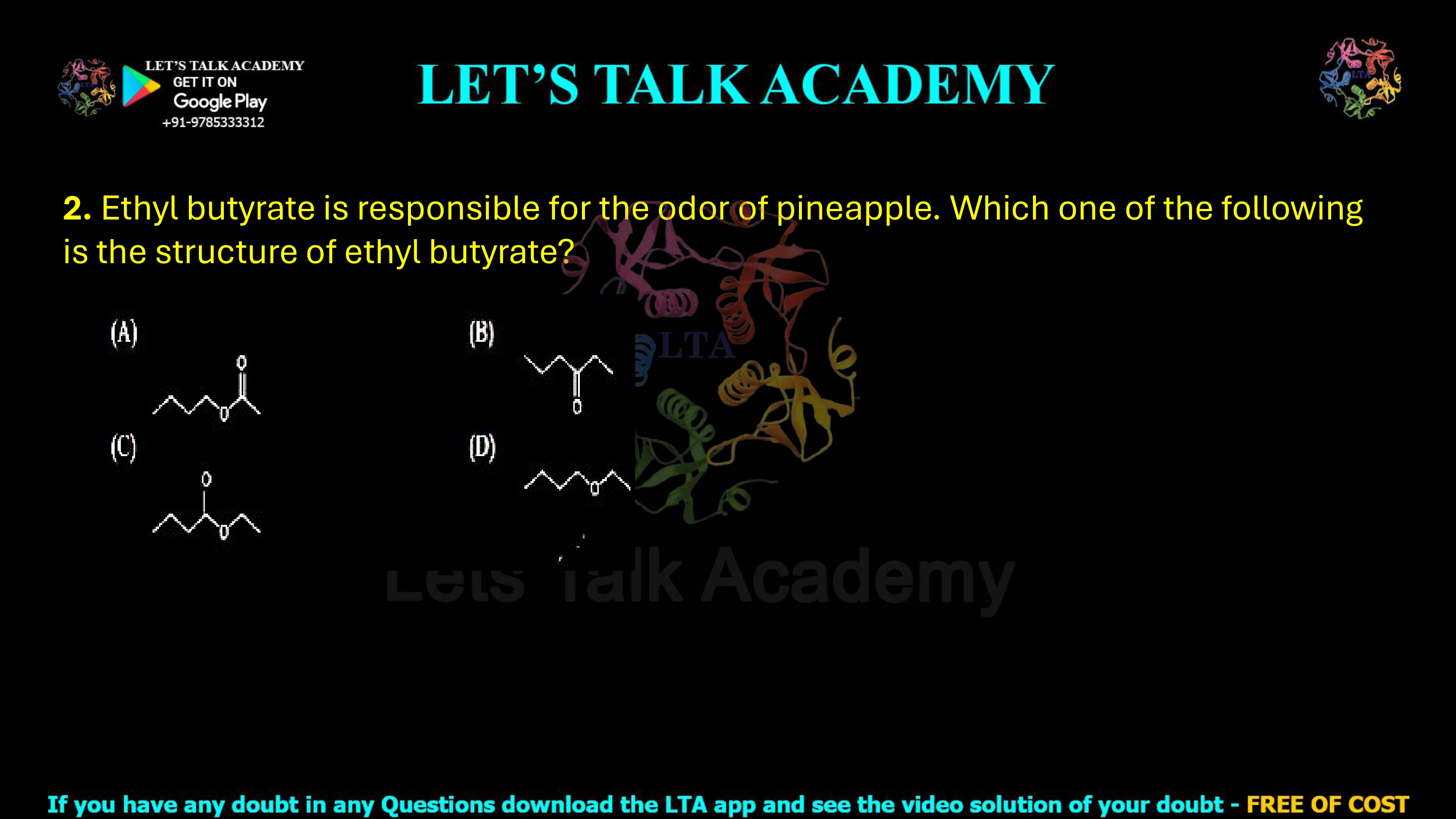
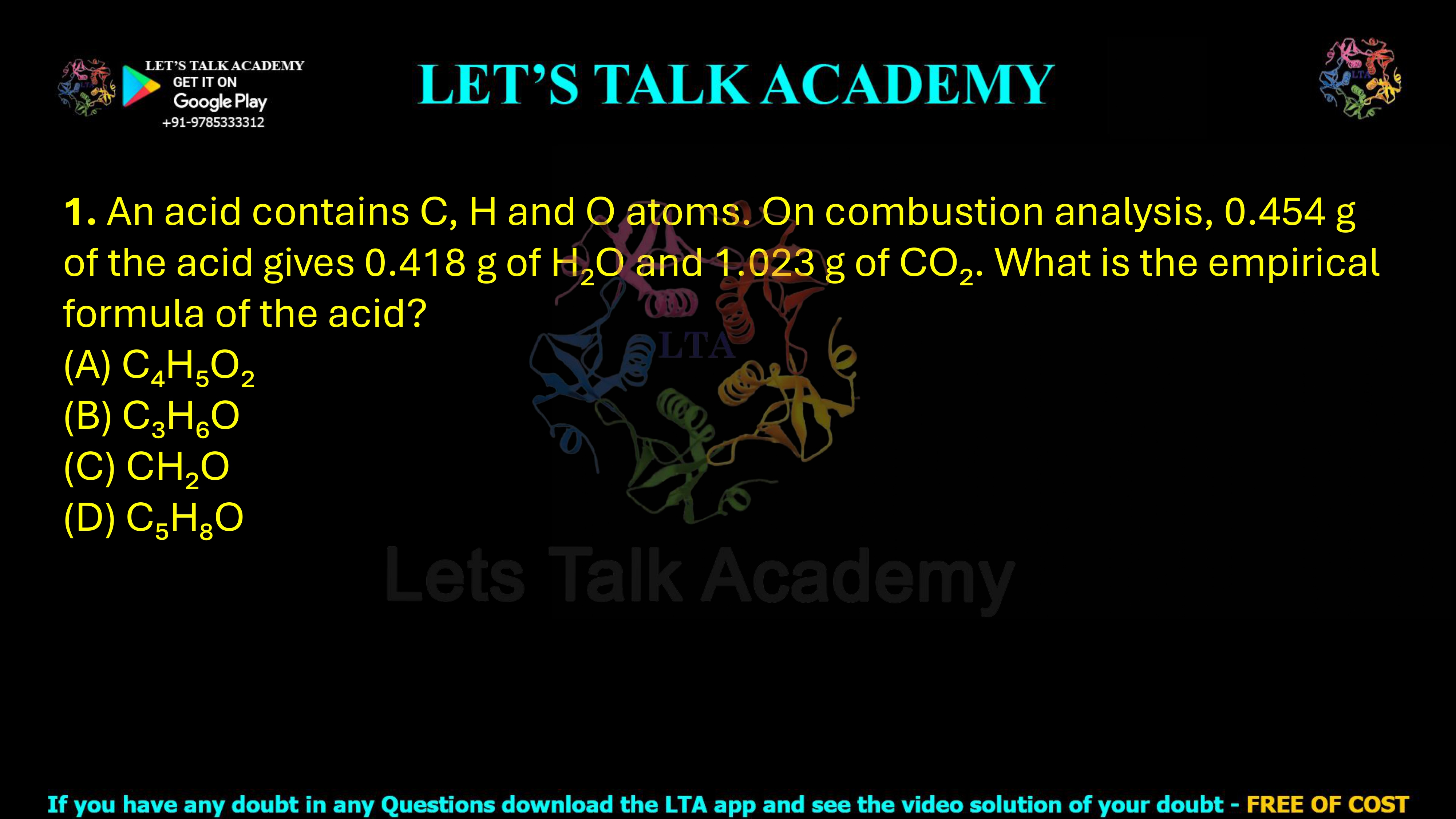
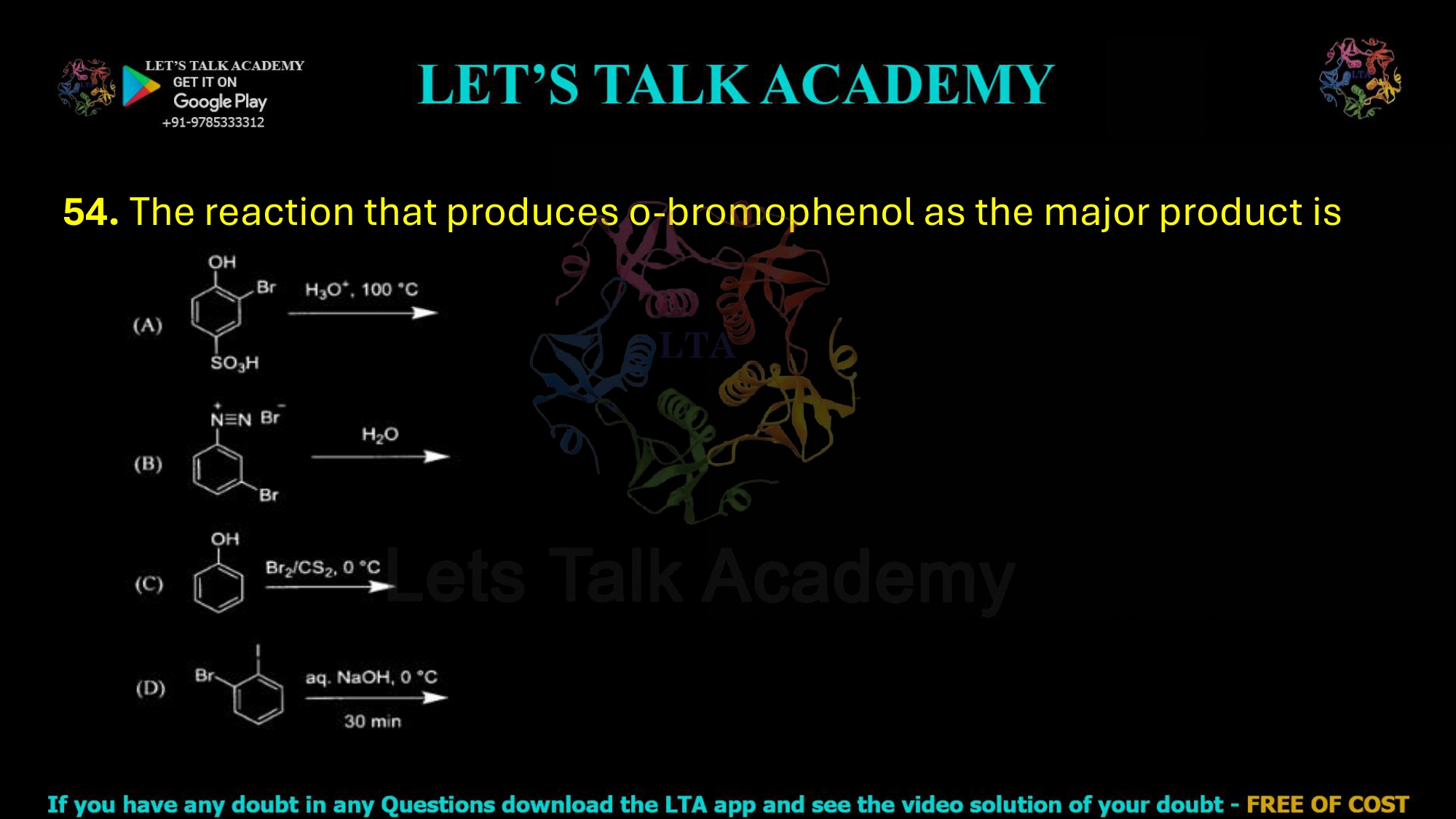
54. The reaction that produces o-bromophenol as the major product is Which Reaction Produces o-Bromophenol as the Major Product? Complete Explanation with Reaction Mechanism In the present question, four different […]
IIT JAM Biotechnology Previous Year Question paper Topic chemistry
54. The reaction that produces o-bromophenol as the major product is Which Reaction Produces o-Bromophenol as the Major Product? Complete Explanation with Reaction Mechanism In the present question, four different […]
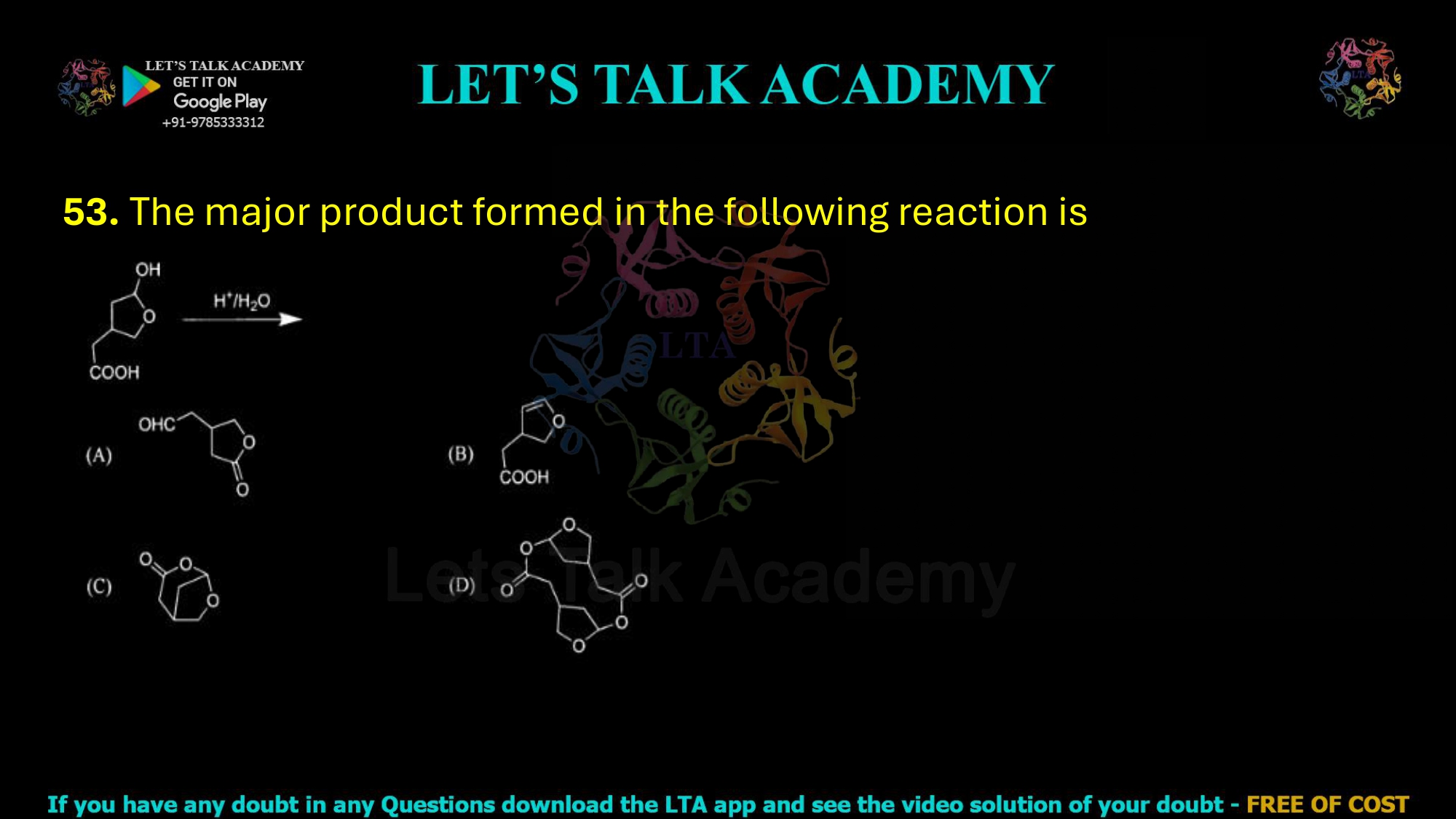
53. The major product formed in the following reaction is Major Product Formed During Acid-Catalyzed Hydrolysis of a Cyclic Hemiacetal In the given question, a cyclic hemiacetal containing a carboxylic […]
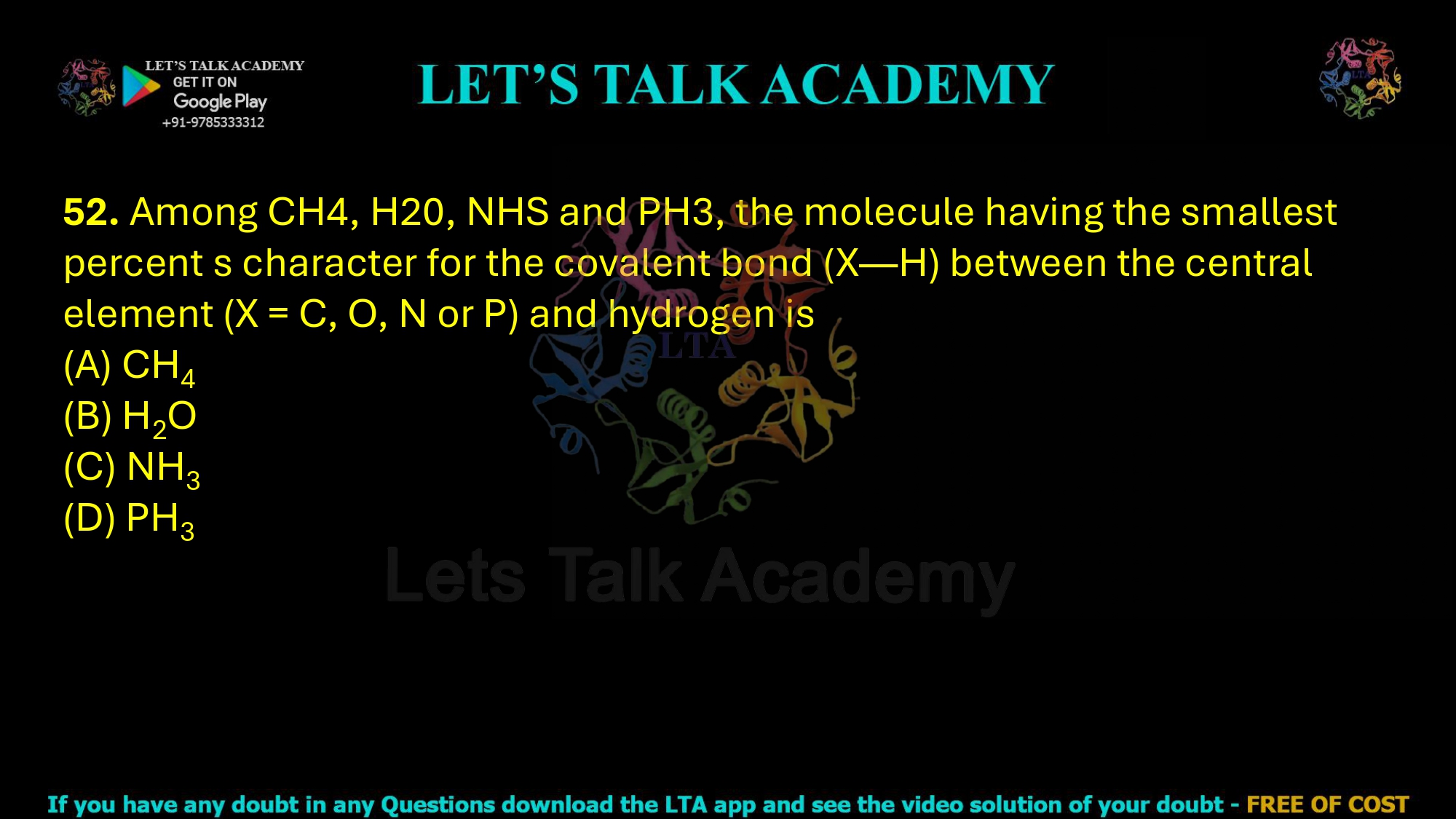
52. Among CH4, H20, NHS and PH3, the molecule having the smallest percent s character for the covalent bond (X—H) between the central element (X = C, O, N or […]

51. A first order reaction is 87.5% complete at the end of 30 minutes. The half-life of the reaction is minute(s). First Order Reaction is 87.5% Complete in 30 […]
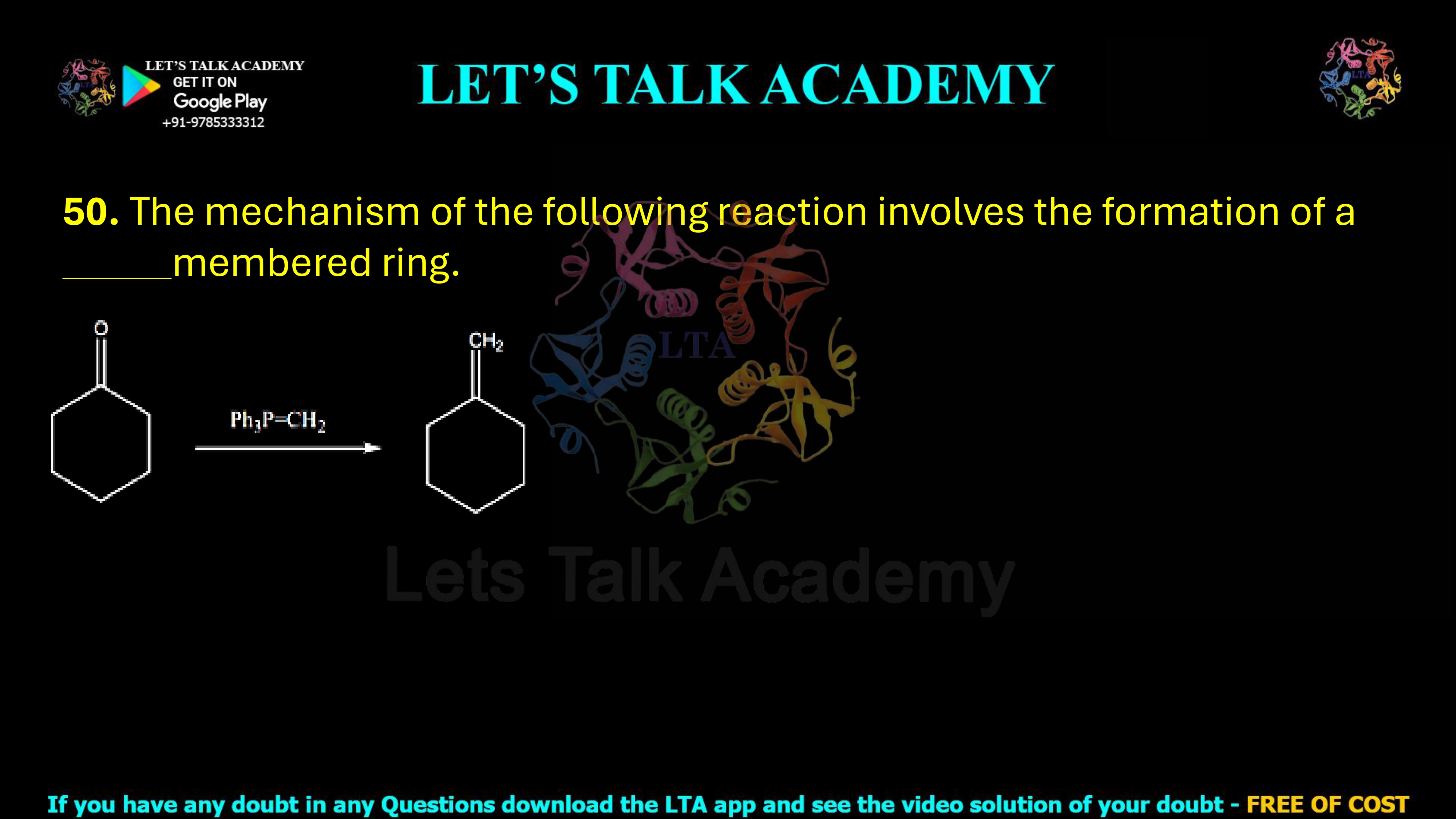
50. The mechanism of the following reaction involves the formation of a _____-membered ring. Wittig Reaction Mechanism and Formation of a Four-Membered Ring Correct Answer: 4 The mechanism of the […]
![49. Oxidation state of Fe in the complex K3[Fe(CN)5NO] is (+) _____.](https://www.letstalkacademy.com/wp-content/uploads/2026/07/1-49-2.jpg)
49. Oxidation state of Fe in the complex K3[Fe(CN)5NO] is (+) _____. Oxidation State of Fe in K3[Fe(CN)5NO] – Detailed Step-by-Step Solution Correct Answer: (+1) Understanding the Given Coordination Compound To […]
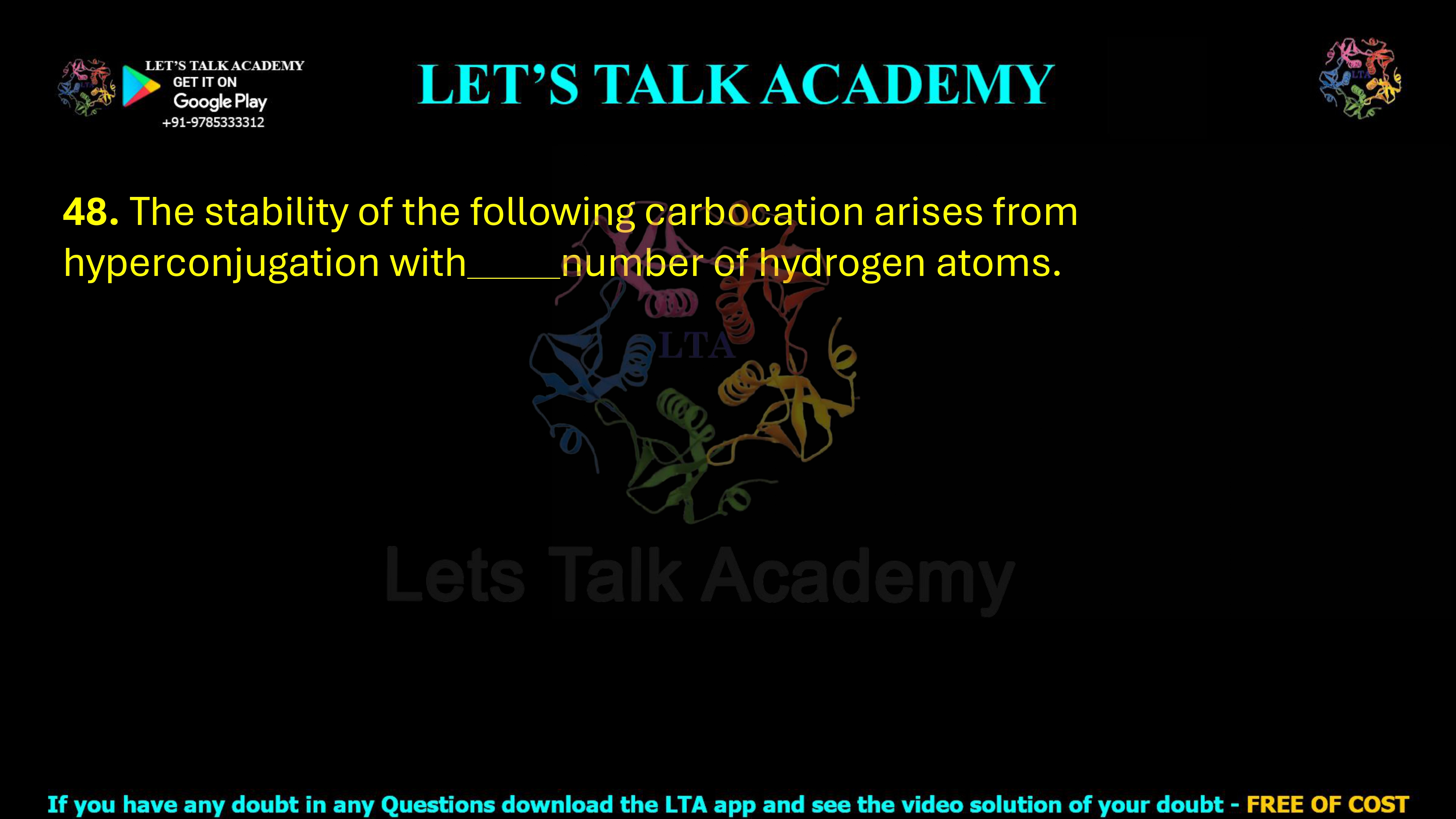
48. The stability of the following carbocation arises from hyperconjugation with _____ number of hydrogen atoms. Carbocation Stability Due to Hyperconjugation: How to Count the Number of Hydrogen Atoms Correct Answer […]
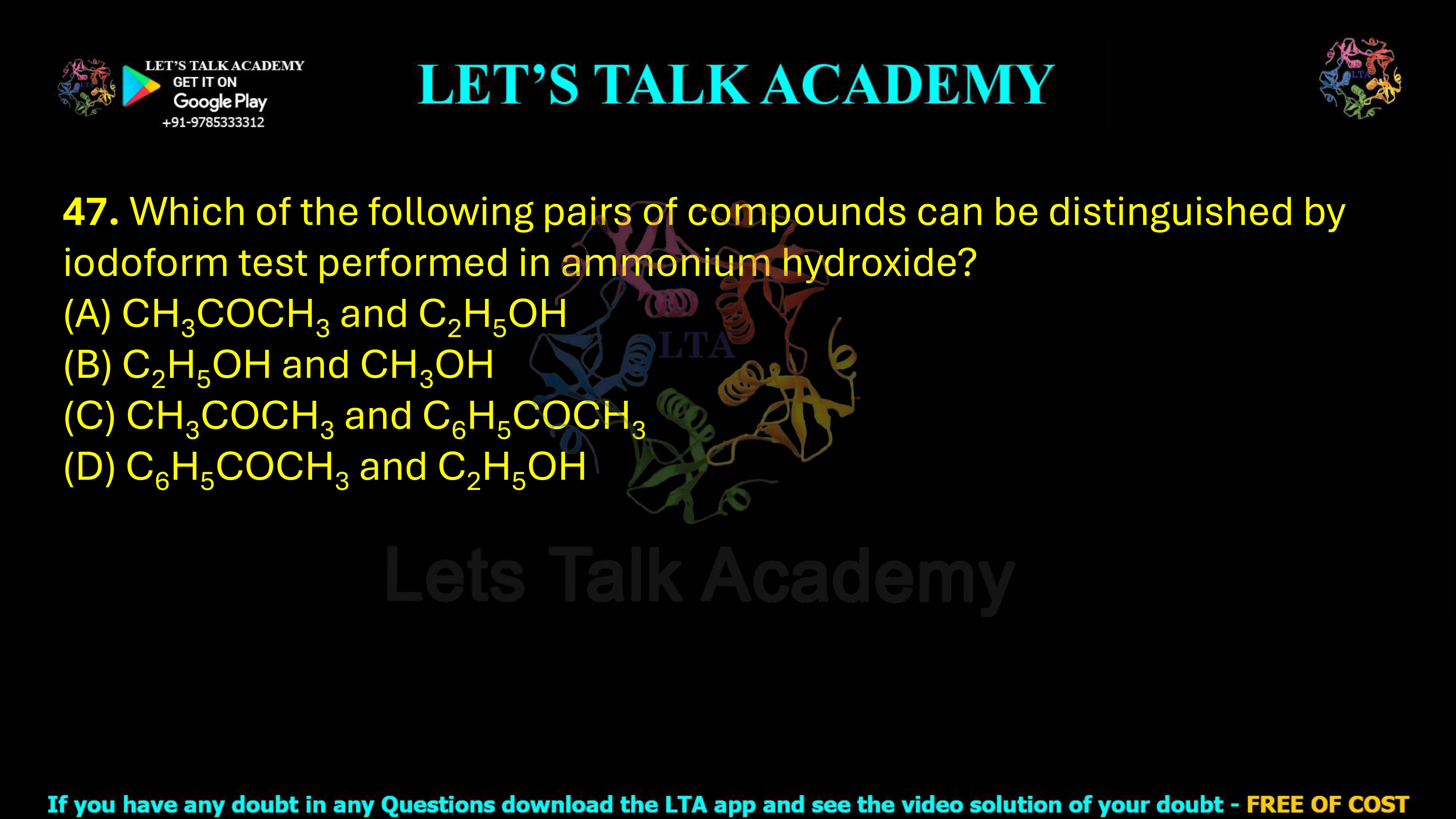
47. Which of the following pairs of compounds can be distinguished by the iodoform test performed in ammonium hydroxide? (A) CH3COCH3 and C2H5OH (B) C2H5OH and CH3OH (C) CH3COCH3 and C6H5COCH3 […]
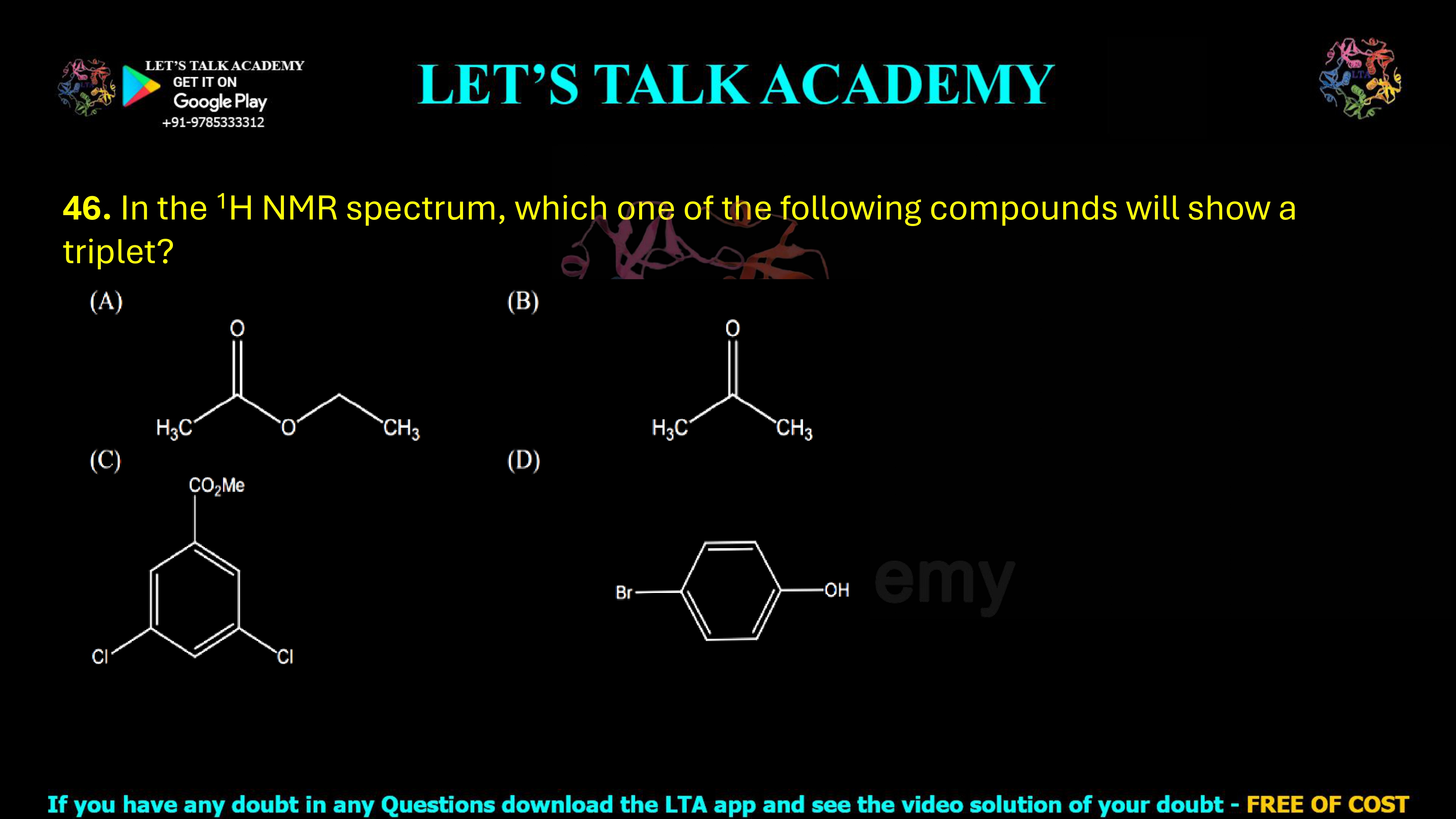
46. In the ¹H NMR spectrum, which one of the following compounds will show a triplet? Which Compound Will Show a Triplet in the ¹H NMR Spectrum? Correct Answer: Option […]
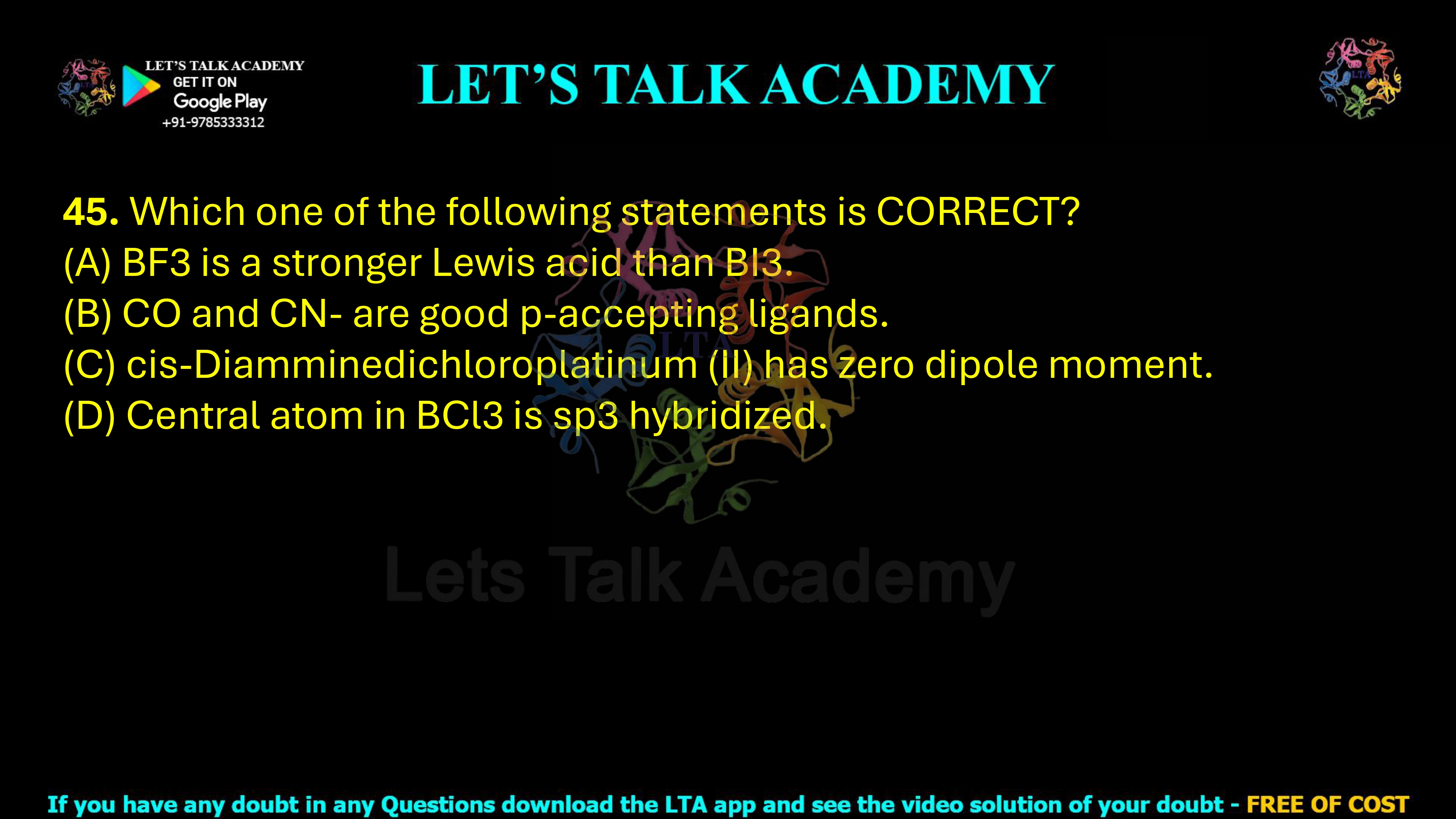
45. Which one of the following statements is correct? (A) BF3 is a stronger Lewis acid than BI3. (B) CO and CN− are good π-accepting ligands. (C) cis-Diamminedichloroplatinum(II) has zero […]


