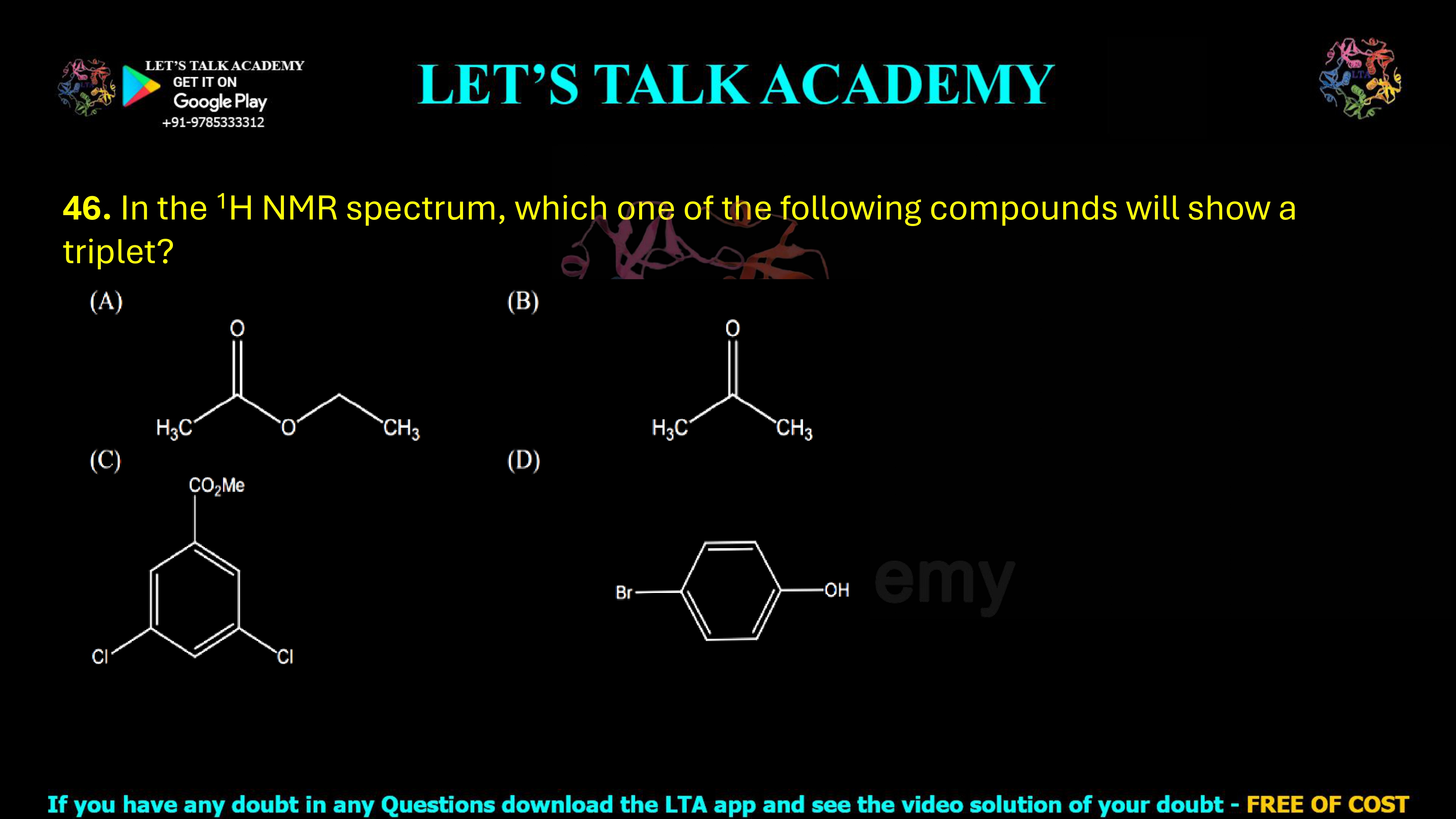
46. In the ¹H NMR spectrum, which one of the following compounds will show a triplet?
Which Compound Will Show a Triplet in the ¹H NMR Spectrum?
Correct Answer: Option (A)
Understanding the Concept of a Triplet in ¹H NMR Spectroscopy
To determine which compound will show a triplet in its ¹H NMR spectrum, we need to examine the number of neighbouring nonequivalent protons around each set of hydrogen atoms. The splitting of a proton signal in proton nuclear magnetic resonance spectroscopy is commonly predicted using the n + 1 rule.
According to the n + 1 rule, if a proton or a group of equivalent protons has n equivalent neighbouring protons on an adjacent carbon atom, its NMR signal is generally split into n + 1 peaks. Therefore, a proton signal appears as a triplet when it is coupled with exactly two equivalent neighbouring protons.
The relationship can be written as:
Number of peaks = n + 1
For a triplet:
n + 1 = 3
Therefore:
n = 2 neighbouring equivalent protons
This means that we should look for a proton environment in which one set of protons is adjacent to a carbon carrying two equivalent hydrogen atoms.
Detailed Analysis of Option (A)
Structure and Proton Environments in Option (A)
Option (A) is an ester containing an ethyl group and can be represented as:
CH₃COOCH₂CH₃
This compound is ethyl acetate. Its structure contains three important proton environments: the methyl group attached directly to the carbonyl carbon, the methylene group attached to oxygen, and the terminal methyl group of the ethyl unit.
The terminal –CH₃ group is directly adjacent to a –CH₂– group. The two hydrogens of this neighbouring CH₂ group are equivalent for the usual first-order analysis. Therefore, the three protons of the terminal methyl group experience spin-spin coupling with two neighbouring protons.
Applying the n + 1 rule:
Number of peaks = 2 + 1 = 3
Thus, the terminal –CH₃ signal is split into a triplet.
The corresponding neighbouring –CH₂– group is adjacent to three equivalent protons of the terminal methyl group. Therefore, its signal is split into four peaks and appears as a quartet. This characteristic combination of a triplet and a quartet is commonly observed for an ethyl group in ¹H NMR spectroscopy.
The methyl group written as CH₃CO– is attached to a carbonyl carbon. Since the adjacent carbonyl carbon carries no hydrogen atoms, this methyl group does not undergo neighbouring proton splitting and generally appears as a singlet.
Therefore, Option (A) clearly contains a proton environment that produces a triplet and is the correct answer.
Detailed Analysis of Option (B)
Why Acetone Does Not Show a Triplet
Option (B) is acetone, represented as:
CH₃COCH₃
Acetone contains two methyl groups attached to the same carbonyl carbon. Because the molecule is symmetrical, both methyl groups are chemically equivalent and together represent six equivalent protons.
The carbonyl carbon located next to each methyl group has no hydrogen atom. Therefore, there are no neighbouring protons available to split the methyl proton signal.
Using the n + 1 rule:
Number of peaks = 0 + 1 = 1
Hence, all six methyl protons of acetone give a single singlet in the ¹H NMR spectrum. Since no proton environment produces three peaks, Option (B) does not show a triplet.
Detailed Analysis of Option (C)
Why the Aromatic Ester Does Not Give a Simple Triplet
Option (C) is a substituted aromatic ester containing a benzene ring with a CO₂Me group and two chlorine substituents. The aromatic proton environments in such a molecule must be analysed according to the substitution pattern and molecular symmetry.
The methoxy group of the ester, –CO₂CH₃, is attached through oxygen and has no neighbouring proton on the directly adjacent atom that can produce the usual n + 1 splitting. Therefore, the three methoxy protons generally appear as a singlet.
The remaining aromatic protons are influenced by the symmetrical substitution pattern of the benzene ring. Their splitting behaviour depends on aromatic coupling relationships and does not produce the simple ethyl-type triplet required in this question.
Therefore, Option (C) is not the correct choice.
Detailed Analysis of Option (D)
Why the Bromophenol Structure Does Not Show a Simple Triplet
Option (D) is a para-substituted benzene containing bromine and a hydroxyl group. In a para-disubstituted benzene with two different substituents, the four aromatic protons are commonly divided into two sets of chemically equivalent protons.
Each set of aromatic protons mainly couples with the neighbouring aromatic proton set. Under typical first-order conditions, this commonly produces two doublets rather than a simple triplet.
The hydroxyl proton usually appears as a broad singlet, although its exact appearance can vary depending on solvent, concentration, hydrogen bonding, and proton exchange. Therefore, Option (D) does not provide the clear triplet expected from coupling with two equivalent neighbouring protons.
Why Option (A) Is the Correct Answer
Option (A) contains the structural fragment –CH₂CH₃. The terminal methyl group has exactly two equivalent neighbouring protons on the adjacent CH₂ carbon. According to the n + 1 rule, these two neighbouring protons split the methyl signal into three peaks.
For the terminal CH₃ group:
n = 2
Multiplicity = n + 1 = 2 + 1 = 3 peaks
Therefore, the signal appears as a triplet.
This is one of the most important and frequently tested splitting patterns in ¹H NMR spectroscopy. Whenever an ethyl fragment is present, the CH₃ group commonly appears as a triplet because it is adjacent to two CH₂ protons, while the CH₂ group commonly appears as a quartet because it is adjacent to three CH₃ protons.
Final Answer
The correct answer is Option (A). The compound in Option (A), ethyl acetate, contains a terminal CH₃ group adjacent to a CH₂ group. The two equivalent neighbouring CH₂ protons split the CH₃ signal according to the n + 1 rule, producing three peaks. Therefore, the terminal methyl group appears as a triplet in the ¹H NMR spectrum.


