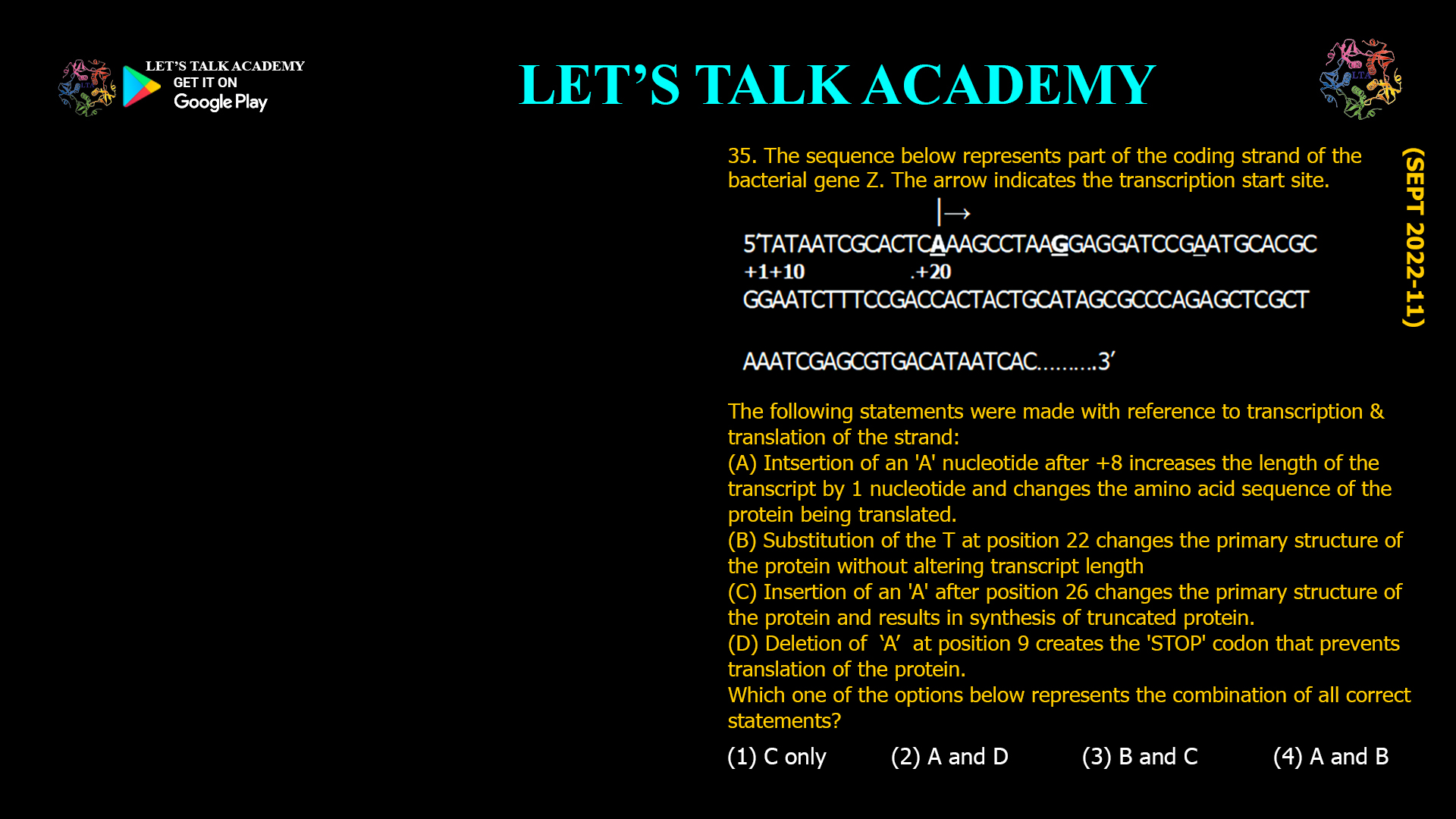
The sequence below represents part of the coding strand of the bacterial gene Z. The arrow indicates the transcription start site. |→ 5’TATAATCGCACTCAAAGCCTAAGGAGGATCCGAATGCACGC +1+10 .+20 GGAATCTTTCCGACCACTACTGCATAGCGCCCAGAGCTCGCT AAATCGAGCGTGACATAATCAC……….3’ The following statements were made withreference to transcoption& translation of the strand: (A) Intsertion of an 'A' nucleotide after +8 increases the length of the transcript by 1 nucleotide and changes the amino acid sequence of the protein being translated. (B) Substitution of the T at position 22 changes the primary structure of the protein without altering transcript length (C) Insertion of an 'A' after posrtton 26 changes the primary structure of the protein and results in synthesis of truncated protein. (D) Deletion of  ‘A’  at position 9 creates the 'STOP' codon that prevents translation of the protein. Which one of the options below represents the combination of all correct statements? (1) C only             (2) A and D (3) B and C           (4) A and B 

Understanding the Polar Effect of Nonsense Mutations in Bacterial Operons and the Role of Suppressor tRNAs

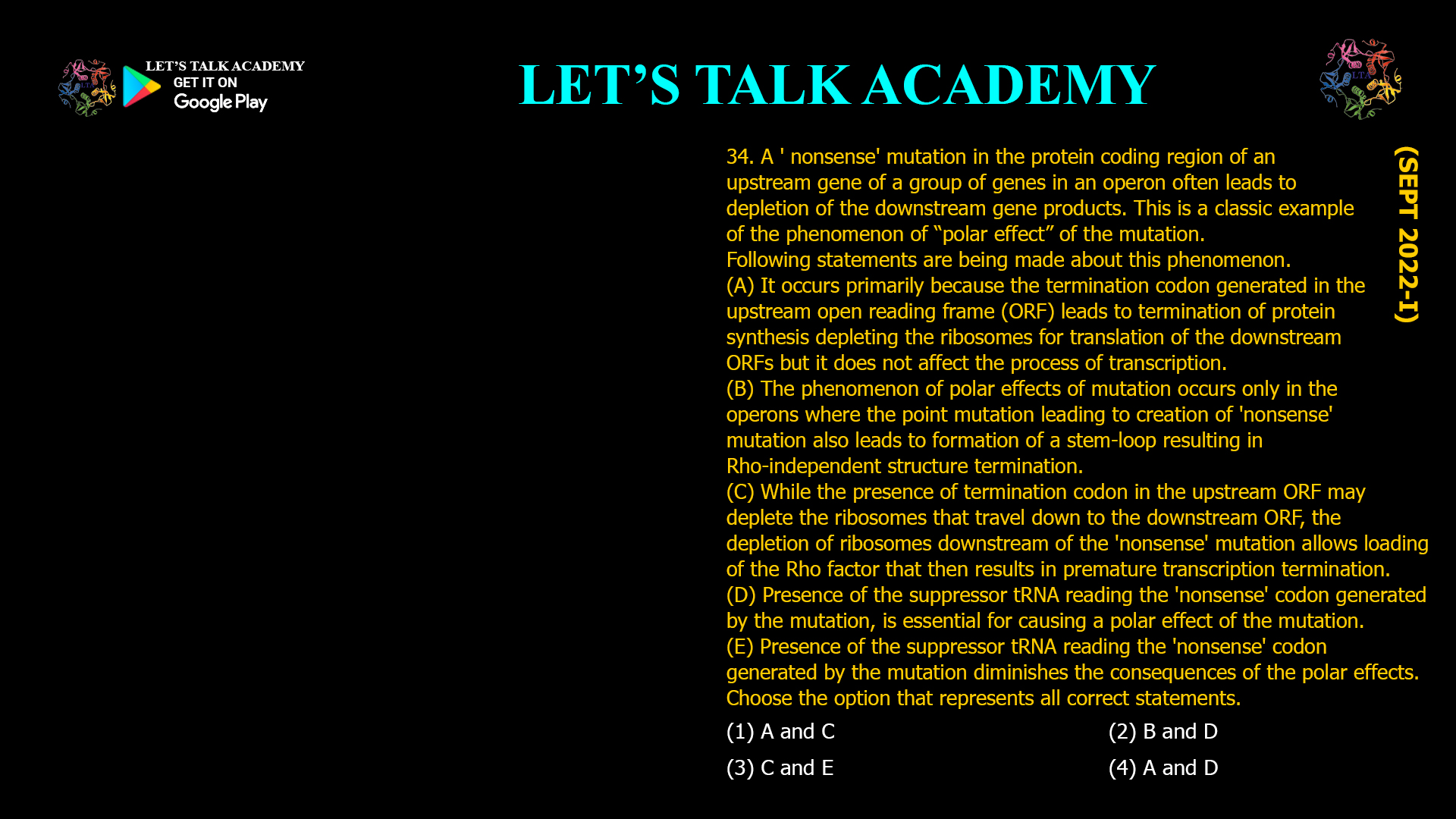
A ' nonsense' mutation in the protein coding region of an upstream gene of a group of genes in an operon often leads to depletion of the downstream gene products. This is a classic example of the phenomenon of “polar effect” of the mutation. Following statements are being made about this phenomenon. (A) It occurs primarily because the termination codon generated in the upstream open reading frame (ORF) leads to termination of protein synthesis depleting the ribosomes for translation of the downstream ORFs but it does not affect the process of transcription. (B) The phenomenon of polar effects of mutation occurs only in the operons where the point mutation leading to creation of 'nonsense' mutation also leads to formation of a stem-loop resulting in Rho-independent structure termination. (C) While the presence of termination codon in the upstream ORF may deplete the ribosomes that travel down to the downstream ORF, the depletion of ribosomes downstream of the 'nonsense' mutation allows loading of the Rho factor that then results in premature transcription termination. (D) Presence of the suppressor tRNA reading the 'nonsense' codon generated by the mutation, is essential for causing a polar effect of the mutation. (E) Presence of the suppressor tRNA reading the nonsense' codon generated by the mutation diminishes the consequences of the polar effects. Choose the option that represents all correct statements. (1) AandC(2) B and D (3) C and E           (4) A and D

Understanding the Polar Effect of Nonsense Mutations in Operons: Role of Rho and Suppressor tRNAs

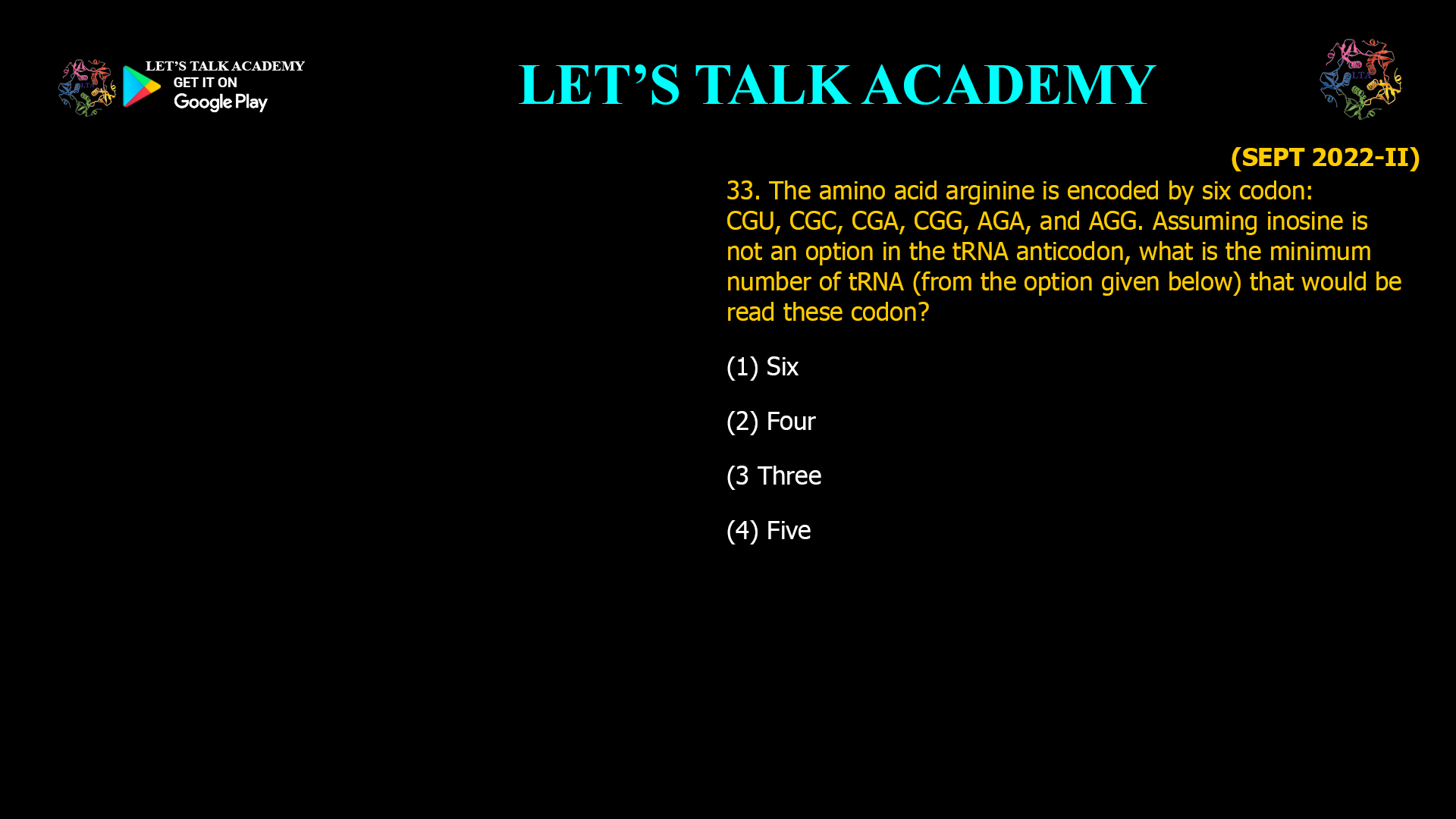
33. The amino acid arginine is encoded by six codon: CGU, CGC, CGA, CGG, AGA, and AGG. Assuming inosine is not an option in the tRNA anticodon, what is the minimum number of tRNA (from the option given below) that would be read these codon? (1) Six (2) Four (3 Three (4) Five

Minimum Number of tRNAs Required to Decode All Arginine Codons Without Inosine

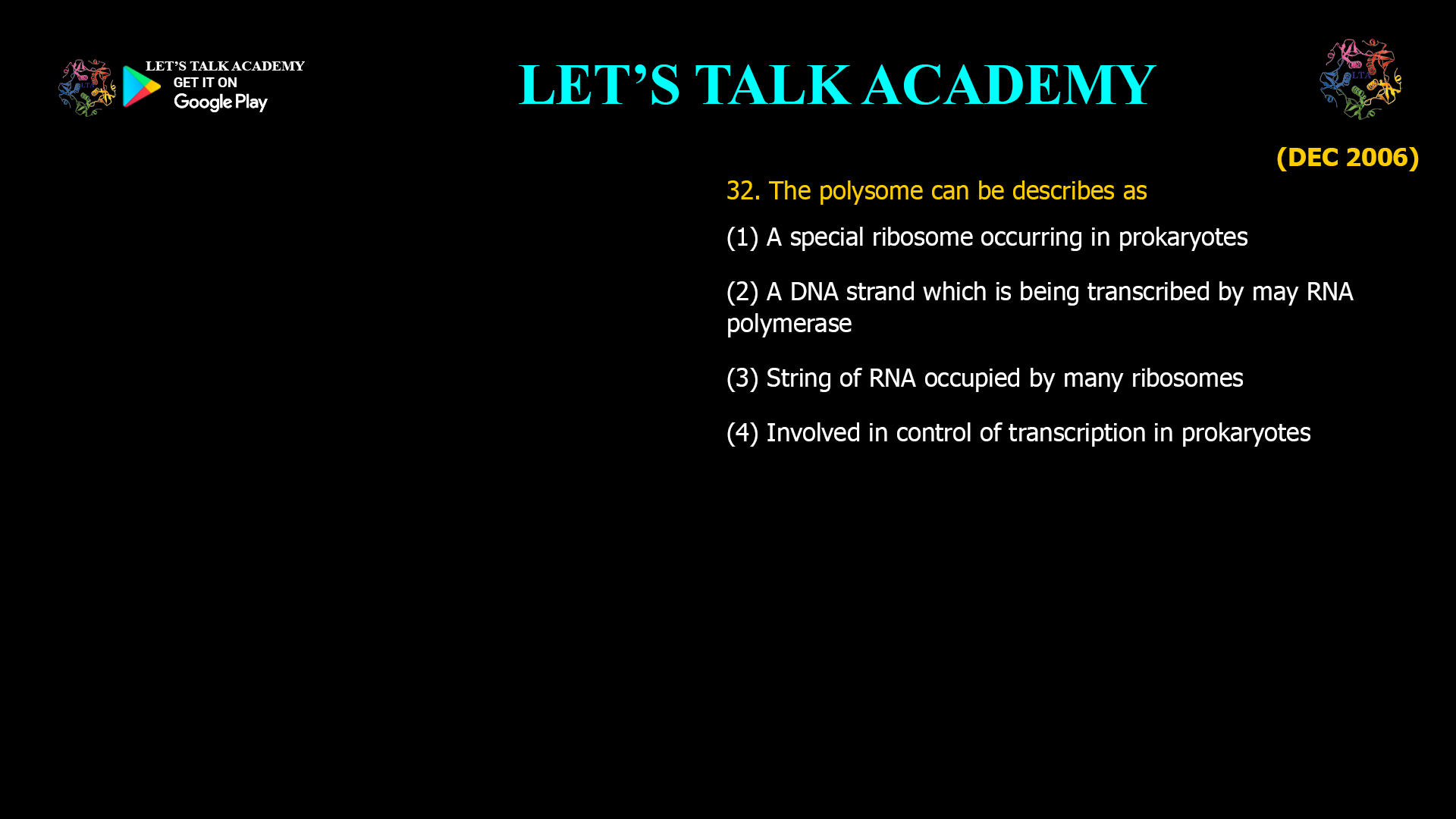
The polysome can be describes as (1) A special ribosome occurring in prokaryotes (2) A DNA strand which is being transcribed by may RNA polymerase (3) String of RNA occupied by many ribosomes (4) Involved in control of transcription in prokaryotes

What Is a Polysome? The Role of Multiple Ribosomes on a Single mRNA Strand

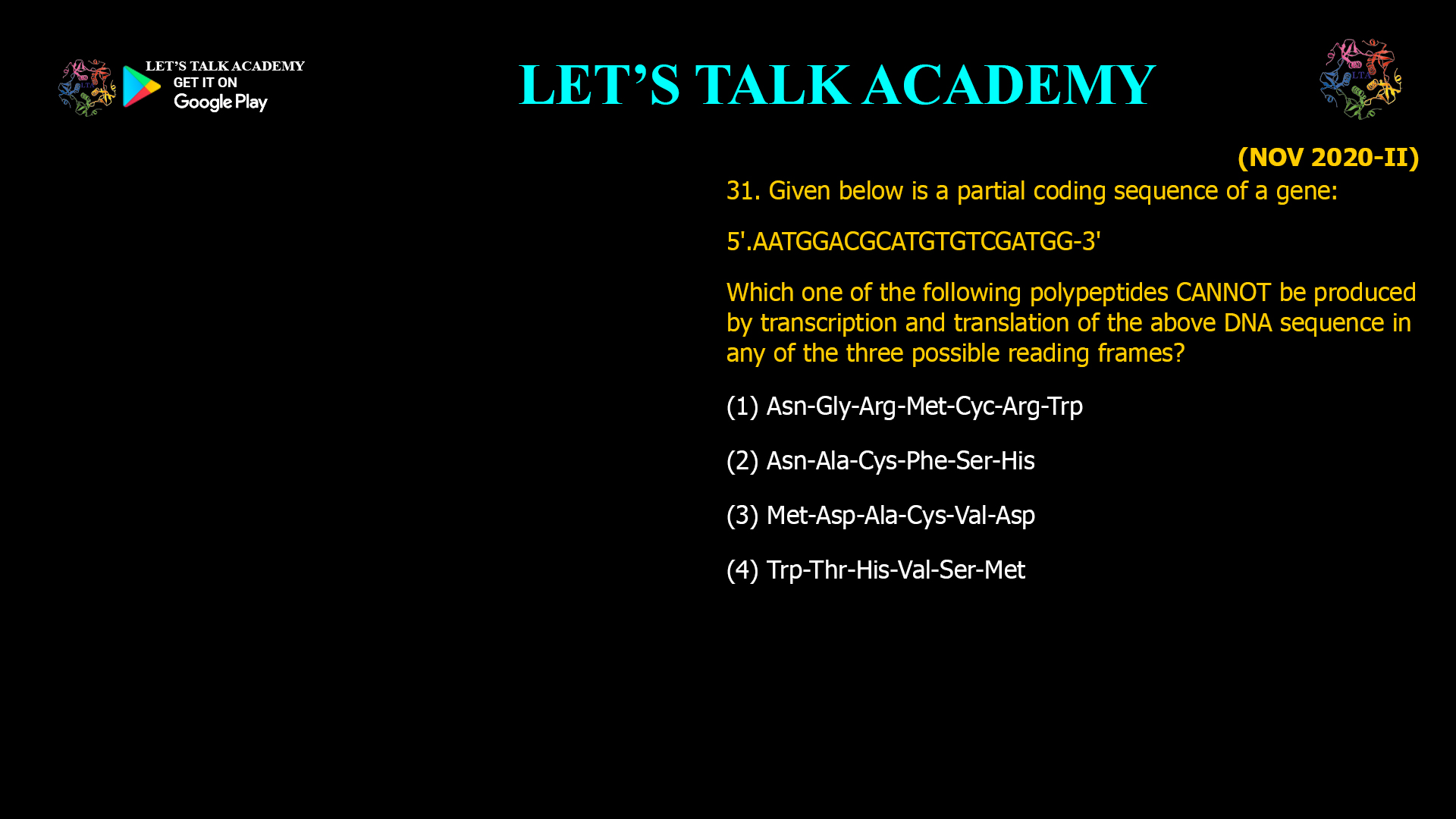
Given below is a partial coding sequence of a gene: 5'.AATGGACGCATGTGTCGATGG-3' Which one of the following polypeptides CANNOT be produced by transcription and translation of the above DNA sequence in any of the three possible reading frames? (1) Asn-Gly-Arg-Met-Cyc-Arg-Trp (2) Asn-Ala-Cys-Phe-Ser-His (3) Met-Asp-Ala-Cys-Val-Asp (4) Trp-Thr-His-Val-Ser-Met

Which Polypeptide Cannot Be Produced from a Given DNA Sequence in Any Reading Frame?

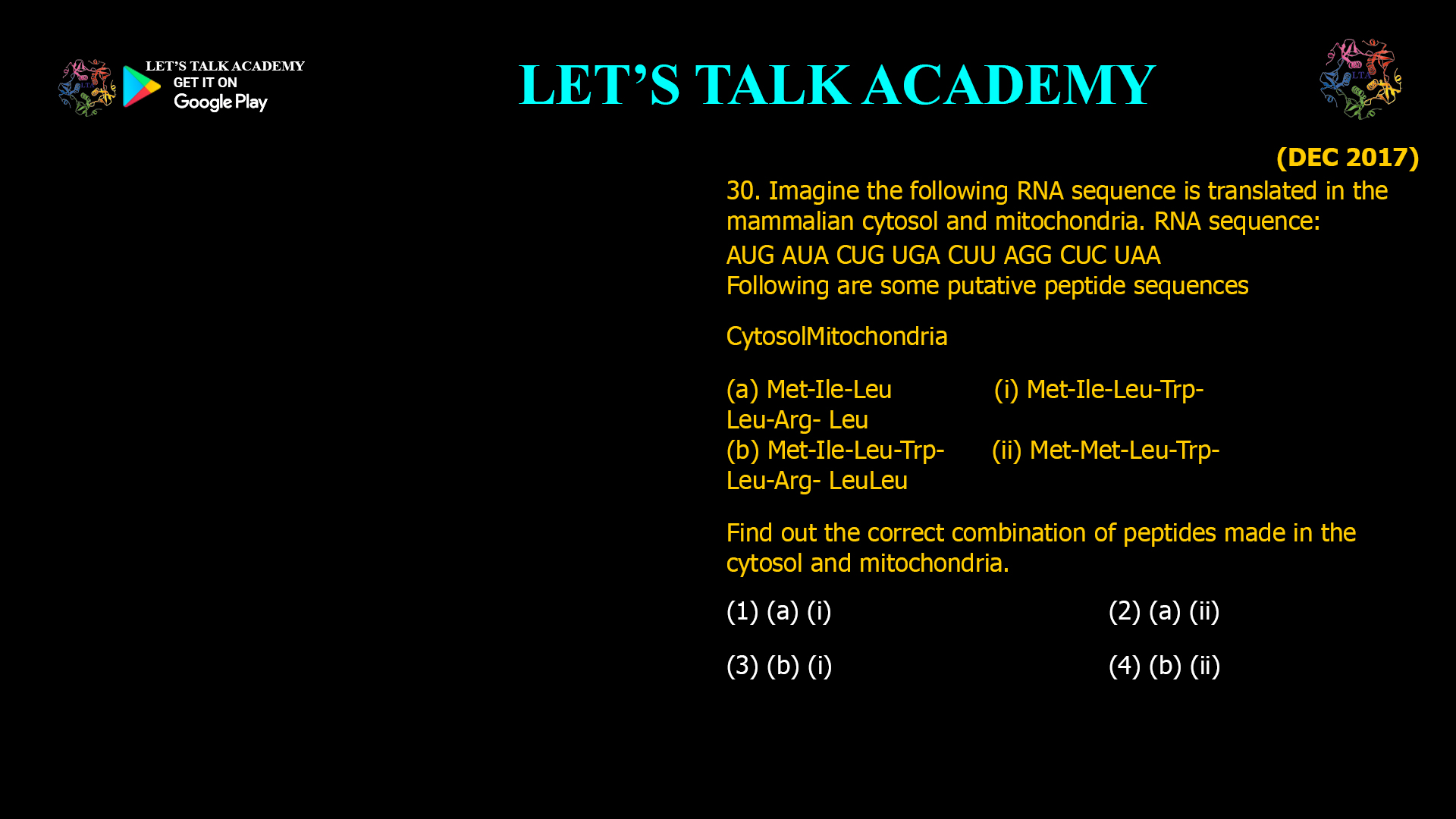
Imagine the following RNA sequence is translated in the mammalian cytosol and mitochondria. RNA sequence: AUG AUA CUG UGA CUU AGG CUC UAA Following are some putative peptide sequences CytosolMitochondria (a) Met-Ile-Leu             (i) Met-Ile-Leu-Trp- Leu-Arg- Leu (b) Met-Ile-Leu-Trp-     (ii) Met-Met-Leu-Trp- Leu-Arg- LeuLeu Find out the correct combination of peptides made in the cytosol and mitochondria. (1) (a) (i)                     (2) (a) (ii) (3) (b) (i)                     (4) (b) (ii) 

Differences in Peptide Translation of the Same RNA Sequence in Mammalian Cytosol and Mitochondria

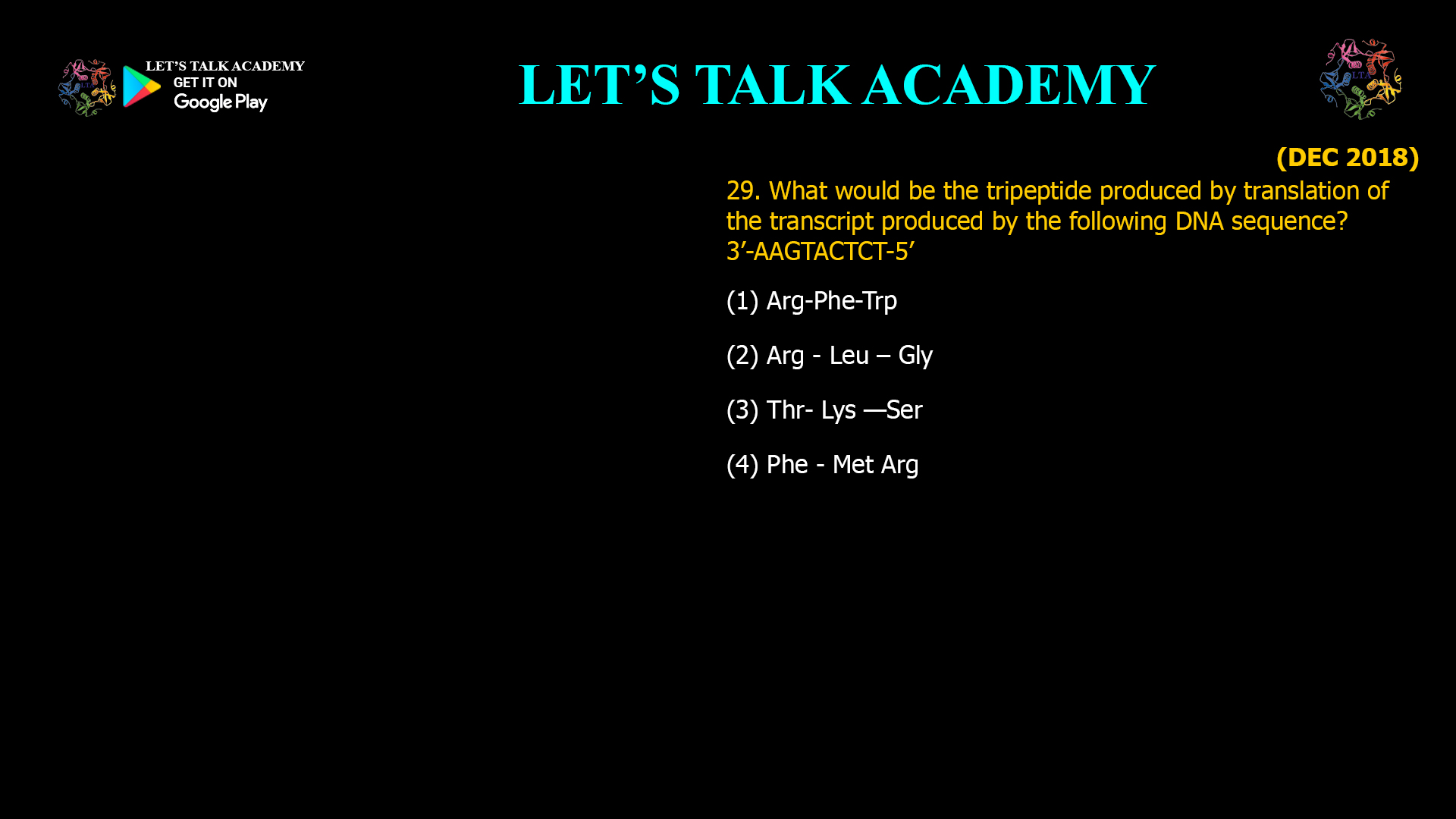
What would be the tripeptide produced by translation of the transcript produced by the following DNA sequence? 3’-AAGTACTCT-5’ (1) Arg-Phe-Trp        (2) Arg - Leu – Gly (3) Thr- Lys —Ser     (4) Phe - Met Arg  

How to Translate DNA Sequence 3’-AAGTACTCT-5’ into a Tripeptide: Phe-Met-Arg Explained

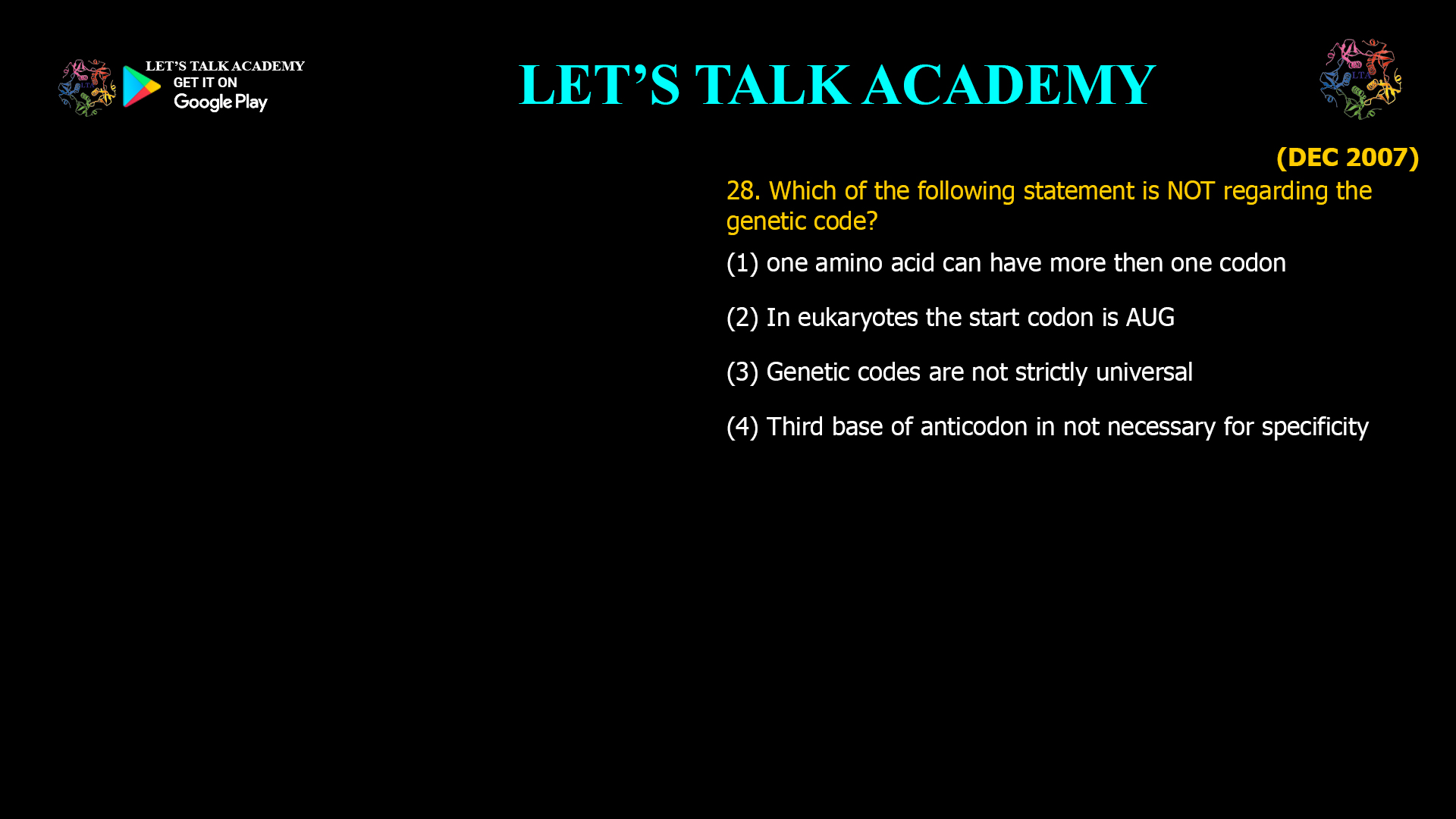
Which of the following statement is NOT regarding the genetic code? (1) one amino acid can have more then one codon (2) In eukaryotes the start codon is AUG (3) Genetic codes are not strictly universal (4) Third base of anticodon in not necessary for specificity 

Common Misconceptions About the Genetic Code: The Importance of the Anticodon’s Third Base

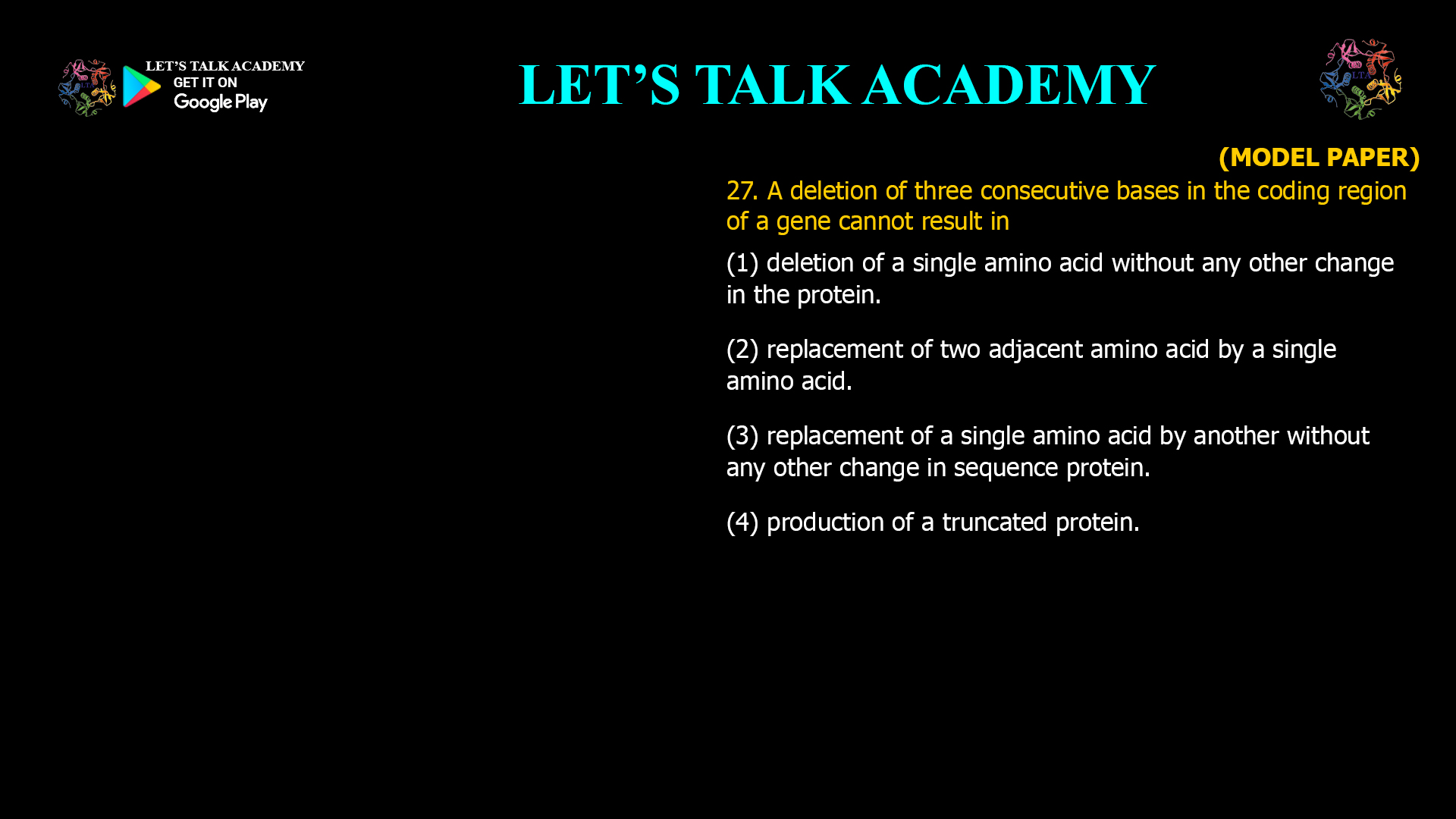
A deletion of three consecutive bases in the coding region of a gene cannot result in (1) deletion of a single amino acid without any other change in the protein. (2) replacement of two adjacent amino acid by a single amino acid. (3) replacement of a single amino acid by another without any other change in sequence protein. (4) production ofa truncated protein.

What Cannot Result from a Three-Base Deletion in a Gene’s Coding Region?

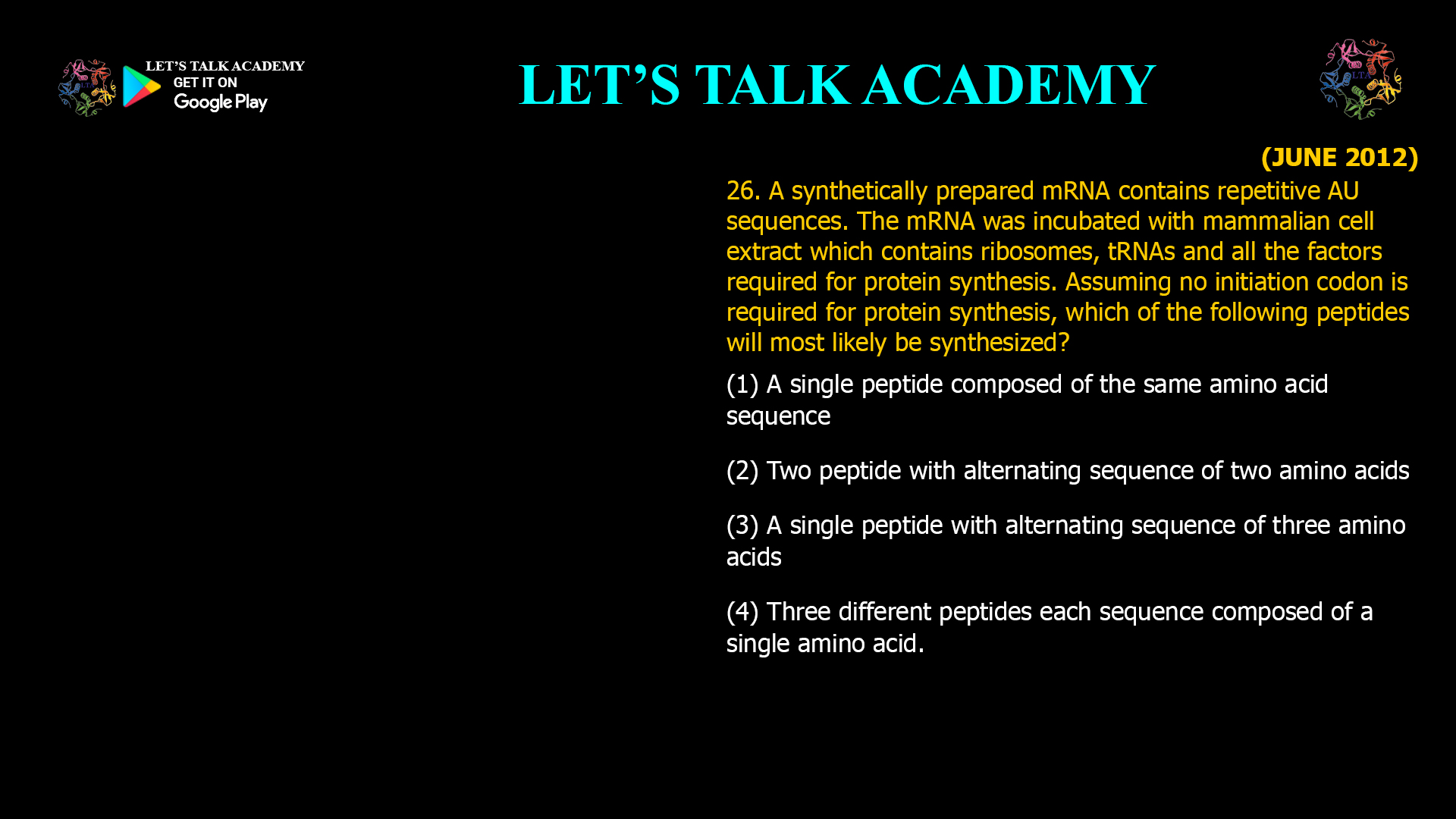
26. A synthetically prepared mRNA contains repetitive AU sequences. The mRNA was incubated with mammalian cell extract which contains ribosomes, tRNAs and all the factors required for protein synthesis. Assuming no initiation codon is required for protein synthesis, which of the following peptides will most likely be synthesized? (1) A single peptide composed of the same amino acid sequence (2) Two peptide with alternating sequence of two amino acids (3) A single peptide with alternating sequence of three amino acids (4) Three different peptides each sequence composed of a single amino acid.

What Peptides Are Synthesized from Synthetic mRNA with Repetitive AU Sequences in Mammalian Cell Extracts?

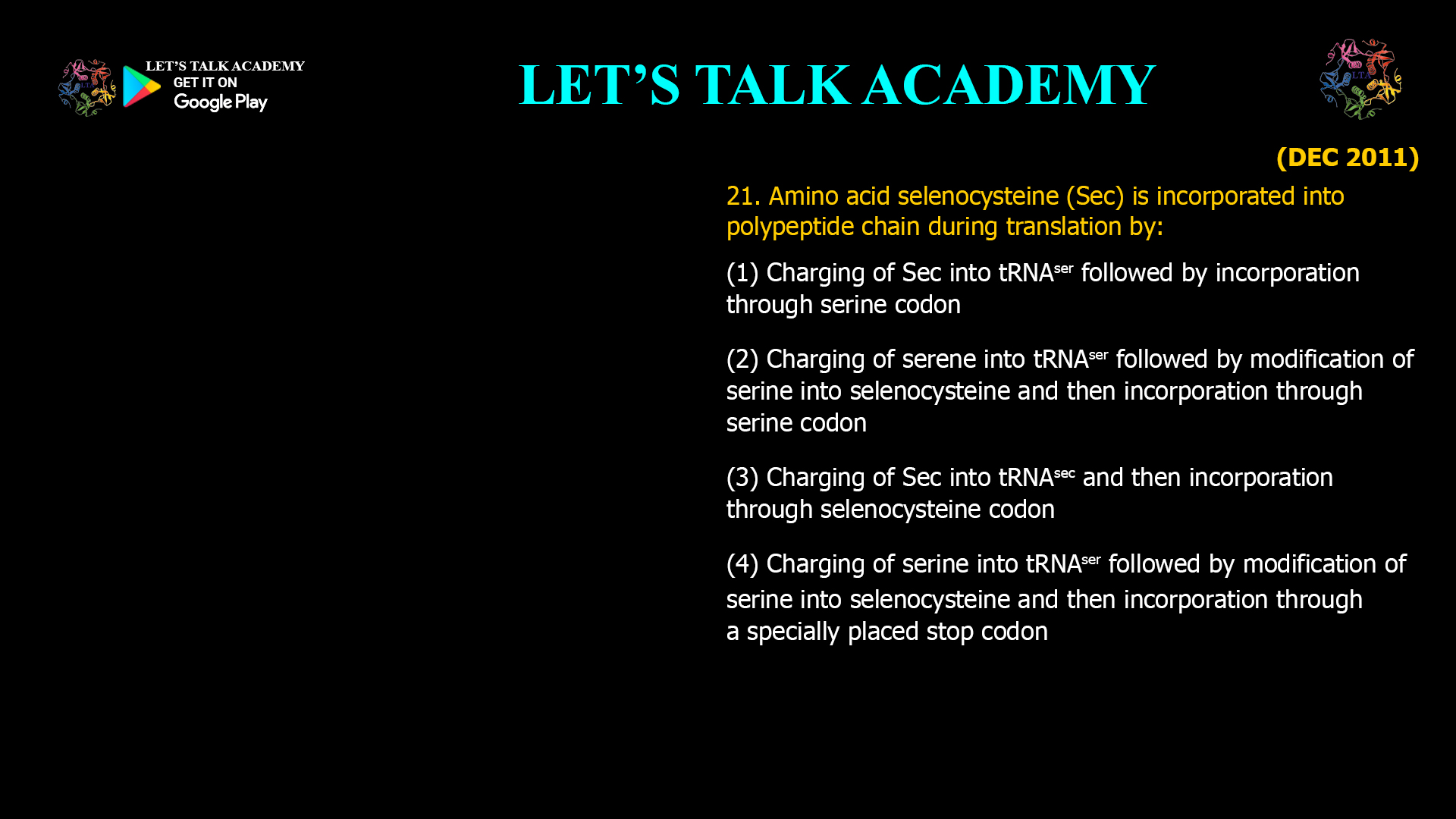
Amino acid selenocysteine (Sec) is incorporated into polypeptide chain during translation by: (1) charging of Sec into tRNAserfollowed byincorporation through serine codon (2) charging of serene into tRNAserfollowed by modification of serine into selenocysteine and then incorporation through serine codon (3) charging of Sec into tRNAsecand then incorporation through selenocysteine codon (4) charging of serine into tRNAser followed by modification of serine intoselenocysteine and then incorporation through a specially placed stop codon

How Selenocysteine Is Incorporated into Proteins: Charging of tRNA^Sec and UGA Codon Recoding

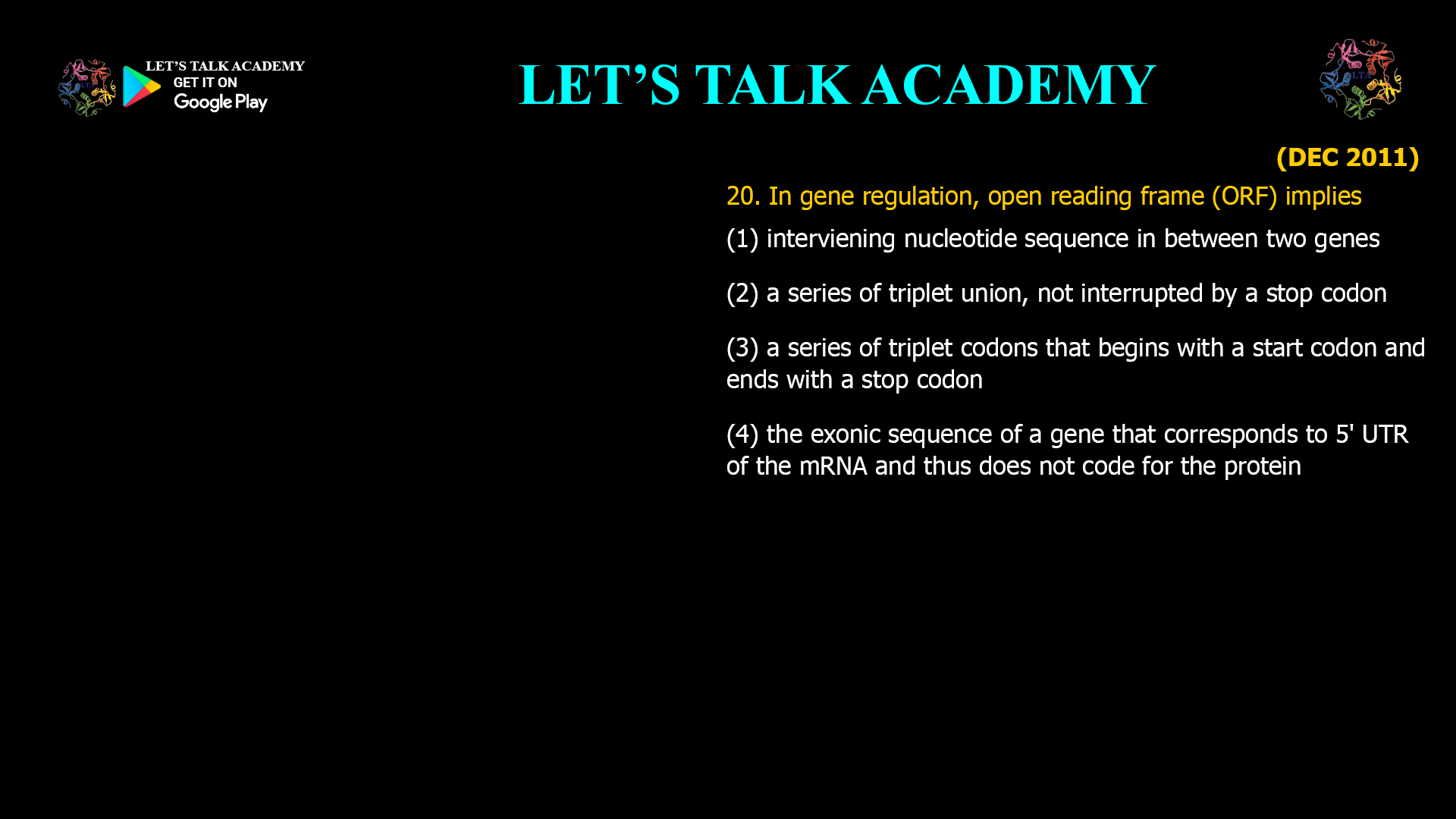
In gene regulation, open reading frame (ORF) implies (1)interviening nucleotide sequence in between two genes (2) a series of triplet union, not interrupted by a stop codon (3) a series of triplet codons that begins with a start codon and ends with a stop codon (4) the exonic sequence of a gene that corresponds to5' UTR of the mRNA and thus does not code for the protein

What Is an Open Reading Frame (ORF)? Definition and Role in Gene Regulation

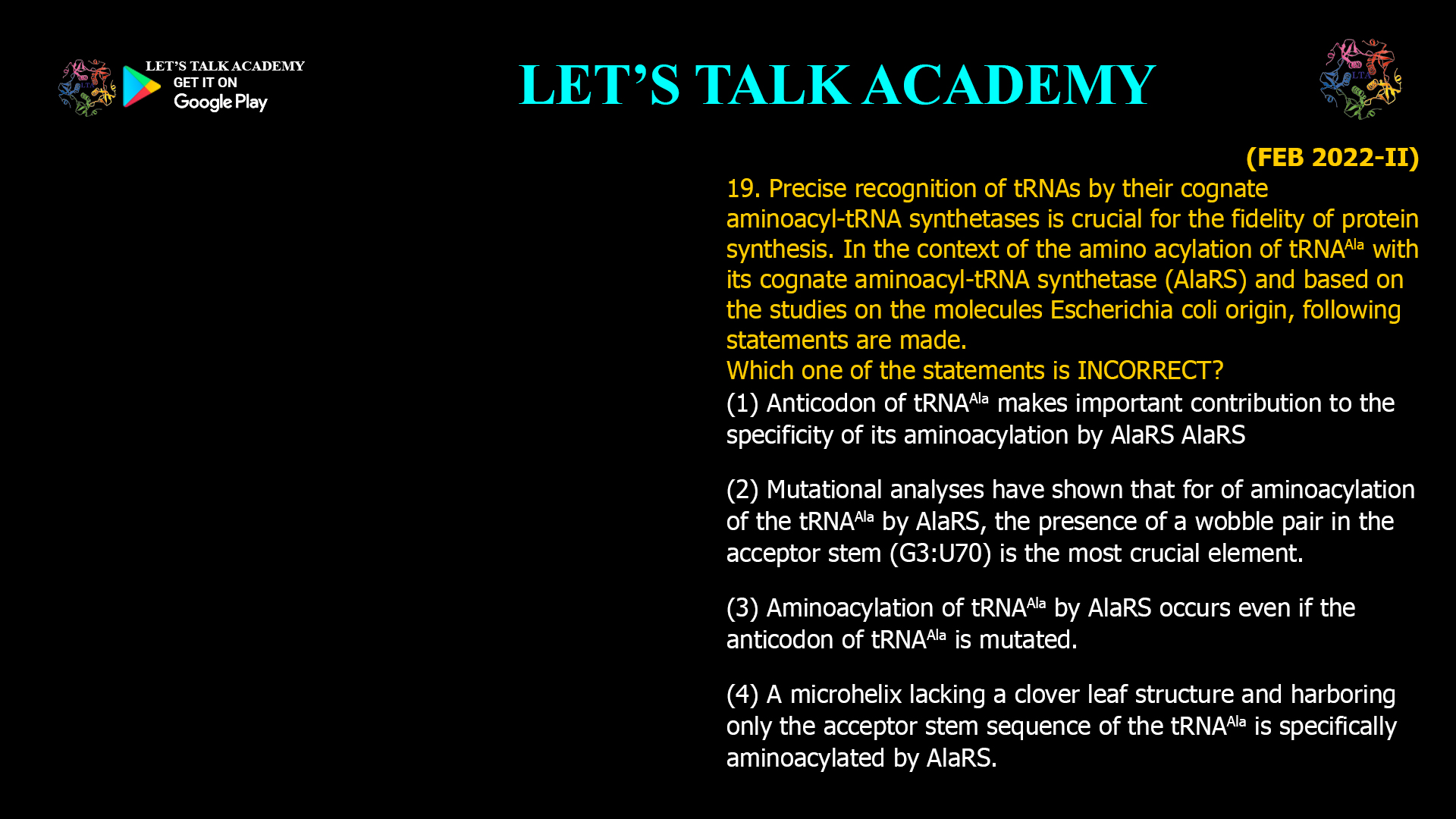
Precise recognition of tRNAs by their cognate aminoacyl-tRNAsynthetases is crucial for the fidelity of protein synthesis. In the context of the aminoacylationof tRNAAlawith its cognate aminoacyl-tRNAsynthetase(AlaRS) and based on the studies on the molecules Escherichia coli origin, following statements are made. Which one of the statements is INCORRECT? (1) Anticodon of tRNAAlamakes important contribution to the specificity of its aminoacylation by AlaRSAlaRS (2) Mutational analyses have shown that for of aminoacylation of the tRNAAla by AlaRS, the presence of a wobble pair in the acceptor stem (G3:U70) is the most crucial element. (3) Aminoacylation of tRNAAla by AlaRS occurs  even if the anticodon of tRNAAla is mutated. (4) A microhelix lacking a clover leaf structure and harboring only the acceptor stem sequence of the tRNAAla is specifically aminoacylated by AlaRS.

Key Identity Element for Alanyl-tRNA Synthetase: The G3:U70 Wobble Base Pair in tRNA^Ala

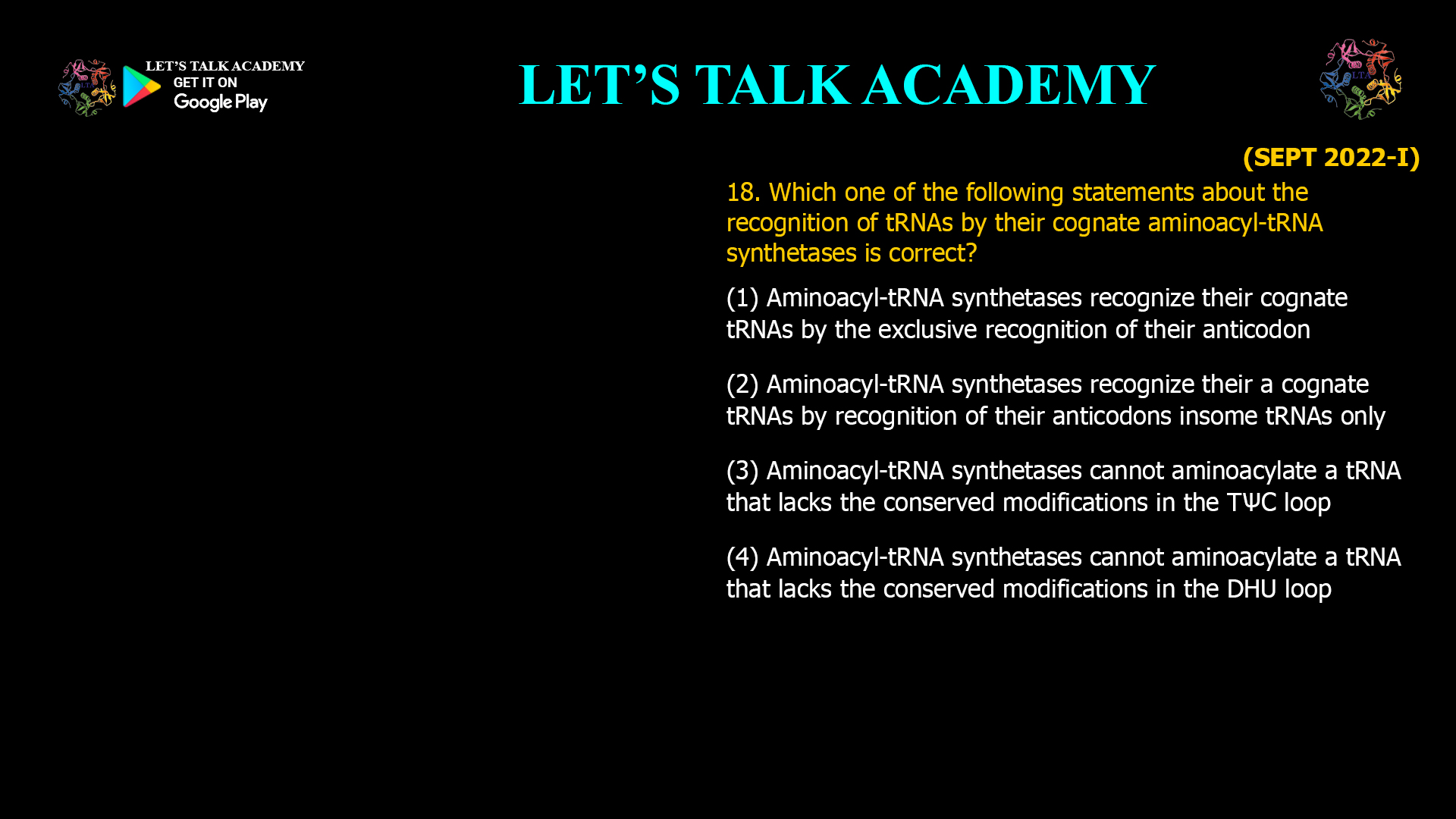
Which one of the following statements about the recognition of tRNAs by their cognate aminoacyl-tRNAsynthetases is correct? (1) Aminoacyl-tRNAsynthetases recognize theircognate tRNAs by the exclusive recognition of theiranticodon (2) Aminoacyl-tRNAsynthetases recognize their a cognate tRNAs by recognition of their anticodons insome tRNAs only (3) Aminoacyl-tRNAsynthetases cannot aminoacylate a tRNA that lacks the conserved modifications in the TѰC loop (4) Aminoacyl-tRNAsynthetases cannot aminoacylate a tRNA that lacks the conserved modifications in the DHU loop  

How Aminoacyl-tRNA Synthetases Recognize tRNAs: Anticodon Importance and Beyond

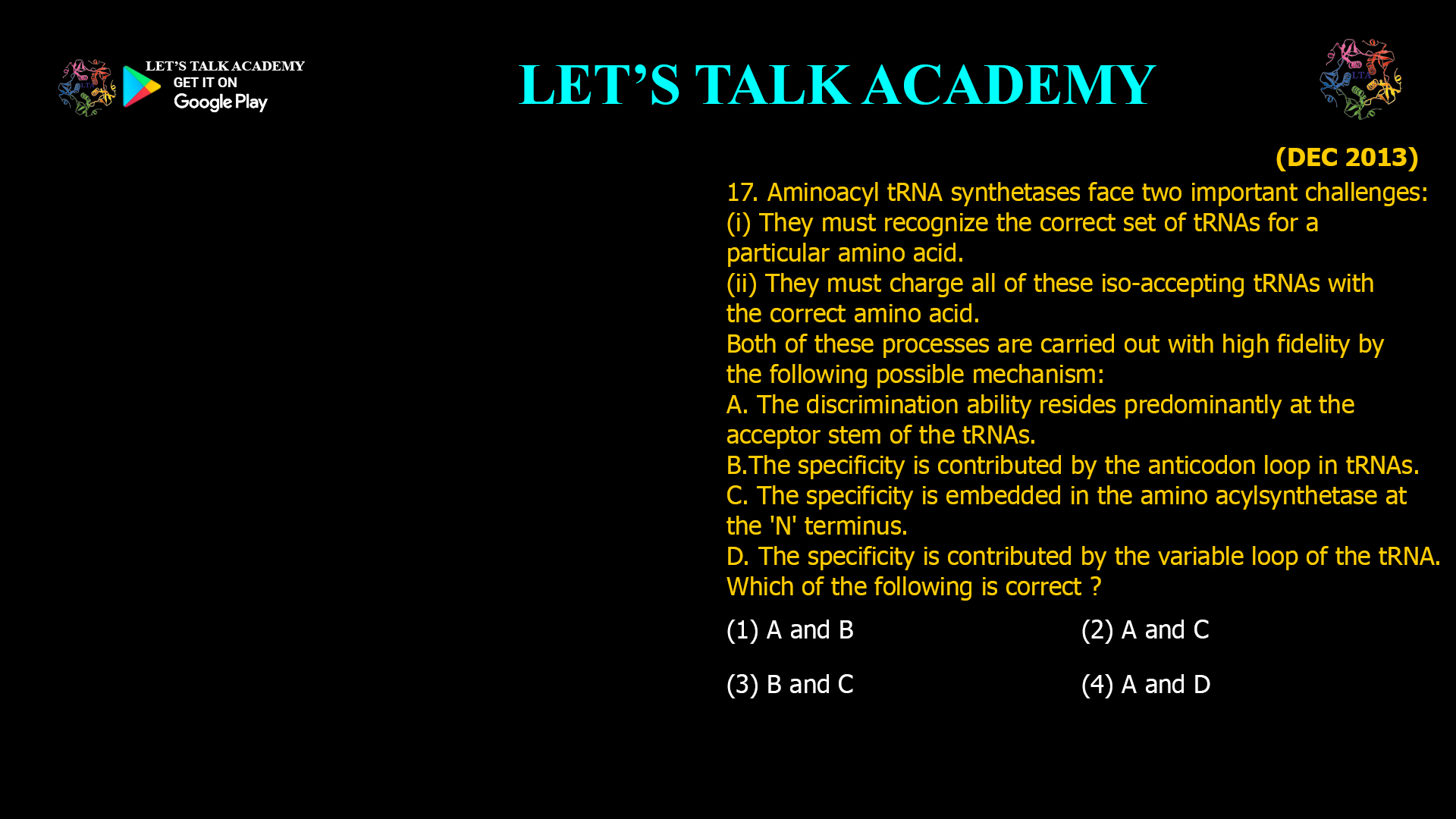
Aminoacyl tRNAsynthetases  face two important challenges: (i) They must recognize the correct set of tRNAs for a particular amino acid. (ii) They must charge all of these iso-accepting tRNAs with the correct amino acid. Both of these processes are carried out with high fidelity by the following possible mechanism: A. The discrimination ability resides predominantly at the acceptor stem of the tRNAs. B.The specificityis contributed by the anticodon loopin tRNAs. Thespecificity is embedded in the amino acylsynthetase at the 'N' terminus. D. The specificity is contributed by the variable loop of the tRNA. Which of the following is correct ? (1) A and B (2) A and C (3) B and C (4) A and D

How Aminoacyl-tRNA Synthetases Recognize tRNAs: Roles of Acceptor Stem and Anticodon Loop

Aminoacyl-tRNAsynthetases are very specific for amino-acylation of tRNAs with the correct cognate amino acids. However, there is a possibility of a mismatch between the tRNA and its cognate amino acid. This error is corrected by the inherent proofreading activity of the aminoacyl-tRNA, synthetase. In case of two very similar amino acids, namely valine and isoleucine, isoleucyl-tRNAsynthetase employs the following possible approaches for an error free aminoacylation A. It removes an incorrect amino acid by hydrolyzing the aminoacyl-AMP linkage following first reaction B. It is activated for proof-reading activity, leading to breakage of the bond between the wrong amino acid and tRNA. C. It has an intrinsic ability to recognize the structural difference between amino acids leading to abortive elimination of the non-cognate amino acid. D. It getssequestered in the second step with the wrong amino acid, and that freezes the aminoacylation process. Which of the following combinations is correct (1) A and B          (2) A and D (3) B and D(4) C and D

How Isoleucyl-tRNA Synthetase Ensures Accurate Aminoacylation Through Pre- and Post-Transfer Editing

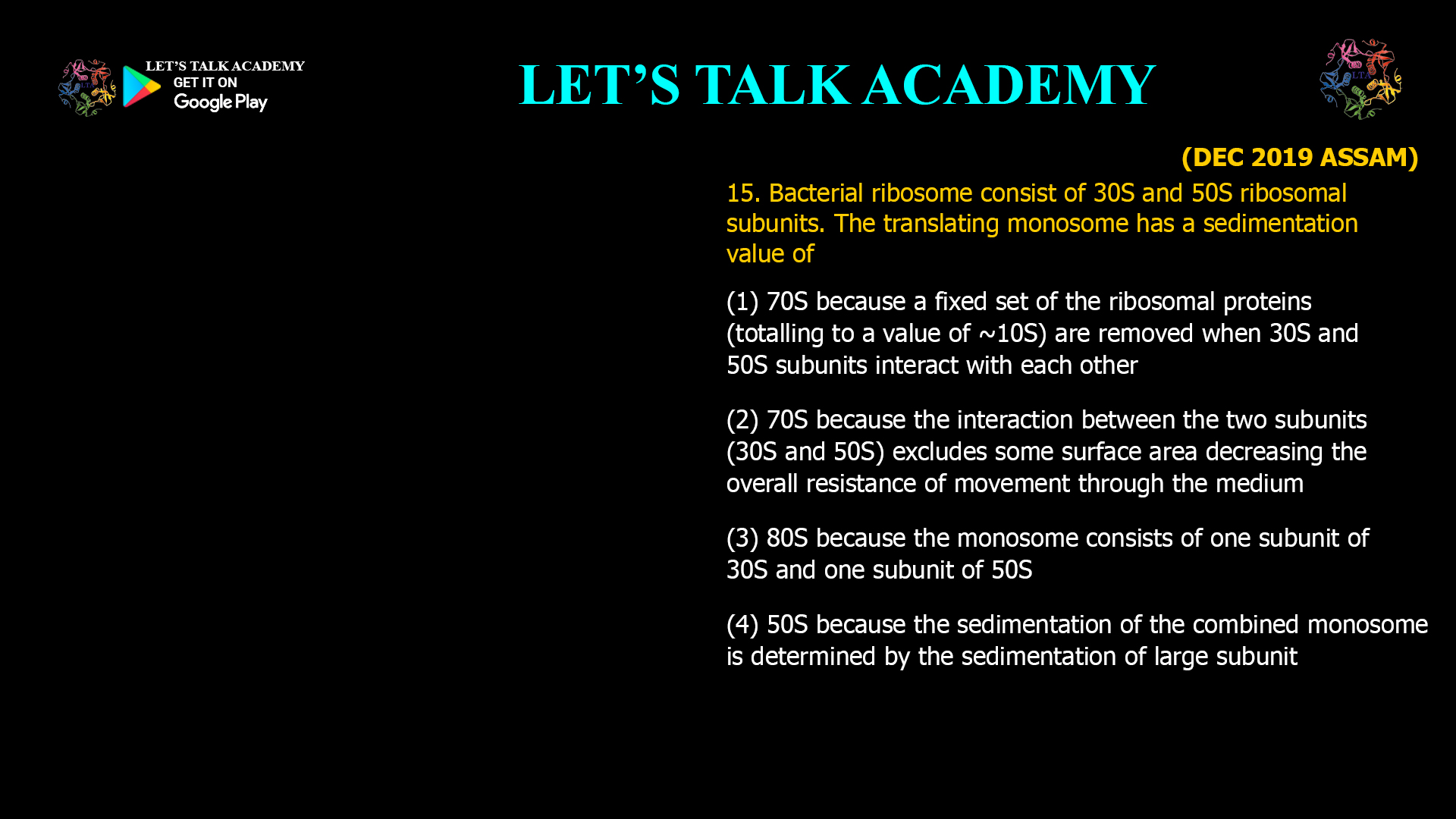
Bacterial ribosome consist of 30S and 50S ribosomal subunits. The translating monosome has a sedimentation value of (1) 70S because a fixed set of the ribosomal proteins (totalling to a value of ~10S) are removed when30S and 50S subunits interact with each other (2) 70S because the interaction between the two subunits (30S and 50S) excludes some surface area decreasing the overall resistance of movement through the medium (3) 80S because the monosome consists of one subunit of 30S and one subunit of 50s (4) 50S because the sedimentation of the combined monosome is determined by the sedimentation of large subunit

Why the Bacterial Ribosome Monosome Sediments at 70S: Understanding Ribosomal Subunit Interaction

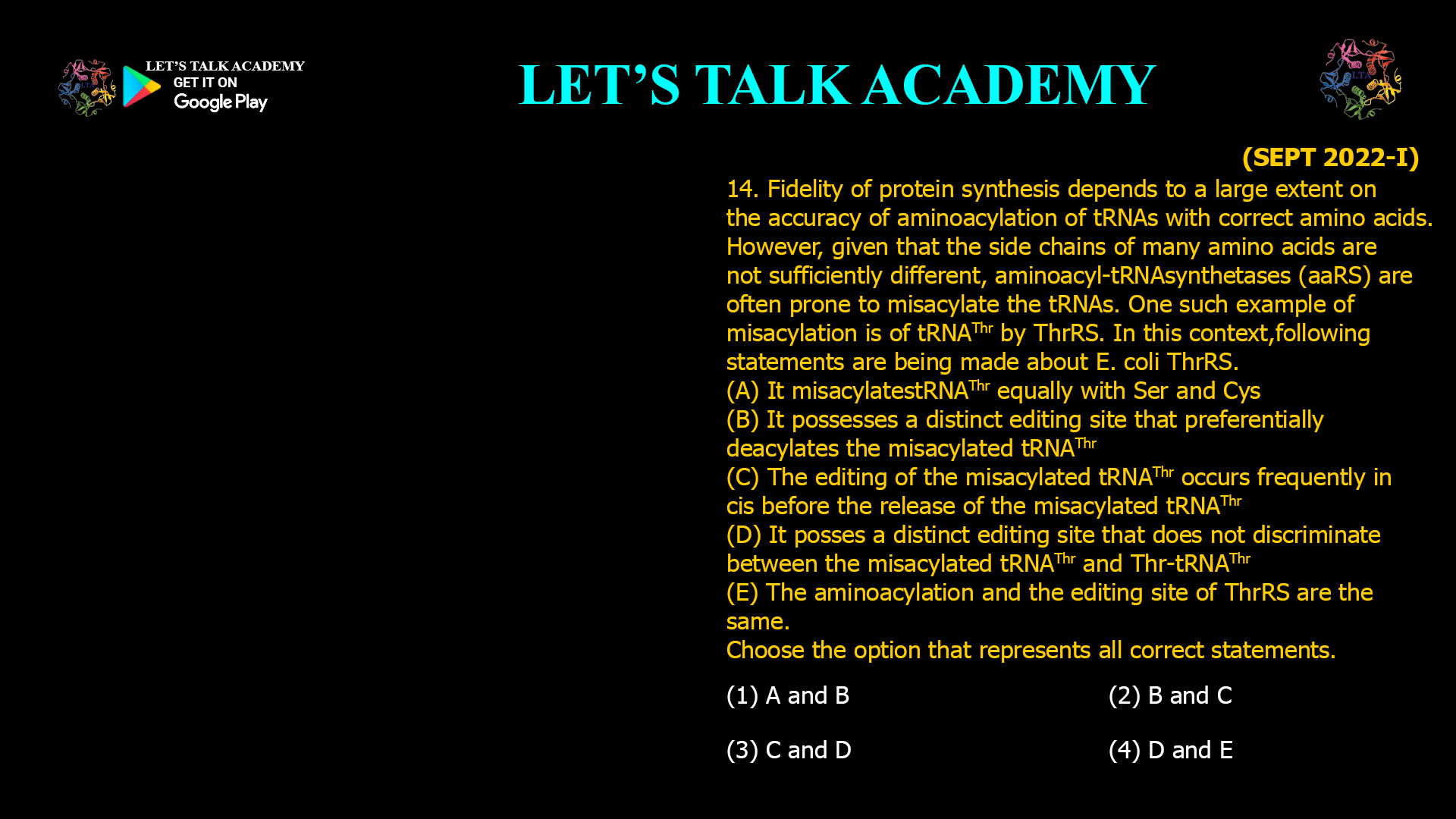
Fidelity of protein synthesis depends to a large extent on the accuracy of aminoacylation of tRNAs with correct amino acids. However, given that the side chains of many amino acids are not sufficiently different, aminoacyl-tRNAsynthetases (aaRS) are often prone to misacylate the tRNAs. One such example of misacylation is of tRNAThrby ThrRS. In this context,following statements are being made about E. coli ThrRS. (A) It misacylatestRNAThrequally with Serand Cys (B) It possesses adistinct editing site that preferentially deacylates the misacylatedtRNAThr (C) The editing of the misacylatedtRNAThroccursfrequently in cis before the release of the misacylatedtRNAThr (D) It posses a distinct editing site that does not discriminate between the misacylatedtRNAThr and Thr-tRNAThr (E) The aminoacylation and the editing site of ThrRS are the same. Choose the option that represents all correct statements. (1) A and B        (2) B and C (3) C and D        (4) D and E

How E. coli Threonyl-tRNA Synthetase Ensures Fidelity: The Role of Editing Site and Cis-Editing

Each amino acyl-tRNAsynthetase is precisely able to match an amino acid with the tRNA containing the correct corresponding anticodon, Most organisms have 20 different tRNAsynthetases, however some bacteria lack the synthetase for charging the tRNA for glutamine (tRNAGIn) with its cognate amino acid. How do these bacteria manage to incorporate glutamine in their proteins? Choose the correct answer. (1) Glutamine is not present in the newly synthesized bacterial protein. Post translational modification converts glutamate to glutamine at the required sites. (2) In these, bacteria, the aminoacyl tRNAsynthetasespecific for tRNA glutamate (tRNAGlu) also charges tRNAGlnwith glutamine. (3) In these bacteria, the aminoacyl tRNAsynthetase specific for tRNAGlualso charges tRNAGln with glutamate. A second enzyme then converts the glutamate of the charged tRNAGln to glutamine. (4) In these bacteria, the aminoacyl tRNAsynthetasecharges tRNAGlu with either glutamate or glutamine according to their requirement during protein synthesis

How Bacteria Without Glutaminyl-tRNA Synthetase Incorporate Glutamine into Proteins

The challenges laced by aminoacyl tRNAsynthetase in selecting the correct amino acid is more daunting than its recognition of the appropriate tRNA. In case of amino acids with similar structures like valine and isoleucine,this challenge is met by the enzyme possibily through its A. catalytic pocket.   B. editing pocket. C. anticodon loop. D. acceptor arm Choose the correct set from the following: (1) A and B(2) A and C (3) B and D        (4) B and C

How Aminoacyl-tRNA Synthetases Use Catalytic and Editing Pockets to Discriminate Similar Amino Acids

The aminoacyl-tRNAsynthetases (AARSS) in an organism have evolved to catalyseaminoacylation of their cognate tRNAs (1) either at the 3'-OH or 2'-OH positions of the adenosine at the CCA end. (2) only at the 3-OH position of the adenosine at the CCA end. (3) only at the 2'-OH position of the adenosine at the CCA end. (4) Only at the C1’ position of the adenosine at the CCA end

Aminoacyl-tRNA Synthetases Attach Amino Acids to Either 2′-OH or 3′-OH of tRNA’s Terminal Adenosine

(DEC 2012) 9. The specificity of tRNA recognition by a aminoacyl tRNAsynthetase that is intrinsic to the tRNA molecule lies on (1) acceptor stem. (2) anticodon loop. (3) acceptor stem and anticodon loop. (4) D-arm

How Aminoacyl-tRNA Synthetases Recognize tRNAs: The Crucial Roles of Acceptor Stem and Anticodon Loop

Aminoacyl tRNAs are escorted to the ribosome by the elongation factor (1) EF-Ts           (2) EF-G (3) EF-Tu           (4) Eef-2 

EF-Tu Escorts Aminoacyl-tRNAs to the Ribosome During Prokaryotic Translation Elongation

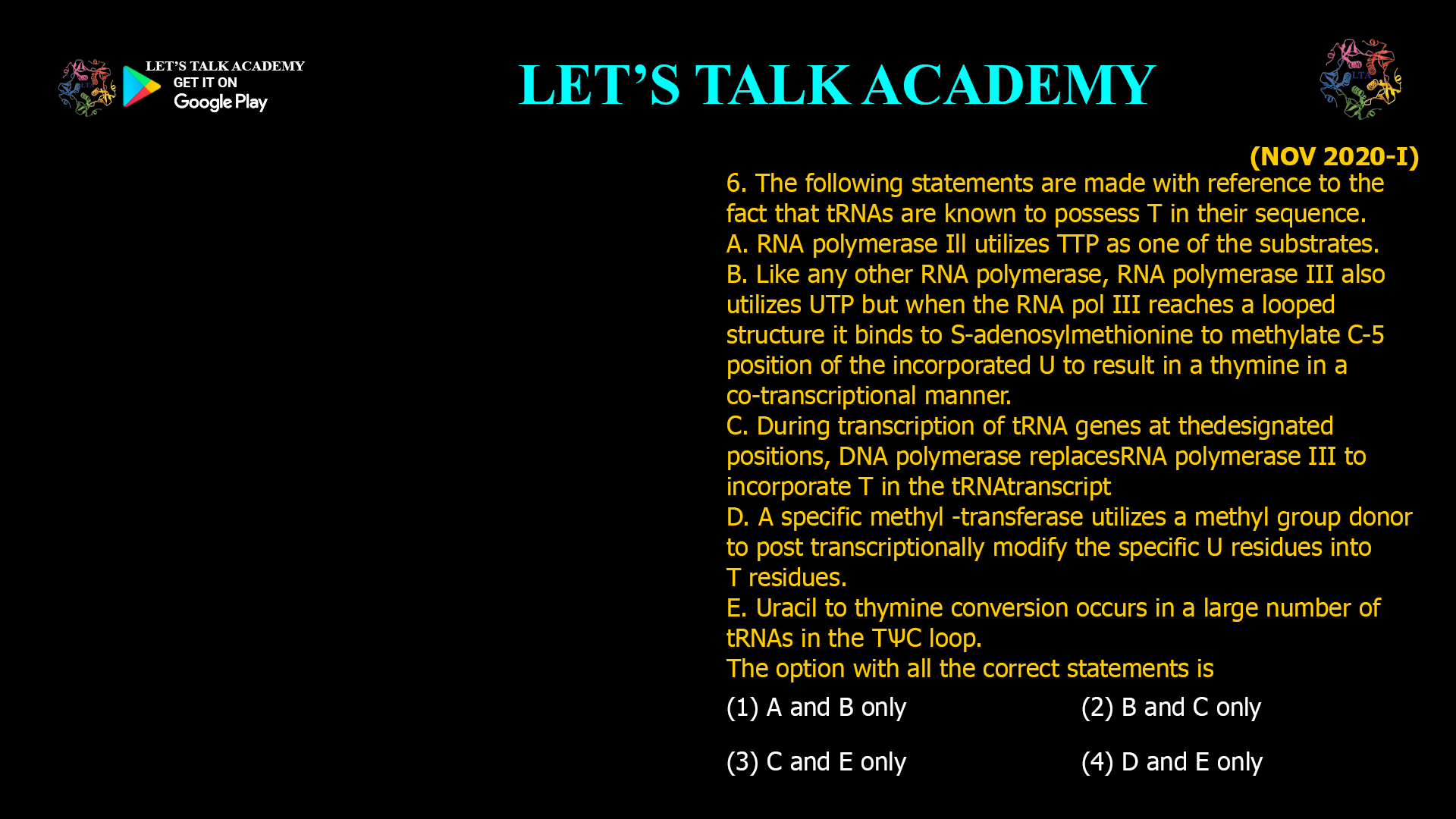
The following statements are made with reference to the fact that tRNAs are known to possess T in their sequence. A. RNA polymerase Ill utilizes TTP as one of the substrates. B. Like any other RNA polymerase, RNA polymerase III also utilizes UTP but when the RNA pol III reaches a looped structure it binds to S-adenosylmethionine to methylate C-5 position of the incorporated U to result in a thymine in a co-transcriptional manner. C. During transcription of tRNAgenes at thedesignated positions, DNA polymerase replacesRNA polymerase III to incorporate T in the tRNAtranscript D. A specific methyl -transferase utilizes a methyl group donor to post transcriptionally modify the specific U residues into T residues. E. Uracil to thymine conversion occurs in a large number of tRNAs in the TѰC loop. The option with all the correct statements is

Why tRNAs Contain Thymine: Mechanisms and Modifications Explained

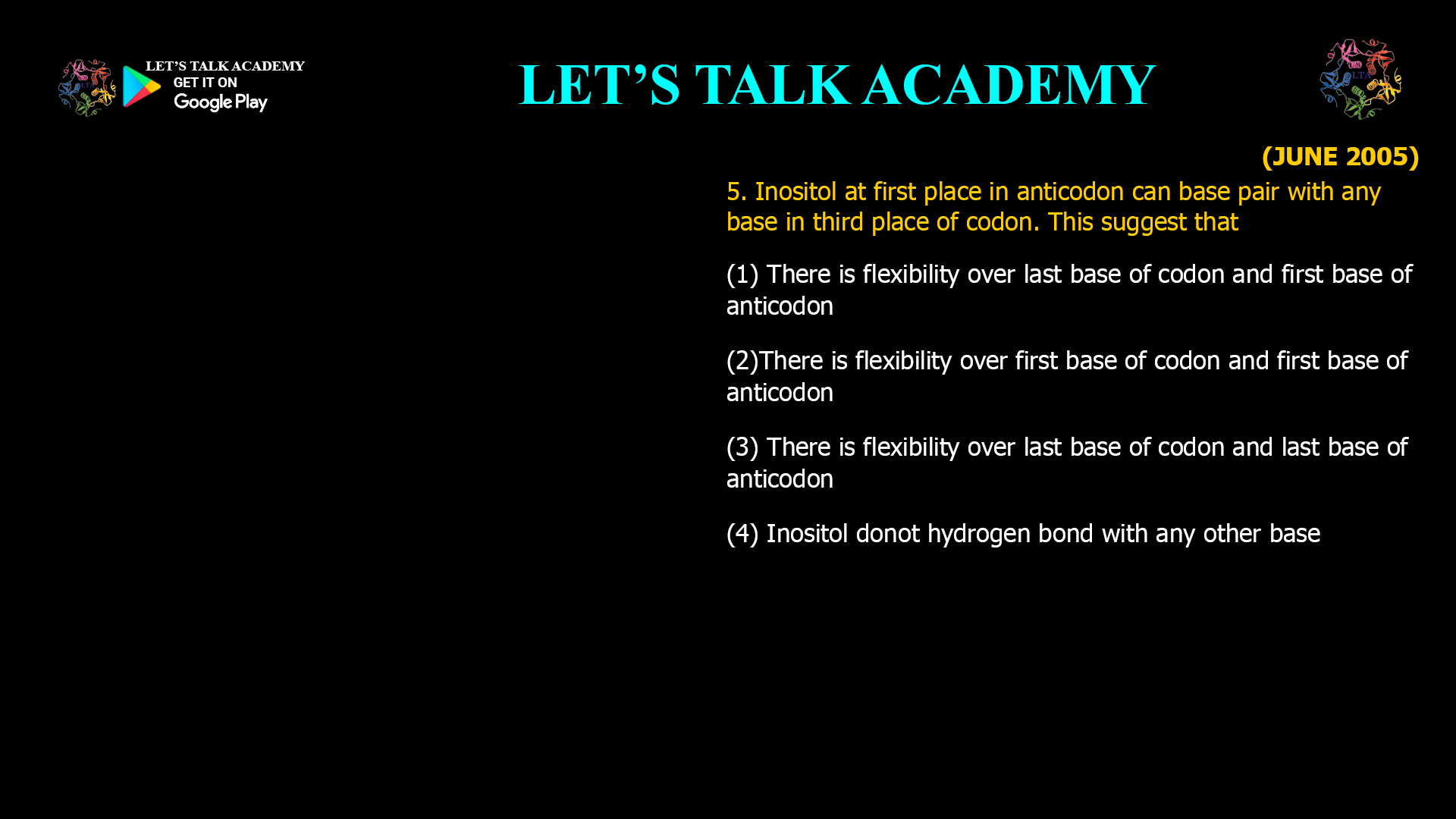
Inositol at first place in anticodon can base pair with any base in third place of codon. This suggest that (1) There is flexibility over last base of codon and first base of anticodon (2)There is flexibility over first base of codon and first base of anticodon (3) There is flexibility over last base of codon and last base of anticodon (4) Inositol donot hydrogen bond with any other base

Inosine in the Anticodon: Flexibility in Codon-Anticodon Pairing Explained

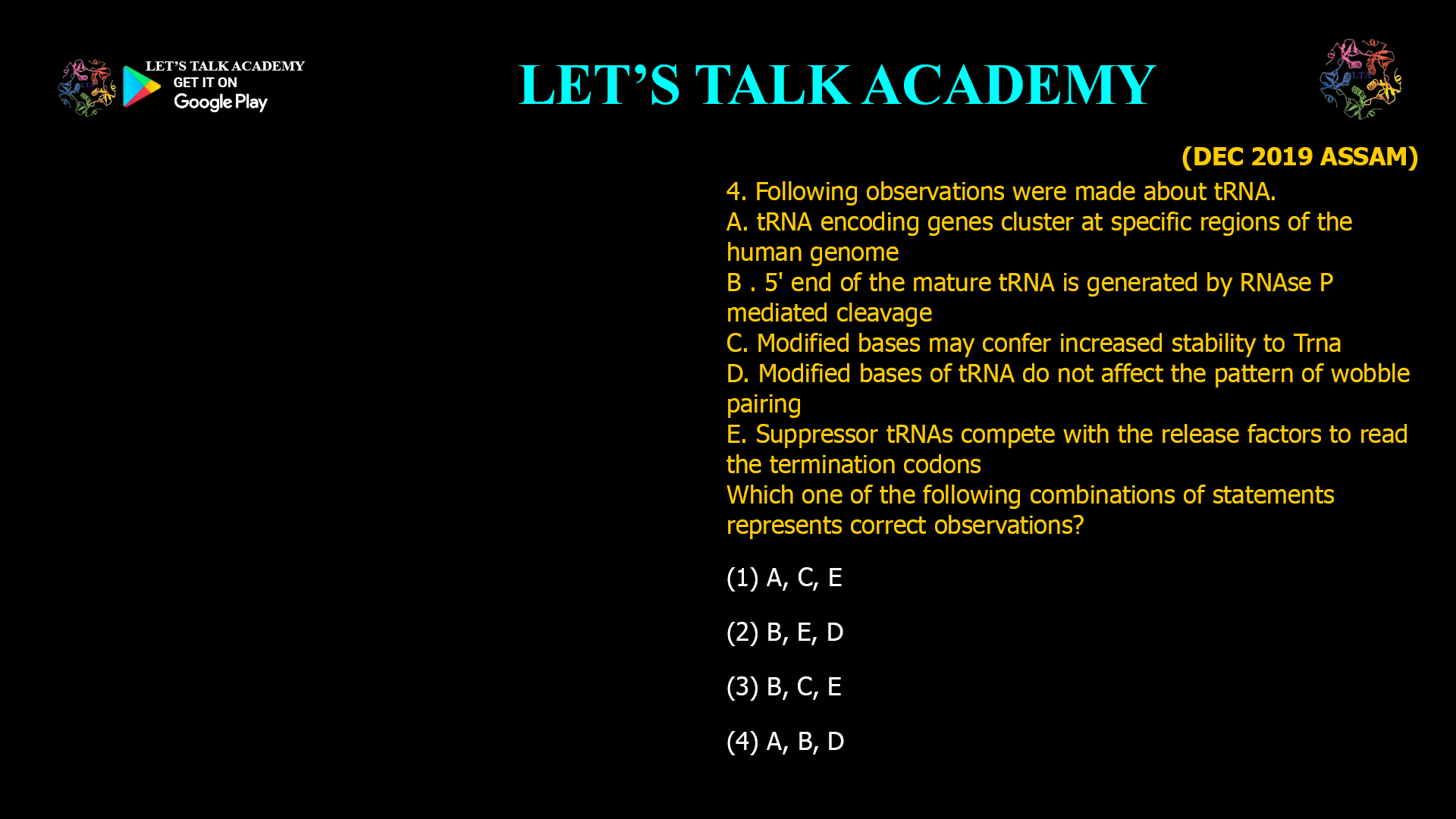
Following observations were made about tRNA. A. tRNA encoding genes cluster at specific regions of the human genome B . 5' end of the mature tRNA is generated by RNAse P mediated cleavage C. Modified bases may confer increased stability to Trna D. Modified bases of tRNA do not affect the pattern of wobble pairing E. Suppressor tRNAs compete with the release factors to read the termination codons Which one of the following combinations of statements represents correct observations?

tRNA: Genomic Clustering, Processing, and Function

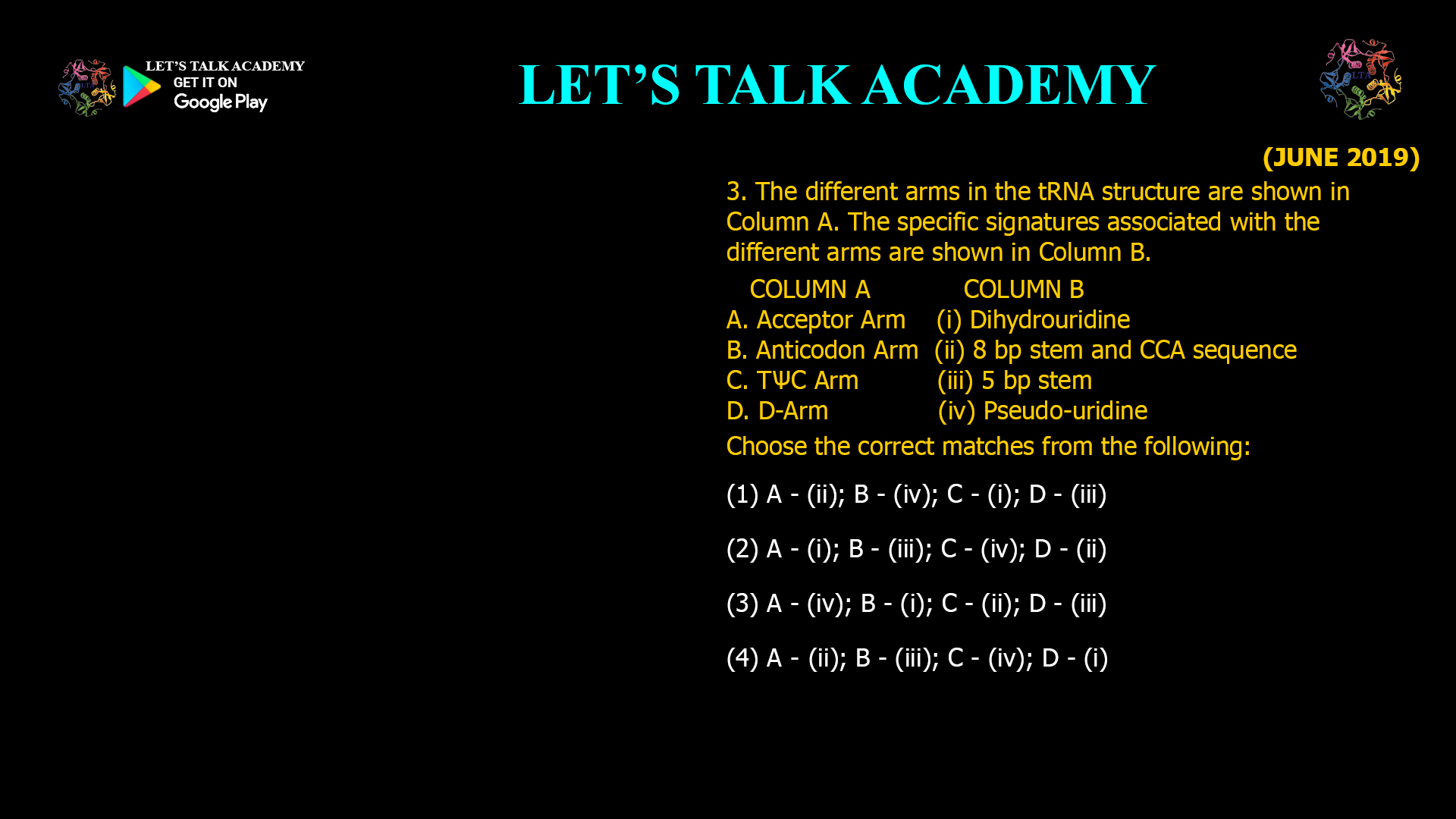
tRNA Arms | Acceptor Arm | Anticodon Arm | TѰC Arm | D-Arm     

tRNA Arms | Acceptor Arm | Anticodon Arm | TѰC Arm | D-Arm     

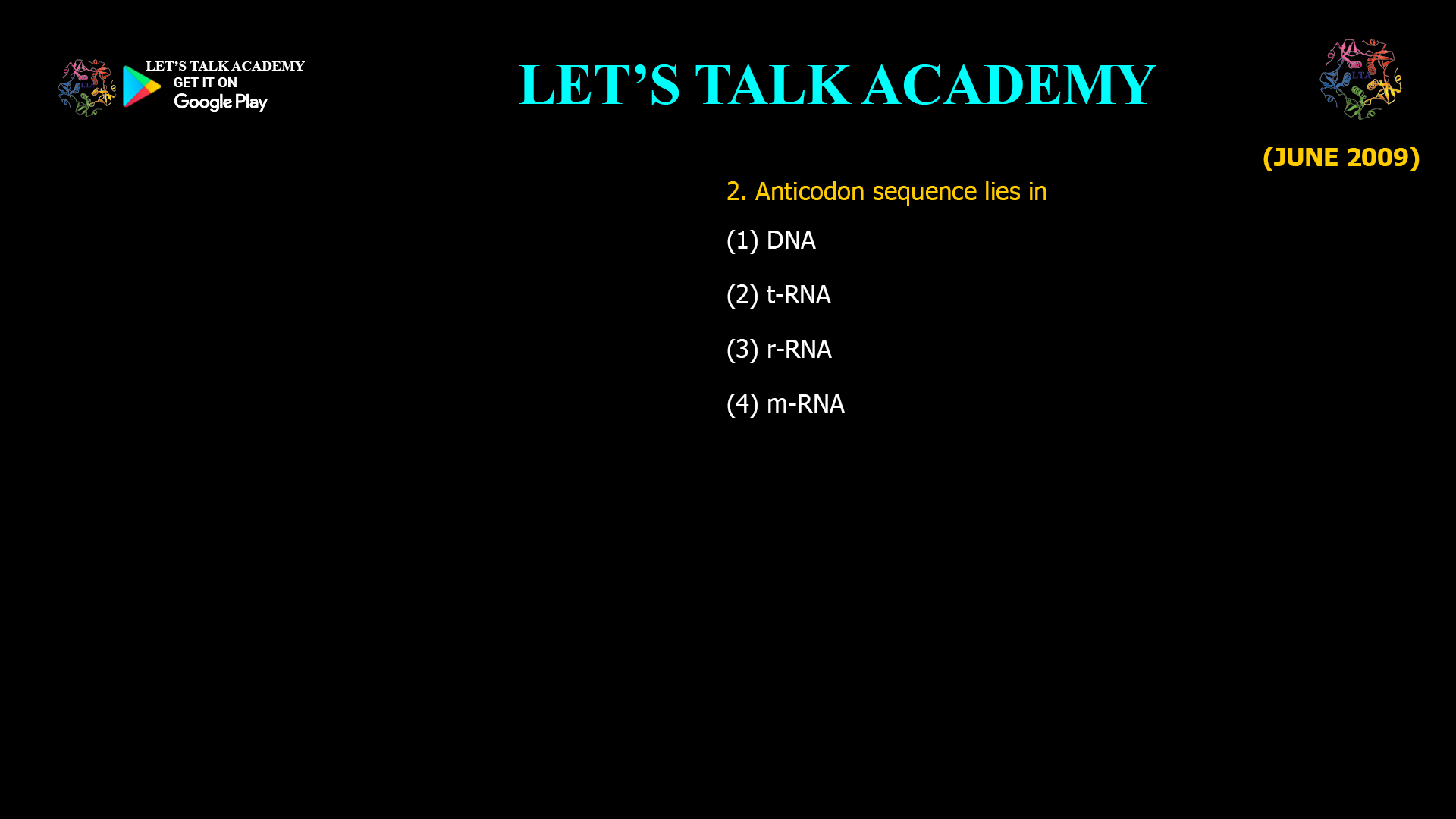
Anticodon Sequence Role in Protein Synthesis

Anticodon Sequence Role in Protein Synthesis

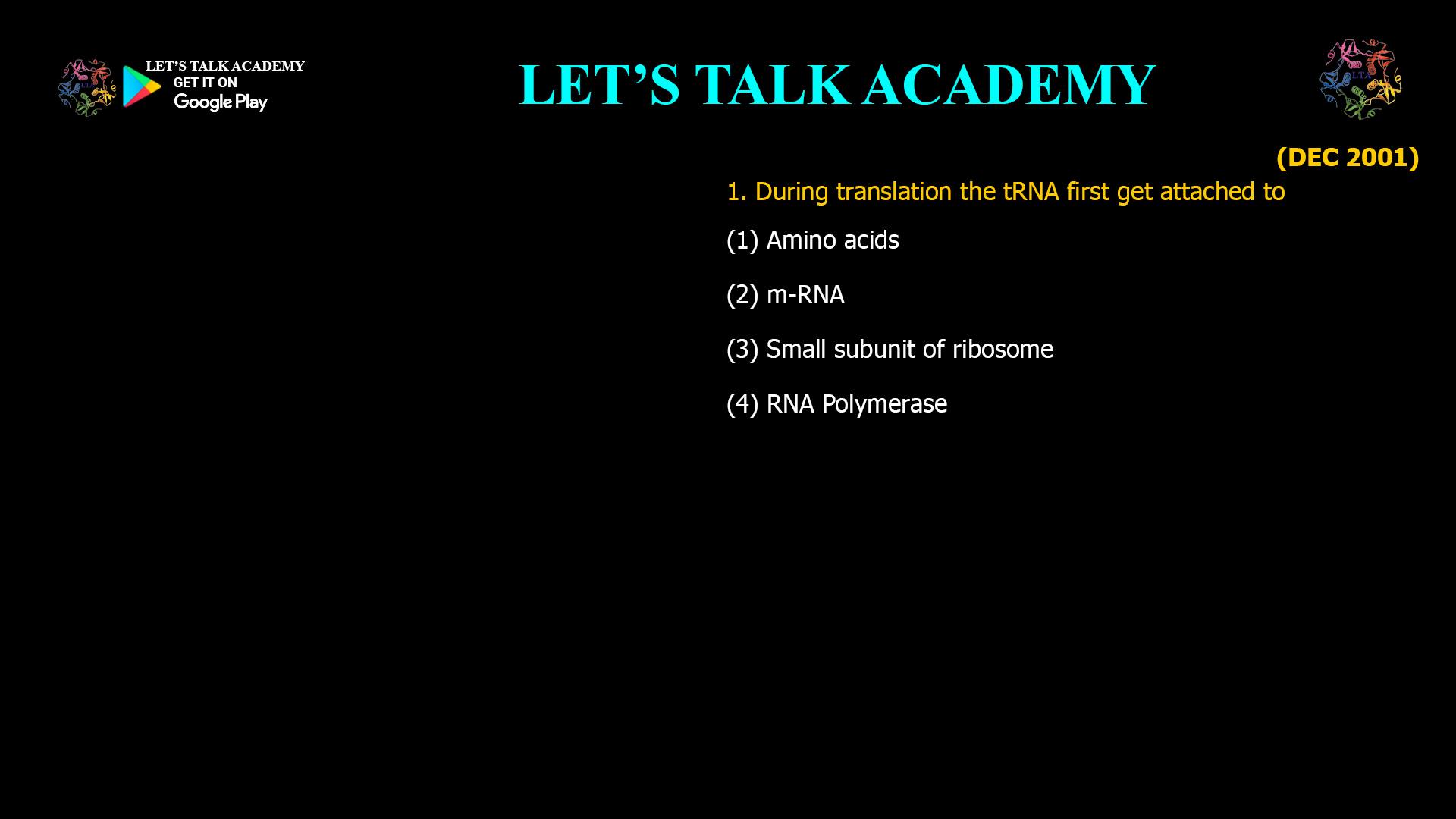
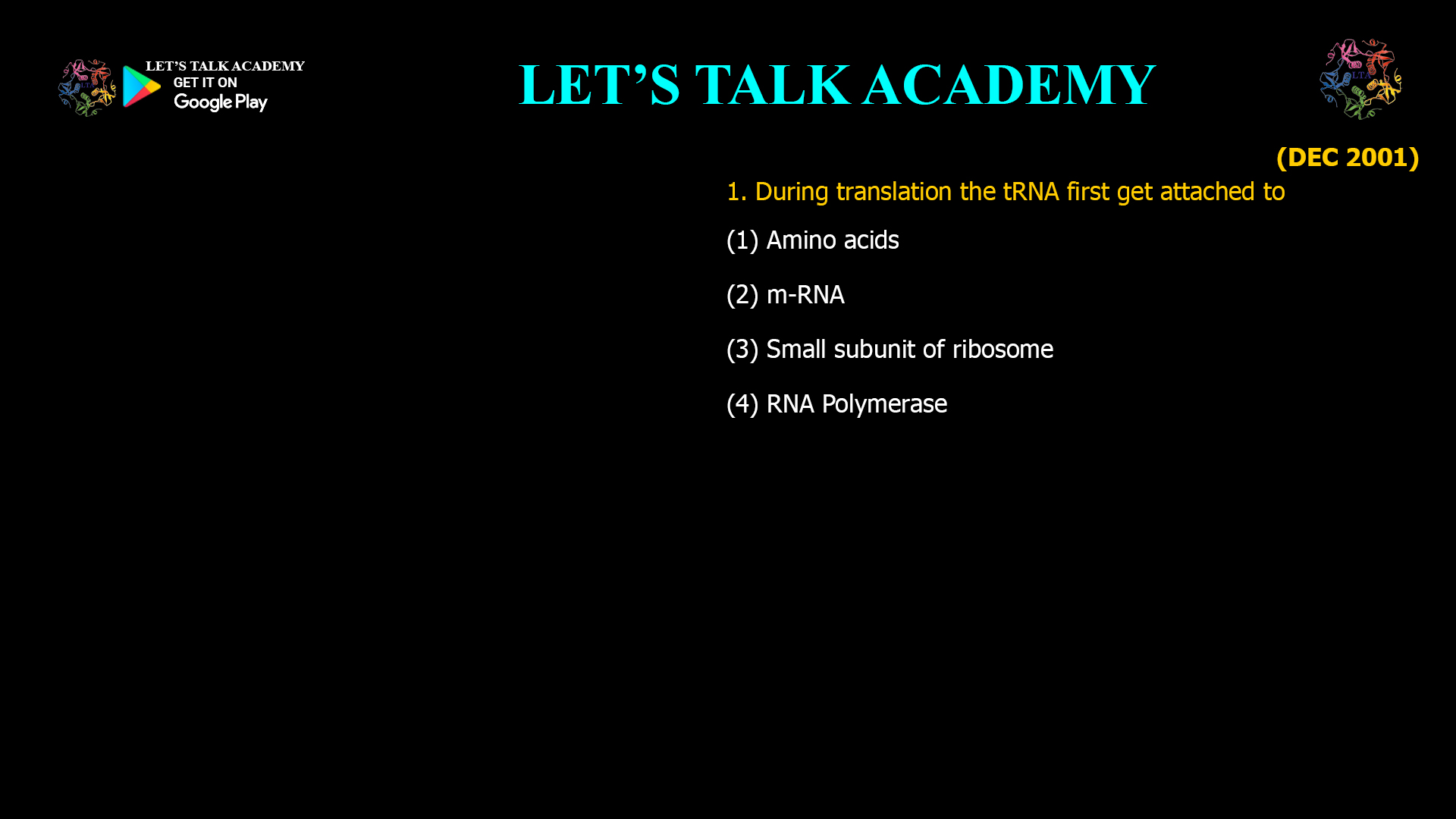
During translation the tRNA first get attached to (1) Amino acids (2) m-RNA (3) Small subunit of ribosome (4) RNA Polymerase

During Translation, the tRNA First Gets Attached to Amino Acids

CSIR NET Life Science Previous Year Questions and Solution on Molecular Biology

Understanding the Polar Effect of Nonsense Mutations in Bacterial Operons and the Role of Suppressor tRNAs

The sequence below represents part of the coding strand of the bacterial gene Z. The arrow indicates the transcription start site. |→ 5’TATAATCGCACTCAAAGCCTAAGGAGGATCCGAATGCACGC +1+10 .+20 GGAATCTTTCCGACCACTACTGCATAGCGCCCAGAGCTCGCT AAATCGAGCGTGACATAATCAC……….3’ The following statements […]
Latest Courses