49. Whichone of the following conditions represents autopolyploidy? (1) More than two sets of chromosomes. both of Which are form the same parental species. (2) More than two sets of chromosomes, both of which are from the different parental species. (3) More than two sets of chromosomes only from a single parent (4) Duplication Of a chromosomal locus leading to spontaneous increase in the copy number ofa gene.

What condition best defines autopolyploidy in plants?

48. Triticumaestivum is an example of (1) Allopolyploid (2) Autopolyploid (3) Chromosome doubling (4) Auto-allopolyploid

Why Triticum aestivum (bread wheat) is an allopolyploid

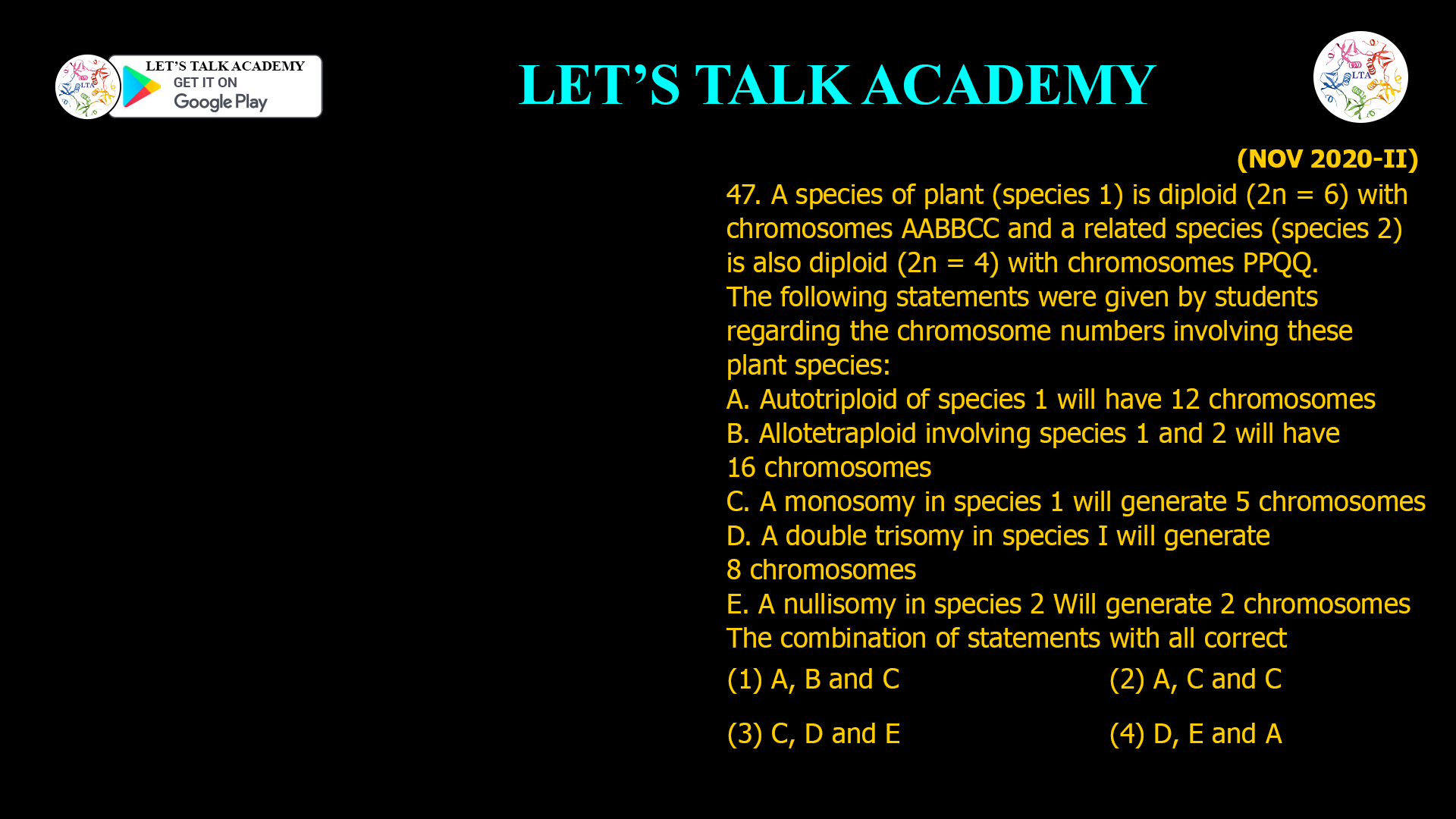
47. A species of plant (species 1) is diploid (2n = 6) with chromosomes AABBCC and a related species (species 2) is also diploid (2n = 4) with chromosomes PPQQ. The following statements were given by students regarding the chromosome numbers involving these plant species: A. Autotrip/oid of species 1 will have 12 chromosomes B. Allotetraploid involving species 1 and 2 will have 16 chromosomes C. A monosomy in species 1 will generate 5 chromosomes D. A double trisomy in species I will generate 8 chromosomes E. A nullisomy in species 2 Will generate 2 Chromosomes The combination of statements with all correct (1) A, B and C (2) A, C and C (3) C, D and E (4) D, E and A

Chromosome number changes in diploid species: autotriploid, allotetraploid, monosomy, double trisomy, and nullisomy

46. Two near inbred parental lines P1 and P2 of an angiosperm species are crossed to produce F1 seeds in which. theplojdv of the endosperm is 6N. If plants generated from these F1 seeds are backcrossed with P1. what be the ploidy of the somatic cells in the next generation ? (1) 2N (2) 4N (3) 5N (4) 6N

How to find sporophytic ploidy from a 6N endosperm and a backcross

45. Autotetraploids arise by the doubling of 2n complement to 4m There are three different pairing possibilities at meiosis in tetraploids as given below: A. Two bivalents B. One quadrivalent C. One univalent + one trivalent Which of the above pairings can lead to production of diploid? (1) only A (2) B and c (3) A and C (4) A and B

Which meiotic pairings in autotetraploids can give diploid (2n) gametes?

44. A colour blind father has a daughter who is also colourblind and has Turner's syndrome. The genotype of the daughter is due to: (1) Translocation event in the father. (2) Translocation event in the mother. (3) Non-disjunction event in the mother. (4) Non-disjunction event in the father.

Why a colour-blind Turner girl from a colour-blind father indicates maternal nondisjunction

43. Red-blue colour blindness is a human X-linked recessive disorder. The two parents with normal colour vision have two sons. Son 1 has 47, XXY chromosome composition and is colour blind. Son 2 has 46. XY and is also colour blind. Assuming that no crossing over took place in prophase I of meiosis, Klinefelter syndrome in Son 1 resulted due to nondisjunction during which one of the following events? (1) Female gamete formation in meiosis I (2) Female gamete formation in meiosis II (3) Male gamete formation in meiosis I (4) Male gamete formation in meiosis II

Origin of XXY colour‑blind son from normal parents without crossing over

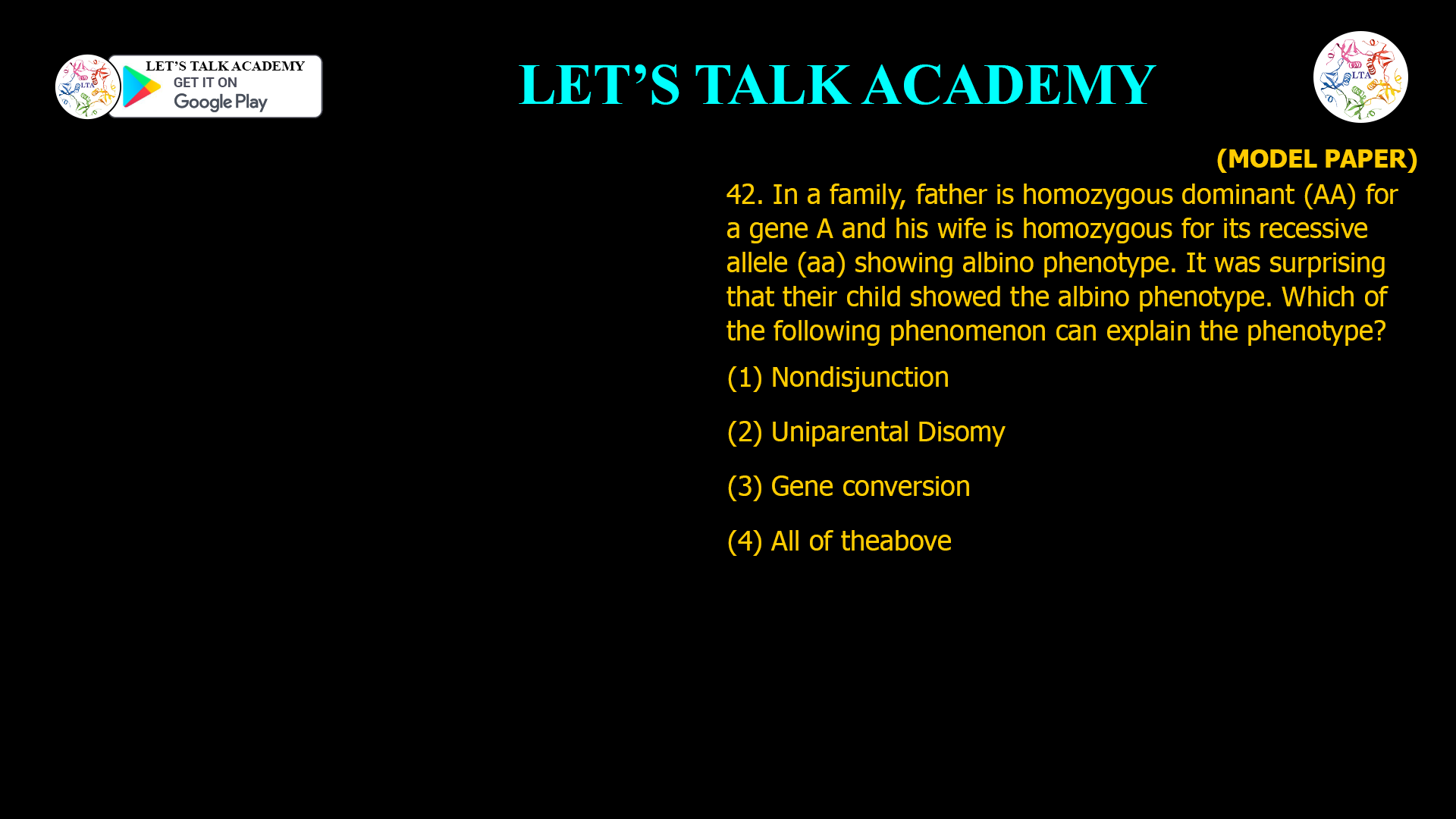
42. In a family, father is homozygous dominant (AA) for a gene A and his wife is homozygous for its recessive allele (aa) showing albino phenotype. It was surprising that their child showed the albino phenotype. Which of the following phenomenon can explain the phenotype? (1) Nondisjunction (2) Uniparental Disomy (3) Gene conversion (4) All of theabove

How can an AA × aa cross produce an albino (aa) child?

41. The PAGE profile of certain marker associated with X chromosome was investigated for Klinefelter syndrome and results are shown below, it suggest that the non- disjunction of chromosome occurred in (1) Maternal Meiosis-I (2) Paternal Meiosis-I (3) Paternal Meiosis-II (4) Maternal Meiosis-II

Determining the stage of nondisjunction in Klinefelter syndrome using X‑linked marker profiles

40. Aneuploid females with only one X chromosome is a characteristic of individuals with (1) Cri du chat syndrome (2) Klinefelter syndrome (3) Down syndrome. (4) Turner syndrome.

Which syndrome shows aneuploid females with only one X chromosome?

39. Turner syndrome results from (1) Monosomy of sex-chromosome. (2) monosomy of autosome. (3) nullisomy of sex-chromosome. (4) trisomy Of autosome.

Turner syndrome and its chromosomal basis

38. If a gamete produced following non disjunction of a chromosome at second meiotic division was fertilized by a normal gamete, what is the expected frequency of trisomic progeny? (1) 1/4 (2) 2/4 (3) 3/4 (4) 1

Why two aneuploid and two normal haploid gametes arise from one meiosis

37. A cell undergoing meiosis produces four daughter cells, two of which are aneuploids, while two are haploid. This can occur due to: (1) Non-disjunction during first meiotic division only (2) Non-disjunctin during second meiotic division only (3) Non-disjunction during either first or second meiotic divisions (4) Non-disjunction during both first and second meiotic divisions

Why some meioses give two normal haploid and two aneuploid gametes

36. What kind of aneuploid gametes will be generated if meiotic non-disjunction occurs at first division? (‘n’ represents the haploid number of chromosomes) (1) onlyn + 1 and n (2) only n - 1 and n (3) bothn + 1 and n - 1 (4) either n + 1 or n – 1

Gamete types produced when nondisjunction occurs in meiosis I

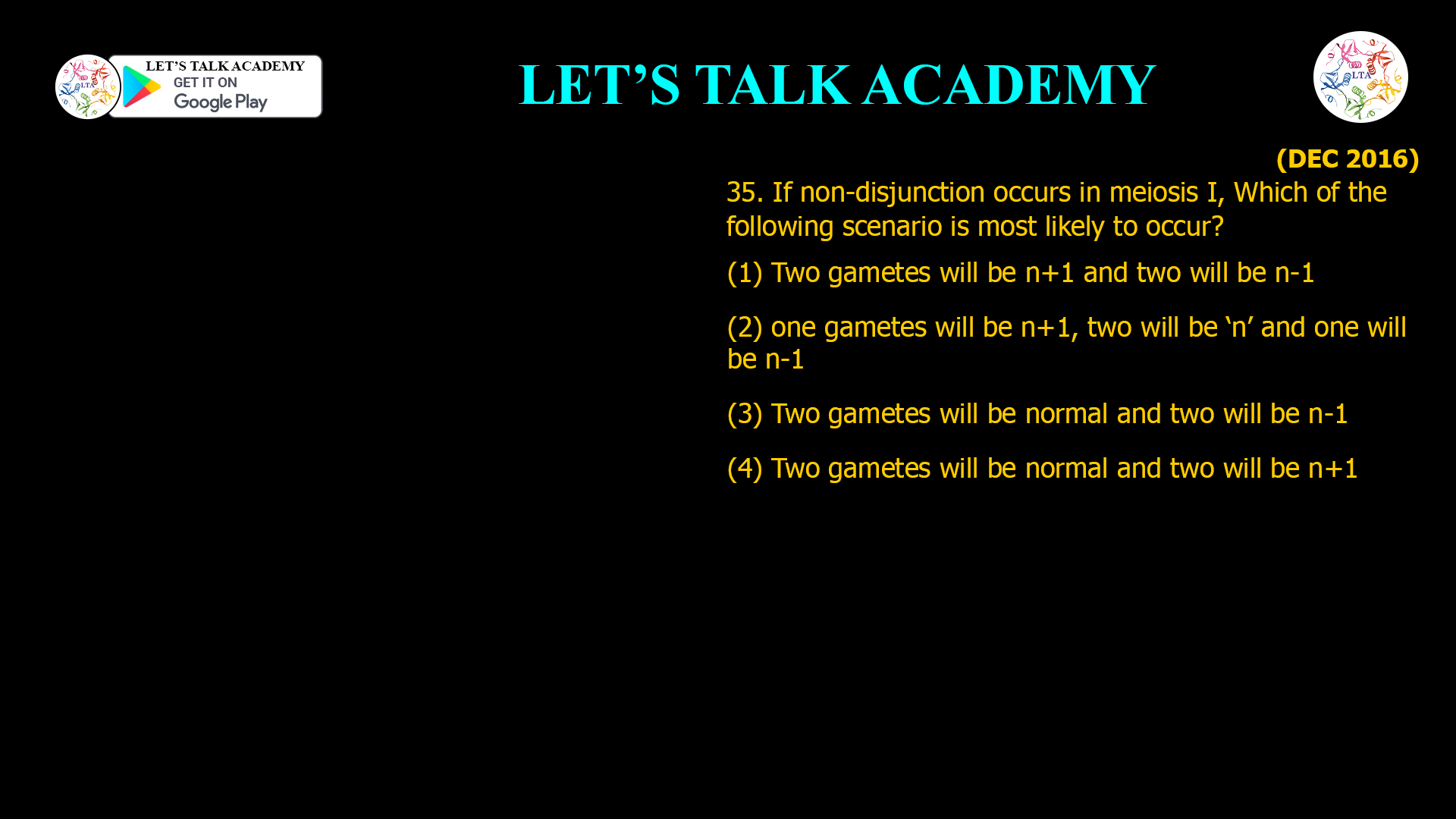
35. If non-disjunction occurs in meiosis I, Which of the following scenario is most likely to occur? (1) Two gametes will be n+1 and two will be n-1 (2) one gametes will be n+1, two will be ‘n’ and one will be n-1 (3) Two gametes will be normal and two will be n-1 (4) Two gametes will be normal and two will be n+1

Gamete types produced when nondisjunction occurs in meiosis I

34. Meiosis produces n, n+l and n-1 gametes. The probable reason is? (1) Non-disjunction during metaphase I (2) Non-disjunction during metaphase-II (3) Non-disjunction during metaphase I and II (4) Non-disjunction during Anaphase I and II

Why meiosis can produce n, n+1 and n–1 gametes

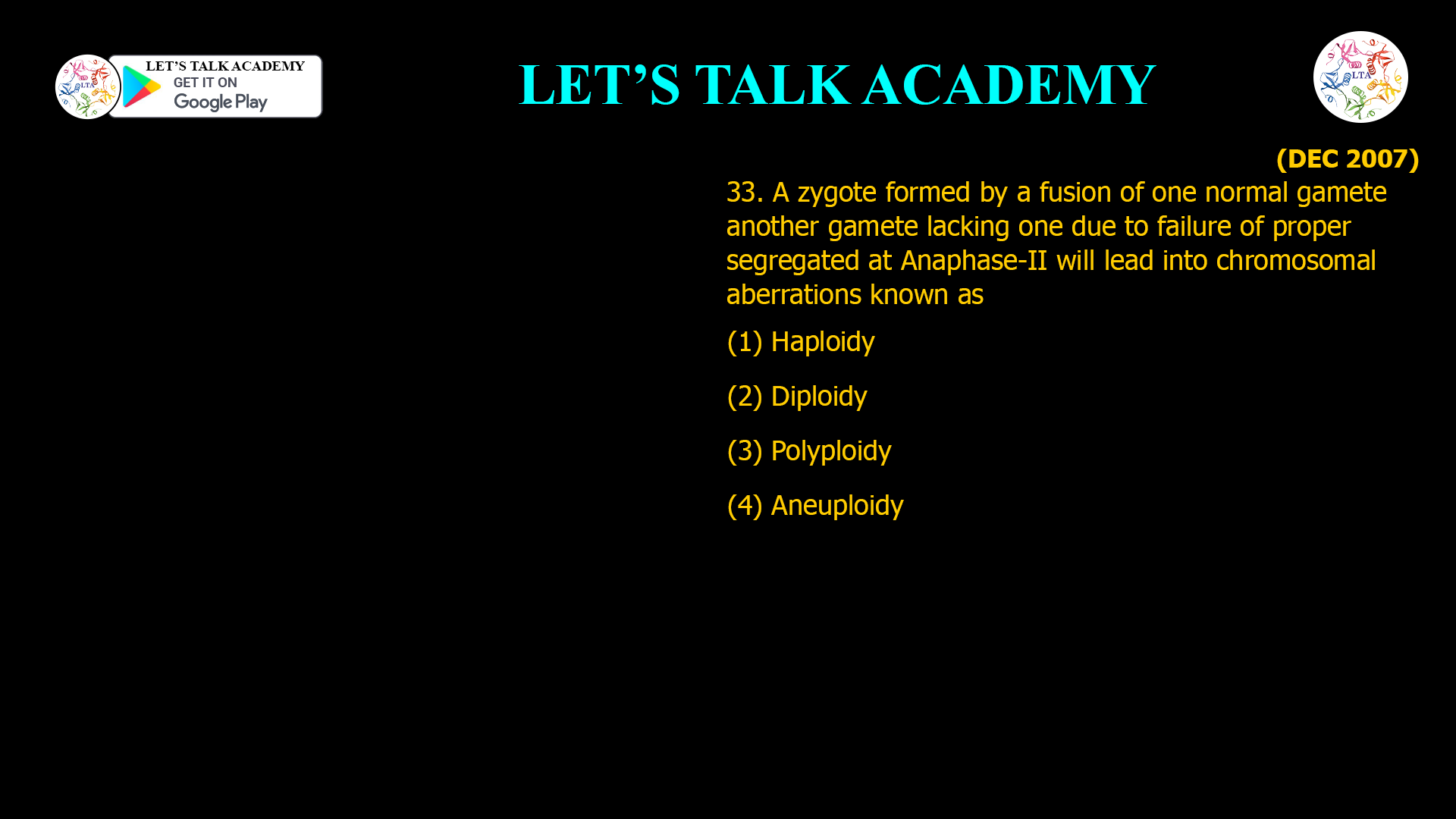
33. A zygote formed by a fusion of one normal gamete another gamete lacking one due to failure of proper segregated at Anaphase-II will lead into chromosomal aberrations known as (1) Haploidy (2) Diploidy (3) Polyploidy (4) Aneuploidy

Why fusion of a normal gamete with a gamete lacking one chromosome causes aneuploidy

32. In human males, autosomal and sex trisomy mains occurs due to- (1) Error in meiosis (2) Non-disjunction of chromosome (3) Dominant Y chromosome (4) Faulty Repair mechanism

Cause of autosomal and sex chromosome trisomy in human males

31. A female with 47 chromosomes have normal phenotype. Her chromosome complements will be- (1) 44 + XXY (2) 44 + XXX (3) 45 + xx (4) 44+ XYY

Karyotype of a phenotypically normal female with 47 chromosomes

30 Whith of the following statements are true Robertsonian translocations? A. The size of the non-homologous chromosome involved in translocation will differ. B. Genes on the chromosome involved in translocation will show linkage with genes which it normal independently assorts. C. There will be change in the physical map, but no change in the genetic map. D. It can be identified by G-banding chromosomes. E. It can be identified by C-banding chromosomes. F. It can lead to Down syndrome Which one of the following combination is correct? (1) A, C and D (2) A, D and F (3) A. B. D and F (4) A, C. E and F

Key features of Robertsonian translocations and how they are detected

29. During meiosis if one of the chromosome lack its homologous partner while all other chromosome are paired, such aberration is termed as (1) Haploidy (2) Monosomic (3) Trisomy (4) Nullisomy

Which chromosomal condition shows one unpaired chromosome during meiosis?

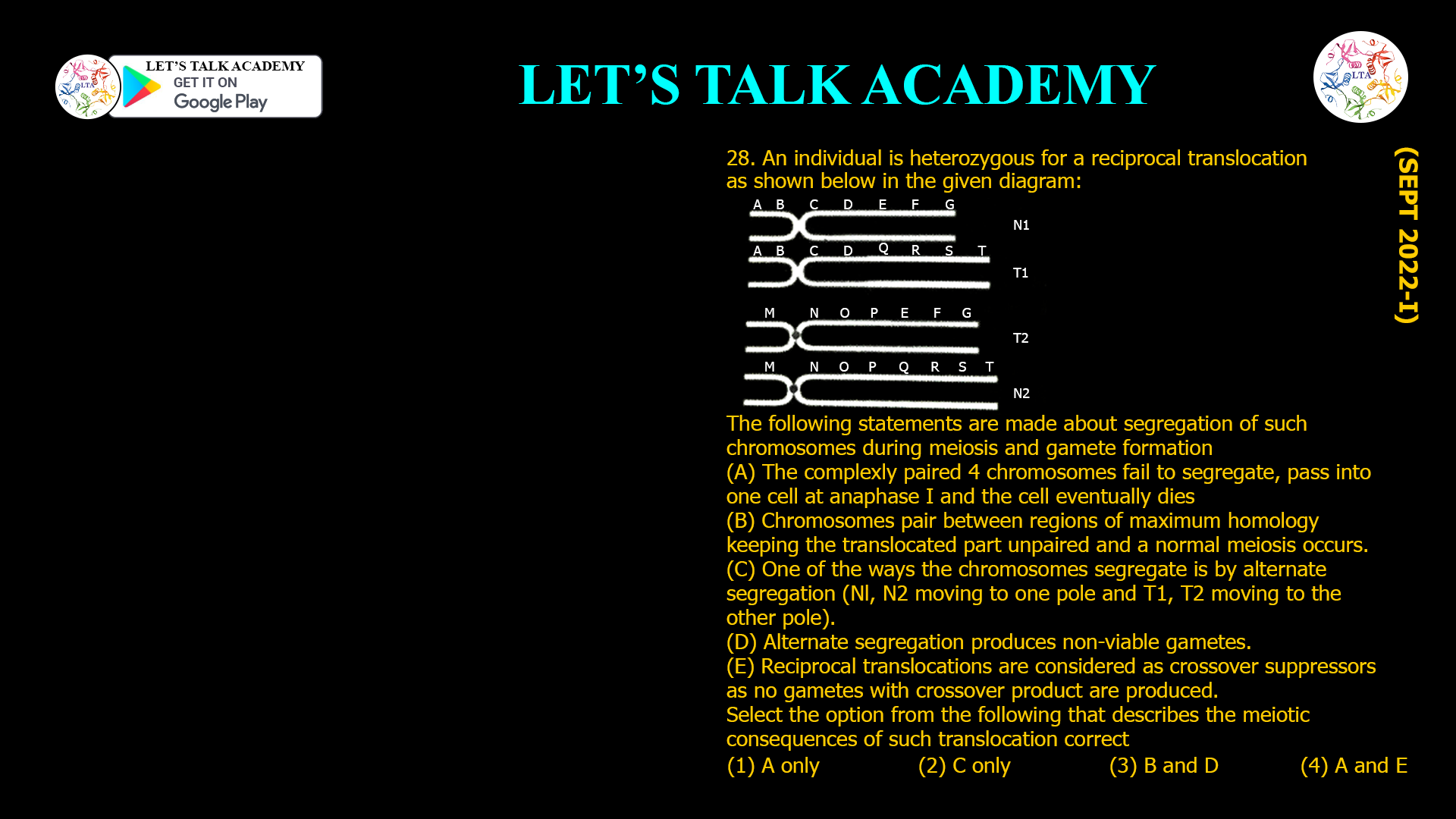
28. An individual is heterozygous for a reciprocal translocation as shown below in the given diagram: The following statements are made about segregation of such chromosomes during meiosis and gamete formation (A) The complexly paired 4 chromosomes fail to segregate, pass into one cell at anaphase I and the cell eventually dies (B) Chromosomes pair between regions of maximum homology keeping the translocated part unpaired and a normal meiosis occurs. (C) One of the ways the chromosomes segregate is by alternate segregation (Nl, N2 moving to one pole and T1, T2 moving to the other pole). (D) Alternate segregation produces non-viable gametes. (E) Reciprocal translocations are considered as crossover suppressors as no gametes with crossover product are produced. Select the option from the following that describes the meiotic consequences of such translocation correct (1) A only (2) C only (3) B and D (4) A and E

Meiotic consequences of a reciprocal translocation heterozygote (alternate vs other segregations)

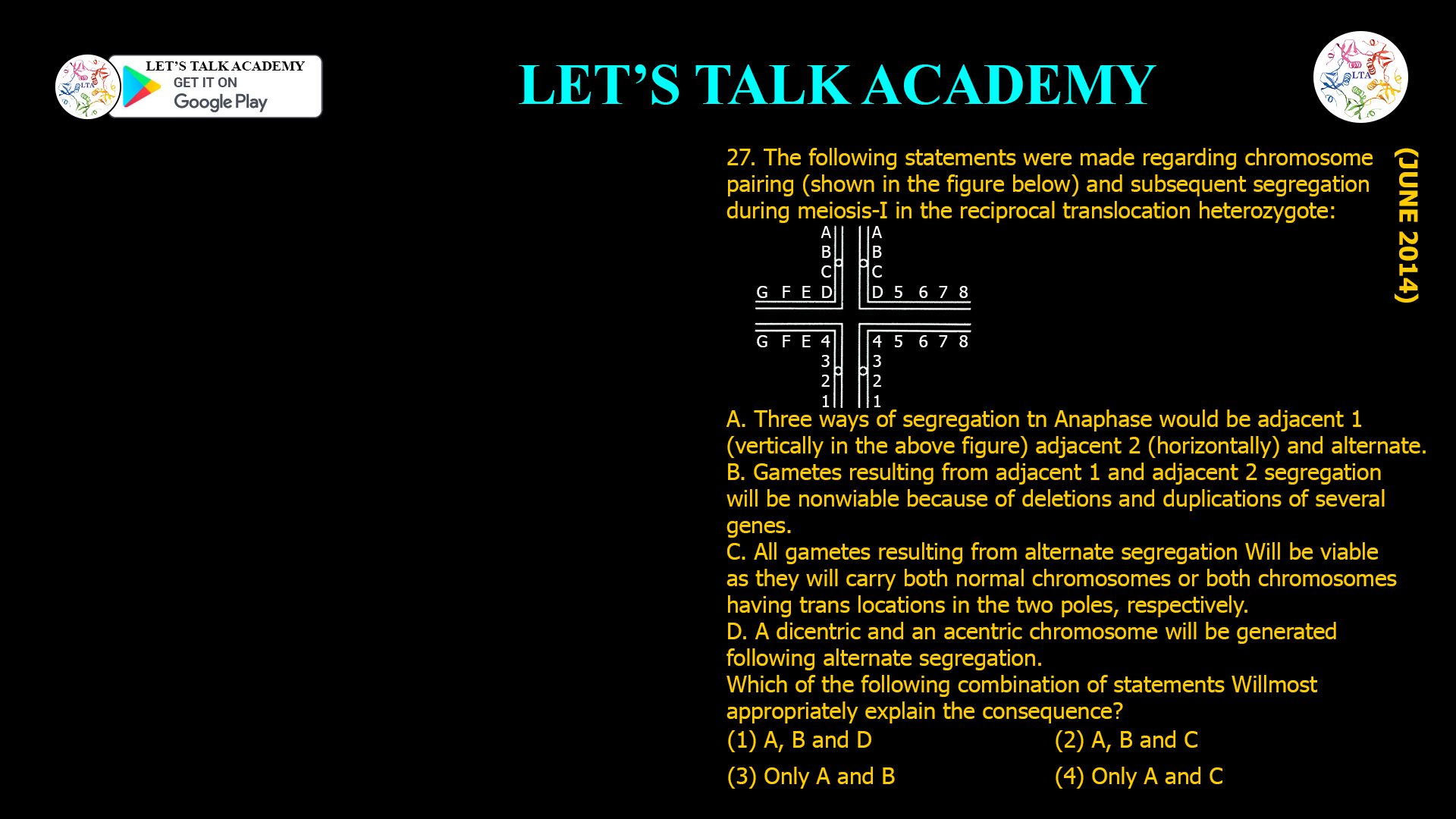
27. The following statements were made regarding chromosome pairing (shown in the figure below) and subsequent segregation during meiosis-I in the reciprocal translocation heterozygote: A. Three ways of segregation tn Anaphase would be adjacent 1 (vertically in the above figure) adjacent 2 (horizontally) and alternate. B. Gametes resulting from adjacent 1 and adjacent 2 segregation will be nonwiable because of deletions and duplications of several genes. C. All gametes resulting from alternate segregation Will be viable as they wilt carry both normal chromosomes or both chromosomes having trans locations in the two poles, respectively. D. A dicentric and an acentric chromosome will be generated following alternate segregation. Which of the following combination of statements Willmost appropriately explain the consequence? (1) A, B and D (2) A, B and C (3) Only A and B (4) Only A and C

Segregation patterns in a reciprocal translocation heterozygote quadrivalent

26. A reciprocal translocation heterozygote at the end of meiosis I generate (1) An acentric and a dicentric chromosome (2) Viable gametes with deletions and duplications (3) Viable gametes with only parental type chromosomes (4) All non-viable gametes

Meiotic outcome of a reciprocal translocation heterozygote

25. A normal man was found to have 45 chromosomes (44+X), the probable reason is- (1) Deletion (2) Translocation (3) Ecentric Fission (4) Point Mutation

Why can a normal man have 45 chromosomes (44 + X)?

24. In humans, XX males and XY females are rare, such rare sexes are due to (1) Deletion of X chromosome (2) Deletion of Y chromosome (3) XY translocation (4) Duplication of X chromosomes

Why rare XX males and XY females arise in humans

23. If both translocated arms in single translocation heterozygote moves to one pole, then segregation is called (1) Alternate (2) Adjacent (3) Linear (4) Uniform

Alternate segregation in a translocation heterozygote

22. In Burkitt’sLymphoma a reciprocal translocation between chromosome 8 and 14 is observed. If an individual is heterozygous for this translocation, the consequence in meiosis Will be as follows: A. Fourchromosomes, i.e., normal chromosome 8 and 14, and translocated chromosome 8 and 14. Pair together B. The two normal chromosomes 8 and 14, and-two translocated chromosomes pair separately C. All gametes produced from this meiosis are non- viable as they have deletions and duplications D. In one of the cross configurations called "alternate all gametes having normal or segregation" translocated chromosomes, survive E. The gametes having normal chromosomes only survive while all gametes having translocated chromosomes hence the non-viable, are translocations are used as crossover suppressors Which of the following combinations best describes the meiotic consequences for the translocation described above? (1) B and E (2) B, C and E (3) A, C and E (4) A and D

Meiotic consequences of reciprocal translocation in Burkitt’s lymphoma (t(8;14))

21. A cruciform structure of chromosome during meiosis is a characteristic feature of: (1) Translocation (2) Inversion (3) Deletion (4) Duplication 21. A cruciform structure of chromosome during meiosis is a characteristic feature of: (1) Translocation (2) Inversion (3) Deletion (4) Duplication

Cruciform chromosome structure in meiosis – which aberration causes it?

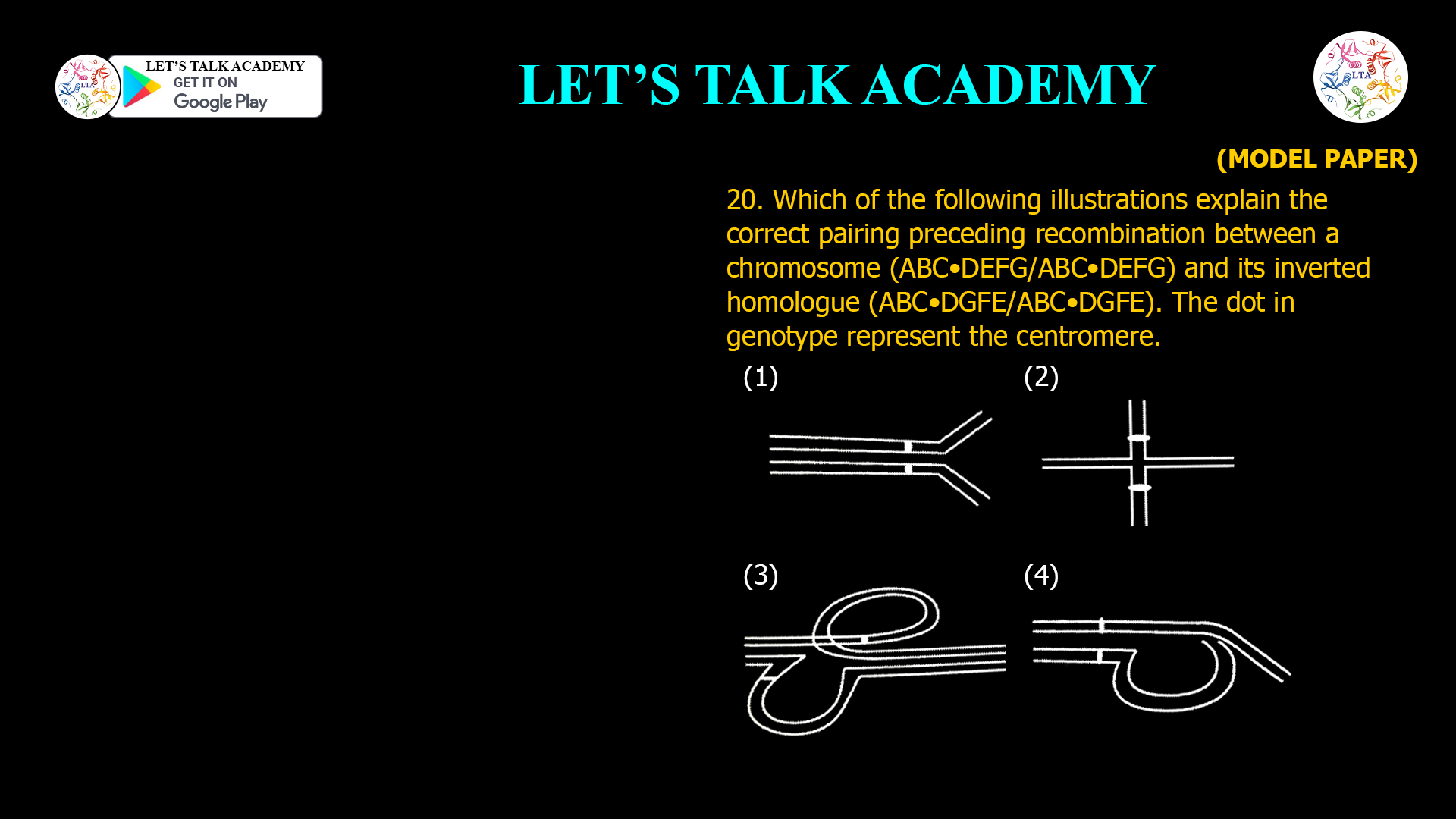
20. Which of the following illustrations explain the correct pairing preceding recombination between a chromosome (ABC•DEFG/ABC•DEFG) and its inverted homologue (ABC•DGFE/ABC•DGFE). The dot in genotype represent the centromere.

Which chromosome aberration changes gene order but not linkage group?

19. A chromosome aberration leads to change in the order of genes in a genetic map but does not alter its linkage group. This is due to (1) translocation. (2) recombination. (3) transposition. (4) inversion.

Which chromosome aberration changes gene order but not linkage group?

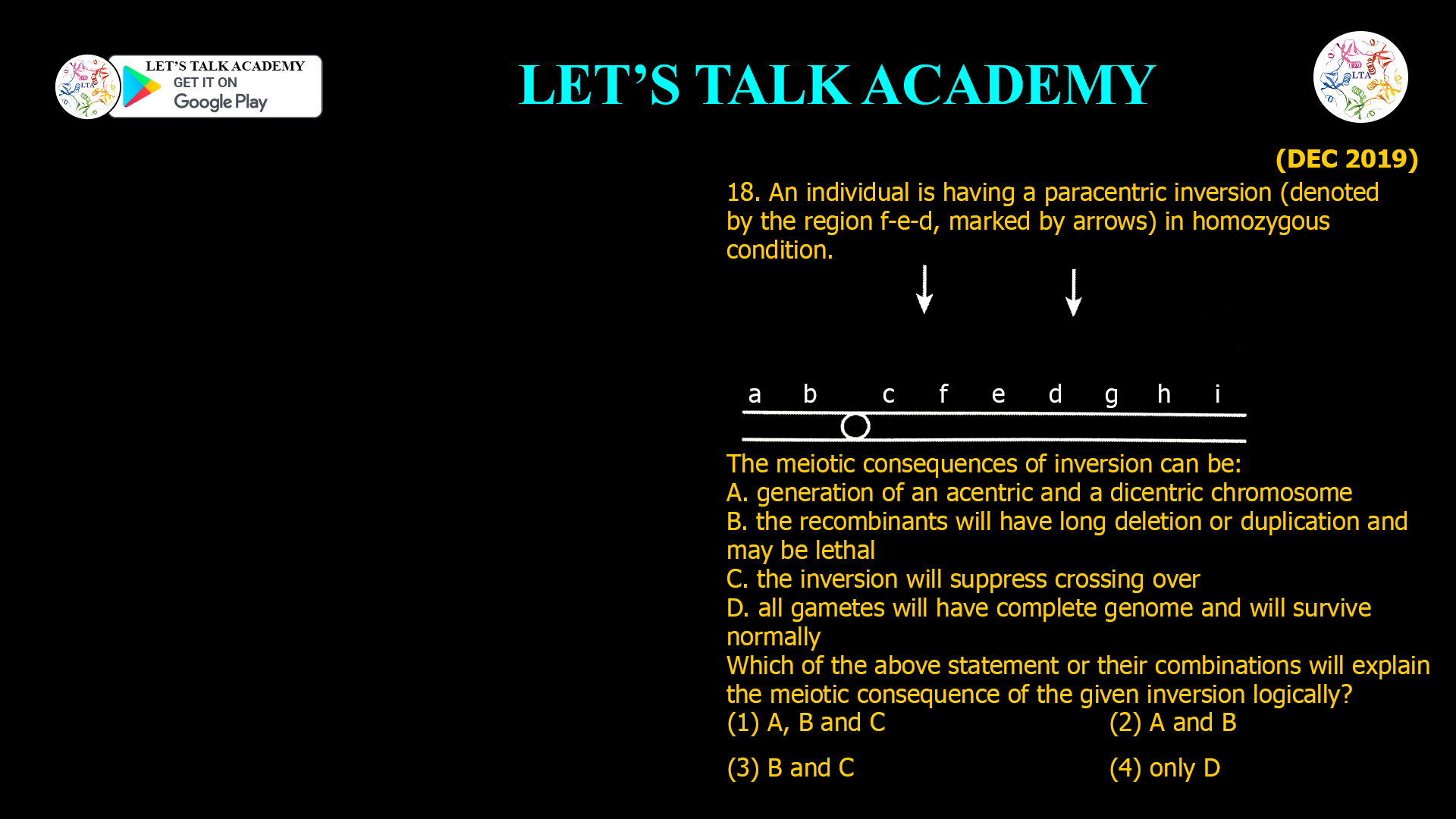
18. An individual is having a paracentricinversion (denoted by the region f-e-d, marked by arrows) in homozygous condition. The meiotic consequences of inversion can be: A. generation of an acentric and a dicentric chromosome B. the recombinants will have long deletion or duplication and may be lethal C. the inversion will suppress crossing over D. all gametes will have complete genome and will survive normally Which of the above statement or their combinations will explain the meiotic consequence of the given inversion logically? (1) A, B and C (2) A and B (3) B and C (4) only D

Meiotic consequences of a homozygous paracentric inversion

17. Fertilization of gametes containing chromosome with duplication or deletion often results in children with disabilities. What is the probability of a couple where the male is karyotypically normal and the female has a pericentric inversion in heterozygous condition producing a child with disabilities if crossing over took place within the pericentric inversion in 26% of meiotic division? In this case consider that fertilization with a gamete containing chromosomes with duplication or deletion will result in disabilities. (1) 26% (2) 13% (3) 25% (4) 50%

Risk of disability from a pericentric inversion heterozygote when crossing over is 26%

16. When gamete formation occurs in individuals heterozygous for an inversion, some of the following possibilities may occur: A. A pericentric inversion heterozygote results in an acentric and a dicentric chromosome at the end of meiosis I B. A paracentric inversion heterozygote also results in an acentric and a dicentric chromosome at the end of meiosis I C. 25% of gametes formed in inversion heterozygoteare non-viable D. Inversion are considered as cross-over suppressors because the gametes having a cross over product do not survive Which combination of the above statements is correct to explain the meiotic consequence in inversion heterozygote? (1) A and D (2) B and C (3) A and B (4) B and D

Meiotic consequences of inversions and why they suppress crossing over

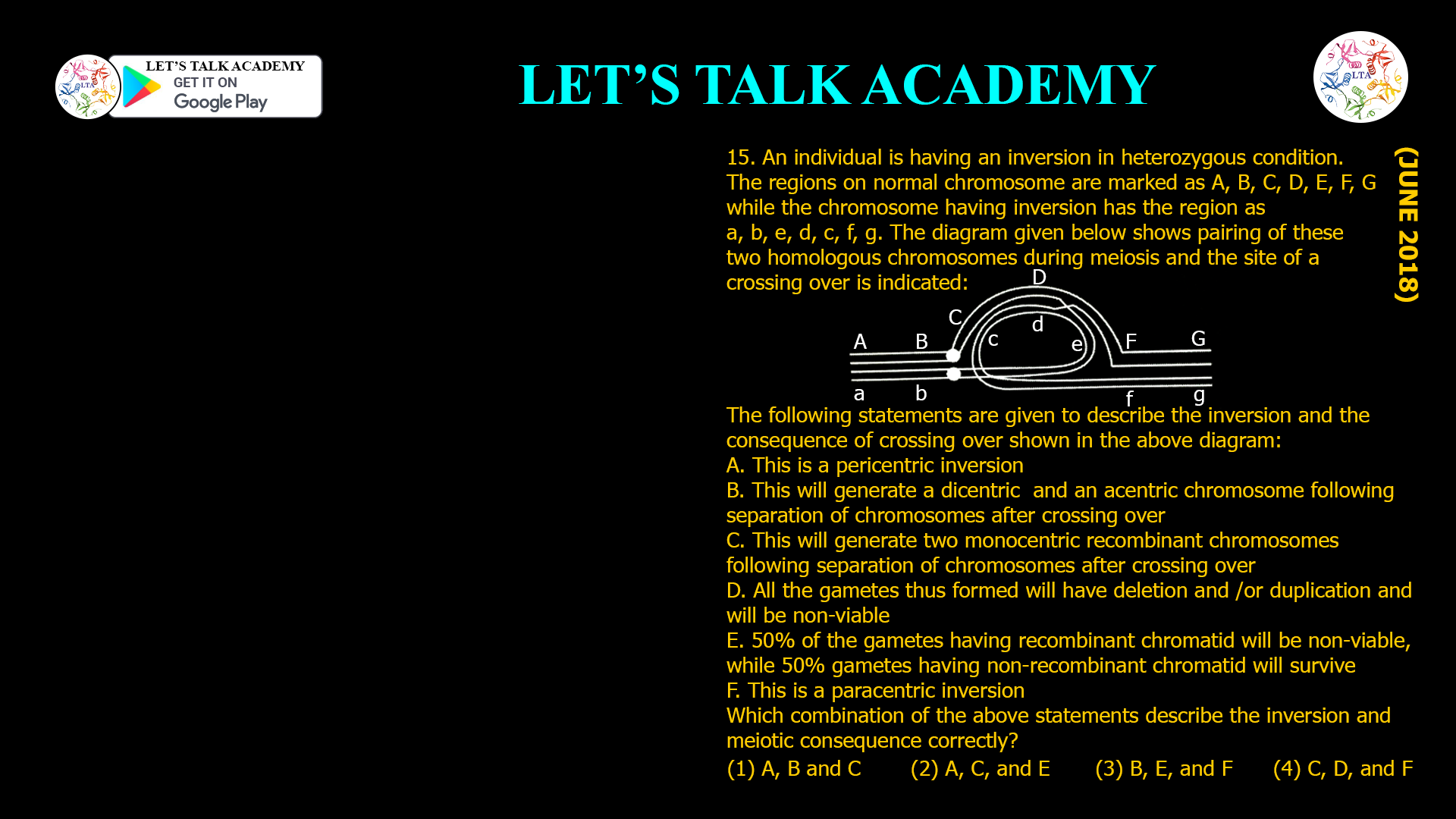
15. An individual is having an inversion in heterozygous condition. The regions on normal chromosome are marked as A, B, C, D, E, F, G while the chromosome having inversion has the region as a, b, e, d, c, f, g. The diagram given below shows pairing of these two homologous chromosomes during meiosis and the site of a crossing over is indicated: The following statements are given to describe the inversion and the consequence of crossing over shown in the above diagram: A. This is a pericentric inversion B. This will generate a dicentric  and an acentric chromosome following separation of chromosomes after crossing over C. This will generate two monocentric recombinant chromosomes following separation of chromosomes after crossing over D. All the gametes thus formed will have deletion and /or duplication and will be non-viable E. 50% of the gametes having recombinant chromatid will be non-viable, while 50% gametes having non-recombinant chromatid will survive F. This is a paracentric inversion Which combination of the above statements describe the inversion and meiotic consequence correctly? (1) A, B and C        (2) A, C, and E (3) B, E, and F       (4) C, D, and F

Paracentric inversion crossover

14. A mechanism that can cause a gene to move from one linkage group to another is (1) crossing over (2) inversion (3) translocation (4) duplication

Which chromosomal change can move a gene to a new linkage group?

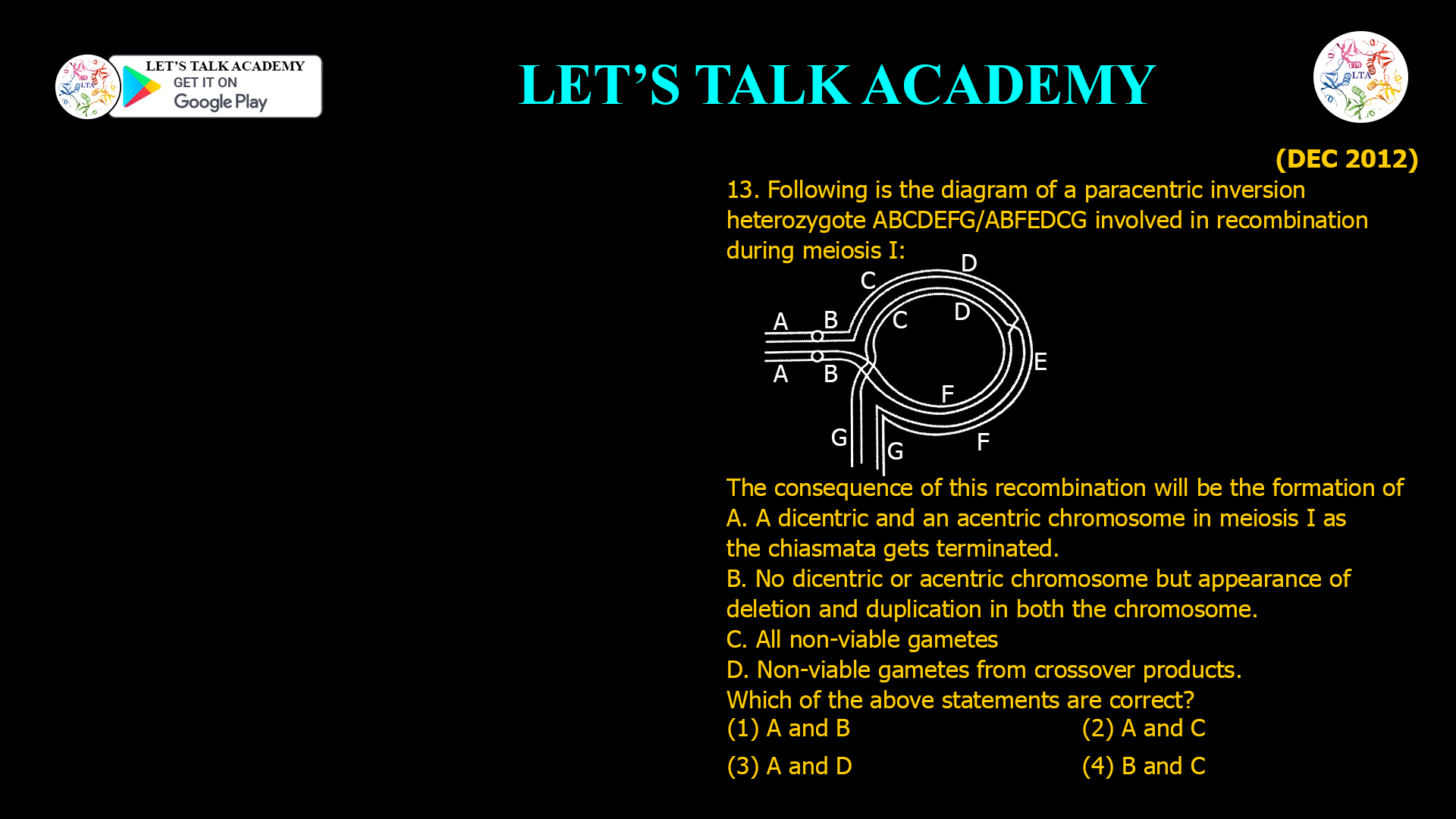
13. Following is the diagram of a paracentric inversion heterozygote ABCDEFG/ABFEDCG involved in recombination during meiosis I: The consequence of this recombination will be the formation of A. A dicentric and an acentric chromosome in meiosis I as the chiasmata gets terminated. B. No dicentric or acentric chromosome but appearance of deletion and duplication in both the chromosome. D. Non-viable gametes from crossover products. Which of the above statements are correct? (1) A and B (2) A and C (3) A and D (4) B and C

Consequences of a single crossover in a paracentric inversion heterozygote

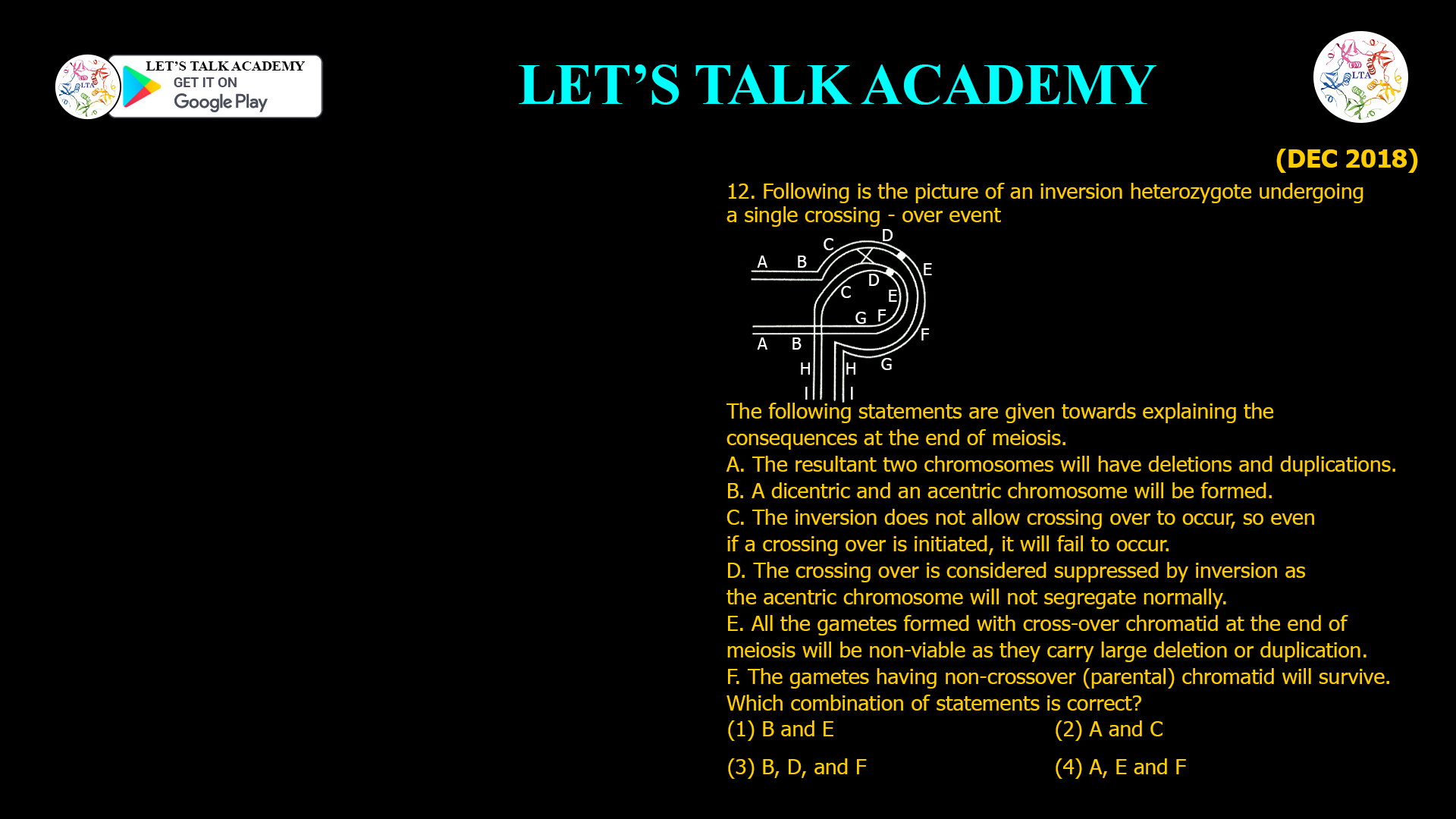
12. Following is the picture of an inversion heterozygote undergoing a single crossing - over event The following statements are given towards explaining the consequences at the end of meiosis. A. The resultant two chromosomes will have deletions and duplications. B. A dicentric and an acentric chromosome will be formed. C. The inversion does not allow crossing over to occur, so even if a crossing over is initiated, it will fail to occur. D. The crossing over is considered suppressed by inversion as the acentric chromosome will not segregate normally. E. All the gametes formed with cross-over chromatid at the end of meiosis will be non-viable as they carry large deletion or duplication. F. The gametes having non-crossover (parental) chromatid will survive. Which combination of statements is correct? (1) B and E (2) A and C (3) B, D, and F (4) A, E and F

Consequences of single crossover in a paracentric inversion heterozygote

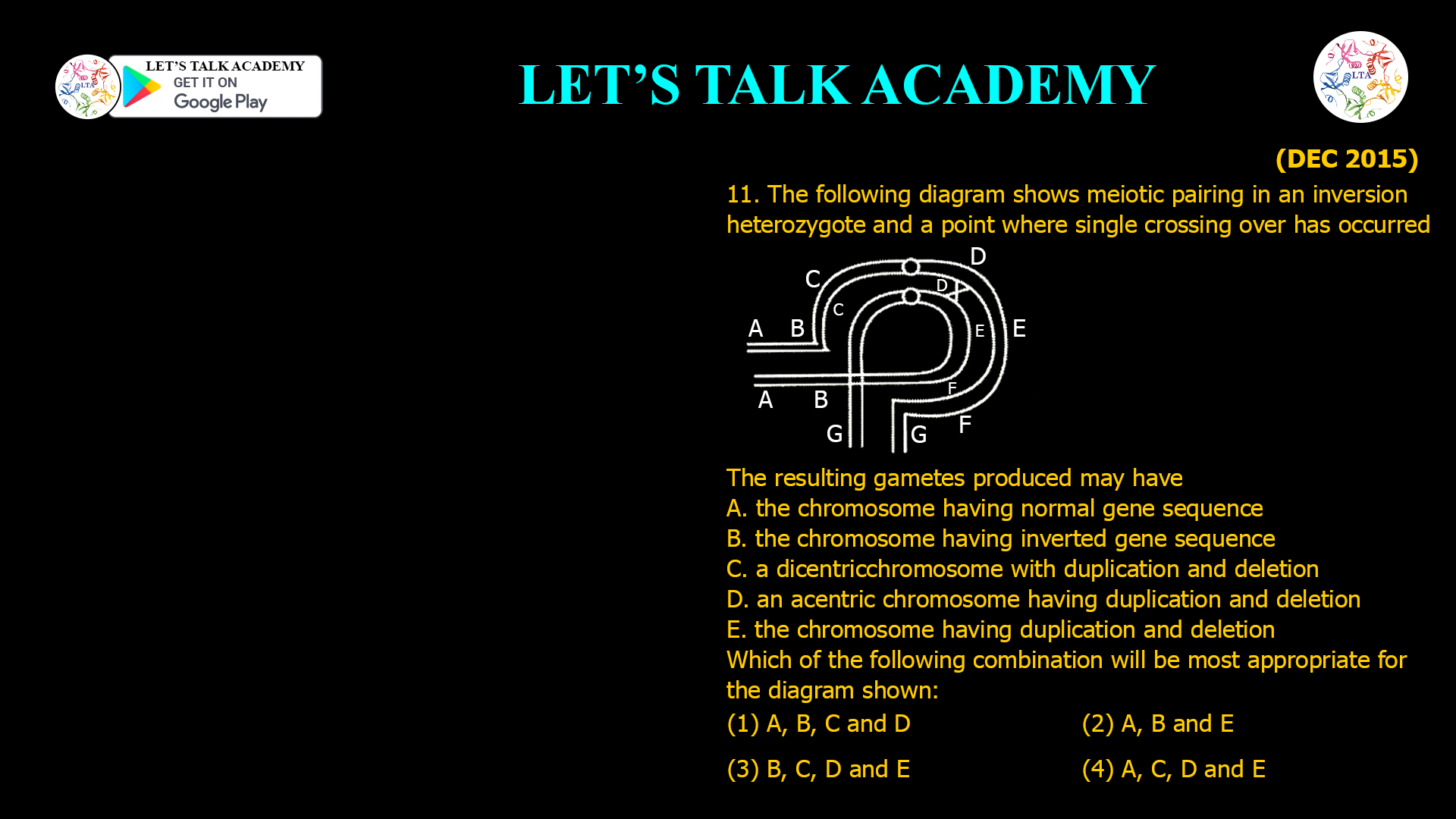
11. The following diagram shows meiotic pairing in an inversion heterozygote and a point where single crossing over has occurred The resulting gametes produced may have A. the chromosome having normal gene sequence B. the chromosome having inverted gene sequence C. a dicentricchromosome with duplication and deletion D. an acentric chromosome having duplication and deletion E. the chromosome having duplication and deletion Which of the following combination will be most appropriate for the diagram shown: (1) A, B, C and D (2) A, B and E (3) B, C, D and E (4) A, C, D and E

Gamete types produced after single crossover in a paracentric inversion loop

10. Inversions are considered as cross-over suppressors because: (1) Homozygous inversions are lethal and thus they do not appear in next generation. (2) Inversion heterozygotes, i.e., one copy having normal chromosome and its homologue having inversion, does not allow crossing over to occur as they cannot pair at all. (3) Due to inversion present. Four chromosomes take part in the pairing and crossing over events and make the structure difficult for separation and gamete formation. (4) The pairing and crossing overs do occur in inversion heterozygotes but the gametes having cross over products are lethal.

Why inversions are called cross‑over suppressors

9. Inversion is termed as crossover suppressor because (1) Single crossing over within an inversion loop, leads to defective (deleted and duplicated) crossoverchromosomes and mortality of zygotes carrying them. (2) No crossing over in the inversion loop (3) Crossing over lead to formation of all acentric chromosomes (4) Segregation of chromosomes in not normal

Why inversions are called crossover suppressors

8. The structural change which leads into crossover suppression and position effect is (1) Deletion (2) Duplication (3) Inversion (4) Translocation

Why inversions cause crossover suppression and position effects

7. What is outcome after single crossover between chromosomes having pericentric inversion and normal? (1) Segmental Deletion and Duplication (2) Bridge formation (3) Ring formation (4) Acentric and dicentric chromosomes

Outcome of crossing over in a pericentric inversion heterozygote

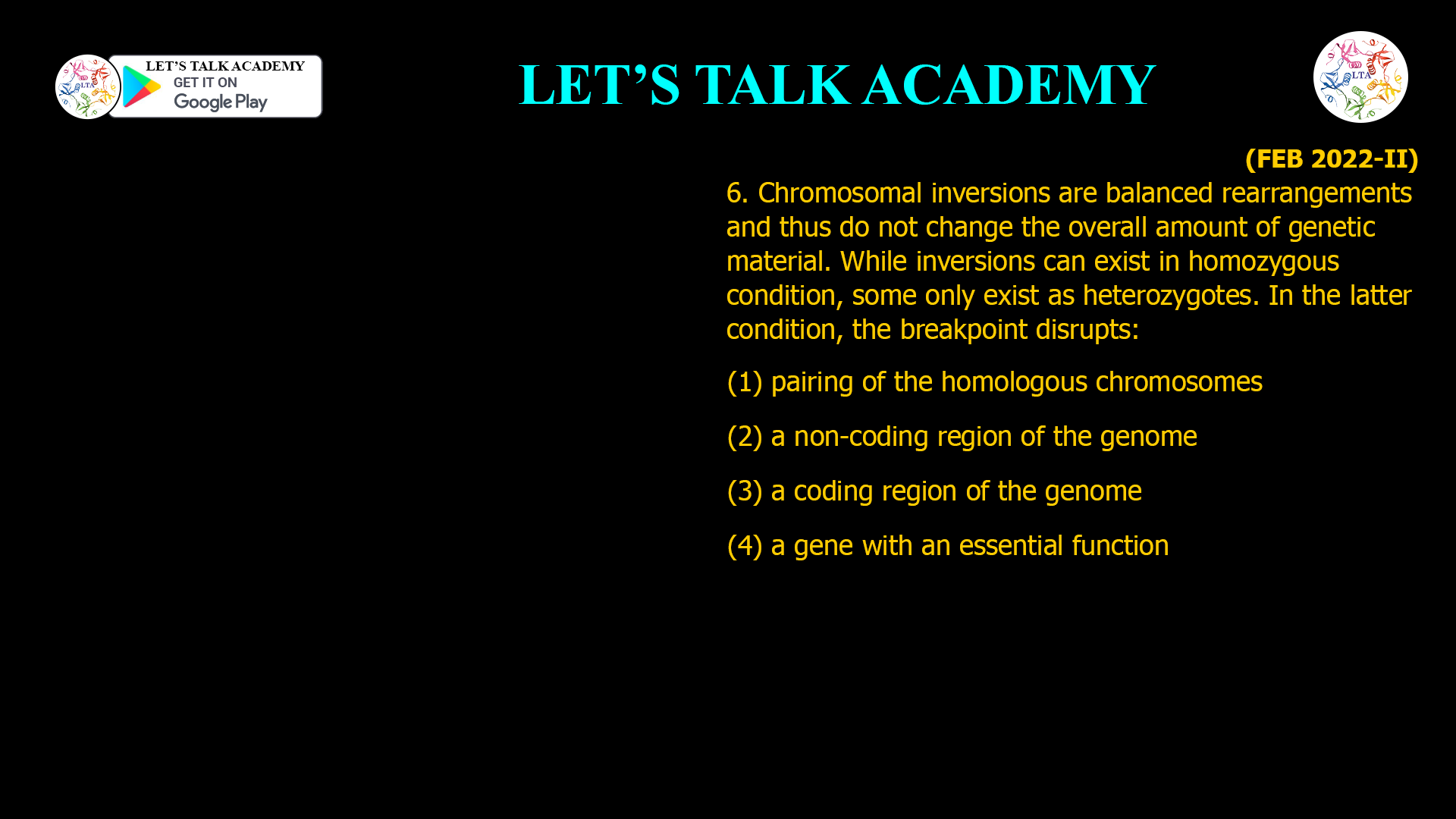
6. Chromosomal inversions are balanced rearrangements and thus do not change the overall amount of genetic material. While inversions can exist in homozygous condition, some only exist as heterozygotes. In the latter condition, the breakpoint disrupts: (1) pairing of the homologous chromosomes (2) a non-coding region of the genome (3) a coding region of the genome (4) a gene with an essential function

Why some chromosomal inversions only survive as heterozygotes

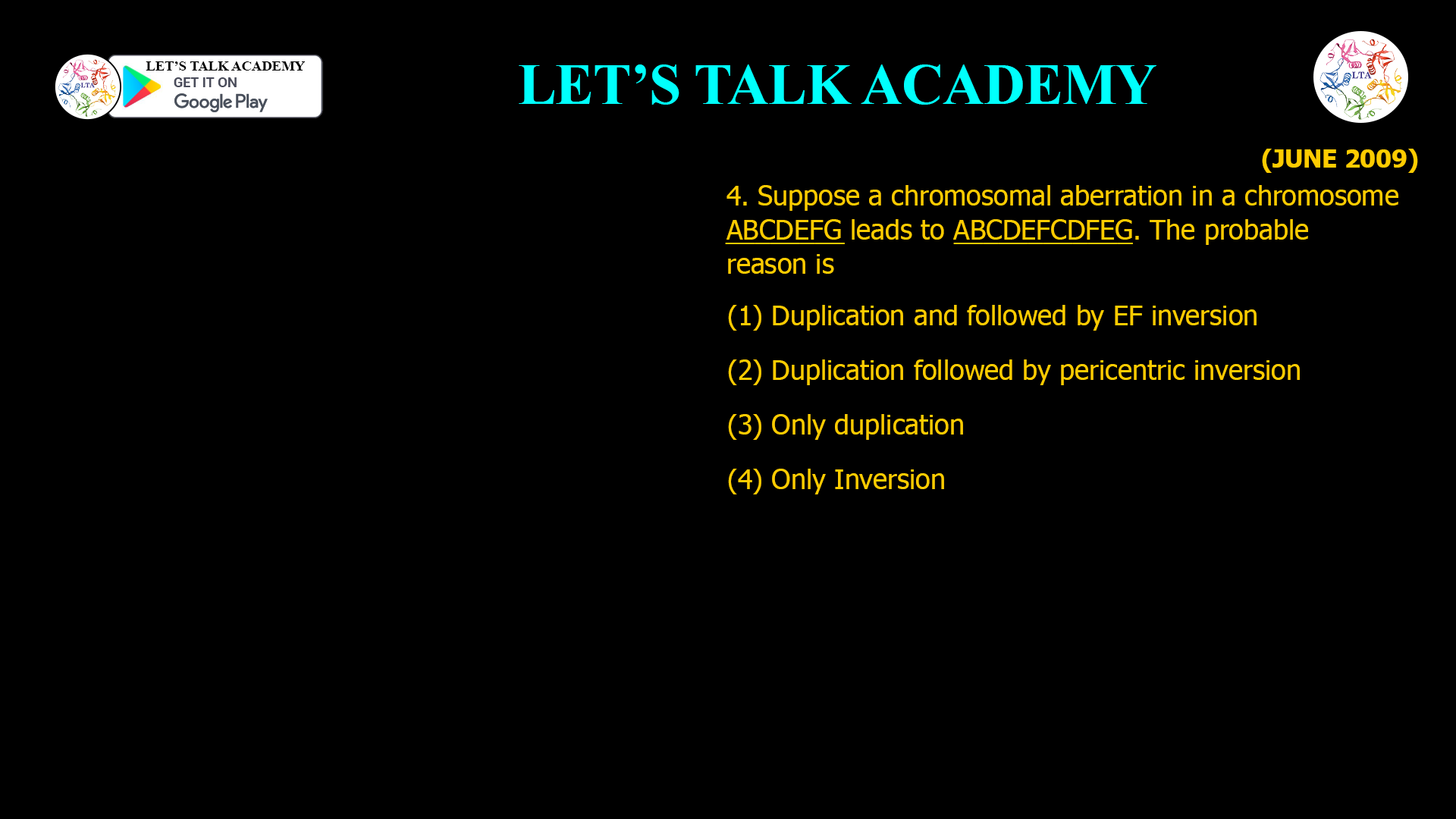
4. Suppose a chromosomal aberration in a chromosome AB.CDEFG leads to AB.CDEFCDFEG. The probable reason is (1) Duplication and followed by EF inversion (2) Duplication followed by pericentric inversion (3) Only duplication (4) Only Inversion

Identifying chromosomal aberration pattern

3. Chromosome aberration characterized by lack of crossing over, pseudo-dominance and non-reversal of mutation occurs in- (1) Inversion (2) Deletion (3) Translocation (4) Duplication

Chromosome aberration showing lack of crossing over, pseudo‑dominance and irreversibility

2. Based on the image given below, select the option that describes it correctly: (1) Q-banded normal human karyotype. (2) G-banded human karyotype depicting aneuploidy. (3) C-banded karyotype depicting Klinefelter syndrome. (4) G-banded normal human karyotype.

Identifying a C‑banded human karyotype showing Klinefelter syndrome

1. Column X and Y of the following table list some treatment methods, reagents, and events that are related to human lymphocyte culture, and banding/ karyotyping of human chromosomes. Which one of the following options represents all correct matches between Column X and Column Y? (1) A-ii; B-v; C-iii; D-i; E-iv (2) A-v; B-iii; C-ii; D-iv; E-i (3) A-iv; B-v; C-i; D-iii; E-ii (4) A-ii; B-v; C-iv; D-i; E-iii

Matching reagents and events with human lymphocyte culture and chromosome banding methods

Latest Courses