Q.20 The value of the integral 0 | cos |x dx   is _____

Definite Integral \(\int_{0}^{\pi}|\cos x|dx\)

Q.19 A circle is given by the equation ݔ2 ଶ ݕ2 ൅ ଶ ൅ 8 ݔെ 20 ݕ൅ 10 ൌ 0. The area of a square whose side equals the radius of the circle is _____

Area of a Square Whose Side Equals the Radius of a Circle

Q.18 A bat emitting ultrasound at 50 kHz is flying directly towards a solid wall with a speed of 3 ms –1 . If the speed of sound in air is 330 ms–1 , the frequency of the reflected signal (in kHz) heard by the bat will be _____

Bat Ultrasound Doppler Effect

Q.17 A nuclear power plant generates 1000 Megawatts (MW) of electrical power and used half of its fuel supply in 5 years. The reactor uses 235 U with 33% efficiency for the conversion of heat released by nuclear fission to electrical power. Each atom of 235 U releases 200 MeV of energy. How many tons of 235 U did the reactor start with? (1 ton = 1000 kg; Avogadro number = 6.023 × 10²³ mol –1 )

How Many Tons of U-235 Does a 1000 MW Nuclear Power Plant Start With?

Q.16 The axis of rotation of the earth makes an angle of 66.5o with the plane containing the Earth’s orbit around the Sun (called the plane of the ecliptic). If this angle were 50o , then the area of the Earth’s surface from which a “midnight Sun” (24 hour daylight) can be observed would change. The ratio of the new area to the previous area is _____

Understanding Earth’s Axial Tilt and Midnight Sun Area Changes

Q.15 The number of equatorial hydrogens in the following structure is _____

Number of Equatorial Hydrogens in Trans‑Decalin

Q.14 Drosophila melanogaster is a diploid organism having 8 chromosomes. The number of combinations of chromosomes which are possible in its gametes is ____

Drosophila melanogaster Gametes Chromosome Combinations

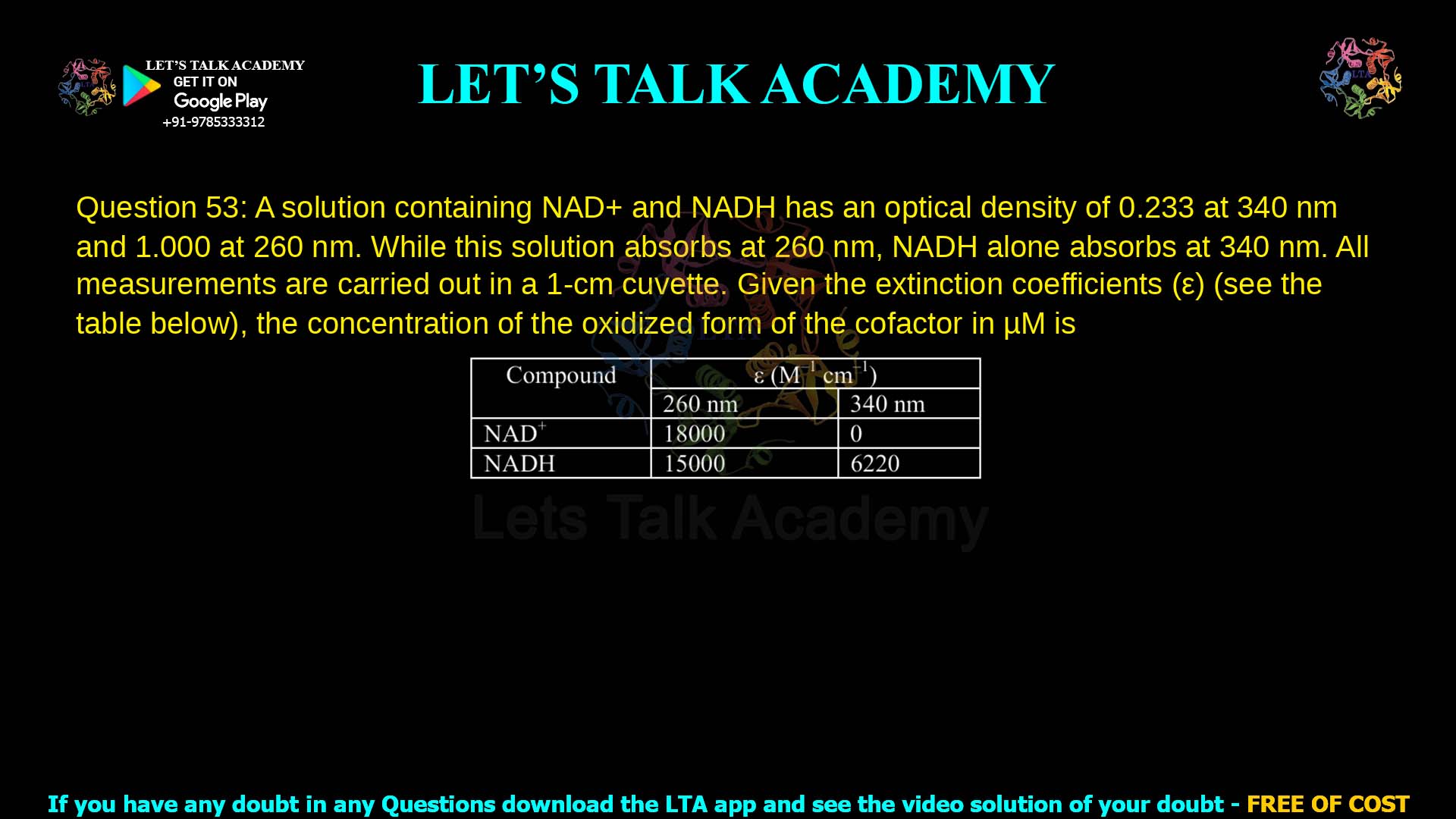
Q.13 A solution containing NAD + and NADH has an optical density of 0.233 at 340 nm and 1.000 at 260 nm. While this solution absorbs at 260 nm, NADH alone absorbs at 340 nm. All measurements are carried out in a 1-cm cuvette. Given the extinction coefficients (ε) (see the table below), the concentration of the oxidized form of the cofactor in μM is ____

Spectrophotometric Calculation of NAD⁺ and NADH Concentrations Using Beer–Lambert Law

Q.12 The pH of gastric juice in the stomach is 2.0. However the pH inside the cells that line the stomach is 7.0. For transport of protons from inside the cell to the stomach, the free energy change (∆G) in kJmol –1 at 37 o C is _____ [Assume Universal Gas constant R = 8.314 Jmol –1 K–1 ]

Free Energy Change for Proton Transport Across Gastric pH Gradient

Q.11 Assume that the gene UNC is essential for the coordinated movement of a nematode and that the wild-type allele U is dominant over the mutant allele u. Similarly, the wild-type allele D of another gene DPY, which is responsible for the normal body length, is dominant over the mutant allele d. Assume the UNC and DPY are on two different chromosomes. If a female of genotype UUDD mates with a male of the genotype uudd, the percentage of the F2 progeny that will display uncoordinated movement but will have normal body length is _____

Nematode UNC DPY Dihybrid Cross F2 Percentage

Q.10 Let the function \( f: \mathbb{R} \to \mathbb{R} \) be defined by \[ f(x) = \begin{cases} \dfrac{\tan x}{x} & \text{if } x \neq 0; \\ kx & \text{if } x = 0. \end{cases} \] If \( f \) is continuous at \( x = 0 \), then the value of \( k \) must be equal to ____

Continuity of Function \(\tan x / x\) at \(x=0\)

Q.9 The value of the complex number (1+i)^150+(1+i)^150 is _____.

De Moivre’s Theorem Solution & Explanation

Q.8 The total number of mappings from the set {1,2} to the set {3, 4,5,6,7} is _____.

Total Number of Mappings from {1,2} to {3,4,5,6,7}

Q.7 A 50-metre tall antenna transmits at 107 MHz (one of the FM radio broadcast frequencies). Calculate the maximum distance from the antenna at which the transmitted signal can be heard. Ignore atmospheric attenuation and give your answer correct to the nearest kilometer only. You are given that the radius of the earth is 6400 km.

Maximum Distance FM Radio Signal 50m Antenna 107 MHz

Q.6 A man weighing 70 kg stands on a weighing scale which is placed in an elevator. The elevator is moving up towards its destination floor with a velocity of 1.0 ms–1 . As it approaches the destination floor it starts slowing down, such that it comes to rest in 2 seconds. Assuming the acceleration due to gravity, g = 9.8 ms–2 , the reading of the weighing scale just before the elevator comes to rest is ____

Elevator Weighing Scale Physics

Q.5 The number of phosphorous-hydrogen bonds in H 3 PO2 is ____

Number of P-H Bonds in H3PO2

Q.4 The number of peaks in the 13 C-NMR spectrum of CDCl3 is ____

Number of Peaks in the 1313C‑NMR Spectrum of CDCl33

Q.3 An enzyme preparation containing 10 mg/ml protein shows a specific activity of 50 U/mg. The initial velocity of reaction in a standard 1 ml reaction mixture containing 10 μl of the preparation in μmol.ml–1 .min –1 is _____

Enzyme Specific Activity Calculation

Q.2 The deactivation rate constant of an enzyme is 0.346 h –1 . Assuming that the deactivation process follows first order kinetics, the half life of the enzyme in minutes is _____

Enzyme Deactivation Rate Constant 0.346 h⁻¹

Q.1 The pH of a 0.1 M solution of monosodium succinate (pKa1 = 4.19 and pKa2 = 5.57) is ____

pH of 0.1 M Monosodium Succinate Solution (pKa1 4.19, pKa2 5.57)

Q.10 Let  be the set of all natural numbers. Consider the relation R on  given by  yis divisible b 2( , ) :R m n m n  . Then (A) R is symmetric and transitive (B) R is symmetric but NOT transitive (C) R is reflexive but NOT symmetric (D) R is reflexive and transitive

Properties of the Relation R = {(m, n)

Q.9 Let 𝐚 and 𝐛 be two non-zero vectors such that |𝐚 + 𝐛|| = |𝐚 - 𝐛||. Then (A) 𝐚 and 𝐛 are parallel to each other (B) 𝐚 and 𝐛 are perpendicular to each other (C) 𝐚 is NOT a scalar multiple of 𝐛 (D) 𝐚 × 𝐛 = 𝟎

Are the Vectors Parallel or Perpendicular?

Q.8 The “strong nuclear force” holds the protons and neutrons (nucleons) together in the nucleus of an atom. It is found that the binding energy per nucleon (for the nucleus of an element) when plotted against the mass number (A) of that element changes very little for 30 < A < 150. The binding energy is lower for A > 150. This leads us to conclude that (A) the strong nuclear force must oscillate with distance with a periodicity approximately same as the size of a proton or neutron (B) the fusion of two elements, both with A > 150 may release energy (C) the strong nuclear force changes very slowly with distance (i.e. It is long ranged on the scale of the size of nucleus) (D) the strong nuclear force goes to zero very rapidly with distance (i.e. It is short ranged on the scale of the size of nucleus)

Binding Energy Per Nucleon Curve and Strong Nuclear Force Range Explained

Q.7 Among the following pairs of co-ordination compounds, the pair(s) which represent(s) a case of “ionization isomerism” is (are): (A) [Pt(en) 2 Cl 2 ]Br 2 and [Pt(en)2 Br 2 ]Cl 2 (B) [Cr(NH3 ) 4 ClBr]NO2 and [Cr(NH3 ) 4 ClNO2 ]Br (C) [Co(NH 3 ) 6 ][Cr(CN)6 ] and [Cr(NH3 ) 6 ][Co(CN) 6 ] (D) [Co(NH 3 ) 5 Br]SO4 and [Co(NH3 ) 5 SO4 ]Br

 Ionization Isomerism Coordination Compounds

Q.6 Among the following compounds, which of these will show two singlets in their 1 H-NMR spectrum? (A) 1,4-Dichlorobenzene (B) 1,2-Dichlorobenzene (C) Dimethoxymethane (D) Methylacetate

Which Compound Shows Two Singlets in 1H NMR Spectrum?

Q.5 The superoxide ion, O2– , is produced by the reaction K+O 2→KO2 . The correct statement(s) pertaining to oxygen and superoxide ion is (are): (A) oxygen is paramagnetic and has two unpaired electrons (B) the bond order in oxygen is 2 (C) the bond order in superoxide is 1.5 (D) the superoxide ion is not paramagnetic

Superoxide Ion O₂⁻ in KO₂

Q.4 Which of the following statements about antigen-antibody (Ag-Ab) complexes is (are) TRUE? (A) Hydrogen bonds and van der Waals forces participate in Ag-Ab interactions (B) Ionic bonds and hydrophobic bonds participate in Ag-Ab interactions (C) The combined strengths of all interactions between a single antigen binding site on an antibody and a single epitope is called avidity (D) Antibody elicited by one antigen can cross react with an unrelated antigen

Antigen-Antibody Complexes

Q.3 N and N0 represent the number of viable cells at time ‘t’ during sterilization and at the start of sterilization (t=0), respectively. Assuming that cell death follows first order kinetics and that k is the death rate constant, which of the following relationship(s) is/are correct? (A) N = N0 ekt (B) െln (N/N0 ) = k t (C) N = N0 k t 2 (D) N – N0 = k t

First Order Kinetics Cell Death Sterilization

Q.2 What is (are) the difference(s) between microtubules and microfilaments? (A) Microtubules are made up of tubulin and microfilaments are made up of intermediate filaments (B) Microtubules are important for compression resistance and microfilaments bear tension (C) Microtubules are important for the functions of cilia and flagella and the microfilaments are important for cytoplasmic streaming (D) Microtubules – muscle contraction; microfilaments – ciliary movement

Microtubules vs Microfilaments

Q.1 In a large wild flower population, assume that no new mutations occur and that no natural selection operates. What factor(s) will affect the frequency of a genotype in this population? (A) Non-random mating (B) Gene flow (C) Out-breeding within the population (D) Invasion of a new pathogen that kills a large number of individuals in the population

Factors Affecting Genotype Frequency in Wild Flower Population

Q.30 If ܣ and ܤ are two skew-symmetric matrices, the matrix ܣܣܤ ൅ ܤ must be (A) skew-symmetric (B) symmetric (C) invertible (D) NOT invertible

Skew-Symmetric Matrices AB + BA Symmetric Property

Q.29 The lengths of two sides of a triangle are 2 units and 3 units and the angle included by these two sides is 60 . The length of the third side of the triangle will be (A) √5 units (B) √7 units (C) 4 units (D) 5 units

Triangle Problem: Find the Third Side When Two Sides Are 2 and 3 Units and Included Angle Is 60°

Q.28 Let n C r n C r denote the number n ! r ! ( n − r ) ! r!(n−r)! n! . Then for n = 100 n=100, the sum of the series 1 − n C 1 + n C 2 − n C 3 + ⋯ + ( − 1 ) r n C r + ⋯ + ( − 1 ) n n C n 1− n C 1 + n C 2 − n C 3 +⋯+(−1) r n C r +⋯+(−1) n n C n is (A) 0 (B) 1 (C) 2 (D) 1024

Alternating Binomial Coefficient Series Problem for n=100

Q.27 Three NOT gates are connected in series and the output of the last gate is fed back to the input of the first one as shown in the figure. Each gate has a propagation delay of T d = 1 T d =1 nanosecond, which means that the gate requires 1 nanosecond to change the output after the signal arrives at the input. What is the expected output at point A? (A) Sine wave with a frequency of 666 MHz (B) Square wave with a frequency of 666 MHz (C) Random white noise (D) Square wave with a frequency of 333 MHz

Ring Oscillator MCQ

Q.26 The minimum light intensity that the human eye can perceive is 10 − 10 W m − 2 10 −10 W m −2 . The area of opening of our eye (the pupil) is approximately 0.4 cm 2 0.4 cm 2 . Consider yellow light with wavelength λ = 600 nm λ=600 nm. The number of photons incident on the retina per second at the minimum intensity the eye can respond is ____.

Minimum Light Intensity of Human Eye

Q.25 An archaeological sample (remains of an animal) containing 14 C 14 C isotope of Carbon is found to give 10 beta decays per minute per gram of Carbon. It is known that the natural abundance of 14 C 14 C in organic matter that is in equilibrium with the atmosphere today will give 15 beta decays per minute per gram of Carbon. The half life of 14 C 14 C is known to be 5730 years. The estimated age of the sample (in years) is (A) 3010 (B) 3350 (C) 3500 (D) 3800

Radiocarbon Dating Problem

Q.24 The major product in the following reaction is

Detailed Solution of NaOEt/EtOH – Br(CH₂)₂Br – H₃O⁺, Heat Reaction

Q.23: Meso 2,3-Dibromobutane Synthesis Question Statement The compound meso 2,3-dibromobutane is obtained by (A) electrophilic addition of HBr to (E)-1-bromobut-2-ene (B) electrophilic addition of Br2 to (E)-2-butene (C) electrophilic addition of Br2 to (Z)-2-butene (D) nucleophilic addition of Br2 to (Z)-1-bromobut-2-ene

Meso 2,3-Dibromobutane Synthesis

Q.22: UV Spectroscopy Transitions Analysis Question Statement The UV spectrum of 2-butanone and the UV spectrum of methyl vinyl ketone (MVK) are independently recorded and compared. Among the various λmax, 185 nm, 219 nm, 277 nm and 324 nm, the absorption at λmax = 324 nm is due to (A) n→π* transition in 2-butanone (B) n→π* transition in MVK (C) π→π* transition in 2-butanone (D) n→σ* transition in 2-butanone

 Q.21: Rate Constant Unit Conversion Question Statement The rate constant for the reaction O(g) + O3(g) → 2O2(g) is 8.0 × 10⁻¹⁵ cm3 molecule–1 s–1. The rate constant in dm3 mol–1 s–1, would be (A) 4.8 × 10⁻⁶ (B) 4.8 × 10⁶ (C) 4.8 × 10⁻⁹ (D) 8.0 × 10⁶

Conversion of Rate Constant from cm³ molecule⁻¹ s⁻¹ to dm³ mol⁻¹ s⁻¹ for O(g) + O₃(g) → 2O₂(g)

Q.20: Enzymes and Industrial Applications Matching Question Statement Which one of the following options shows the correct pairing of the enzyme with its corresponding application? P. Papain i. Gluten complex reduction Q. Bromelain ii. Immuno assay marker enzyme R. Peroxidase iii. Maltose syrup preparation S. β-amylase iv. Meat tenderizer (A) P-iv, Q-i, R-ii, S-iii (B) P-iv, Q-iii, R-i, S-ii (C) P-iv, Q-i, R-iii, S-ii (D) P-i, Q-ii, R-iv, S-iii

Correct pairing of enzymes with applications

 Q.19: B Cells and T Cells Immunity Assertion-Reason Question Statement Determine the correctness or otherwise of the following Assertion [a] and Reason [r]. Assertion [a]. B cells secrete antibodies against a virus while cytotoxic T cells kill virus-infected cells. Reason [r]. B cells confer active immunity while cytotoxic T cells confer passive immunity. (A) [a] and [r] are true and [r] is the correct reason for [a] (B) [a] and [r] are true but [r] is not the correct reason for [a] (C) [a] is true but [r] is false (D) [a] false but [r] is true

B Cells and T Cells Immunity Assertion-Reason Explained

Q.18: Microbial Products and Organisms Matching Question Statement Choose the option that shows the correct pairing of the products with their corresponding microorganisms. P. Citric acid i. Micromonospora purpurea Q. Polyhydroxyalkonates ii. Zymomonas mobilis R. Gentamycin iii. Aspergillus niger S. Ethanol iv. Ralstonia eutropha (A) P-ii, Q-iii, R-i, S-iv (B) P-iv, Q-ii, R-iii, S-i (C) P-iii, Q-iv, R-i, S-ii (D) P-iii, Q-i, R-iv, S-ii

Industrial products and their producing microorganisms

 Q.17: Diseases and Causative Organisms Matching Question Statement Choose the option that shows the correct pairing of the diseases with their corresponding causative organisms. P. Chagas disease i. Trypanosoma gambiense Q. Sleeping sickness ii. Plasmodium falciparum R. Malaria iii. Yersinia pestis S. Plague iv. Trypanosoma cruzi (A) P-iv, Q-i, R-iii, S-ii (B) P-iv, Q-i, R-ii, S-iii (C) P-i, Q-iv, R-ii, S-iii (D) P-i, Q-iv, R-iii, S-ii

Diseases and Causative Organisms Matching

Q.16 The specific productivity (qp) of cellulase production by Aspergillus niger follows a linear relationship with the specific growth rate (μ) and is of the form qp = αμ + β, where α and β are constants. Assuming that the values of α and β are 0.006 and 25, respectively, which type of product formation kinetics is TRUE? (A) Growth-dependent kinetics (B) Non-growth-dependent kinetics (C) Both growth- and non-growth-dependent kinetics (D) Inhibition kinetics

 Specific Productivity Cellulase Production Aspergillus niger qp = αμ + β Kinetics

Q.10 Let ℝ be the set of all real numbers. Consider the sets P = {x ∈ ℝ : (x - 1)(x2 + 1) = 0}, Q = {x ∈ ℝ : x2 - 9x + 2 = 0} and S = {x ∈ ℝ : x = 5y for some y ∈ ℝ}. Then the set (P ∩ S) ∪ Q contains (A) exactly two elements (B) exactly three elements (C) exactly four elements (D) infinitely many elements

Cardinality of (P ∩ S) ∪ Q for Real Numbers

Q.15 An enzyme shows highest activity in the pH range 2.0 - 3.0. At pH 4.0 and pH 7.0, the enzyme exhibits 50% and 1%, respectively, of its highest activity. Which of the following states of an amino acid residue in the catalytic site is most responsible for its activity profile? (A) A protonated Asp (B) A deprotonated Asp (C) A deprotonated Asn (D) A protonated Asn

Enzyme pH Activity Profile

Q.14 Choose the option that shows the correct pairing of the cellular components with their corresponding function. P. Dynein i. Movement of organelles Q. Desmosome ii. Membrane vesicle R. Endosome iii. Beating of flagella S. Kinesin iv. Attachment of cells together (A) P-iv, Q-i, R-ii, S-iii (B) P-iii, Q-iv, R-ii, S-i (C) P-iii, Q-i, R-ii, S-iv (D) P-ii, Q-i, R-iv, S-iii

 Dynein Desmosome Endosome Kinesin

Q.13 Which one of the following is NOT TRUE of RNA polymerase II? (A) It requires a primer to initiate the transcription (B) It makes an RNA copy of only one strand of a double-stranded DNA at any given time (C) It does not synthesize rRNA and tRNA (D) It catalyzes the polymerization of RNA only in the 5'→3' direction

RNA Polymerase II: Does It Require Primer?

Q.12 Which part of the genomic DNA contains the sequence corresponding to the 5' untranslated region (5' UTR)? (A) Exon (B) Intron (C) Upstream of the transcription start site (D) Upstream of the promoter

Where is 5′ UTR Located in Genomic DNA?

Q.11 In a population growing according to the logistic growth model (A) individuals reproduce according to their physiological capacity (B) the per capita rate of increase approaches zero as the population nears the carrying capacity (C) the number of births is always more than the number of deaths (D) the birth-to-death ratio is NOT influenced by the carrying capacity

Logistic Growth Model

Q.9 The speed of an electron (v), in the lowest energy orbit in the Bohr model of the Hydrogen atom divided by the speed of light in vacuum (c), is given by (where m is the mass of the electron, M is the mass of the proton, ε0 is the permittivity of free space, a0 is the Bohr radius) (A) v/c = 1/(4π ε0) * (e2)/(ℏ c) (B) v/c = e4 / (32 π2 ε02 m ℏ2 c2) (C) v/c = m/M (D) v/c = ℏ / (m c a0)

Bohr Model Hydrogen Atom

Q.8 If a projectile lifts off from the surface of the Earth with a speed of 11.2 km.s–1 , then it can escape from the Earth’s gravitational field completely. This is called the escape velocity. If the radius of the Earth were 2 times larger and the mass 8 times larger, then the escape velocity (in km.s–1 ) would be (A) 5.6 (B) 11.2 (C) 22.4 (D) 44.8

Escape Velocity Calculation

Q.7 The major product(s) produced by gas phase UV irradiation of 2-pentanone is (are) (A) acetone and ethene (B) acetic acid and propionic acid (C) 2-pentanol (D) cyclopentane

Gas Phase UV Irradiation of 2-Pentanone

Q.6 Cephalin, a biological surfactant, is (A) choline phosphoglyceride (B) ethanolamine phosphoglyceride (C) glycosphingolipid (D) sphingolipid

Cephalin Biological Surfactant

Q.5 Choose the option that lists the correct sequence of steps involved in gene therapy. P. Injection of expression vector into patient Q. Wild-type gene is inserted into expression vector R. Wild-type gene is isolated and cloned S. Wild-type gene is transcribed and translated in the patient (A) Q, S, P, R (B) Q, P, R, S (C) R, P, Q, S (D) R, Q, P, S

Gene Therapy Steps Sequence

Q.4 Which among the following contain(s) oxygen-rich blood in the human vascular system? I. Right ventricle II. Aorta III. Pulmonary vein (A) I only           (B) I and II only (C) I, II and III (D) II and III only

Oxygen-Rich Blood in Human Vascular System

Q.3 Signaling pathways usually comprise of several intermediate steps that are arranged in the form of a cascade. What is the primary outcome of such an arrangement? (A) Specificity of signal transduction (B) Specificity of the cellular response (C) Amplification of the cellular response (D) Fine-tuning of the cellular response

Signaling Pathways Cascade

Q.2 Identify the statement that is TRUE of operons. (A) Fine regulation of the expression of individual genes are made possible by operons (B) Only genes involved in carbohydrate metabolism are present in operons (C) Feedback inhibition of the biosynthesis of multiple enzymes by a single small molecule is made possible by operons (D) In the case of inducible operons, the inducer binds to the operator

True Statement About Operons

Q.1 Which one of the following most accurately describes the process of natural selection? (A) Selection of one species over a competing species (B) Selection of individuals that successfully defend themselves against enemies (C) Selection of individuals that produce more than the average number of offspring (D) Selection of individuals that are more attractive to the opposite sex

Natural Selection Process

Latest Courses