Matching genome-editing tools (ZFN, meganuclease, CRISPR–Cas9, TALEN)

22. Which one of the following statements regarding use of hybrid nucleases for plant genome engineering is INCORRECT? (1) For gene knock out experiments, the nuclease is expressed without a donor DNA template. (2) Hybrid nucleases typically comprise two protein subunits that dimerize at their nuclease domain. (3) Zinc finger nucleases (ZFNs) can efficiently target all nuclear genes with equal efficiency. (4) Both ZFNs and TALENs are fused with cleavage domains of Fokl endonuclease.

Hybrid nucleases in plant genome engineering

21. TILLING is a reverse genetics approach used in functional genomics. Which one of the following is used for TILLING? (1) T-DNA tagging by Agrobacterium-mediated transformation. (2) Transposon tagging using Ac/Ds elements. (3) Mutagenesis with ethylmethane sulphonate. (4) Protoplast transformation by electroporation.

Why EMS mutagenesis is used in TILLING

20. In a forward genetic screen to investigate the heat stress response in Arabidopsis, a team of researchers identified an uncharacterized gene 'x' that shows some sequence homology to alpha-subunit of heterotrimeric G-protein. Since a typical alpha-subunit of heterotrimeric G-protein localizes at the membrane in a eukaryotic cell, researchers sought to validate whether the protein coded by gene 'x' localizes to membrane in tobacco protoplasts. To achieve this, they cloned the gene in fusion with GFP at its N-terminus, under the control of the CaMV promoter; however, upon expression of this GFP-gene 'x' fusion construct, they did not observe any membrane localization of GFP- signal in tobacco protoplasts. Based on this, they made a few assumptions: A. N-terminally tagging of protein 'X' with GFP may block membrane localization of protein X B. Tagging of protein 'X' with GFP may alter the conformation of protein X because of its bigger size C. Tobacco protoplasts are a heterologous system for the expression of gene 'x' and thus, the protein X does not localize to the membrane D. Gene 'x' is not getting transcribed because of the wrong promoter choice Which one of the following options represents all correct assumptions? (1) A and B only (2) B and D only (3) C and D only (4) A, B and C

Why a GFP–fusion protein may fail to show expected membrane localization

19. Given below are schematic representations of the T- DNA regions of four constructs that are to be used for Agrobacterium — mediated transformation to silence an endogenous plant gene represented as XYFP that is expressed constitutively in the plant. M: Selectable marker gene expression cassette LB Left Border RB: Right Border Which of the four constructs depicted above could be used to silence the target gene XYFP? (1) A and B only (2) B and D only (3) A and C only (4) C and D only

Choosing RNAi constructs to silence a constitutively expressed plant gene (XYFP)

18. In a breeding experiment; two homozygous parental lines (P1 and P2) were crossed to produce F1 hybrids. Due to an experimental error, seeds of these hybrids got mixed up with the seeds of two other germplasm lines (P3 and P4) and hybrid seeds derived from them. A marker-based fingerprinting exercise was performed using six randomly selected seeds (F1-F6) from the mixed material and the four parental lines. Results of this analysis are shown below: Based on the above data, which one of the following options represents the correct set of parents and their F1 progeny? (1) P1 X P2 = F3 (2) P3 X P4 = F2 (3) P1 X P2 = F1 (4) P3 X P4 = F6

Using DNA fingerprint bands to identify true F₁ hybrids in a mixed seed lot

17. Some of the following transgenic approaches could be used for functional characterization of endogenous genes in plants: (A) Transformation using a binary vector containing a strong enhancer element and lacking the right border of T-DNA (B) Transformation using a binary vector containing a promoter-less reporter gene sequence and a selection maker gene cassette within the T-DNA. (C) Transformation using a binary vector containing only a strong enhancer element and a selection marker gene cassette within the T-DNA. (D) Transformation using a binary vector lacking a reporter gene as well as both the left and right borders of T-DNA. Which one of the following combinations can be used? (1) A and B only (2) B and C only (3) C and D only (4) A and D only

Transgenic strategies for functional characterization of endogenous plant genes

16. In a gene stacking experiment, a transgenic plant generated using bar as a selection marker was crossed with another transgenic line containing hpt as the selection marker. Analysis of the F1 progeny of this cross showed that 50% of the progeny was resistant to both selection agents (Basta and hygromycin) while the remaining 50% of the progeny was resistant to only hygromycin. Which one of the following statements is a possible explanation of the above results? (1) Both the transgenic lines used as parents for the cross are single-copy events that are homozygous for the transgenes. (2) The Basta-resistant transgenic plant is a single- copy, homozygous event and the hygromycin- resistant plant is a double-copy event that is homozygous for two unlinked copies of the transgene. (3) The bar containing transgenic plant is a hemizygous single-copy event and the hpt containing transgenic plant is a homozygous, single-copy event (4) Both the transgenic plants used as parents for the cross are hemizygous, single-copy

Explaining a 1:1 segregation of double resistance in a gene stacking cross

15. A single copy homozygous transgenic plant containing the transgene 'A' for fungal resistance was subsequently re-transformed with another gene ' B' for conforming resistance to salt stress. The selection marker genes used for both the transformation experiment were different. Transgenic plant obtained following the retransformation experiment were screened for salt stress resistance and single copy event were identified by southern hybridization. These single copy event were self - pollinated. In the event of the two T-DNA (containing the A and B transgenes) getting integrated in unlinked location in all transgenic plants, the phenotypic ratios among the T1 progeny would be: (1) 3 (fungal resistant + salt- stress resistant): 1(fungal resistant) (2) 1 (fungal resistant): 2 (fungal resistant + salt resistant): 1(salt- stress resistant) (3) 3 (salt -stress resistant): 1 (fungal resistant) (4) 1 (fungal resistant) :1(salt- stress resistant): 1(fungal resistant+ salt stress resistant)

Segregation of two independent transgenes for fungal and salt-stress resistance

14. Which one of the following statements is correct? (1) If a transgenic plant heterozygous for an insert segregates into 1:1 ratio for the transgenic phenotype on back-crossing then it contains two unlinked copies of the insert. (2) ANOVA allows a plant breeder to test whether measurements from three or more treatments show statistically significant differences. (3) Comparative genomics allows scientists to identify regions of collinearity but not synteny between different species. (4) For genetic mapping of a quantitative trait in plants, an RIL mapping population comprising of individuals that are heterozygous at most loci is preferred.

Understanding ANOVA, segregation ratios, synteny vs collinearity, and RILs in plant genetics

13. Which one of the following statements related to genetic transformation of plants is correct? (1) Negative selection markers need to be expressed only under strong constitutive promoter development of transgenic plants (2) A transgenic plant containing two linked copies of the transgene in heterozygous condition would segregate in a 3:1(transgenic: non- transgenic) ratio for the transgenic phenotype on pollination. (3) Agrobacterium -mediated transfer of T-DNA into a host plant does not require host plant proteins. (4) In a binary vector system of Agrobacterium tumefaciens, the oncogenes are located on the Helper plasmid.

Key facts about plant transformation, segregation, and Agrobacterium binary vectors

12. ATO transgenic plant containing a transgene for herbicide resistance shows two bands on Southern blot analysis using a probe that is internal to the restriction sites used for genomic DNA digestion. However, it segregates in a 3: 1 ratio for herbicide resistance: sensitivity in the T1 progeny obtained by self- pollination. Which one of the following statements is correct? (1) The T0 plant is a single-copy event (2) The T0 plant is a double-copy event and the two transgene copies are tightly linked (3) The T0 plant is a double-copy event and the two transgene copies are integrated in two different chromosomes (4) The T0 plant contains two unlinked copies of the transgene, both of which are truncated versions of the herbicide resistance gene.

Interpreting Southern blot and segregation data for herbicide‑resistant transgenic plants

11. Given below are four statements regarding genetic transformation of plants in the laboratory: (A) Plants incapable of sexual reproduction cannot be transformed by Agrobacterium tumefaciens (B) Integration of transgene in organellar (chloroplast) genome occurs primarily by homologous recombination (C) An enhancer trap construct used in Agrobacterium- mediated transformation would contain a functional coding sequence of a reporter gene and a minimal promoter (D) A T0 transgenic plant containing two unlinked copies of a selection marker gene (hpt) and one copy of the passenger gene (gfp) would segregate in a 1 : 1 ratio for hygromycin resistance: sensitivity in the backcrossed progeny grown on selection media Which one of the combinations of above statements are correct? (1) A and D (2) B and C (3) A and C (4) B and D

Key facts about plant transformation, chloroplast integration, enhancer traps, and segregation of marker genes

10. A transgenic plant having a homozygous single-copy insertion for trait A was re- transformed by Agrobacterium-mediated transformation with a gene conferring trait B. Given below are a few statements regarding the above experiment: A. All T0 transgenic plants obtained after re- transformation would be single copy events for both traits, A and B. B. T1 progeny generated by self-pollination of single- copy transgenic plants obtained by retransformation would segregate in a 3:1 ratio for trait A. C. Plant selection marker genes used for transformation experiments for both traits, A and B should be necessarily identical. Different selection marker genes cannot be used. D. 25% of T1 progeny generated by self-pollination of single-copy transgenic plants obtained by retransformation would be homozygous for both traits, A and B. Which one of the following options represents all INCORRECT statements? (1) A, C and D (2) A, B and C (3) D only (4) A and C only

Retransformation of a single-copy transgenic plant – segregation of traits A and B

9. Given below are some statements that are associated with transgenic plants. Each statement has a blank space indicated by '_______'. A. A transgenic plant with two functional copies of a transgene can segregate in a _______ ratio for the transgenic phenotype on self-pollination if the two genes are linked. B. The _______ system can be used for removal of marker genes from transgenic plants. C. The endogenous plant gene,_____, can be used to engineer resistance to imidazolinone herbicides. D. Variations in transgene expression levels between five independent transgenic lines generated using the same T-DNA construct can be due to _______ Which one of the following options has the correct sequence of terms that can be used to fill in the blanks in the above statements (from A to D) such that all statements become true? (1) A-9:3:3:1; B-Cre/loxP: C-ALS: D-codon usage of the transgene (2) A-3:1; B-FLP/FRT; C-bar; D-copy number of transgene (3) A-3:1; B-Cre/loxP: C-ALS; D-position effect (4) A-1:2:1; B-FLP/FRT; C-EPSPS; D-position effect

Key concepts in transgenic plant genetics and marker removal

8. A To transgenic plant contains two unlinked copies of the T- DNA of which one is functional and the other is silenced. Segregation of the transgenic to non-transgenic phenotype would occur in a (i) Ratio in progeny obtained by backcrossing and in a (ii) Ration in F1 progeny obtained by self- pollination. Fill in the blanks with the correct combination of (i) and (ii) from the options given below: (1) (i) — 3:1 and (ii)— 15 : 1 (2) (i)— 1:1 and (ii) -- 3 : l (3) (i)—3:1 and (ii) —3:1 (4) (i) —1:1 and (ii) -15 : 1

Segregation ratios for a transgenic plant carrying two unlinked T-DNA copies

7. Given below is a schematic representation of a Southern blot performed to identify single copy integration events of the T-DNA among six transgenic plants (T1 — T6). Which one of the following options represent potential single copy events? (1) T1, T5 and T6 (2) T2 and T3 (3) T4 only (4) T1 only

Identifying single-copy T-DNA insertions from a Southern blot (T₁–T₆ lines)

6. Given below is a schematic representation of the T-DNA region of a binary vector used for genetic transformation of plants. LB: Left Border, RB: Right Border, M: Marker gene, P: Passenger gene, pA: poly-adenylation signal, Pr1: promoter of M gene Pr2: Promoter of P gene, E: Restriction enzyme (sites) used for digestion of genomic DNA for Southern blotting, Probe 1 and Probe 2: probes used for Southern blotting. Transgenic plants generated using the above construct were subjected to Southern hybridization following digestion of genomic DNA with restriction enzyme 'E', to identify true single copy integration events from LB and RB flanks of the DNA. Based on the above information, the following statements are made: (A) Single copy events from the LB flank identified using Probe 1 would show two hybridization bands on THE Southern blot. (B) Single copy events from the RB flank identified using Probe 2 would show a single hybridization band on the Southern blot. (C) For true single copy events, one hybridization band would be of the same length for each of the two probes used for hybridization. (D) True single copy events would show two bands each for copy number on the left border and right border flanks. (E) There would be no similar hybridization band obtained using Probe 1 and Probe 2. Which one of the following options represents only correct statements? (1) A, B and D (2) C, D and E (3) B, C and E (4) A, C and D

Using Southern blot with LB/RB probes to detect true single-copy T‑DNA insertions

5. Given below is a schematic representation of the T- DNA region of a transgene construct and the Southern blot analysis (using Pst l digested genomic DNA) of five independent transgenic lines (labelled as A to E) developed using the construct. The probe used for hybridization is shown as a black box below the construct (UT: Untransformed Plant) Based on the above data, which one of the following options gives the correct list of single insertion transgenic events? (1) B and C only (2) A, B and E only (3) A and B only (4) E only

Identifying single-copy T-DNA insertions from Southern blot patterns

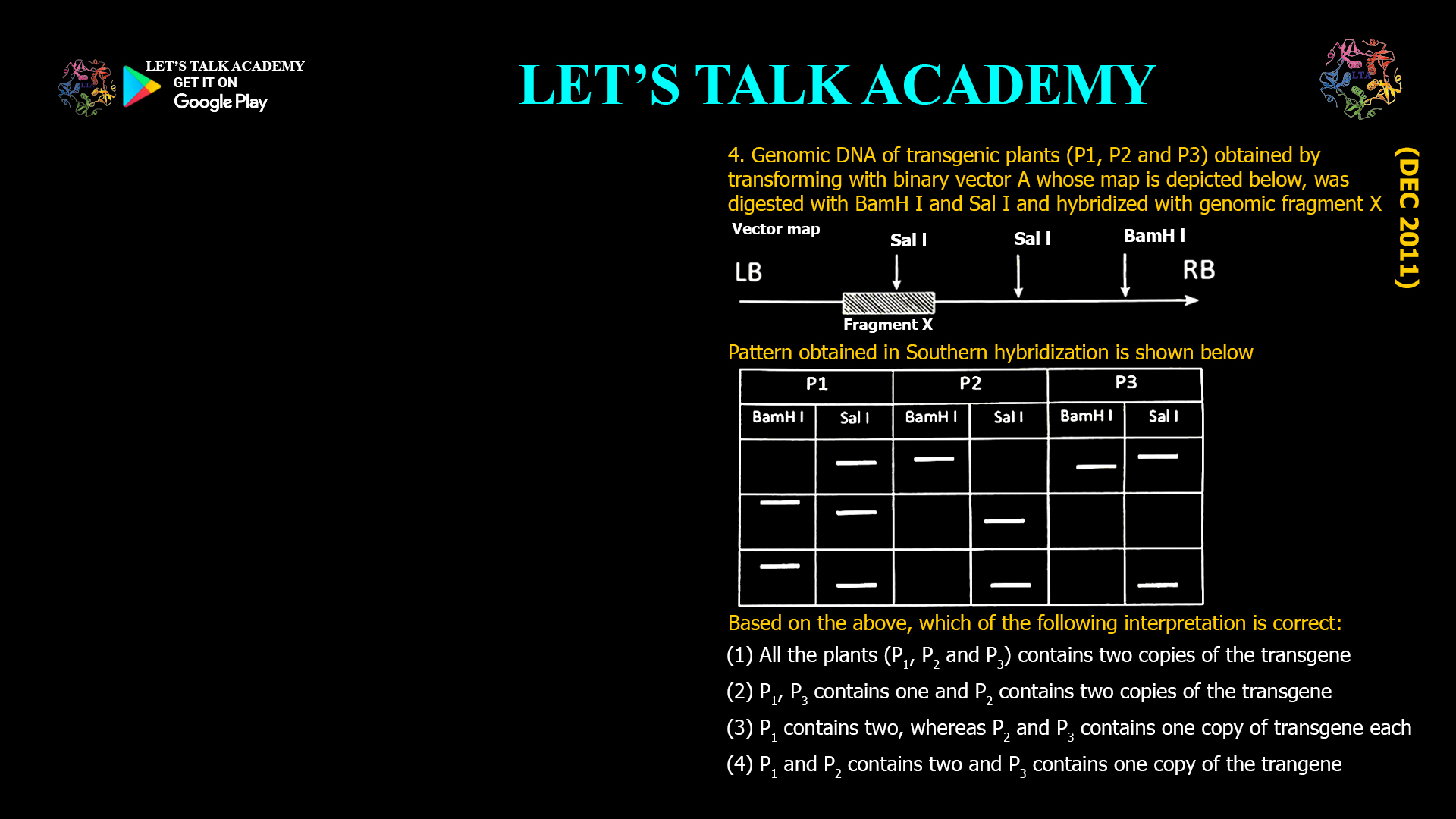
4. Genomic DNA of transgenic plants (P1, P2 and P3) obtained by transforming with binary vector A whose map is depicted below, was digested with BamH I and Sal I and hybridized with genomic fragment X Pattern obtained in Southern hybridization is shown below Based on the above, which of the following interpretation is correct: (1) All the plants (P1, P2 and P3) contains two copies of the transgene (2) P1, P3 contains one and P2 contains two copies of the transgene (3) P1 contains two, whereas P2 and P3 contains one copy of transgene each (4) P1 and P2 contains two and P3 contains one copy of the trangene

Using Southern blot patterns to estimate transgene copy number in plants

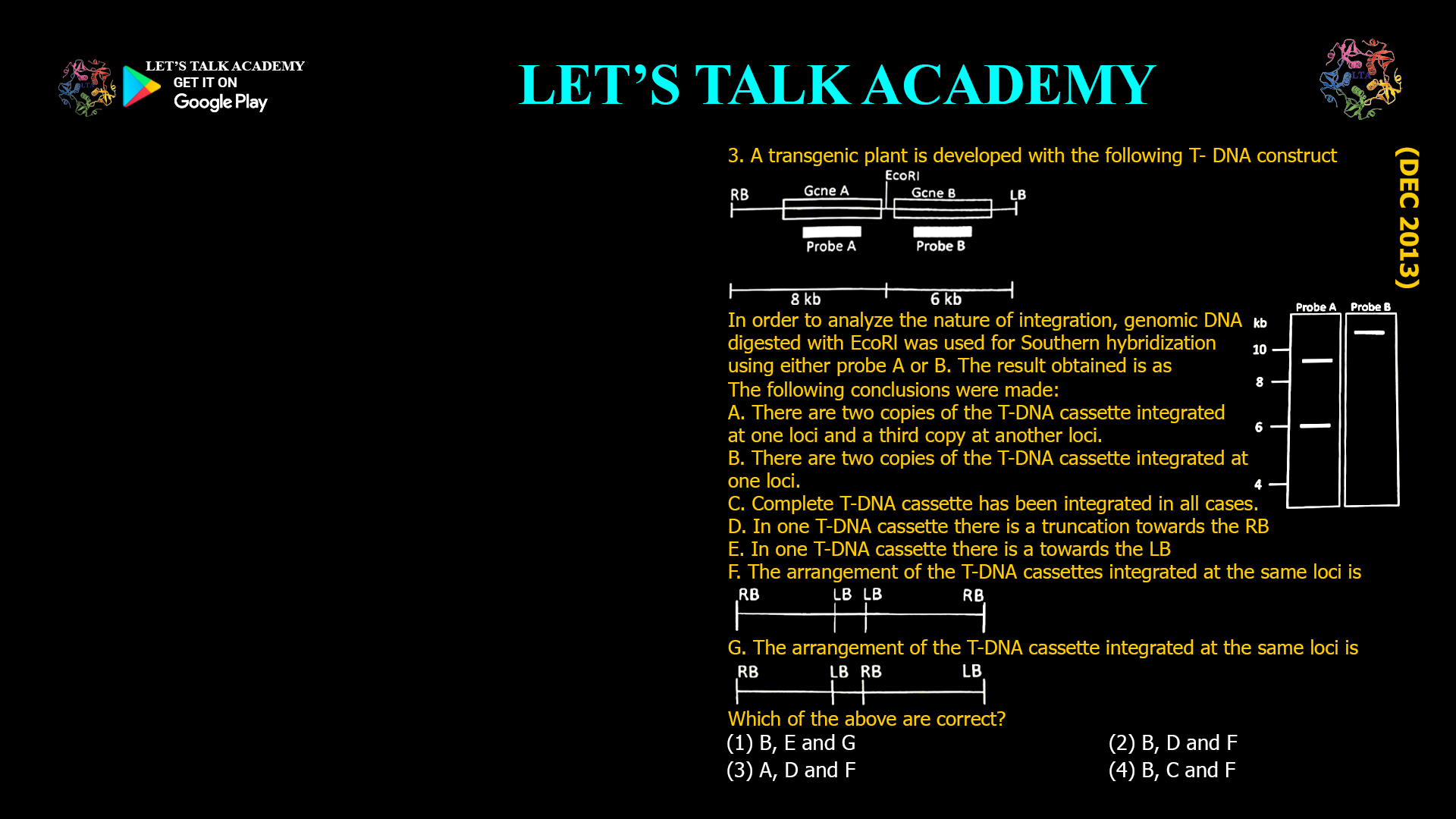
3. A transgenic plant is developed with the following T- DNA construct In order to analyze the nature of integration, genomic DNA digested with EcoRl was used for Southern hybridization using either probe A or B. The result obtained is as The following conclusions were made: A. There are two copies of the T-DNA cassette integrated at one loci and a third copy at another loci. B. There are two copies of the T-DNA cassette integrated at one loci. C. Complete T-DNA cassette has been integrated in all cases. D. In one T-DNA cassette there is a truncation towards the RB E. In one T-DNA cassette there is a towards the LB F. The arrangement of the T-DNA cassettes integrated at the same loci is G. The arrangement of the T-DNA cassette integrated at the same loci is Which of the above are correct? (1) B, E and G (2) B, D and F (3) A, D and F (4) B, C and F

Interpreting Southern blot patterns to infer T-DNA copy number, truncation and arrangement

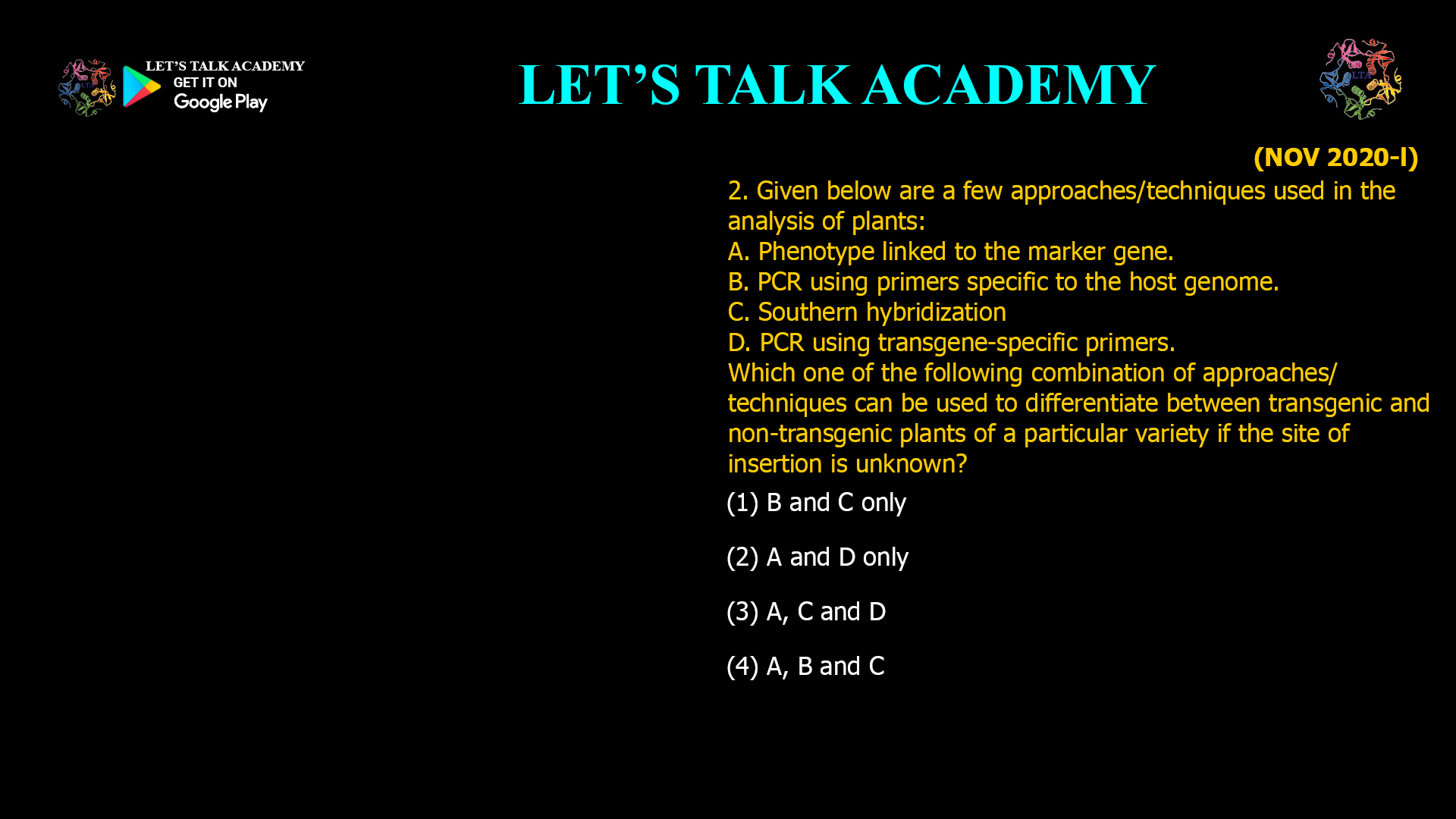
2. Given below are a few approaches/techniques used in the analysis of plants: A. Phenotype linked to the marker gene. B. PCR using primers specific to the host genome. C. Southern hybridization D. PCR using transgene-specific primers. Which one of the following combination of approaches/ techniques can be used to differentiate between transgenic and non-transgenic plants of a particular variety if the site of insertion is unknown? (1) B and C only (2) A and D only (3) A, C and D (4) A, B and C

How to distinguish transgenic from non-transgenic plants when the insertion site is unknown

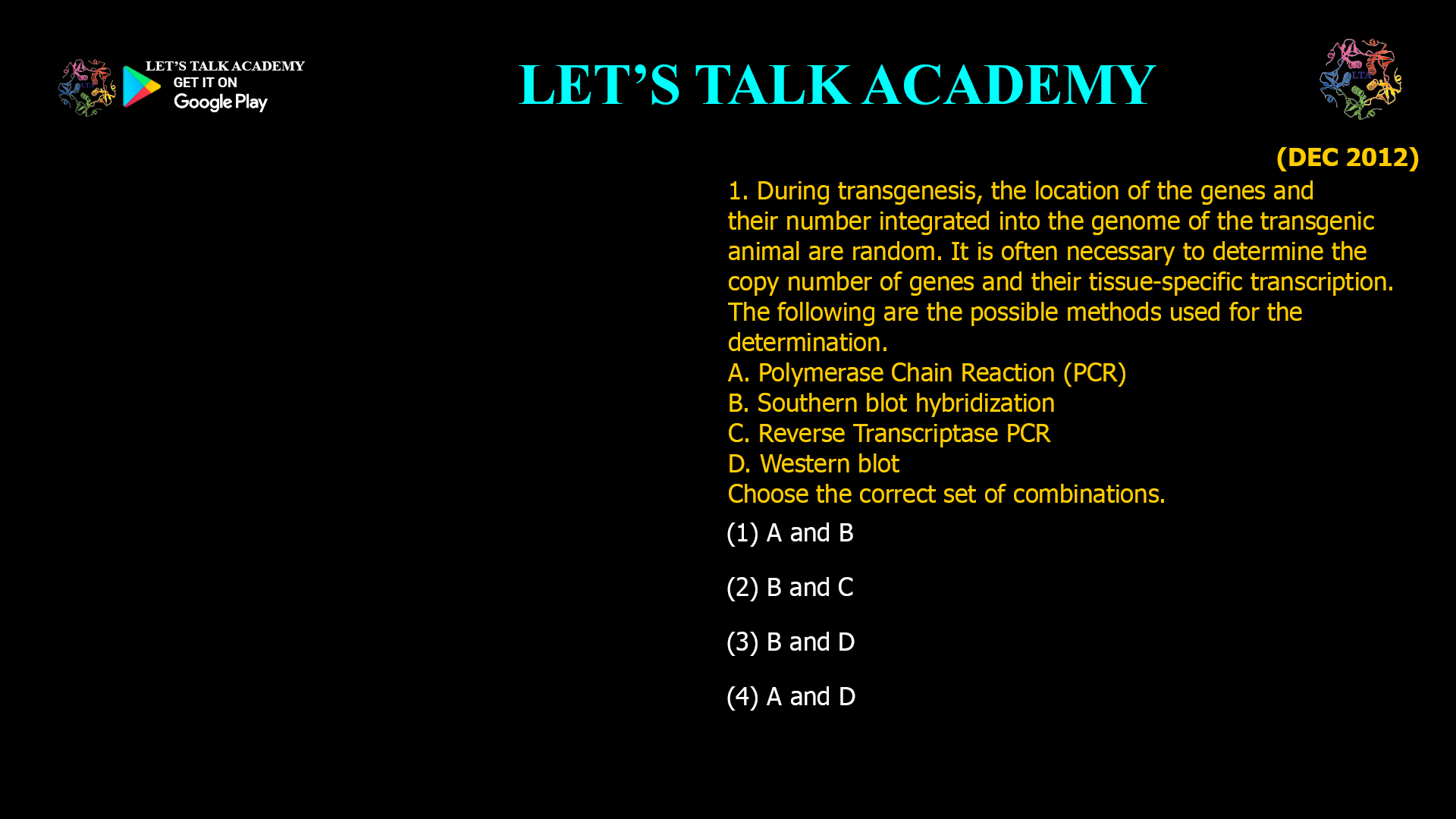
1. During transgenesis, the location of the genes and their number integrated into the genome of the transgenic animal are random. It is often necessary to determine the copy number of genes and their tissue-specific transcription. The following are the possible methods used for the determination. A. Polymerase Chain Reaction (PCR) B. Southern blot hybridization C. Reverse Transcriptase PCR D. Western blot Choose the correct set of combinations. (1) A and B (2) B and C (3) B and D (4) A and D

Methods to determine copy number and tissue-specific expression in transgenic animals

Latest Courses