A bacterial culture initiated from a single bacterial cell with a DNA repair- deficient system is inoculated into several individual test tubes and allowed to grow in parallel. Wild type cells are also inoculated in a similar manner and grown simultaneously. After several generations, individual cultures are tested for resistance to antibiotics. Which one of the following statements describes the most likely outcome? (1) More antibiotic resistant cells will emerge from the DNA repair-deficient cultures and all wild type cells will be sensitive. (2) Wild type cells will produce more antibiotic resistant populations than the DNA repair- deficient cells. (3) The DNA repair-deficient cells may produce more antibiotic resistant cells but wild type cells will also produce some antibiotic resistant population. (4) The DNA repair-deficient cells would be dead and therefore will not produce any resistant population of cells.  

DNA Repair-Deficient Bacteria Produce More Antibiotic-Resistant Mutants, But Wild-Type Cells Also Generate Resistance

The following statements are made about the E.coli SOS response to DNA damage: A. RecA-DNA filament complex stimulates the autoproteolytic activity of the Lex A repressor. B. RecA is activated due to the blunt ends of double strand breaks caused damage inducing agents. C. The SOS response includes the activation of synthesis of translesion polymerases. D. The destruction of LexA promotes synthesis of photolyase, which acts along with RecA to reverse the pyrimidine dimer formation process. Which one of the following options represents the combination of all correct statements? (1) A and D (2) B and D (3) A and C (4) C and D

Key Features of the E. coli SOS Response: Role of RecA, LexA, and Translesion Polymerases

Which of the following can induce SOS response in bacteria (1) UV exposure                (2) Hydroxyl-amine (3) 5-Fluro-Uracil               (4) 2-Aminopurine 

UV Exposure Is a Primary Inducer of the Bacterial SOS Response: Mechanisms and Implications

UB-induced DNA damage cause advancing replication forks to stall. To avoid a collapse of these stalled replication forks the cell uses: (1) non-homologous end joining (2) lesion bypasss (3) mismatch repair (4) base excision repair 

Lesion Bypass Prevents Replication Fork Collapse Caused by UV-Induced DNA Damage

The fidelity of replicative base selection can be reduced by a factor of 102  when the repair of DNA synthesis involves (1) AP endonuclease                (2) ABC exonuclease (3) DNA photolyase                  (4) TLS DNA polymerase.

How TLS DNA Polymerases Reduce Replicative Fidelity by 100-Fold During DNA Damage Bypass

Following statements are made about double-strand break repair (DSBR)model of homologous recombination: A. Process of DSBR recombination is triggered by introducing a double-strand break in a DNA duplex B. In a process known as 3-end resection, the exonucleases along with a DNA helicase degrade one strand on either side of the break and generates 3'-single stranded termini C. One strand of the donor duplex is displaced due to formation of heteroduplex DNA and generates a displacement loop (D-Loop) D. Branch migration allows the point of crossover to move in 5'--à3' direction of recipient strand E. Completion of DSBR recombination may generate either crossover recombinant or non-recombinant product Which one of the following combination of statements is correct? (1) A, B and D           (2) A, C and E (3) A, C and D           (4) A, B and E

Key Steps of Double-Strand Break Repair (DSBR) Model in Homologous Recombination Explained

Which one of the following proteins catalyzes branch migration activity in Holliday Junction? (1) Spo11 (2) RuvB (3) Zip1 (4) RuvC

RuvB Protein Catalyzes Branch Migration Activity in the Holliday Junction During DNA Recombination

In E. coil, recA gene is involved in recombination as well as repair and dnaB gene is involved in unwinding of DNA double strands during replication. Which of the following statement is/are correct about Rec A and Dna B? A. Mutation in E. coli recA gene is lethal. B. E.coli with mutated dnaB gene does not survive. C. Dna B after uncoiling DNA double strands, prevents further reannealing at the separated strands. D. Rec A gene is involved in SOS response and helpsDNA repair. The correct options are: (1) B and C                (2) A and B (3) B and D               (4) A and C

Roles of E. coli RecA and DnaB Genes: DNA Repair, SOS Response, and DNA Unwinding Explained

The homologous genetic recombination is a DNA repair process referred to as recombination repair. Which one of the following statements is INCORRECT for recombination repair? (1) DNA polymerase III stalls at the site of the damage. (2) DNA polymerase III leaves a gap in the daughter strand. (3) The gap is filled by recombination between complementary parent strand homologous to daughter strand and the gapped daughter strand. (4) Homologous recombination process is catalyzed by topoisomerase II. 

Recombination Repair Explained: Why Topoisomerase II Does Not Catalyze Homologous Recombination

Repair of double strand break made during meiosis in the yeast Saccharomyces cerevisiae (1) occurs mostly by non-homologous end joining. (2) occurs mostly using the sister chromatid as a template. (3) occurs mostly using the homologous chromosome as a template. (4) is associated with a high frequency of mutations.

Meiotic Double-Strand Break Repair in Saccharomyces cerevisiae Uses Homologous Chromosome as Template

21.single -strand nick in parental DNA helix just ahead of a replication fork causesthe replication fork to break. Recovery from this calamity requires (1) DNA ligase (2) DNA primase (3) Site-specific recombination (4) homologous recombination

Recovery from Replication Fork Breakage Caused by Single-Strand Nick Requires Homologous Recombination

20. Error-free repair of double strand breaks in DNA is accomplished by (1) non-homologous end-joining (2) base excision repair (3) homologous recombination (4) mismatch repair

Error-Free Repair of DNA Double-Strand Breaks Is Accomplished by Homologous Recombination

Among the following which repair mechanism involves recombination? (1) Photo active direct repair mechanism (2) SOS repair mechanism (3) Post replication repair mechanism (4) Nucleotide excision repair mechanism 

sos-repair-mechanism-involves-recombination-understanding-dna-damage-responses

A meiotic recombination does not involve (1) formation of Holliday junction. (2) newly replicated identical DNA duplexes. (3) gene conversion. (4) crossover and non-crossover.

Meiotic Recombination Does Not Involve Newly Replicated Identical DNA Duplexes: Key Features Explained

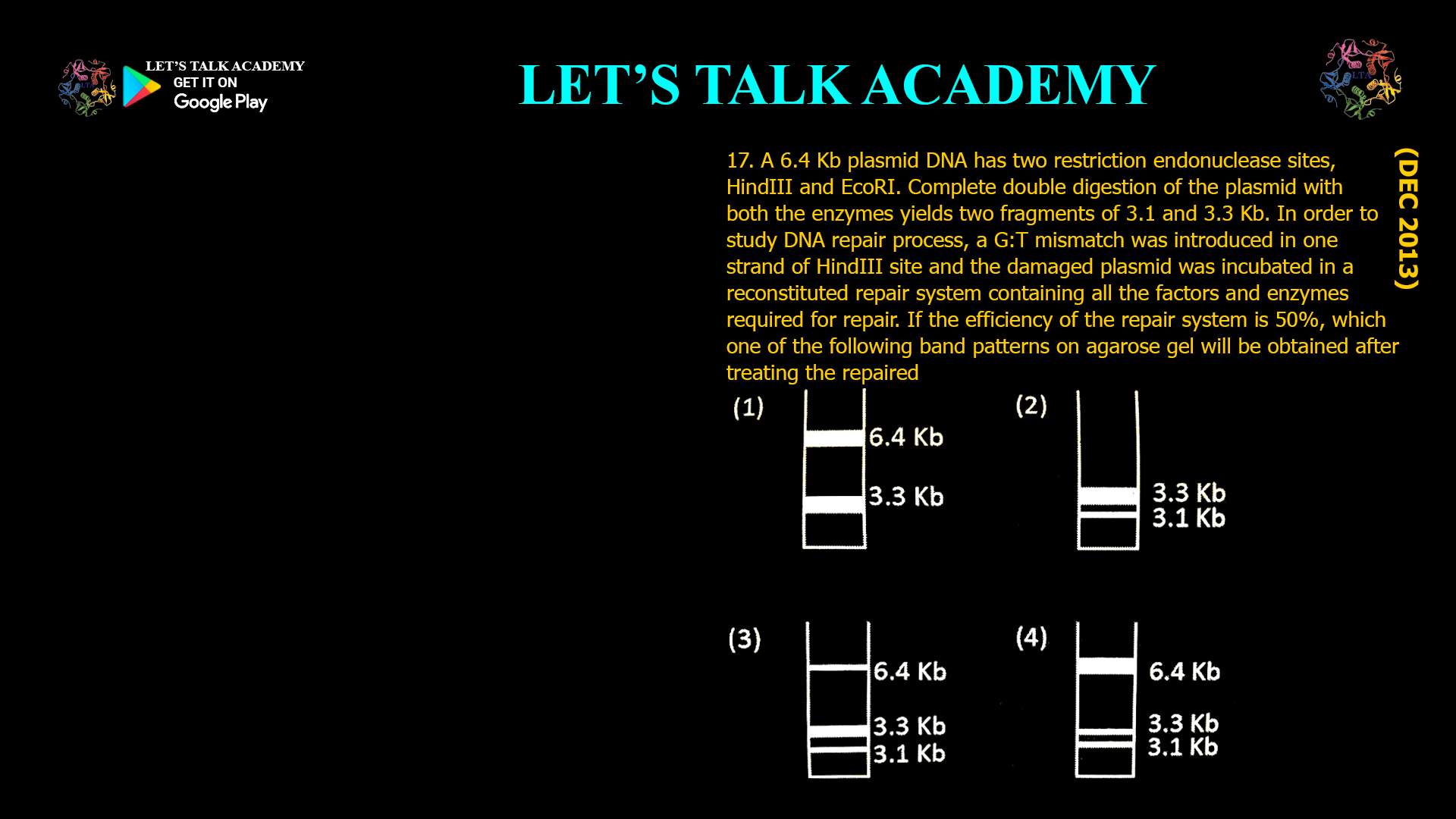
A 6.4 Kb plasmid DNA has two restriction endonuclease sites, HindIII and EcoRI. Complete double digestion of the plasmid with both the enzymes yields two fragments of 3.1 and 3.3 Kb. In order to study DNA repair process, a G:T mismatch was introduced in one strand of HindIII site and the damaged plasmid was incubated in a reconstituted repair system containing all the factors and enzymes rquired for repair. If the efficiency of the repair system is 50%, which one of the following band patterns on agarose gel will be obtained after treating the repaired

Predicting Agarose Gel Band Pattern After Repair of G:T Mismatch at HindIII Site in 6.4 Kb Plasmid Digested with HindIII and EcoRI

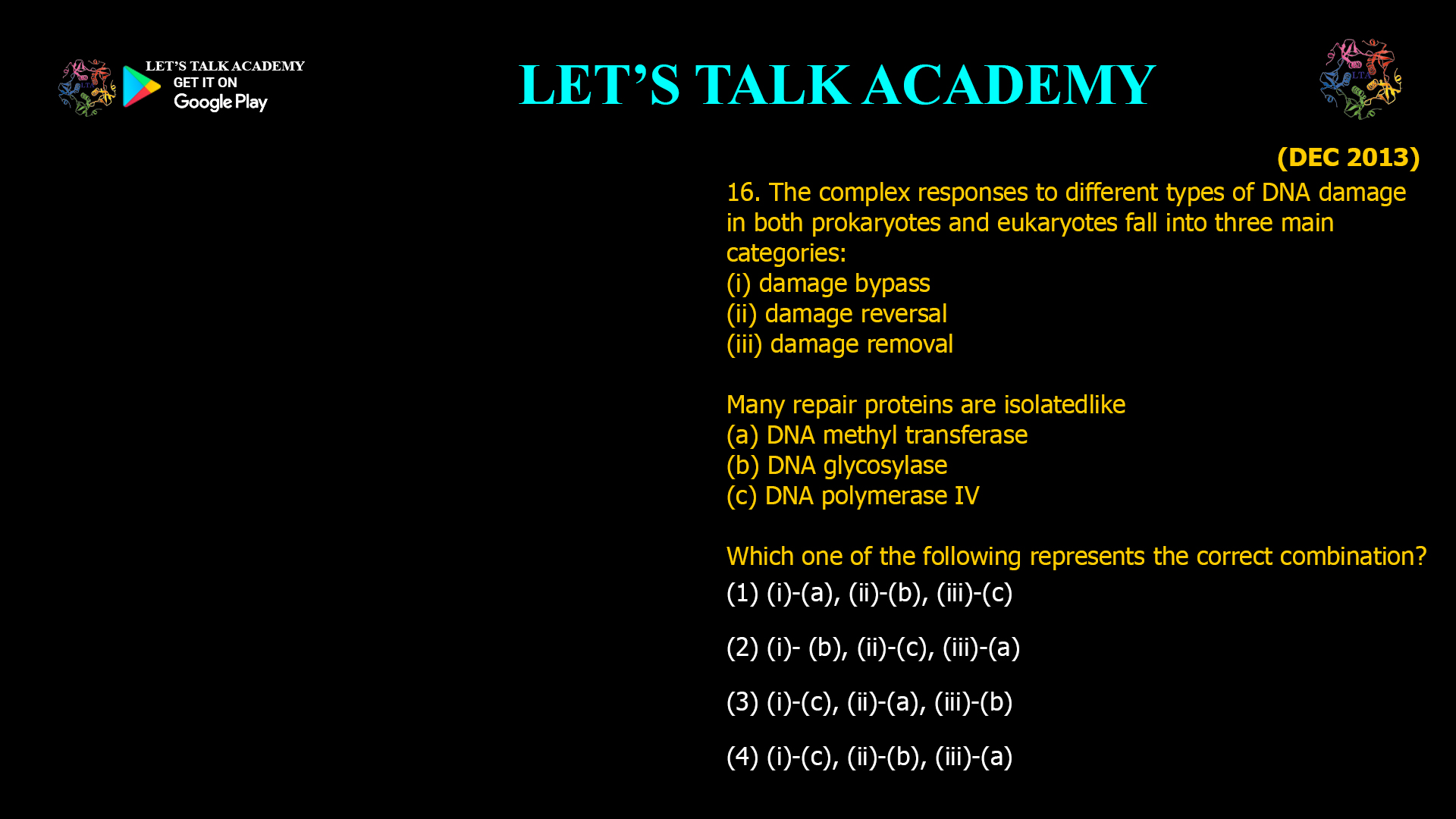
The complex responses to different types of DNAdamage in both prokaryotes and eukaryotes fall into three main categories: (i) damage bypass (ii) damage reversal (iii) damage removal Many repair proteins are isolated  like (a) DNA methyl transferase (b) DNA glycosylase (c) DNA polymerase IV Which one of the following represents the correct combination? (1) (i)-(a), (ii)-(b), (iii)-(c) (2) (i)- (b), (ii)-(c), (iii)-(a) (3) (i)-(c), (ii)-(a), (iii)-(b) (4) (i)-(c), (ii)-(b), (iii)-(a)

DNA Damage Responses Explained: Damage Bypass, Reversal, and Removal with Key Repair Proteins

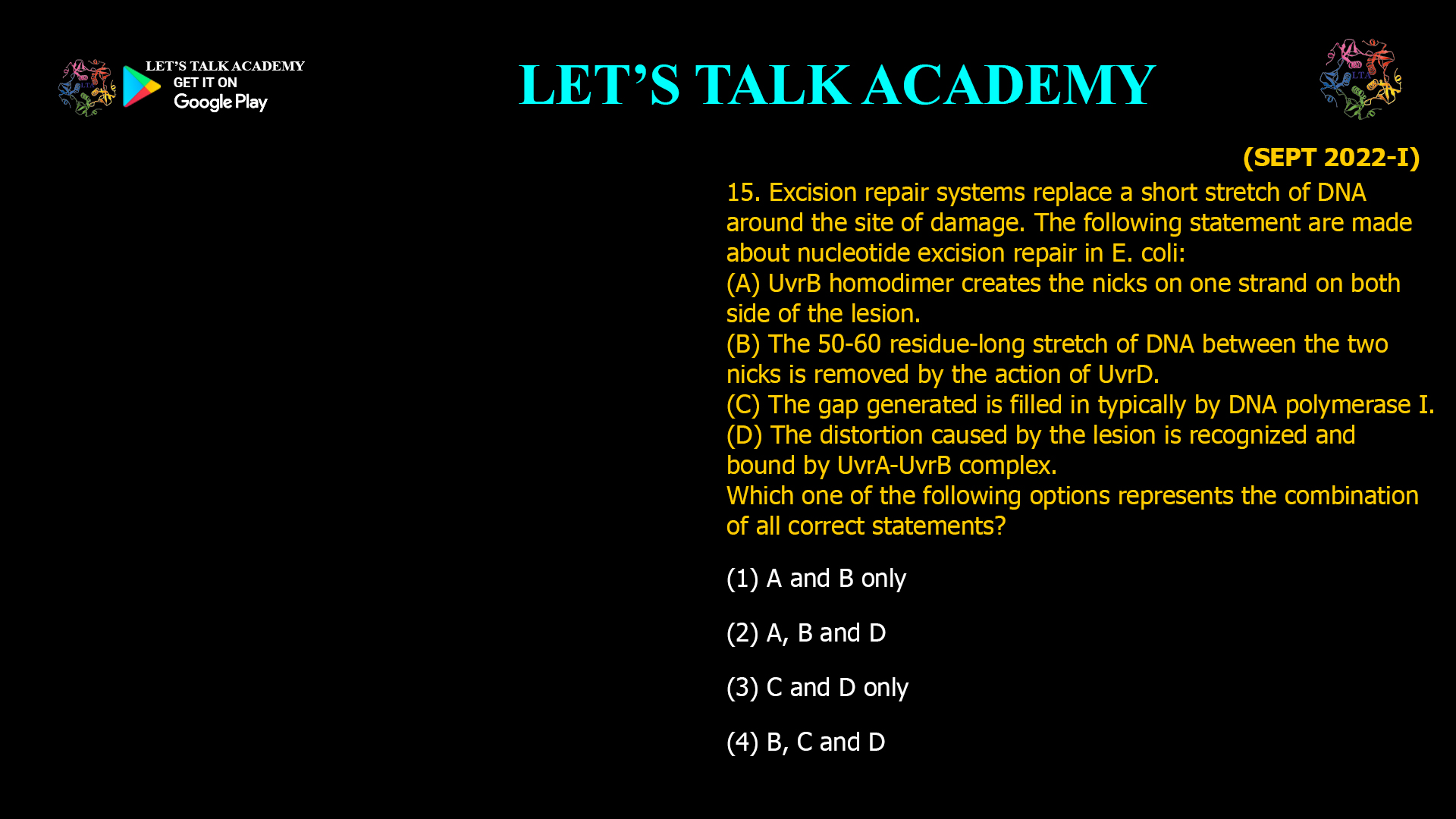
Excision repair systems replace a short stretch of DNA around the site of damage. The following statement are made about nucleotide excision repair in E. coli: (A) UvrB homodimer creates the nicks on one strand on both side of the lesion. (B) The 50-60 residue-long stretch of DNA between the two nicks is removed by the action of UvrD. (C) The gap generated is filled in typically by DNA polymerase I. (D) The distortion caused by the lesion is recognized and bound by UvrA-UvrB complex. Which one of the following options represents the combination of all correct statements? (1) A and B only       (2) A, B and D (3) C and D only (4) B, C and D

Nucleotide Excision Repair in E. coli: Roles of Uvr Proteins, UvrD, and DNA Polymerase I Explained

Genetic disorder Xeroderma pigmentosum is due to defect in (1) Base excision repair mechanism (2) Nucleotide excision repair mechanism (3) Direct repair mechanism (4) DNA replication mechanism

Xeroderma Pigmentosum Is Caused by Defects in Nucleotide Excision Repair Mechanism

The 'Uvr ABC' repair mechanism is involved in repairing (1) missing bases. (2) strand break. (3) cross linked strands. (4) DNA damage caused by "bulky" chemical adducts.

UvrABC Repair Mechanism Repairs DNA Damage Caused by Bulky Chemical Adducts

Pyrimidine dimers in eukaryotic cells are repaired by (1) nucleotide excision repair     (2) SOS pathway (3) base excision repair (4) mismatch repair

Pyrimidine Dimers in Eukaryotic Cells Are Repaired by Nucleotide Excision Repair

Among the following which mutagen induces formation of thymidine dimmers in DNA (1) UV rays (2) Ethyl methyl sulphate (3) Nitrous oxide (4) Ethidium bromide 

Which Mutagen Induces Thymine Dimer Formation in DNA? Understanding UV Radiation Effects

Aguanine (G) base in DNA is susceptible to modification to 8-oxo-G because of oxidative damage. If the modified G residues are not removed by a DNA glycosylase (Mut M or Fpg) prior to replication, an adenine (A) may be incorporated against 8-oxo-G. To avoid mutations, the cells have another DNA glycosylase called Mut Y. However, when the gene coding for Mut Y is deleted in Escherichia coli, the strain survives. This observation suggests that in E. coli (1) MutY is not responsible for the excision of 'A' incorporated against 8-oxo-G (2) Alternate DNA repair pathways may substitute for the repair of ‘A’ incorporated against 8-oxo-G (3) Incorporation of 'A' against 8-oxo-G does not cause mutation in E. coli (4) The 8-oxo-G:A base pair in DNA distorts its structure in such a way that, during the next round of replication a 'G' is incorporated against ‘A’ in the 8-oxo-G:A mispair. 

MutY and Alternative Repair Pathways: How E. coli Survives Without This Key DNA Glycosylase

Uracil containing plasmid was constructed and was used in transformation into the wild type (ung+) and uracil-N-glycosylase mutated (ung-) E. coli cells and scored for transformants in the presence of appropriate antibiotics. Which one of the following statements correctly describes the experimental outcome? (1) ung+cells will have fewer transformants compared to ung-cells. (2) ung- cells will give fewer transformants compared to ung cells. (3) No transformants will be obtained in ung- cells as uracil excision repair will not occur and the plasmid would not replicate. (4) Presence of uracil in DNA is unnatural and the plasmid DNA with uracils in it will not produce transformants in either ung+ or ung- cells

Transformation with Uracil-Containing Plasmids: Why ung+ E. coli Cells Yield Fewer Transformants Than ung- Mutants

In DNA if thymidine is replaced by uracil then what would be drastic changes in organism (1) Uridine is more mutation sensitive (2) No differentiation of DNA and RNA (3) Repair mechanism for deaminated cytosine will not work (4) All of the above

What Happens If Thymidine Is Replaced by Uracil in DNA? Drastic Consequences for Organisms

7.If cell is not dividing (arrested in cell cycle) which repair mechanism will not occur (1) Recombination repair mechanism (2) Excision repair mechanism (3) Transcriptional coupled repair mechanism (4) DNA synthesis dependent strand annealing repair 

Which DNA Repair Mechanism Is Blocked in Non-Dividing Cells? Understanding Cell Cycle Arrest and Repair Pathways

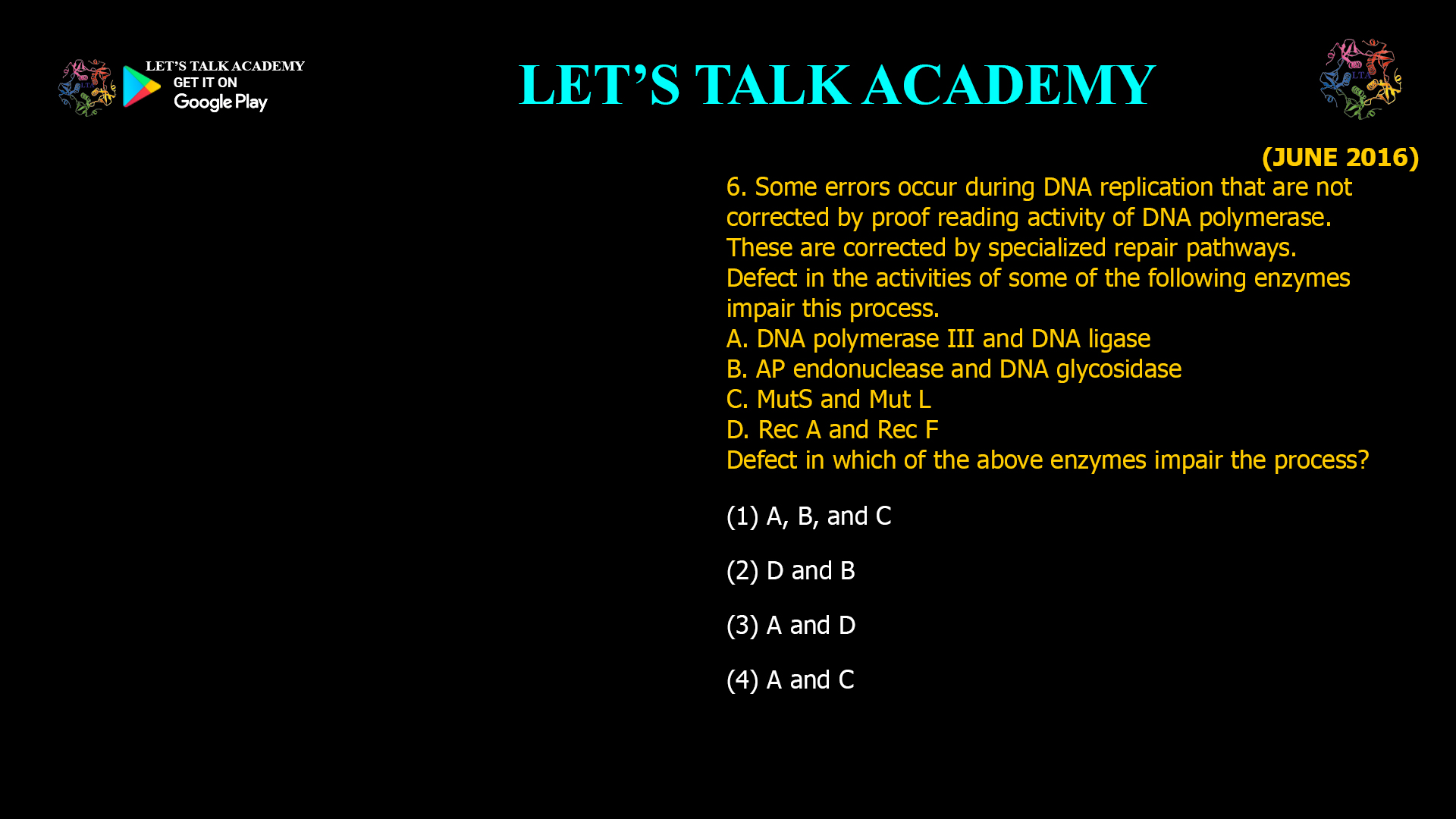
Some errors occur during DNA replication that are not corrected by proof reading activity of DNA polymerase. These are corrected by specialized repair pathways. Defect in the activities of some of the following enzymes impair this process. A. DNA polymerase III and DNA ligase B. AP endonuclease and DNA glycosidase C. MutS and Mut L D. Rec A and Rec F Defect in which of the above enzymes impair the process? (1) A, B, and C (2) D and B (3) A and D (4) A and C 

Which Enzyme Defects Impair the Correction of DNA Replication Errors? Understanding Mismatch Repair and Related Pathways

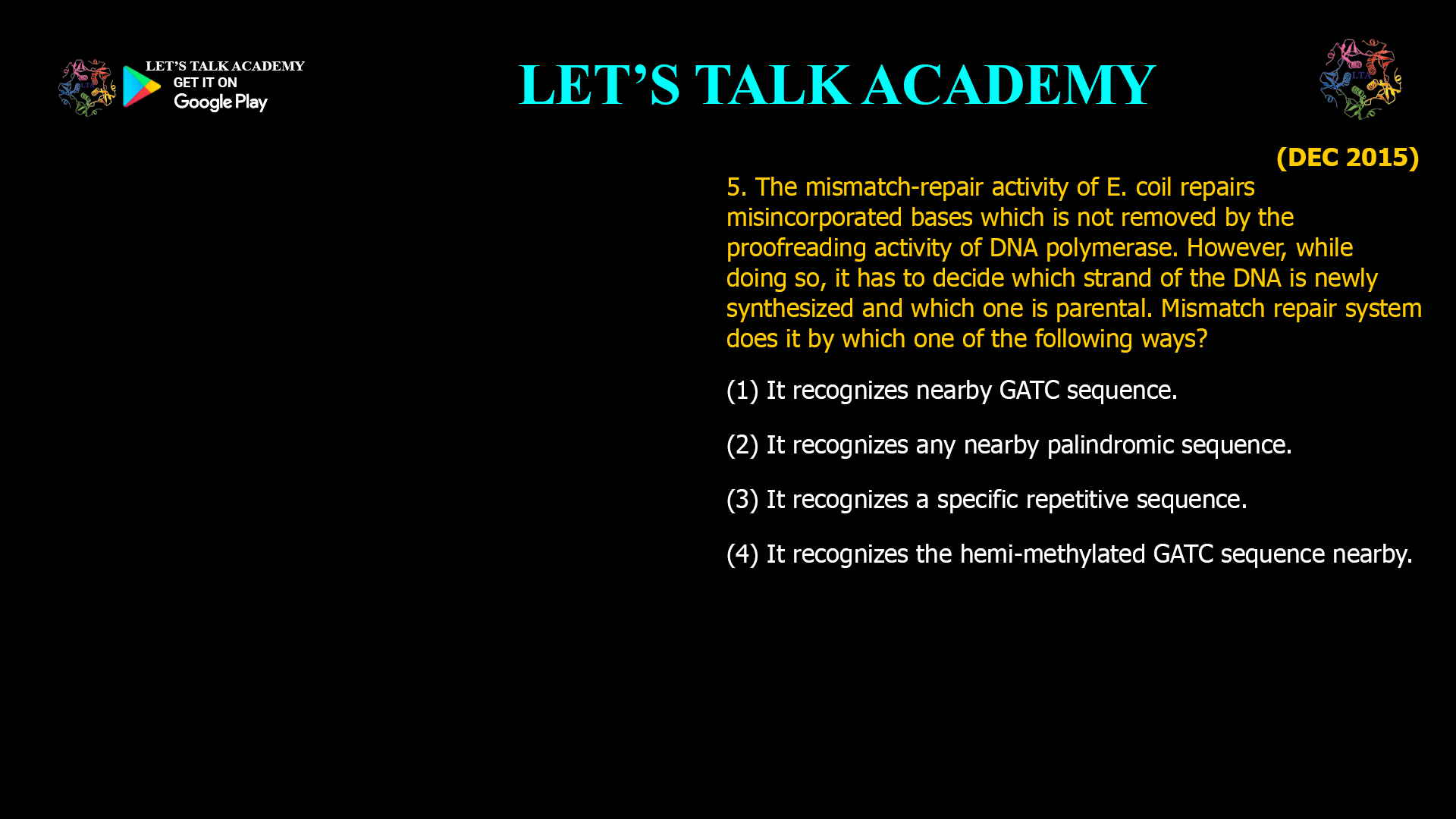
The mismatch-repair activity of E. coil repairs misincorporated bases which is not removed by the proofreading activity of DNA polymerase. However, while doing so, it has to decide which strand of the DNA is newly synthesized and which one is parental. Mismatch repair system does it by which one of the following ways? (1) It recognizes nearby GATC sequence. (2) It recognizes any nearby palindromic sequence. (3) It recognizes a specific repetitive sequence. (4) It recognizes the hemi-methylated GATC sequence nearby.

How E. coli Mismatch Repair System Recognizes the Newly Synthesized Strand: The Role of Hemi-Methylated GATC Sequences

15. Semi-conservative mode of DNA replication in eukaryotes can be experimentally demonstrated by using (1) BromodU labeling(2) S35 labelling (3) In situ hybridization (4) G-banding

How Semi-Conservative DNA Replication in Eukaryotes Is Demonstrated Using Bromodeoxyuridine (BrdU) Labeling

.The basic difference between direct repair and base excision repair is (1) Direct repair restores original structure of altered nucleotide without replacement, while in base excision repair the section of DNA containing the distortion is removed, the correct base is added and resealed. (2) In direct repair, homologous recombination repairs the broken region while base excision repair restores original structure of altered nucleotide by modification. (3) Direct repair restores original structure by non-homologous end joining without using homologous template while in base excision repair the section of DNA containing the distortion is repaired by using homologous recombination. (4) In direct repair, an exonuclease, a DNA polymerase and a ligase are used, while in base excision repair a translesion polymerase that bypasses the bulky lesions is used by the cell.  

Direct Repair vs Base Excision Repair: Key Differences in DNA Damage Repair Mechanisms

Latest Courses