22. Bacteriophage λ and Pl are both temperate phages. Which one of the following statements made about these phages and their lytic and lysogeny cycles in E. coli is INCORRECT? (1) Both λ and Pl phages are double stranded DNA viruses. (2) In their lysogenic states in E. coli, while  the λ phage integrates into the genome, the P1 phage remains as a low copy number plasmid. (3) In their lysogenic states, both the λ and the P1 phages are integrated into the genome in E. coli. (4) In their lytic cycles, both the phages occur in plasmid forms in E. coli.

Comparing Lysogenic and Lytic Cycles of Bacteriophage Lambda and P1 in E. coli

21. Bacteriophage λ proteins, Cl and Cro are crucial regulators of the lysogeny and lytic cycles of the bacteriophage. These proteins bind to the rightward operator region consisting of OR1, OR2, and OR3 (shown below). Which one of the following statements about the regulation by Cl and Cro proteins is CORRECT? (1) Cro binding to OR3 activates expression of cl. (2) Cl binding to OR3 activates expression of cl and represses the expression of cro. (3) Cl binding to OR1 and OR2 leads to repression of cl and cro. (4) Cl binding to OR1 and OR2 leads to higher expression of cl and repression of cro.

How CI and Cro Proteins Regulate Gene Expression via OR1, OR2, and OR3 in Bacteriophage Lambda

20. The lambda (λ) and P22 phages are two related lambdoid bacteriophages. A recombinant lambda phage (λMut) was derived from the wild type lambda phage (λWT) by replacing its Cl repressor gene and the CI binding sites with those from the P22 phage. Both the λWTandλMut were used independently to infectEscherichia coli strain over-producing λWT Cl repressor. Following outcomes were surmised (i) Infection withλWT will lyse the E. coli used (ii) Infection withλWT will invariably establish lysogeny in the E. coli used (iii) Infection withλMut will lyse the E. coli used (iv) Infection with λMut will invariably establish lysogeny in the E. coli used. Which combination of the above statements is correct? (1) (i) and (ii)       (2) (ii) and (iii) (3) (iii) and (iv)    (4) (iv) and (i)

Infection Dynamics of Recombinant Lambda Phage Carrying P22 Repressor Genes in E. coli Overproducing Lambda Repressor

19. Insertion lambda vectors are used to create cDNA libraries, In some insertion vectors, the site of insertion is within the cl gene. The, recombinants which are cl-can then be screened by plating on E. coli hfl. The gene hfl encodes a protease that controls lytic-lysogenydecision through which mechanism? (1) Hfl protease degrades cl, thereby promoting lytic pathway (2) Hfl protease degrades clll and so clll cannot interact withCll, lysogenic pathway is thus preferred. (3) Hfl protease degrades cll, and therefore cl synthesis cannot be established, thus lytic pathway is preferred. (4) Hfl protease degrades INT, the protein involved in phage integration and the lytic pathway is initiated.

Role of Hfl Protease in Regulating the Lytic-Lysogeny Switch of Bacteriophage Lambda

18. Given below are a few statements about the A infection cycle A. Competition between cl and Cll gene products determines the establishment of lysogeny versus lysis. B. cl binds OR1 first while cro binds to OR3 first C. Cro binding to OR represses cl transcription D. Rich mediumfavours lytic cycle because cll is protected from cellular proteases Which one of the following options represents all correct statements? (1) B and C        (2) A and B (3) C and D         (4) A and C

key-molecular-players-in-bacteriophage-lambdas-lysis-lysogeny-decision-ci-cii-and-cro-explained

Key Regulatory Features of Bacteriophage Lambda: Repressor Function and Operator Mutations Explained

16. Bacteriophage λ is a temperate phage. Immediately after infection, viral specific mRNAs for N and Cro proteins are expressed followed by early mRNAs. At the commitment phase, either lytic cycle starts with the expression of genes for head tail, and lytic proteins or lysogenisation cycle begins with the expression of repressor and integrase genes. During induction of lysogens both INT and XIS proteins are needed along with host factors. Out of the four processes below, some govern integration of viral genome and its excision? A. Repression of transcription B. Retro-regulation C. Rearrangement of viral genome D. Repression of translation Identify the correct set of combination: (1) A and B           (2) B and C (3) cand D            (4) D and A

How Bacteriophage Lambda Integrates and Excises Its Genome: Roles of Int, Xis, and Host Factors

15. The statements given below refer to the lambda phage. A. Clear plaques are formed in Q mutants B. No plaques are formed in nut mutants C. Clear plaques are formed in Cll mutants D. Turbid plaques are formed in integrase mutants E. Clear plaques are formed in P mutants F. No plaques are formed in cl mutants Which of the following combination of statement is correct? (1) A, B and F only    (2) C, D and E only (3) B and C only      (4) D and F only

Decoding Plaque Morphology of Lambda Phage Mutants: Clear and Turbid Plaques Explained

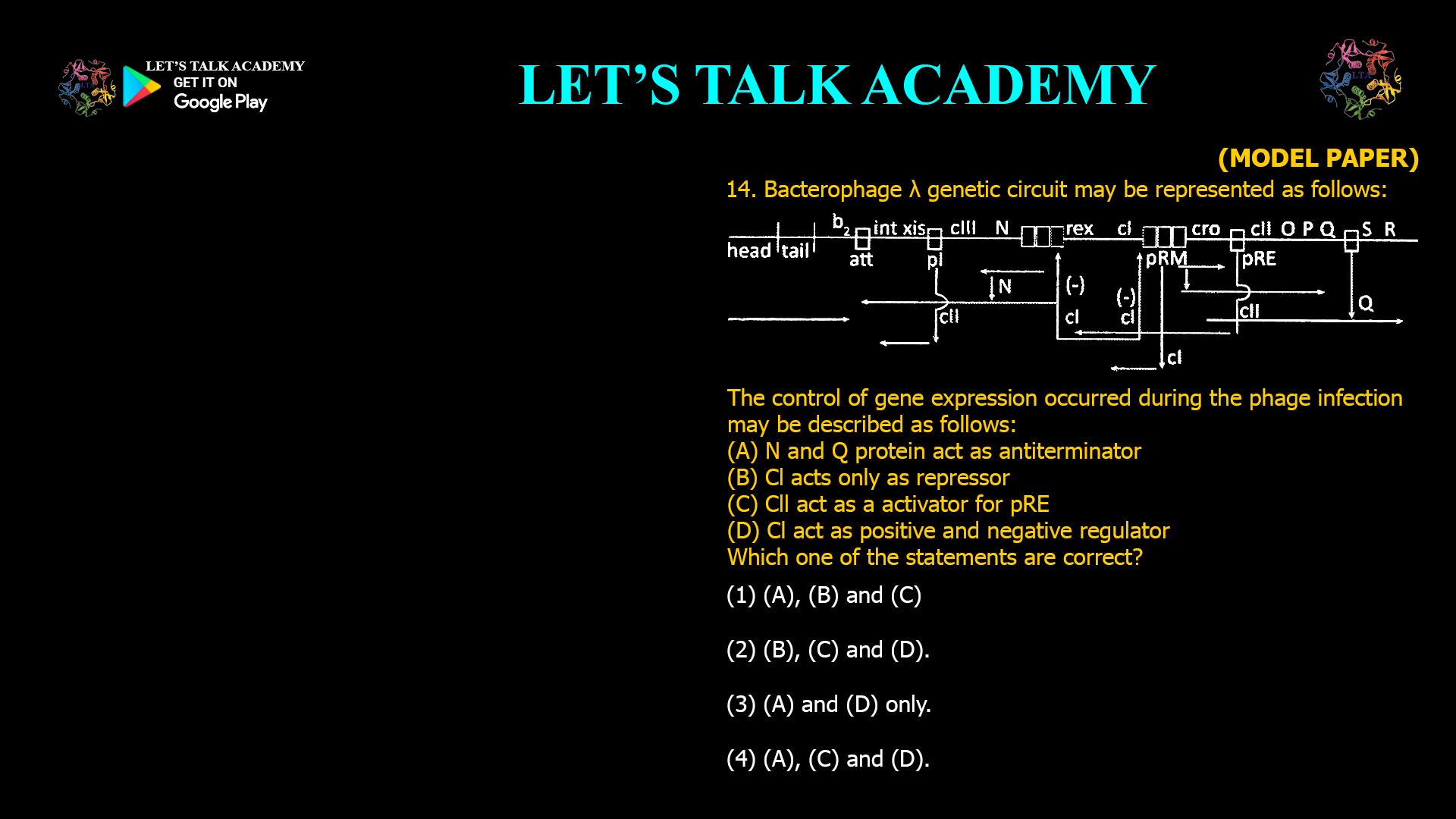
14. Bacterophageλgenetic circuit may be represented as follows: The control of gene expression occurred during the phage infection may be described as follows: (A) N and Q protein act as antiterminator (B) Cl acts only as repressor (C)Cli act as a activator for pRE (D) Cl act as positive and negative regulator Which one of the statements are correct? (1) (A), (B) and (C). (2) (B), (C) and (D). (3) (A) and (D) only. (4) (A), (C) and (D) 

Key Regulatory Proteins and Their Roles in Gene Expression Control During Bacteriophage Lambda Infection

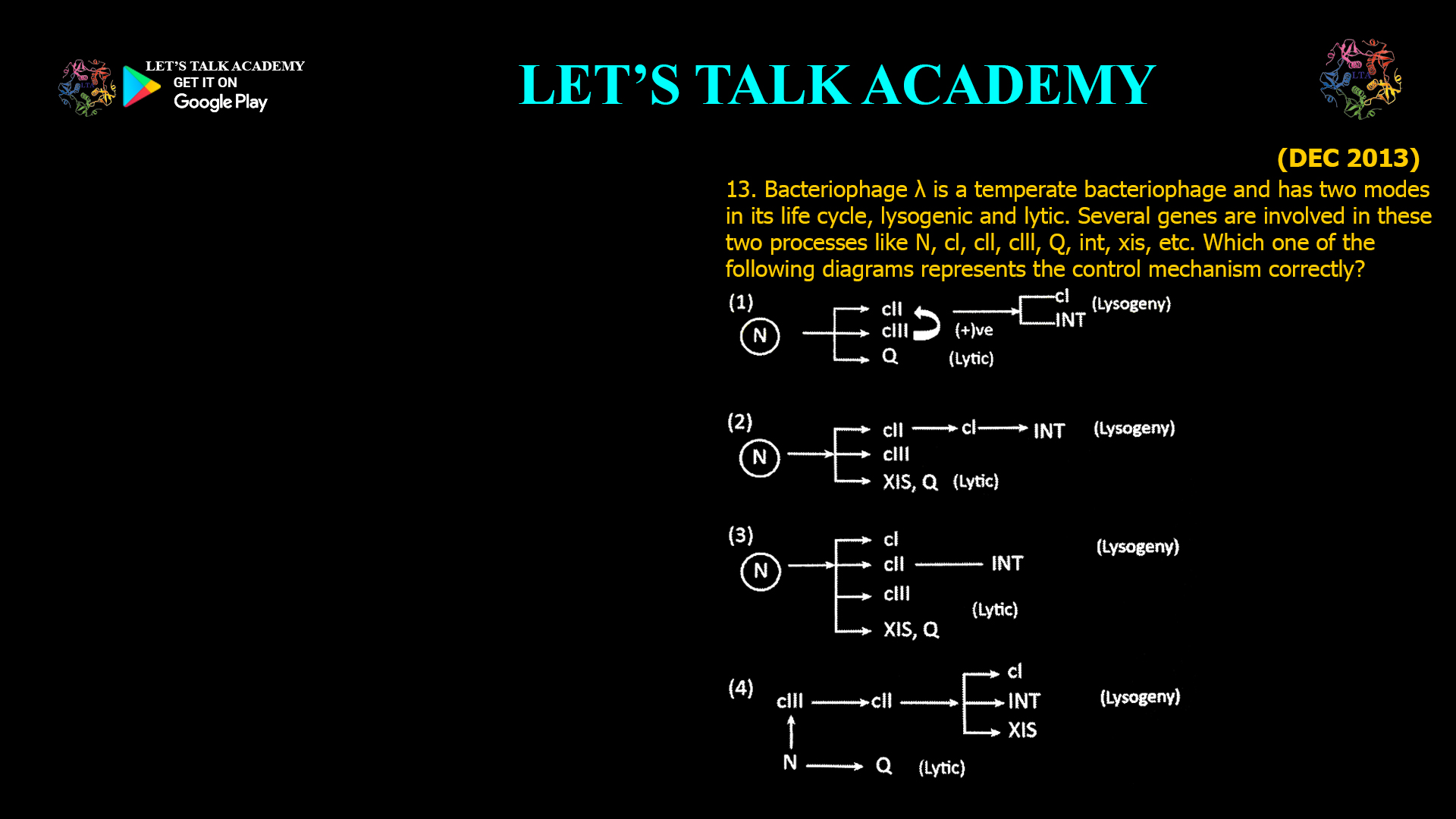
13. Bacteriophage λ is a temperate bacteriophage and has two modes in its life cycle, lysogenic and lytic. Several genes are involved in these two processes like N, cl, cll, clll, Q,int, xis, etc. Which one of the following diagrams represents the control mechanism correctly?

Understanding the Genetic Control Mechanism of Bacteriophage Lambda’s Lytic and Lysogenic Cycles

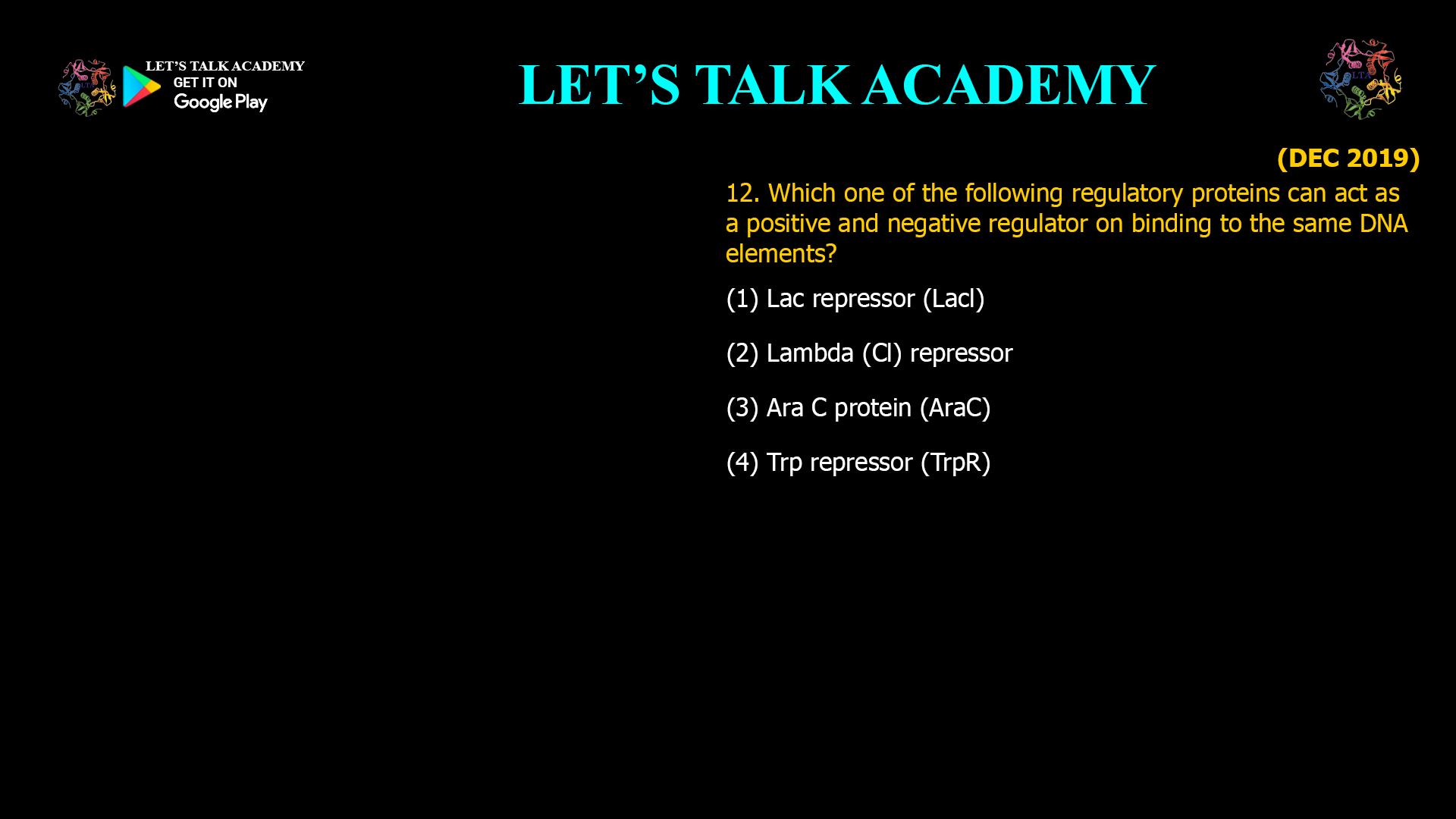
Which one of the following regulatory proteins can act as a positive and negative regulator on binding to the same DNA elements? (1) Lac repressor (Lacl) (2) Lambda (Cl) repressor (3) Ara C protein (AraC) (4) Trp repressor (TrpR)

Understanding the Dual Role of Regulatory Proteins: How Lambda CI Repressor Acts as Both Activator and Repressor

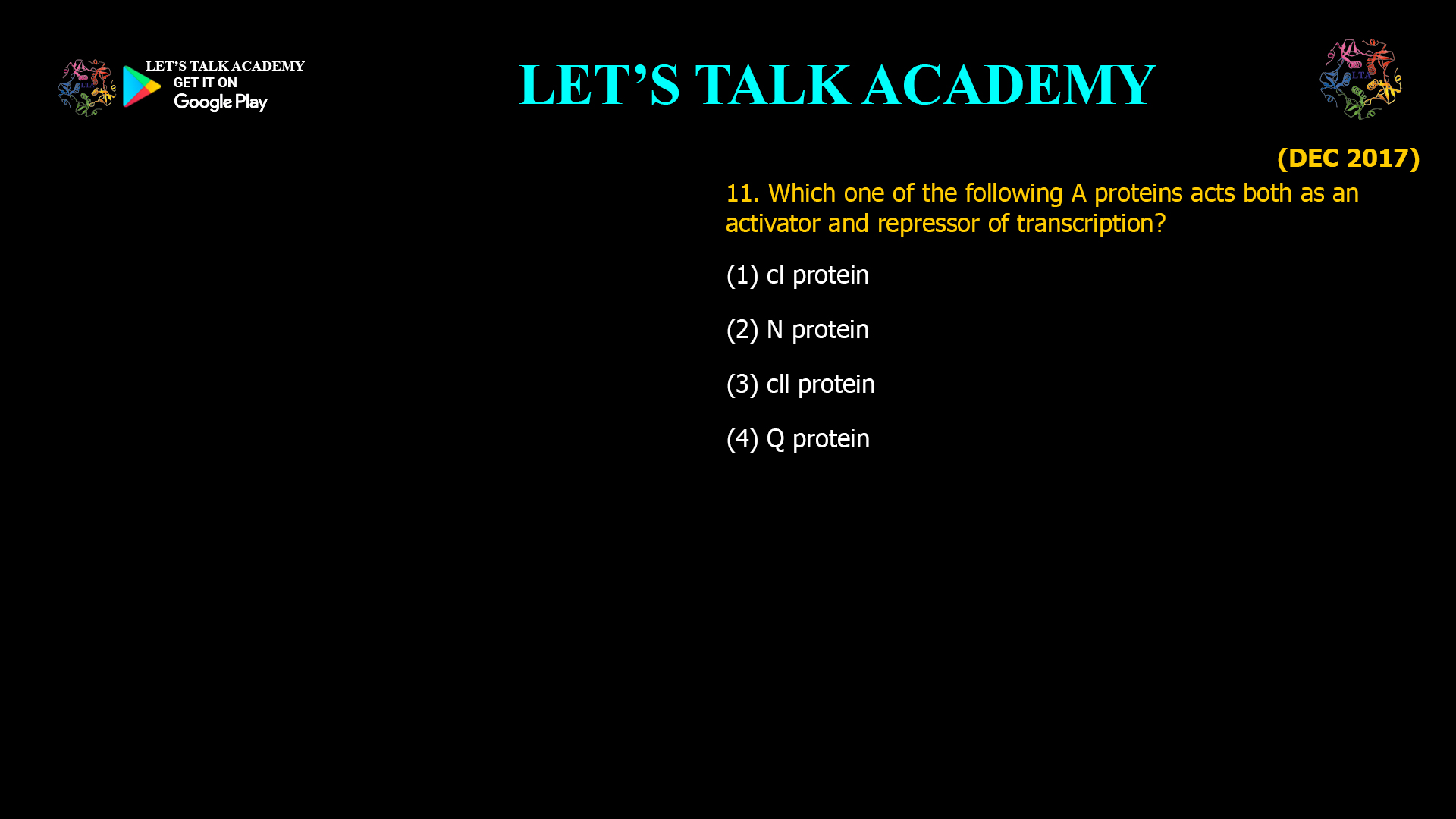
11. Which one of the following A proteins acts both as an activator and repressor of transcription? (1) cl protein         (2) N protein (3) Cll protein       (4) Q protein 

The Dual Role of Lambda Phage CI Protein as Both Activator and Repressor of Transcription

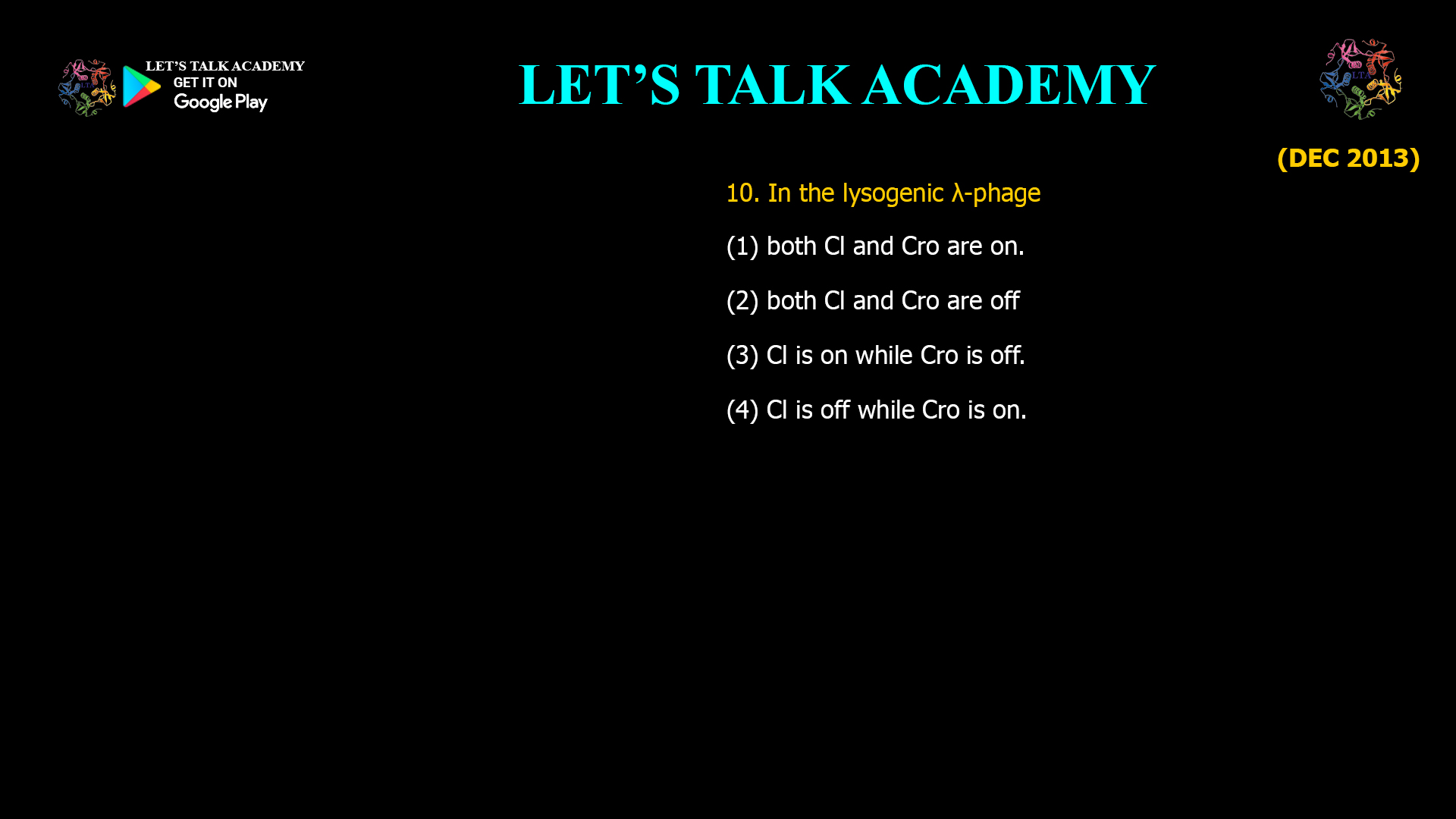
10. In the lysogenic λ-phage (1) both Cl and Cro are on. (2) both Cl and Cro are off (3) Cl is on while Cro is off. (4) Cl is off while Cro is on.

Why CI is On and Cro is Off During the Lysogenic Cycle of Lambda Phage

. Why lysogenic cycle is more beneficial to a virus than lytic cycle under certain circumstances? (1) The Lysogenic cycle prevent local extinction of host while still retaining infectious potential (2) By integrating with the bacterial chromosomes, the genetic instructions for the virus become refreshed after one or more replication events during binary fission (3) Lysogenic infection cycles donot harm their host cells, so they can produce virus C. Clear plaques are formed in Cll mutants D. Turbid plaques are formed in integrase mutants E. Clear plaques are formed in P mutants F. No plaques are formed in cl mutants Which of the following combination of statement is correct? (1) A, B and F only    (2) C, D and E only (3) B and C only      (4) D and F only

Why the Lysogenic Cycle Offers Survival Advantages to Viruses Over the Lytic Cycle

8. During development and differentiation, there is a dynamic programme of differential expression of sets of genes. In bacteria, phage infections are among the simplest examples of developmental process. Typically, only a subset of the phage genome, offer referred to as immediate early genes, are expressed in the host immediately after phage infection. As time passes, early genes start to be expressed, and the immediate early genes and bacterial genes are turned off. In the final stage of phage infection, the early genes give way to late genes. One of the simplest way it is achieved is through (A) expression of cascade of σ factors (B) expression of new RNA polymerases (C) expression of different holoenzymes (D) expression of different transcription factors The correct reasons are (1) A, D           (2) A, C, D (3) A, B, D       (4) A, B, C

Understanding Temporal Gene Expression in Phages: The Role of Sigma Factors, Holoenzymes, and Transcription Factors

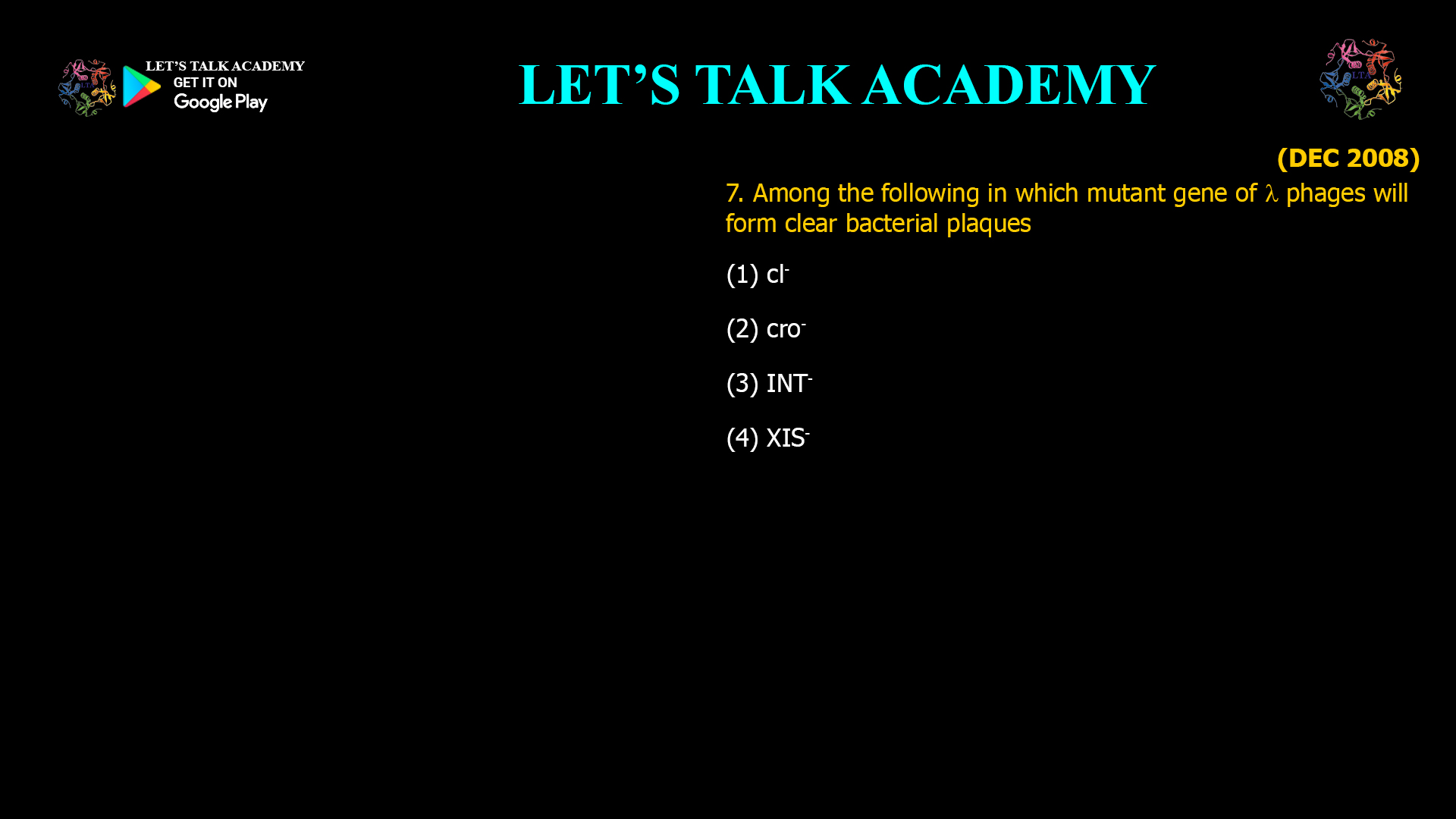
7. Among the following in which mutant gene of  phages will form clear bacterial plaques (1) cl- (2) cro- (3) INT- (4) XIS-

Understanding Which Lambda Phage Mutant Gene Produces Clear Bacterial Plaques

6. A culture of an E. coli strain that is lysogenic for phage lambda is grown at 320C Induction of the prophage from the host chromosome will occur when the culture is exposed to (1) 400C. (2) Ultra violet radiation. (3) Infra-red radiation (4) Wild type E. coli culture

How UV Radiation Induces Lambda Prophage from Lysogenic E. coli Cultures

5. T4 bacteriophage after infecting E. coli generally hijack host machinery for transcription of its own genes. It is done by (1) Degrading host RNA polymerase (2) Modifying host RNA polymerase (3) Synthesis of own RNA polymerase (4) Degradation of host genome

How Bacteriophage T4 Hijacks Host RNA Polymerase for Viral Gene Transcription in E. coli

4. Bacteriophage T4 transcribe the viral genes immediately after infection using (1) host RNA polymerase. (2) viral RNA polymerase. (3) modified host RNA polymerase. (4) RNA transcriptase.

How Bacteriophage T4 Transcribes Viral Genes Immediately After Infection

Latest Courses