97. For a particle executing SHM: v(t) = −100 sin (20t + π/3) a(t) = −2000 cos (20t + π/3) Find the amplitude of oscillation.

Amplitude of SHM from Velocity and Acceleration Equations

96. The energy of an electron in the ground state of hydrogen is 13.6 eV. The energy required to excite it to the first excited state is ________.

Energy Required to Excite Hydrogen Electron

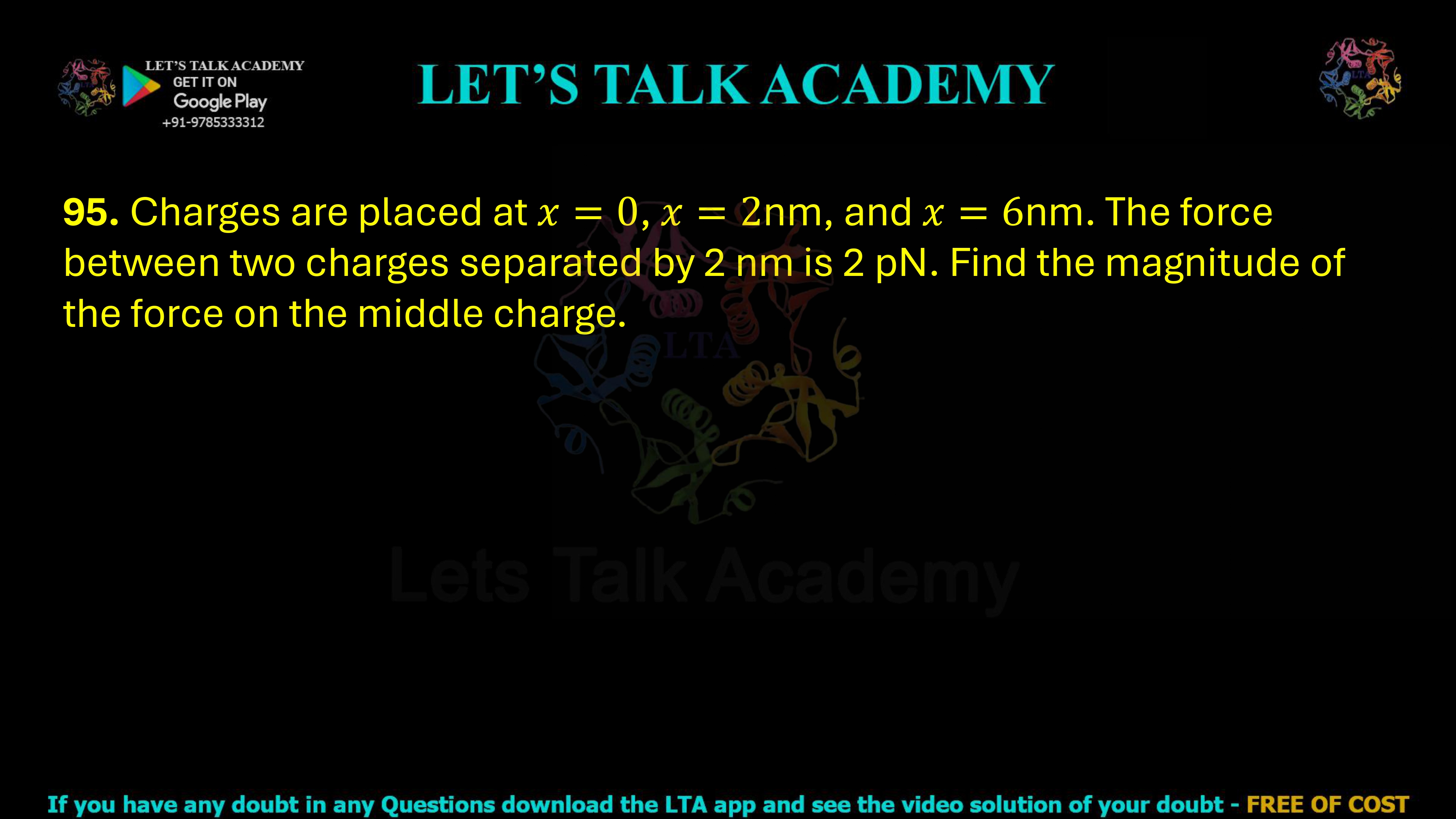
95. Charges are placed at x=0, x=2nm, and x=6nm. The force between two charges separated by 2 nm is 2 pN. Find the magnitude of the force on the middle charge.

Force on the Middle Charge Using Coulomb’s Law

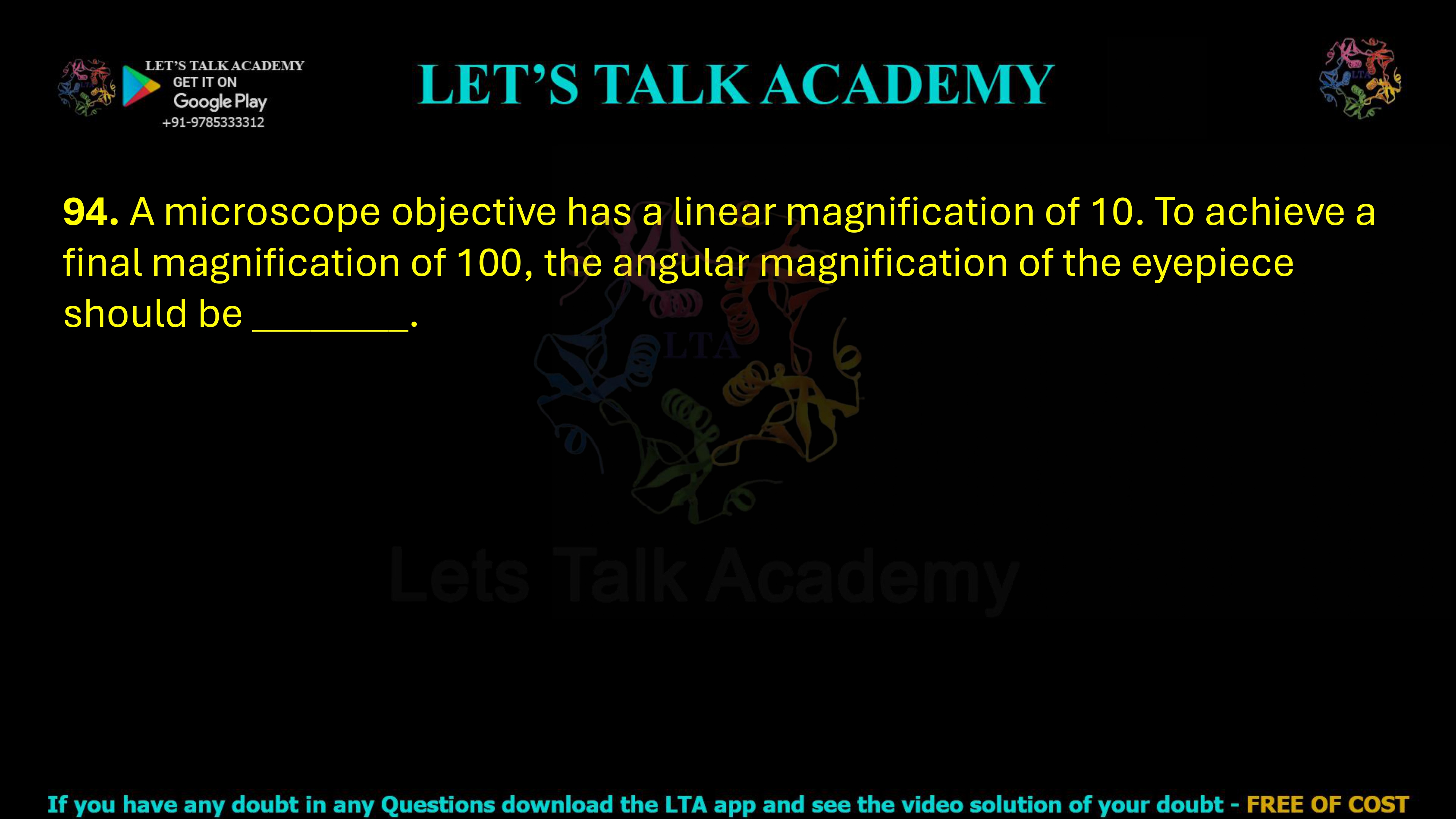
94. A microscope objective has a linear magnification of 10. To achieve a final magnification of 100, the angular magnification of the eyepiece should be ________.

Compound Microscope Magnification Numerical

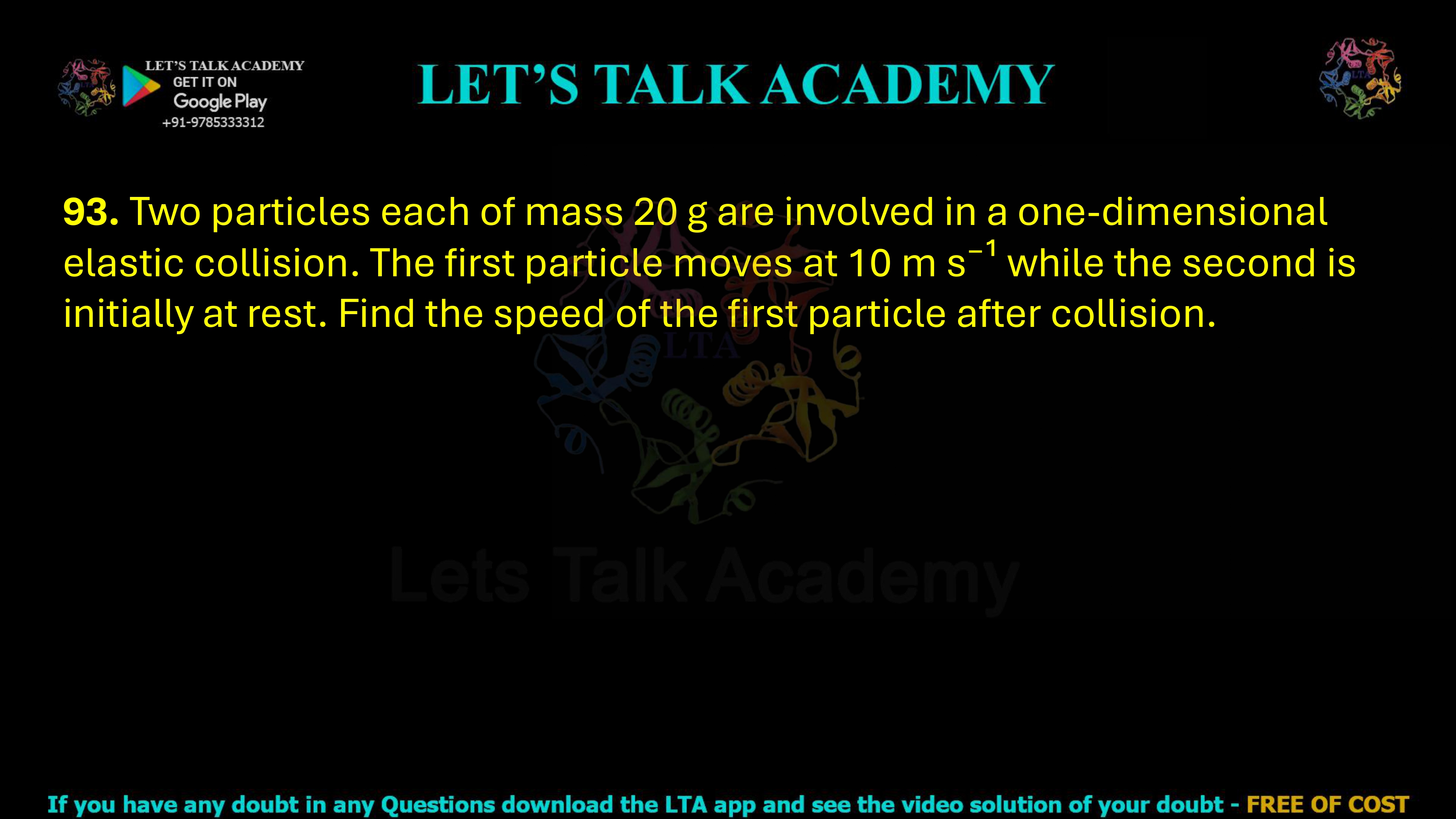
93. Two particles each of mass 20 g are involved in a one-dimensional elastic collision. The first particle moves at 10 m s⁻¹ while the second is initially at rest. Find the speed of the first particle after collision.

One-Dimensional Elastic Collision Between Two Equal Masses

92. The truth table of a logic gate is: Input A Input B Output 0 0 1 0 1 1 1 1 0 Find the output for input (1,0).

Logic Gate Truth Table

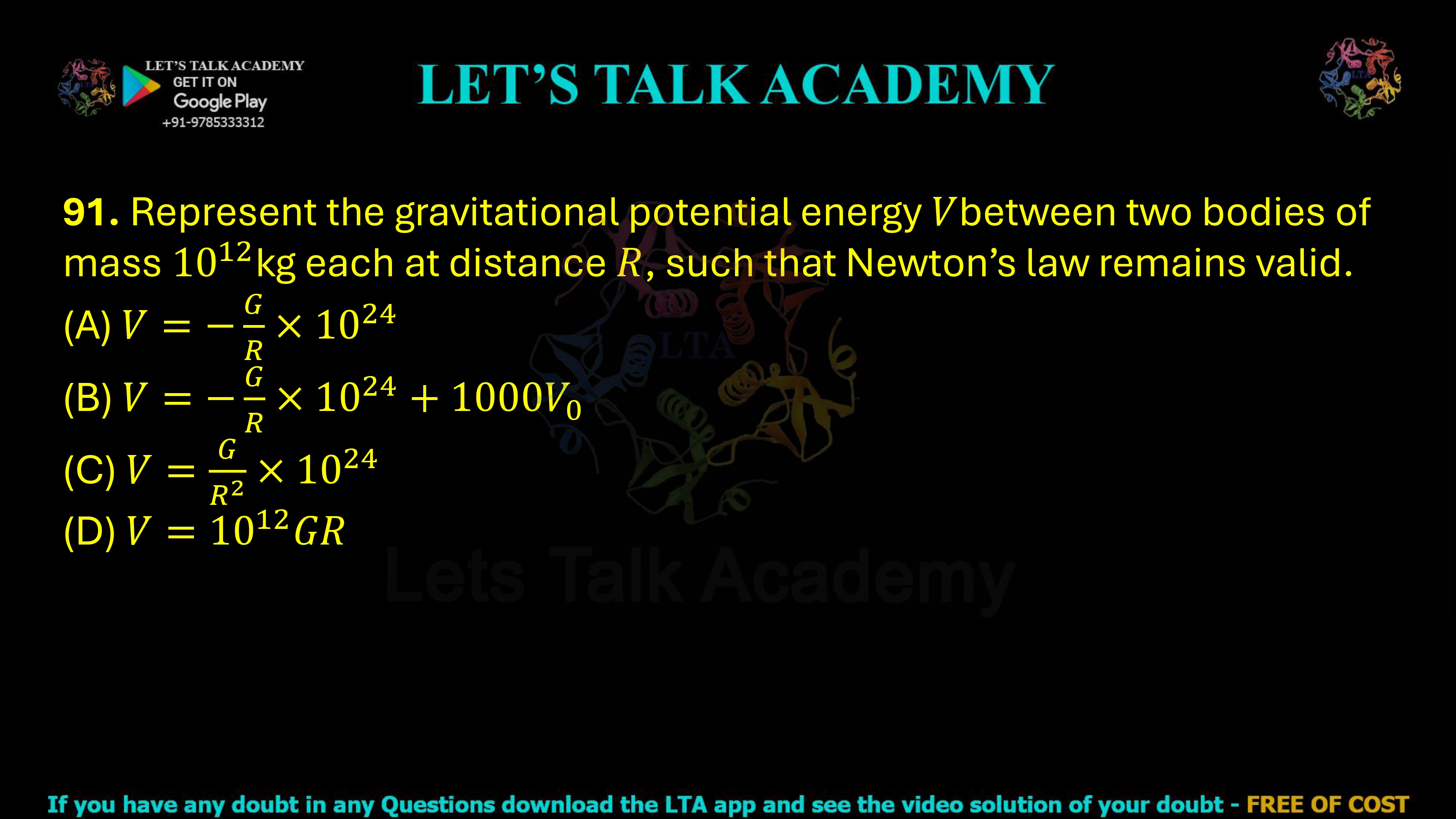
91. Represent the gravitational potential energy V between two bodies of mass 1012 kg each at distance R, such that Newton's law remains valid. (A) V = −(G/R) × 1024 (B) V = −(G/R) × 1024 + 1000V0 (C) V = (G/R²) × 1024 (D) V = 1012GR

Gravitational Potential Energy Between Two Masses

90. Which of the following is(are) CORRECT? (A) Light has wave nature only (B) Light can have both wave and particle nature (C) Photoelectric effect shows that light can behave like particles (D)Interference experiments show that light behaves like particles

Wave Nature and Particle Nature of Light

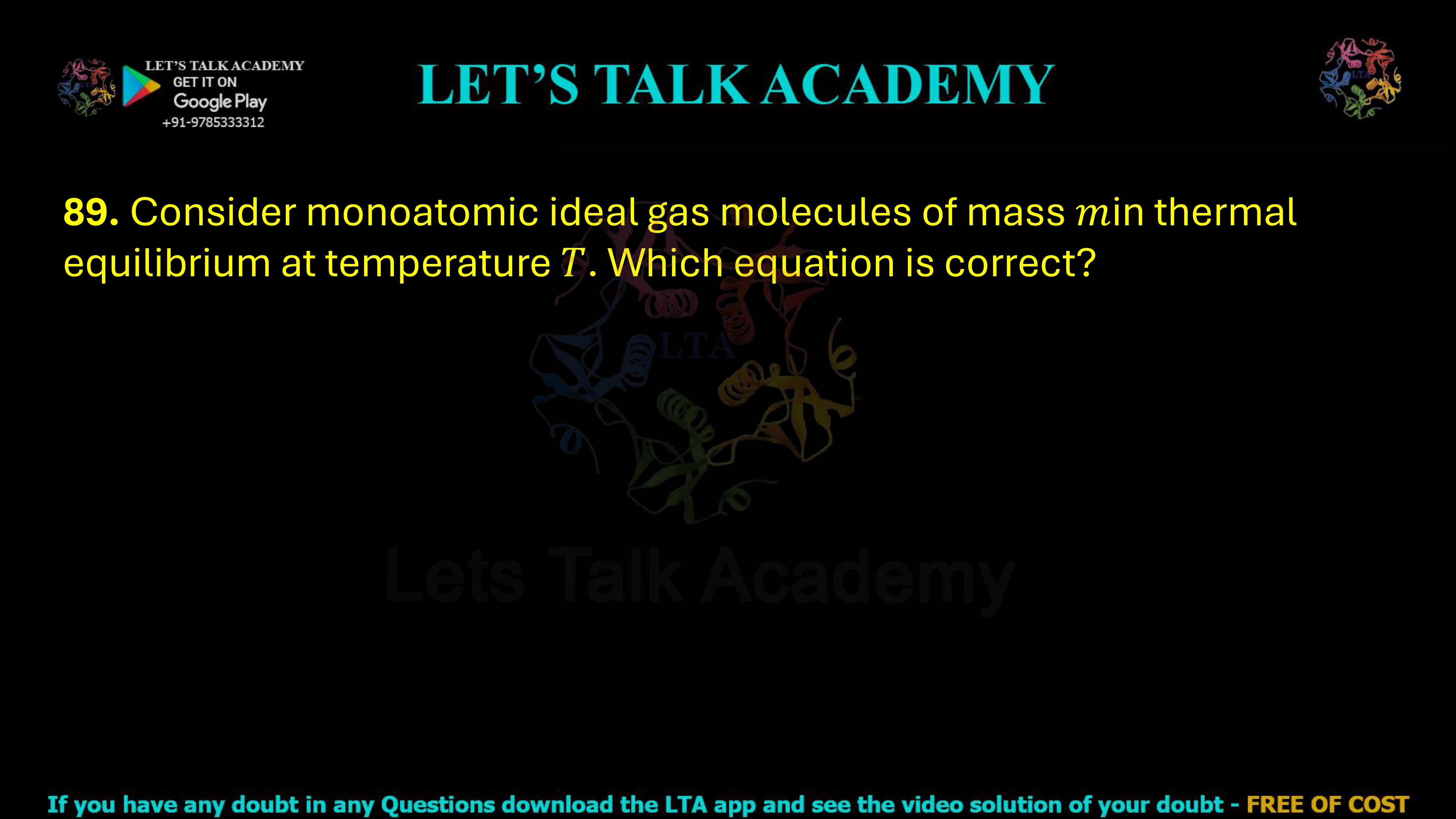
89. Consider monoatomic ideal gas molecules of mass min thermal equilibrium at temperature T. Which one of the following equations is correct? (the angular brackets denote average, 𝑘𝐵 is Boltzmann constant, 𝑣 is velocity, and vx is the x-component of velocity)

Equipartition Theorem

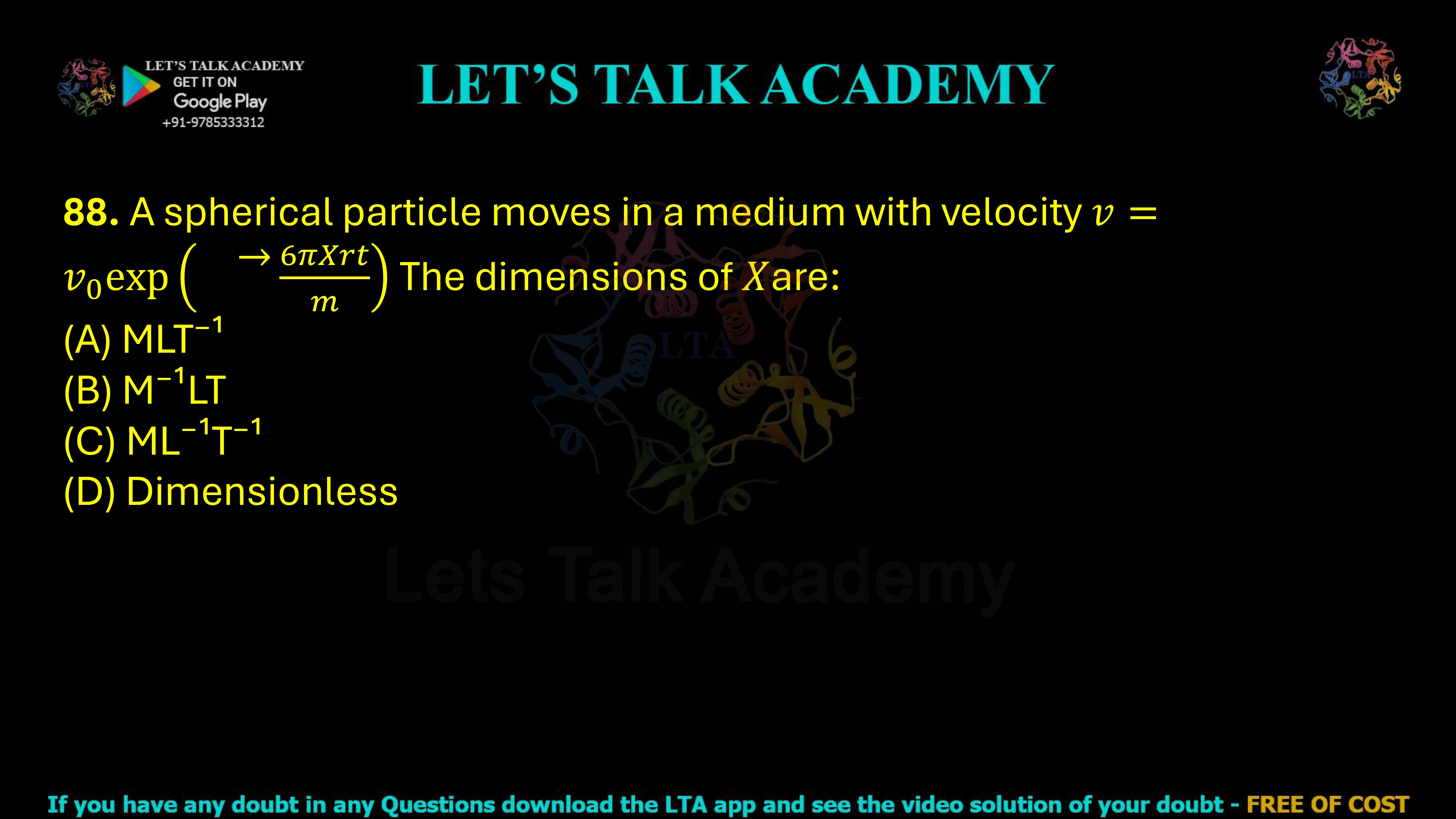
88. A spherical particle moves in a medium with velocity v = v0 exp (−6πXrt / m) The dimensions of  X are: (A) MLT⁻¹ (B) M⁻¹LT (C) ML⁻¹T⁻¹ (D) Dimensionless

Dimensions of X in Exponential Velocity Equation

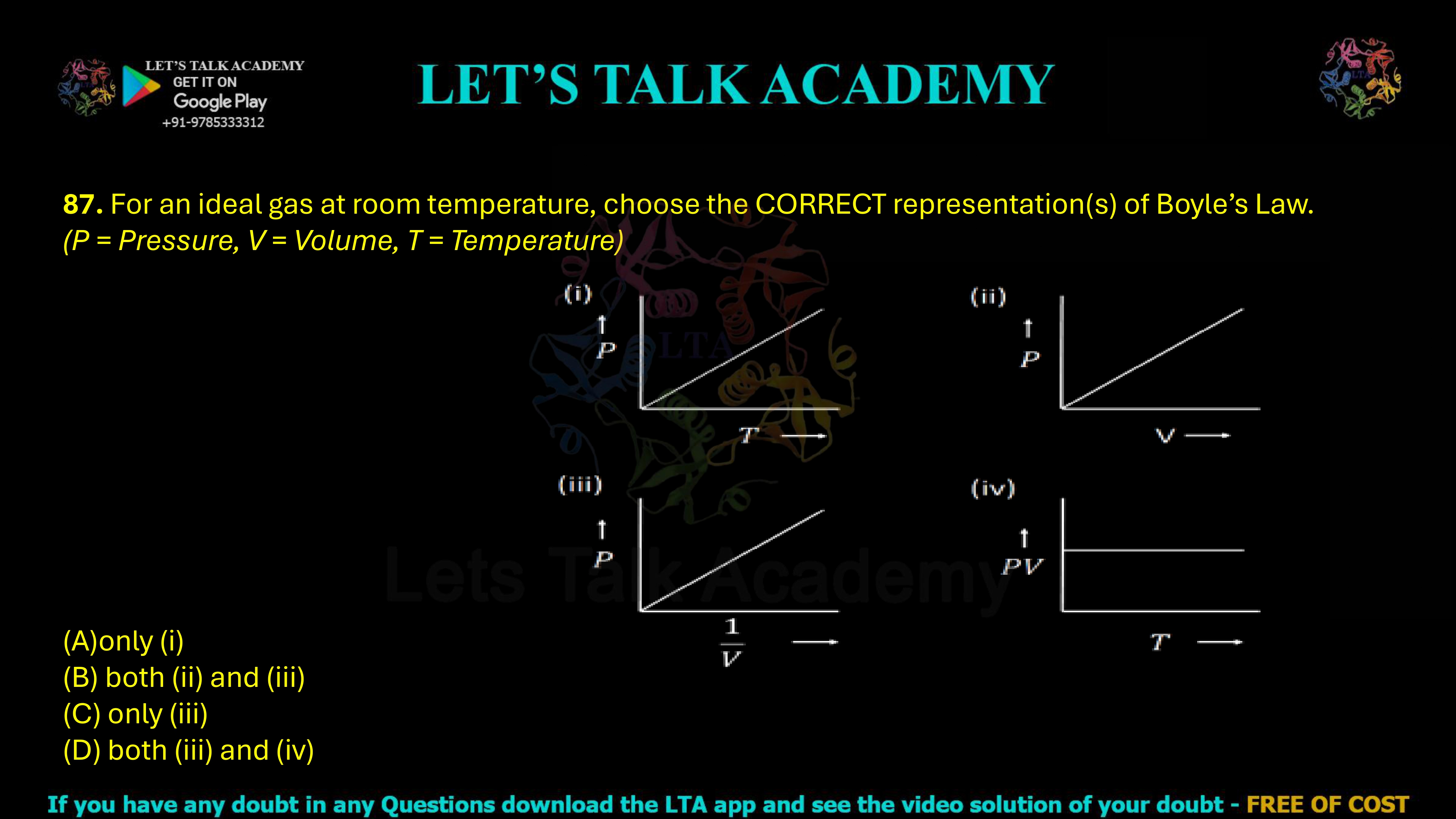
87. For an ideal gas at room temperature, choose the CORRECT representation(s) of Boyle’s Law. (P = Pressure, V = Volume, T = Temperature) (A) only (i) (B) both (ii) and (iii) (C) only (iii) (D) both (iii) and (iv)

Boyle’s Law Graph

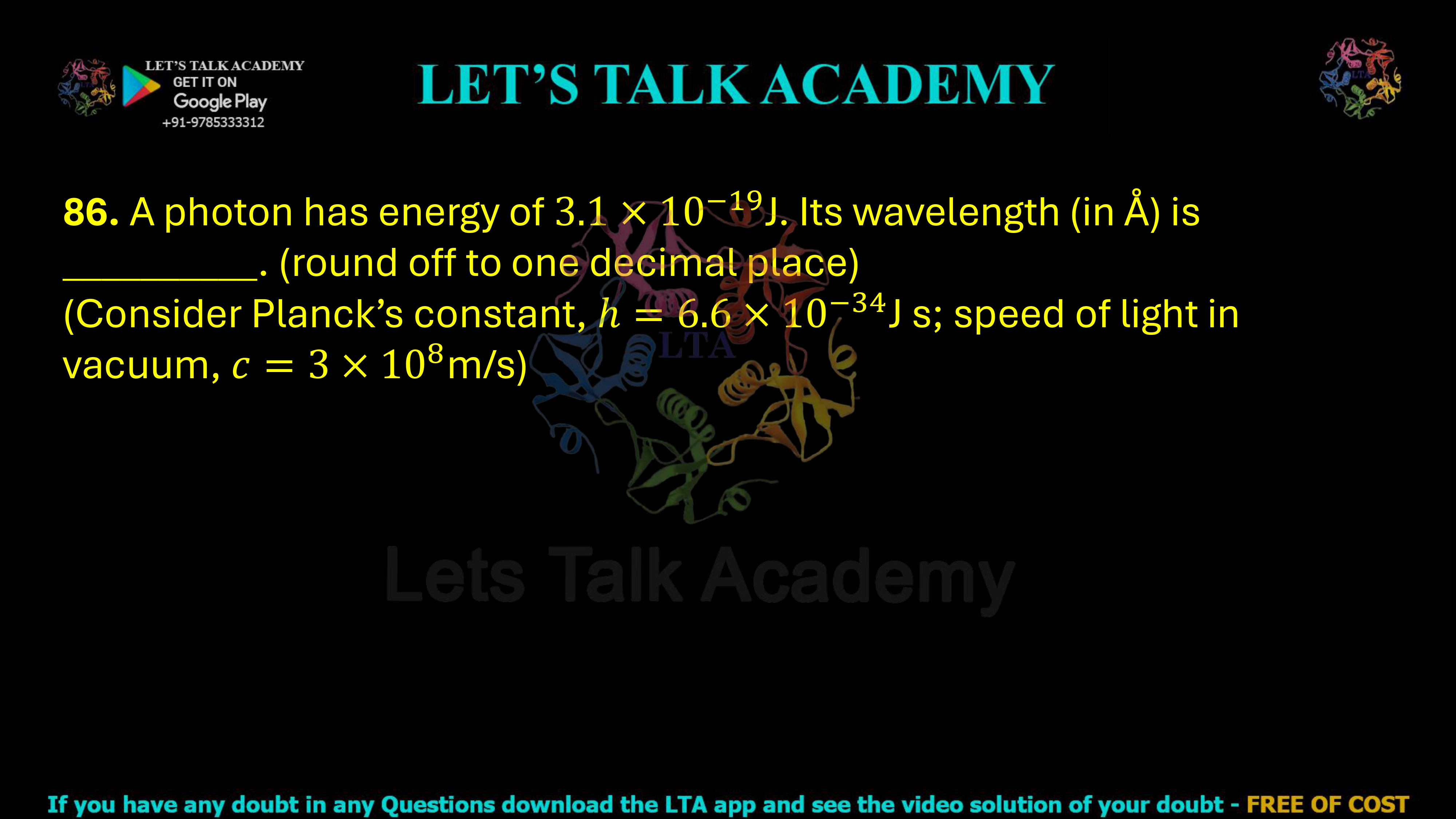
86. A photon has energy of J. Its wavelength (in Å) is __________. (round off to one decimal place) (Consider Planck’s constant, J s; speed of light in vacuum, m/s)    

Photon Wavelength from Energy Numerical

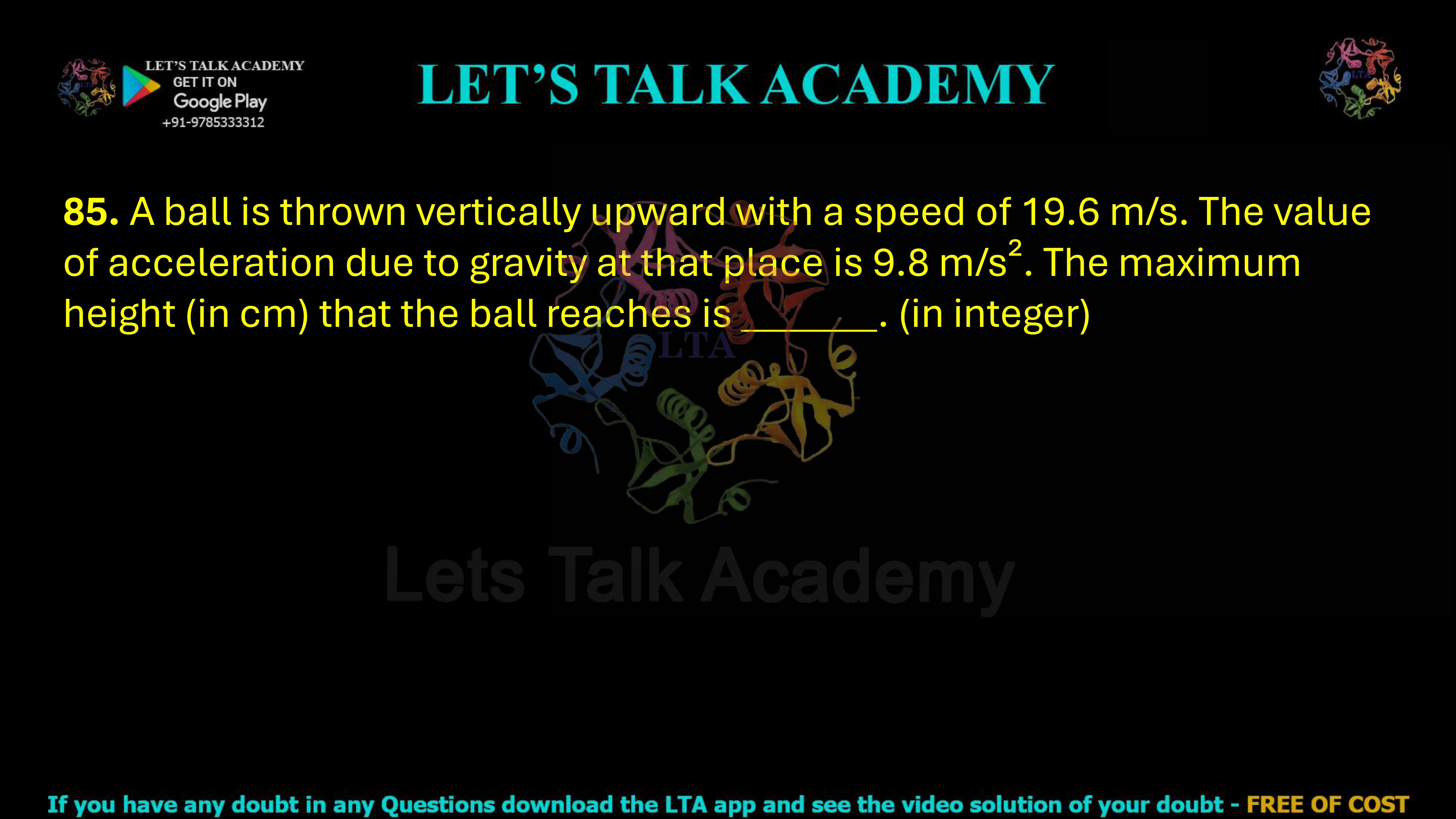
85. A ball is thrown vertically upward with a speed of 19.6 m/s. The value of acceleration due to gravity at that place is 9.8 m/s². The maximum height (in cm) that the ball reaches is _______. (in integer)

Maximum Height Reached by a Vertically Thrown Ball

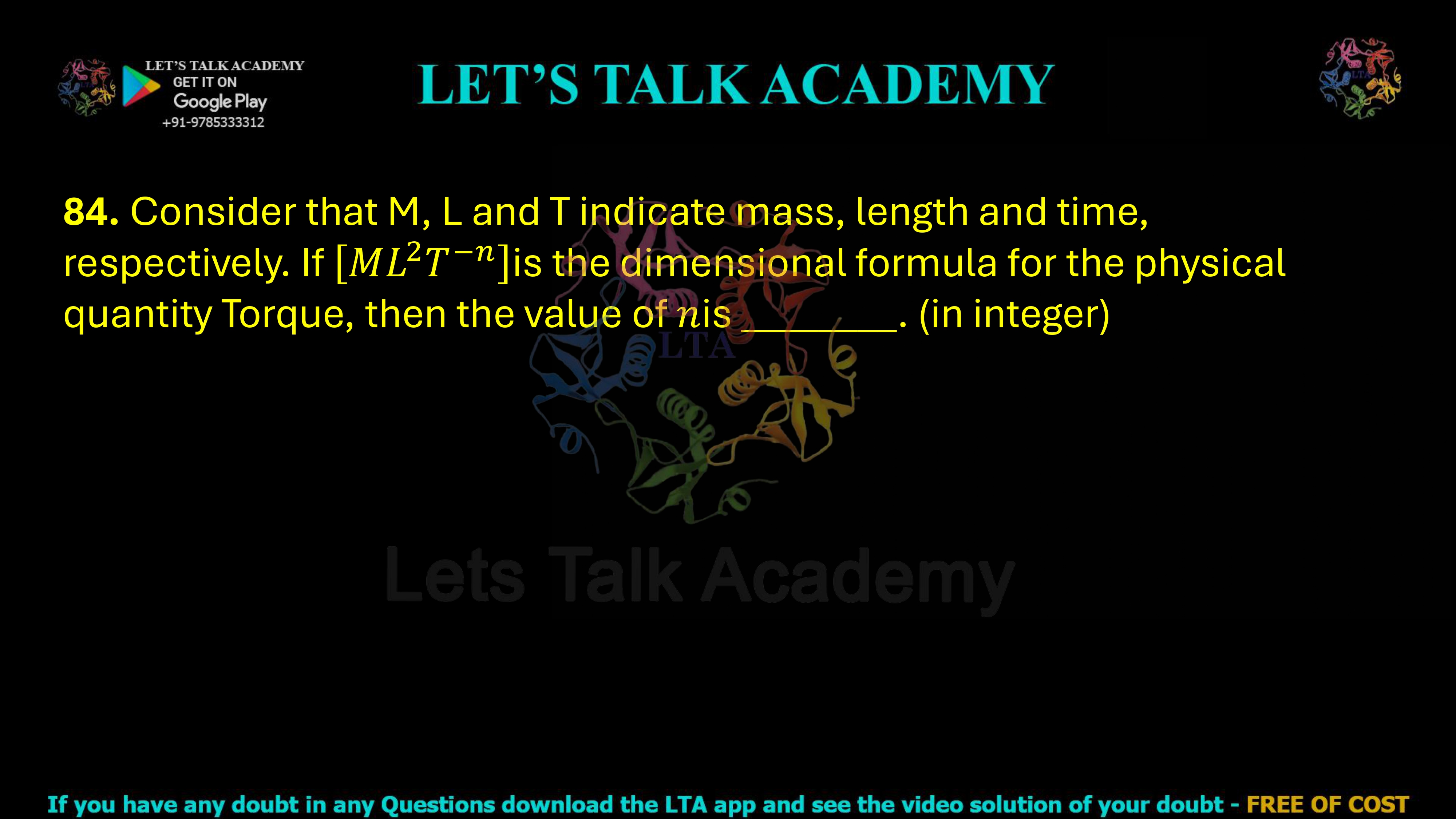
84. Consider that M, L and T indicate mass, length and time, respectively. If is the dimensional formula for the physical quantity Torque, then the value of is ________. (in integer)

Dimensional Formula of Torque

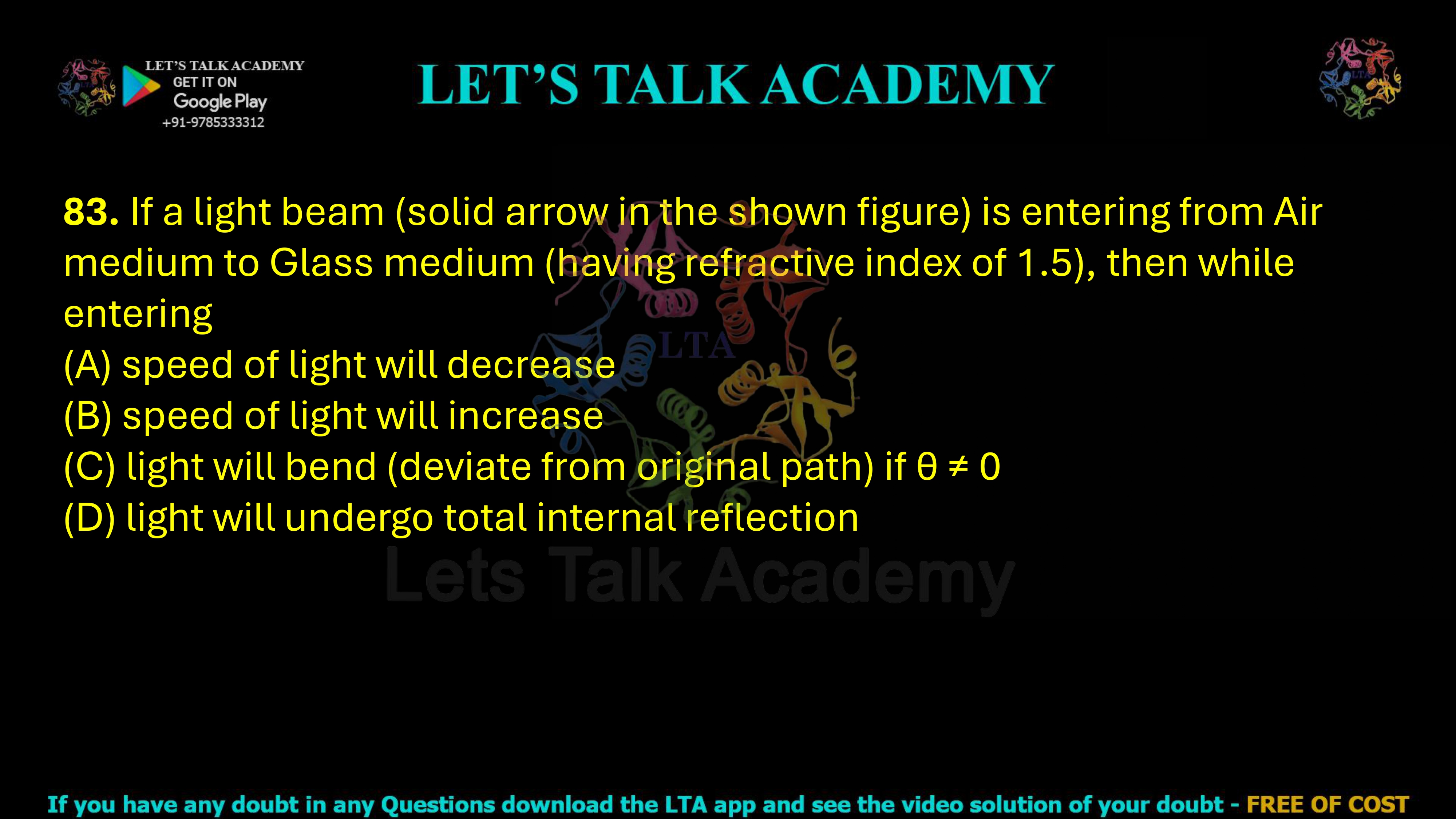
83. If a light beam (solid arrow in the shown figure) is entering from Air medium to Glass medium (having refractive index of 1.5), then while entering (A) speed of light will decrease (B) speed of light will increase (C) light will bend (deviate from original path) if θ ≠ 0 (D) light will undergo total internal reflection

Light Entering from Air to Glass

82. The capacitance of a parallel plate capacitor will get doubled if  (A) the area of each plate is doubled (B) the area of each plate is halved (C) the distance between the plates is doubled (D) the distance between the plates is halved

Capacitance of a Parallel Plate Capacitor

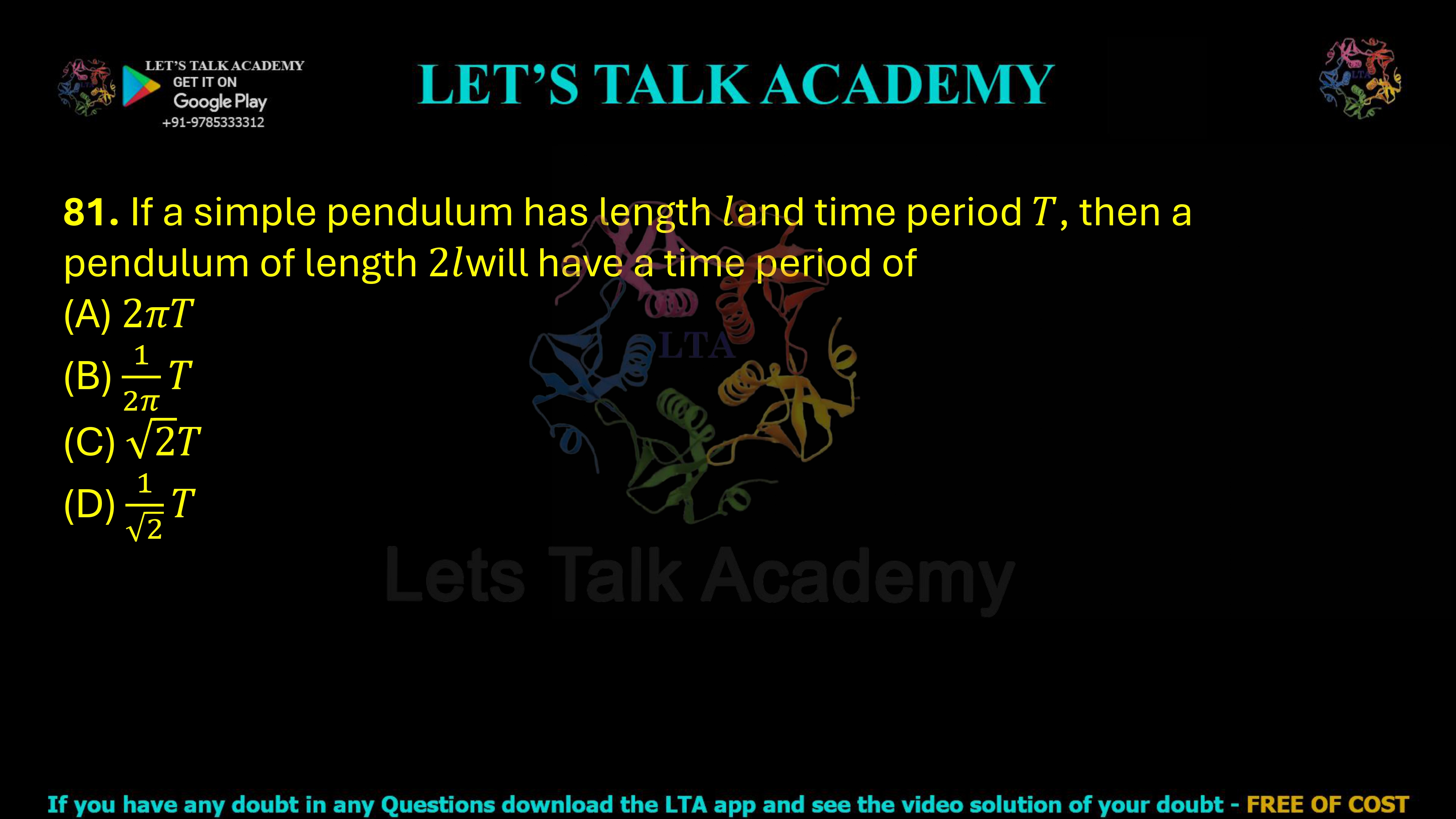
81. If a simple pendulum has length and time period , then a pendulum of length will have a time period of 

Time Period of a Simple Pendulum

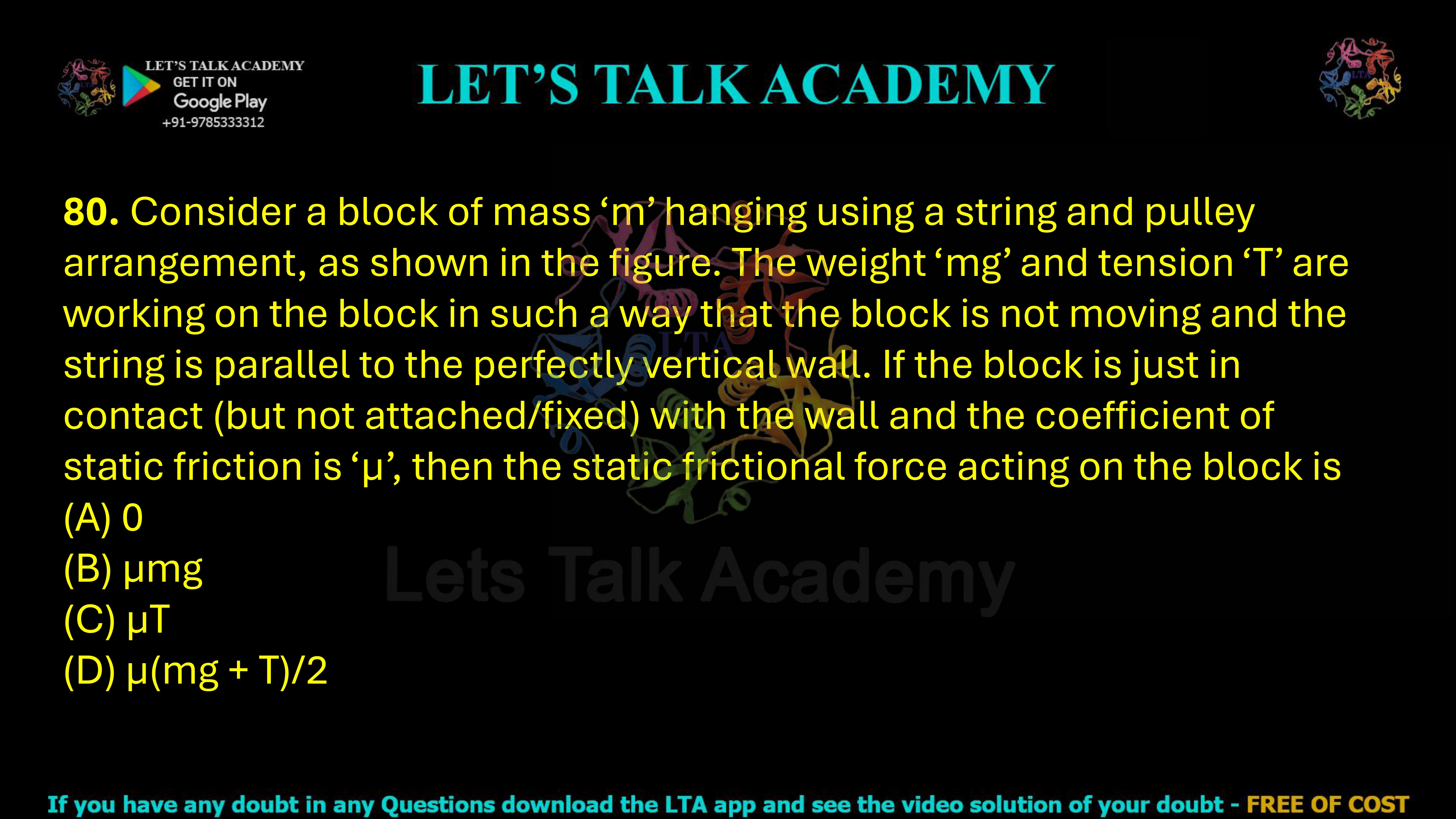
80. Consider a block of mass ‘m’ hanging using a string and pulley arrangement, as shown in the figure. The weight ‘mg’ and tension ‘T’ are working on the block in such a way that the block is not moving and the string is parallel to the perfectly vertical wall. If the block is just in contact (but not attached/fixed) with the wall and the coefficient of static friction is ‘μ’, then the static frictional force acting on the block is  (A) 0 (B) μmg (C) μT (D) μ(mg + T)/2

Static Friction on a Block Just Touching a Vertical Wall

79. A bat emitting ultrasound at 50 kHz is flying directly towards a solid wall with a speed of 3 ms–1. If the speed of sound in air is 330 ms–1, the frequency of the reflected signal (in kHz) heard by the bat will  be    

Bat and Wall Doppler Effect Problem

 78. A nuclear power plant generates 1000 Megawatts (MW) of electrical power and used half of its fuel supply in 5 years. The reactor uses 235U with 33% efficiency for the conversion of heat released by nuclear fission to electrical power. Each atom of 235U releases 200 MeV of energy. How many tons of 235U did the reactor start with? (1 ton = 1000 kg; Avogadro number = 6.023 × 10²³ mol–1)                    

Nuclear Power Plant Fuel Consumption Numerical

77. The axis of rotation of the earth makes an angle of 66.5o with the plane containing the Earth’s orbit around the Sun (called the plane of the ecliptic). If this angle were 50o, then the area of the Earth’s surface from which a “midnight Sun” (24 hour daylight) can be observed would change. The ratio of the new area to the previous area is    

Midnight Sun Area Ratio When Earth’s Axial Tilt Changes

76. A 50-metre tall antenna transmits at 107 MHz (one of the FM radio broadcast frequencies). Calculate the maximum distance from the antenna at which the transmitted signal can be heard. Ignore atmospheric attenuation and give your answer correct to the nearest kilometer only. You are given that the radius of the earth is 6400 km.

Maximum Distance of FM Radio Signal from an Antenna

75. A man weighing 70 kg stands on a weighing scale which is placed in an elevator. The elevator is moving up towards its destination floor with a velocity of 1.0 ms–1. As it approaches the destination floor it starts slowing down, such that it comes to rest in 2 seconds. Assuming the acceleration due to gravity, g = 9.8 ms–2, the reading of the weighing scale just before the elevator comes to rest is 

Weighing Scale Reading in a Decelerating Elevator

74. The “strong nuclear force” holds the protons and neutrons (nucleons) together in the nucleus of an atom. It is found that the binding energy per nucleon (for the nucleus of an element) when plotted against the mass number (A) of that element changes very little for 30 < A < 150. The binding energy is lower for A > 150. This leads us to conclude that     (A) the strong nuclear force must oscillate with distance with a periodicity approximately same as the size of a proton or neutron (B) the fusion of two elements, both with A > 150 may release energy (C) the strong nuclear force changes very slowly with distance (i.e. It is long ranged on the scale of the size of nucleus) (D) the strong nuclear force goes to zero very rapidly with distance (i.e. It is short ranged on the scale of the size of nucleus)

Binding Energy Per Nucleon and Strong Nuclear Force

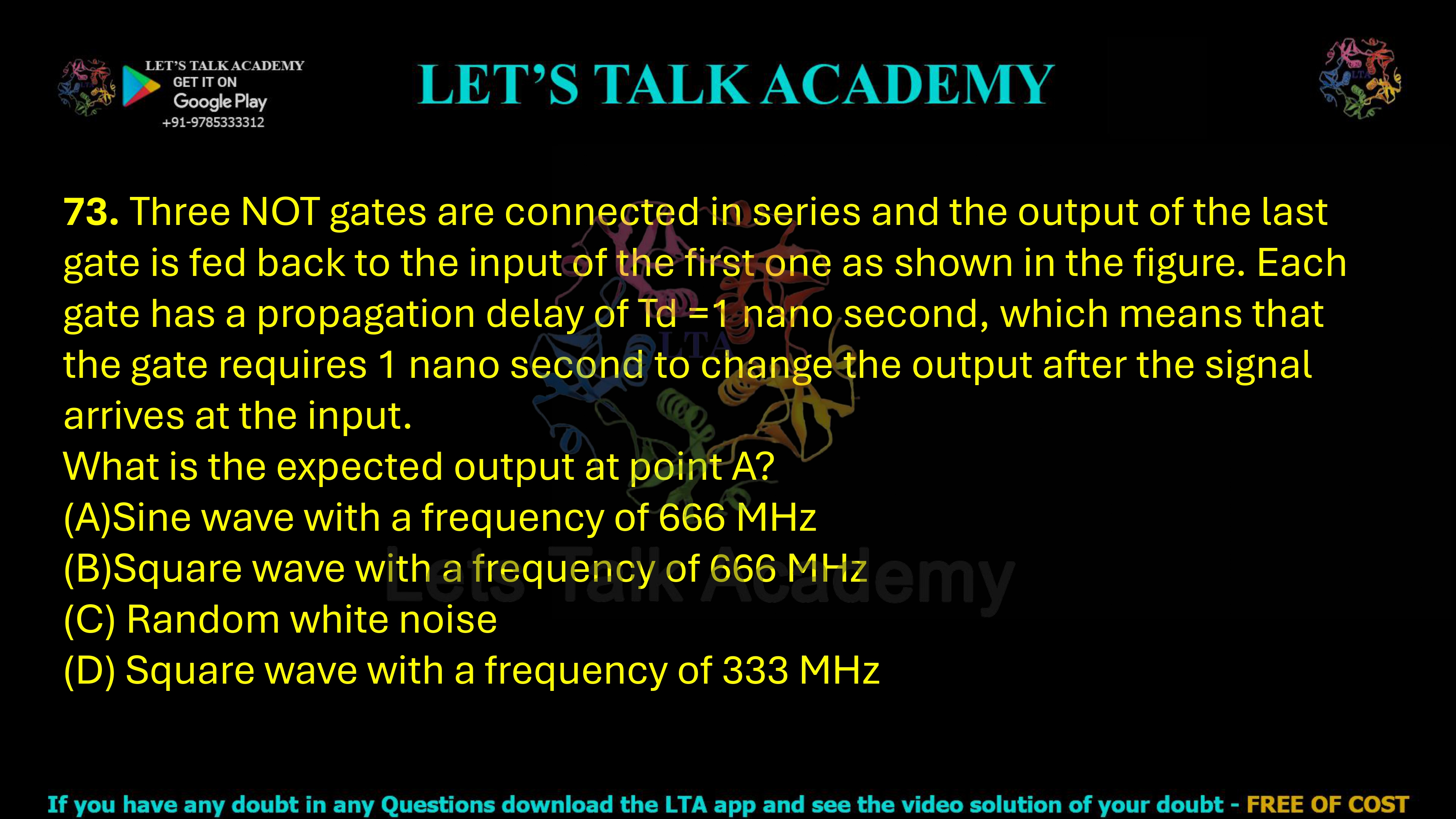
73. Three NOT gates are connected in series and the output of the last gate is fed back to the input of the first one as shown in the figure. Each gate has a propagation delay of Td =1 nano second, which means that the gate requires 1 nano second to change the output after the signal arrives at the input.  What is the expected output at point A? (A)Sine wave with a frequency of 666 MHz          (B)Square wave with a frequency of 666 MHz (C) Random white noise (D) Square wave with a frequency of 333 MHz

Ring Oscillator Using Three NOT Gates

72. The minimum light intensity that the human eye can perceive is 10–10 Wm–2. The area of the opening of our eye (the pupil) is approximately 0.4 cm–2. Consider yellow light with wavelength l=600 nm. The number of photons incident on the retina per second at the minimum intensity for the eye to respond is  (A)1.5×10³ (B) 5×10³ (C) 8×10³ (D) 1.2×10⁴

Number of Photons Incident on the Human Eye

71. If a projectile lifts off from the surface of the Earth with a speed of 11.2 km.s–1, then it can escape from the Earth’s gravitational field completely. This is called the escape velocity. If the radius of the Earth were 2 times larger and the mass 8 times larger, then the escape velocity (in km.s–1) would be (A) 5.6 (B) 11.2 (C) 22.4 (D) 44.8

Escape Velocity When Earth’s Mass and Radius Change

70. A copper wire having a cross sectional area of 6.62 × 10⁻⁶ m2 carries a current of 20 A. Assuming that each atom contributes one free electron to the current, the time required by electrons to travel a distance of 1 m is min. Given data: Density of copper = 8.92 g/cm3 and molar mass = 63.5 g/mol, Avogadro number = 6.02 × 10²³ 

Drift Velocity of Electrons in a Copper Wire

69. A jet plane lands on an aircraft carrier at 70 m/s and stops in 3 seconds. Assuming that the acceleration is constant, the jet plane travels a distance of ____ m before it stops.

Distance Travelled by a Jet Plane Before Stopping

68. In Young’s double slit experiment, the slits are separated by a distance of 0.05 mm and the source emits light of two wavelengths 450 and 520 nm. If the distance between the slit and viewing screen is 2 m, the separation between 2nd order bright fringes for the two wavelengths is _____cm.           

Separation Between Second Order Bright Fringes

67. The magnetic field in the interior of a long current-carrying solenoid can be increased by (A) increasing the length of solenoid while keeping the number of turns per unit length as constant (B) increasing the number of turns per unit length (C) increasing the current in the solenoid (D) decreasing the length of solenoid while keeping the number of turns per unit length as constant

Magnetic Field Inside a Long Solenoid

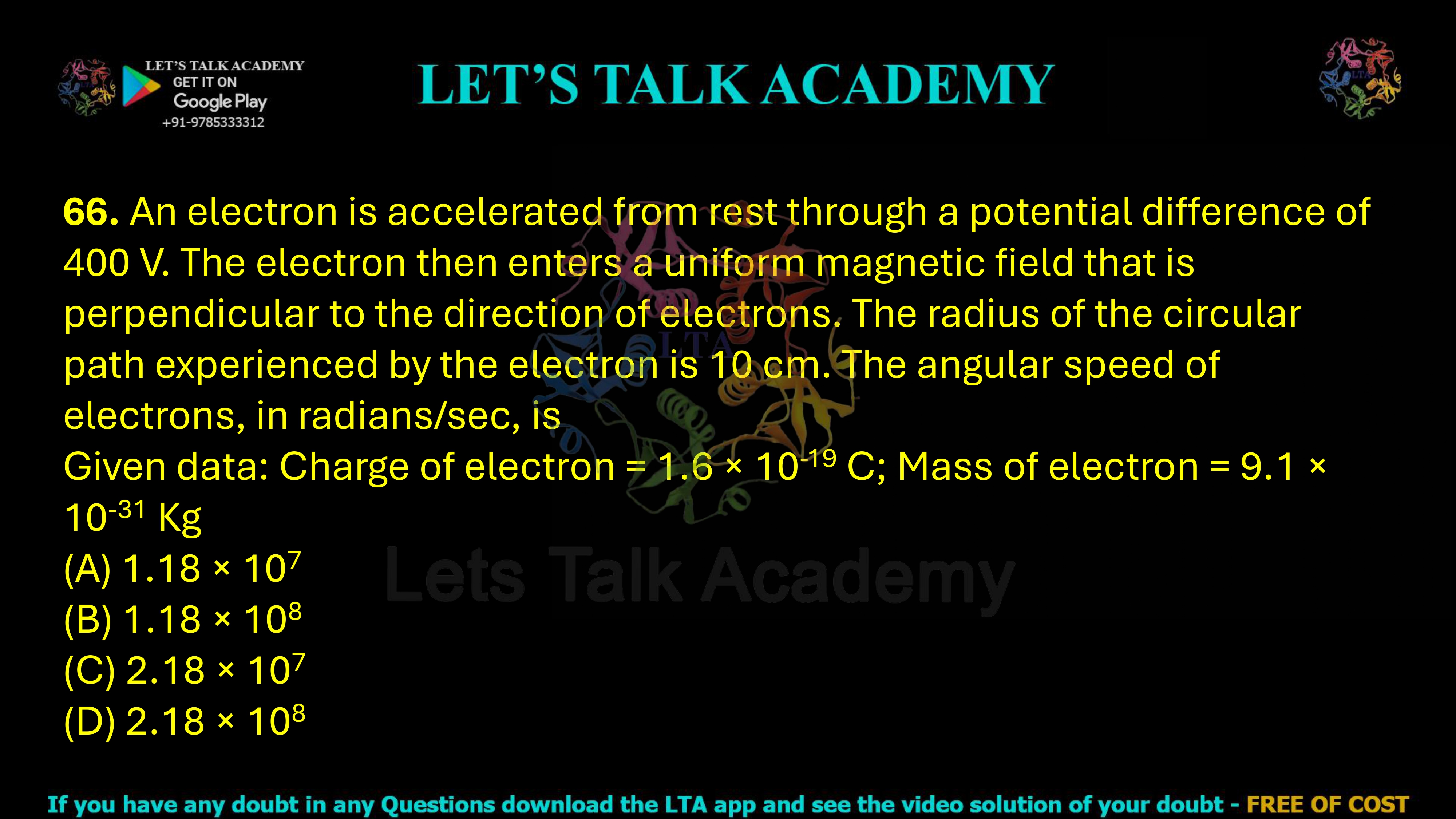
66. An electron is accelerated from rest through a potential difference of 400 V. The electron then enters a uniform magnetic field that is perpendicular to the direction of electrons. The radius of the circular path experienced by the electron is 10 cm. The angular speed of electrons, in radians/sec, is Given data: Charge of electron = 1.6 × 10⁻¹⁹ C; Mass of electron = 9.1 × 10⁻³¹ Kg                      (A) 1.18 × 10⁷    (B) 1.18 × 10⁸    (C) 2.18 × 10⁷    (D) 2.18 × 10⁸

Electron Angular Speed in a Magnetic Field

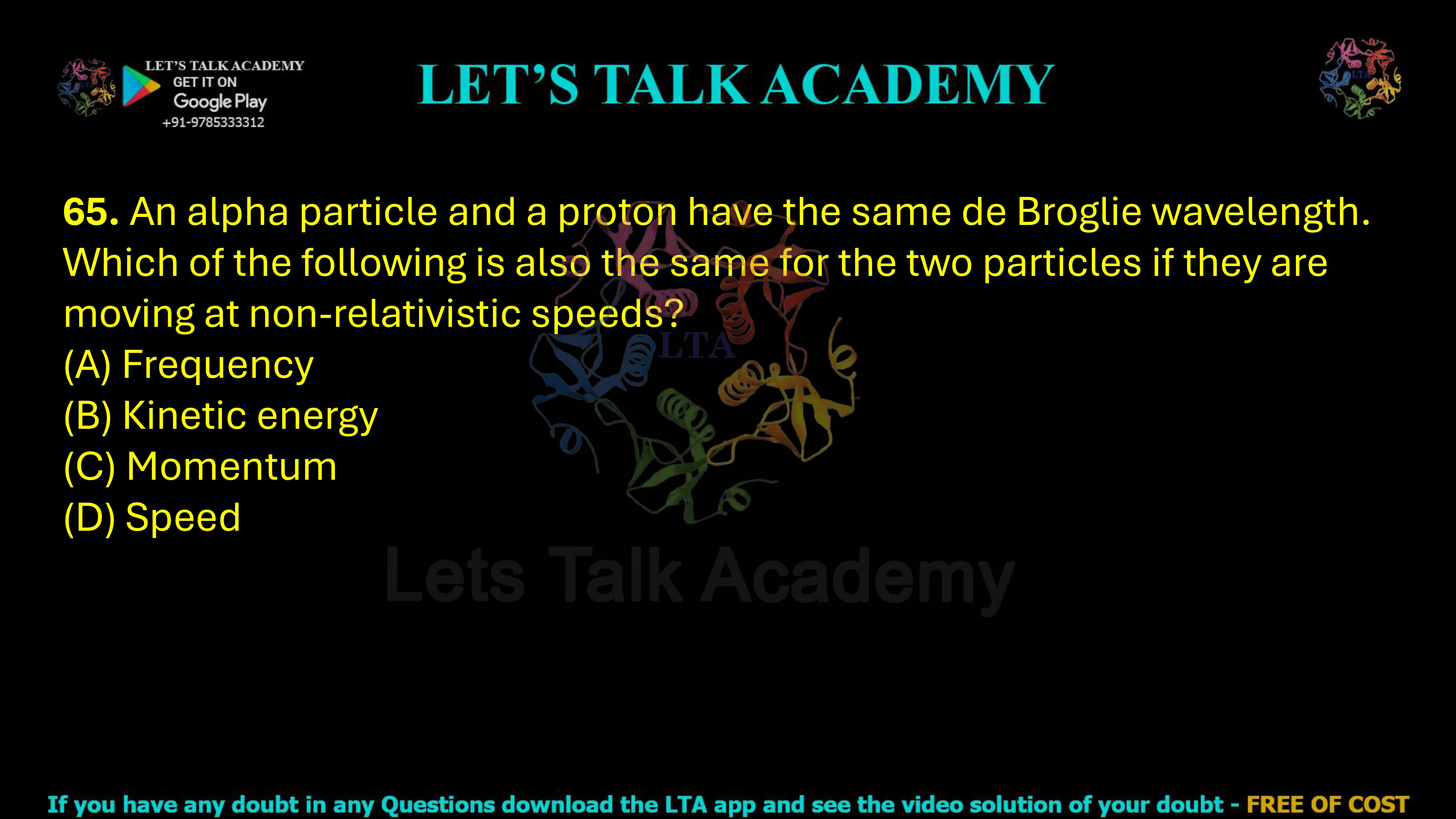
65. An alpha particle and a proton have the same de Broglie wavelength. Which of the following is also the same for the two particles if they are moving at non-relativistic speeds?   (A) Frequency   (B) Kinetic energy         (C) Momentum  (D) Speed

Alpha Particle and Proton with Same de Broglie Wavelength

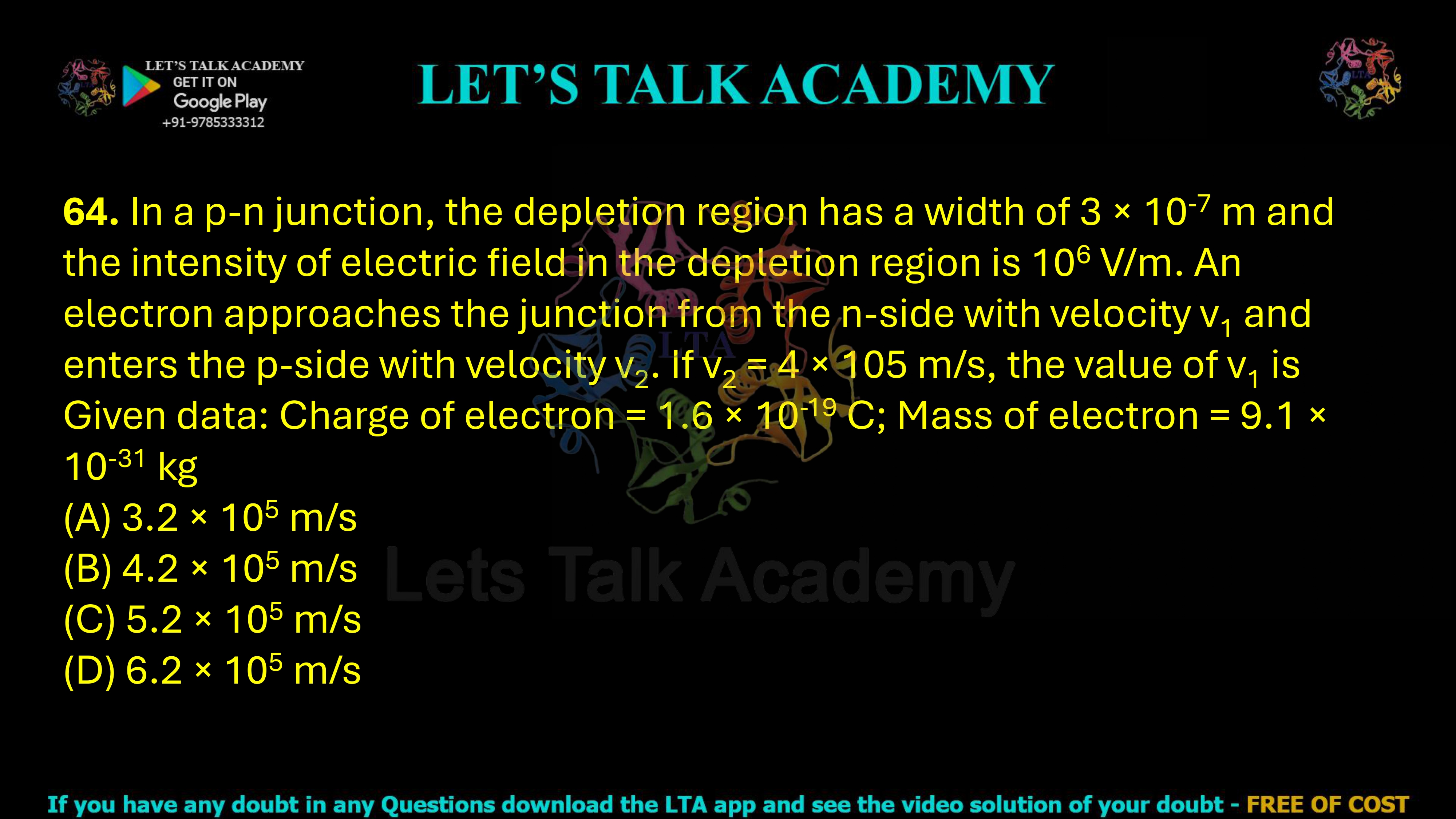
64. In a p-n junction, the depletion region has a width of 3 × 10⁻⁷ m and the intensity of electric field in the depletion region is 106 V/m. An electron approaches the junction from the n-side with velocity v1 and enters the p-side with velocity v2. If v2 = 4 × 10⁵ m/s, the value of v1 is Given data: Charge of electron = 1.6 × 10⁻¹⁹ C; Mass of electron = 9.1 × 10⁻³¹ kg                      (A) 3.2 × 10⁵ m/s           (B) 4.2 × 10⁵ m/s           (C) 5.2 × 10⁵ m/s           (D) 6.2 × 10⁵ m/s

Electron Velocity in a p-n Junction

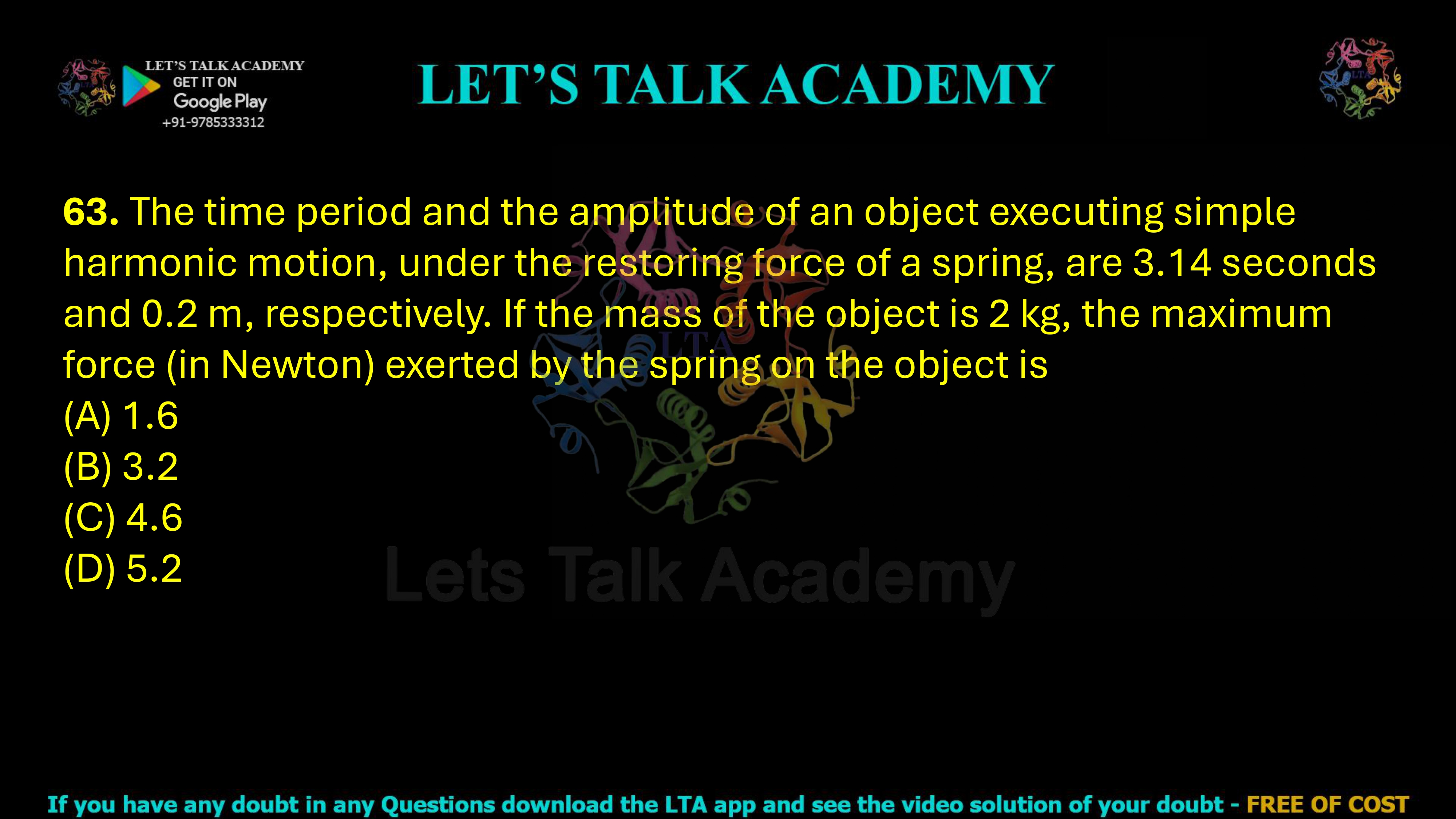
63. The time period and the amplitude of an object executing simple harmonic motion, under the restoring force of a spring, are 3.14 seconds and 0.2 m, respectively. If the mass of the object is 2 kg, the maximum force (in Newton) exerted by the spring on the object is     (A) 1.6  (B) 3.2 (C) 4.6  (D) 5.2

Maximum Restoring Force in Simple Harmonic Motion

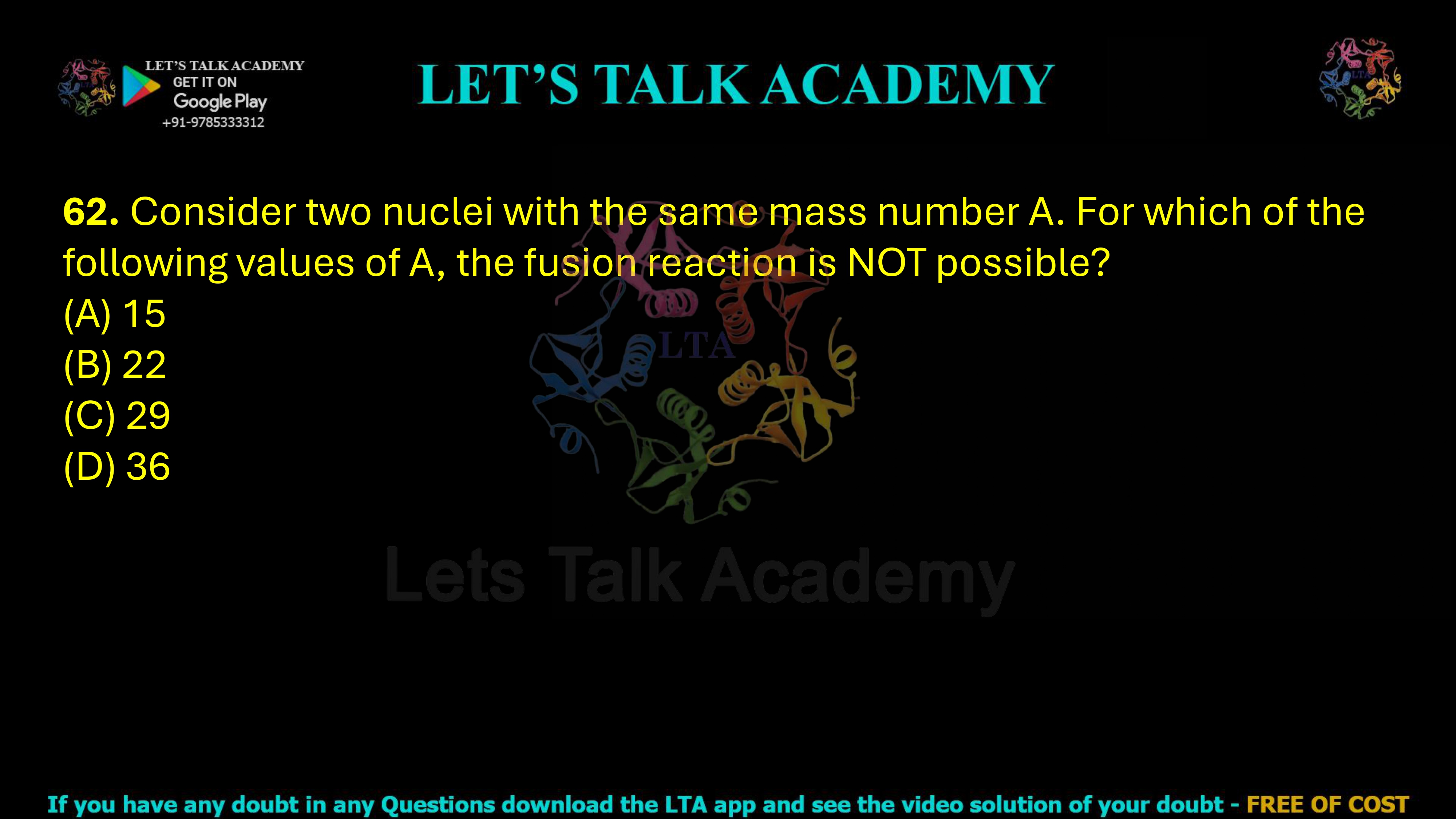
62. Consider two nuclei with the same mass number A. For which of the following values of A, the fusion reaction is NOT possible? (A) 15   (B) 22   (C) 29   (D) 36

Fusion Reaction and Mass Number

61. In a mass spectrometer, a deuteron with kinetic energy 17 MeV enters a uniform magnetic field of 2.4 T with its velocity perpendicular to the field. The deuteron moves in a circular path in the magnetic field. The radius of its path in the magnetic field (correct to two decimal places) is ­____ cm. [mass of deuteron is 3.34 × l0-27 kg, 1MeV = 1.6 × 10⁻¹³ and e = 1.6 × 10⁻¹⁹ C]    

Radius of Circular Path of a Deuteron

60. An X-ray tube operates at 30 kV. If one electron converts 10% of its energy into a photon at first collision, then the wavelength of the photon (correct to two decimal places) is ____.

X-ray Tube Operates at 30 kV

59. Two sources P and Q produce electromagnetic waves with wavelengths Z and 2Z, respectively. Source P ejects a photon with a maximum kinetic energy of 4.0 eV from a metal with work function 2.0 eV. The maximum kinetic energy (eV) of a photon ejected by source Q from the same metal is

Maximum Kinetic Energy in the Photoelectric Effect

58. One gram of radioactive nuclei with a half life of 300 days is kept in an open container. The weight of nuclei remaining after 900 days (correct to 1 decimal place) is       mg.

Radioactive Decay Half-Life Problem

57. The electric field and capacitance of a capacitor in the absence of dielectric material are E and C, respectively. When the capacitor is filled with a dielectric material, the electric field and capacitance of the capacitor becomes E’ and C', respectively. Which of the following is(are) correct?  (A) E' > E and C' = C (B) E' < E and C' > C (C) E' = E and C' > C (D) E' > E and C' < C

Effect of Dielectric on Electric Field and Capacitance of a Capacitor

56. Kinetic theory of an ideal gas is based upon the following assumption(s)  (A) Gases are made of molecules with negligible volume (B) The gaseous molecules do not possess kinetic energy (C) The molecules are in constant random motion (D) Intermolecular forces of attraction are negligible

Kinetic Theory of an Ideal Gas Assumptions

55. A body X of mass M moving with velocity v hits a stationary body Y of mass m. If M >> m and X moves with the velocity v', then the velocity of Y after an elastic collision is  (A) 2v               (B) v + v’          (C) v - v'           (D) 2v'

Velocity of a Body After Elastic Collision

54. Two inductors P and Q having inductance ratio 1:2 are connected in parallel in an electric circuit. The energy stored in the inductors P and Q are in the ratio                                                      (A) 1 : 4            (B) 1 : 2  (C) 2 : 1            (D) 4 : 1

Two Inductors Connected in Parallel

53. The position of a particle along the y-axis is y —— P t4 + Q. For the equation to be dimensionally consistent, the dimension of P in terms of length [L] and time [T] is    (A) LT-1            (B) LT-2  (C) LT-3            (D) LT-4

Dimensions of P in the Equation y = Pt⁴ + Q

52. The refractive index of diamond is 2.419. lf the speed of light in vacuum is 3 × 10⁸ m s-1, then the speed of light in diamond is  (A) 1.240 × 10⁸ m s-1      (B) 1.352 × 10⁸ m s-1      (C) 1.521 × 10⁸ m s-1      (D) 2.433 × 10⁸ m s-1

Speed of Light in Diamond

51. The average energy of a diatomic gaseous molecule at temperature T is kBT where kB is Boltzmann's constant. The average energy of this molecule per degree of freedom is  (A) 1/2 kBT       (B) 2/3 kBT       (C) kBT                 (D) 3/2 kBT

Average Energy of a Diatomic Gas Molecule

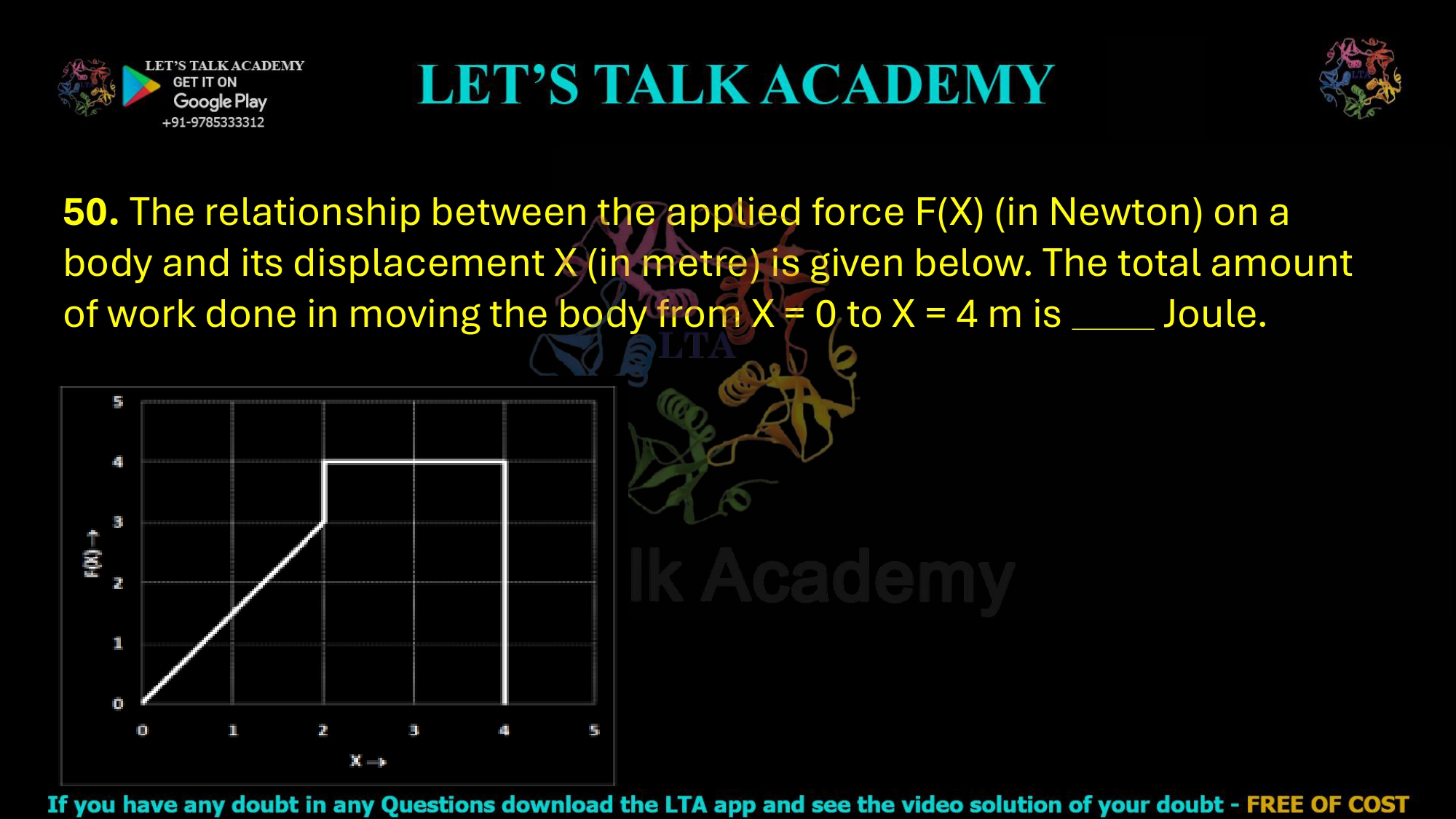
50. The relationship between the applied force F(X) (in Newton) on a body and its displacement X (in metre) is given below. The total amount of work done in moving the body from X = 0 to X = 4 m is Joule.

Work Done from a Force-Displacement Graph

49. An ultrasound signal of frequency 50 KHz is sent vertically down into a medium. The signal gets reflected from a depth of 25 mm and returns to source 0.00005 seconds after it is emitted. The wavelength of the ultrasound signal in that medium is cm.

Wavelength of Ultrasound Signal Reflected

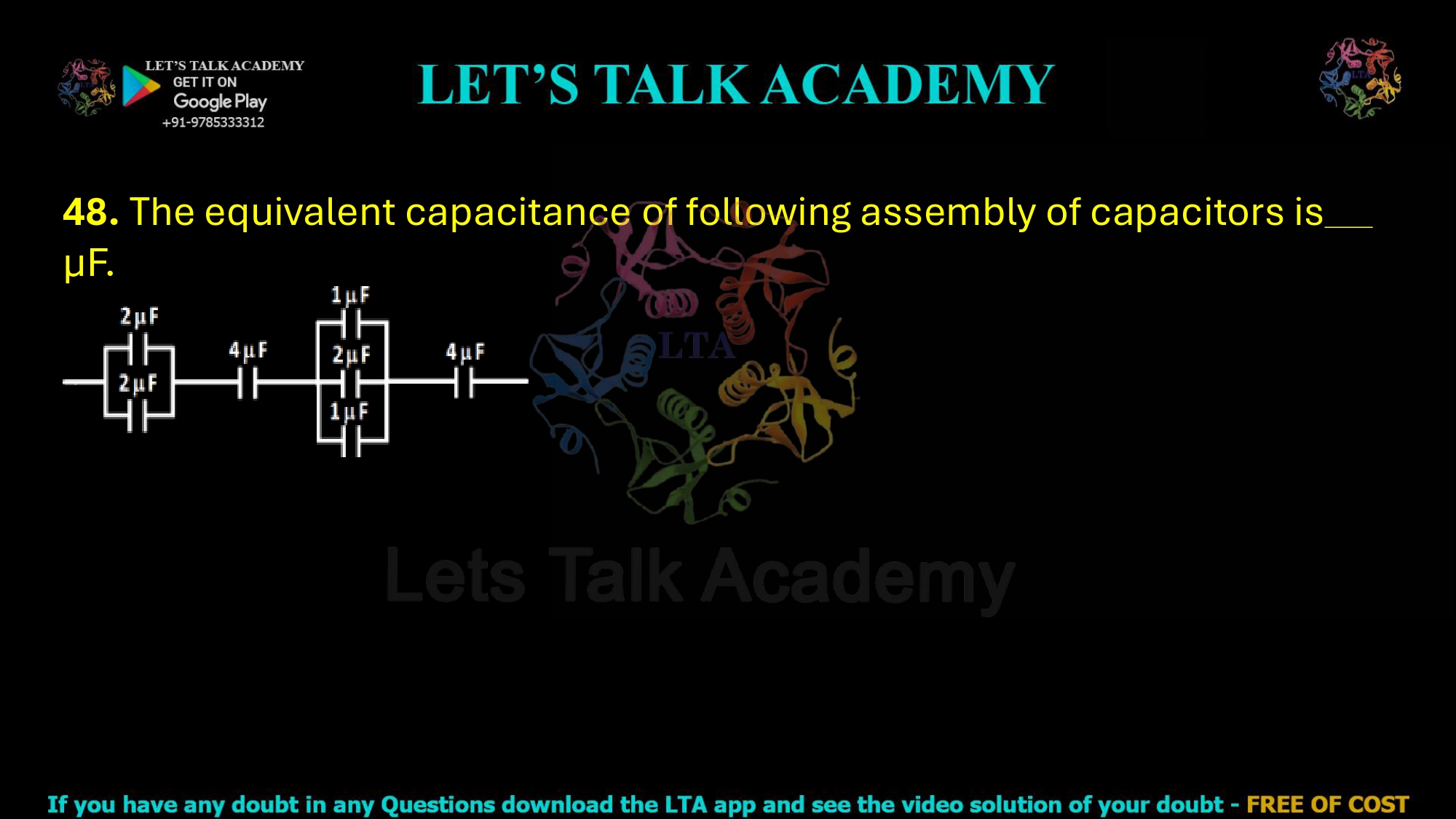
48. The equivalent capacitance of following assembly of capacitors is µF.

Equivalent Capacitance of the Given Capacitor Combination

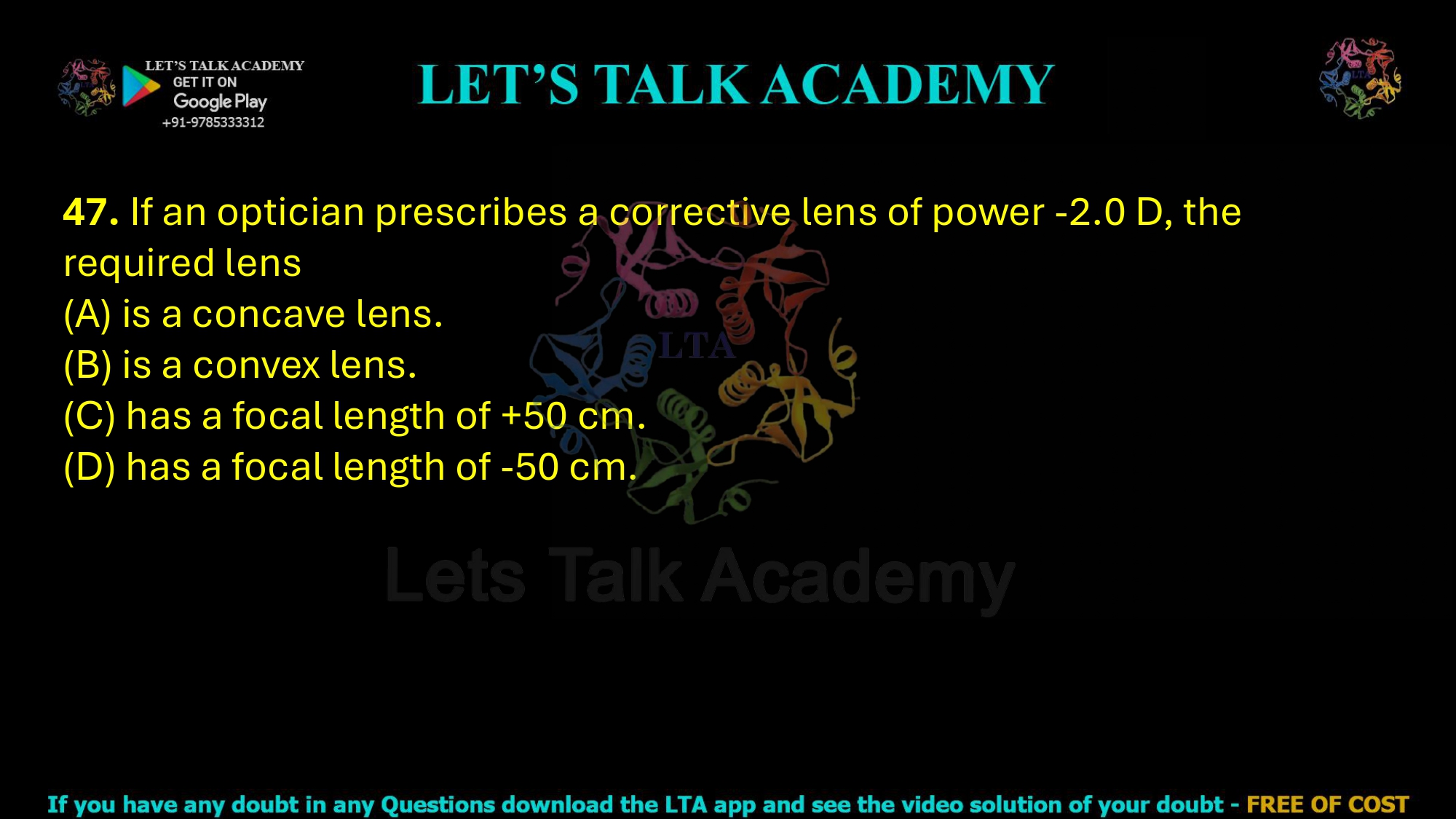
47. If an optician prescribes a corrective lens of power -2.0 D, the required lens  (A) is a concave lens. (B) is a convex lens. (C) has a focal length of +50 cm. (D) has a focal length of -50 cm.

Corrective Lens of Power −2.0 D

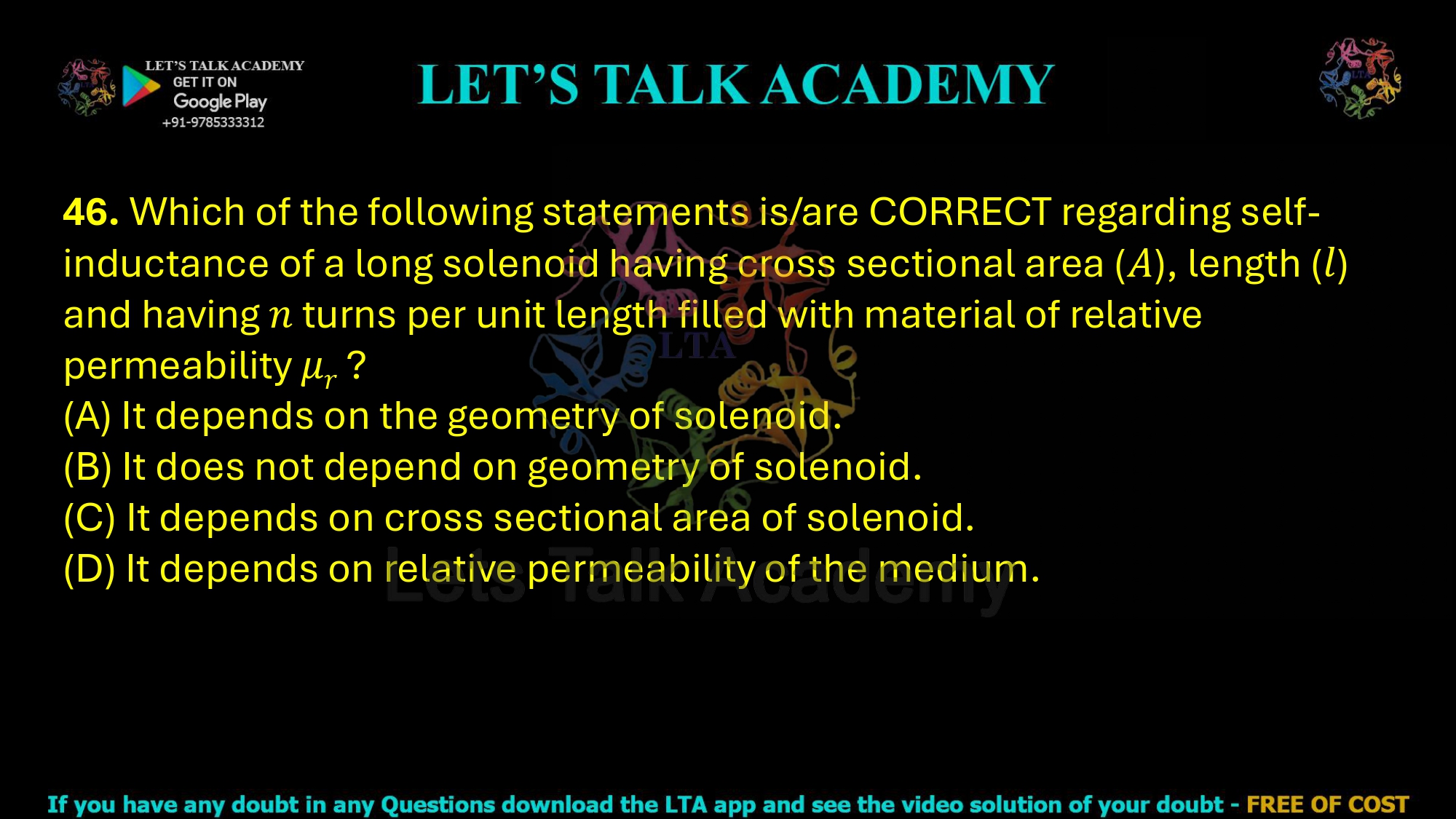
46. Which of the following statements is/are CORRECT regarding self-inductance of a long solenoid having cross sectional area (𝐴), length (𝑙) and having 𝑛 turns per unit length filled with material of relative permeability 𝜇𝑟 ?  (A) It depends on the geometry of solenoid. (B) It does not depend on geometry of solenoid. (C) It depends on cross sectional area of solenoid. (D) It depends on relative permeability of the medium.

Self-Inductance of a Long Solenoid

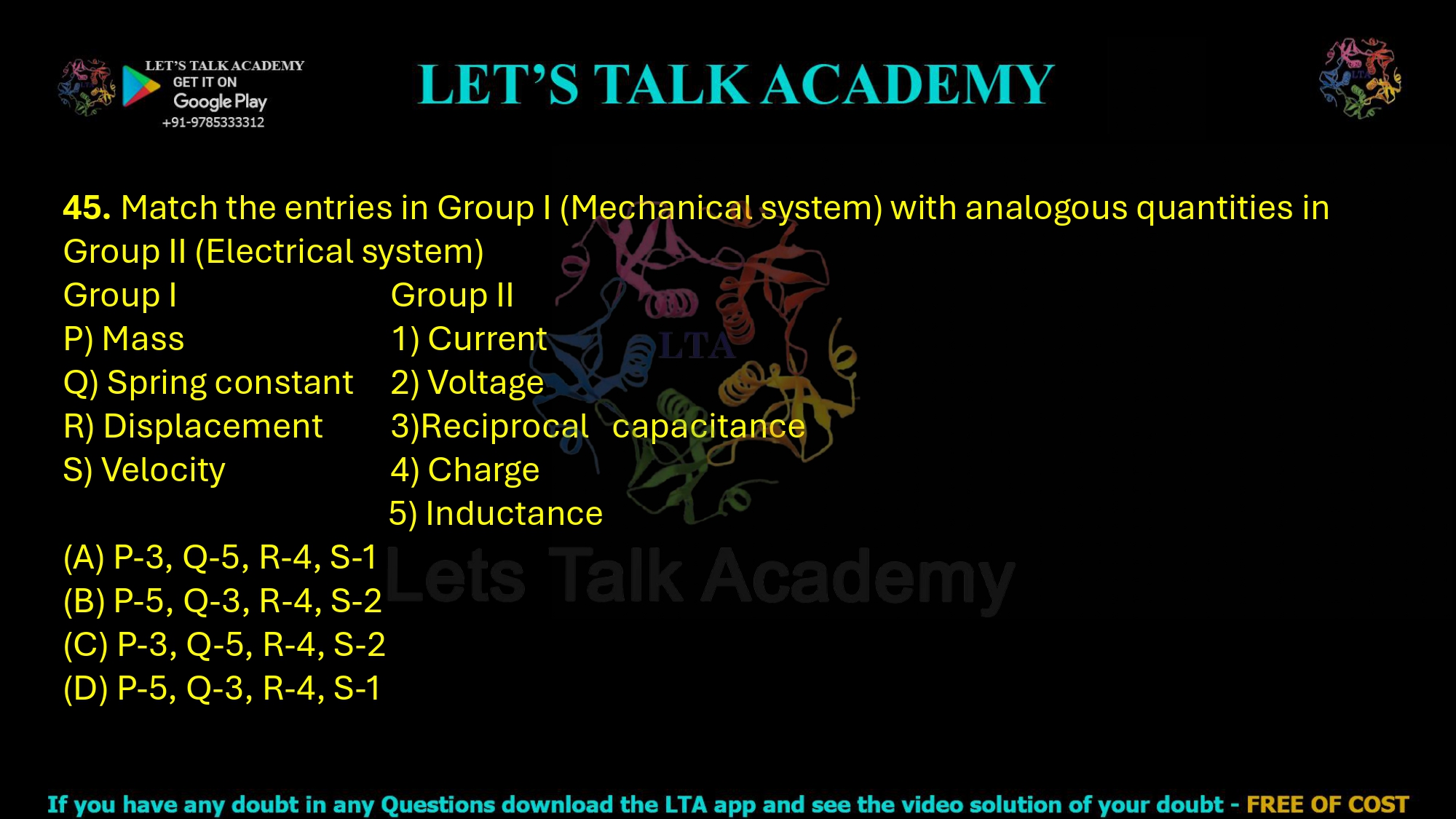
45. Match the entries in Group I (Mechanical system) with analogous quantities in Group II (Electrical system)  Group I                                           Group II P) Mass                                            1) Current Q) Spring constant                        2) Voltage R) Displacement                            3)Reciprocal capacitance S) Velocity                                       4) Charge                                                            5) Inductance (A) P-3, Q-5, R-4, S-1 (B) P-5, Q-3, R-4, S-2 (C) P-3, Q-5, R-4, S-2     (D) P-5, Q-3, R-4, S-1

Mechanical and Electrical System Analogy

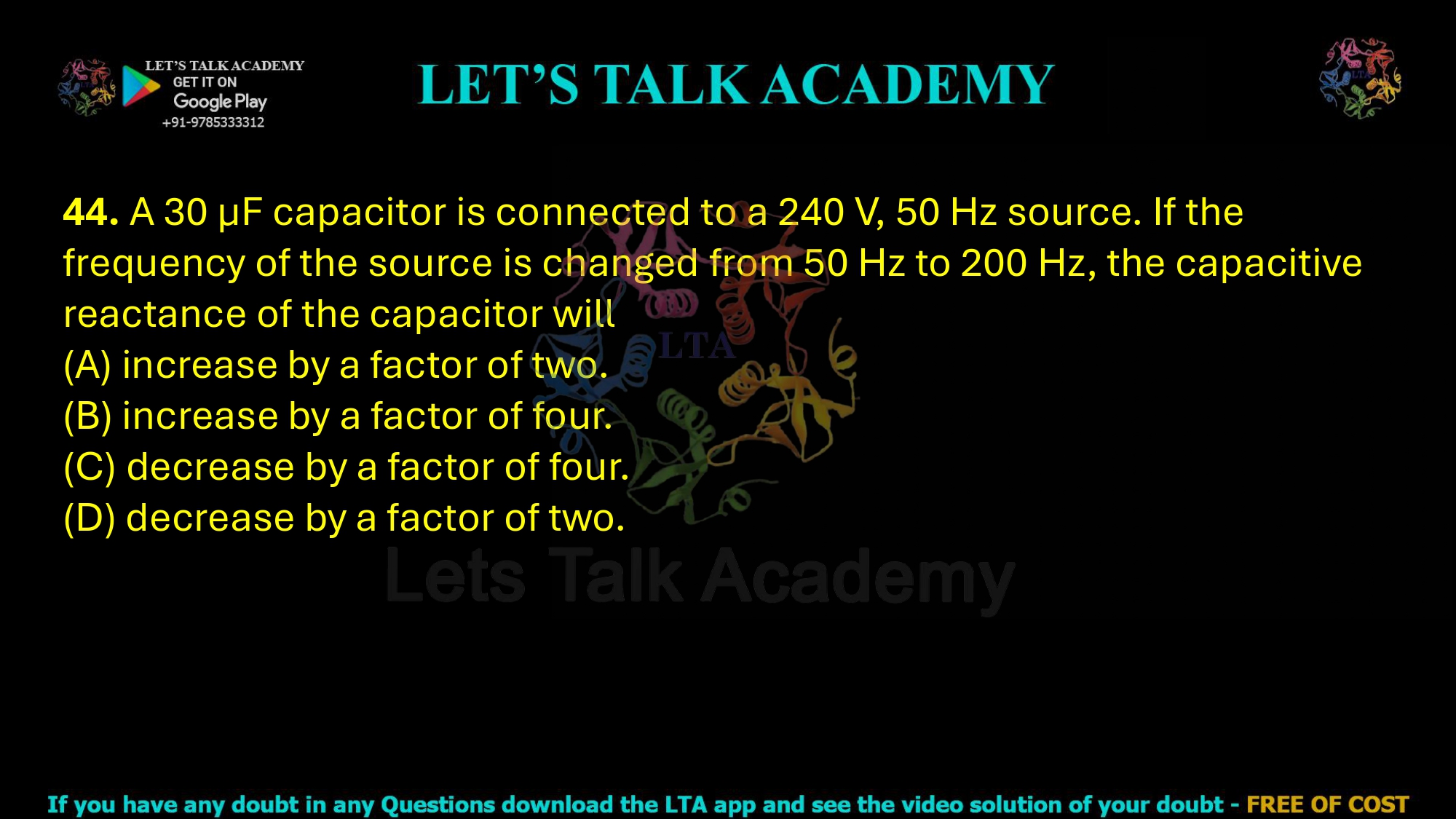
44. A 30 µF capacitor is connected to a 240 V, 50 Hz source. If the frequency of the source is changed from 50 Hz to 200 Hz, the capacitive reactance of the capacitor will  (A) increase by a factor of two. (B) increase by a factor of four. (C) decrease by a factor of four. (D) decrease by a factor of two.

Effect of Frequency on Capacitive Reactance

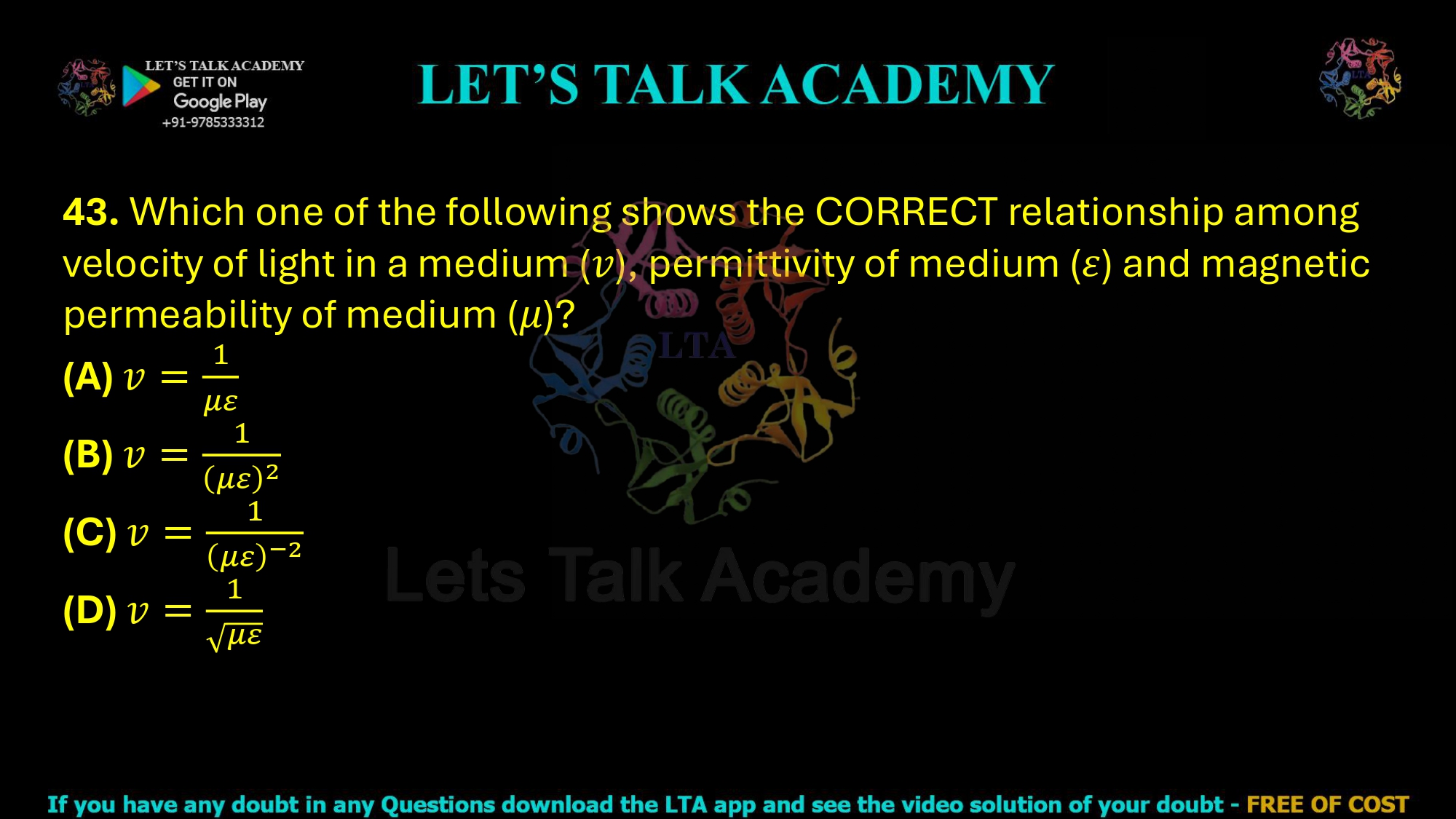
43. Which one of the following shows the CORRECT relationship among velocity of light in a medium (𝑣), permittivity of medium (𝜀) and magnetic permeability of medium (𝜇)?

Correct Relationship Between Velocity of Light

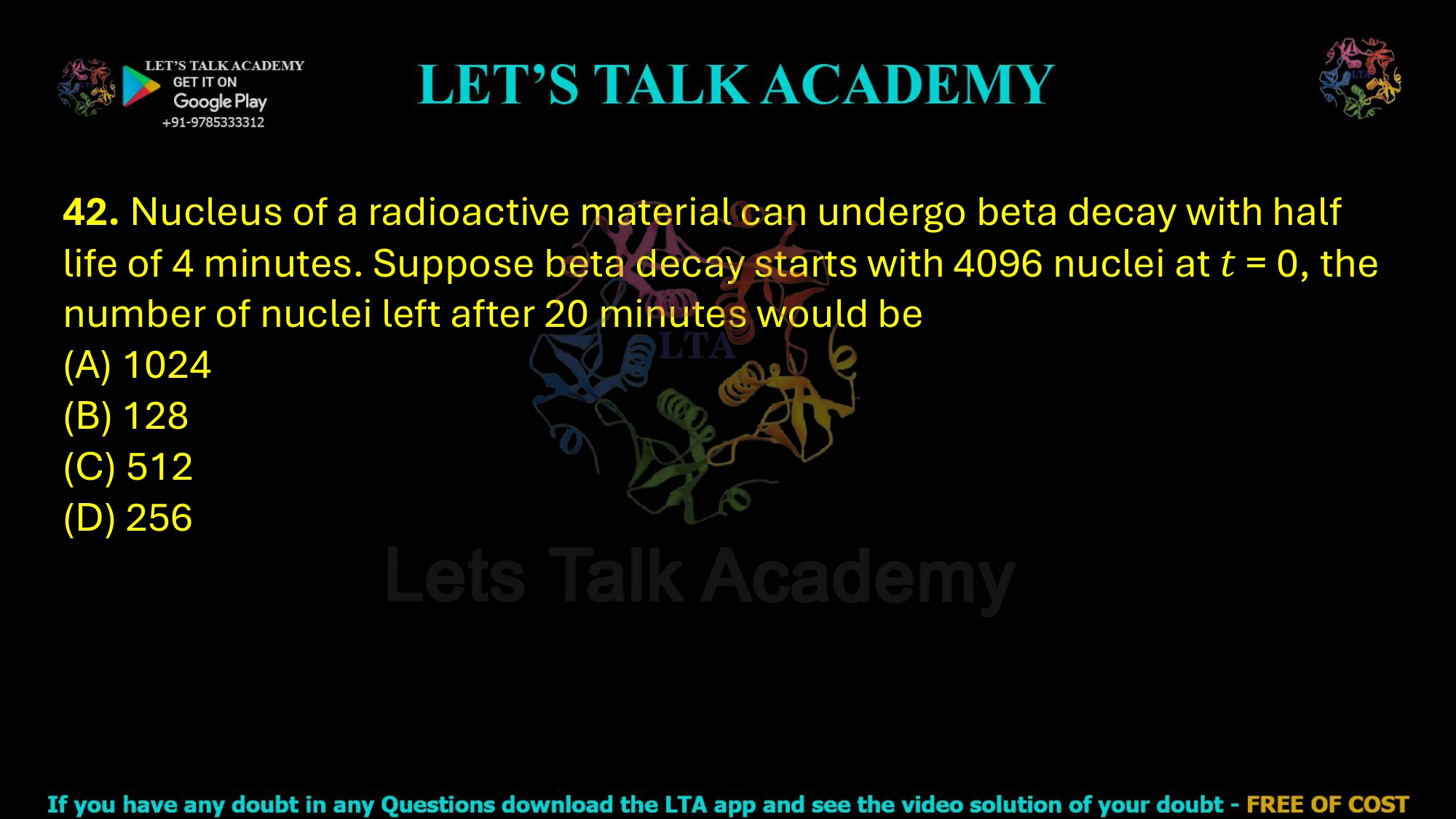
42. Nucleus of a radioactive material can undergo beta decay with half life of 4 minutes. Suppose beta decay starts with 4096 nuclei at 𝑡 = 0, the number of nuclei left after 20 minutes would be (A) 1024           (B) 128 (C) 512 (D) 256

Radioactive Decay Half-Life Calculation

41. An infinitely long solenoid of radius r and number of turns per unit length n carries a steady current I. The ratio of the magnetic fields at a point on the axis of the solenoid to a point r/2 from the axis is                     

Magnetic Field Ratio Inside an Infinitely Long Solenoid

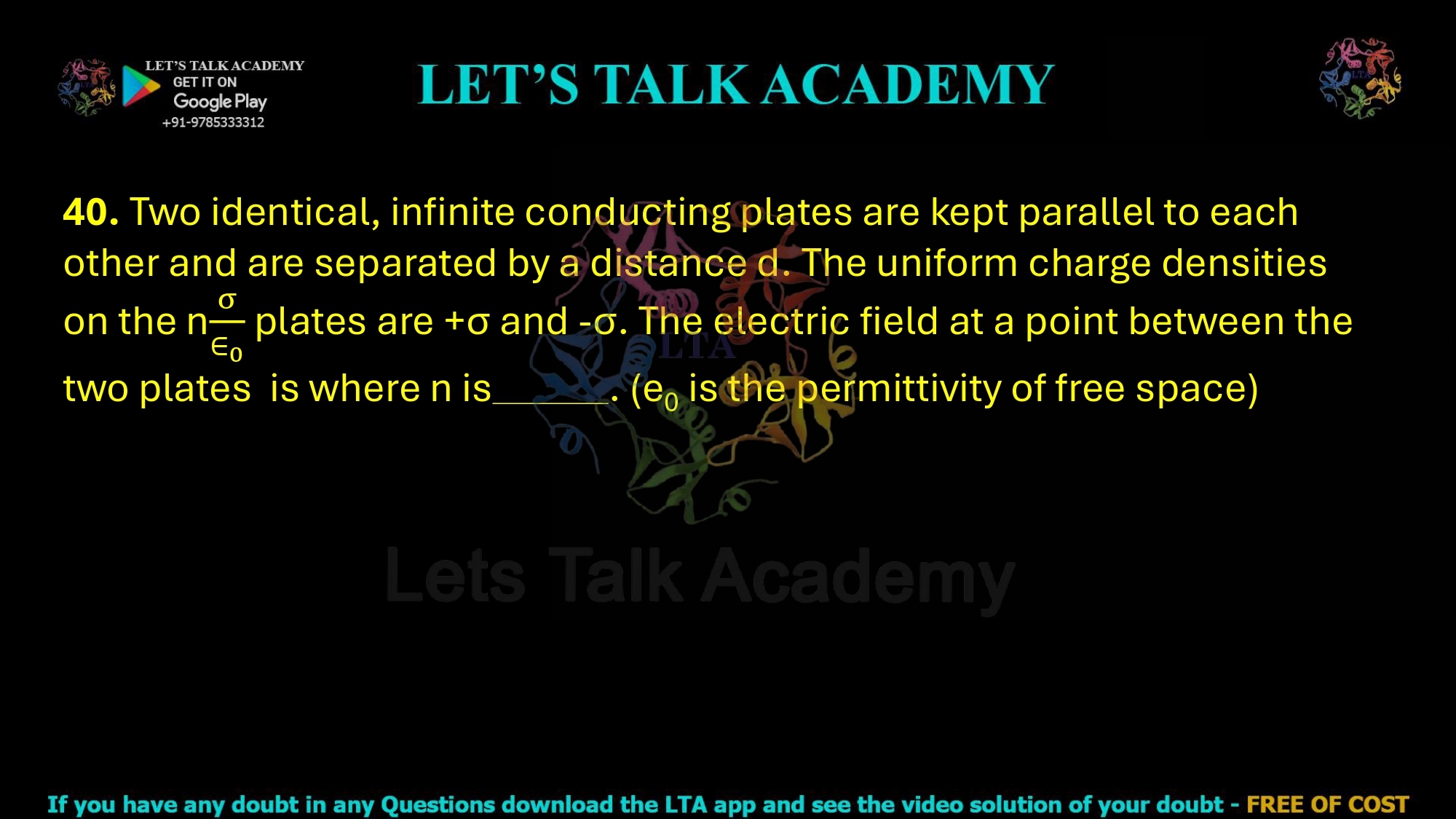
40. Two identical, infinite conducting plates are kept parallel to each other and are separated by a distance d. The uniform charge densities on the n plates are +σ and -σ. The electric field at a point between the two plates  is where n is         . (e0 is the permittivity of free space)

Electric Field Between Two Infinite Parallel Conducting Plates

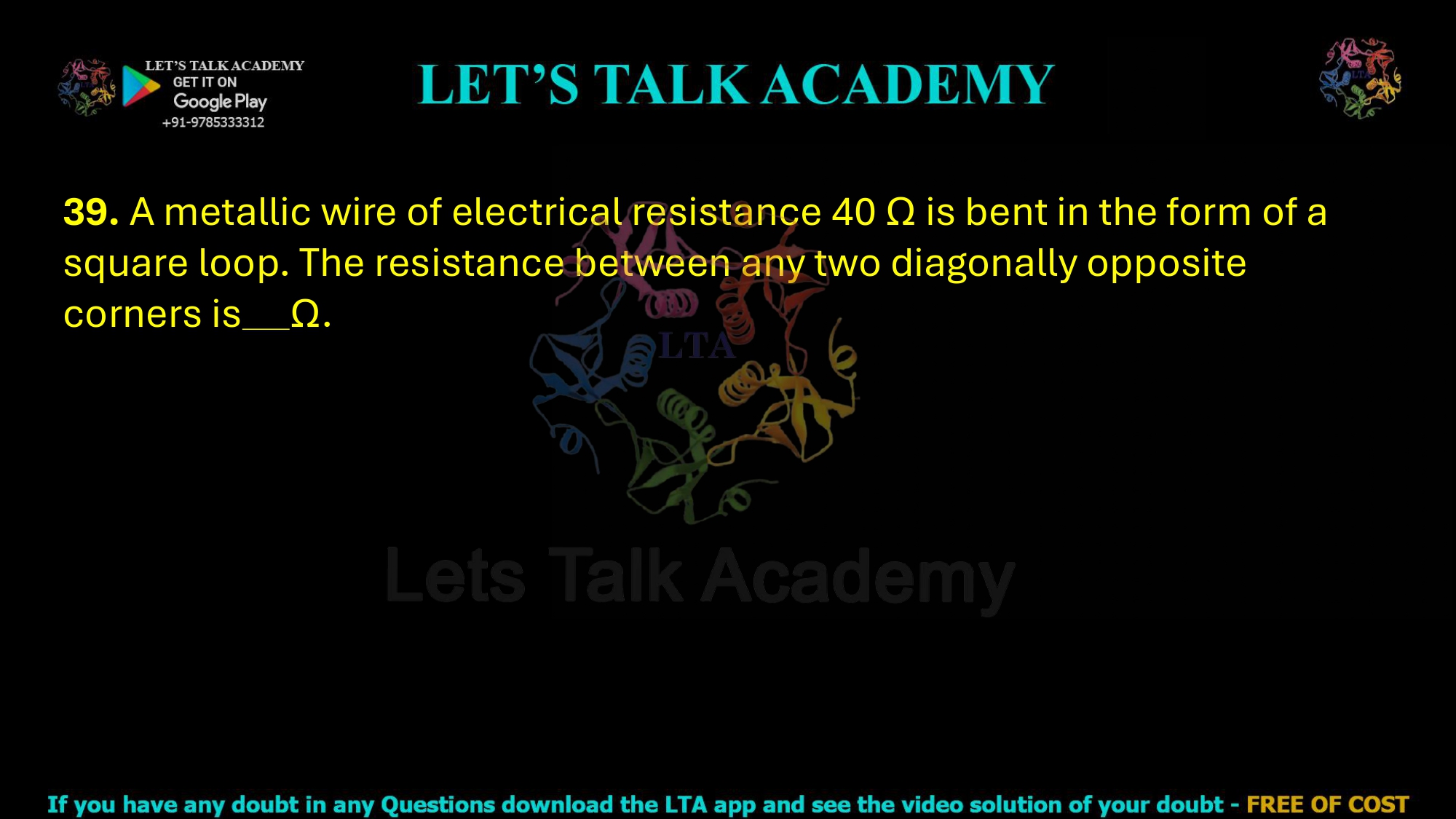
39. A metallic wire of electrical resistance 40 Ω is bent in the form of a square loop. The resistance between any two diagonally opposite corners is       Ω.      

Resistance Between Diagonally Opposite Corners

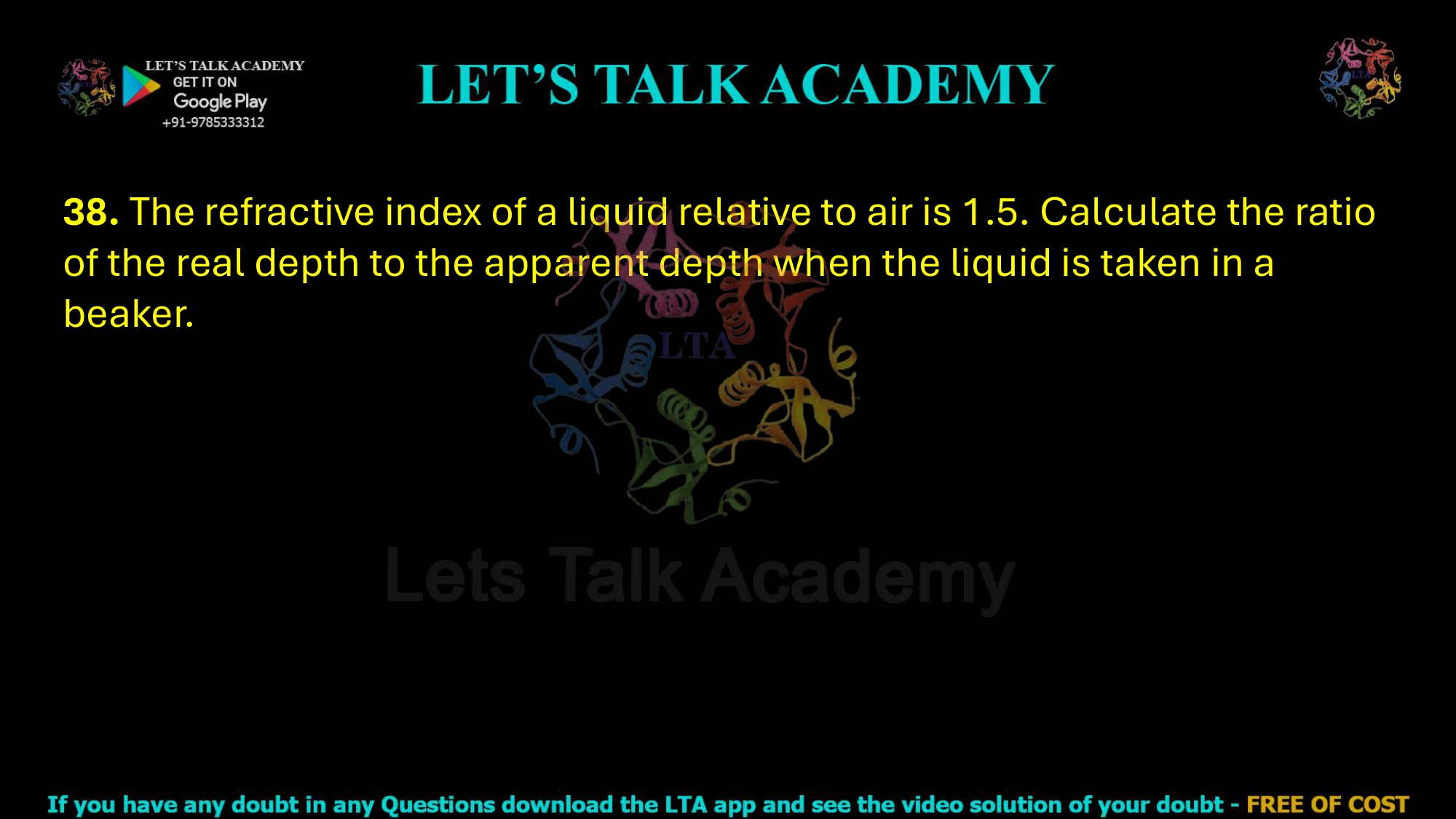
38. The refractive index of a liquid relative to air is 1.5. Calculate the ratio of the real depth to the apparent depth when the liquid is taken in a beaker.

Calculate the Ratio of Real Depth to Apparent Depth

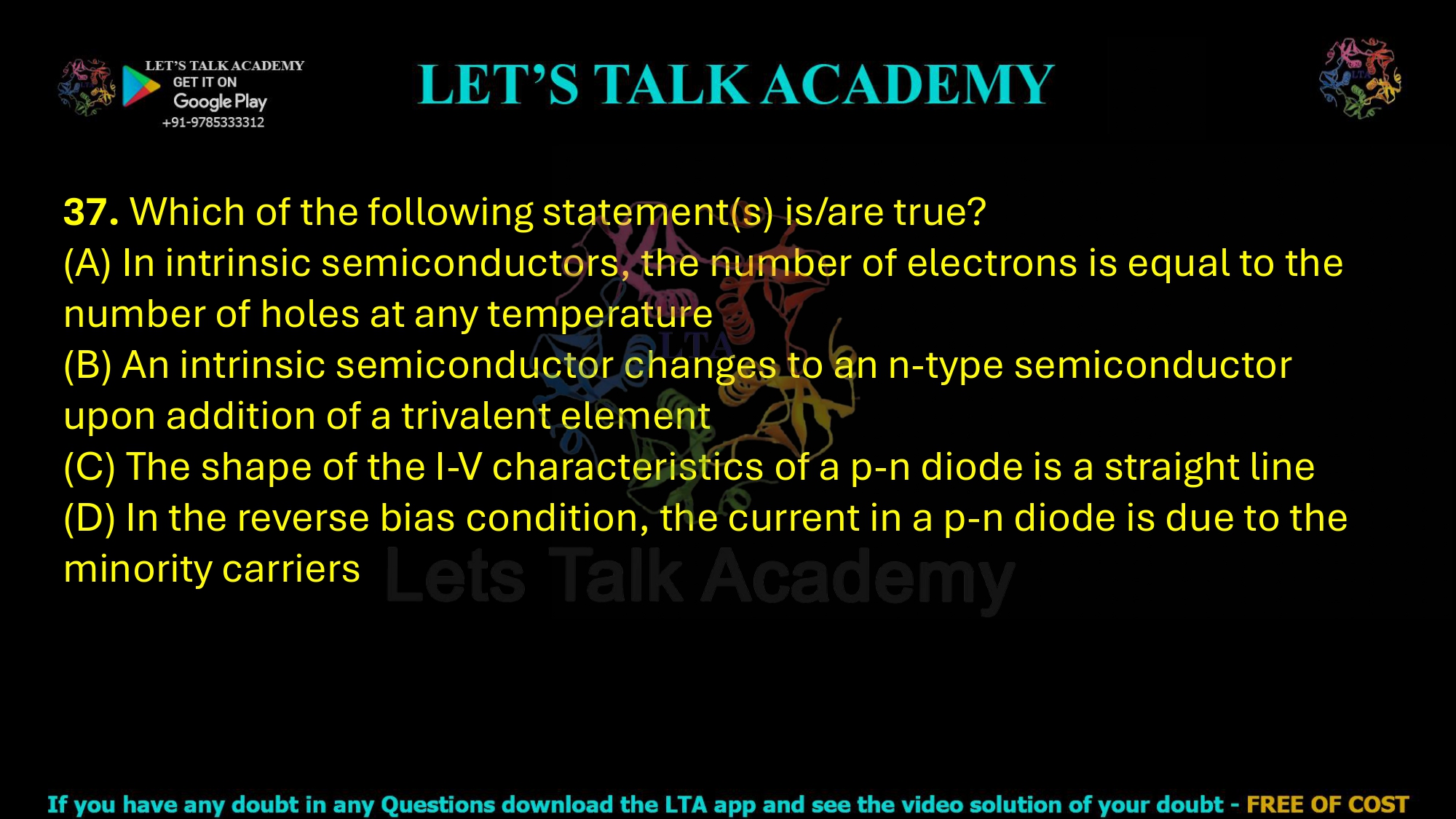
37. Which of the following statement(s) is/are true? (A) In intrinsic semiconductors, the number of electrons is equal to the number of holes at any temperature (B) An intrinsic semiconductor changes to an n-type semiconductor upon addition of a trivalent element (C) The shape of the I-V characteristics of a p-n diode is a straight line (D) In the reverse bias condition, the current in a p-n diode is due to the minority carriers

Intrinsic Semiconductors and P-N Diode Characteristics

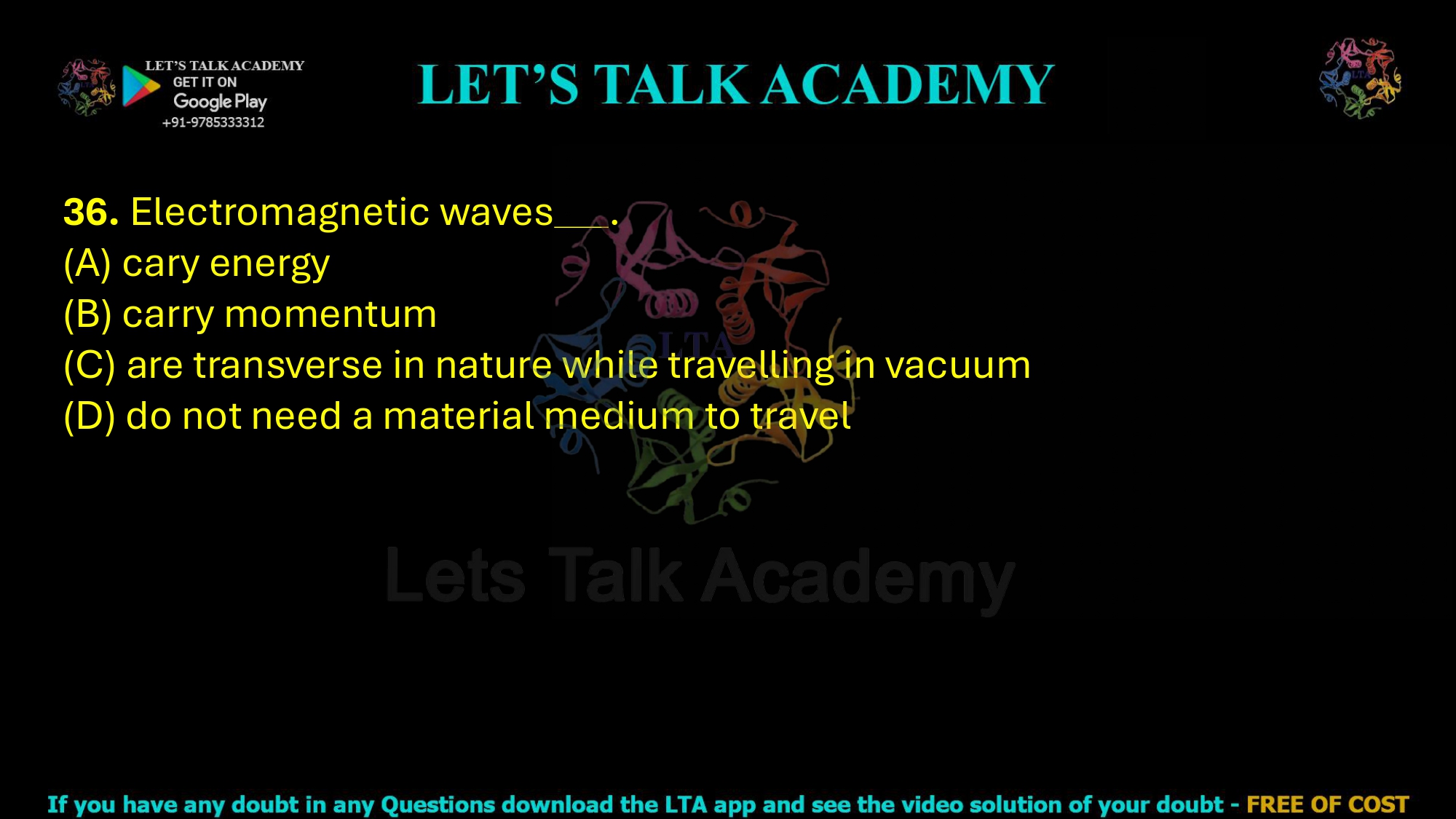
36. Electromagnetic waves . (A) cary energy (B) carry momentum (C) are transverse in nature while travelling in vacuum (D) do not need a material medium to travel

Electromagnetic Waves Carry Energy and Momentum

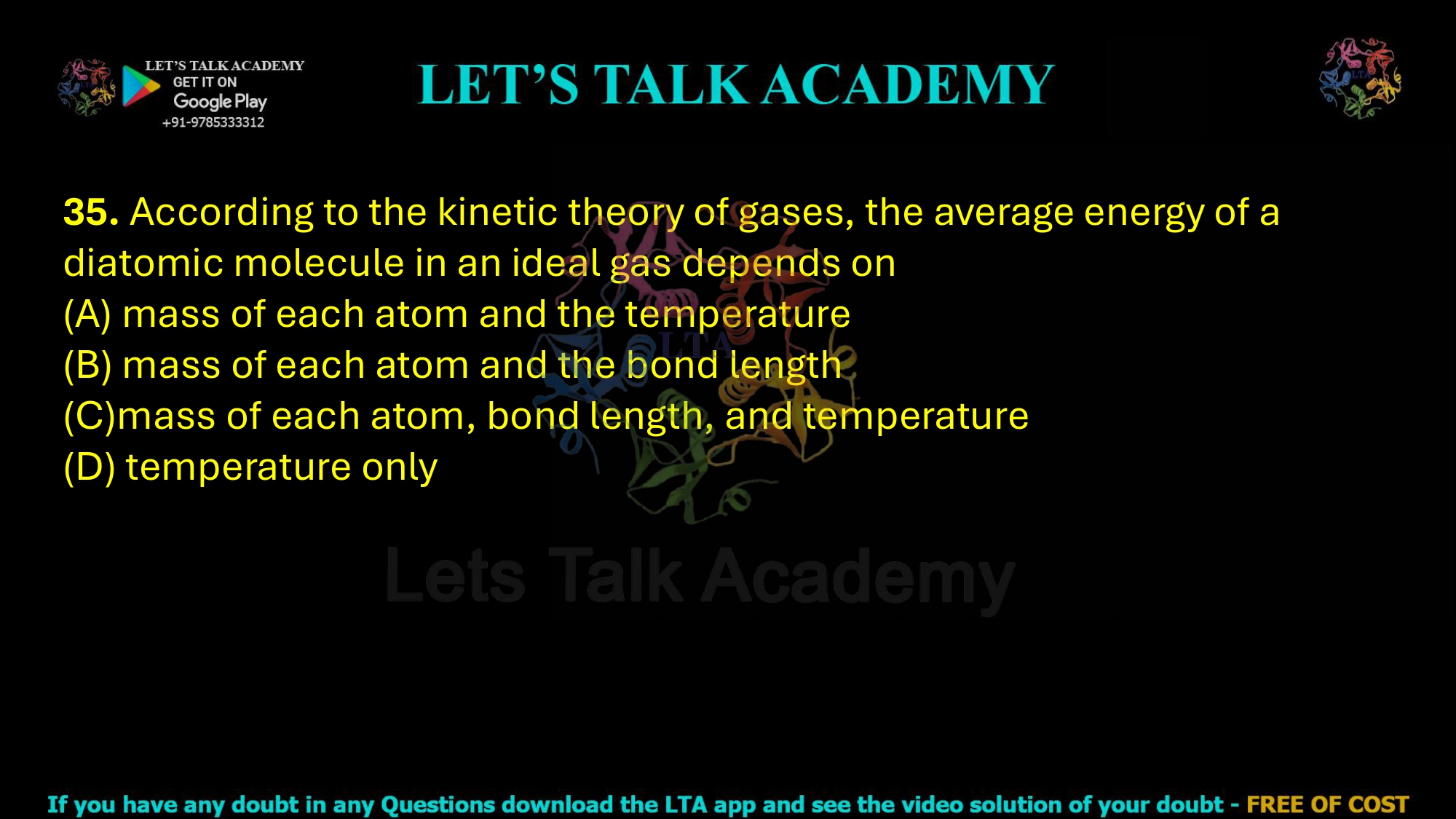
35. According to the kinetic theory of gases, the average energy of a diatomic molecule in an ideal gas depends on  (A) mass of each atom and the temperature (B) mass of each atom and the bond length (C)mass of each atom, bond length, and temperature (D) temperature only

Average Energy of a Diatomic Molecule in an Ideal Gas

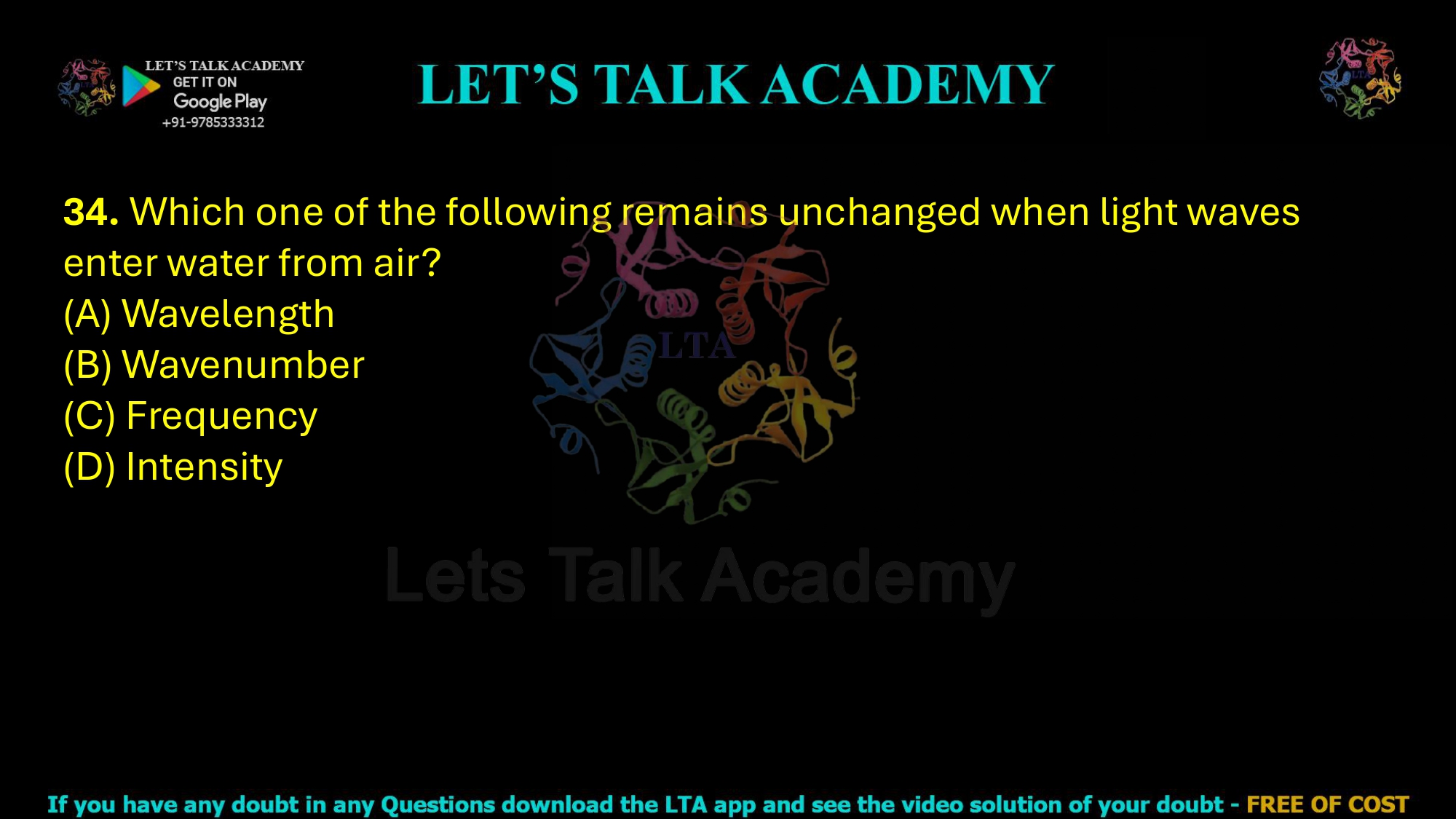
34. Which one of the following remains unchanged when light waves enter water from air?  (A) Wavelength (B) Wavenumber           (C) Frequency   (D) Intensity

What Remains Unchanged When Light Enters Water from Air?

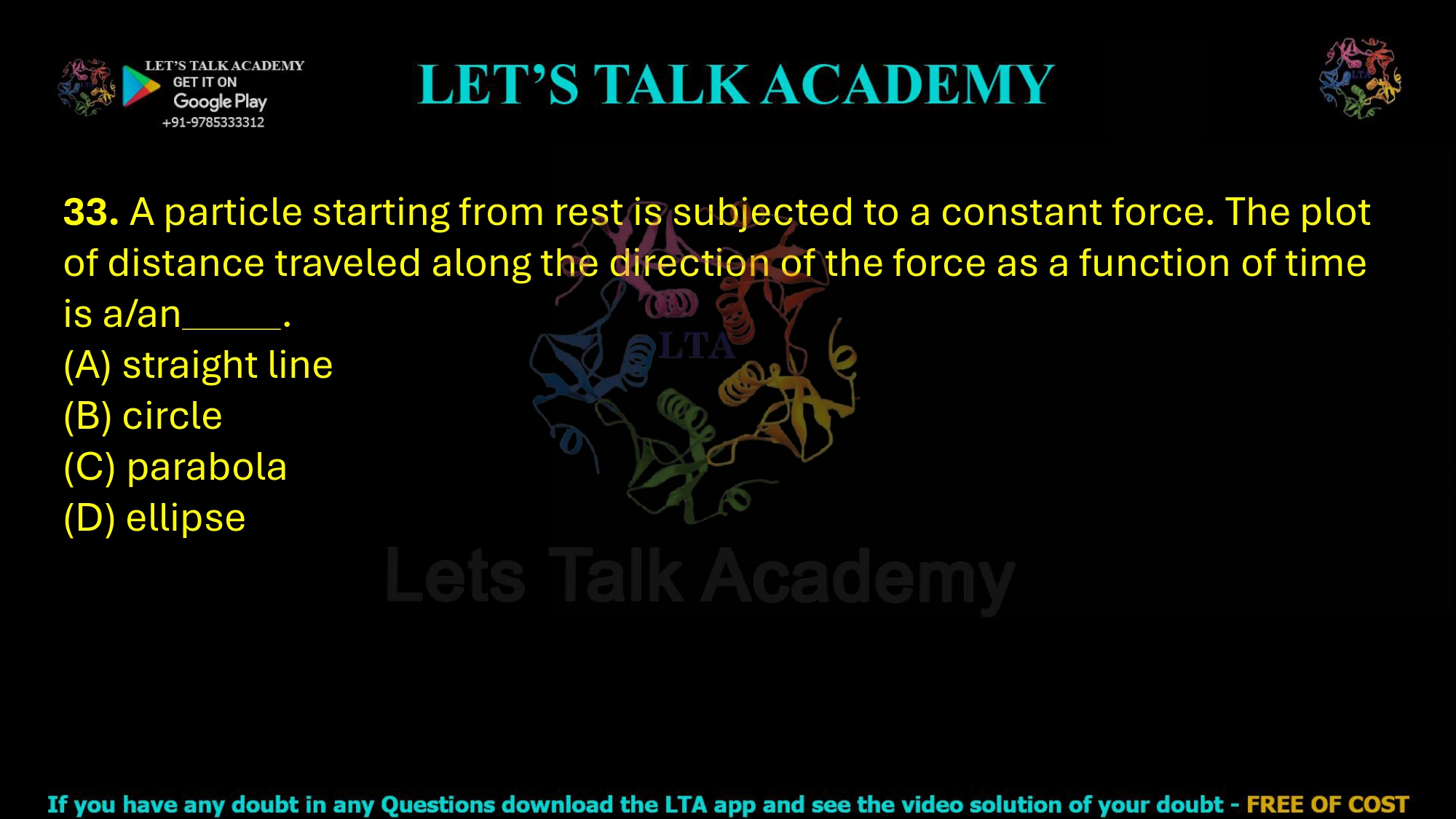
33. A particle starting from rest is subjected to a constant force. The plot of distance traveled along the direction of the force as a function of time is a/an .     (A) straight line (B) circle          (C) parabola      (D) ellipse

Distance-Time Graph of a Particle Under Constant

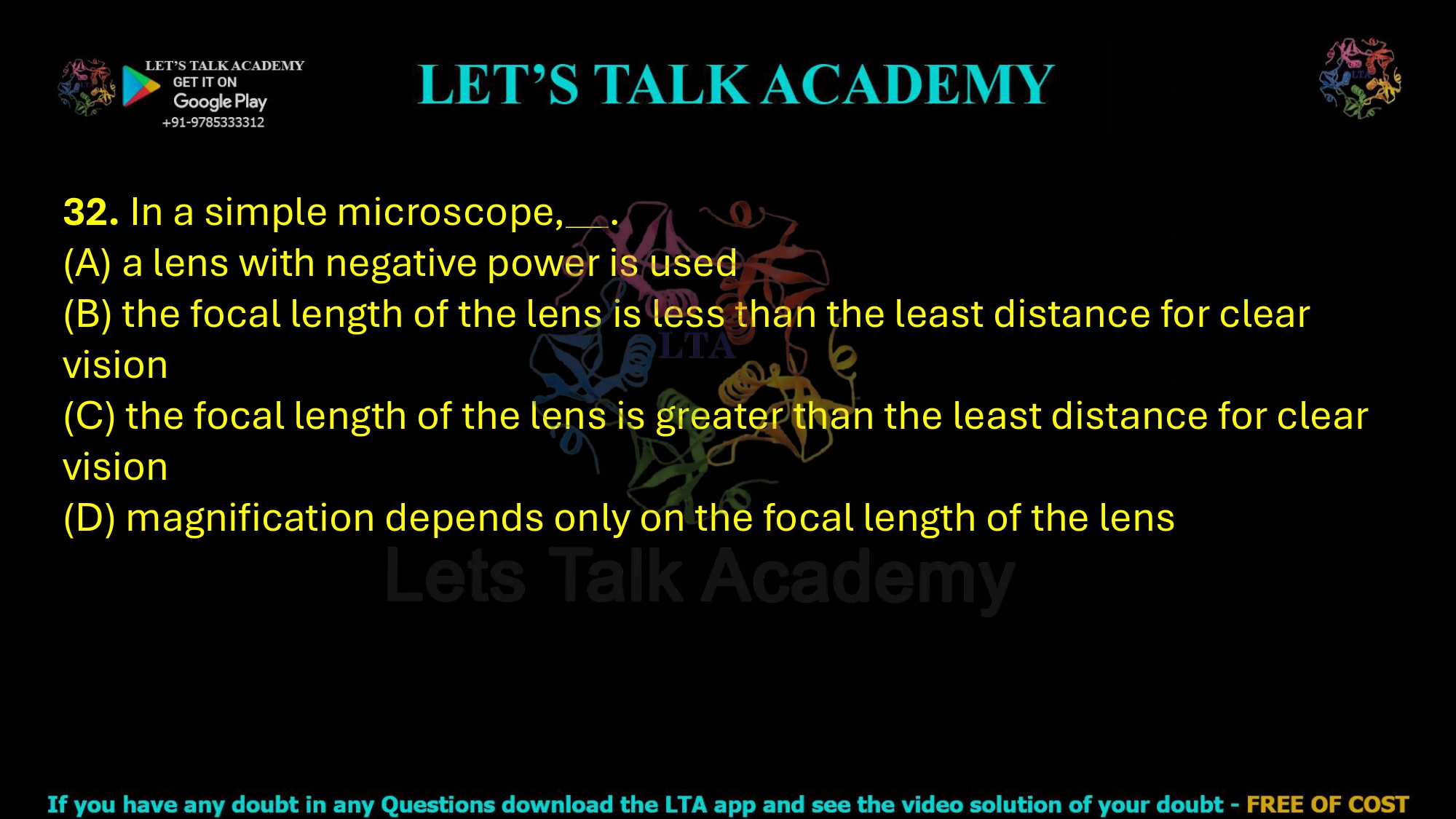
32. In a simple microscope, .     (A) a lens with negative power is used (B) the focal length of the lens is less than the least distance for clear vision (C) the focal length of the lens is greater than the least distance for clear vision (D) magnification depends only on the focal length of the lens

In a Simple Microscope, Which Statement Is Correct?

31. The dimensions of coefficient of viscosity are .    (A) ML-1T-1       (B) ML-1T-2       (C) ML-2T-2       (D) ML-2T-1

Dimensions of Coefficient of Viscosity

30. An insect weighing 5 g takes off vertically for a distance of 100 cm with a speed of 4 m s⁻¹ by using its hind legs. Ignoring the resistance due to air, the magnitude of the average net force exerted by the hind legs during the take-off is _____________ N. (rounded off to 3 decimals) [g = 9.8 m s⁻²]      

Eukaryotic Asymmetric Cell Division

29. Three particles A,B,C with masses of 100 g, 200 g, and 300 g, respectively, are placed at the vertices of an equilateral triangular structure with a side length of 2 m. A is placed at the (0,0) position and B is placed at (2,0) position in a Cartesian coordinate system. Assume that ΔABC lies parallel to the base. The distance between the center of mass and position of the particle A is ______________ m. (rounded off to 2 decimals)  

Center of Mass of Three Particles

28. A candle is placed 18 cm in front of a concave mirror to generate a real, inverted and doubly magnified image. The radius of curvature of the concave mirror is ____________ cm. (answer in integer)            

Radius of Curvature of a Concave Mirror

27. The wavelength of a photon emitted during a transition from n = 3 to n = 2 state in the H atom is ____________ nm. (answer in integer). [Rydberg energy constant R_H = 2.18×10⁻¹⁸ J; Planck constant h = 6.626×10⁻³⁴ J s, c = 3×10⁸ m/s]  

Wavelength of Photon Emitted During n = 3 to n = 2

26. Which of the following statements about eukaryotic asymmetric cell division is NOT correct?     (A) Chromosomes are unequally distributed in the daughter cells  (B) Chromosomes are equally distributed in the daughter cells  (C) RNA and proteins are unequally distributed in the daughter cells  (D) Cytoplasmic contents are unequally distributed in the daughter cells

Eukaryotic Asymmetric Cell Division

25. An electric circuit with a resistor of constant resistance 'R' is maintained at a constant voltage 'V'. Based on Ohm's law, if the current 'I' through the circuit is doubled, the power 'P' dissipated across the resistor is     (A) P/2  (B) P  (C) 2P  (D) 4P

If Current Through a Resistor Is Doubled

24. A box of mass 20 kg is pulled at constant speed across a floor by a rope making 45° with the horizontal. Assuming friction is negligible, the work done pulling the box 20 m is __________ J (rounded to nearest integer). (Use g = 9.8 m s⁻²)

Work Done Pulling a Box at Constant Speed

23. Two resistors 2Ω and 4Ω are combined in parallel. If this combination is connected to a battery of 16 V, the maximum current that can be drawn from the battery is __________ A (rounded off to the nearest integer).       

de Broglie Wavelength of an Electron Accelerated

22. A ball dropped from a bridge hits the surface of the water in 3 s. The height of the bridge, ignoring air resistance, is __________ m (rounded off to one decimal place). (Use g = 9.8 m s⁻²)

Height of a Bridge When a Ball Takes 3 Seconds

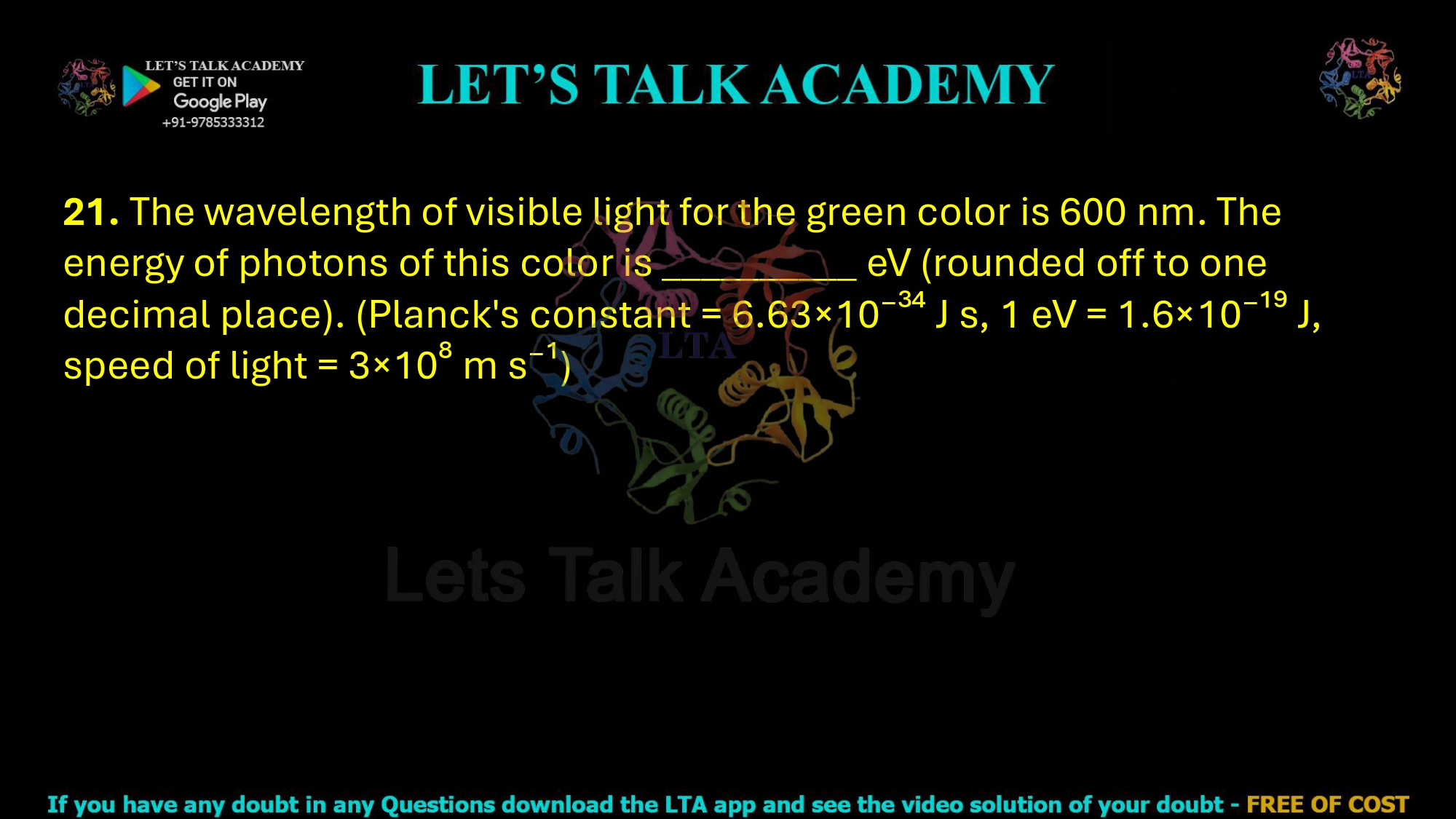
21. The wavelength of visible light for the green color is 600 nm. The energy of photons of this color is __________ eV (rounded off to one decimal place). (Planck's constant = 6.63×10⁻³⁴ J s, 1 eV = 1.6×10⁻¹⁹ J, speed of light = 3×10⁸ m s⁻¹) 

Energy of a 600 nm Green Light Photon in Electron Volts

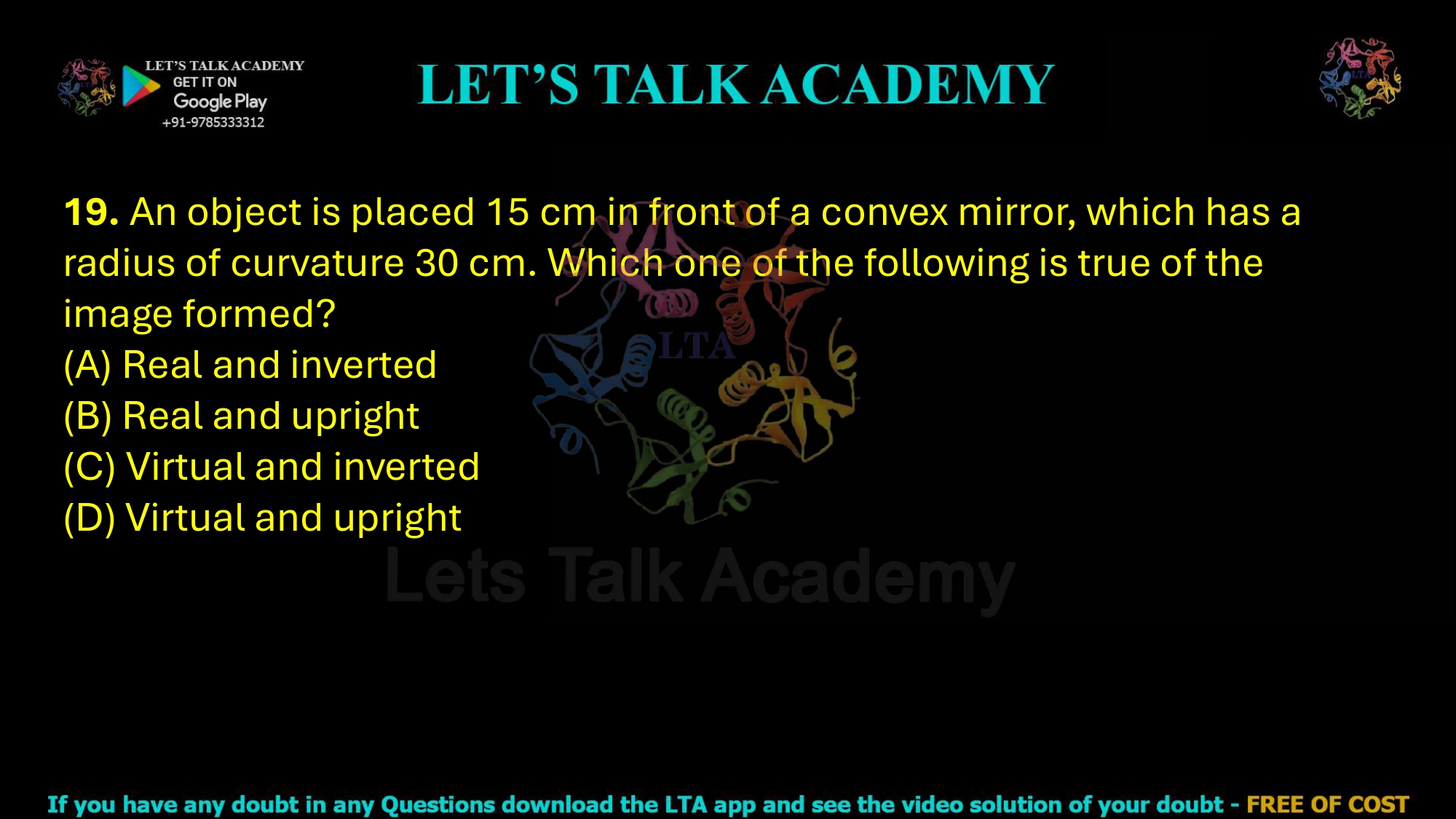
19. An object is placed 15 cm in front of a convex mirror, which has a radius of curvature 30 cm. Which one of the following is true of the image formed?  (A) Real and inverted (B) Real and upright (C) Virtual and inverted (D) Virtual and upright

Image Formed by a Convex Mirror: Virtual and Upright Image

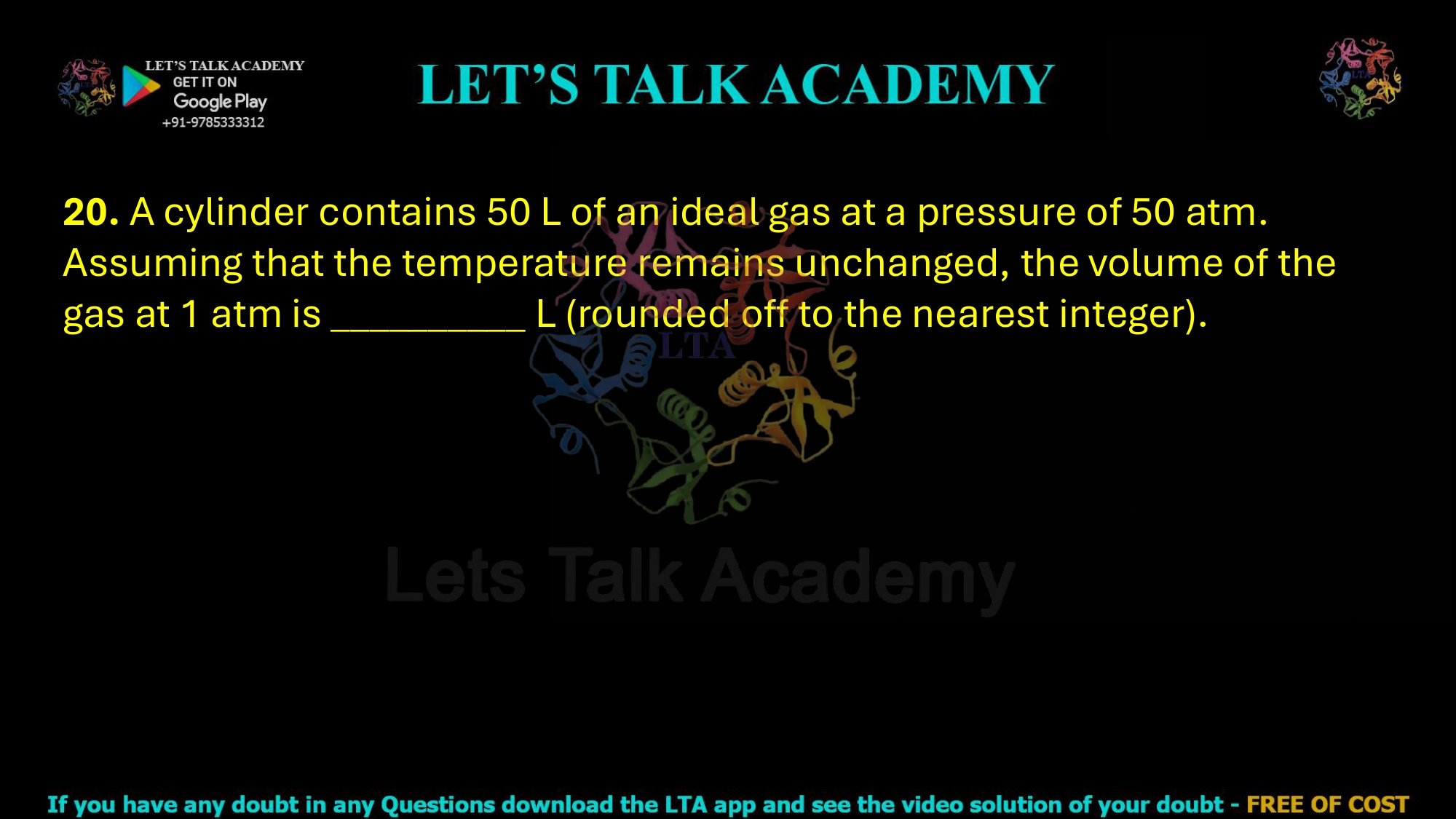
20. A cylinder contains 50 L of an ideal gas at a pressure of 50 atm. Assuming that the temperature remains unchanged, the volume of the gas at 1 atm is __________ L (rounded off to the nearest integer).

Volume of an Ideal Gas at 1 atm Using Boyle’s Law

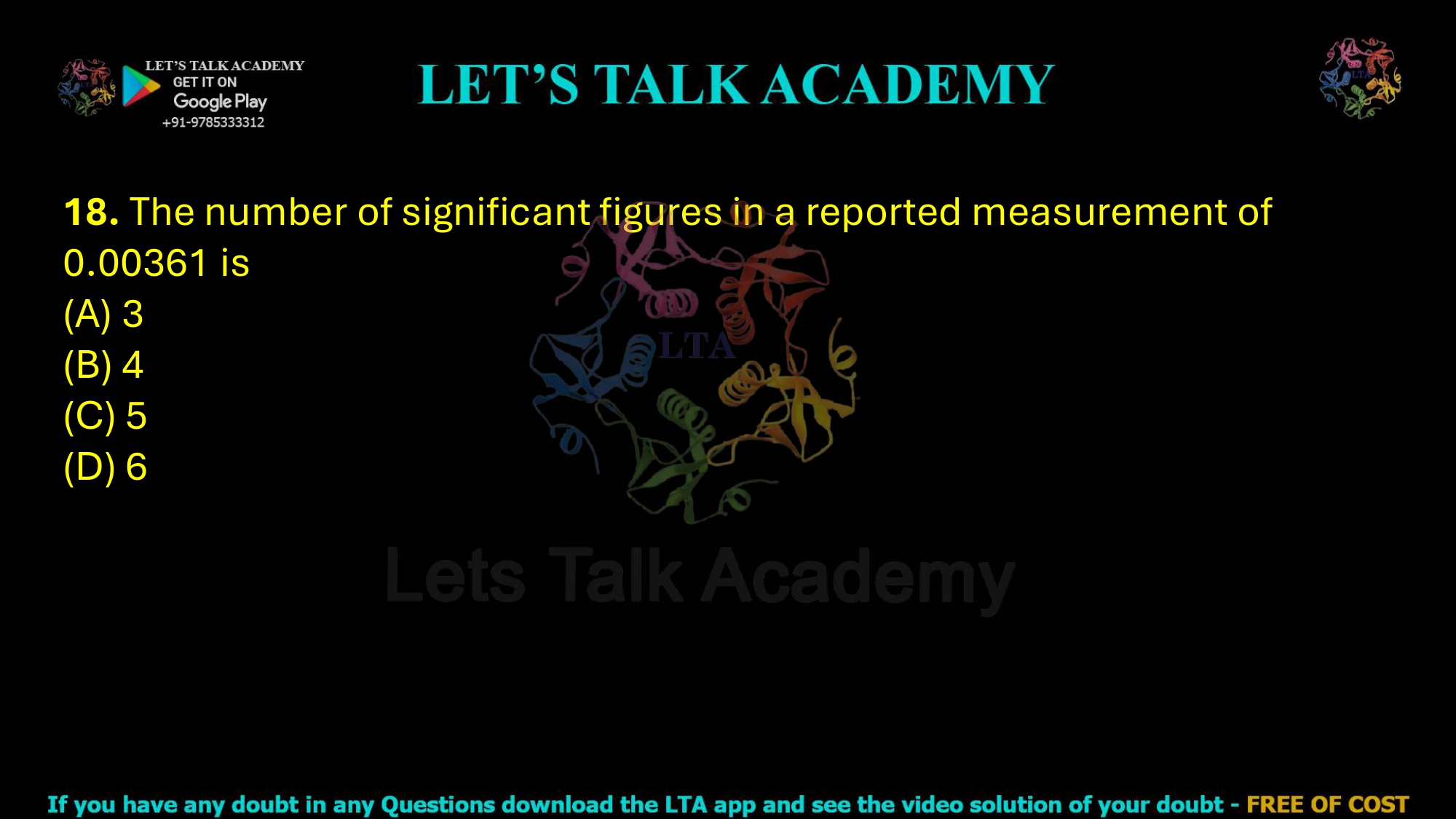
18. The number of significant figures in a reported measurement of 0.00361 is  (A) 3 (B) 4 (C) 5 (D) 6

Number of Significant Figures in 0.00361

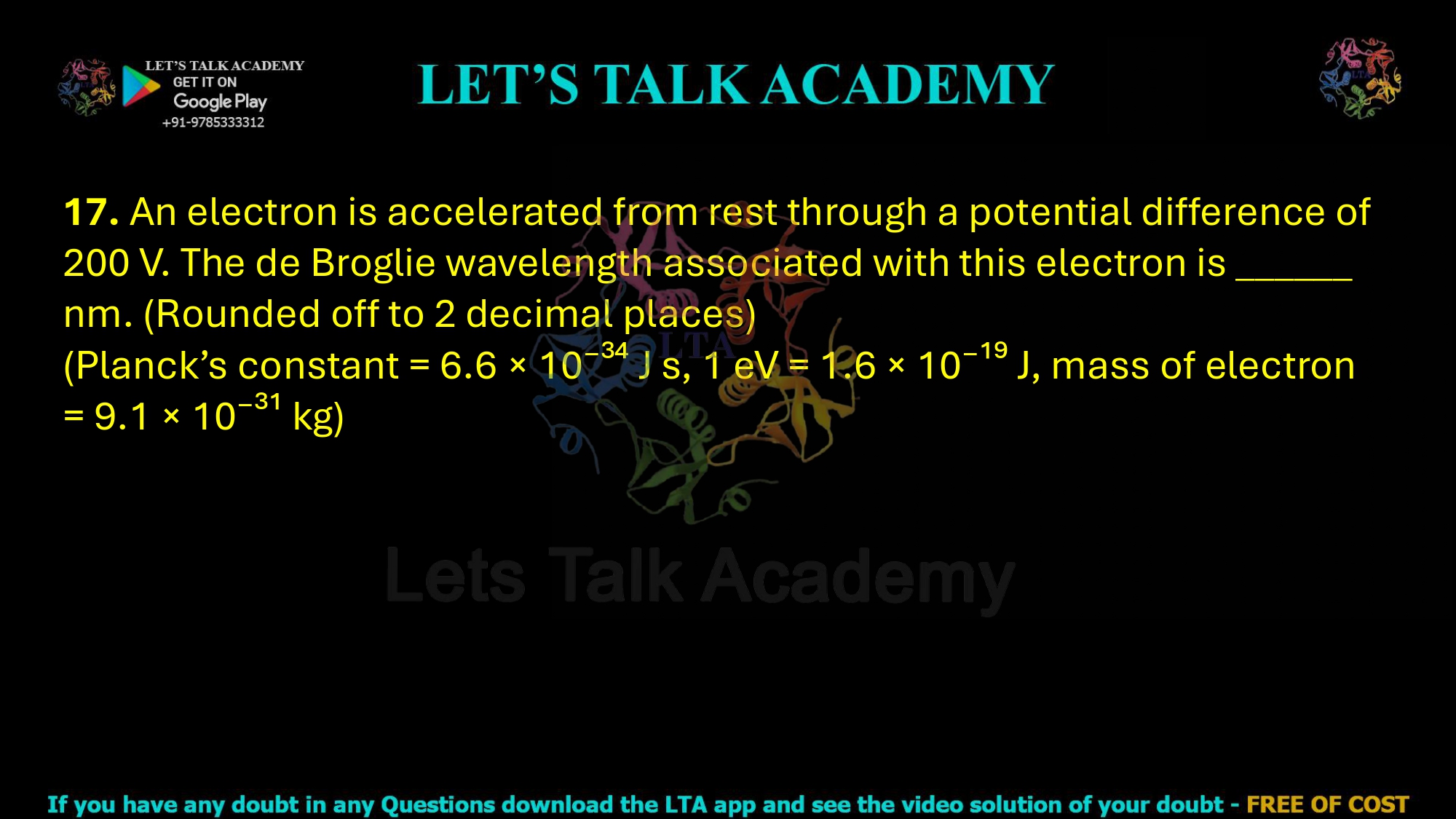
17. An electron is accelerated from rest through a potential difference of 200 V. The de Broglie wavelength associated with this electron is ______ nm. (Rounded off to 2 decimal places) (Planck’s constant = 6.6 × 10⁻³⁴ J s, 1 eV = 1.6 × 10⁻¹⁹ J, mass of electron = 9.1 × 10⁻³¹ kg)       

de Broglie Wavelength of an Electron Accelerated

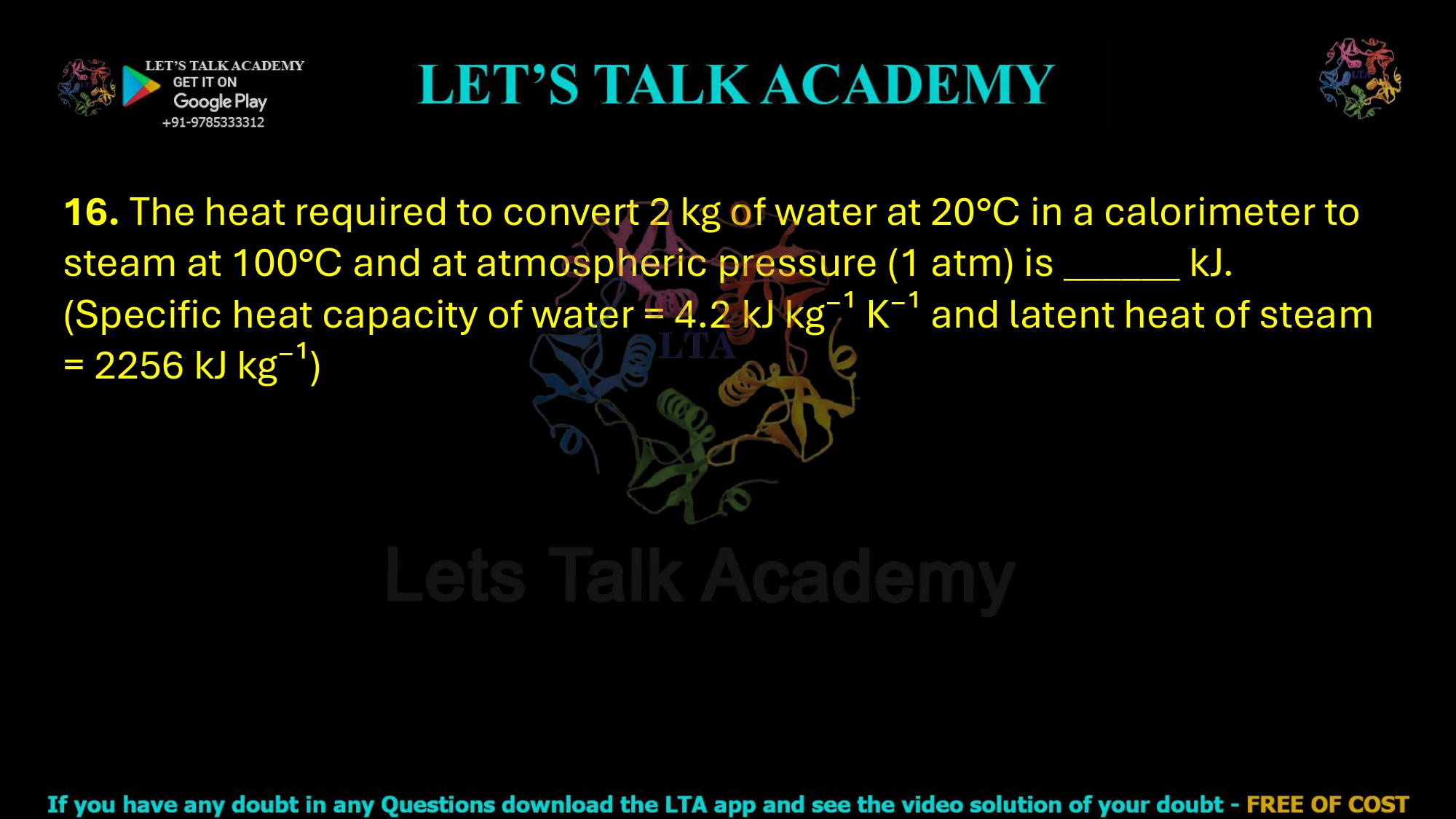
16. The heat required to convert 2 kg of water at 20°C in a calorimeter to steam at 100°C and at atmospheric pressure (1 atm) is ______ kJ. (Specific heat capacity of water = 4.2 kJ kg⁻¹ K⁻¹ and latent heat of steam = 2256 kJ kg⁻¹)

Heat Required to Convert 2 kg of Water

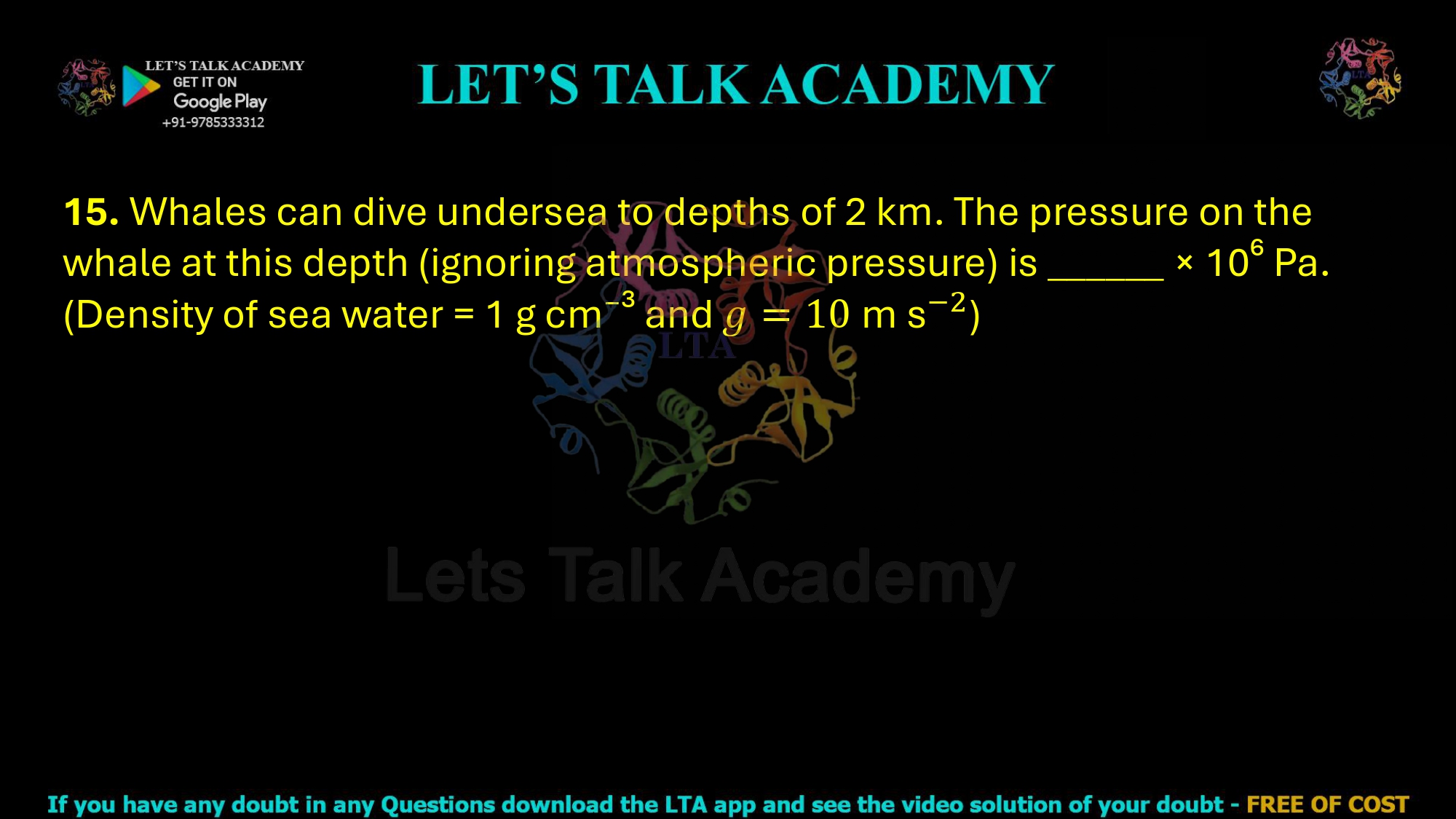
15. Whales can dive undersea to depths of 2 km. The pressure on the whale at this depth (ignoring atmospheric pressure) is ______ × 10⁶ Pa. (Density of sea water = 1 g cm⁻³ and )     

Pressure on a Whale at 2 km Depth Under Sea

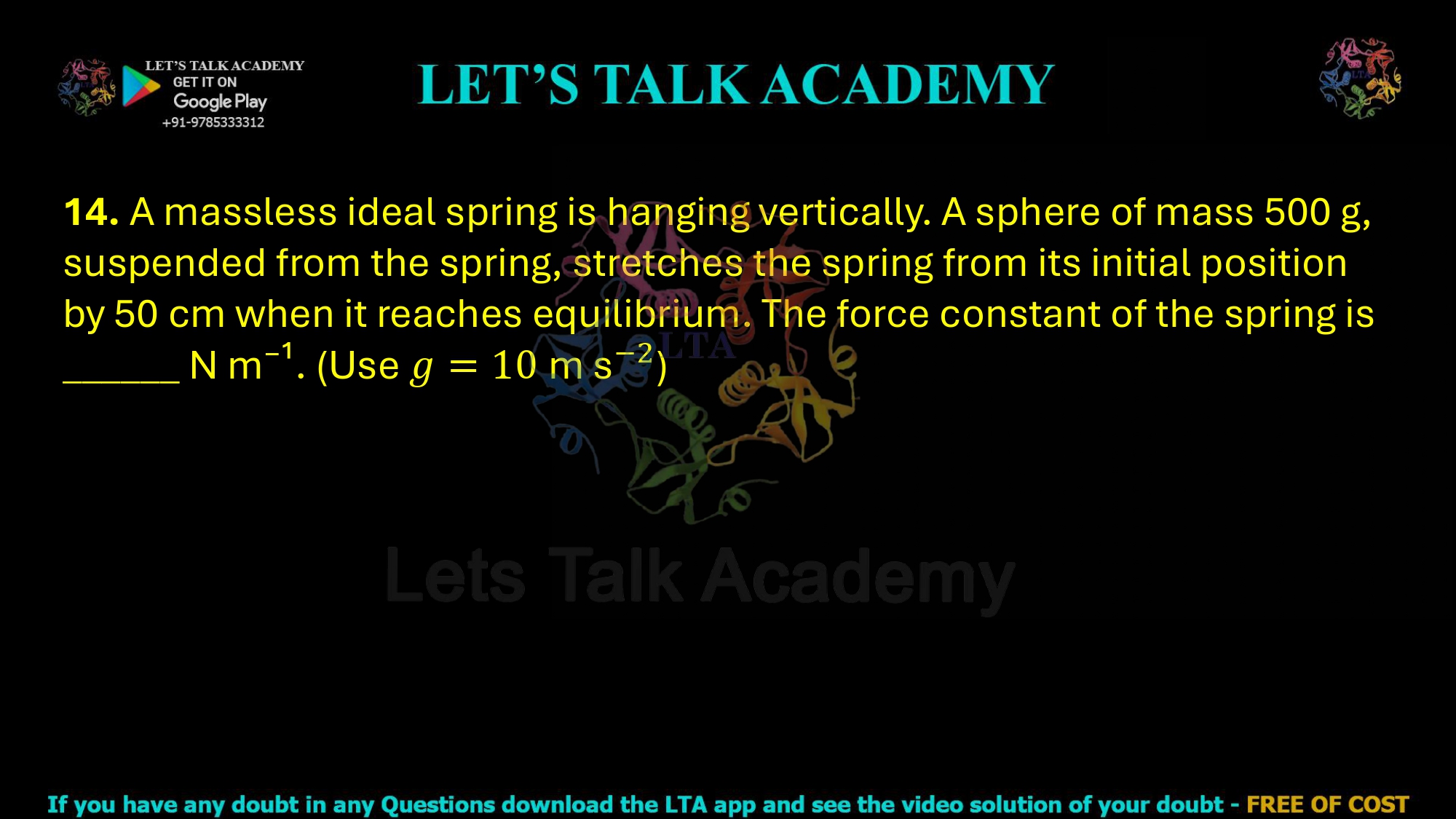
14. A massless ideal spring is hanging vertically. A sphere of mass 500 g, suspended from the spring, stretches the spring from its initial position by 50 cm when it reaches equilibrium. The force constant of the spring is ______ N m⁻¹. (Use )

Force Constant of a Spring: Calculate Spring Constant

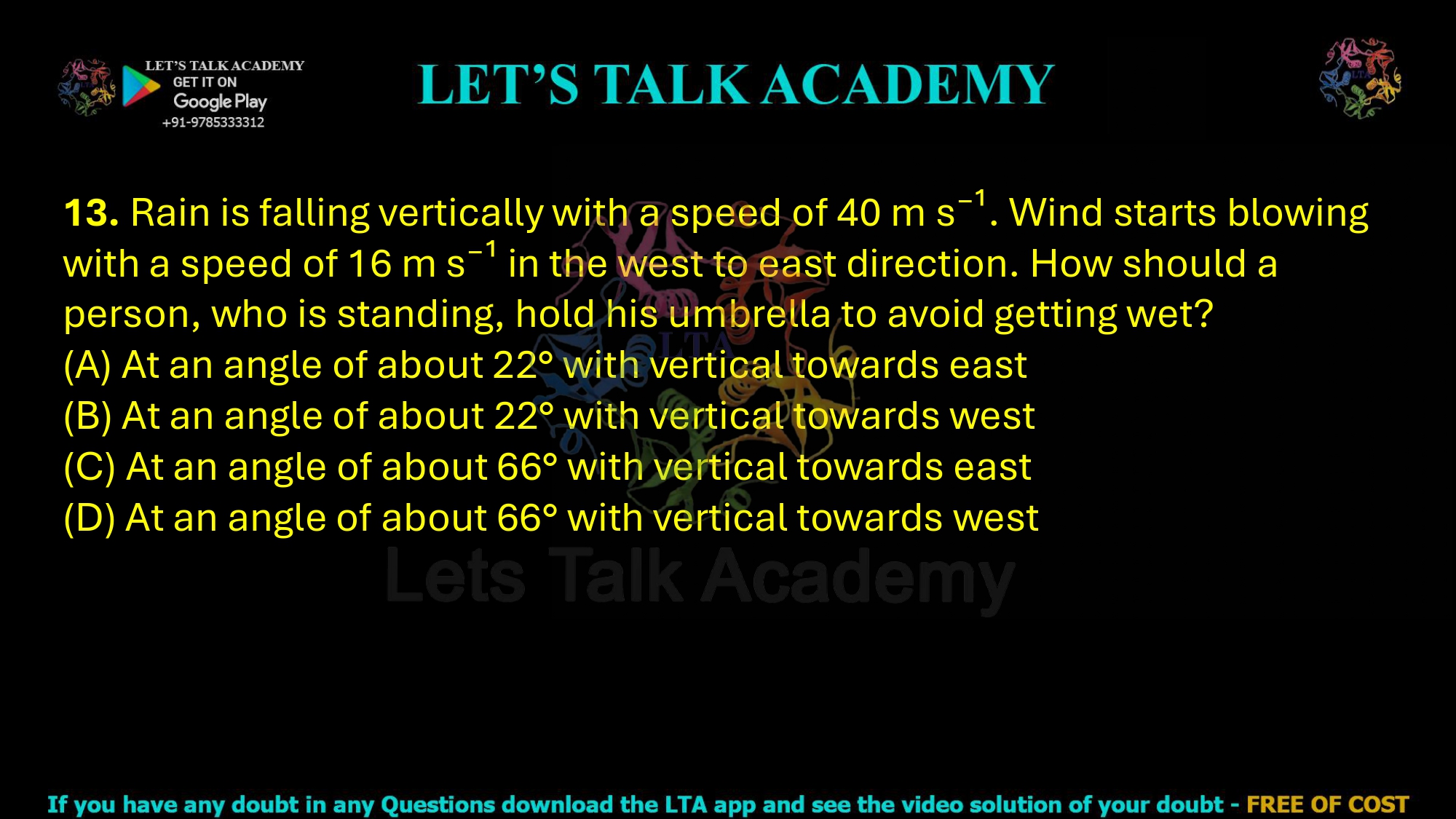
13. Rain is falling vertically with a speed of 40 m s⁻¹. Wind starts blowing with a speed of 16 m s⁻¹ in the west to east direction. How should a person, who is standing, hold his umbrella to avoid getting wet? (A) At an angle of about 22° with vertical towards east (B) At an angle of about 22° with vertical towards west (C) At an angle of about 66° with vertical towards east (D) At an angle of about 66° with vertical towards west

Rain and Wind Relative Velocity Problem

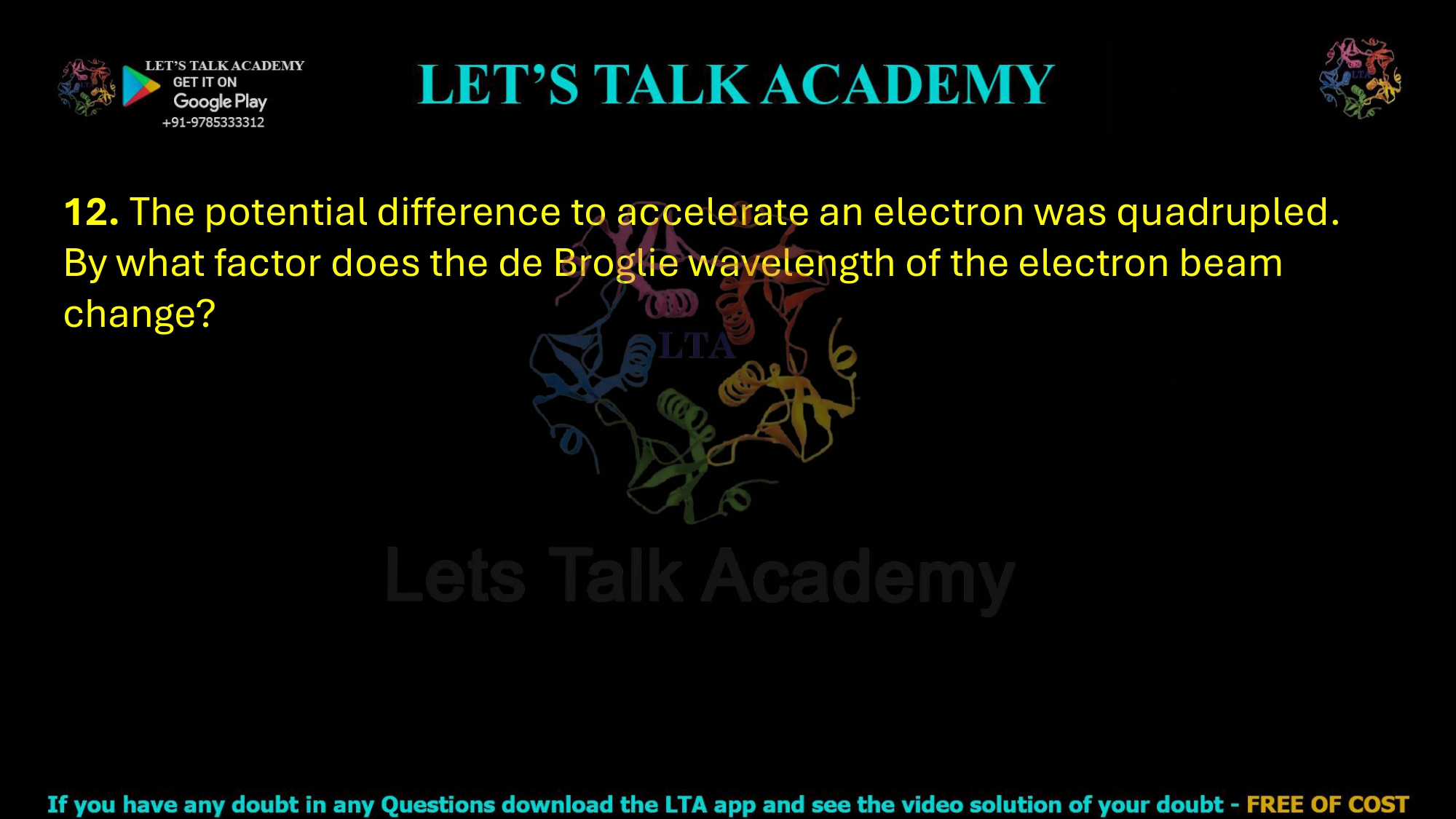
12. The potential difference to accelerate an electron was quadrupled. By what factor does the de Broglie wavelength of the electron beam change?

Effect of Quadrupling Accelerating Potential

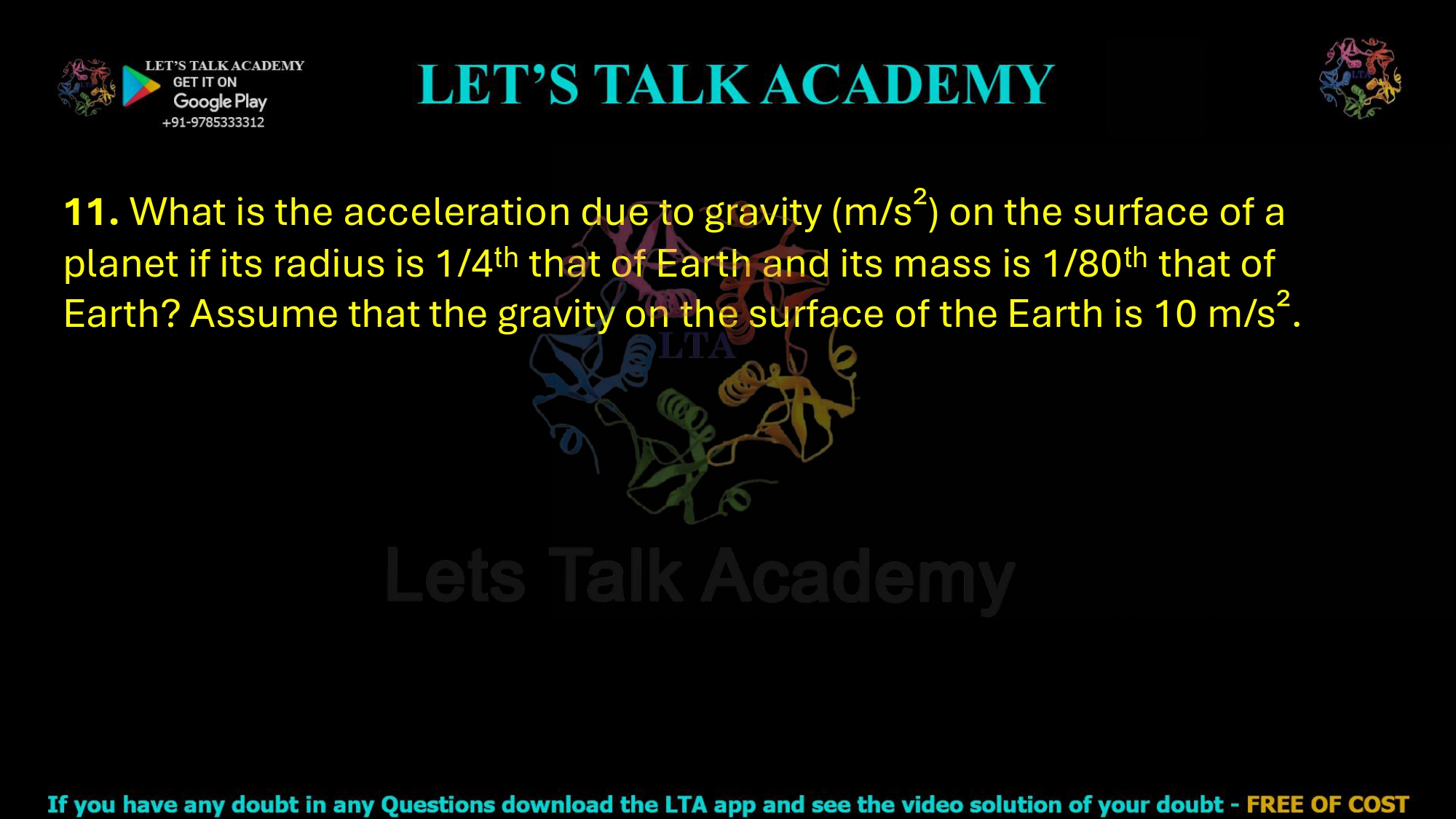
11. What is the acceleration due to gravity (m/s²) on the surface of a planet if its radius is 1/4ᵗʰ that of Earth and its mass is 1/80ᵗʰ that of Earth? Assume that the gravity on the surface of the Earth is 10 m/s².                          

Acceleration Due to Gravity on a Planet

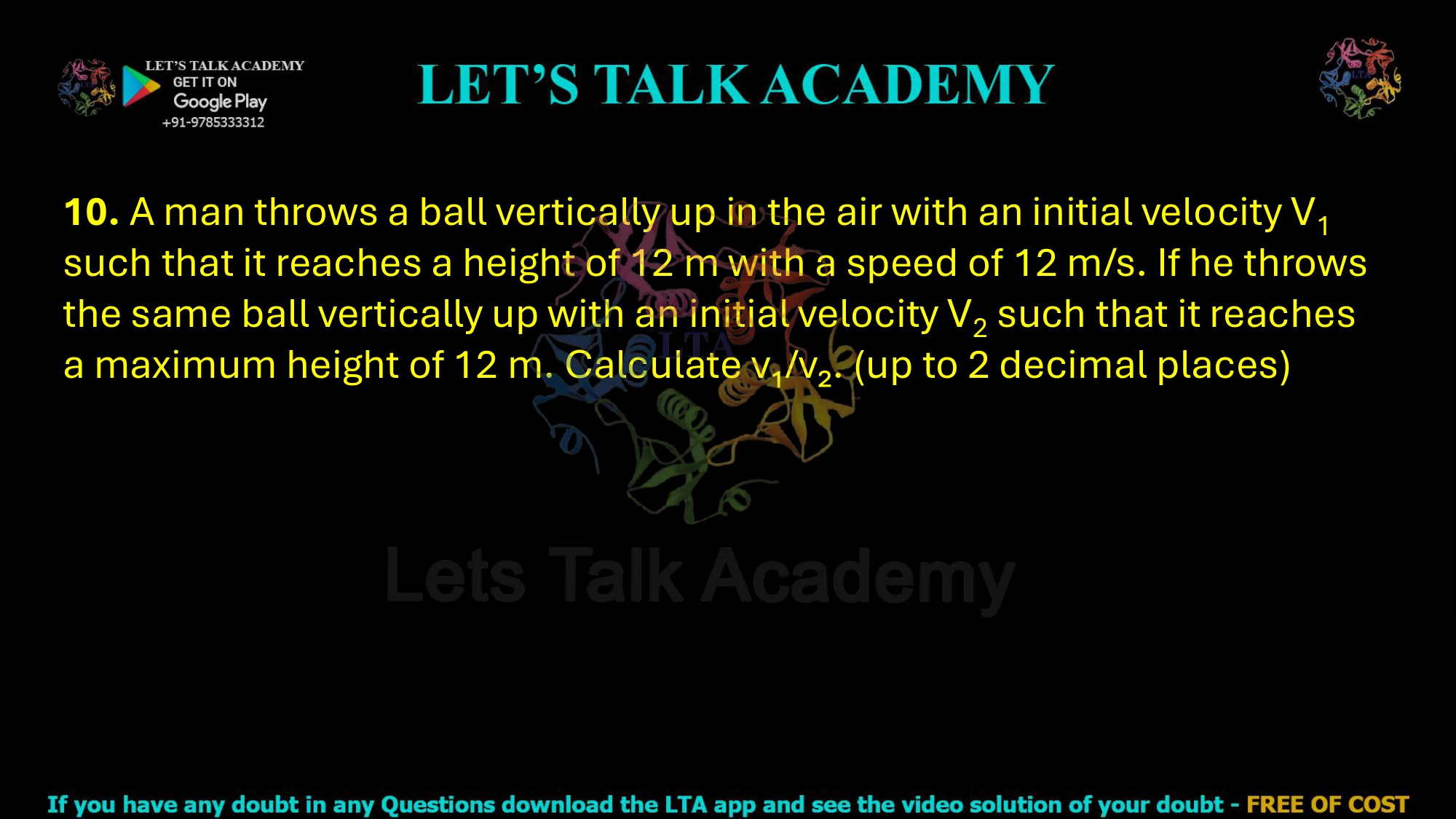
10. A man throws a ball vertically up in the air with an initial velocity V1 such that it reaches a height of 12 m with a speed of 12 m/s. If he throws the same ball vertically up with an initial velocity V2 such that it reaches a maximum height of 12 m. Calculate v₁/v₂. (up to 2 decimal places)

Calculate V₁/V₂ for a Ball Thrown Vertically Up to 12 m

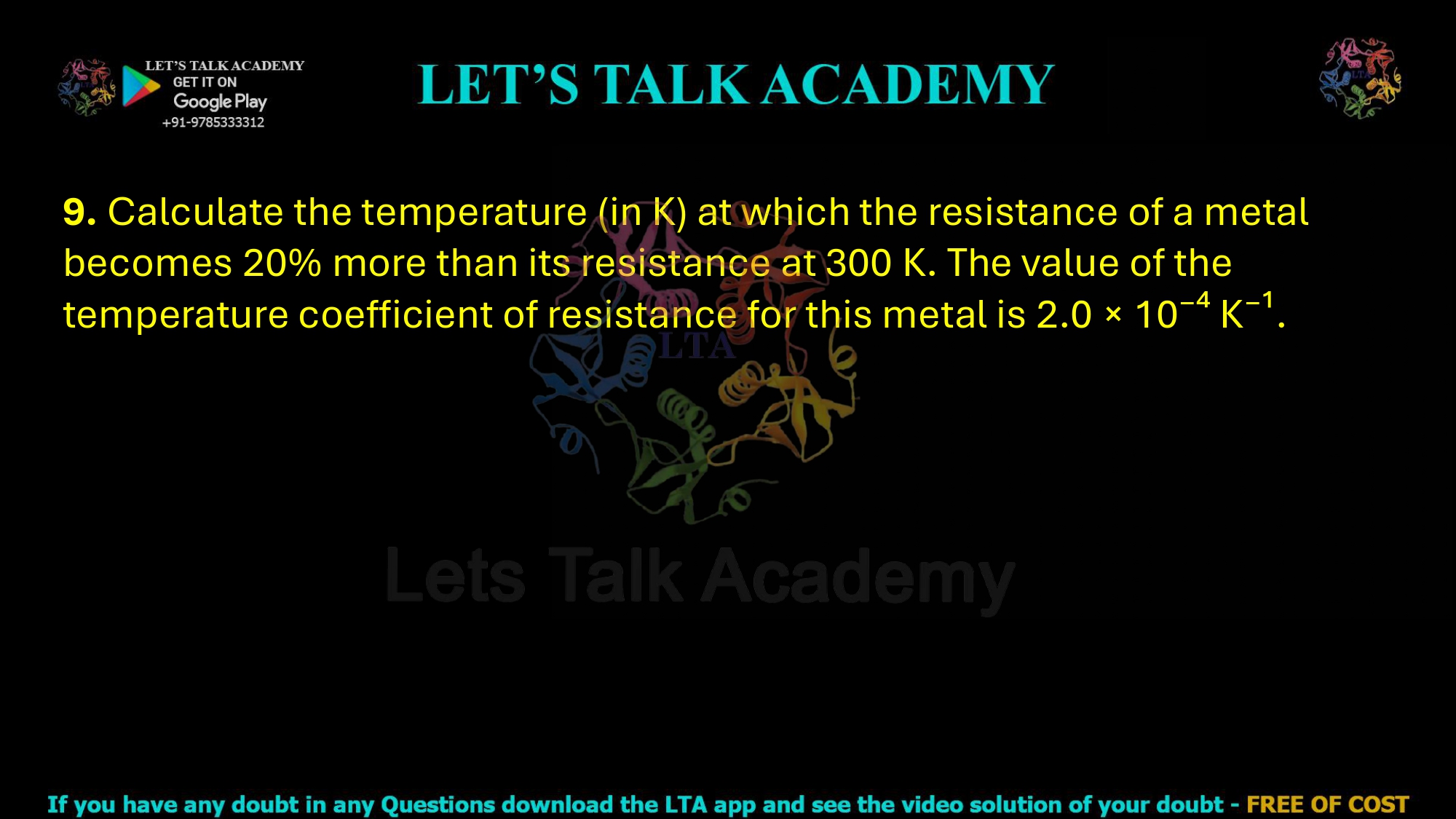
9. Calculate the temperature (in K) at which the resistance of a metal becomes 20% more than its resistance at 300 K. The value of the temperature coefficient of resistance for this metal is 2.0 × 10⁻⁴ K⁻¹.

Calculate the Temperature at Which Metal Resistance

8. An object is placed at the principal focus of a concave lens of focal length 10 cm. The image will be formed at ____ cm, between the optical center and the focus of the lens on the same side of the object.

Image Formation by Concave Lens

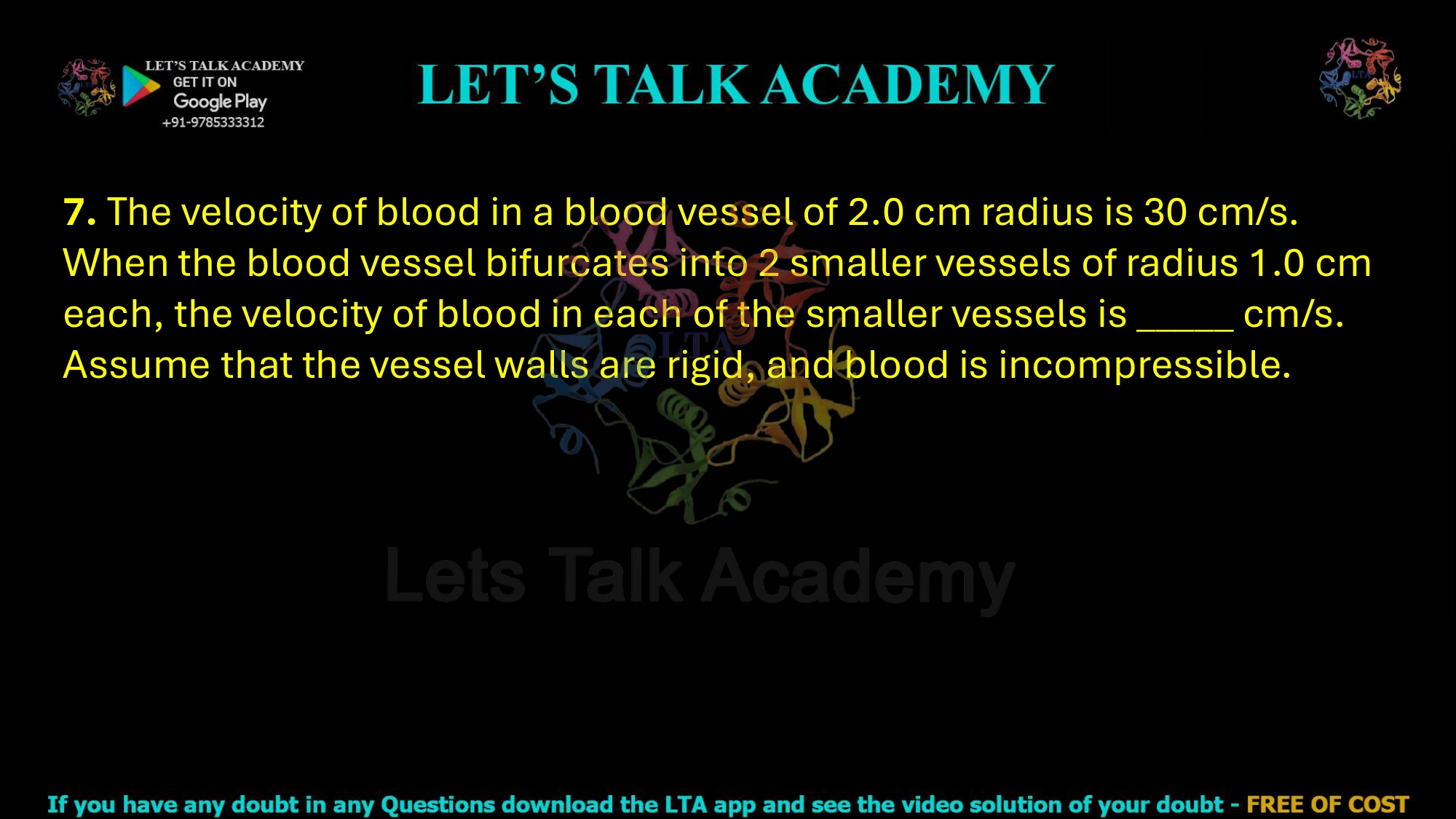
7. The velocity of blood in a blood vessel of 2.0 cm radius is 30 cm/s. When the blood vessel bifurcates into 2 smaller vessels of radius 1.0 cm each, the velocity of blood in each of the smaller vessels is _____ cm/s. Assume that the vessel walls are rigid, and blood is incompressible.    

Blood Flow Velocity After Bifurcation: Continuity Equation Numerical

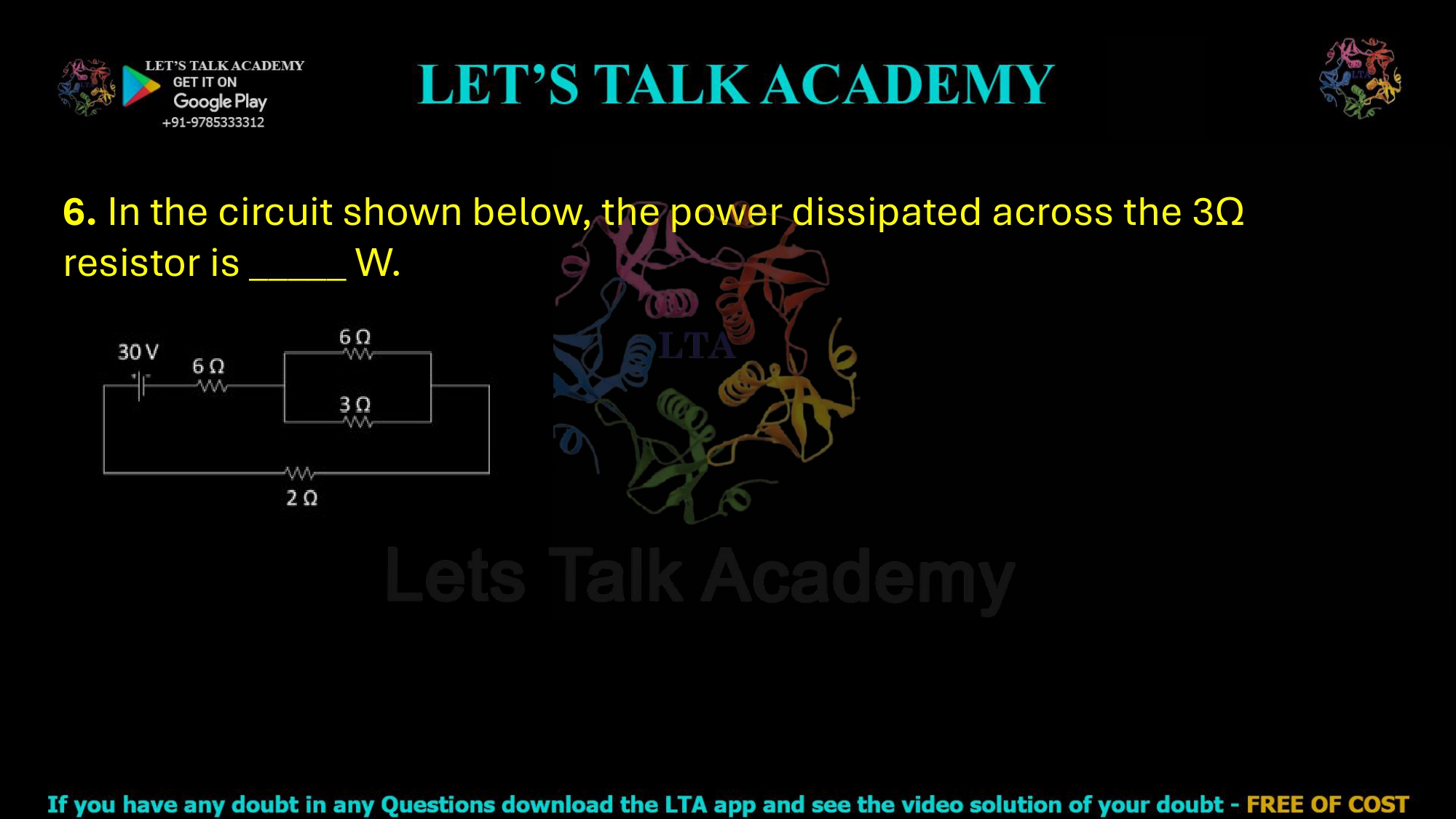
6. In the circuit shown below, the power dissipated across the 3Ω resistor is _____ W. 

Power Dissipated Across 3 Ohm Resistor in Series-Parallel Circuit

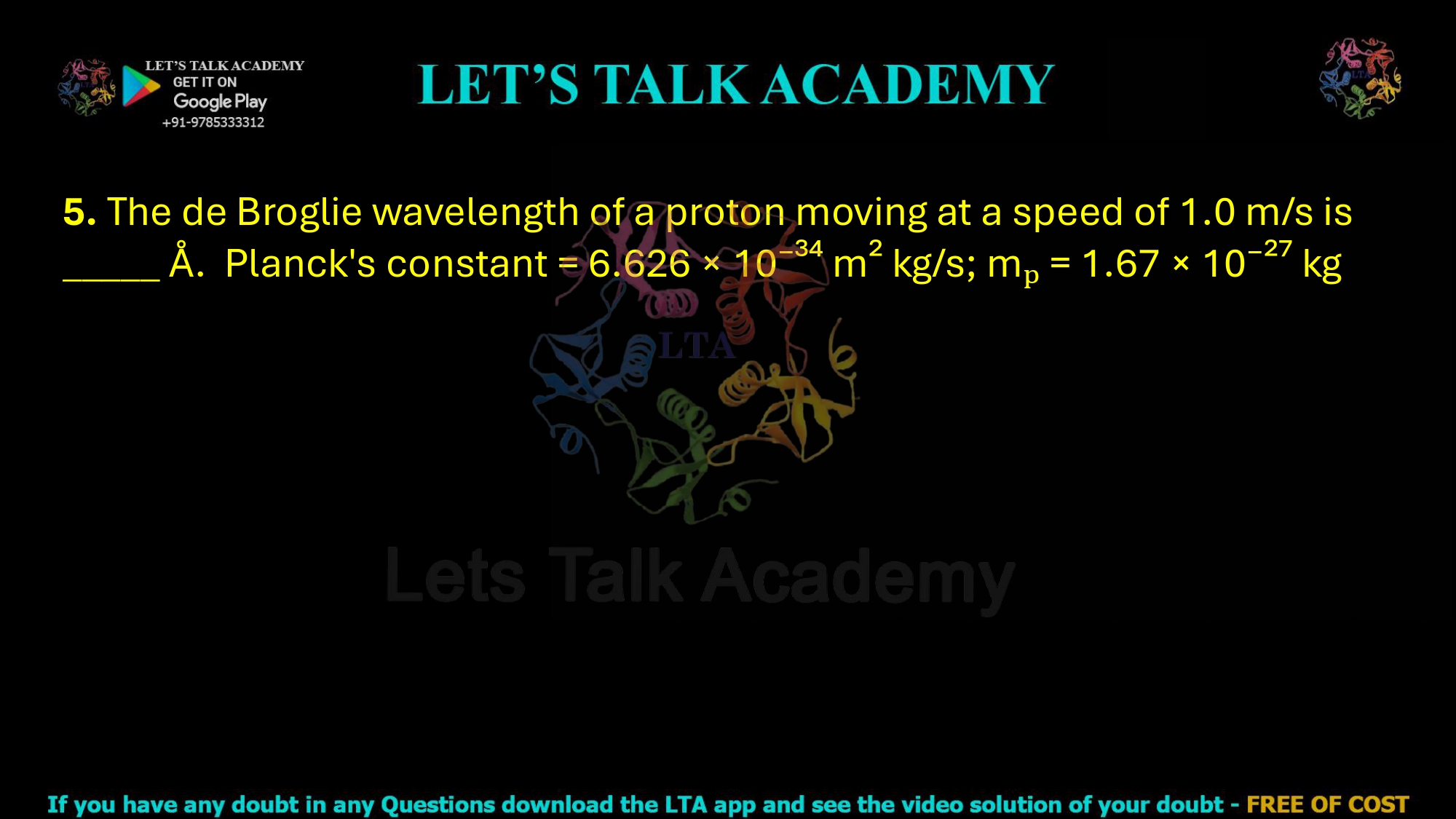
5. The de Broglie wavelength of a proton moving at a speed of 1.0 m/s is _____ Å.  Planck's constant = 6.626 × 10⁻³⁴ m² kg/s; mₚ = 1.67 × 10⁻²⁷ kg      

De Broglie Wavelength of a Proton Moving at 1.0 m/s

4. A charged particle accelerated by a potential V moves in a circular path with a velocity v in a uniform magnetic field B that is perpendicular to the motion. Which of the following is/are correct if the value of V is increased?  (A) Kinetic energy of the particle increases (B) Radius of the circular path increases (C) Time period of the motion increases (D) Work done by the magnetic field increases

harged Particle in Magnetic Field

3. A stationary enemy ship is docked in the sea at a distance of 1.0 km from the coastline. A gun located at sea level on the coastline can fire projectiles at a velocity of 120 m/s. What is the angle (in degrees) above the horizontal at which the gun must fire to hit the ship? [g = 9.8 m s⁻²]     (A) 21.4 (B) 42.9 (C) 23.6 (D) 47.1

Projectile Motion Angle to Hit a Ship 1 km Away

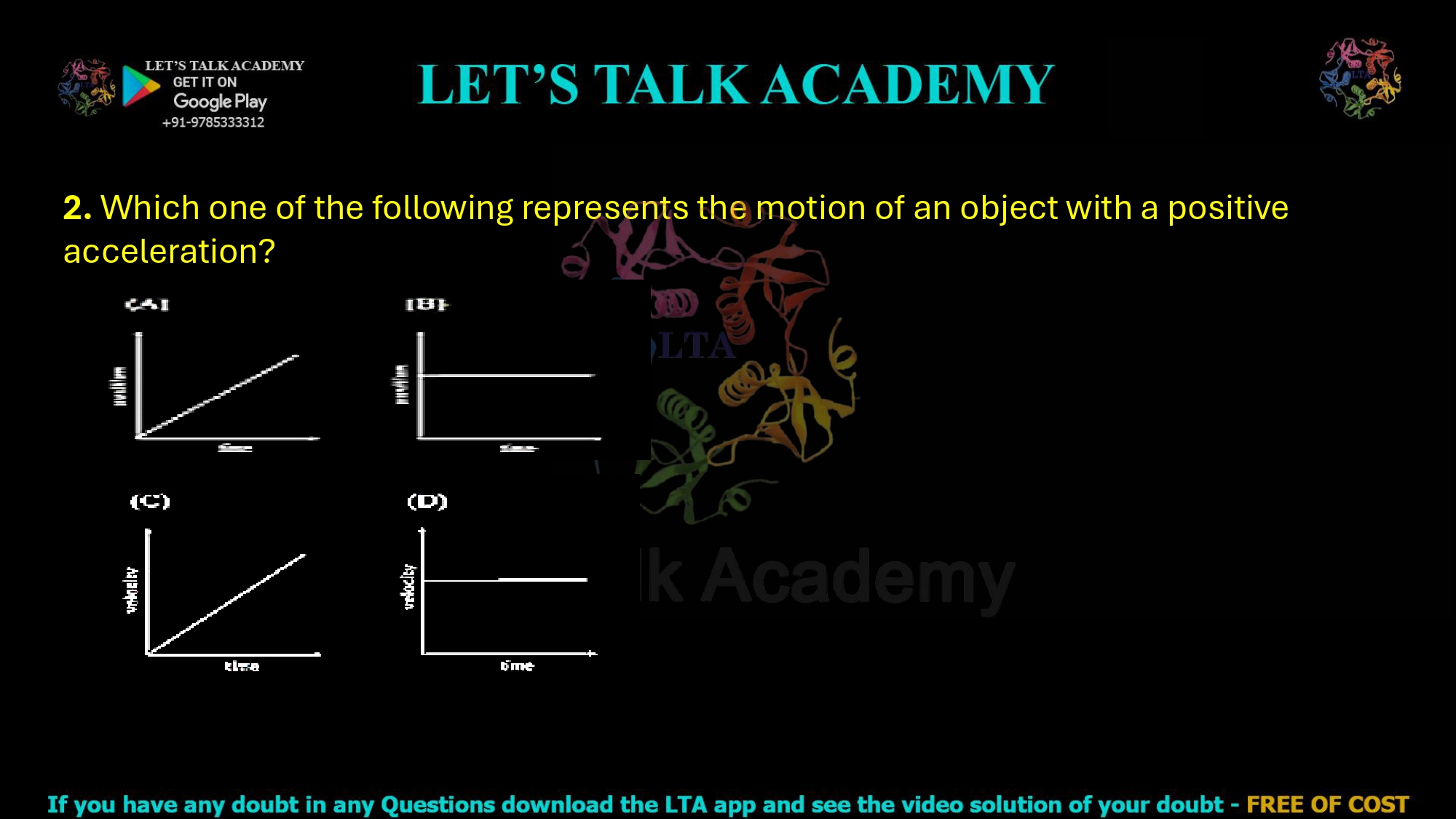
2. Which one of the following represents the motion of an object with a positive acceleration?         

Which Graph Represents the Motion of an Object

1. The moment of force in terms of fundamental dimensions is  (A) MLT⁻¹ (B) MLT⁻² (C) ML⁻¹T⁻¹ (D) ML²T⁻²

Moment of Force Dimensional Formula

Latest Courses