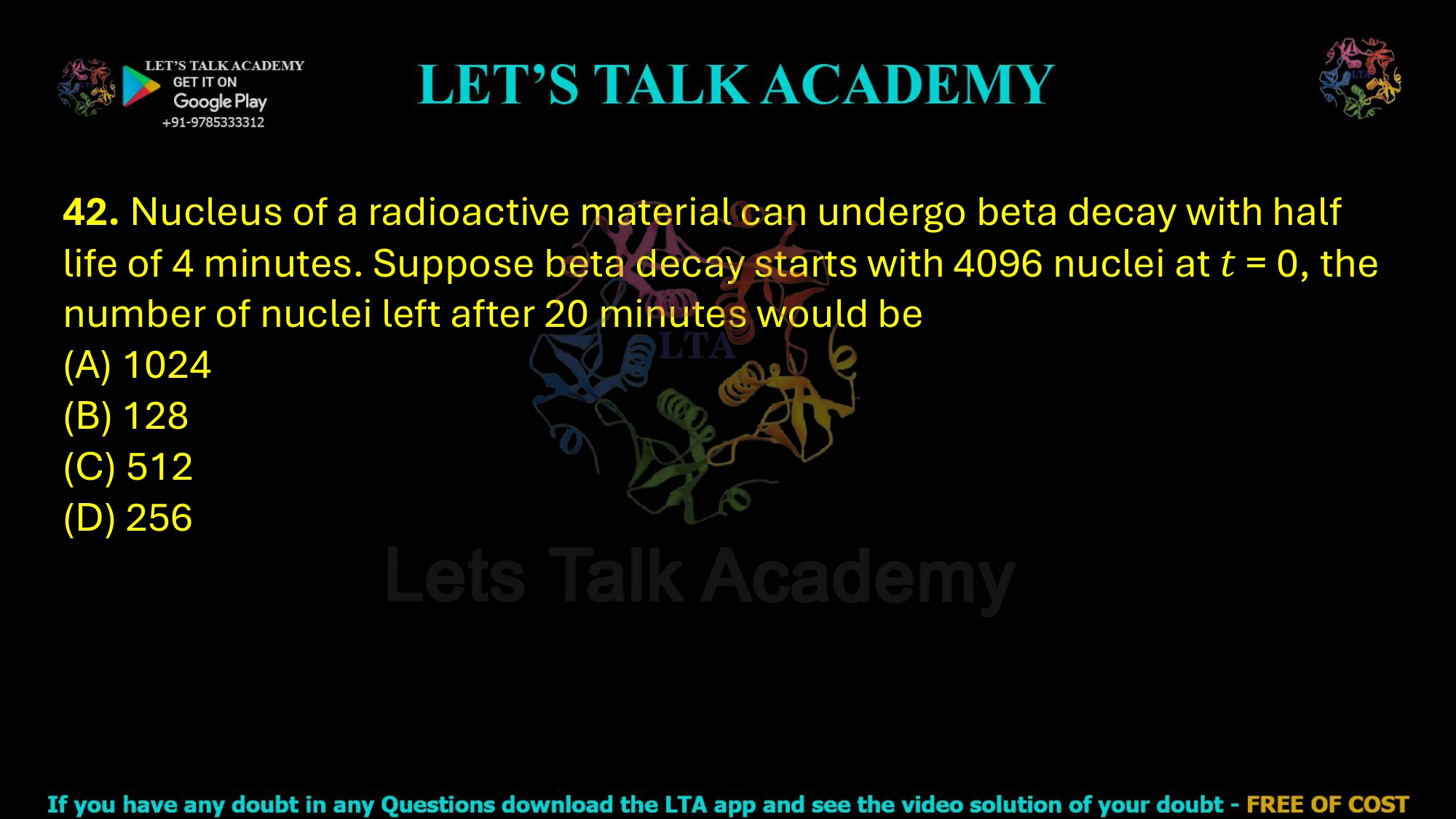
42. Nucleus of a radioactive material can undergo beta decay with half life of 4 minutes. Suppose beta decay starts with 4096 nuclei at 𝑡 = 0, the number of nuclei left after 20 minutes would be
(A) 1024
(B) 128
(C) 512
(D) 256
Radioactive Decay Half-Life Calculation: Number of Nuclei Left After 20 Minutes
Correct Answer: (B) 128
Understanding the Radioactive Decay Problem
This question deals with the concept of radioactive half-life. A radioactive material contains unstable nuclei that spontaneously decay into other nuclei while emitting radiation. In this problem, the radioactive nuclei undergo beta decay, and the half-life of the material is given as 4 minutes.
The sample initially contains 4096 radioactive nuclei at t = 0. We need to determine how many undecayed nuclei remain after 20 minutes. Since the half-life is 4 minutes, the first step is to calculate how many half-life periods have passed during the given time interval.
After each half-life, exactly half of the radioactive nuclei present at the beginning of that interval remain undecayed. Therefore, the number of nuclei decreases successively by a factor of 2 after every 4 minutes.
What Is the Half-Life of a Radioactive Material?
The half-life of a radioactive material is the time required for half of the radioactive nuclei initially present in a sample to decay.
If a sample initially contains N0 radioactive nuclei, then after one half-life, the number of undecayed nuclei becomes:
N = N0/2
After two half-lives, the number becomes:
N = N0/4
After three half-lives:
N = N0/8
This process continues exponentially. The number of radioactive nuclei does not decrease by the same numerical amount during each half-life. Instead, the same fraction, one-half, of the nuclei present at that time remains after every half-life.
Given Information in the Question
The initial number of radioactive nuclei is:
N0 = 4096
The half-life of the radioactive material is:
T1/2 = 4 minutes
The total elapsed time is:
t = 20 minutes
We need to calculate the number of radioactive nuclei that remain undecayed after 20 minutes.
Calculating the Number of Half-Lives
The number of half-lives that have passed is calculated by dividing the total elapsed time by the half-life of the radioactive material:
Number of half-lives = Total time/Half-life
Therefore:
n = t/T1/2
Substituting the given values:
n = 20/4
Hence:
n = 5
Therefore, exactly five half-life periods have passed during the 20-minute interval.
Using the Radioactive Decay Half-Life Formula
The number of undecayed radioactive nuclei remaining after n half-lives is given by:
N = N0(1/2)n
where N is the number of nuclei remaining, N0 is the initial number of nuclei and n is the number of half-lives elapsed.
For this problem:
N0 = 4096
and:
n = 5
Therefore:
N = 4096(1/2)5
Since:
25 = 32
we obtain:
N = 4096/32
Therefore:
N = 128
Hence, 128 radioactive nuclei remain undecayed after 20 minutes.
Step-by-Step Decay of the Radioactive Nuclei
The same answer can be understood by following the radioactive sample through each successive half-life. Initially, at t = 0, the sample contains 4096 radioactive nuclei.
After 4 Minutes: First Half-Life
After one half-life of 4 minutes, half of the initial nuclei remain:
4096 → 2048
Therefore, 2048 nuclei remain after 4 minutes.
After 8 Minutes: Second Half-Life
During the next 4 minutes, half of the 2048 remaining nuclei decay:
2048 → 1024
Therefore, 1024 nuclei remain after 8 minutes.
After 12 Minutes: Third Half-Life
After another half-life:
1024 → 512
Therefore, 512 nuclei remain after 12 minutes.
After 16 Minutes: Fourth Half-Life
During the fourth half-life:
512 → 256
Therefore, 256 nuclei remain after 16 minutes.
After 20 Minutes: Fifth Half-Life
During the fifth and final half-life:
256 → 128
Therefore, after 20 minutes, the number of undecayed radioactive nuclei is:
128
Complete Decay Sequence
The entire radioactive decay process can be written compactly as:
4096 → 2048 → 1024 → 512 → 256 → 128
Each arrow represents the passage of one half-life, which is equal to 4 minutes. Since 20 minutes contains five half-lives, the initial number of nuclei is halved five times.
This sequence clearly confirms that the final number of nuclei remaining after 20 minutes is 128.
Why Radioactive Decay Is an Exponential Process
Radioactive decay follows an exponential law because the probability of decay of an individual unstable nucleus is constant and independent of the age of the nucleus. During each half-life, the same fraction of the nuclei present at the beginning of that interval decays.
The general radioactive decay law is:
N = N0e−λt
where λ is the radioactive decay constant. The half-life and decay constant are related by:
T1/2 = ln 2/λ
For questions in which the elapsed time is an exact multiple of the half-life, the simpler relation N = N0(1/2)n provides the fastest and clearest solution.
Detailed Analysis of Each Option
Option (A): 1024
Option (A) is incorrect. Starting with 4096 nuclei, the number becomes 1024 after only two half-lives:
4096 → 2048 → 1024
Two half-lives correspond to:
2 × 4 = 8 minutes
Therefore, 1024 nuclei would remain after 8 minutes, not after 20 minutes.
Option (B): 128
Option (B) is correct. In 20 minutes, five half-lives of 4 minutes each are completed:
20/4 = 5
Therefore:
N = 4096(1/2)5
N = 4096/32 = 128
Hence, 128 radioactive nuclei remain after 20 minutes.
Option (C): 512
Option (C) is incorrect. The number of nuclei becomes 512 after three half-lives:
4096 → 2048 → 1024 → 512
Three half-lives correspond to:
3 × 4 = 12 minutes
Therefore, 512 nuclei remain after 12 minutes rather than after 20 minutes.
Option (D): 256
Option (D) is incorrect. The number of nuclei becomes 256 after four half-lives:
4096 → 2048 → 1024 → 512 → 256
Four half-lives correspond to:
4 × 4 = 16 minutes
After the fifth half-life, from 16 minutes to 20 minutes, the number decreases further from 256 to 128.
Difference Between Nuclei Remaining and Nuclei Decayed
The question asks for the number of nuclei left after 20 minutes. Therefore, we calculate the number of undecayed nuclei remaining in the sample.
The number remaining is:
N = 128
If the question instead asked for the total number of nuclei that had decayed during 20 minutes, the calculation would be:
Number decayed = Initial number − Number remaining
Therefore:
Number decayed = 4096 − 128
Number decayed = 3968
Thus, after 20 minutes, 128 nuclei remain undecayed, while 3968 nuclei have undergone radioactive decay.
Final Answer
The half-life of the radioactive material is:
T1/2 = 4 minutes
The total elapsed time is:
t = 20 minutes
Therefore, the number of half-lives is:
n = 20/4 = 5
Using the half-life relation:
N = N0(1/2)n
we get:
N = 4096(1/2)5
N = 4096/32
N = 128
Therefore, the correct answer is (B) 128.


