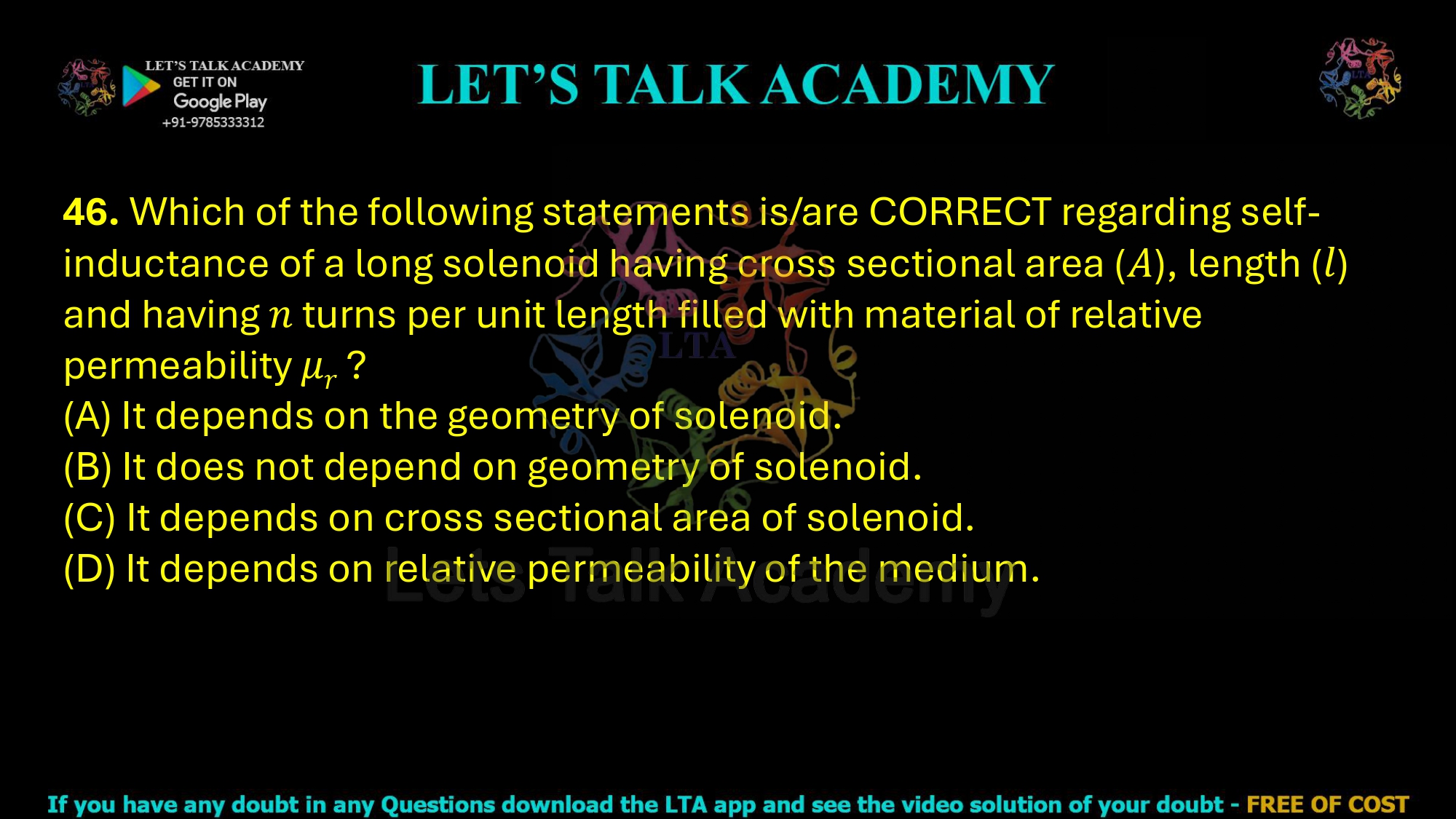
46. Which of the following statements is/are CORRECT regarding self-inductance of a long solenoid having cross sectional area (𝐴), length (𝑙) and having 𝑛 turns per unit length filled with material of relative permeability 𝜇𝑟 ?
(A) It depends on the geometry of solenoid.
(B) It does not depend on geometry of solenoid.
(C) It depends on cross sectional area of solenoid.
(D) It depends on relative permeability of the medium.
Which Statements Are Correct Regarding the Self-Inductance of a Long Solenoid?
Correct Answer: (A), (C), and (D)
The correct statements are (A), (C), and (D). The self-inductance of a long solenoid depends on its geometry, including its cross-sectional area and length, and also on the magnetic permeability of the material present inside the solenoid.
For a long solenoid of cross-sectional area A, length l, number of turns per unit length n, and relative permeability μr, the self-inductance is given by
L = μ0μrn2Al
This formula immediately reveals the factors that control the self-inductance. The inductance depends on the cross-sectional area A, length l, turns per unit length n, and relative permeability μr. Therefore, statement (A) is correct, statement (B) is incorrect, statement (C) is correct, and statement (D) is correct.
Understanding Self-Inductance of a Solenoid
Self-inductance is the property of a current-carrying coil by which a change in the current flowing through it produces an induced electromotive force in the same coil. When the current through a solenoid changes, the magnetic field produced by the solenoid also changes. This changing magnetic field changes the magnetic flux linked with the turns of the solenoid and produces a self-induced emf.
The induced emf always opposes the change in current responsible for producing it. This behaviour is a consequence of Lenz’s law and is mathematically expressed as
ε = −L(dI/dt)
Here, L represents the self-inductance of the solenoid. A larger value of self-inductance means that the solenoid produces a greater opposition to a change in current.
Derivation of the Self-Inductance Formula for a Long Solenoid
To understand why the given statements are correct or incorrect, it is useful to derive the expression for the self-inductance of a long solenoid.
The magnetic field inside a long solenoid containing a magnetic material is
B = μ0μrnI
where μ0 is the permeability of free space, μr is the relative permeability of the material, n is the number of turns per unit length, and I is the current flowing through the solenoid.
If the cross-sectional area of the solenoid is A, the magnetic flux passing through one turn is
Φ = BA
Substituting the expression for the magnetic field gives
Φ = μ0μrnIA
The total number of turns in a solenoid of length l is
N = nl
Therefore, the total magnetic flux linkage is
NΦ = (nl)(μ0μrnIA)
Hence,
NΦ = μ0μrn2AlI
Self-inductance is defined as the total magnetic flux linkage per unit current:
L = NΦ/I
Therefore, the self-inductance of the long solenoid is
L = μ0μrn2Al
This final expression provides the complete basis for analysing all four statements in the question.
How Does the Geometry of a Solenoid Affect Self-Inductance?
The geometry of a solenoid refers to its physical dimensions and arrangement. Important geometrical parameters include its length, cross-sectional area, and the distribution of turns along its length.
The formula L = μ0μrn2Al contains both the cross-sectional area A and the length l. Therefore, changing the physical dimensions of the solenoid can change its self-inductance.
This means that two solenoids made from the same material and carrying the same current can have different self-inductances if their dimensions or winding arrangements are different. Therefore, the geometry of the solenoid is an important factor in determining its inductance.
Dependence of Self-Inductance on Cross-Sectional Area
The self-inductance of the solenoid is directly proportional to its cross-sectional area:
L ∝ A
If all other quantities remain constant, increasing the cross-sectional area increases the magnetic flux passing through each turn. A greater magnetic flux produces greater flux linkage with the coil, which results in a larger self-inductance.
For example, if the cross-sectional area is doubled while μr, n, and l remain unchanged, the self-inductance also doubles. Therefore, the dependence of self-inductance on cross-sectional area is direct and clearly established by the formula.
Dependence of Self-Inductance on Relative Permeability
The relative permeability μr describes how effectively a material supports the formation of a magnetic field compared with vacuum. The self-inductance of the solenoid is directly proportional to the relative permeability of the medium:
L ∝ μr
When a material with higher relative permeability is placed inside the solenoid, the magnetic field produced for the same current becomes stronger. This increases the magnetic flux through each turn and therefore increases the total flux linkage.
As a result, inserting a high-permeability magnetic core into a solenoid can greatly increase its self-inductance. This principle is widely used in practical inductors, transformers, and electromagnetic devices.
Detailed Explanation of Each Option
Option (A): It Depends on the Geometry of Solenoid
This statement is correct. The self-inductance of a solenoid depends on physical parameters such as its cross-sectional area and length. These parameters form part of the geometry of the solenoid.
The expression L = μ0μrn2Al explicitly contains A and l. Therefore, changing the dimensions of the solenoid changes its self-inductance. Hence, option (A) is correct.
Option (B): It Does Not Depend on Geometry of Solenoid
This statement is incorrect. It directly contradicts the formula for the self-inductance of a long solenoid. Since the cross-sectional area and length are geometrical quantities and both appear in the inductance formula, self-inductance cannot be independent of geometry.
Therefore, option (B) is incorrect.
Option (C): It Depends on Cross-Sectional Area of Solenoid
This statement is correct. The self-inductance is directly proportional to the cross-sectional area:
L ∝ A
A larger cross-sectional area allows a greater magnetic flux to pass through each turn of the solenoid. This increases the total magnetic flux linkage and consequently increases the self-inductance. Hence, option (C) is correct.
Option (D): It Depends on Relative Permeability of the Medium
This statement is correct. The relative permeability of the material inside the solenoid directly affects the strength of the magnetic field and therefore the magnetic flux linkage.
Since L ∝ μr, a material with greater relative permeability produces a greater self-inductance. Hence, option (D) is correct.
Alternative Form of the Self-Inductance Formula
The formula for the self-inductance of a long solenoid is also commonly written in terms of the total number of turns N. Since
n = N/l
substituting this relation into L = μ0μrn2Al gives
L = μ0μrN2A/l
This form makes the geometrical dependence even clearer. For a fixed total number of turns, the self-inductance is directly proportional to the cross-sectional area and inversely proportional to the length of the solenoid.
There is no contradiction between the two formulas. The expression L = μ0μrn2Al is written when the number of turns per unit length n is specified, whereas L = μ0μrN2A/l is written when the total number of turns N is specified.
Factors Affecting the Self-Inductance of a Long Solenoid
The self-inductance of a long solenoid is controlled by several physical factors. It increases with the relative permeability of the medium, increases with the cross-sectional area, and increases with the square of the number of turns per unit length. Its dependence on length must be interpreted according to whether the turns per unit length or the total number of turns is being held constant.
In the present question, n is explicitly defined as the number of turns per unit length. Therefore, the appropriate expression is L = μ0μrn2Al.
Final Answer
The self-inductance of the given long solenoid is
L = μ0μrn2Al
This expression shows that self-inductance depends on the geometry of the solenoid, specifically its cross-sectional area and length, and also depends on the relative permeability of the material filling the solenoid.
Therefore, the correct statements are (A), (C), and (D).


