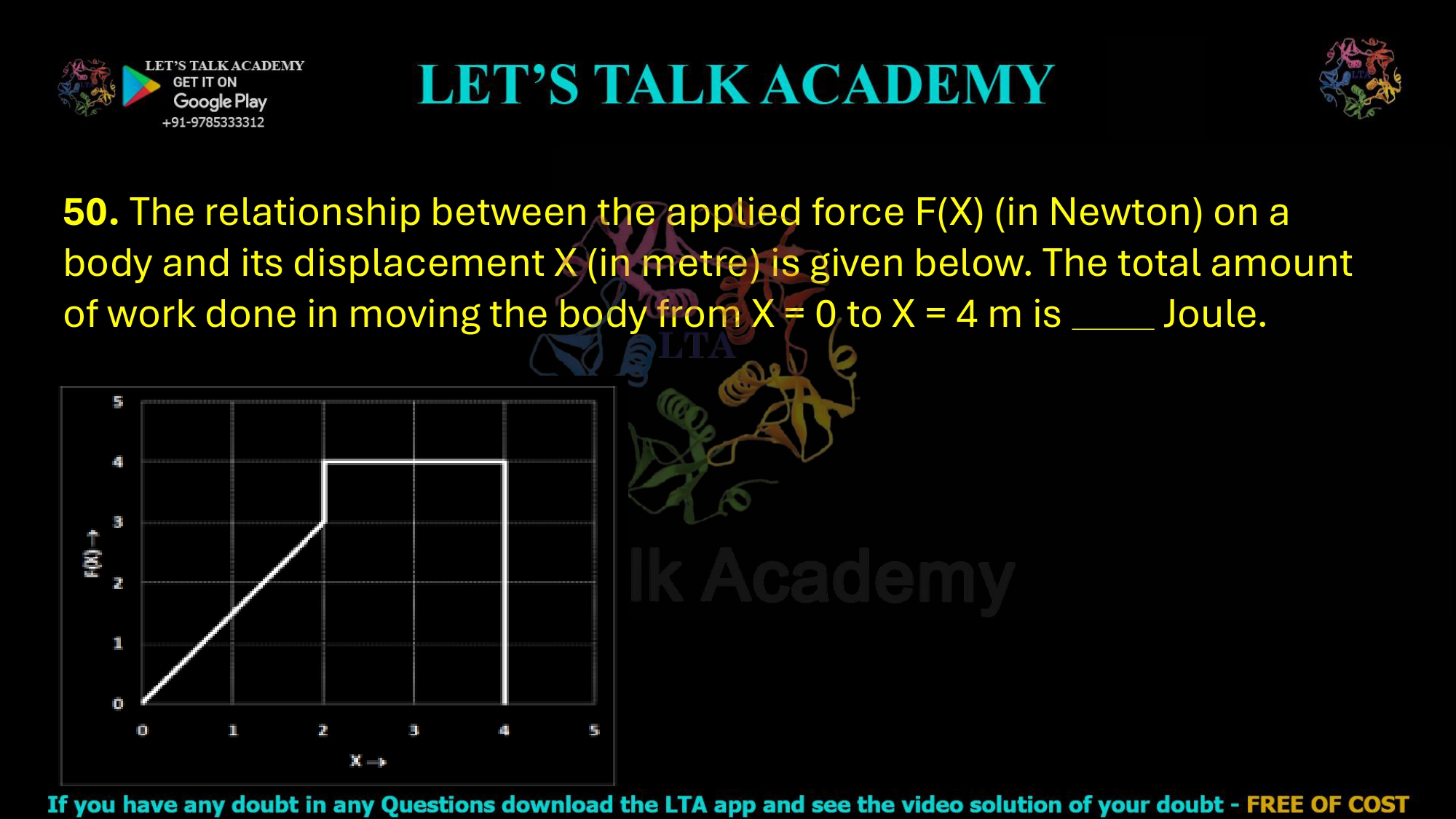
50. The relationship between the applied force F(X) (in Newton) on a body and its displacement X (in metre) is given below. The total amount of work done in moving the body from X = 0 to X = 4 m is Joule.
Work Done from a Force-Displacement Graph Between X = 0 and X = 4 m
Correct Answer: 11 J
Understanding the Force-Displacement Graph
This question is based on the calculation of work done by a variable force using a force-displacement graph. When force changes with position, the work done cannot always be calculated directly by using the simple expression W = Fs. Instead, the total work done is determined by finding the area under the force-displacement curve.
In the given graph, the force does not remain constant throughout the entire displacement from X = 0 to X = 4 m. From X = 0 to X = 2 m, the force increases linearly from 0 N to 3 N. At X = 2 m, the force suddenly increases from 3 N to 4 N. From X = 2 m to X = 4 m, the force remains constant at 4 N.
Therefore, the total area under the graph can be divided into two simple geometrical regions: a triangle from X = 0 to X = 2 m and a rectangle from X = 2 m to X = 4 m.
Work Done and the Area Under an F-X Graph
For a variable force acting along the direction of displacement, the work done is represented mathematically by:
W = ∫F(X)dX
Graphically, this integral represents the signed area between the force-displacement curve and the displacement axis.
Since the entire graph in this question lies above the X-axis, all the calculated areas are positive. Therefore, the total work done is obtained by simply adding the area of the triangular region and the area of the rectangular region.
Dividing the Graph into Simple Geometrical Shapes
The force-displacement graph consists of two regions that contribute to the total work done.
From X = 0 to X = 2 m, the force increases uniformly from 0 N to 3 N. The area under this part of the graph forms a triangle.
From X = 2 m to X = 4 m, the force remains constant at 4 N. The area under this part of the graph forms a rectangle.
Thus:
Total work done = Area of triangle + Area of rectangle
Work Done from X = 0 to X = 2 m
Calculating the Area of the Triangular Region
Between X = 0 and X = 2 m, the force increases linearly from 0 N to 3 N. The region under the graph is therefore a triangle.
The base of the triangle is:
Base = 2 m
The height of the triangle is:
Height = 3 N
The area of a triangle is:
Area = (1/2) × Base × Height
Therefore, the work done from X = 0 to X = 2 m is:
W1 = (1/2) × 2 × 3
W1 = 3 J
Thus, the work done during the first 2 m of displacement is 3 Joule.
Work Done from X = 2 m to X = 4 m
Calculating the Area of the Rectangular Region
Between X = 2 m and X = 4 m, the applied force remains constant at 4 N. Therefore, the area under this portion of the graph forms a rectangle.
The width of the rectangle is:
Width = 4 − 2 = 2 m
The height of the rectangle is:
Height = 4 N
The area of a rectangle is:
Area = Width × Height
Therefore, the work done from X = 2 m to X = 4 m is:
W2 = 2 × 4
W2 = 8 J
Thus, the work done during this part of the displacement is 8 Joule.
Calculating the Total Work Done
The total work done in moving the body from X = 0 to X = 4 m is the sum of the work done over the two regions of the graph.
W = W1 + W2
Substituting the calculated values:
W = 3 + 8
W = 11 J
Final Answer
The total amount of work done in moving the body from X = 0 to X = 4 m is 11 Joule.
Therefore, the required answer is 11.
Why Is the Area Under the Force-Displacement Graph Equal to Work?
For a very small displacement dX, the small amount of work done by a force F(X) is given by:
dW = F(X)dX
On a force-displacement graph, F(X) represents the vertical height and dX represents a very small horizontal width. Their product represents the area of a thin vertical strip under the graph.
Adding all such small strips from the initial position to the final position gives the total area under the curve. Mathematically, this addition is represented by integration. Therefore, the total work done by a variable force is equal to the area under the F-X graph.
Why the Vertical Line at X = 2 m Does Not Contribute to Work
At X = 2 m, the force changes vertically from 3 N to 4 N. This vertical segment may appear to be an additional part of the graph, but it does not contribute any work.
Work requires displacement. Along this vertical segment, the displacement does not change because X remains fixed at 2 m. Therefore, the horizontal width of this region is zero.
Since the area of a region with zero width is zero, the sudden change in force from 3 N to 4 N at X = 2 m adds no work by itself.
Understanding the First Region of the Graph
From X = 0 to X = 2 m, the force is not constant. It begins at zero and increases uniformly to 3 N. Therefore, multiplying the final force of 3 N directly by the displacement of 2 m would incorrectly give 6 J.
Because the force increases linearly, its average value over this interval is:
Average force = (0 + 3)/2 = 1.5 N
The work done can therefore also be calculated as:
W1 = Average force × Displacement
W1 = 1.5 × 2 = 3 J
This is exactly equal to the area of the triangle under the graph.
Understanding the Constant-Force Region
From X = 2 m to X = 4 m, the graph is horizontal at F = 4 N. A horizontal line on a force-displacement graph indicates that the applied force remains constant throughout that interval.
For a constant force acting in the direction of displacement, the work done is simply:
W = F × ΔX
Therefore:
W = 4 × (4 − 2) = 8 J
This is identical to the area of the rectangular region under the graph.
Physical Meaning of the Positive Work
The force remains positive throughout the displacement from X = 0 to X = 4 m. The body also moves in the positive X-direction. Therefore, the applied force and displacement are in the same direction.
As a result, the work done by the applied force is positive. Positive work means that the applied force transfers energy to the body.
If a portion of the force-displacement graph were below the X-axis, the force would act opposite to the positive direction of displacement, and the corresponding area would represent negative work. No such negative region is present in this graph.
Alternative Calculation Using the Piecewise Force Function
The graph can also be interpreted mathematically as a piecewise force function. From X = 0 to X = 2 m, the force increases linearly from 0 N to 3 N. Therefore, the force in this region can be represented as:
F(X) = (3/2)X
From X = 2 m to X = 4 m, the force remains constant:
F(X) = 4
The total work can therefore be written as:
W = ∫02(3X/2)dX + ∫244dX
Evaluating the first integral gives 3 J, while the second integral gives 8 J. Therefore:
W = 3 + 8 = 11 J
Key Concept Behind the Numerical
The central principle in this question is that work done is equal to the area under a force-displacement graph. The graph must first be divided into simple geometrical regions whose areas can be calculated separately.
From X = 0 to X = 2 m, the triangular area gives 3 J. From X = 2 m to X = 4 m, the rectangular area gives 8 J. Adding both contributions gives a total work of 11 J.
Conclusion
The total work done is obtained by calculating the complete area under the force-displacement graph from X = 0 to X = 4 m. The triangular region from 0 to 2 m contributes 3 J, while the rectangular region from 2 to 4 m contributes 8 J. Therefore, the total amount of work done is 11 Joule.


