When species express a suite of correlated traits (e.g., behavior, morphology, function), within a given context or across contexts, it is referred to as (1) A syndrome (2) Trait flexibility (3) Plasticity (4) Character displacement What is a Syndrome? A syndrome refers to a suite of correlated traits that are consistently expressed by a species, population, […]
Tag: CSIR NET Life Science Previous Year Questions and Solution on Brain
No posts found.
Dispersal Behavior: Which Is NOT a Function of Moving Away from Natal Homes?
- admin
- July 6, 2025
- 3 Comments
Which of the following is NOT the function of dispersal behaviour in which organisms move away from their natal homes? (1) Tracking resource availability (2) Providing mating opportunities (3) Preventing species extinction (4) Avoiding pathogens Core Functions of Dispersal Behavior Dispersal serves several important roles in the lives of plants, animals, fungi, and even […]
Odometry: How Insects Measure Distance for Navigation
- admin
- July 6, 2025
- 3 Comments
Measurement of distance based on counting steps or number of vertical bars by insects for navigation is called (1) Path integration. (2) Allocentric coding. (3) Odometry. (4) Alignment image-matching. What is Odometry in Insect Navigation? Odometry refers to the process by which insects calculate the distance they have traveled, typically by counting steps or using […]
How Ants Find Their Way Home: The Science of Path Integration in Ant Navigation
- admin
- July 6, 2025
- 2 Comments
The mechanism by which ants find their way back to the nests after searching and finding food is: (1) Migration (2) Topographical mapping (3) Piloting (4) Path integration What is Path Integration? Path integration is a navigational process where an ant continuously updates its position relative to its starting point (the nest) as it moves […]
How Homing Pigeons Navigate: Sun and Magnetic Field Experiments Explained
Homing pigeons, when released at a place far away from their home, use earth’s magnetic field or the sun as navigational cues and choose the right direction to fly. To test the hypotheses, two experiments were conducted. In Experiment l, one group of pigeons (Test) were equipped with Helmholtz coils (which disrupt magnetic field detection), […]
How Starlings Respond to Artificial Light During Migration: Insights from Orientation Experiments
Starling birds orient themselves by sunlight during migration. If they are kept in captivity with artificial light source form one direction, then (1) They will stop migration (2) They will orient toward light source (3) They will re-orient themselves, 15o per hour from the direction of artificial light (4) Moves all around the artificial light […]
What Triggers Bird Migration in Winter? The Key Role of Day Length
Which of the following is the major environmental cue for migration of birds during winter? (1) Duration of day length (2) Earth magnetism (3) Falling temperature (4) Land marks The Science Behind Bird Migration Timing Birds rely on a combination of internal biological clocks and external environmental cues to know when to migrate. Among […]
The Ideal Conditions for Successful Mimicry: What Makes Mimicry Evolutionarily Stable?
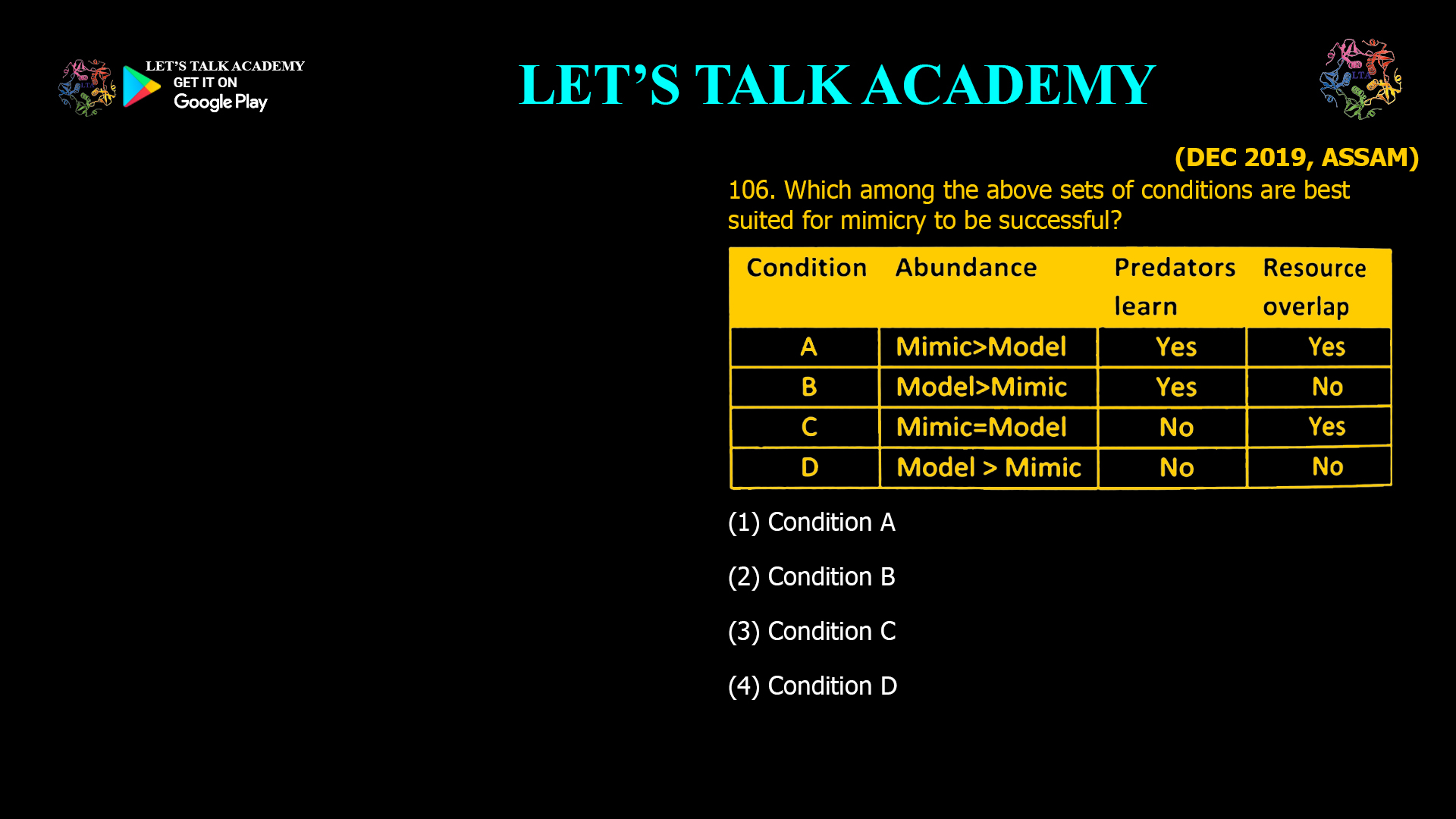
Which among the above sets of conditions are best suited for mimicry to be successful? (1) Condition A (2) Condition B (3) Condition C (4) Condition D Key Factors for Successful Mimicry For mimicry—especially Batesian and Müllerian types—to be evolutionarily stable and effective, several ecological and evolutionary conditions must align: Relative Abundance of Models […]
How Batesian Mimicry Impacts the Fitness of Poisonous Butterflies: The Role of Frequency-Dependent Selection
The Population of the Non-poisonous butterflies have the same the color pattern as some highly poisonous butterflies. Assume that the population of non- poisonous butterflies is higher than the poisonous butterflies. Given this, what will be the impact of this mimicry on the fitness of the population of the poisonous butterflies in the presence of […]
Deceptive Mimicry with High Fitness Costs: Understanding Batesian Mimicry
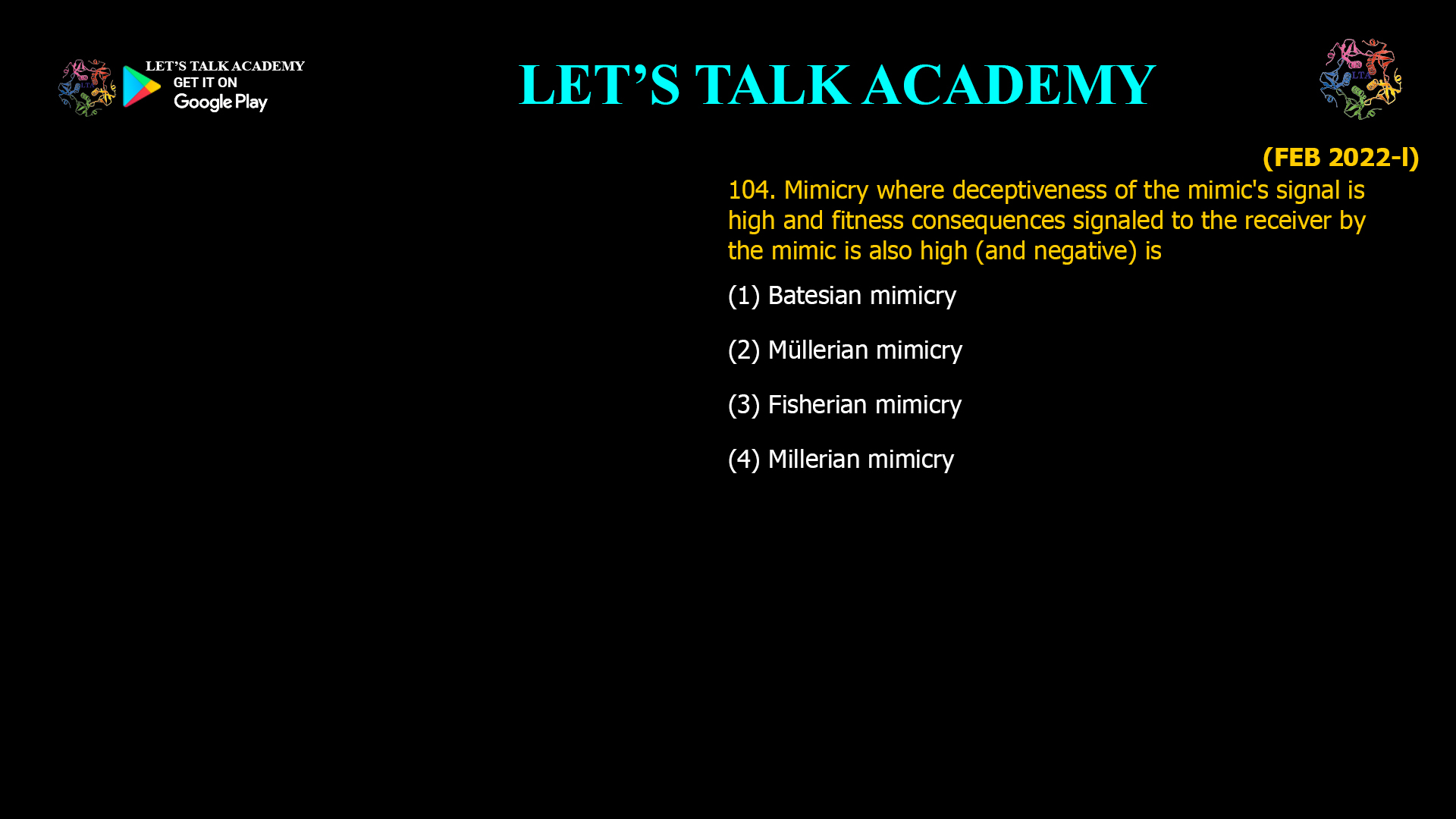
Mimicry where deceptiveness of the mimic’s signal is high and fitness consequences signaled to the receiver by the mimic is also high (and negative) is (1) Batesian mimicry (2) Müllerian mimicry (3) Fisherian mimicry (4) Millerian mimicry What Defines Batesian Mimicry? Batesian mimicry occurs when a harmless or palatable species (the mimic) evolves to closely […]