23. Which one of the following statements regarding molecular markers for genotyping is INCORRECT? (1) Polymorphism in intronic regions of a gene cannot be used for trait mapping. (2) Codominant molecular markers can be used to detect heterozygosity. (3) Sequence Tagged Microsatellite Sites (STMS) and Simple Sequence Repeat Polymorphisms (SSRPs) are based on polymorphisms in repetitive DNA sequences. (4) Restriction Fragment Length Polymorphisms (RFLPs) and Simple Sequence Repeats (SSRS) are multi-allelic markers.

Incorrect statement about molecular markers used for genotyping

22. Given below are a few statements about plant breeding and transgenesis: (A) Recombinant inbred lines and double haploid populations have high levels of genetic homozygosity. (B) Gene pyramiding involves introducing different genes for resistance to a specific pest in different genotypes of a plant species. (C) Agrobacterium strains with a disarmed Ti plasmid do not require vir genes for transfer of T-DNA. (D) Molecular breeding can be used for crop improvement if the trait of interest is present in naturally occurring populations of the plant. Which one of the following options represents a combination of INCORRECT statements? (1) A and B (2) A and C (3) B and D (4) B and C

Incorrect statements about gene pyramiding and Agrobacterium-mediated transgenesis

21. Use of double haploids in plant breeding helps to (1) reduce generation time while interogressing recessive traits (2) reduce generation time while interogressing dominant traits (3) develop somatic hybrids (4) interogress transgenic traits

Role of doubled haploids in speeding introgression of recessive traits

Which technique is NOT used in Indian major carp aquaculture?

19. Which of the following is wild relative of wheat? (1) Triticum monococcum (2) Triticum compactum (3) Triticum vulgare (4) Triticum boeoticum

Wild relatives of wheat: which Triticum species qualifies?

18. Given below are a few statements related to biological principles and/or techniques: A. Genetic diversity plays an important role in the identification of combiners for heterosis breeding B. Genotyping by sequencing (GBS) can be used to identify allelic diversity but is not useful for construction of linkage maps. C. Genome editing by sequence specific nucleases (SSNs) in the presence of guide RNAs would result in NHEJ-mediated knock outs and loss of function mutations. D. In a comparison of synteny and colinearity between diploid and polyploid plant genomes, colinearity is high but synteny is low. Which one of the following options represents all correct statements? (1) A and C only (2) B and D only (3) A, C and D (4) B only

Correct statements about heterosis breeding, GBS, genome editing and synteny

17. Which one of the following regions of the target gene is NOT used for making an RNAi construct to knock down its expression? (1) 5' UTR of the mature transcript (2) 3' UTR of the mature transcript (3) Exonic region (4) Intronic region

Which gene region is not used for designing an RNAi construct?

16. Which one of the following approaches/markers would be typically used for discovering polymorphism between two closely related accessions of a crop plant? (1) AFLP (2) GBS (3) SSR (4) RAPD

15. The rattans and canes that we use in furniture belong to (1) bamboos (2) palms (3) arborescent lilies (4) legumes

Rattans and canes used in furniture belong to which plant group?

14. Cultivated bananas are sterile because (1) male flower-bearing plants are very rare. (2) they lack natural pollinators in the crop plants. (3) they are triploid and therefore seeds are not set. (4) they are a cross of two unrelated species.

Why cultivated bananas are sterile

13. Given below are a few statements related to plant breeding and genetics: A. Non-random mating between individuals closely related to each other would tend to promote a decrease in homozygosity at all loci. B. Quantitative traits are typically influenced by environmental conditions to a greater extent than qualitative traits. C. The over dominance theory for explanation of heterosis assumes that in a heterozygote, only one of the alleles plays a functional role. D. During domestication selected genes/traits show a decrease in diversity. Which one of the following options represents a combination of all INCORRECT statements? (1) A and D only (2) B, C and D (3) A and C only (4) B and D only

Identifying incorrect statements in plant breeding and genetics

12. In the context of plant breeding and genetic engineering, which one of the following statements is correct? (1) To achieve high expression level of a heterologous gene in a transgenic plant a promoter of bacterial origin is often used. (2) F1 progeny derived by crosses between inbred lines with low genetic diversity is more likely to show heterosis. (3) In Agrobacterium mediated plant transformation, always a single copy of the transgene is inserted in the host genome. (4) Qualitative traits are typically characterized by discontinuous phenotypic variation while quantitative traits often generate continuous phenotypic variation

Correct concept in plant breeding and genetic engineering MCQ

11. Which one of the following statements regarding crop improvement programs using molecular breeding approaches is INCORRECT? (1) Allelic diversity for traits of interest should be available in the naturally occurring crossable germplasm (2) The genes of interest cannot be derived from a sexually incompatible organism (3) Availability of markers and linkage maps would facilitate the breeding program (4) The crop plant should necessarily have an optimized robust system for production of doubled haploids

Identifying the incorrect requirement for molecular breeding-based crop improvement

10. Given below are a few statements on mapping populations and marker-assisted selection (MAS): A. MAS can be used to eliminate undesirable genotypes early in the breeding program by screening plants at the seedling stage. B. In backcross breeding programs, breeders use molecular markers to select against the donor genome to accelerate recovery of the recurrent parent genome. C. Among different types of mapping populations, F2 and F2.3 populations are immortal populations. D. Near lsogenic Lines (NILs) can be produced by repeated self-pollination of F1. Which one of the following options represents the combination of all correct statements? (1) A and D (2) B and D (3) C and A (4) A and B

Correct statements about mapping populations and marker-assisted selection (MAS)

9. Given below are four statements regarding the use of marker assisted selection (MAS) in plant breeding? A. Markers that are not linked to target traits cannot be used to test accumulation of the desired recurrent parent's genetic background in a backcross breeding program. B. Co-dominant markers are more effective for marker assisted backcrossing since they facilitate selection of heterozygous progeny. C. MAS can be used to facilitate backcrossing of recessive genes that influence traits of interest. D. Use of tightly linked flanking makers for a trait of interest increases linkage drag in a breeding program. Which one of the following options represents a combination of all INCORRECT statements? (1) A and B (2) B and C (3) A and D (4) C and D

Identifying incorrect statements about marker-assisted selection (MAS) in backcross breeding

8. Given below are a few statements on use of plant breeding to develop improved varieties of a crop plant A. Genotypic/phenotypic variation in the desired trait should be available in the germplasm resources of the crop plant. B. Availability of molecular markers linked to the trait of interest would decelerate the process of trait introgression into desired varieties. C. Breeding procedures to improve plant varieties are generally more successful among sexually compatible species as compared to sexually incompatible species. D. Co-dominant molecular markers cannot be used for selection of plants with the desired trait Which of the above statement(s) is/are INCORRECT? (1) A and C (2) B only (3) C and D (4) B and D

Identifying incorrect statements about plant breeding and molecular markers

7. Given below are some terms in Column A and their corresponding properties/related terms in column B Which one of the following options represents the most appropriate match between all terms of column A and B (1) A-(ii), B-(iv), C-(i), D-(iii) (2) A-(iii), B-(i), C-(iv), D-(ii) (3) A-(iv),B-(iii), C-(iv), D-(i) (4) A-(iii), B-(iv), C-(i), D-(ii)

Matching bulk segregant analysis

6. Which one of the following options is an INCORRECT match?

Which mapping population type is incorrectly labeled as immortal?

5. Different types of mapping populations that can be created using a variety of methods are presented as I to IV in the figure below: A list of probable mapping populations denoted by I to IV in the figure and their status of genetic mortality is given below. A. I - Recombinant inbred lines (RILS) – immortal B. II - Doubled haploid - Not immortal C. III F2:3 Not immortal D. IV - Near isogenic Lines (NILS) – immortal Which one of the following options represents the combination of all correct matches? (1) C only (2) A and D only (3) B and C only (4) A, C and D

Mapping populations and their genetic mortality status (RILs, DHs, F2:3 and NILs)

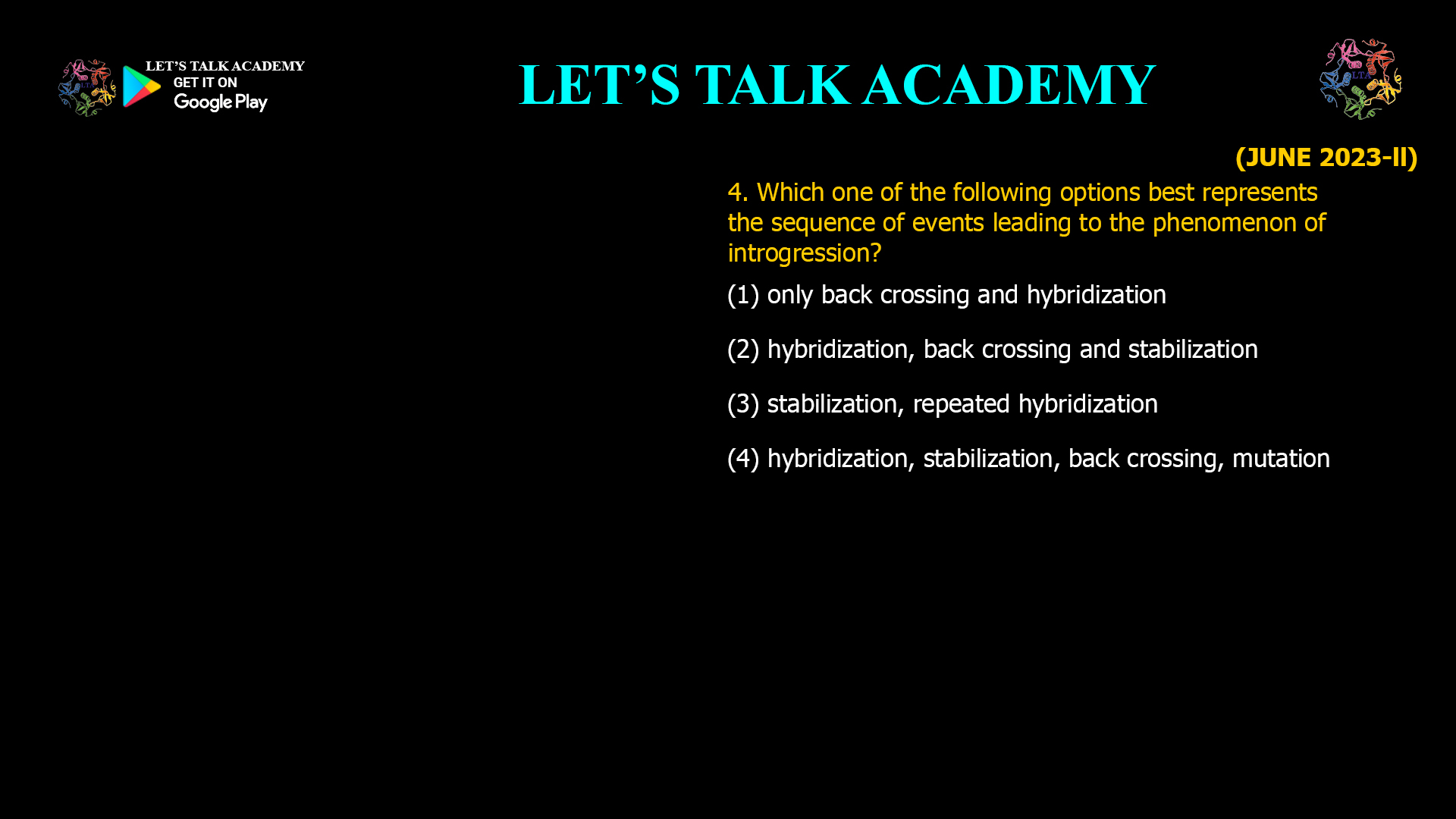
4. Which one of the following options best represents the sequence of events leading to the phenomenon of introgression? (1) only back crossing and hybridization (2) hybridization, back crossing and stabilization (3) stabilization, repeated hybridization (4) hybridization, stabilization, back crossing, mutation

Correct sequence of steps leading to introgression in plant breeding

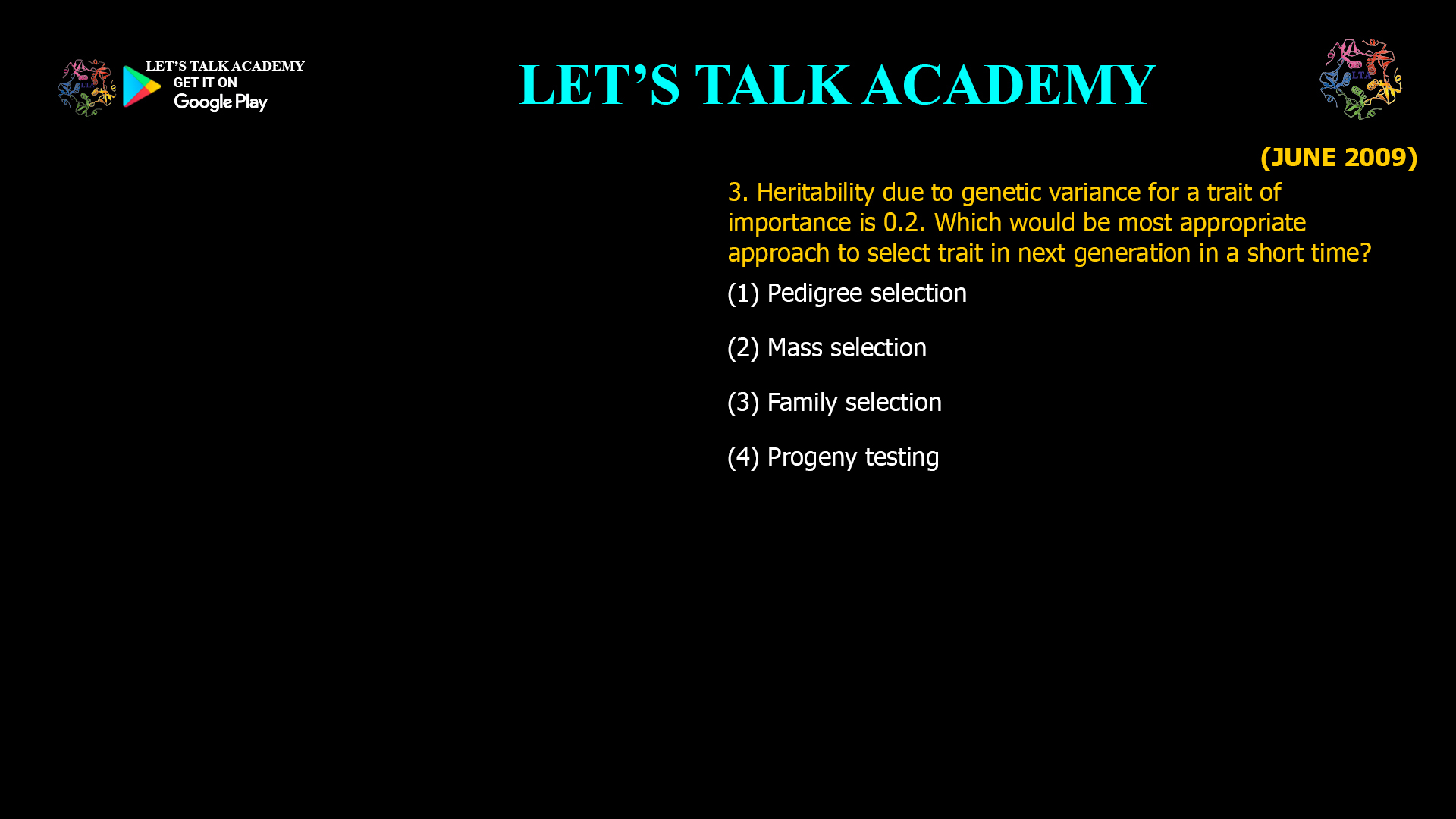
3. Heritability due to genetic variance for a trait of importance is 0.2. Which would be most appropriate approach to select trait in next generation in a short time? (1) Pedigree selection (2) Mass selection (3) Family selection (4) Progeny testing

Best selection method when heritability is low (h² = 0.2)

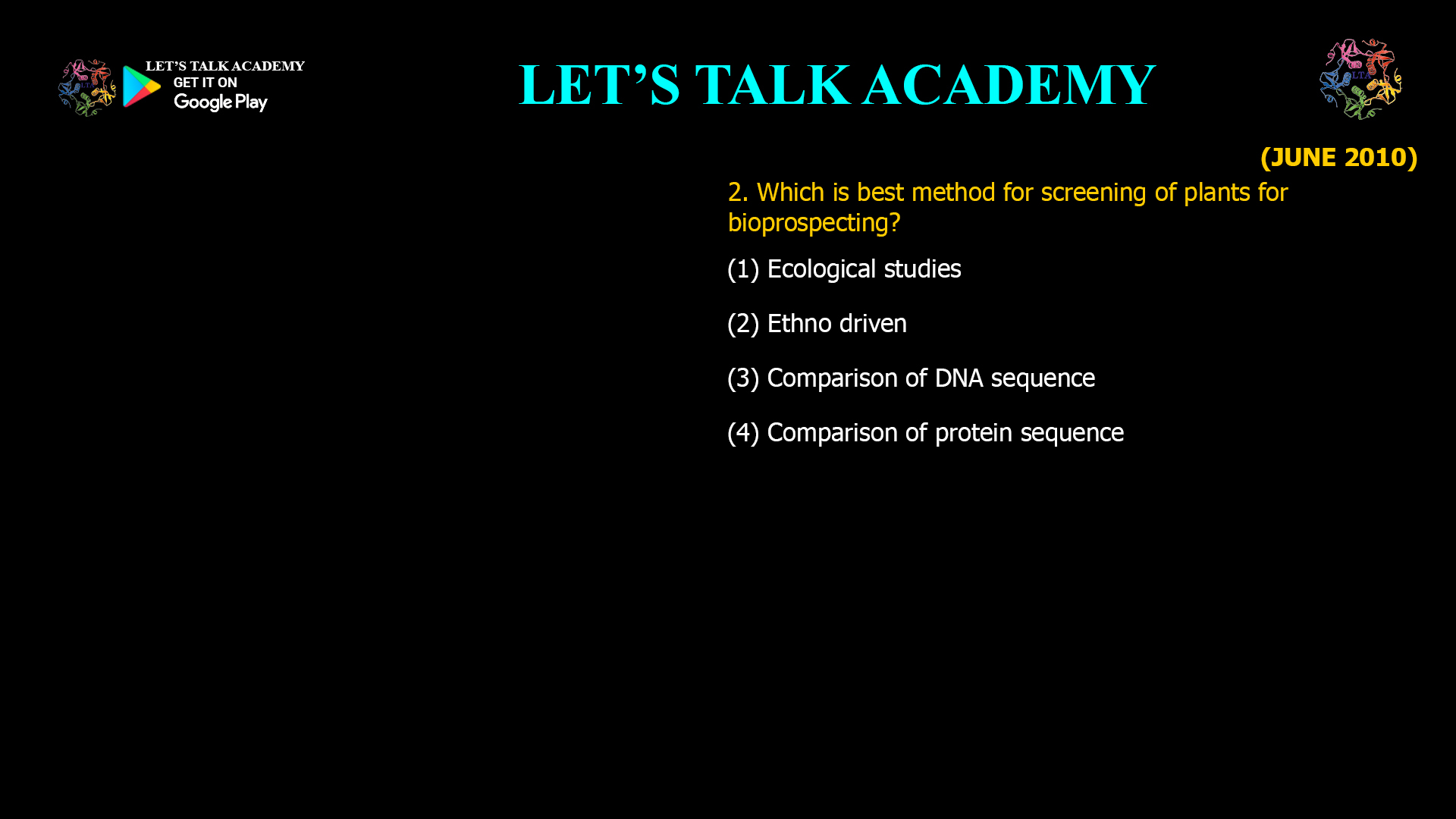
2. Which is best method for screening of plants for bioprospecting? (1) Ecological studies (2) Ethno driven (3) Comparison of DNA sequence (4) Comparison of protein sequence

Best screening strategy for bioprospecting plants

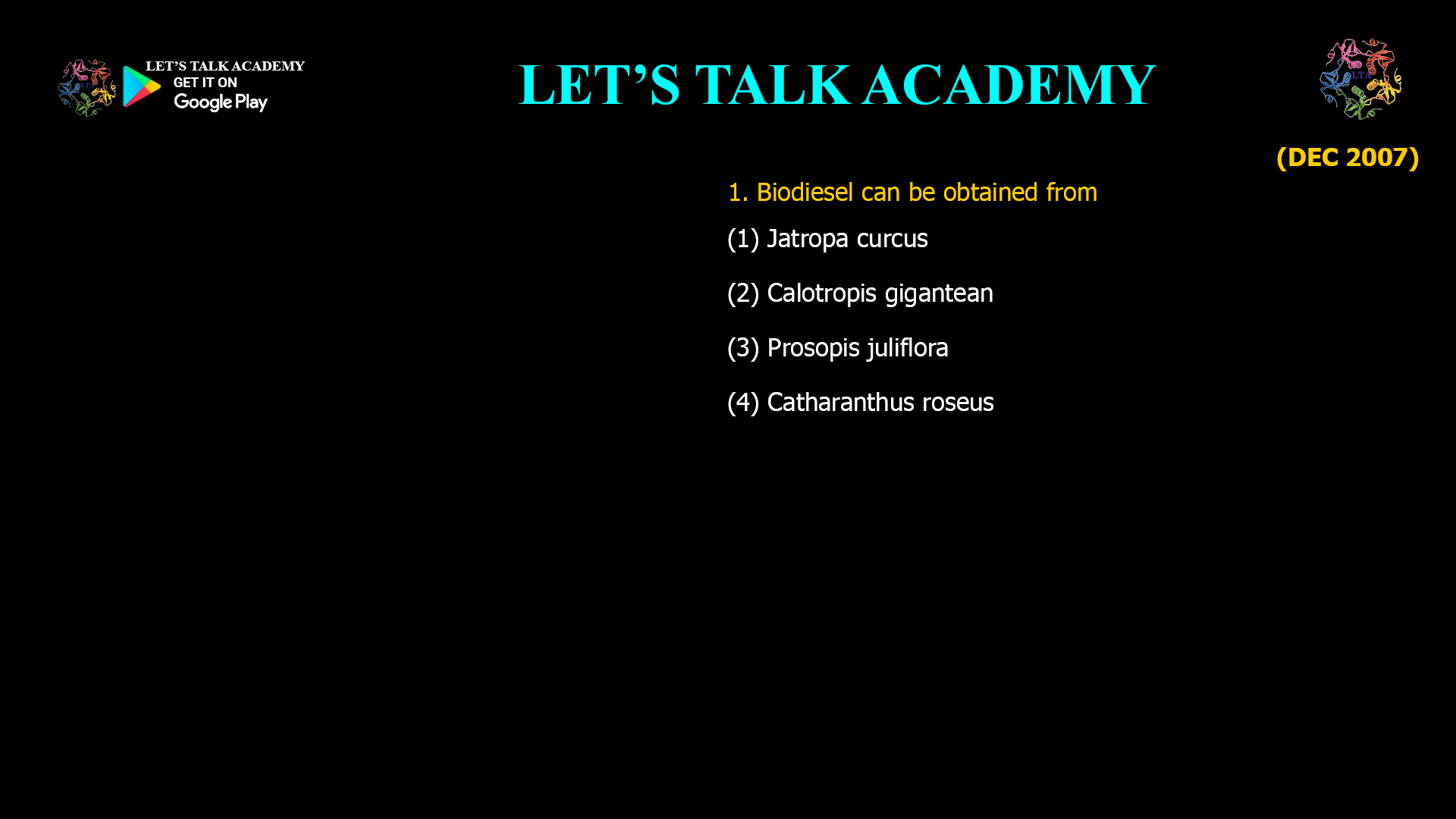
1. Biodiesel can be obtained from (1) Jatropa curcus (2) Calotropis gigantean (3) Prosopis juliflora (4) Catharanthus roseus

Which plant is a major biodiesel crop?

Latest Courses