13. The following table enlists different ways of carrying out reverse genetics (Column X) and different strategies to achieve the same (Column Y) Which one of the following options is a correct match between Column X and Y? (1) A - i and iv; B - iii; C - ii and v (2) A - ii and iv; B - iii and v (3) A- i and iv; B - iii and v (4) A - ii and iv; B - i and iii

Reverse genetics strategies – matching random mutagenesis, targeted mutagenesis and phenocopying

12. Pichia pastoris is a good host for producing human proteins for therapeutic use. Given below are some statements on the reasons for its utility. A. It produces large amount of recombinant protein. B. It has the property of secreting proteins into the medium. C. It allows the formation of disulphide bonds similar to those in humans. D. It carries out protein glycosylations identical to those found in humans. Which one of the following options represents a combination of correct statements? (1) A and B only (2) A, B and C only (3) A, B and D only (4) B, C and D only

Why Pichia pastoris is useful but not perfect for human therapeutic protein production

11. Given below are a few terms related to map-based sequencing of genomes: A. Partial digestion with restriction enzymes. B. Assembly of contigs C. Pulsed field gel electrophoresis D. Cloning in cosmids/YACs/BACs E. Sub-cloning and sequencing Which one of the following options represents the correct order of steps (based on the above terms) in map-based sequencing? (1) C-B-D-E-A (2) C-A-D-B-E (3) E-A-B-D-C (4) A-C-B-D-E

Correct order of steps in map‑based (clone‑by‑clone) genome sequencing

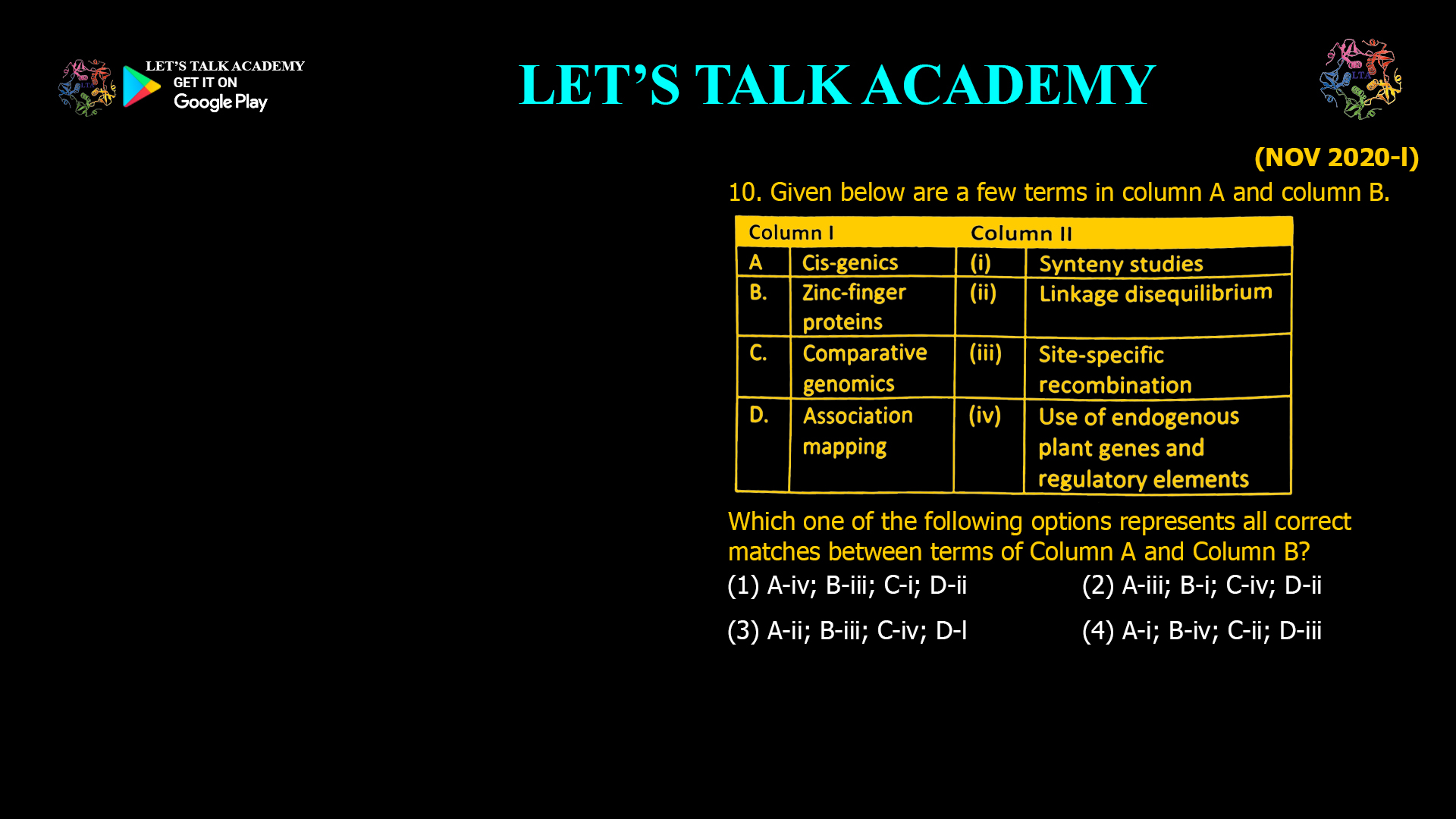
10. Given below are a few terms in column A and column B. Which one of the following options represents all correct matches between terms of Column A and Column B? (1) A-iv; B-iii; C-i; D-ii (2) A-iii; B-i; C-iv; D-ii (3) A-ii; B-iii; C-iv; D-l (4) A-i; B-iv; C-ii; D-iii

Matching cis-genics, zinc-finger proteins, comparative genomics and association mapping with their key features

9. Duchenne muscular dystrophy (DMD) is caused by a defective dystrophin gene and can be cured by removing a specific faulty exon. If a CRISPR/Cas9 based genome editing approach is to be designed to remove the faulty exon, some of the following conditions have to be met. A. Two guide RNA molecules to match the flanking regions of the faulty exon B. An efficient non-homologous end joining system in the host C. Two separate, specific Cas9 endonucleases to target both ends of the exon D. A single guide RNA that targets the intron preceding the exo Choose the option that includes all the correct conditions. (1) A, B and C only (2) A and B only (3) C and D only (4) A and C only

Designing CRISPR/Cas9 editing to remove a faulty exon in DMD

8. Vif gene is one of the important regulatory gene in lifecycle of HIV virus. It was observed that HIV virus with mutated Vif gene fails to culture of normal T- helper cells. The main reason is (1) Vif gene helps in reverse transcription process (2) Vif gene helps in transport of HIV genome to nucleus (3) Vif gene helps in insertion of viral genome into host genome (4) Vif product targets the enzyme responsible for hypermutaion to ubiquitination and cellular degradation

Role of HIV Vif in preventing APOBEC3G-mediated hypermutation

7. Factor IX is essential for blood clotting. Deficiency of Factor IX could be corrected by delivering factor IX gene using viral vectors. In an experiment the gene for Factor IX was cloned appropriately into Adenovirus (AV), Adeno-associated virus (AAV) and Retrovirus (RV). Retrovirus integrate the gene into the dividing cells. AAV integrates partially into non-dividing cells. AV does not integrate the gene but transfects both dividing and non-dividing cells. Following expression profile for Factor IX was observed when the three vectors were injected intra-muscularly into three groups of experimental mice. Which one of the following outcomes is correct? (1) a by RV; b by AV; c by AAV (2) a by AV; b by AAV; c by RV (3) a by AA V; b by RV; c by AV (4) a by AV; b by RV; c by AAV

Factor IX gene delivery – comparing AV, RV and AAV expression profiles

6. One aims to find out the role of a gene product in macrophages by using a transgenic mouse expressing the genes under a promoter. Which of the following is the most appropriate promoter? (1) Actin promoter. (2) MHC Class ll promoter. (3) Mac-1/CD llb promoter. (4) IL-2 promoter.

Choosing the right promoter for macrophage‑specific transgene expression

5. Stem cell therapies are being used in regenerative medicine like forming new adult bone, which usually does not regrow to bridge wide gaps. Successful attempts have now been made in this area because the same paracrine and endocrine factors were found to be involved in both endochondral ossification and fracture repair. Few methods to achieve the above are given below. A. Develop a collagen gel containing plasmids carrying the human parathyroid hormone gene and place in the gap between the ends of broken leg. B. Develop a gel matrix disc containing genetically modified stem cells stem to secrete BMP4 and VEGF-A and implant it at the site of wound. C. Make scaffold of material that resembles normal extracellular matrix that could be molded to form the shape of a bone needed and seed them with bone marrow stems cells D. Develop a collagen gel containing plasmids carrying the human bone marrow cells and place them between ends of bones. Which of the above methods would you employ to develop a new functional bone in patients with severely fractured bones? (1) A and B (2) A, B and C (3) A and C (4) C and D

Stem cell–based strategies to regenerate functional bone across large defects

4. Gene therapy is a promising tool for addressing several diseases in humans. With respect to the above, which one of the following statements is FALSE? (1) Gene therapy involves the direct genetic modification of the cells/model to achieve a therapeutic goal. (2) Current gene therapy is directed at modifying somatic cells. (3) The only successful gene therapies are those in which cells are removed from a patient, genetically modified, and then reintroduced into patients. (4) Recessively inherited disorders are good targets for gene therapy.

Identifying the false statement about modern gene therapy

3. Following are the different ways of obtaining human stem cells- (A) Cells from morula are dispersed and cultured to give rise pluripotent stem cells. (B) Isolated inner cell mass of a blastocyst are cultured and they become pluripotent stem cells. (C) The primordial germ cells from a fetus are collected and cultured, which grow into pluripotent stem cells. (D) Stem cells are collected from adult tissues and grown in specific manner to develop into pluripotent stem cells. Which of the above cell type(s) is extensively used for somatic cell gene therapy in human? (1) (A) and (B) (2) (B) only (3) (B) and (D) (4) (D) only

Which human stem cells are actually used in somatic cell gene therapy?

2. Stem cells are widely used for their regenerative property and capacity to differentiate into different lineages. A person with a damaged liver approaches a stem cell therapist. Which of the following therapeutic strategy would be safest? (1) Transplanting adult liver cells from healthy donor and grafting them into patient (2) Transforming skin cells from patient into iPS cells and using them for further differentiation and grafting in liver (3) Injecting embryonic stem cells into the damaged liver (4) Injecting cord blood cells into the liver directly

Safest stem‑cell strategy for liver regeneration using patient‑specific iPS cells

1. The muscle tone was increased after electrolytic lesion of the caudate nucleus in a cat. The muscle tone decreased within seven days. The following explanations were given by the researcher. A. The functional recovery was due to plastic changes of nervous system. B. The brain tissue surrounding the lesioned area was non-functional due to circulatory insufficiency immediately after surgery which led to the greater functional loss. C. The circulatory status in surrounding tissue recovered with time resulting in partial functional recovery. D. The degenerating nerve fibres were regenerated which underlie functional recovery. Which one of the following is correct? (1) A and B (2) B and C (3) C and D (4) A and D

Explaining transient increase and recovery of muscle tone after caudate lesion

Latest Courses