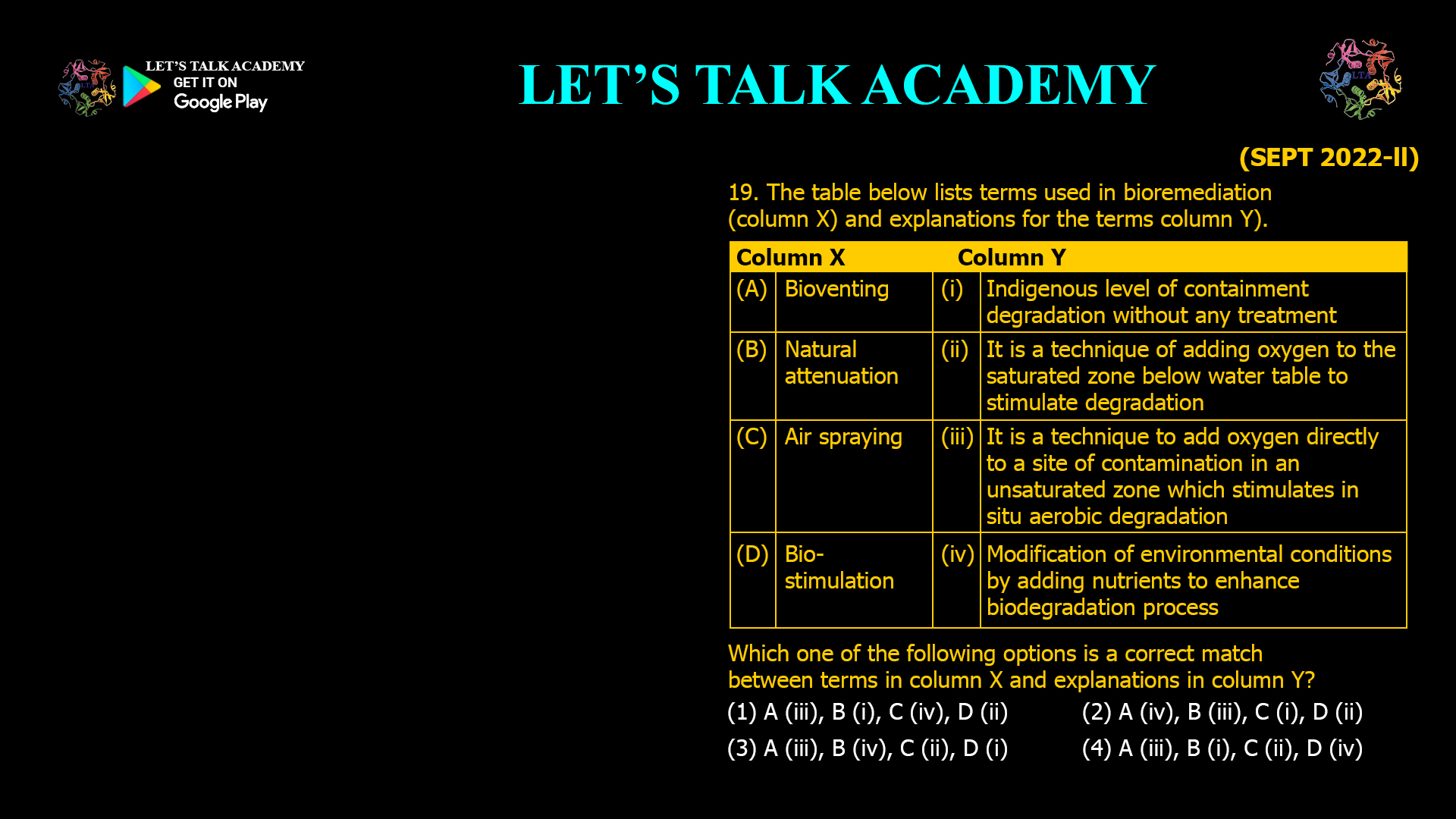
19. The table below lists terms used in bioremediation (column X) and explanations for the terms column Y). Which one of the following options is a correct match between terms in column X and explanations in column Y? (1) A (iii), B (i), C (iv), D (ii) (2) A (iv), B (iii), C (i), D (ii) (3) A (iii), B (iv), C (ii), D (i) (4) A (iii), B (i), C (ii), D (iv)

Bioventing, natural attenuation, air sparging and biostimulation: correct definitions in bioremediation

18. Given below are some terms and concepts related to phytoremediation in Column A and B Which one of the following options represents the most appropriate match of all terms/concepts in column A and B? (1) A- II, B - IV, C-I, D-III (2) A - III, B - IV, C-II, D-I (3) A - II, B – III, C-IV, D-I (4) A - IV, B - III, C-I, D-II

Matching phytoremediation terms: excluders, metal transporters, hyperaccumulators and high-biomass non‑accumulators

What happens during secondary sewage treatment?

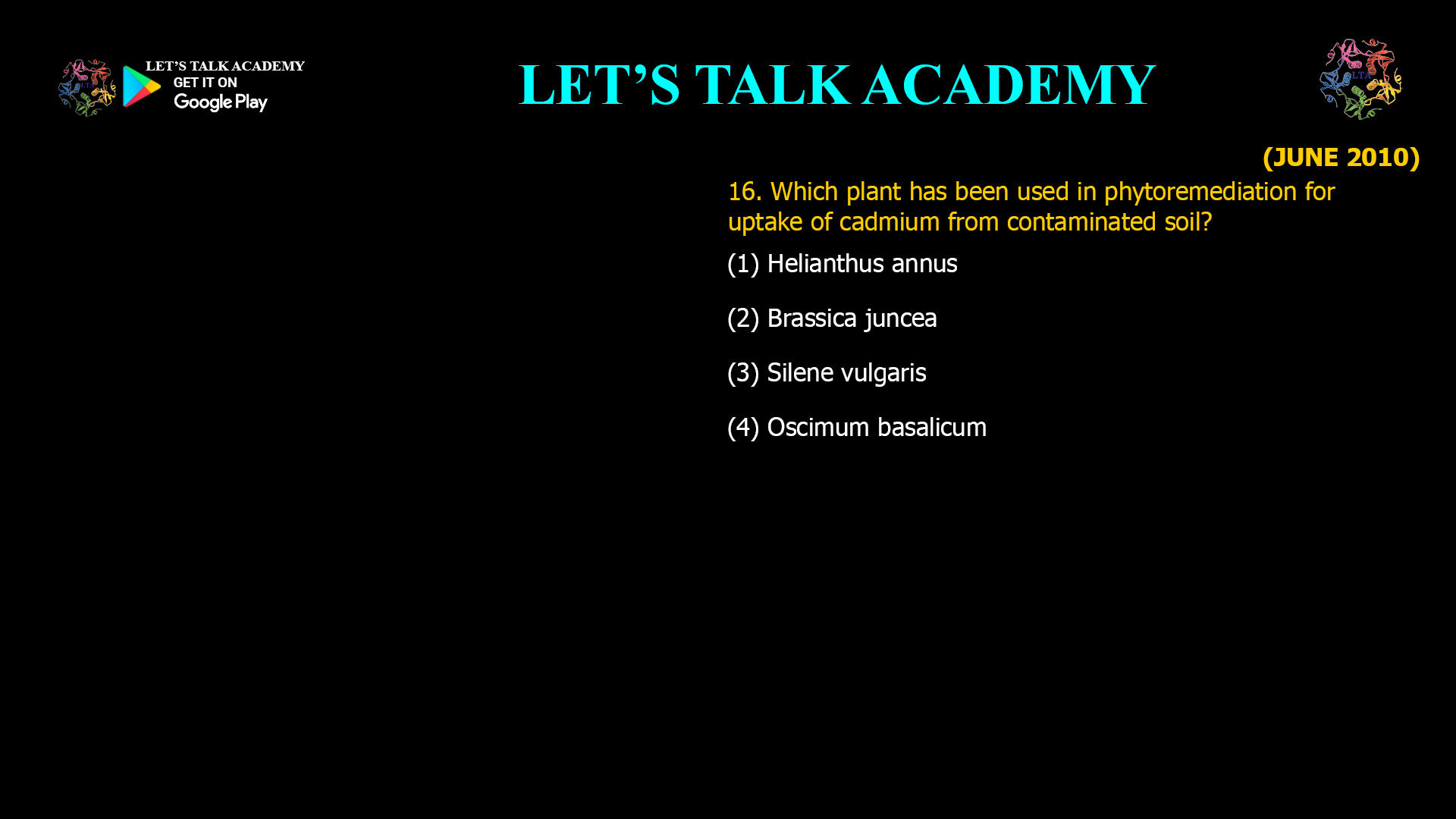
16. Which plant has been used in phytoremediation for uptake of cadmium from contaminated soil? (1) Helianthus annus (2) Brassica juncea (3) Silene vulgaris (4) Oscimum basalicum

Which plant is widely used to phytoextract cadmium from contaminated soil?

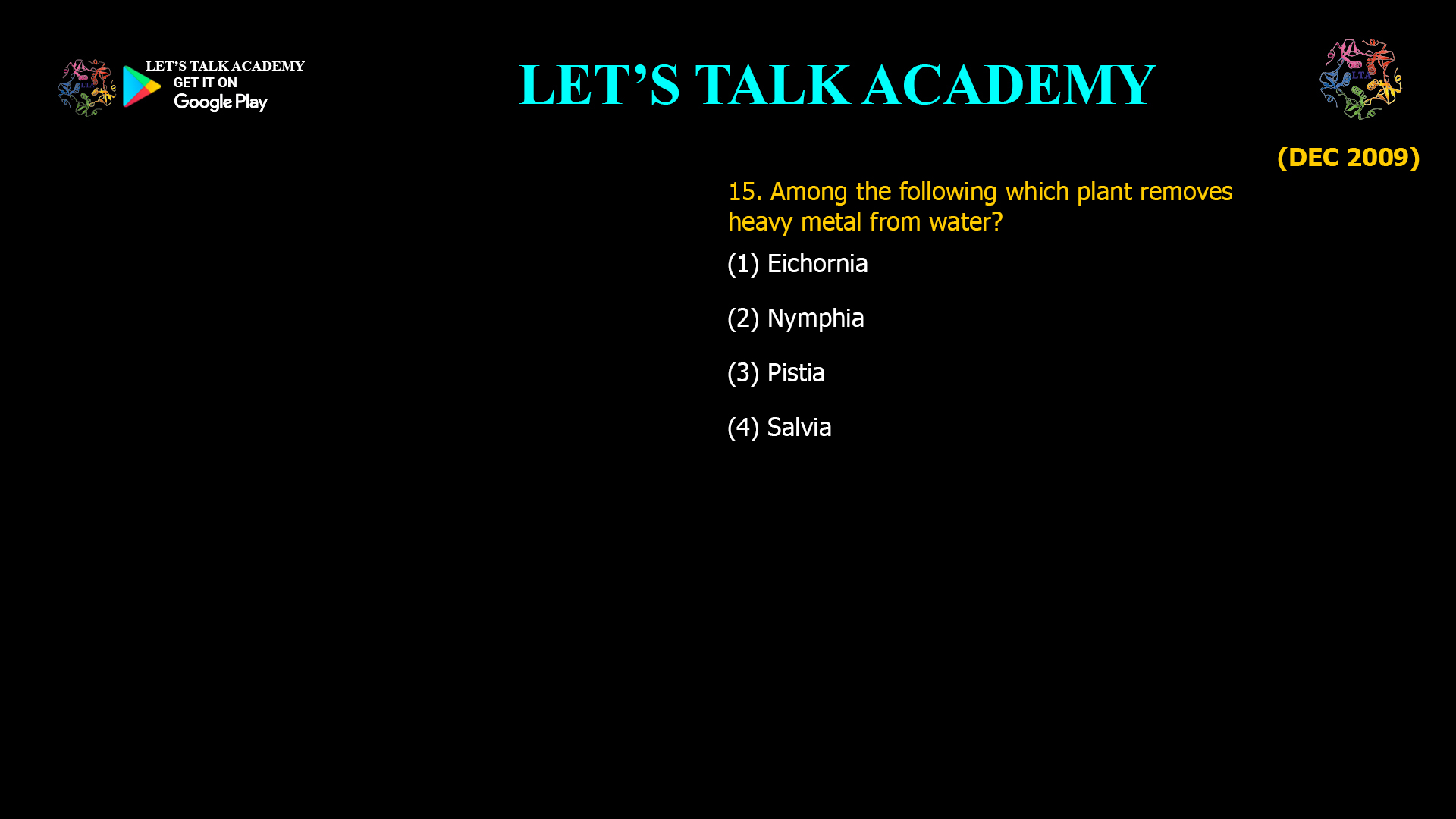
15. Among the following which plant removes heavy metal from water? (1) Eichornia (2) Nymphia (3) Pistia (4) Salvia

Which aquatic plant removes heavy metals from water?

14. Chinese Brake fern (Pteris vittata) is hyperaccumulator of: (1) Cadmium. (2) Arsenic. (3) Lead. (4) Chromium

Chinese Brake fern Pteris vittata as an arsenic hyperaccumulator

13. Heavy metal (cadmium & zinc) resistance in Thalspie curulesiensis is due to (1) Presence of cation efflux pumps (metal ATPase) (2) Presence of Na-K pumps (3) Metal adsorbtion (4) Metal metabolism

How Thlaspi caerulescens resists cadmium and zinc: role of metal ATPases

12. Among the following which plant family has been extensively used for phyto-remediation (1) Poaceae (2) Brassicaceae (3) Malvaceae (4) Anonaceae

Which plant family is most widely used in phytoremediation?

11. Which of the following does not represents strategy for phytoremediation? (1) Phyto-degradation (2) Phyto-mining (3) Continuous removal through hyper accumulators (4) Chelate mediated extraction of pollutants

Which process is not a true phytoremediation strategy?

10. The process of phytoremediation where complexation and immobilization of toxin takes place within the soil is called (1) phytoextraction. (2) phytodegradation (3) phytovolatilization (4) phytostabilization.

What is phytostabilization in phytoremediation?

9. A plot of soil contaminated with diesel oil was inoculated with oyster mushrooms. After 4 weeks, more than 95% of the polycyclic aromatic hydrocarbons had been reduced to non-toxic compounds. This process is called (1) phytoremediation. (2) chemoremediation. (3) mycoremediation. (4) zooremediation.

Mycoremediation: using fungi to clean diesel‑contaminated soils

8. Microorganisms having nitrilase activity can be enriched from soil samples by supplying nitriles as the sole nitrogen or carbon source in the growth medium. A problem with this approach is that false-positive strains may be isolated, which use nitrites to produce amide with the help of a different enzyme activity such as (1) phosphorylases (2) phosphatases (3) hydratases (4) phosphoestarases

False positives in nitrilase enrichment: role of hydratase enzymes

7. Microbial leaching involves the process of dissolution of metals from ore breaking rocks using microorganisms. Which one of the following bacteria helps in leaching copper from its ore? (1) Acidithiobacillus ferroxidans (2) Pseudomonas putida. (3) Deinococcus radiodurans. (4) Rhodopseudomonas capsulate.

Which bacterium is used for copper bioleaching in microbial leaching?

6. Column A lists names of microorganisms and column B lists the pollutants that are degraded by the microbes. Which one of the following options correctly matches the organism to the pollutant it most commonly degrades? (1) 1- (ii); II - (iv); III – (i); IV - (iii) (2) 1- (iii); II - (iv); III - (ii); IV - (i) (3) 1- (iii); II – (i); III - (iv); IV - (ii) (4) 1- (iv); II – (iii); III - (i); IV - (ii)

Matching Pseudomonas, Methylibium, Alcanivorax and Deinococcus with their key pollutants

5. Desulphovibrio desulfuricans (A) and Pseudomonas species (B) are involved in mercury bioremediation. Which of the statement below is correct? (1) A converts methyl mercury to mercuric ion, B converts mercury to methyl mercury (2) A converts mercury to methyl mercury, B converts mercury to mercuric ions (3) A converts mercury to methyl mercury, B converts methyl mercury to mercuric ions (4) A converts methyl mercury to mercuric ions, B converts mercury to mercury ions

Mercury transformations by Desulfovibrio desulfuricans and Pseudomonas in bioremediation

4. The following are certain facts regarding bioremediation: A. Biodegradable plastics are made using polyhydroxy alkanoates (PHAs) such as polyhydroxybutyrate (PHB). B. Pseudomonas putida F1 bacterial strain is involved in degradation of aromatic hydrocarbon. C. The bacterium Deinococcus radiodurans consume and digest toluene and ionic mercury from highly radioactive nuclear waste. D. Bioaugmentation is a process of improving environment of the microorganisms already existing in the system for degradation of xenobiotic compound. Which one of the following combination of above statements is correct? (1) A, B and C (2) A, B and D (3) A, C and D (4) B, C and D

Key facts about PHB bioplastics, Pseudomonas putida F1, Deinococcus radiodurans and bioaugmentation

3. Bio-augmentation refers to: (1) Developing microbial strains through genetic engineering which can degrade pollutants and toxic compounds efficiently. (2) Ex- situ bioremediation of toxins from soil or any other contaminant site by addition of selected microbes to enhance biodegradation. (3) Addition of nutrients at contaminated sites to enhance growth of indigenous microflora which will in turn degrade pollutants, (4) Addition of selected microbes both archaea and bacteria to the polluted site so that biodegradation is enhanced.

What is bioaugmentation in bioremediation?

2. Release of nutrients, oxidants or electron donors into the environment to stimulate naturally occurring microorganisms to degrade a contaminant, is referred to as (1) biostimulation. (2) phytoremediation. (3) bioaugmentation. (4) bioremediation

Biostimulation vs bioaugmentation and other bioremediation terms

1. In bioremediation by microorganisms detailed below, choose INCORRECT option? (1) The organic contaminants provide a source of carbon (2) The bacteria do not get energy by degrading contaminants. (3) Bacteria can produce oxidized and reduced species that can cause metals to precipitate. (4) Bacteria act on contaminants by aerobic and anaerobic respiration.

Incorrect statement about microbial bioremediation mechanisms

CSIR NET Life Science Previous Year Questions and Solution on applied biology

Which plant is widely used to phytoextract cadmium from contaminated soil?

16. Which plant has been used in phytoremediation for uptake of cadmium from contaminated soil? (1) Helianthus annus                                        (2) Brassica juncea (3) Silene vulgaris                                            (4) Oscimum basalicum Option-wise explanation Helianthus […]
Latest Courses