25. Recessive lethal alleles are never completely eliminated from the population because: (1) lethal alleles are always conditional in nature. (2) lethal alleles have selective advantage. (3) they are maintained in the population as heterozygotes. (4) lethal alleles protect organisms from other deleterious mutations.

Why recessive lethal alleles persist in populations

24. Across is made between Drosophila stocks, each with an independent mutant allele, resulting in white eye color. The mutant alleles (named w1 and w2) are recessive. X- linked and caused by a deletion in the w+ allele. The wild type phenotype is red eye color. The F1 females are then crossed with wild type mates. In the progeny. all females have red eye color, 1 out of 10,000 males was observed to have red eye color. while the remaining had white eyes. Which one ot the following could possibly expiainthe occurrence of red eyed males in the progeny? (1) One of the mutant alleles has a high rate of spontaneous reversion (2) There is an intragenic recombination between the w1 and w2 alleles during meiosis of F1 (3) There is non-disjunction of X-chromosome during meiosis of F1 females (4) The w1and w2 alleles show intragenic complementation in red eyed mates though it is a rare event.

Why rare red‑eyed males appear from crosses between two white mutants in Drosophila

23. T4 phages were plated on three E. coli bacterial plateslabelled I,II and III. The phenotypes obtained aredepicted in the picture below. The black spotsrepresent plaques. The following combination of conditions were given to explain the results obtained: Plate Bacterial strain rll locus I i. either B or K-12 a. Wild type II ii. B b. mutant III iii. K-12 From the options listed below, select the one that accurately lists the E.coli strain type ans the corresponding rll locus type. (1) I-iii-a, II-ii-b, III-iii-a (2) I-ii-b, II-i-a, III-iii-b (3) I-i-b, II-iii-b, III-ii-a (4) I-ii-b, II-ii-a, III-ii-b

Identifying bacterial strain and rII locus type from T4 plaque patterns

22. Wild type T4 bacteriophage can grow on Band K strains of E. coli forming small plaques. rll mutants of T4bacteriophage cannot grow on E. coli strain K (non- permissive host), but form large plaques on E. coli strain B (permissive host). The following two experiments were carried out: Experiment l: E. coli K cells were simultaneously infected with two rllmutants (a- and b-). Several plaques with wild typemorphology were formed. Experiment II: E. coli B cells were simultaneously infected with thesame mutants as above. T4 phages were isolated fromthe resulting plaques and used to infect E. coli K cells.Few plaques with wild type morphology were formed. Which one is the correct conclusion made regarding therll mutants. a- and b- from the above experiments? (1) The mutations a- and b- belong to two differentcistrons (experimentl) and there is norecombination between them (experiment ll). (2) The mutations a- and b- belong to two differentcistrons (experiment l) and they recombined(experiment ll). (3) The mutations a- and b- belong to two differentcistrons (experiment ll) and they recombined(experiment l). (4) The mutants a- and b- belong to the same cistron(experiment l) and they did not recombine(experiment ll).

Complementation and recombination of rII mutants a– and b– in T4 phage

21. upon studying a considerable number of different crosses in Drosophila, Morgan reached the conclusion that all genes of this fly were clustered into four linked groups corresponding to the four pairs of chromosomes. Further studies revealed that linkage is not absolute and it is broken frequently. It is broken in prophase by a process called (1) Recombination. (2) Jumping of genes. (3) Integration. (4) Mutation.

How linkage is broken during prophase in Drosophila

20. The concept of recon was proposed by Seymour Benzerby studying recombination between (1) lysis mutants of bacteriophage T4 (2) white eye mutants of Drosophila melanogaster. (3) biochemical mutants of Neurosporacrassa. (4) auxotrophic mutants of Escherichia coli.

Benzer’s recon concept from T4 rII lysis mutants

19. How many complementation groups do the following mutants m1 to m6 come under? Result of complementary between different mutants m1 m2 m3 m4 m5 m6 m1 - - + + - + m2 - + + - + m3 - - + + m4 - + + m5 - + m6 - (1) Two (2) Four (3) Five (4) Three

How many complementation groups do mutants m1–m6 form?

18. The results of a complementation test for five independent mutants (1 to 6) are summarized below 1 2 3 4 5 6 0 + 0 + + 0 1 0 + + + + 2 0 + + 0 3 0 0 + 4 0 + 5 0 6 ‘+’ represents complementation; ‘0’ represents non-complementation. Based on the above, which one of the following conclusions is correct? (1) The mutations can be ordered in a single cistron as 1-3-5-2-4-6. (2) All mutations belong to a single cistron, but their order cannot be determined. (3) There are threecistrons, mutations 1, 3 and 6 represent one cistron, 4 and 5 represent the second cistron and 2 represents the third cistron. (4) There are three linkage groups, mutations 1, 3 and 6 represent linkage group A, 4 and 5 represent linkage group B, and 6 represents linkage group C.

Interpreting a complementation test matrix to find cistrons

17. The results of a complementation test for five independent mutants (1 to 5) are summarized below: 1 2 3 4 5 0 0 0 + + 1 0 0 + + 2 0 + + 3 0 0 4 0 5 '+' represents complementation; 'O' represents non-complementation. Based on the above, which one of the following conclusion is correct? (1) There are two cistrons. Mutations 1, 2 and 3 belong to one cistron; while 4 and 5 belong to a second cistron. (2) There is a single cistron. Mutations 1, 2 and 3 can recombine out from 4 and 5. (3) Each mutation represents a cistron. (4) There are two linkage groups. 1, 2, 3 comprise onegroup while 4 and 5 comprise the second group.

Interpreting complementation test matrix to count cistrons

16. Four different mutant lines showing similar phenotype were identified from a genetic screen. When genetic crosses among these mutants were carried out, the first mutant was found to complement the second, third and lines. However, no other fourth mutant complementation groups do the four mutant lines belongs to? (1) 1 (2) 2 (3) 3 (4) 4

Determining the number of complementation groups from mutant crosses

15. When two mutants having the same phenotype were crossed, the progeny obtained showed a wild-type phenotype. Thus the mutations are (1) non-allelic. (2) allelic. (3) segregating from each other. (4) independently assorting

Interpretation of wild-type progeny from crossing two mutants with the same phenotype

14. Two mutants of Drosophila melanogaster. one showing light red eye colour and the other showing dark brown eye colour, were crossed. In F1 all flies showed normal red eye colour. This indicated that the two mutations are (1) allelic. (2) non allelic. (3) linked. (4) unlinked.

Why light‑red and dark‑brown eye mutants give wild‑type F₁ in Drosophila

13. A cis-trans complementation test is carried out to identify (1) if two mutations are allelic in nature. (2) if two genes interact with one another. (3) the number of genes influencing phenotype. (4) to understand the dominance / recessjve relationships between alleles.

What does a cis–trans complementation test identify?

12. A fly with apricot coloured eye was crossed With a septa eyed fly of opposite sex. In Fl all flies were Wild tvpe. The genes responsible for the two (1) allelic (2) nonallelic (3) pseudo-allelic (4) paralogous genes

Complementation between apricot and sepia eye mutants in Drosophila

11. In a heterozygous two recessive mutation at different site will give mutant phenotype when genes involved are (1) Allelic and placed in cis (2) Allelic and placed in trans (3) Non-allelic and placed in cis (4) Non-allelic and placed in trans

When do two recessive mutations in a heterozygote still give a mutant phenotype?

10. Two different mutant of Drosophilla gives a mutant black body color. When these mutants are crossed all progeny have wild type color, It means mutation are (1) Codominant (2) Allelic (3) Non Allelic (4) Epistatic

Why two black-body mutants of Drosophila giving wild-type progeny are non‑allelic

9. In E. coli the complementation test is done by (1) Transformation (2) Obtaining merozygotes (3) Obtaining heterokaryons (4) Making them diploid

How is the complementation test performed in E. coli?

8. Mutation at two different loci of the same gene X results in altered functions. These two mutated versions of gene X are called (1) alleles (2) Complementation group (3) interrupted genes (4) linkage group

What are two different mutant versions of the same gene called?

7. A recessive inherited disease is expressed only in individuals of blood group O and not expressed in blood groups A, B or AB. Alleles controlling the disease and blood group are independently inherited. A normal woman with blood group A and her normal husband with blood group B already had one child with the disease. The woman is pregnant for second time. What is the probability that the second child will also have the disease? (1) 1/2 (2) 1/4 (3) 1/16 (4) 1/64

Probability that a second child has a recessive disease expressed only in blood group O

6. A newborn baby got mixed up with other babies in a hospital. If the mother is of O blood group and is Rh +veand the father is of AB blood group and is Rh -ve, which one of the following can be their baby? (1) AB and Rh +ve (2) O and Rh -ve (3) A and Rh +ve(4) B and Rh –ve

Which baby matches an O Rh+ mother and AB Rh– father?

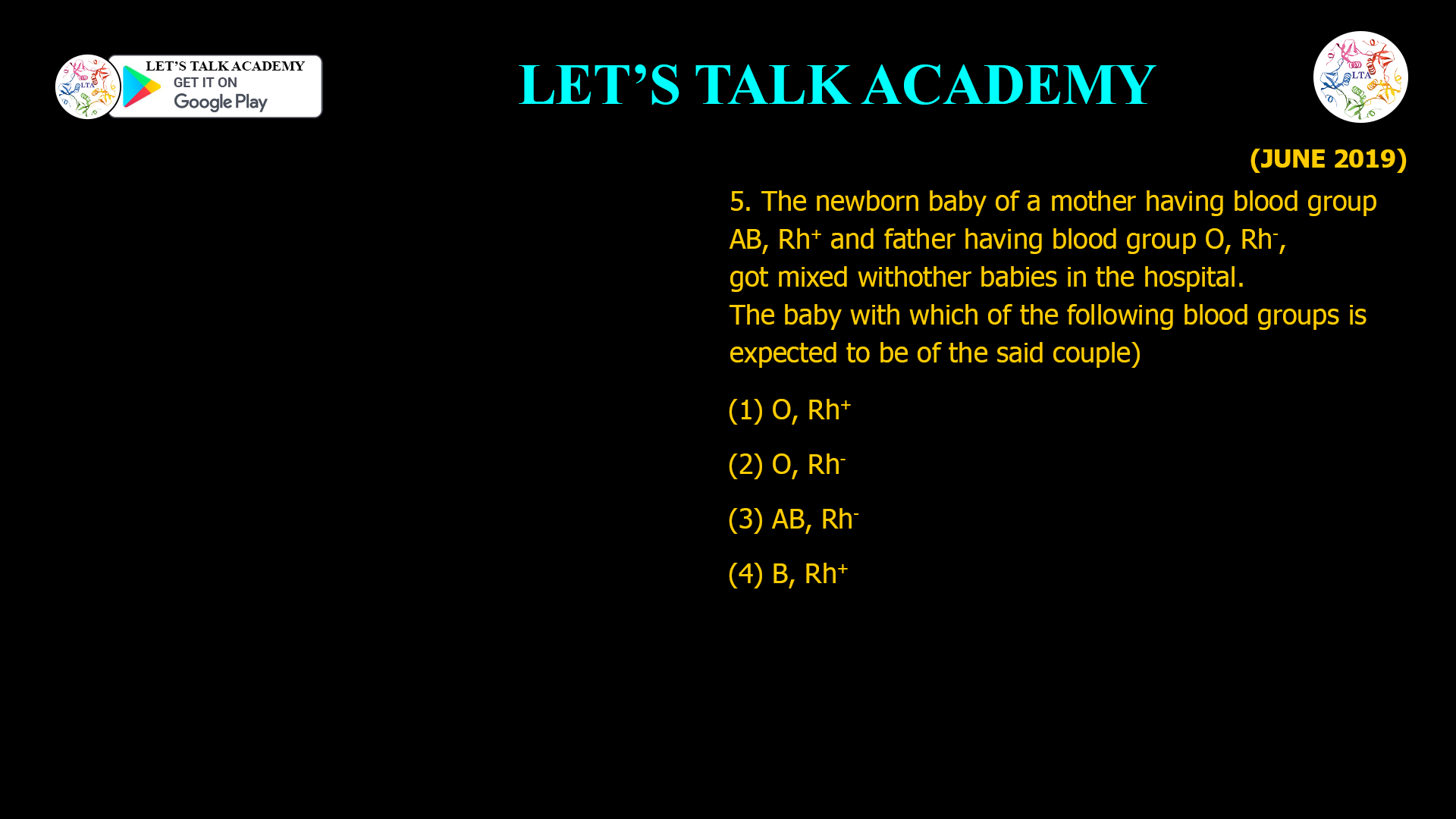
5. The newborn baby of a mother having blood group AB, Rh+ and father having blood group O, Rh-, got mixed withother babies in the hospital. The baby with which of the following blood groups is expected to be of the said couple) (1) O, Rh+ (2) O, Rh- (3) AB, Rh-(4) B, Rh+

Which baby belongs to AB Rh+ mother and O Rh– father?

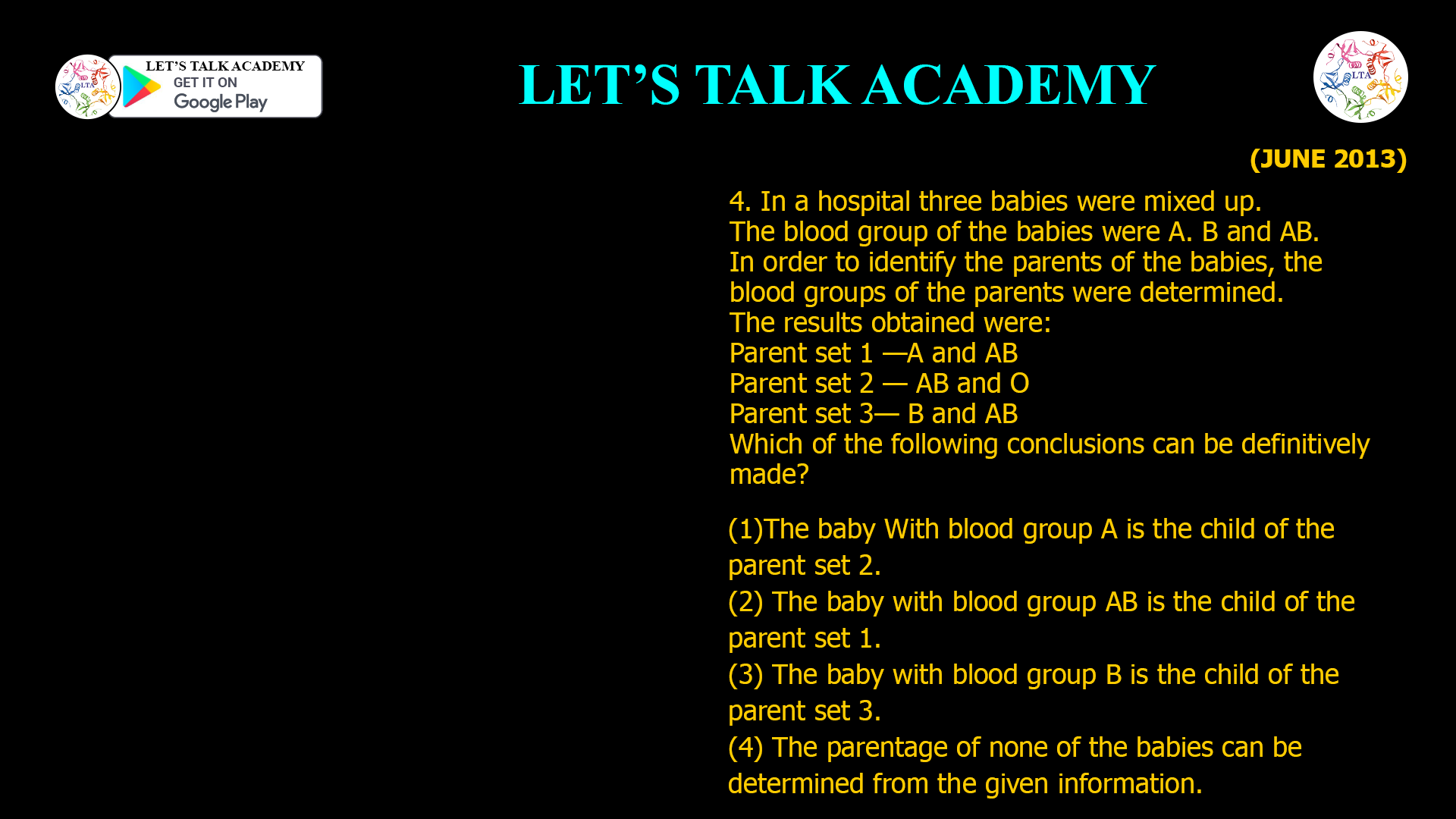
4. In a hospital three babies were mixed up. The blood group of the babies were A. B and AB. In order to identify the parents of the babies, the blood groups of the parents were determined. The results obtained were: Parent set 1 —A and AB Parent set 2 — AB and O Parent set 3— B and AB Which of the following conclusions can be definitively made? (1)The baby With blood group A is the child of the parent set 2. (2) The baby with blood group AB is the child of the parent set 1. (3) The baby with blood group B is the child of the parent set 3. (4) The parentage of none of the babies can be determined from the given information.

Can ABO blood groups alone identify parents when three babies are mixed up?

3. The ABO blood type tn human is under the control of autosomal multiple alleles. Colour blindness is recessive X-linked trait. A male with a blood type A and normal vision marries a female who also has blood type A and normal vision. The couple's first child a mate who is colour blind and has a blood group O. What is the probability that their next female child has normal vision and a blood group O? (1) 1/4 (2) 3/4 (3) 1/8 (4) 1

Probability that the next daughter is normal‑vision, blood group O

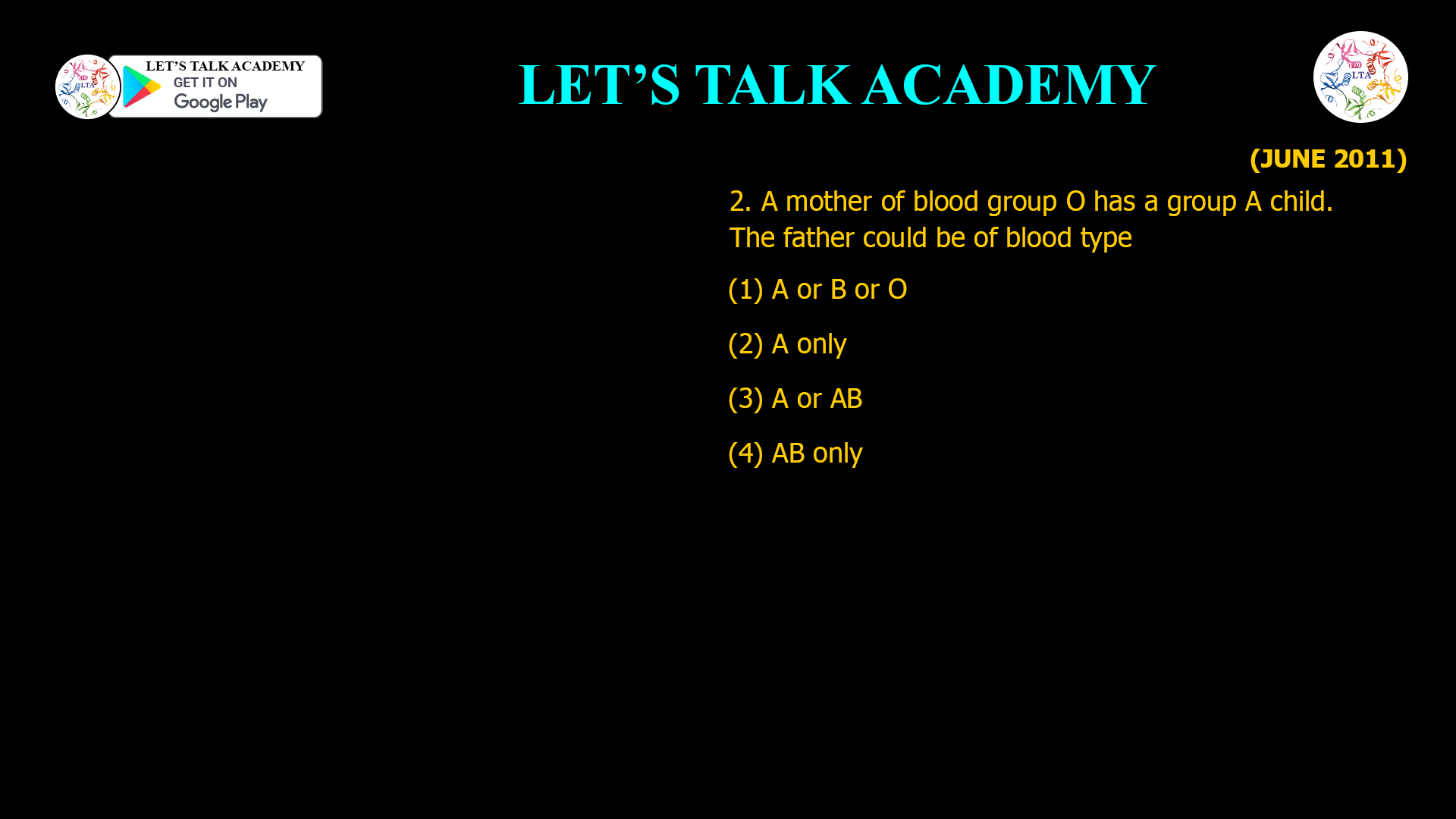
2. A mother of blood group O has a group A child. The father could be of blood type (1) A or B or O. (2) A only. (3) A or AB. (4) AB only.

Possible father blood groups when mother is O and child is A

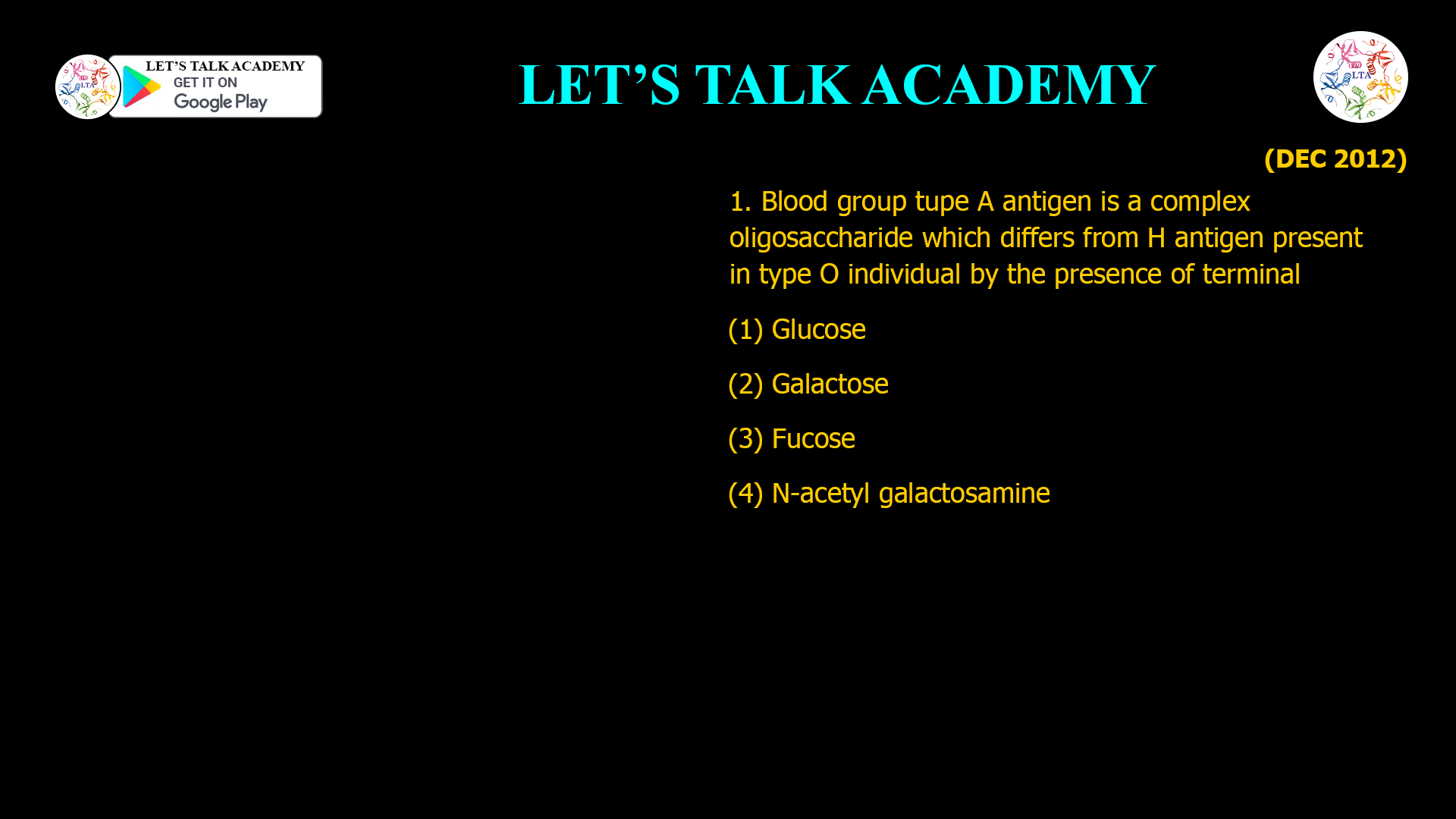
1. Blood group tupe A antigen is a complex oligosaccharide which differs from H antigen present in type O individual by the presence of terminal (1) Glucose (2) Galactose (3) Fucose (4) N-acetyl galactosamine

Difference between blood group A antigen and H antigen in type O blood

Latest Courses