22. Match the chemical agents that interfere in oxidative phosphorylation process with their respective mode of action. Column I Column II (A) Antimycin A (i) Inhibits Fo component of ATP synthase (B) Oligomycine (ii) Disrupts inner mitochondrial membrane potential (C) Valinomycin (iii) Prevent electron transport from Fe/S cluster to ubiquinone (D) Rotenone (iv) Blocks electron transfer from cytochrome b to cytochrome C1 (v) Inhibits adenine nucleotide translocase Choose the correct combination from below: (1) A-(ii), B-(iv), C-(v), D-(iii) (2) A-(iv), B-(i), C-(ii), D-(iii) (3) A-(i), B-(ii), C-(i), D-(ii) (4) A-(v), B-(ii), C-(i), D-(ii)

Matching Chemical Inhibitors of Oxidative Phosphorylation with Their Modes of Action

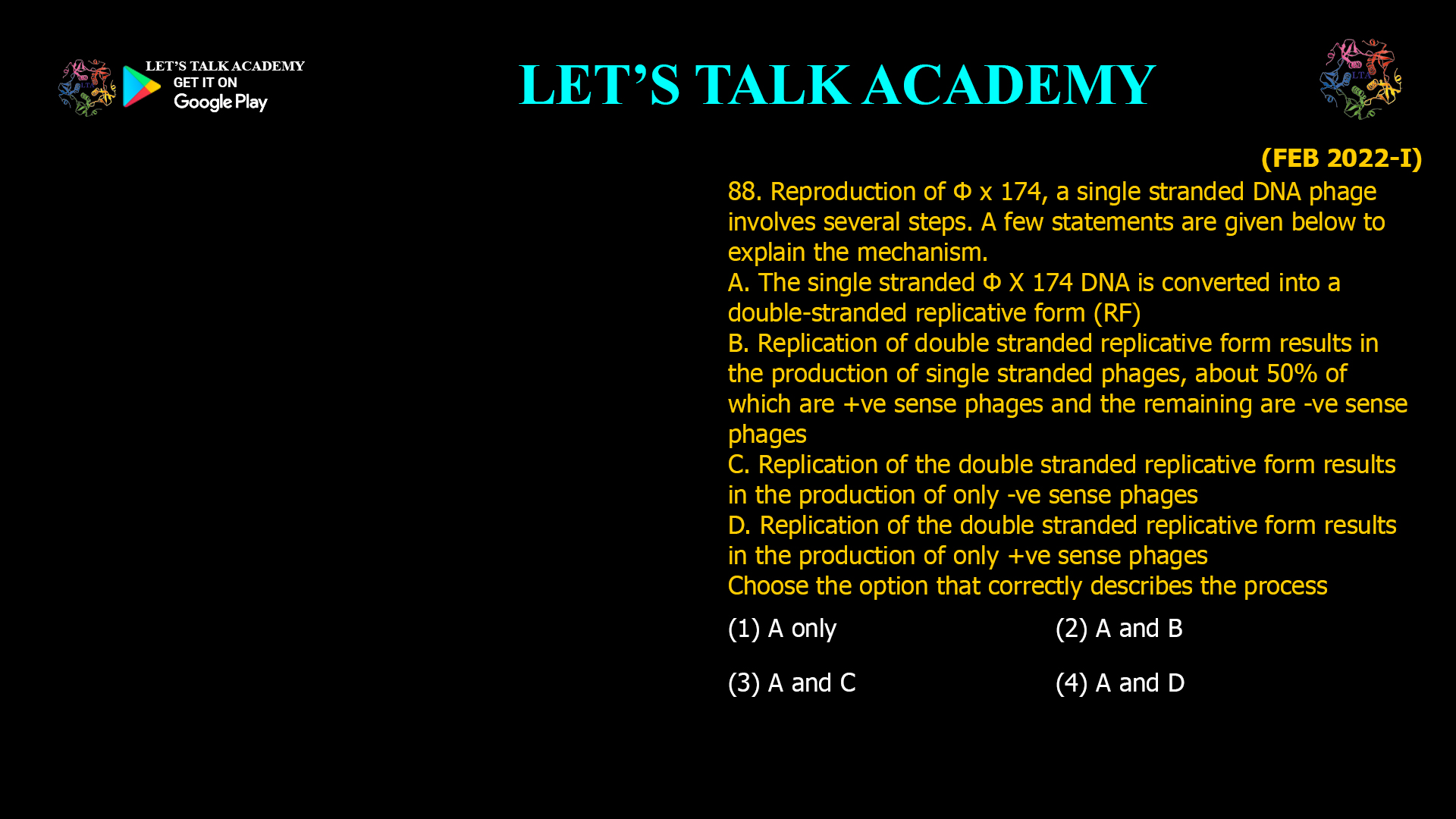
88. Reproduction of Φ x 174, a single stranded DNA phage involves several steps. A few statements are given below to explain the mechanism. A. The single stranded Φ X 174 DNA is converted into a double-stranded replicative form (RF) B. Replication of double stranded replicative form results in the production of single stranded phages, about 50% of which are +ve sense phages and the remaining are -ve sense phages C. Replication of the double stranded replicative form results in the production of only -ve sense phages D. Replication of the double stranded replicative form results in the production of only +ve sense phages Choose the option that correctly describes the process (1) A only (2) A and B (3) A and C (4) A and D

Understanding the Replication Process of ΦX174: From Single-Stranded DNA to Progeny Phages

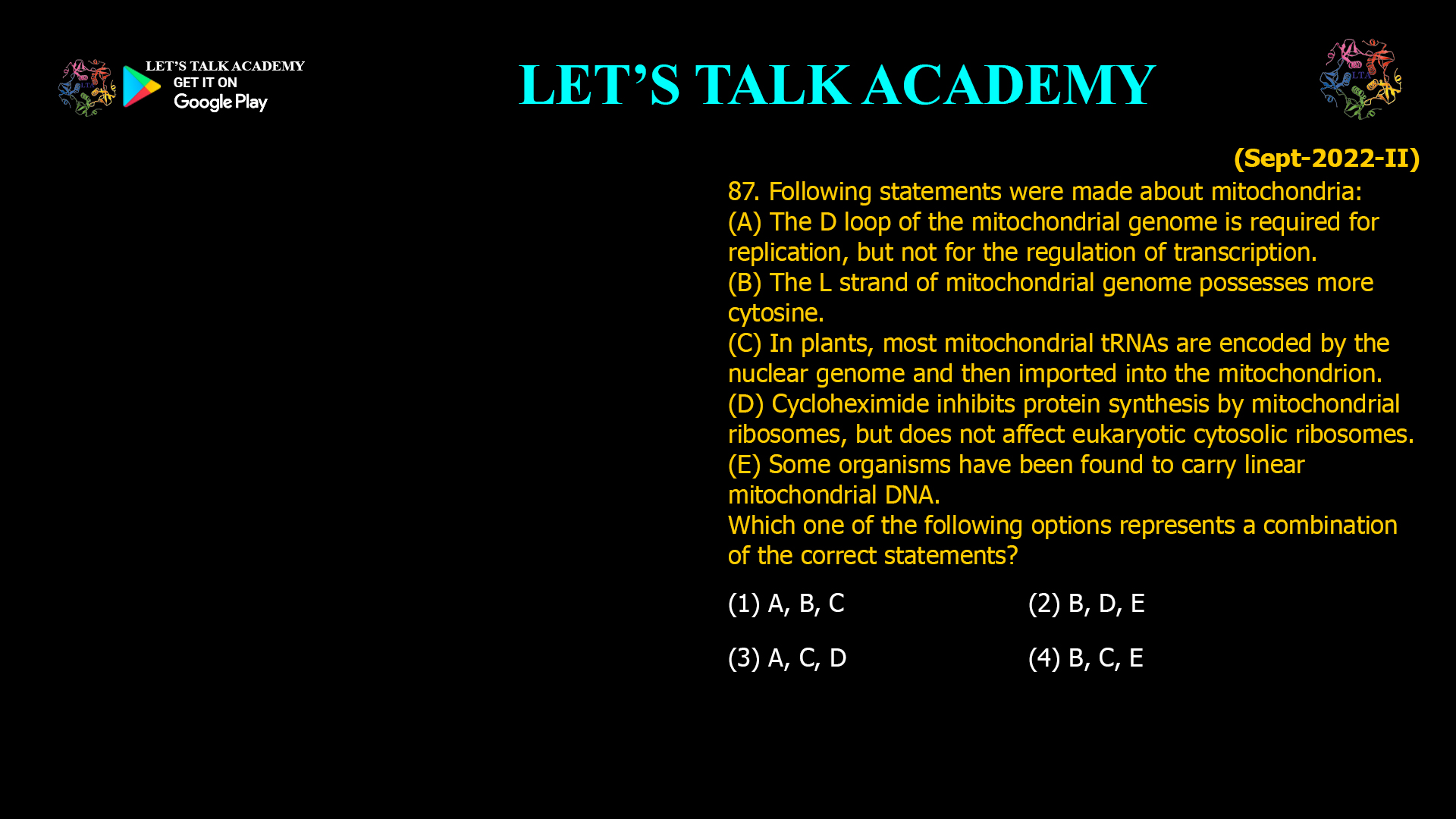
87. Following statements were made about mitochondria: (A) The D loop of the mitochondrial genome is required for replication, but not for the regulation of transcription. (B) The L strand of mitochondrial genome possesses more cytosine. (C) In plants, most mitochondrial tRNAs are encoded by the nuclear genome and then imported into the mitochondrion. (D) Cycloheximide inhibits protein synthesis by mitochondrial ribosomes, but does not affect eukaryotic cytosolic ribosomes. (E) Some organisms have been found to carry linear mitochondrial DNA. Which one of the following options represents a combination of the correct statements? (1) A, B, C (2) B, D, E (3) A, C, D (4) B, C, E

Key Facts About Mitochondria: D-loop Function, Strand Composition, tRNA Import, Protein Synthesis Inhibitors, and mtDNA Forms

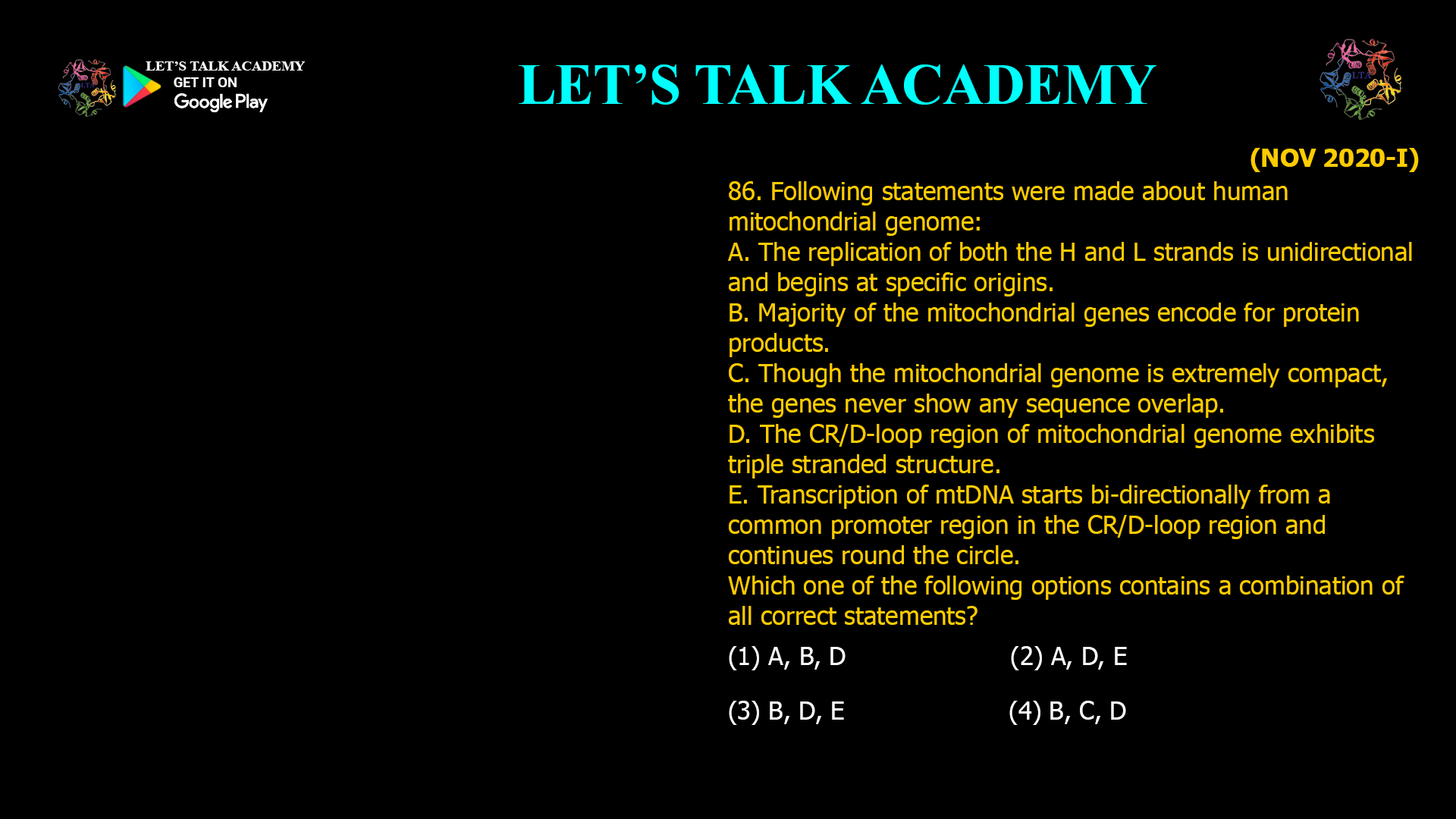
86. Following statements were made about human mitochondrial genome: A. The replication of both the H and L strands is unidirectional and begins at specific origins B. Majority of the mitochondrial genes encode for protein products. C. Though the mitochondrial genome is extremely compact, the genes never show any sequence overlap. D. The CR/D-loop region of mitochondrial genome exhibits triple stranded structure. E. Transcription of mtDNA starts bi-directionally from a common promoter region in the CR/D-loop region and continues round the circle. Which one of the following options contains a combination of all correct statements? (1) A, B, D (2) A, D, E (3) B, D, E (4) B, C, D

Key Features of the Human Mitochondrial Genome: Replication, Transcription, and Structure

85. The ColE1 plasmid has a low to medium copy number. However, pUC18, which is also a ColE1- based plasmid, has a high copy number because: (1) It has a mutation in RNAI (antisense RNA) and does not carry the rop gene. (2) It has a mutation in RNAII (primer for replication initiation) and does not carry the rop gene. (3) It has a mutation in RNAI and the rop gene is overexpressed. (4) It has a mutation in RNAII and the rop gene is overexpressed.

Understanding the High Copy Number of pUC18: Mutation in RNAII and Absence of Rop Gene

84. Plasmid copy number achieved by plasmid-encodedcontrol elements that regulate the initiation of the replication step. For example in stringent plasmid protein Rep A dimerize and binds to origin of replication and donot allow replication more than once. What mutation may convert this stringent mode of replication in plasmid into relaxed one? (1) Over expression in repA protein (2) Mutation in repB dimerization domain (3) Mutation in repA other than dimerization domain (4) Gain of function in recognition domain of repA

How Mutations in RepA Dimerization Domain Convert Stringent Plasmid Replication to Relaxed Mode

83. Reverse transcriptase of retero virus is- (1) DNA dependent DNA polymerase (2) DNA dependent RNA polymerase (3) RNA dependent DNA polymerase (4) RNA dependent RNA polymerase

Retroviral Reverse Transcriptase: The RNA-Dependent DNA Polymerase Essential for Viral Replication

82. Reverse transcriptase has both ribonuclease and polymerase activities. Ribonuclease activity is required for (1)the synthesis of new RNA strand (2)the degradation RNA strand (3)the synthesis of new DNA strand (4)the degradation of DNA strand

Understanding the Ribonuclease Activity of Reverse Transcriptase: Degradation of RNA Strand in RNA/DNA Hybrids

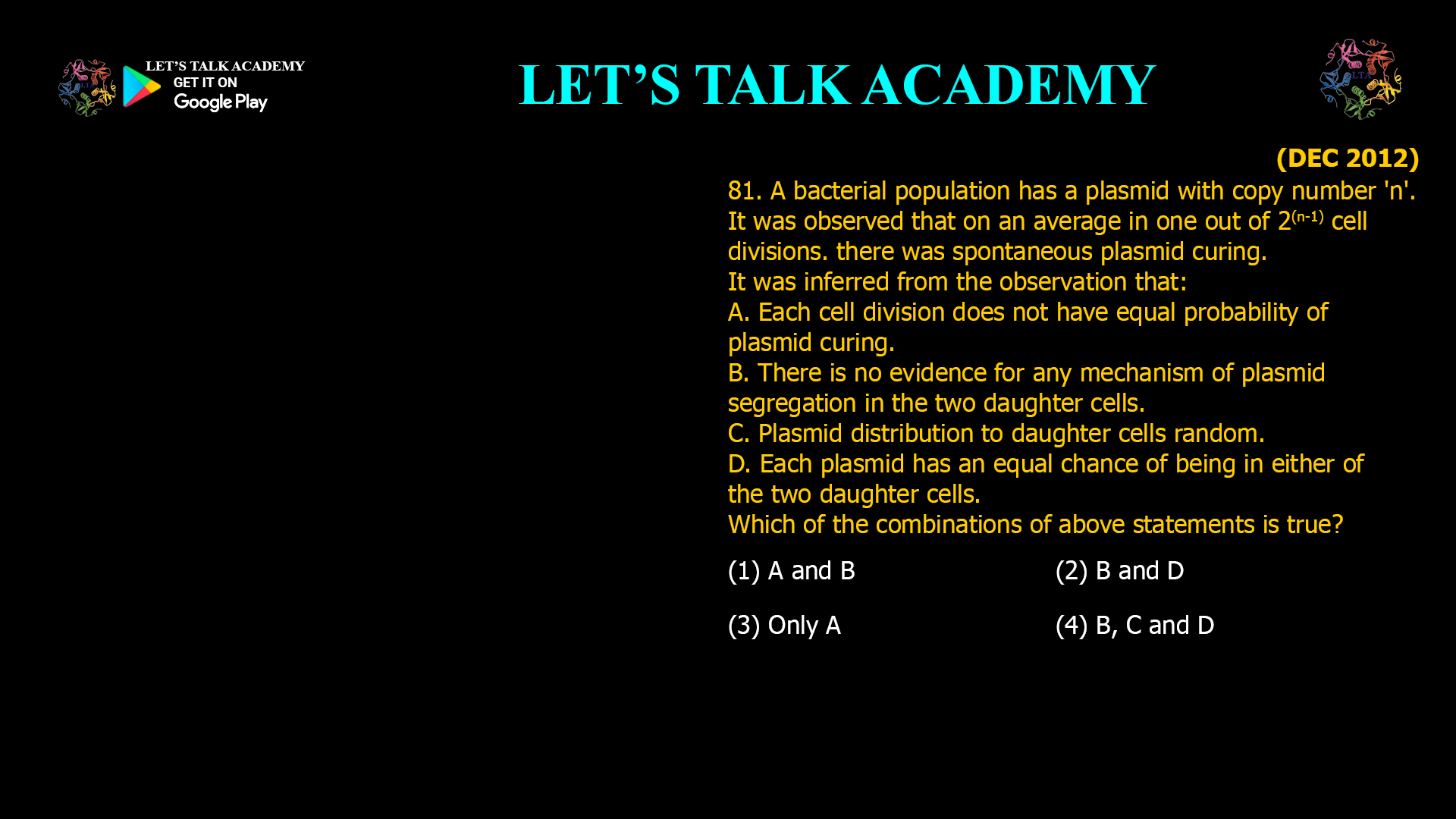
81. A bacterial population has a plasmid with copy number 'n'. It was observed that on an average in one out of 2(n-1) cell divisions. therewas spontaneous plasmid curing. It was inferred from the observation that: A. Each cell division does not have equal probability of plasmid curing. B. There is no evidence for any mechanism of plasmid segregation in the two daughter cells. C. Plasmid distribution to daughter cells random. D. Each plasmid has an equal chance of being in either of the two daughter cells. Which of the combinations of above statements is true? (1) A and B(2) B and D (3) only A (4) B, C and D

 Insights into Plasmid Curing and Segregation: Random Distribution vs Active Partitioning in Bacteria

80. In an in vitro experiment using radio-labeled nucleotides, a researcher is trying to analyze the possible products or DNA replication by resolving the products using urea-polyacrylamide gel electrophoresis. In one experimental set up RNase H was added (Set 1), while in another set no RNase H was added (Set 2), The possible observations of this experiment could be A. There is no difference in the mobility of labelled DNA fragments between the Set I and Set 2 B. There is distinct difference in the mobility of the newly synthesized labeled DNA fragments between Set I and Set 2 C. The mobility of the newly synthesized labelled DNA fragments in case of Set 1 is faster as compared to the Set 2 D. The mobility of the newly synthesized labelled DNA fragments in case of Set 1 is slower as compared to the Set 2 Which of the following combinations represent correct observations? (1) A and B (2) B and C (3) A and D (4) B and D

How RNase H Influences the Mobility of Newly Synthesized DNA Fragments in Urea-PAGE Analysis

79. Following statements have been made about removal of supercoiling produced by DNA unwinding at the replication fork: A. Accumulation of supercoils is the result of DNA helicase activity during unwinding of DNA B. Problem of DNA supercoiling is valid only for circular chromosomes of bacteria and not for the linear chromosomes C. Supercoiling of DNA is removed by topoisomerases by breaking either one or both strands of DNA on the unreplicated DNA in front of replication fork. D. Both topoisomerase I and topoisomerase can remove positive super-coiling during replication Which one of the following options has all correct statements? (1) A, B and C (2) A B and D (3) A, C and D (4) B, C and D

Understanding DNA Supercoiling Removal During Replication: Roles of Helicase and Topoisomerases

78. As topoisomerases play an important role duringreplication, a large number of anticancer drugs havebeen developed that inhibit the activity of these enzymes. Which of the following statements is NOTtrue about topoisomerases as a potential anticancer drug target ? (1) AS cancer cells are rapidly growing cells. They contain higher level of topoisomerases. (2) The transient DNA breaks created by topotsomerases are usually converted to permanent breaks in the genome in the presence of topoisomerase targeted drugs. (3) As cancer cells often have impaired DNA repair pathways. they are more susceptible-towards topoisomerase targeted drugs. (4) The drugs which specifically target topoisomerases, usually do not affect normal fast growing cells.

Topoisomerases as Targets for Anticancer Drugs: Clarifying Common Misconceptions

77. A polypeptide antibiotic isolated from the genus Streptomyces which intercalates into DNA, preventing the progression of RNA polymerase(s) and initiation of DNA replication both prokaryotes and eukaryotes is (1) Rifampicin (2) α-Aminitin (3) Actinomycin D (4) Cyclohexamide

Actinomycin D: DNA Intercalating Antibiotic Blocking RNA Polymerase and DNA Replication in Prokaryotes and Eukaryotes

76. Ciprofloxacin is a synthetic chemotherapeutic antibiotic of the fluoroquinolone drug class. The target of antibiotic ciprofloxacin is (1) Replication (2) Protein synthesis (3) Cell wall synthesis (4) Membrane structure

 Ciprofloxacin Mechanism of Action: Inhibition of Bacterial DNA Replication Enzymes

75. When circular plasmids having a centromere sequence are transformed into yeast cells, they replicate and segregate in each cell division. However, if a linear chromosome is generated by cutting the plasmid, at a single site with a restriction endonuclease, the plasmids are quickly lost from the yeast. It is known that genes on the plasmids are lost because of the instability of the chromosome ends. What could be done so as to restore its stability and can be inherited? (1) Methylation of adenine residues of the plasmid. (2) Complexing the plasmid ends with histone proteins. (3) By incorporating telomere sequences to the end of plasmid. (4) By incorporating acetylated histone proteins to the plasmid ends.

How Incorporating Telomere Sequences Restores Stability of Linear Plasmids in Yeast

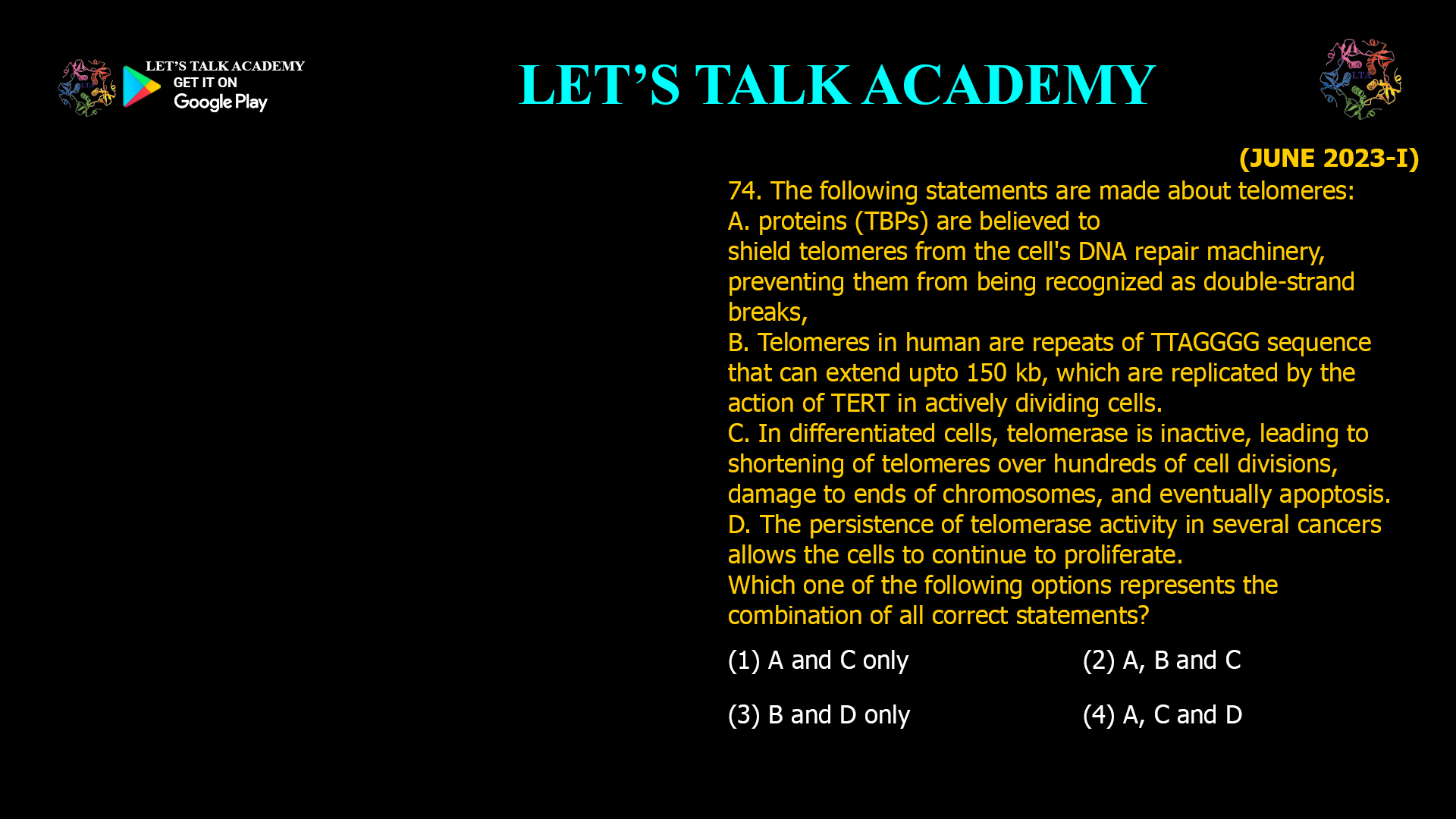
proteins (TBPs) are believed to

Telomeres: Protecting Chromosome Ends and Maintaining Genome Integrity

73. Which one of the following does NOT characterize aging? (I) An insulin/IGF-I signaling system plays an important role in controlling lifespan. (2) Lifespan increases due to resistance to oxidative stress. (3) Shortening of telomeres. (4) Female mice with a mutation in the IGF-1 and IGF-2 show reduced lifespan.

Which Statement Does NOT Characterize Aging? Insights into Insulin/IGF-1 Signaling, Telomeres, and Lifespan

72. Which statement is correct in relation of activity of telomerase? (1) Increase with age (2) Observed in all cancers and responsible for immortality (3) Responsible for apoptosis but not for ageing (4) Elongate telomeres

 Telomerase Activity: Key to Telomere Elongation, Aging, and Cancer Immortality

71. In order to study the role of telomeres in DNA replication, genetically engineered mice were prepared, where the gene for telomerase RNA was knocked out. When cells from these knock out mice were taken and cultured in vitro, they proliferated even after 100 celldivisions which is quite unlikely in the case of human cells. Which of the following is the correct reason? (1) Human and mice are fundamentally different with respect to their requirements for telomerase enzyme in the context of DNA replication. (2) In vitro, mice DNA becomes circular due to end to end chromosome fusion and does not require telomerase for DNA end replication. (3) Mice have very long stretch of telomere DNA sequence compared to that of human. (4) In vitro, mice DNA replication does not require the removal of RNA primers.

Understanding Why Telomerase RNA Knockout Mice Cells Proliferate Longer Than Human Cells

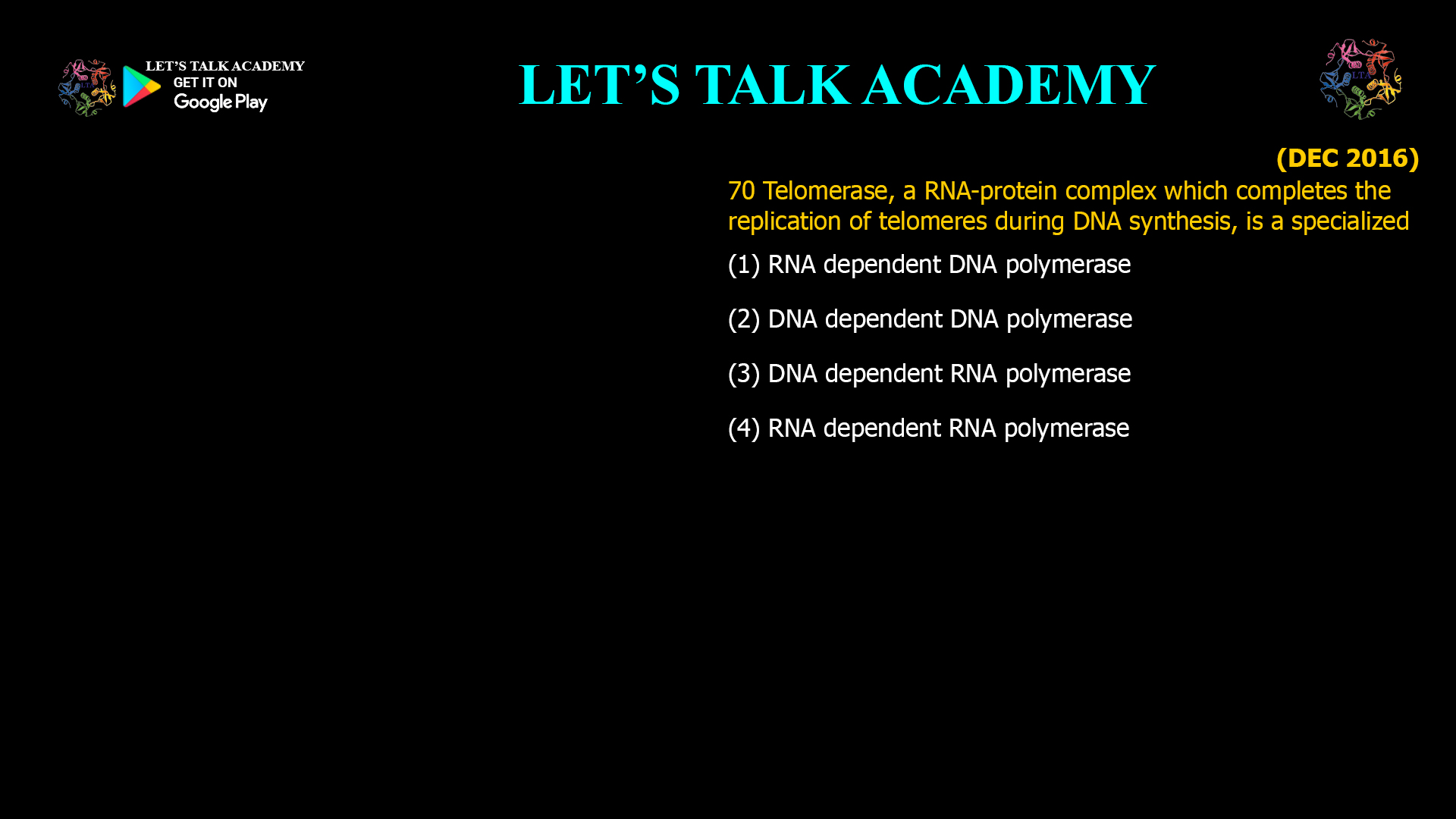
70 Telomerase, a RNA-protein complex which completes the replication of telomeres during DNA synthesis, is a specialized (1) RNA dependent DNA polymerase (2) DNA dependent DNA polymerase (3) DNA dependent RNA polymerase (4) RNA dependent RNA polymerase

 Telomerase: The Specialized RNA-Dependent DNA Polymerase That Maintains Chromosome Ends

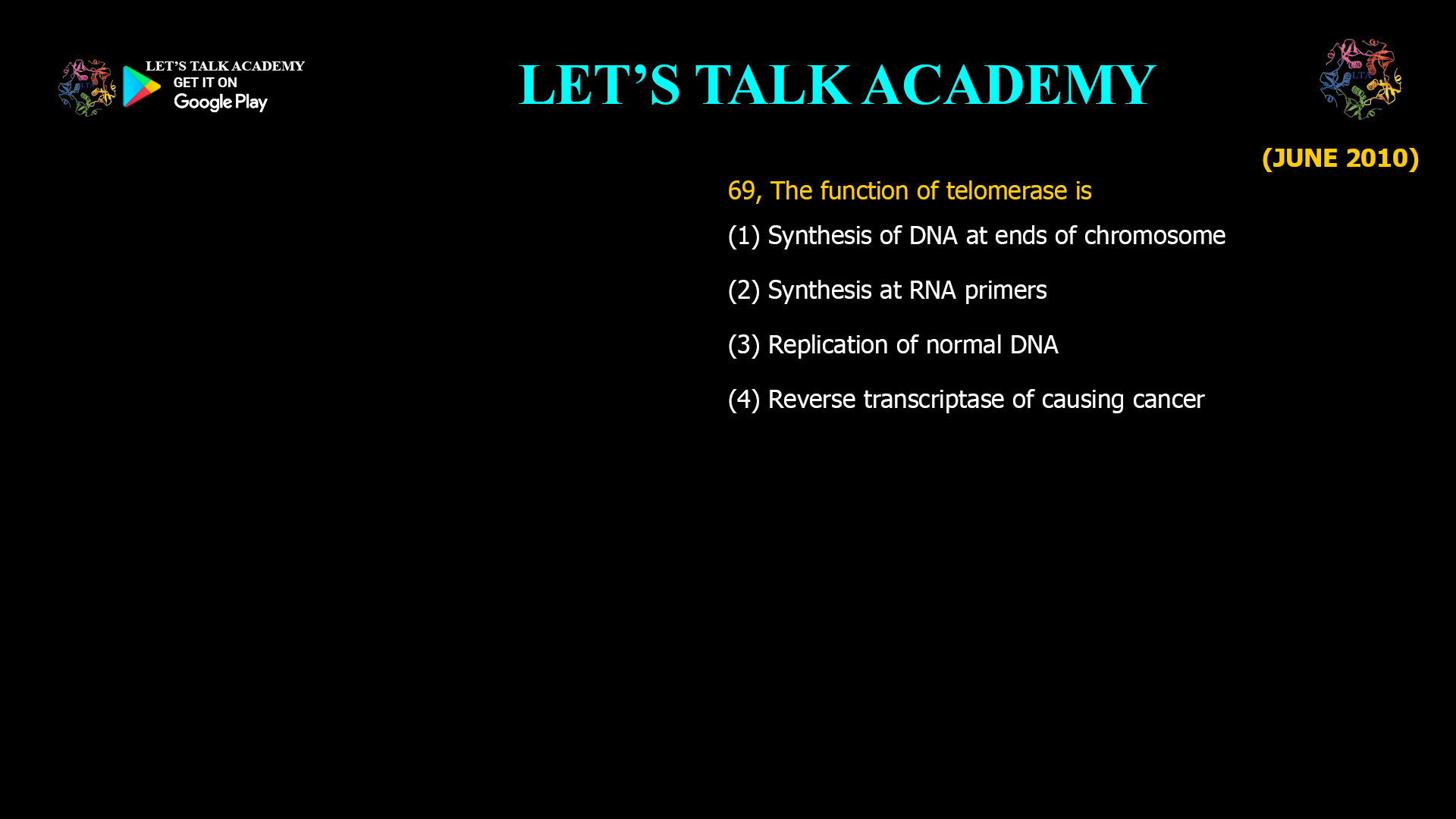
69, The function of telomerase is (1) Synthesis of DNA at ends of chromosome (2) Synthesis at RNA primers (3) Replication of normal DNA (4) Reverse transcriptase of causing cancer

Telomerase: The Key Enzyme Synthesizing DNA at Chromosome Ends to Preserve Genome Integrity

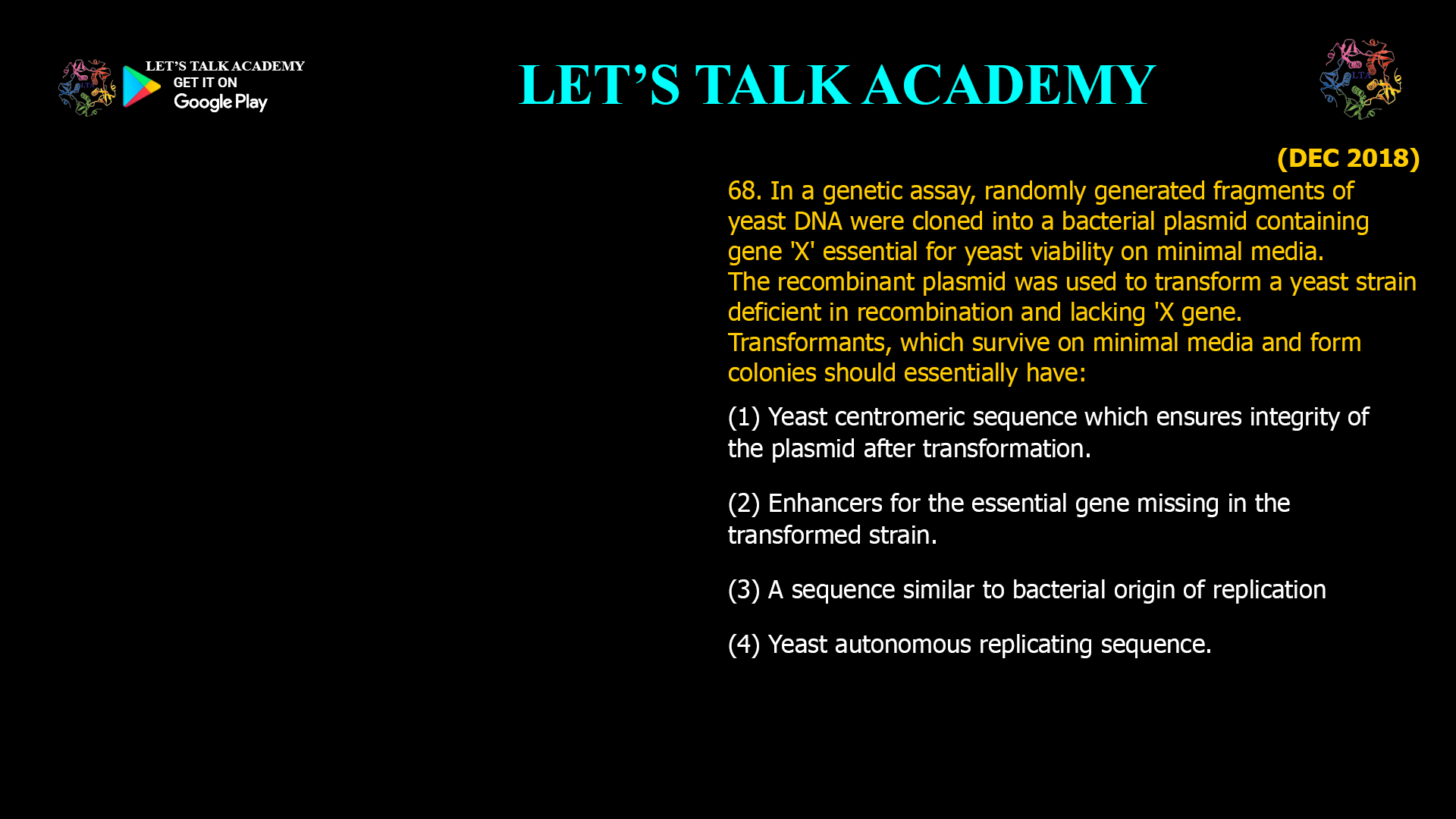
68. In a genetic assay, randomly generated fragments of yeast DNA were cloned into a bacterial plasmid containing gene 'X' essential for yeast viability on minimal media. The recombinant plasmid was used to transform a yeast strain deficient in recombination and lacking 'X gene. Transformants. which survive on minimal media and form colonies should essentially have: (1) Yeast centromeric sequence which ensures integrity of the plasmid after transformation. (2)Enhancers for the essential gene missing in the transformed strain. (3) A sequence similar to bacterial origin of replication (4) Yeast autonomous replicating sequence

 Why Yeast Autonomous Replicating Sequence (ARS) Is Essential for Plasmid Stability and Yeast Viability

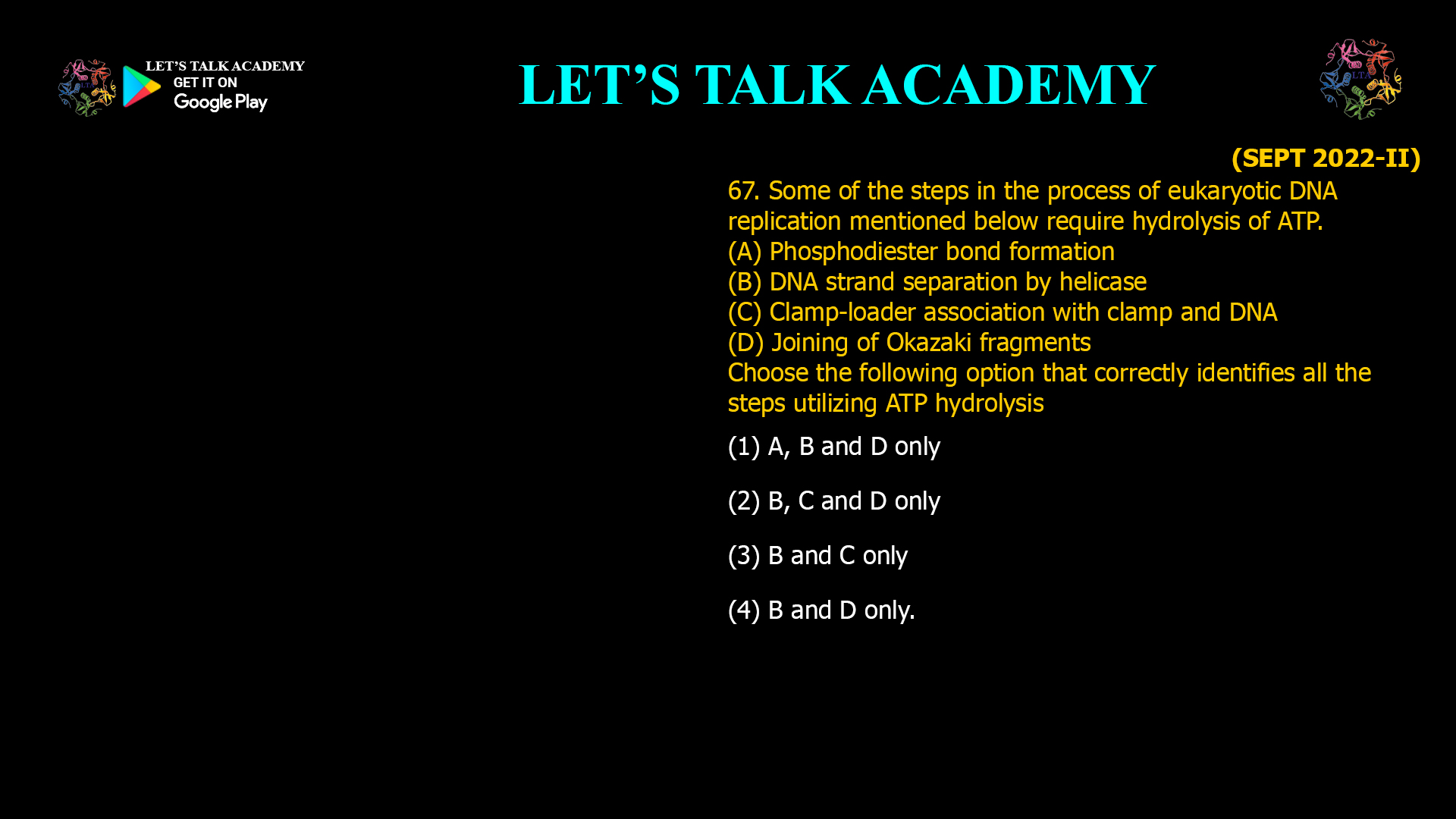
67. Some of the steps in the process of eukaryotic DNA replication mentioned below require hydrolysis of ATP. (A) Phosphodiester bond formation (B) DNA strand separation by helicase (C) Clamp-loader association with clamp and DNA (D) Joining of Okazaki fragments Choose the following option that correctly identifies all the steps utilizing ATP hydrolysis (1) A, B and D only (2) B, C and D only (3) B and C only (4) B and D only.

Key Steps in Eukaryotic DNA Replication That Require ATP Hydrolysis

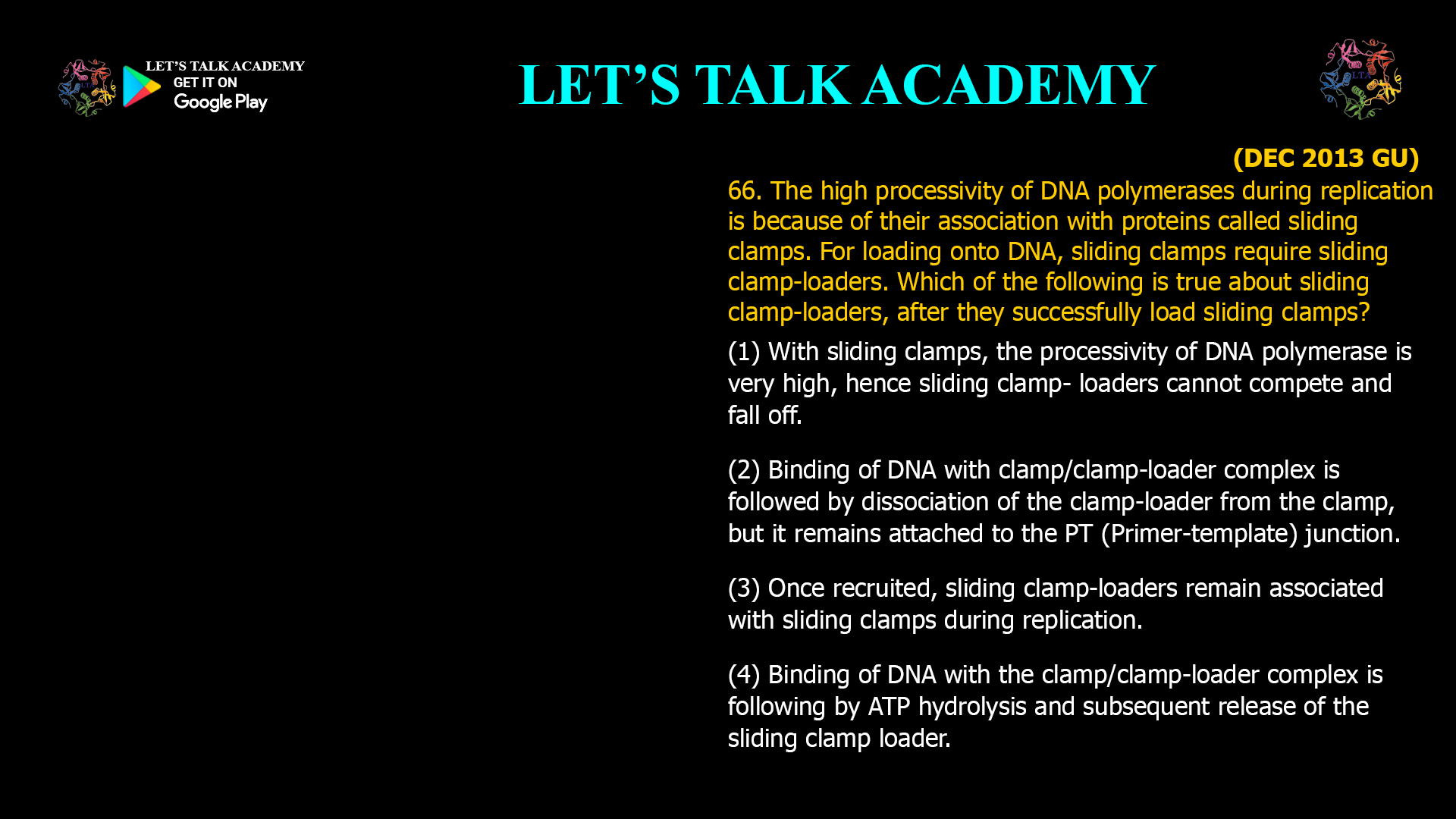
66. The high processivity of DNA polymerases during replication is because of their association with proteins called sliding clamps. For loading onto DNA, sliding clamps require sliding clamp-loaders. Which of the following is true about sliding clamp-loaders, after they successfully load sliding clamps? (1) With sliding clamps, the processivity of DNA polymerase is very high, hence sliding clamp- loaders cannot compete and fall off. (2) Binding of DNA with clamp/clamp-loader complex is followed by dissociation of the clamp-loader from the clamp, but it remains attached to the PT (Primer-template) junction. (3) Once recruited, sliding clamp-loaders remain associated with sliding clamps during replication. (4) Binding of DNA with the clamp/clamp-loader complex is following by ATP hydrolysis and subsequent release of the sliding clamp loader.

What Happens to Sliding Clamp-Loaders After They Load Sliding Clamps Onto DNA?

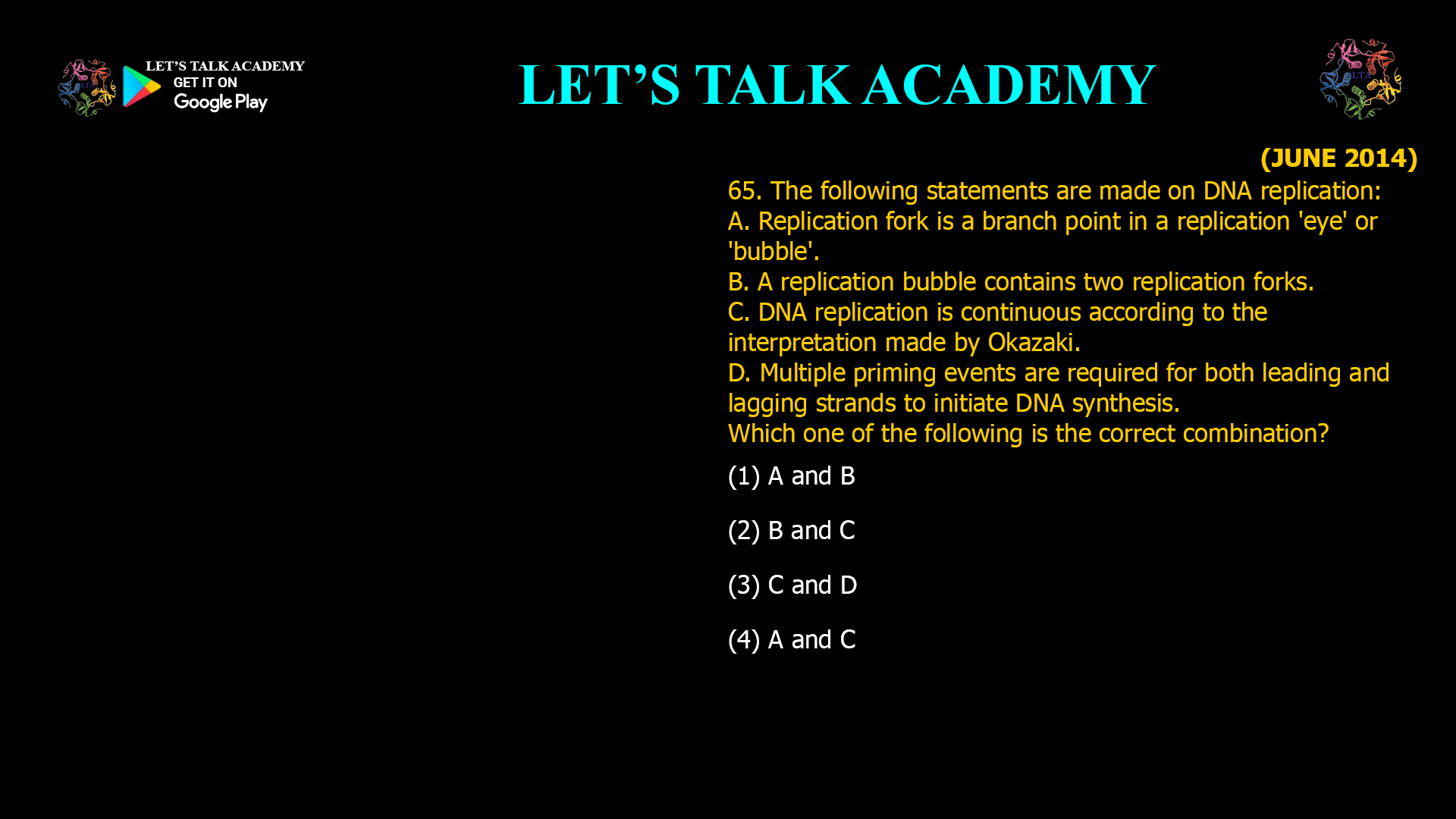
65. The following statements are made on DNA replication: A. Replication fork is a branch point in a replication 'eye' or 'bubble'. B. A replication bubble contains two replication forks. C. DNA replication is continuous according to the interpretation made by Okazaki. D. Multiple priming events are required for both leading and lagging strands to initiate DNA synthesis. Which one of the following is the correct combination? (1) A and B (2) B and C (3) C and D (4) A and C

 Understanding Replication Forks, Bubbles, and DNA Synthesis According to Okazaki

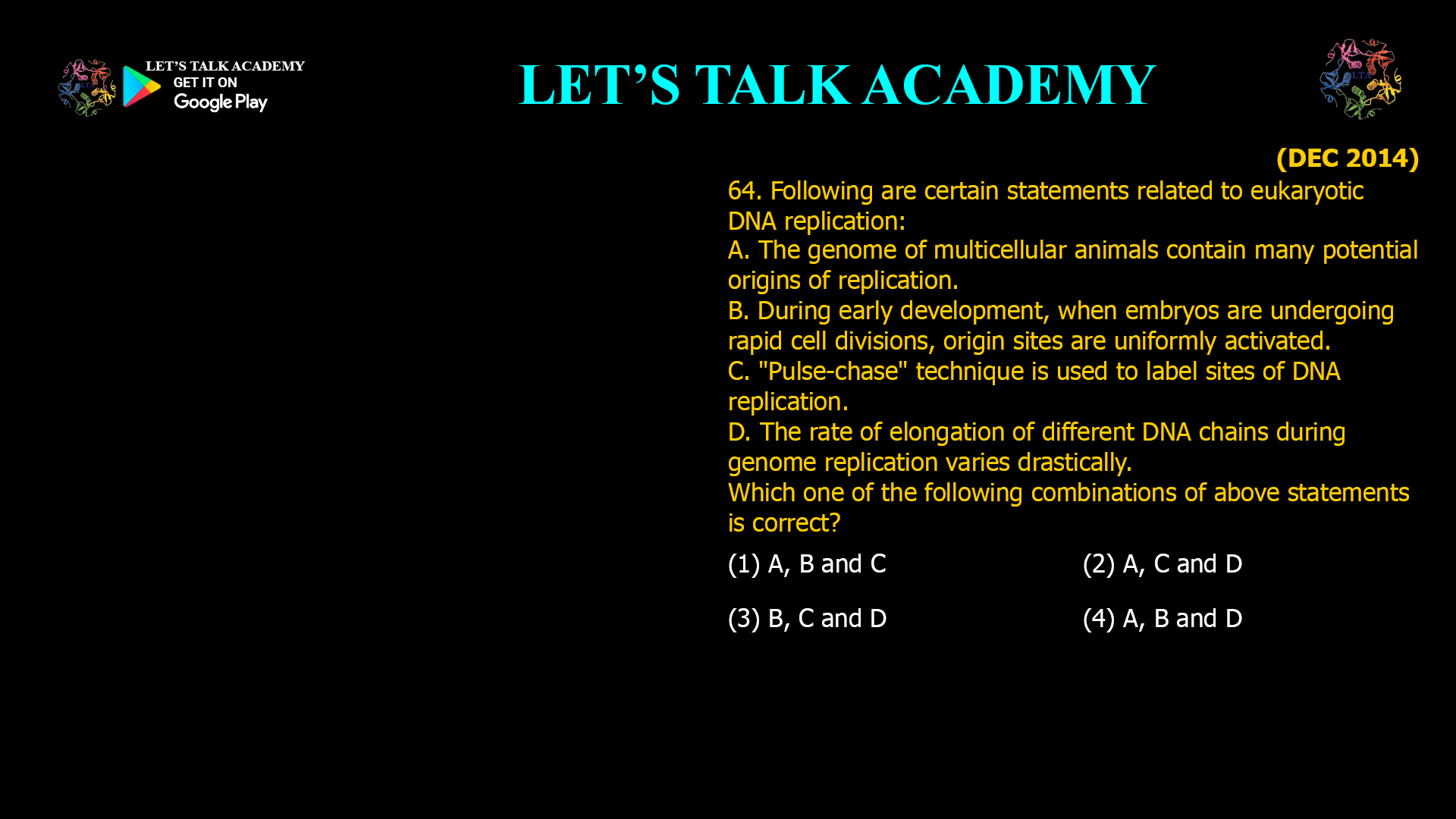
64. Following are certain statements related to eukaryotic DNA replication: A. The genome of multicellular animals contain many potential origins of replication. B. During early development, when embryos are undergoing rapid cell divisions, origin sites are uniformly activated. C. "Pulse-chase" technique is used to label sites of DNA replication. D. The rate of elongation of different DNA chains during genome replication varies drastically. Which one of the following combinations of above statements is correct? (1) A, Band C (2) A, C and D (3) B, c and D (4) A, B and D

 Key Facts About Eukaryotic DNA Replication: Origins, Pulse-Chase Labeling, and Elongation Rates

63. Given below are few statements related to DNA replication: A. Replication in eukaryotic chromosomes from the origin(s) is initiated multiple times in each cell cycle while it is initiated only once in each cell cycle at the origin in bacterial chromosomes B. Improper reinitiation of replication in a eubacterial chromosome is prevented by hemi-methylation status of the bacterial origin C. DNA polymerase III is the major replication polymerase responsible for de novo synthesis of both leading and lagging strands of DNA in E. coli D. Rolling circle mode of replication produces multiple units of the original molecule Which one of the following options represents INCORRECT statement(s)? (1) A only (2) Both B and C (3) Both A and D (4) B only

Which DNA Replication Statements Are Incorrect? A Comparison of Prokaryotic and Eukaryotic Processes

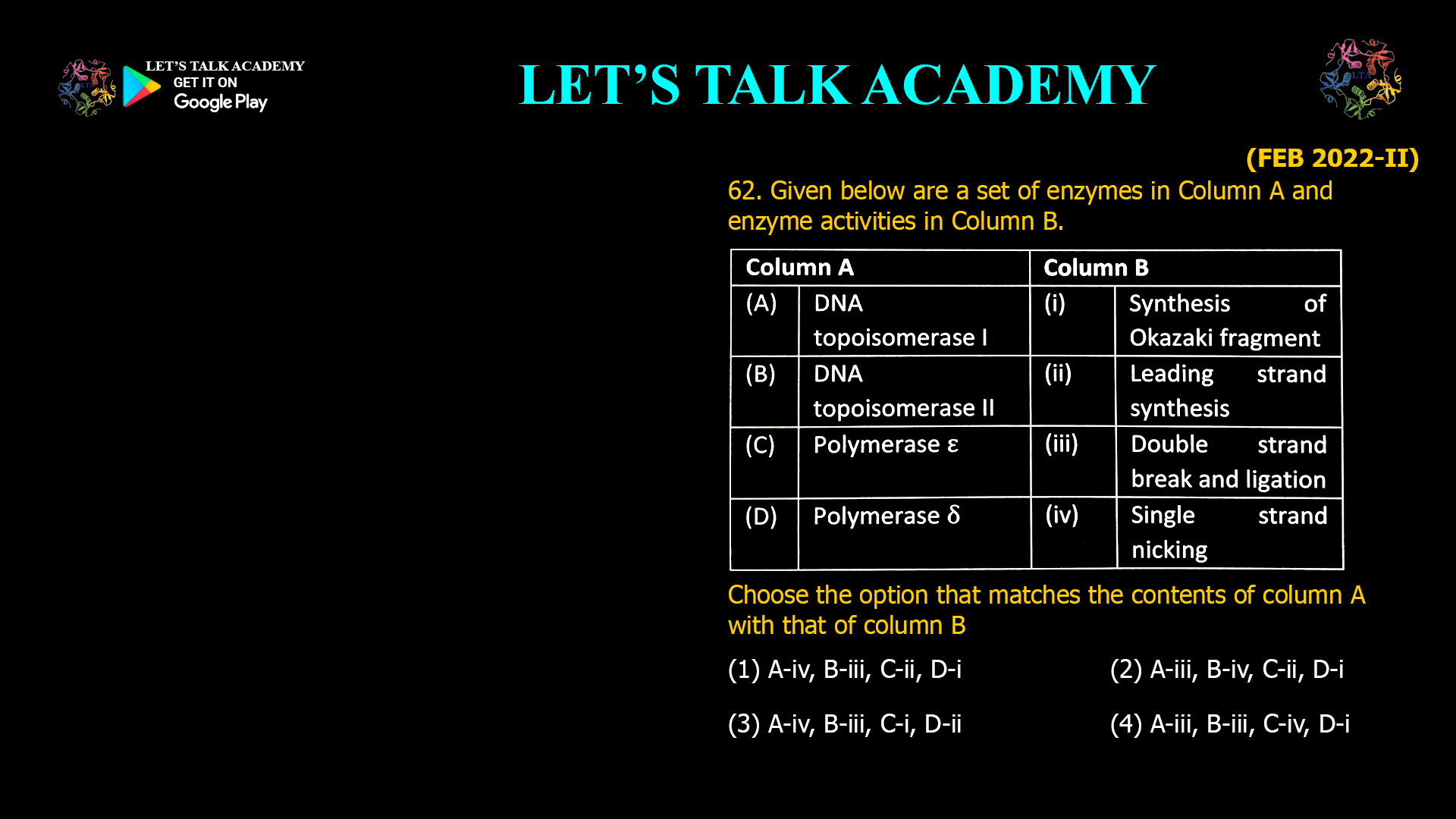
62. Given below are a set of enzymes in Column A and enzyme activities in Column B. Column A Column B (A) DNA (i) Synthesis of topoisomerase I Okazakifragment (B) DNA (ii) Leading strand topoisomerase II synthesis (C) Polymerase ϵ (iii) Double strand break and ligation (D) Polymerase Delta (iv) Single strand (Ꟙ) nicking choose the option that matches the contents of column A with that of column B (1) A-iv, B-iii, C-ii, D-i (2) A-iii, B-iv, C-ii, D-i (3) A-iv, B-iii, C-i, D-ii (4) A-iii, B-iii, C-iv, D-i

Matching DNA Topoisomerases and Polymerases with Their Specific Activities in DNA Replication

61. Eukaryotic DNA polymerase a has tightly associated primase activity but moderate processivity. DNA polymerase ϵ and Ꟙ are highly processive but lack primase activity. Given below are four statements about leading and lagging strand synthesis in eukaryotes. Which one is true? (1) Both leading and lagging strands are synthesized by DNA polymerase α. Moderate processivity is essential to maintain fidelity of replication. (2) Entire leading and lagging strands are synthesized by ϵ and Ꟙ. Eukaryotic replication is primer independent process. (3) Only the lagging strand synthesis needs primer and synthesized by DNA polymerase α. (4) Primers for both the strands are synthesized by DNA polymerase α followed by “Polymerase switching” with ϵ and Ꟙ

 Understanding Leading and Lagging Strand Synthesis in Eukaryotic DNA Replication: The Roles of DNA Polymerase α, ε, and δ

60. Telomerase, a protein RNA complex, has special reverse transcriptase activity that completes replication of telomerase during DNA synthesis. Although it has many properties similar to DNA polymerase, some of them are also different. Which one of the following properties of telomerase is different from that of DNA-polymerase? (1) Telomerase requires a template to direct the addition of nucleotide (2) Telomerase can only extent a 3'-OH end of DNA (3) Telomerase does not carry out lagging strand synthesis (4) Telomerase acts in processive manner

What Distinguishes Telomerase from DNA Polymerase? Key Differences Explained

59. The following statements are made With reference to DNA replication: A. Camptothecin causes intra- strand and jnter-strand crosslinks in DNA, leading to stalling of replication forks. B. Prevention of re-initiation of DNA replicationduring the same cell cycle is mediated by regulating the loading of the initiator complex ORC. C. A glu ala mutation in the nucleotide building pocket of DNA polymerase III could lead to the incorporation of ribonucleotides in the extending DNA chain. D. A mutation in the gene encoding Topoisomerase II could lead to entanglement of DNA daughter strands during replication. Which one of the following options represents all correct statements? (1) A and B only (2) B and C only (3) C and D only (4) B, C and D only

Evaluating DNA Replication Statements: Effects of Camptothecin, ORC Regulation, DNA Polymerase III Mutations, and Topoisomerase II Function

58. The followjng statements are made with reference to the replication of DNA. A. The eukaryotic counterpart of the bacterial B- clamp protein is proliferating cell nuclear antigen (PCNA) B. Mutation inactivating one of the subunits of the Mcm 2-7 complex negatively affects the initiation of DNA replication in eukaryotes, but has no effect on elongation of the replication fork C. All DNA polymerases responsible for replicating the eukaryotic genome catalyze DNA chain extension in a DNA template- dependent manner. D. The FENI protein plays a role in the synthesis of the lagging strand during DNA replication as well as in base excision repair Which one of the following options represents INCORRECT (1) B only (2) B and C only (3) B and O only (4) A, B and C

Evaluating Common Statements on Eukaryotic DNA Replication: Identifying Incorrect Assertions

57. Which one of the following proteins is essential for both the initiation of DNA replication as well as the continued advance of the replication fork? (1) ORC (2) Geminin (3) Cdc45 (4) Cdc6

 Cdc45: The Key Protein Required for Initiation and Continued Progression of Eukaryotic DNA Replication Fork

56. E. coli DNA ligase catalyses formation of a phosphodiester bond between the adjoining 3' hydroxyl, and the 5' phosphoryl ends in DNA duplexes. The energetic need for this reaction is met by the hydrolysis of NAD+ to NMN+ and AMP in a three-step reaction. Following statements are being made about the mechanism of this reaction. (i) AMP is linked to the 5' phosphoryl end of the nicked DNA. (ii) Adenylyl group of NAD+ is transferred to the ϵ-amino group of Lys in DNA ligase to form a phosphoamide adduct. (iii) DNA ligase catalyses the formation of a phosphodiester bond by the nucleophilic attack of the 3' hydroxyl group onto the phosphate and releases AMP. Based on the statements made above, identify the correct sequence of the reaction steps. (1) (i)-(ii)-(iii) (2) (i)-(iii)-(ii) (3) (ii)-(i)-(iii) (4) (iii)-(i)-(ii)

 Understanding the Three-Step Mechanism of E. coli DNA Ligase in DNA Repair and Replication

55. In eukaryotes shortening of chromosomes from ends is prevented bv (1) DNA polymerase (2) RNA polymerase (3) Telomerase (4) Transposase

Telomerase: The Key Enzyme Preventing Chromosome Shortening in Eukaryotic Cells

54 In eukaryotic replication, priming of DNA synthesis and removal of RNA catalyzed by (1) DNAPol α and PCNA, respectively (2) DNA Pol α and FEN 1, respectively (3) DNA Pol Ꟙ and FEN 1, respectively. (4) DNA Pol ϵ and PCNA, respectivelv.

Priming and RNA Primer Removal in Eukaryotic DNA Replication: DNA Polymerase α and FEN1 Functions Explained

53. In a human cell line, a large fraction of double-strand DNA breaks are repaired by non-homologous end joining (NHEJ). An inhibitor of FLAP endonuclease will affect (1) recruitment of DNA—dependent kinase (2) gap trimming (3) DNA unwinding (4) pairing of micro-homology regions.

How Flap Endonuclease Inhibition Affects Gap Trimming During Non-Homologous End Joining in DNA Repair

52. In prokaryotes during replication, the lagging strand is synthesized in a series of short fragments known as Okazaki fragments, consequently requiring many primers. The RNA primers of Okazaki fragments are subsequently degraded by DNA polymerase I and the gap are filled. How DNA polymerase I fills the gap once the primer have been removed from lagging stand? (1) DNA polymerase I has its own primer (2) DNA polymerase I do not require primer (3) DNA from leading stand serves as primer (4) 3'-ends of existing Okazaki fragments on lagging stand serves as primer

Role of DNA Polymerase I in Filling Gaps After RNA Primer Removal During Prokaryotic Lagging Strand Replication

51. During replication, RNaseH removes all of the RNA primer except the ribonucleotide directly linked to the DNA end. This is because (1) it can degrade RNA and DNA end. From their 5' end. (2) it can only cleave bonds between two ribonucleotides. (3) it can degrade RNA and DNA from their 3' end. (4) activity of RNaseHis inhibited by the presence of duplex containing both strands as DNA.

 Understanding RNase H Activity: Why It Leaves the Last Ribonucleotide Attached to DNA During Primer Removal

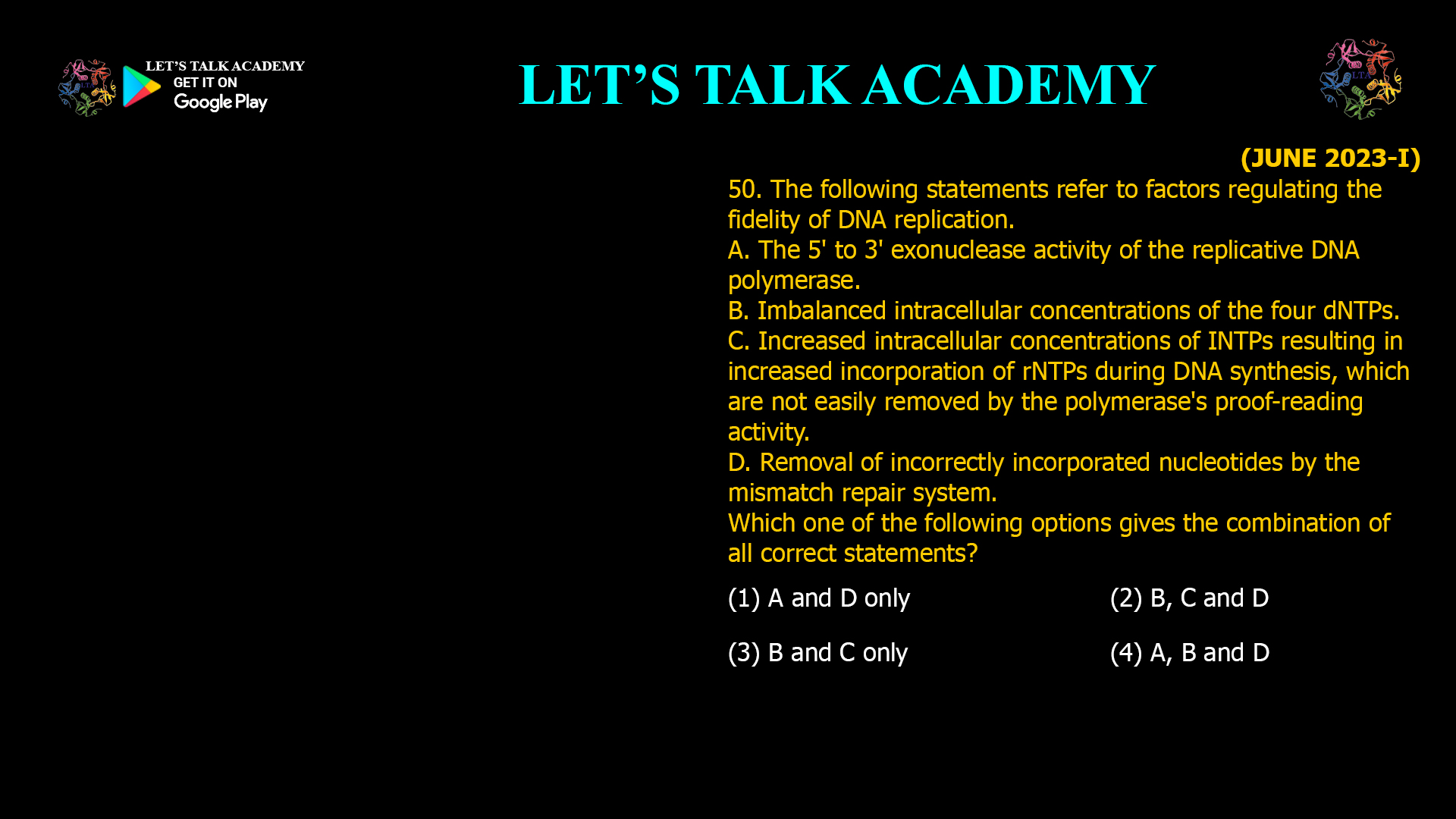
50. The following statements refer to factors regulating the fidelity of DNA replication. A. The 5' to 3' exonuclease activity of the replicative DNA polymerase. B. Imbalanced intracellular concentrations of the four dNTPs. C. Increased intracellular concentrations of INTPs resulting in increased incorporation of rNTPs during DNA synthesis, which are not easily removed by the polymerase's proof-reading activity. D. Removal of incorrectly incorporated nucleotides by the mismatch repair system. Which one of the following options gives the combination of all correct statements? (1) A and D only (2) B, C and D (3) B and C only (4) A, B and D

Key Factors Regulating Fidelity of DNA Replication: Proofreading, dNTP Balance, and Mismatch Repair

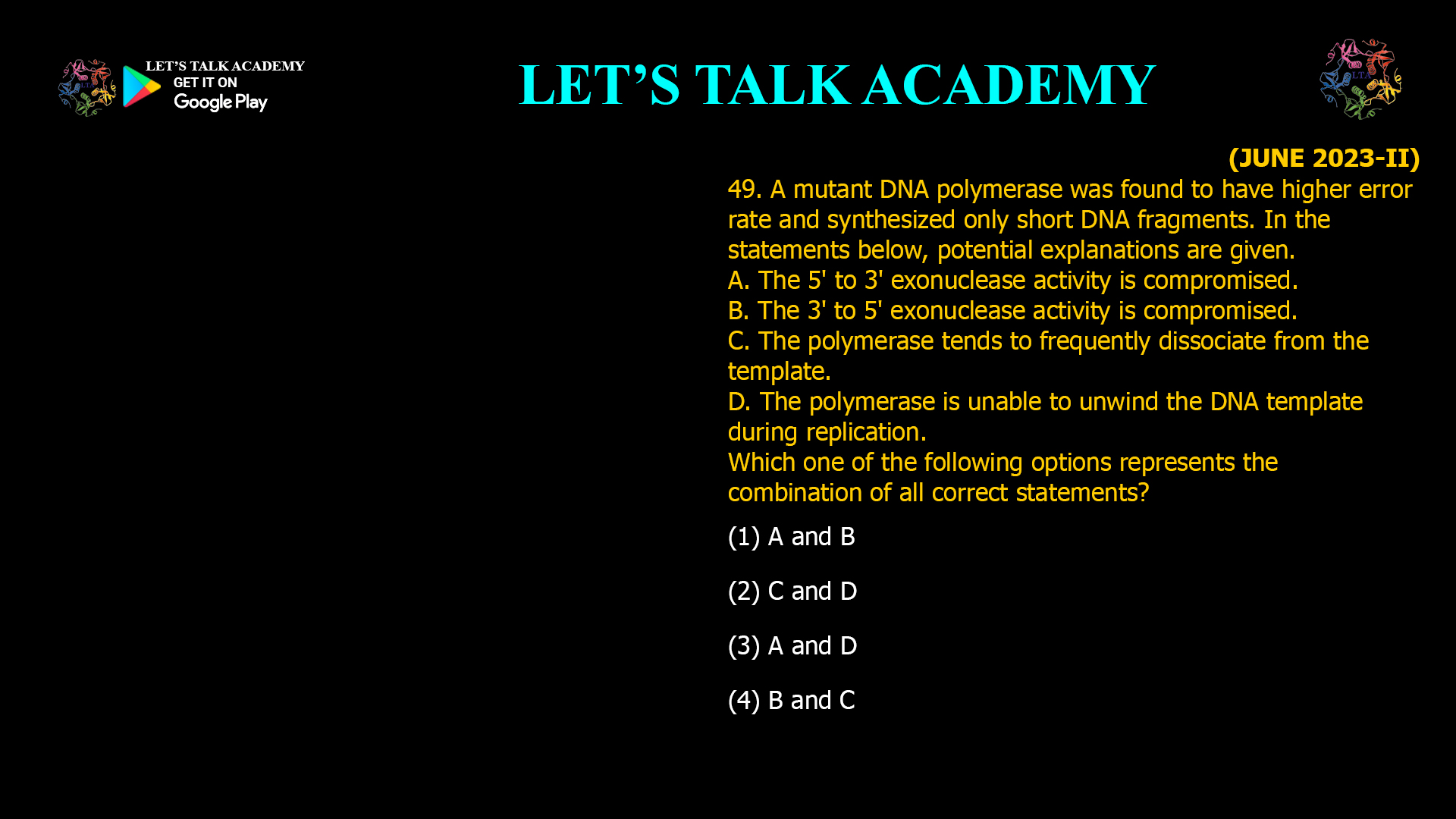
 Understand the reasons behind increased error rates and short DNA fragment synthesis by mutant DNA polymerases, focusing on compromised proofreading and processivity.

Why Does a Mutant DNA Polymerase Show Higher Error Rate and Synthesize Short DNA Fragments?

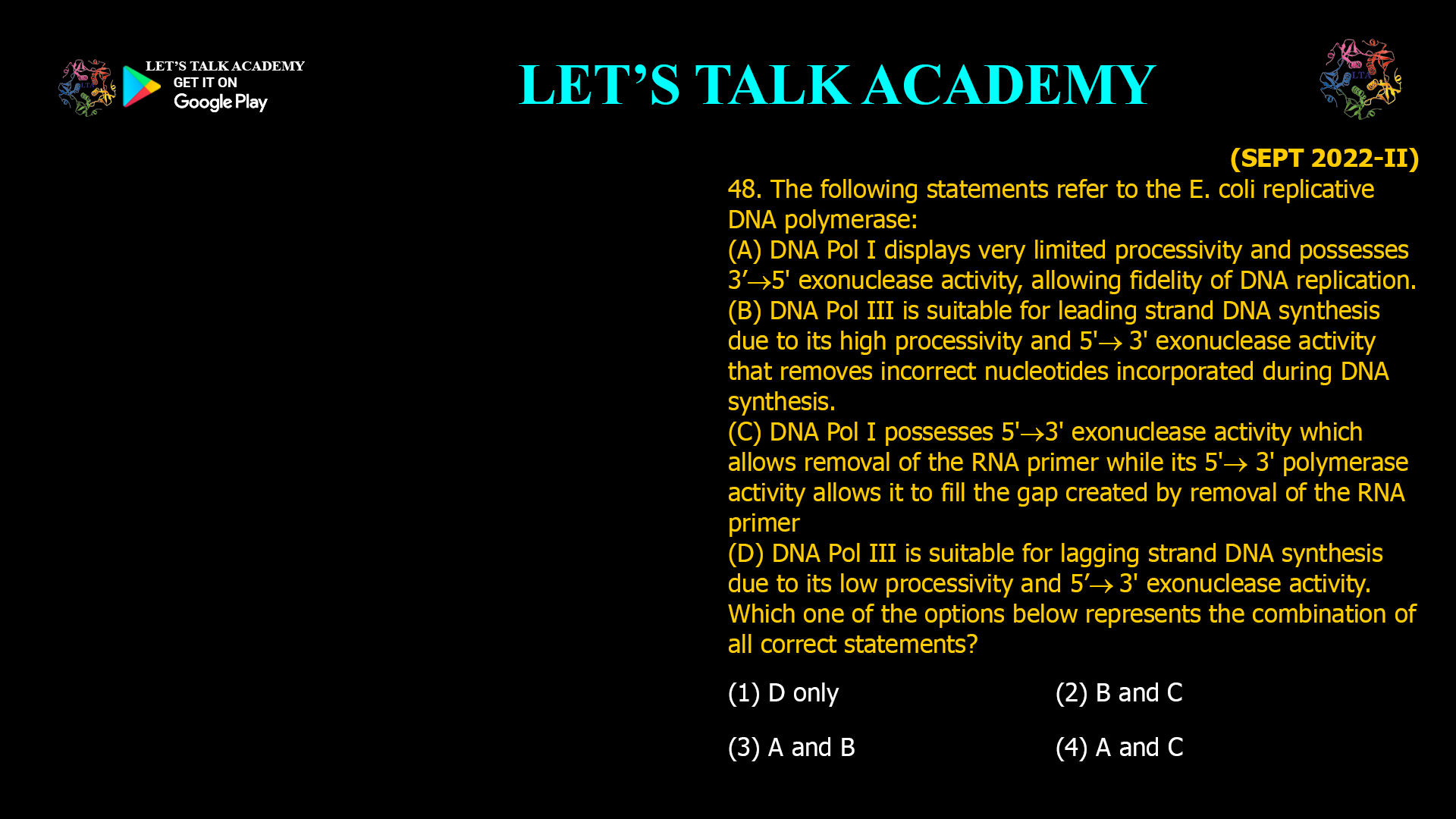
Slug: ecoli-dna-polymerase-i-iii-processivity-exonuclease Title: Understanding E. coli DNA Polymerase I and III: Processivity, Exonuclease Activities, and Roles in Replication Meta Description: Explore the distinct roles of DNA polymerase I and III in Escherichia coli replication, focusing on processivity, exonuclease activities, and suitability for leading and lagging strand synthesis. Analysis of Each Statement (A) DNA Pol I displays very limited processivity and possesses 3′→5′ exonuclease activity, allowing fidelity of DNA replication. True: DNA polymerase I has limited processivity compared to Pol III and possesses 3′→5′ exonuclease proofreading activity that enhances fidelity during DNA synthesis. However, its processivity is low, making it unsuitable for bulk replication. (B) DNA Pol III is suitable for leading strand DNA synthesis due to its high processivity and 5′→3′ exonuclease activity that removes incorrect nucleotides incorporated during DNA synthesis. Partially incorrect: DNA polymerase III is highly processive and suitable for leading strand synthesis. However, the proofreading exonuclease activity is 3′→5′, not 5′→3′. The 5′→3′ exonuclease activity is characteristic of Pol I, not Pol III. Pol III lacks 5′→3′ exonuclease activity. (C) DNA Pol I possesses 5′→3′ exonuclease activity which allows removal of the RNA primer while its 3′ polymerase activity allows it to fill the gap created by removal of the RNA primer. True: DNA polymerase I uniquely has 5′→3′ exonuclease activity to remove RNA primers and 5′→3′ polymerase activity to fill in the gaps with DNA. (D) DNA Pol III is suitable for lagging strand DNA synthesis due to its low processivity and 5′→3′ exonuclease activity. False: DNA polymerase III has high processivity, essential for lagging strand synthesis. It also lacks 5′→3′ exonuclease activity; this activity is present in Pol I. Summary Table Statement Correctness Explanation A Correct Pol I has limited processivity and 3′→5′ exonuclease proofreading activity. B Incorrect Pol III is highly processive but does not have 5′→3′ exonuclease activity; proofreading is 3′→5′. C Correct Pol I removes RNA primers via 5′→3′ exonuclease and fills gaps with polymerase activity. D Incorrect Pol III has high processivity and lacks 5′→3′ exonuclease activity. Correct Combination of Statements (4) A and C Explanation DNA polymerase I is specialized for primer removal and gap filling with limited processivity but has proofreading ability. DNA polymerase III is the main replicative polymerase with high processivity and 3′→5′ exonuclease proofreading activity but lacks 5′→3′ exonuclease activity. The 5′→3′ exonuclease activity for primer removal is unique to DNA polymerase I. Keywords E. coli DNA polymerase I, DNA polymerase III, processivity, exonuclease activity, 3′→5′ proofreading, 5′→3′ exonuclease, leading strand synthesis, lagging strand synthesis, RNA primer removal, Okazaki fragments Final Answer: (4) A and C

Understanding E. coli DNA Polymerase I and III: Processivity, Exonuclease Activities, and Roles in Replication

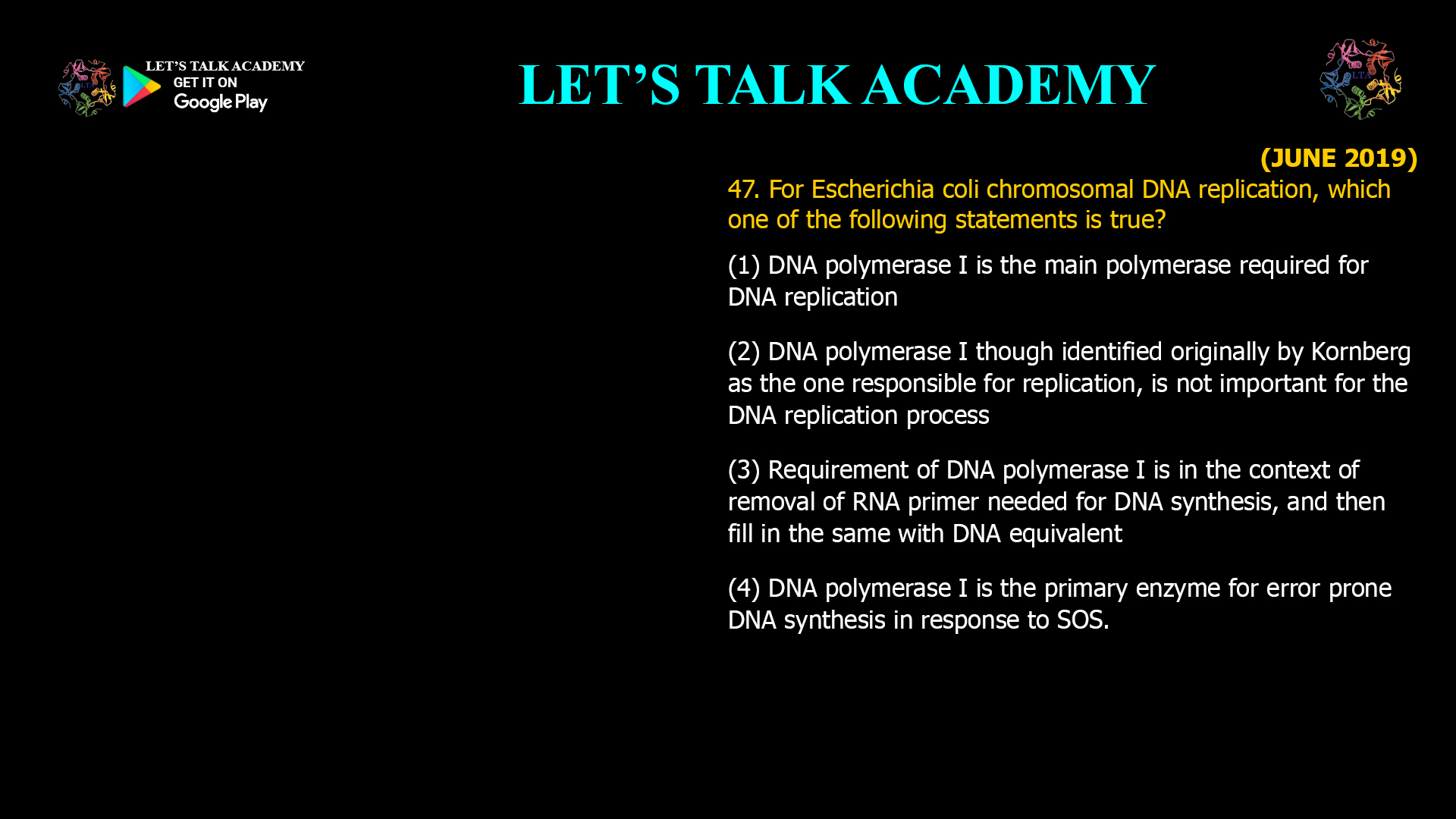
47. for Escherichia coli chromosomal DNA replication, which one of the following statements is true? (1) DNA polymerase I is the main polymerase required for DNA replication (2) DNA polymerase I though identified originally by Kornberg as the one responsible for replication, is not important for the DNA replication process (3) Requirement of DNA polymerase I is in the context of removal of RNA primer needed for DNA synthesis, and then fill in the same with DNA equivalent (4) DNA polymerase I is the primary enzyme for error prone DNA synthesis in response to SOS.

Understanding the Role of DNA Polymerases in E. coli Chromosomal DNA Replication

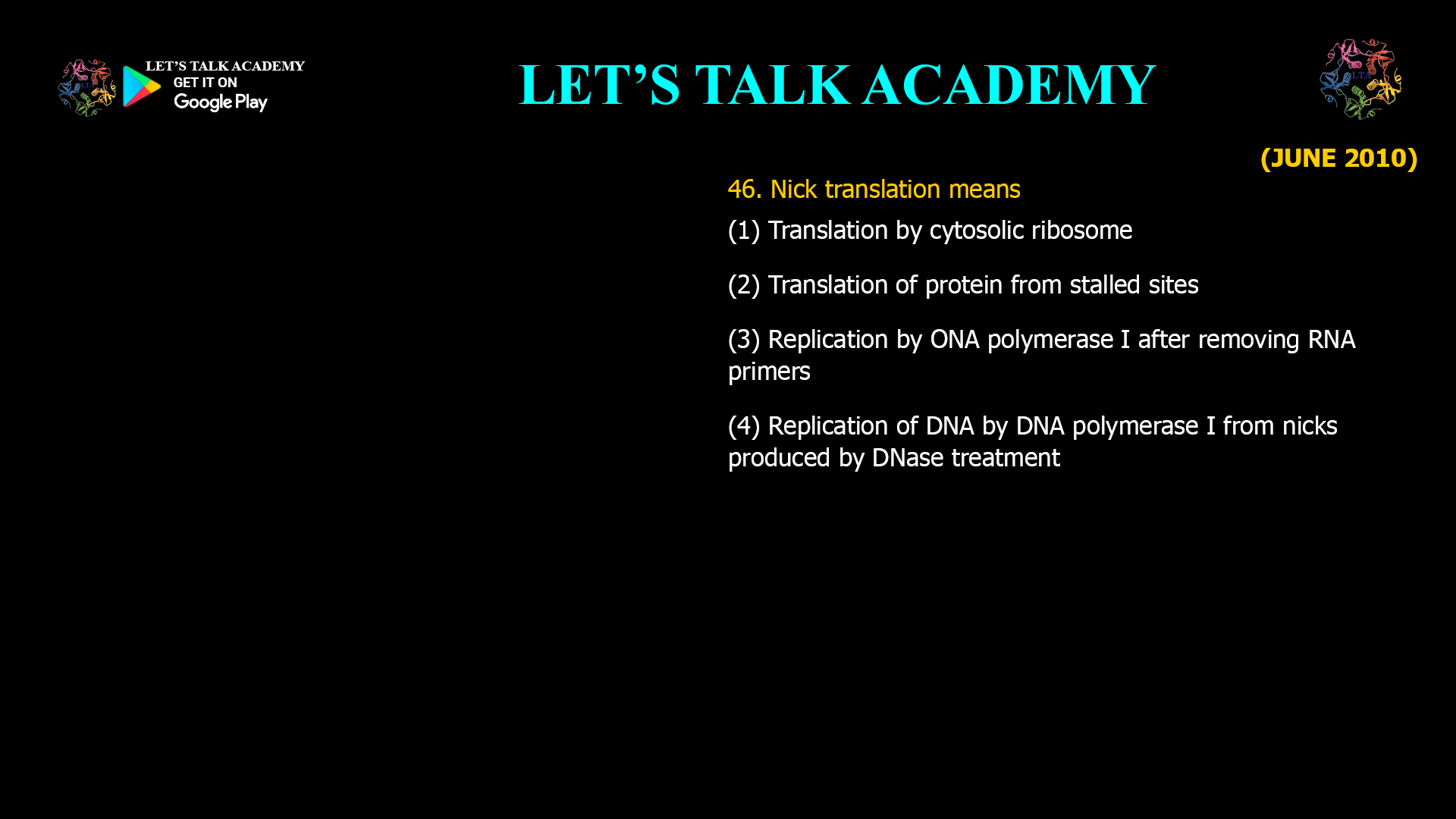
46. Nick translation means (1) Translation by cytosolic ribosome (2) Translation of protein from stalled sites (3) Replication by ONA polymerase I after removing RNA primers (4) Replication of DNA by DNA polymerase I from nicks produced by DNase treatment

What is Nick Translation? Mechanism and Role of DNA Polymerase I in DNA Labeling and Repair

45. Which of the following statement is correct with reference to replication in eukaryotes? (1) Single origin and continuous replication (2) Multiple origin and semi-discontinuous replication (3) Multiple origin and continuous replication (4) Single origin and semi-discontinuous replication

Understanding Eukaryotic DNA Replication: Multiple Origins and Semi-Discontinuous Synthesis Explained

44. Among the following which DNA polymerase lacks proof reading activity? (1) DNA polymerase α primase activity (2) DNA polymerase Ꟙ (3) DNA polymerase ϵ (4) Both DNA polymerase α and ϵ

 Which DNA Polymerases Lack Proofreading Activity? Understanding 3′→5′ Exonuclease Functions in DNA Replication

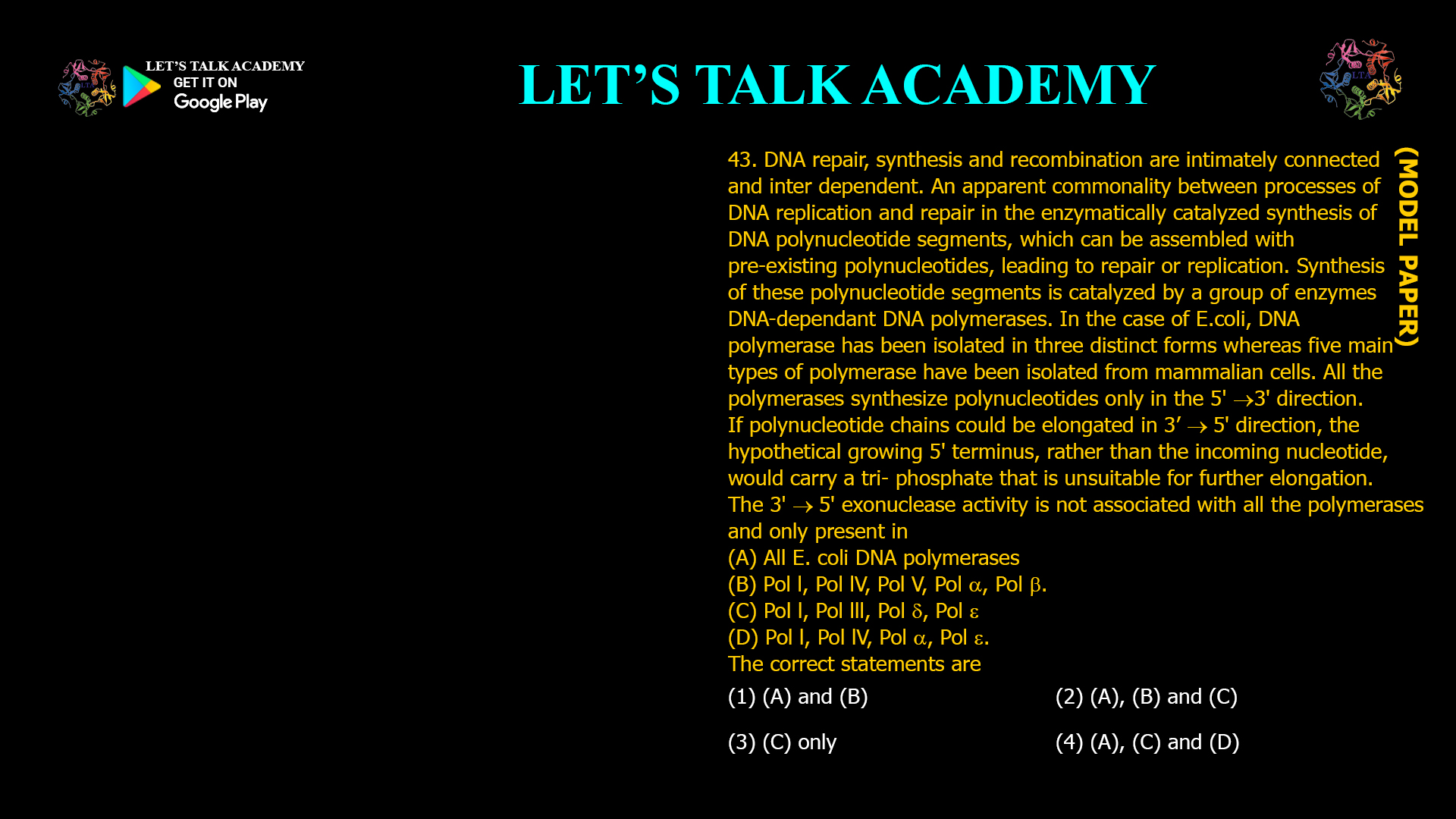
43. DNA repair, synthesis and recombination are intimately connected and inter dependent. An apparent commonality between processes of DNA replication and repair in the enzymatically catalyzed synthesis of DNA polynucleotide segments, which can be assembled with pre-existing polynucleotides, leading to repair or replication. Synthesis of these polynucleotide segments is catalyzed by a group of enzymes DNA-dependantDNA polymerases. In the case of E.coli, DNA polymerase has been isolated in three distinct forms whereas five main types of polymerase have been isolated from mammalian cells. All the polymerases synthesize polynucleotides only in the 5'3' direction. If polynucleotide chains could be elongated in 3’5' direction, the hypothetical growing 5' terminus, rather than the incoming nucleotide, would carry a tri- phosphate that is unsuitable for further elongation. The 3'5' exonuclease activity is not associated with all the polymerases and only present in (A) All E. coli DNA polymerases (B) Pol l, Pol IV, Pol V, Pol α, Polβ. (C) Pol l, Pol III, Poi Ꟙ, Poi ϵ (D) Pol l, Pol IV, POlα, Poi ϵ. The correct statements are (1) (A) and (B) (2) (A), (B) and (C) (3) (C) only (4) (A), (C) and (D)

Which DNA Polymerases Possess 3′→5′ Exonuclease (Proofreading) Activity in E. coli and Mammals?

42, During replication, the RNA primer is degraded by the 5' - 3' exonuclease activity of (1) RNAseH (2) FEN-1 (flap endonuclease 1) (3) Topoisomerase II B (4) DNA polymerase

Which Enzyme Removes RNA Primers During DNA Replication Using 5′→3′ Exonuclease Activity?

41. In the diagram below, the dotted line marks the point of initiation of bidirectional replication c, A. On the right side of the dotted line, leading strand synthesis occurs using the upper strand as the template. B. On the right side of the dotted line, leading strand synthesis occurs using the lower strand as the template. C. A ligase deficient (lig-) mutant would affect replication of the upper strand on the left side of the dotted line. D. A ligase deficient (lig-) mutant would affect replication of the lower strand on the left side of the dotted line. Which one of the following options represents the combinations of the correct statements? (1) A and D (2) B and C (3) B and D (4) A and C

Understanding Leading Strand Synthesis and Ligase Deficiency Effects in Bidirectional DNA Replication

40. The long DNA strand depicted below is serving as a template for lagging strand DNA synthesis. The short lines represent the newly synthesized okazaki fragments. At which position among A, B, C and D would DNA primase act next? (1) A (2) B (3) C (4) D

 Determining the Next Site of DNA Primase Action in Lagging Strand DNA Synthesis

39. In the figure above, replication of DNA beginning from the origin of replication of the chromosome of a newly identified bacterium having a double stranded circular DNA genome is shown. Characterization of DNA polymerase responsible for genome replication showedthat DNA synthesis occurred in to direction and it depends on the presence of a primer (as is the case in Escherichia coli). Polarities ot DNA (5' or 3') are as shown. Replication begjns at a point marked ‘O’ on the left of the bubble. and both the parent strands were replicated concurrently. The longer arrow inside the bubble shows the leading strand, whereas the shorter arrows (marked a, b, c) show the Okazaki fragments. The model depicts a: (i) bidirectional mode of replication wherein synthesis of the Okazaki fragment marked 'c' occurs prior to those marked 'a' and 'b' (2) bidirectional mode of replication wherein synthesis of the Okazaki fragment marked 'a' occurs prior to those marked 'b' and 'c' (3) unidirectional mode of replication wherein synthesis of the Okazaki fragment marked 'c' occurs prior to those marked 'a' and 'b'. (4) unidirectional mode of replication wherein synthesis of the Okazaki fragment marked 'a' occurs prior to those marked 'b' and 'c'.

 Bidirectional Replication and Okazaki Fragment Synthesis Order in Circular Bacterial Chromosomes

Based on this information following statements are made: A. (i) represents the leading strand while (ii), (ii) and (iv) represent the Okazaki fragments. B. Among the Okazaki fragments, synthesis of (iv) occurs prior to the synthesis of (iii) and (i) C. Among the Okazaki fragments, synthesis of (ii) occurs prior to the synthesis of (iii) and (iv). Which one of the following options represents the correct statement(s)? (1) A only (2) B only (3) A and B(4) A and C

Decoding the Replication Fork: Which Okazaki Fragment Is Synthesized First?

37. Telomeres consist of (1) Simple tandem repeats (2) Nucleolar organizer region (3) GC rich sequences (4) Single copy repeats

Telomeres Are Made of Simple Tandem Repeats: Understanding Their Structure and Role in Chromosome Protection

36. Two experiments were performed. In the first one, Okazaki fragments were prepared from a replicating cell of E. coli grown in the presence of 32P. In the other,the two strands of E. coli chromosome were separated into a H strand and L strand, immobilized onto anitrocellulose membrane and hybridized with the Okazaki fragments prepared in the first experiment. Which one of the following options correctly describes the observation? (1) Okazaki fragments will hybridize to only H strand (2) Okazaki fragments will hybridize to only L strand (3) Okazaki fragments will hybridize with both H and L strands (4) Because the H and L strands have been prepared from different cultures of E. coli, the Okazaki fragments will hybridize to neither

 Okazaki Fragments Hybridize Specifically to the Lagging Strand (L Strand) in E. coli DNA Replication

35. If bacterial genome and plasmid are allowed to replicate in same manner using same replication machinery then (1) Plasmid DNA will complete replication first (2) Bacterial DNA will complete replication first (3) Both will replicate at same time (4) It depends on GC content of both DNA

Does Plasmid or Bacterial Genome Replicate Faster Using the Same Replication Machinery?

34. Speed of DNA replication in mammals is 256 bp/sec, so for replication of 3X10⁹bp DNA it will take a very long time, but it is completed within few hours because (1) Most of DNA is intron (2) High amount of Repetitive DNA (3) Multiple origin of replication (4) Only small portion is replicated in one cycle

How Multiple Origins of Replication Enable Rapid Mammalian DNA Replication Despite Slow Fork Speed

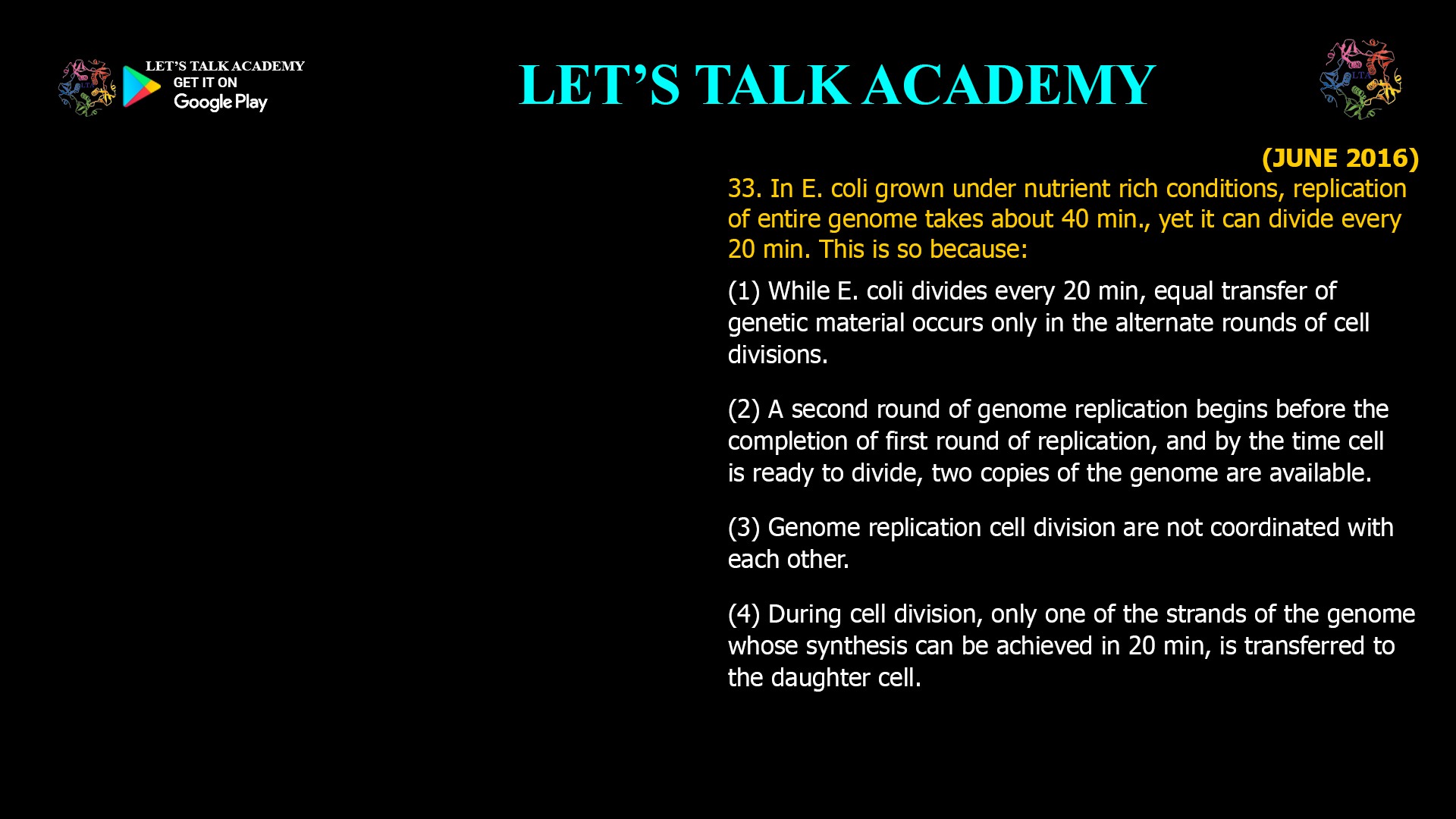
33. In E. coli grown under nutrient rich conditions, replication of entire genome takes about 40 min., yet it can divide every 20 min. This is so because: (1) While E. coli divides every 20 min, equal transfer of genetic material occurs only in the alternate rounds of cell divisions. (2) A second round of genome replication begins before the completion of first round of replication, and by the time cell is ready to divide, two copies of the genome are available. (3) Genome replication cell division are not coordinated with each other. (4) During cell division, only one of the strands of the genome whose synthesis can be achieved in 20 min, is transferred to the daughter cell.

 Understanding How E. coli Divides Every 20 Minutes While Genome Replication Takes 40 Minutes: The Role of Overlapping Replication Rounds

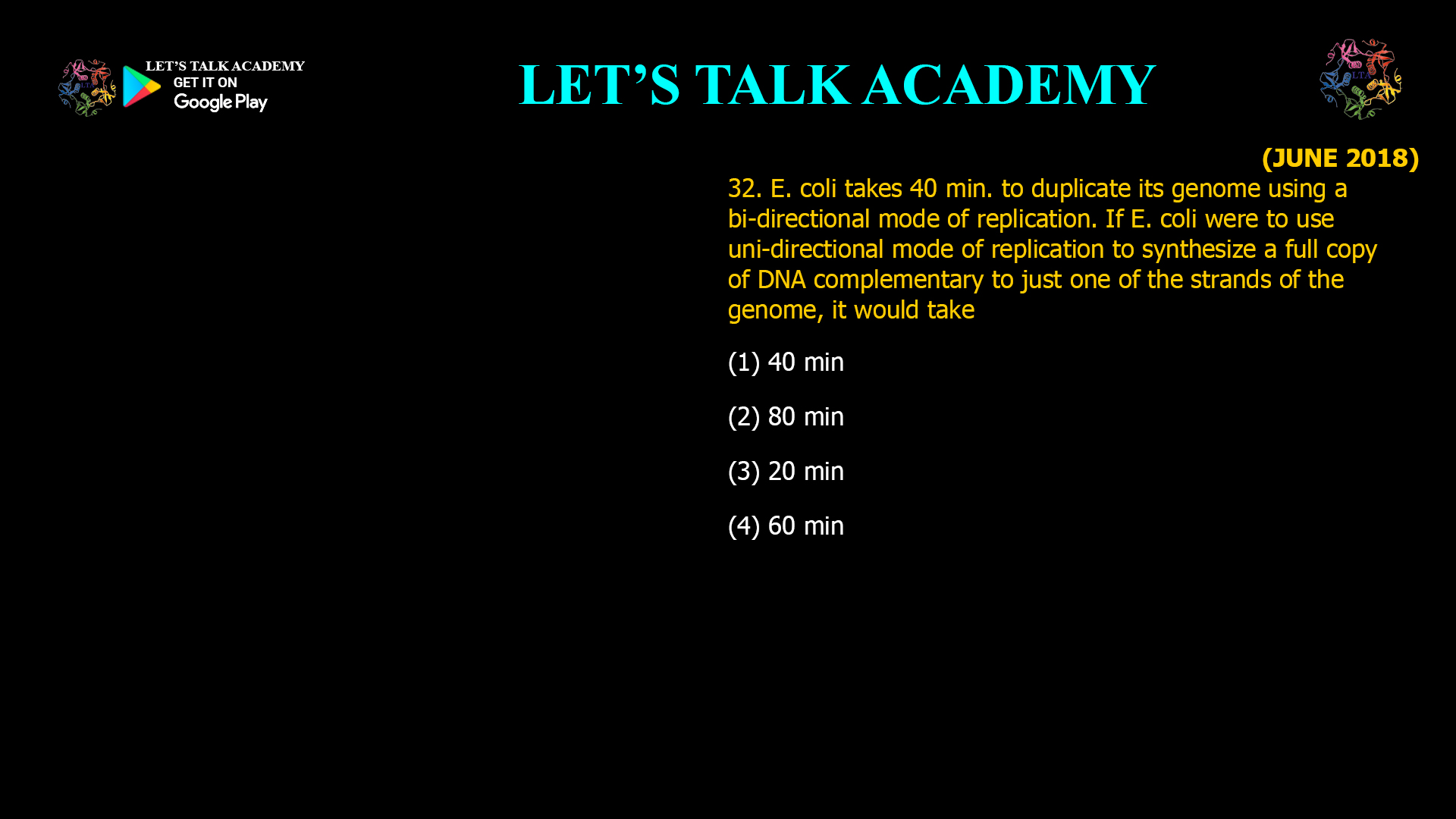
32. E. coli takes 40 min. to duplicate its genome using a bi-directional mode of replication. If E. coli were to use uni-directional mode of replication to synthesize a full copy of DNA complementary to just one of the strands of the genome, it would take (1) 40 min (2) 80 min (3) 20 min(4) 60 min

How Uni-directional Replication Affects E. coli Genome Duplication Time Compared to Bi-directional Replication

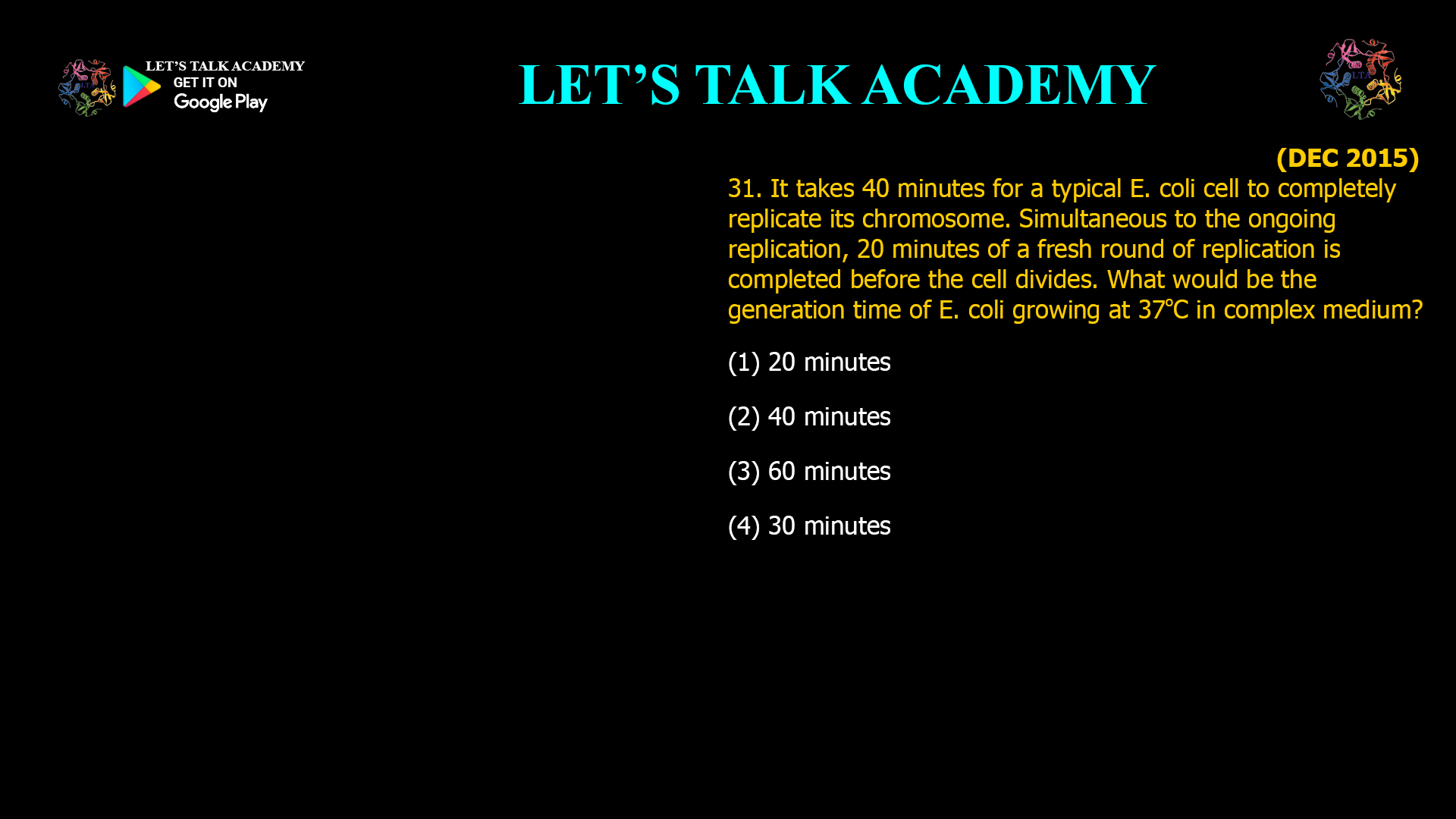
31. It takes 40 minutes for a typical E. coli cell to completely replicate its chromosome. Simultaneous to the ongoing replication, 20 minutes of a fresh round of replication is completed before the cell divides. What would be the generation time of E. coli growing at 37oC in complex medium? (1) 20 minutes (2) 40 minutes (3) 60 minutes (4) 30 minutes

How to Calculate E. coli Generation Time with Overlapping DNA Replication Cycles

30. In all organisms, it is critical that replication initiation be tightly controlled to ensure that chromosome number and cell number remain appropriately balanced. Given below are several statements regarding regulation of replication in E. coli. A. Hemi-methylation and sequestration of oriC (origin of replication) by a protein called SeqA prevents initiation of replication. B. Availability of DnaA protein is an important requirement for initiation of replication. C. The ratio of ADP : ATP is important as high level of ADP is required for initiation of replication. D. Recruitment of Hda protein by sliding clamp inhibits ATP hydrolysis required for initiation of replication. Which of the above statements are NOT true? (1) A and B (2) B and C (3) C and D (4) D and A

Regulation of Replication Initiation in E. coli: Which Statements About SeqA, DnaA, ATP/ADP Ratio, and Hda Are Incorrect?

30. In all organisms, it is critical that replication initiation be tightly controlled to ensure that chromosome number and cell number remain appropriately balanced. Given below are several statements regarding regulation of replication in E. coli. A. Hemi-methylation and sequestration of oriC (origin of replication) by a protein called SeqA prevents initiation of replication. B. Availability of DnaA protein is an important requirement for initiation of replication. C. The ratio of ADP : ATP is important as high level of ADP is required for initiation of replication. D. Recruitment of Hda protein by sliding clamp inhibits ATP hydrolysis required for initiation of replication. Which of the above statements are NOT true? (1) A and B (2) B and C (3) C and D (4) D and A

Which Statements About DNA Replication Initiation Regulation in E. coli Are Incorrect? Roles of SeqA, DnaA, ATP/ADP Ratio, and Hda Protein

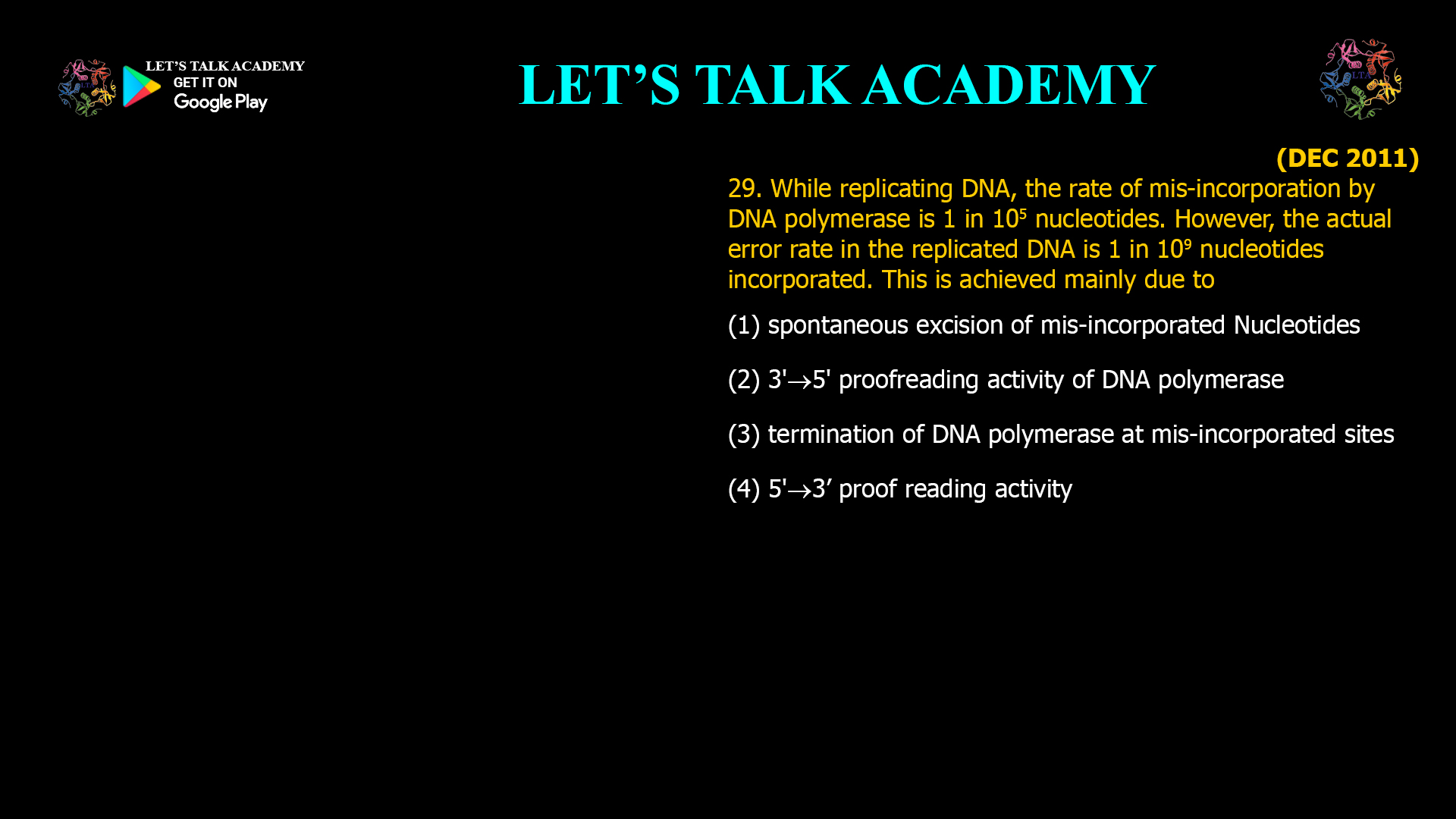
29. While replicating DNA, the rate of mis-incorporation by DNA polymerase is 1 in 105 nucleotides. However, the actual error rate in the replicated DNA is 1 in 109nucleotides incorporated. This is achieved mainly due to (1) spontaneousexcision of mis-incorporated Nucleotides (2) 3'5' proofreading activity of DNA polymerase (3) termination of DNA polymerase at mis-incorporated sites (4) 5'3’ proof reading activity

How DNA Polymerase Reduces Replication Errors: The Critical Role of 3′→5′ Proofreading Activity

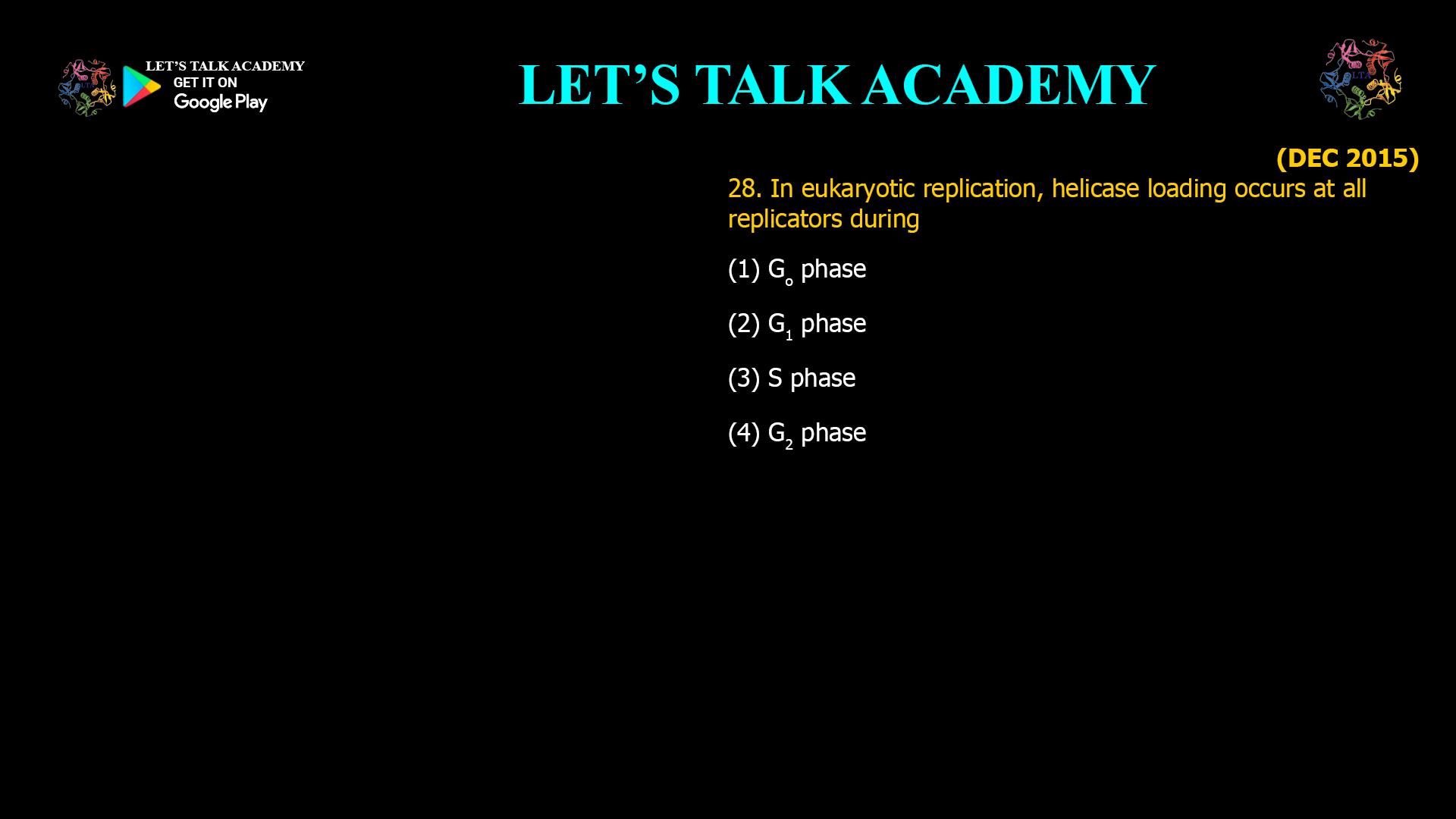
28. In eukaryotic replication, helicase loading occurs at all replicators during (1) Go phase (2) G1 phase (3) S phase (4) G2 phase

Helicase Loading in Eukaryotic DNA Replication Occurs During G1 Phase: Mechanism and Regulation Explained

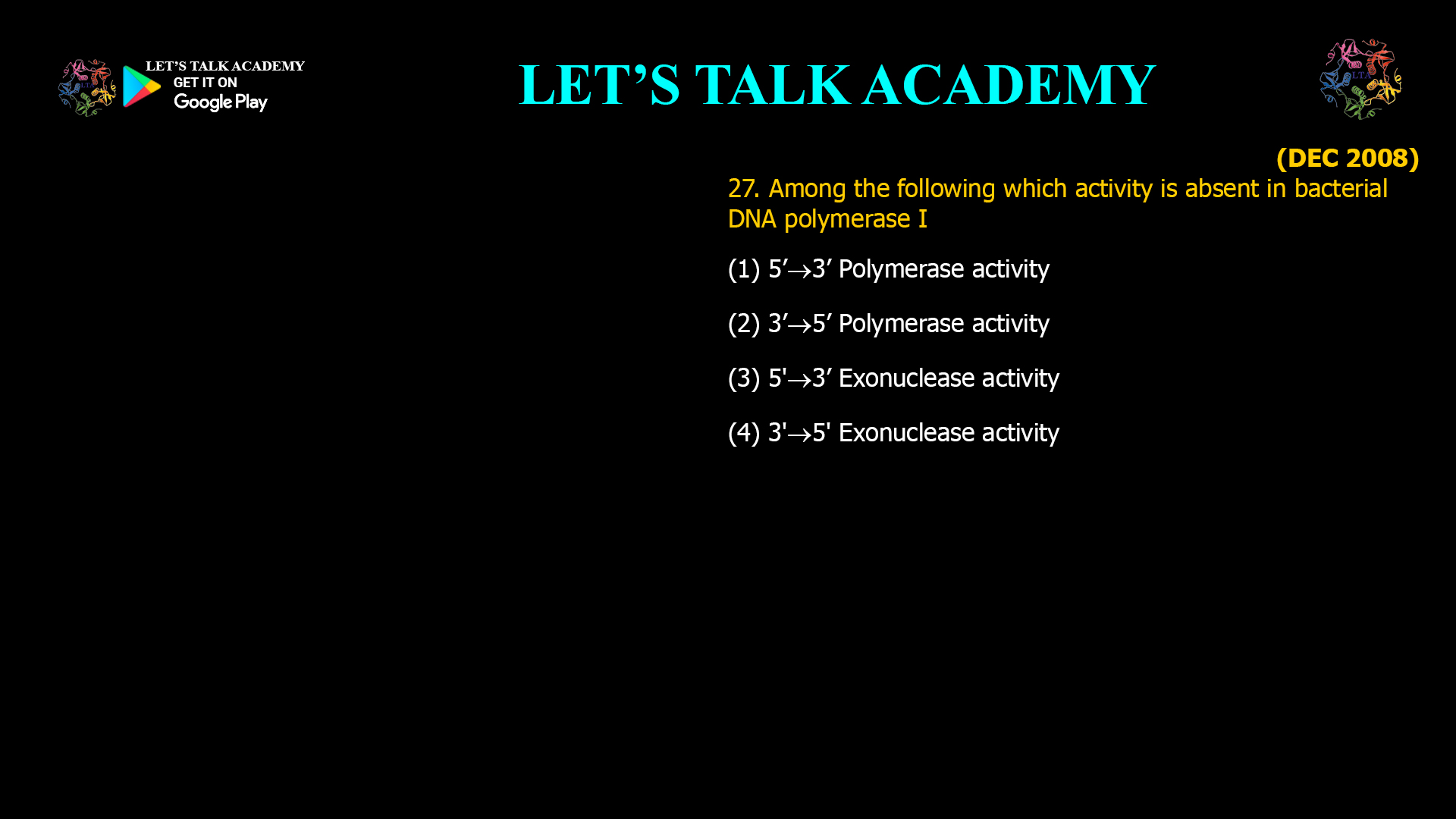
27. Among the following which activity is absent in bacterial DNA polymerase I (1) 5’3’ Polymerase activity (2) 3’5’ Polymerase activity (3) 5'3’ Exonuclease activity (4) 3'5' Exonuclease activity

Which Activity Is Absent in Bacterial DNA Polymerase I?

26. Among the following which iS termed as proof reading activity of DNA polymerase? (1) 5'3' polymerase activity (2) 3’5’ polymerase activity (3) 5'3' exonuclease activity (4) 3'5’ exonuclease activity

What Is the Proofreading Activity of DNA Polymerase? Exploring the Essential 3′→5′ Exonuclease Function

25. Type of proofreading activity bv DNA polymerase I in E.coli is (1) 5’-3’ exonuclease (2) 5'-3' endonuclease (3) 3'-5' exonuclease (4) 3'-5' endonuclease

The Proofreading Mechanism of DNA Polymerase I in E. coli: Role of 3′→5′ Exonuclease Activity

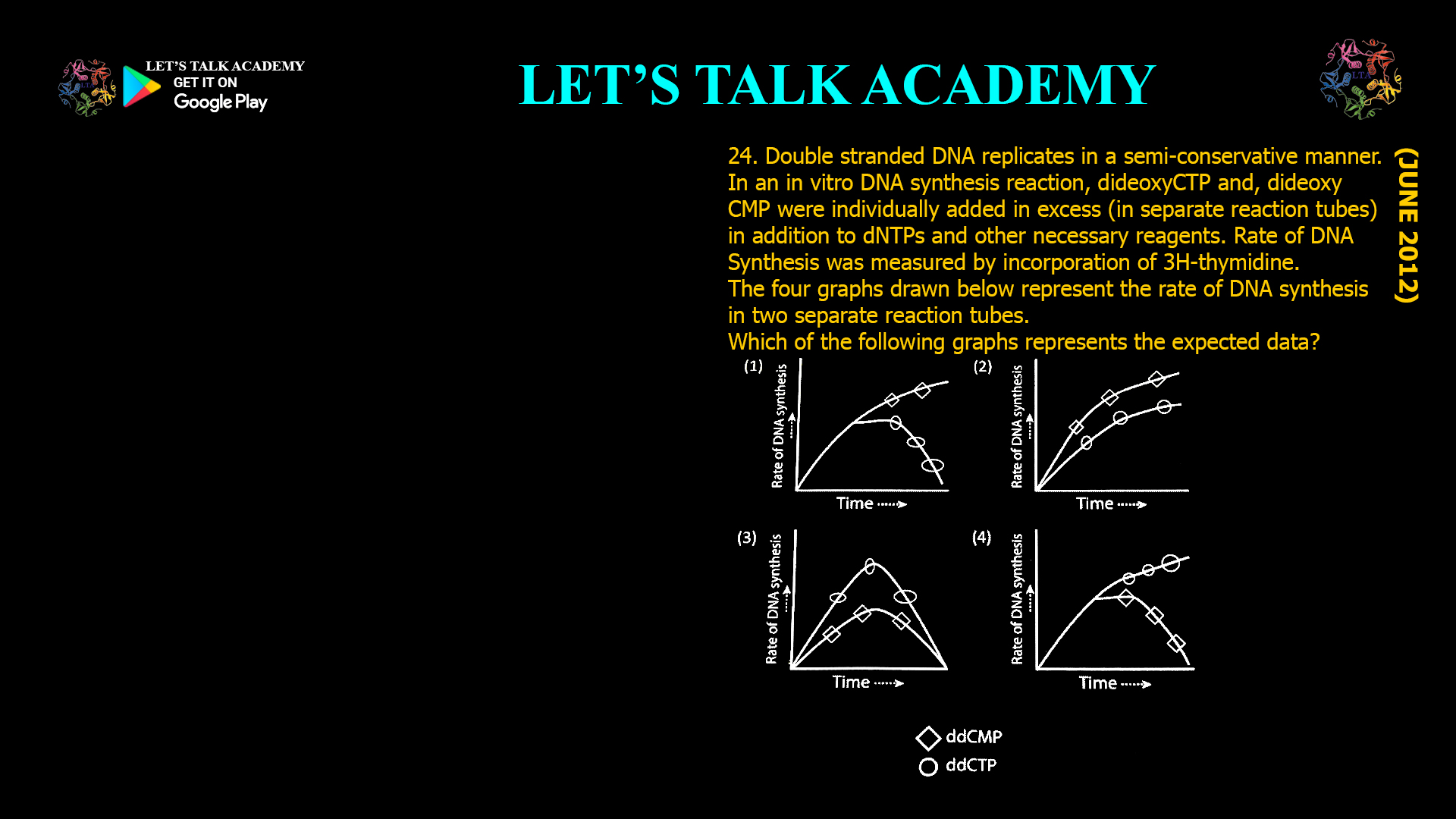
24. Double stranded DNA replicates in a semi-conservative manner. In an in vitro DNA synthesis reaction, dideoxyCTP and, dideoxy CMP were individually added in excess (in separate reaction tubes) in addition to dNTPs and other necessary reagents. Rate of DNA Synthesis was measured by incorporation of 3H-thymidine. The four graphs drawn below represent the rate of DNA synthesis in two separate reaction tubes. Which of the following graphs represents the expected data?

How Dideoxycytidine Triphosphate and Dideoxy CMP Affect DNA Synthesis Rate in In Vitro Reactions

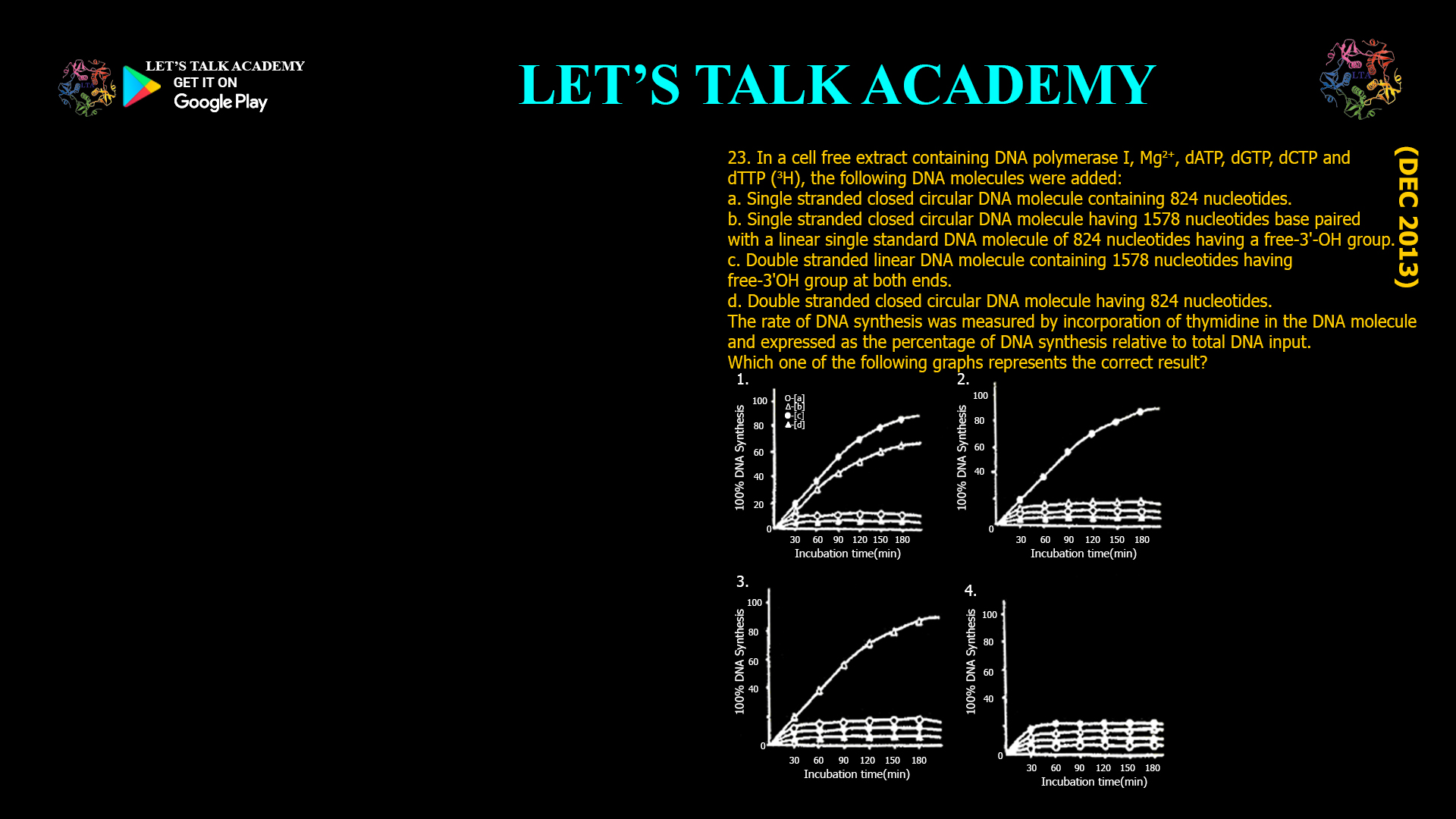
23. In a cell free extract containing DNA polymerase I, Mg2+, dATP, dGTP, dCTP and dTTP3H), the following DNA molecules were added: a. Single stranded closed circular DNA moleculecontaining 824 nucleotides. b. Single stranded closed circular DNA molecule having1578 nucleotides base paired with a linear singlestandard DNA molecule of 824 nucleotides having a free-3'-OH group. c. Double stranded linear DNA molecule containing 1578 nucleotides having free-3'OH group at both ends. d. Double stranded closed circular DNA molecule having 824 nucleotides. The rate of DNA synthesis was measured by incorporation of thymidine in the DNA molecule and expressed as the percentage of DNA synthesis relative to total DNA input. Which one of the following graphs represents the correct result?

 How DNA Polymerase I Synthesizes DNA on Different DNA Substrates: Single-Stranded, Nicked, Linear, and Circular Molecules

22. Which one of the following statements about DNA replication is INCORRECT? (1) Once DNA replication commences, it always continues uninterrupted until the entire process is complete. (2) Eukaryotic genomes replicate from multiple origins of replication. (3) A consensus sequence for the origins of DNA replication has been identified in Saccharomyces cerevisiae. (4) Both, fully methylated as well as non-methylated oriC can initiate DNA replication, while hemi-methylated oriC does not.

Which Statement About DNA Replication Is Incorrect? Insights into Replication Continuity, Origins, and Methylation

21. Which one of the following statements about DNA replication is INCORRECT? (1) During DNA replication, When adjacent bidirectional forks converge, the lagging strandwill meet the leading strand of the same template strand (2) Mispaired nucleotide at the 3'-OH end of the primer strand triggers the 3-5' exonucleolyticproof reading activity (3) In a replication bubble moving bidirectionally, the same parental DNA strand cannot serve as a template for both the lagging and leading strand synthesis (4) DNA replication involves a RNA-DNA chimeric molecule

Which Statement About DNA Replication Is Incorrect? Clarifying Leading and Lagging Strand Synthesis

20. Although ribonucleoside triphosphates (rNTPs) are present at approximately IO-fold higher concentration than deoxyribo-nucleoside triphosphates (dNTPs) in the cell but they are incorporated into DNA at a rate that is more than 1000-fold lower than dNTPs. This is because (1) DNA polymerase cannot discriminate between dNTPs and rNTPs. But as soon as rNTPs areincorporated in the DNA chain, they are hydrolyzed due to the presence of 2'-OH group. (2) DNA polymerase cannot dtscrirntnate between dNTPs and rNTPs. But IIS soon as rNTPs are incorporated in the DNA chain, they are excised by the proof reading activity of DNA polymerase. (3) DNA polymerase efficiently discrtrrunatee. Between rNTPs and dNTPs, because its nucleotide binding pocket cannot accommodate a 2'-OH on the incoming nucleotide. (4) DNA polymerase cannot discriminate between rNTPs and dNTPs. Since the rate of transcription jncell is 106 times faster than replication, it cannot compete with RNA polymerase for rNTPs.

Understanding DNA Polymerase’s Selectivity: Why rNTPs Are Incorporated Into DNA at Much Lower Rates Than dNTPs

19. In E. coli, though DNA polymerase I (POI l) plays an essential role in the replication process, it is not the major polymerase. Instead, the enzyme responsible for advancement of replication fork is POI Ill. From the four structures (A, B, C and D) given below, students made several interpretations about the shorter arm beingextended by POI I and/or POI III. Which one of the interpretation written below is correct? (1) A will be extended by POI Ill but not by Pol I. (2) Neither B nor C will be extended by either POl I or Pol III. (3) C will be extended by both Pol I and POl III. (4) D will be extended only by POl I, but not by POI III.

 Roles of DNA Polymerase I and DNA Polymerase III in Extending DNA Structures During E. coli Replication

18. Which one of the tollowtng statements made about the is INCORRECT (1) The rate of forward movement otDnaB helicase along the template DNA increases 10-fold when DnaBand DNA POI III interact, thus ensuring that the helicase does not move ahead rapidly without the polymerase. (2) The transient interaction of the primase with the helicase allows activation of primase activity by 1000- fold, promoting RNA primer synthesis. (3) The length of the Okazaki fragments is typically restricted to 1000-2000 nucleotides. (4) The E. coli ori C carries repeats of two sequence motifs: repeats of a 9-mer that collectively form the site at which the origin first becomes single-stranded, and repeats of a 13-mer to which the DnaA initiator protein binds.

Which Statement About Bacterial DNA Replication Is Incorrect? Insights into DNAB Helicase, Primase, Okazaki Fragments, and oriC Structure

17. The following statements were made about bacterialDNA gyrase, which introduces negative supercoiling inDNA. A. If gyrase activity is inhibited, there is an increase inreplication initiation at the origin. B. If gyrase activity is inhibited, there is a decrease inreplication initiation at the origin. C. Gyrases are usually ATP-dependent. D. When gyrase introduces negative supercoils, itdecreases, the linking number of a DNA loop by two. Which of the above statement(s) is/are NOT true? (1) C and D(2) only B (3) B and C(4) only A

Which Statements About Bacterial DNA Gyrase Are Not True? Understanding Gyrase Function and Its Role in DNA Replication

16. In semi-conservative mode of DNA replication twoparental strands unwind and are used for synthesis of new strands following the rule of complimentary base pairing. Synthesis of complimentary strands requirethat DNA synthesis proceeds in opposite direction,while the double helix is progressively unwinding andreplicating in only one direction.one of the DNA strands is continuously synthesised in the same direction as theadvancing replication fork and is called leading strandstrands is synthesized the otherwhereasdiscontinuously in segments and is referred to aslagging strands. These short fragments madediscontinuously are labelled as okazaki fragments.These okazaki fragments need to be matured intocontinuous DNA strand by which one of the followingcombination of enzymes? (1) DNA Pol III and DNA ligase (2) DNA pol I and DNA ligase (3) DNA pol II and DNA ligase (4) DNA gyrase and DNA ligase

How Okazaki Fragments Are Matured into Continuous DNA Strands: Role of DNA Polymerase I and DNA Ligase

14. The semi-conservative nature of DNA replication was established by Meselson and Stahl in their classic experiment with bacteria. They grew bacteria in N15-NH4Cl containing medium, washed and then incubated in fresh medium with N14- containing compounds and allowed to grow for three generations. CSCI density gradient centrifugation of isolated DNA established the nature of semiconservative DNA replication. The pictorial representation below shows the position of differentially labeled DNA in CSCI density gradient. Had the DNA replication been conservative, what would have been the pattern?

Predicting DNA Banding Patterns in CsCl Gradient if DNA Replication Were Conservative: A Meselson-Stahl Perspective

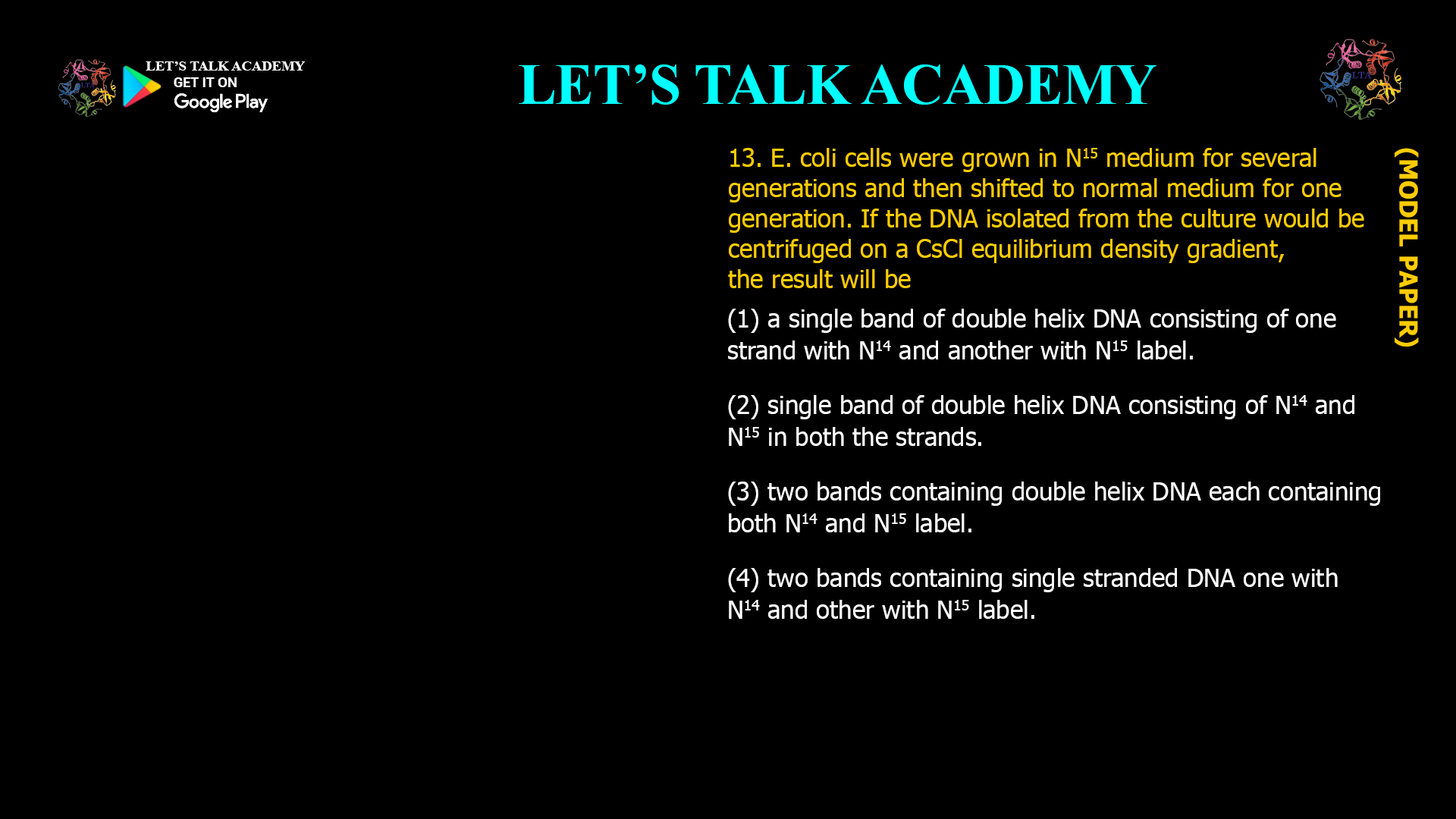
13. E. coli cells were grown in N15 medium for several generations and then shifted to normal medium for one generation. If the DNA isolated from the culture would be centrifuged on a CSCl equilibrium density gradient, the result will be (1) a single band of double helix DNA consisting of one strand with N14 and another with N15 label. (2) single band of double helix DNA consisting of N14and N15 in both the strands. (3) two bands containing double helix DNA each containing both N14 and N15 label. (4) two bands containing single stranded DNA one with N14 and other with N15 label.

DNA Banding Patterns in CsCl Density Gradient After E. coli Shift from N15 to N14 Medium

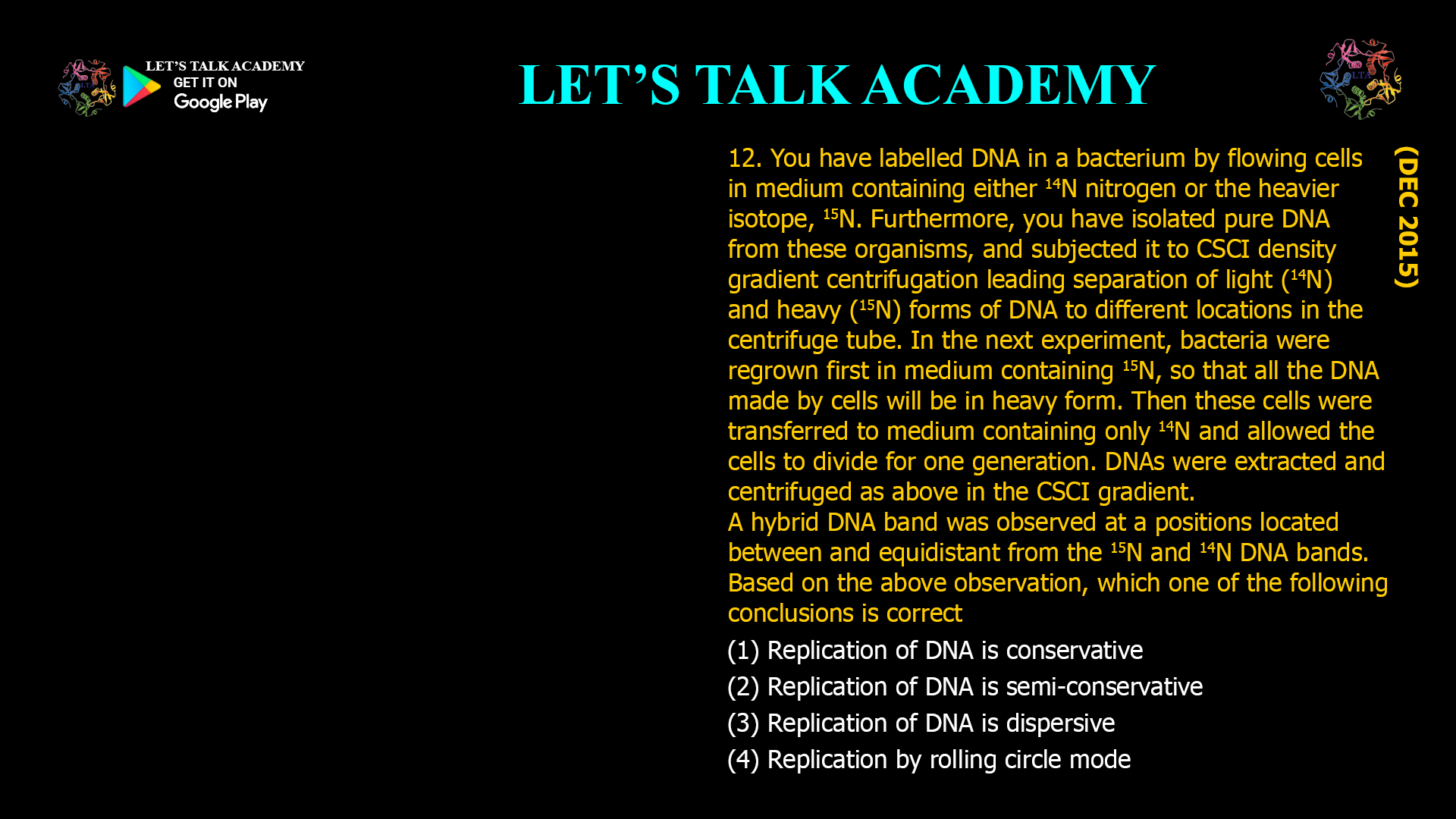
. You have labelled DNA in a bacterium by flowing cells in medium containing either 14N nitrogen or the heavier isotope, 15N. Furthermore, you have isolated pure DNA from these organisms, and subjected it to CSCI density gradient centrifugation leading separation of light (14N) and heavy (15N) forms of DNA to different locations in the centrifuge tube. In the next experiment, bacteria were regrown first in medium containing 15N, so that all the DNA made by cells will be in heavy form. Then these cells were transferred to medium containing only 14N and allowed the cells to divide for one generation. DNAs were extracted and centrifuged as above in the CSCI gradient. A hybrid DNA band was observed at a positions located between and equidistant from the 15N and 14N DNA bands. Based on the above observation, which one of the following conclusions is correct (1) Replication of DNA is conservative (2) Replication of DNA is semi-conservative (3) Replication of DNA is dispersive (4) Replication by rolling circle mode

How 15N/14N Density Gradient Experiment Demonstrates Semi-Conservative DNA Replication

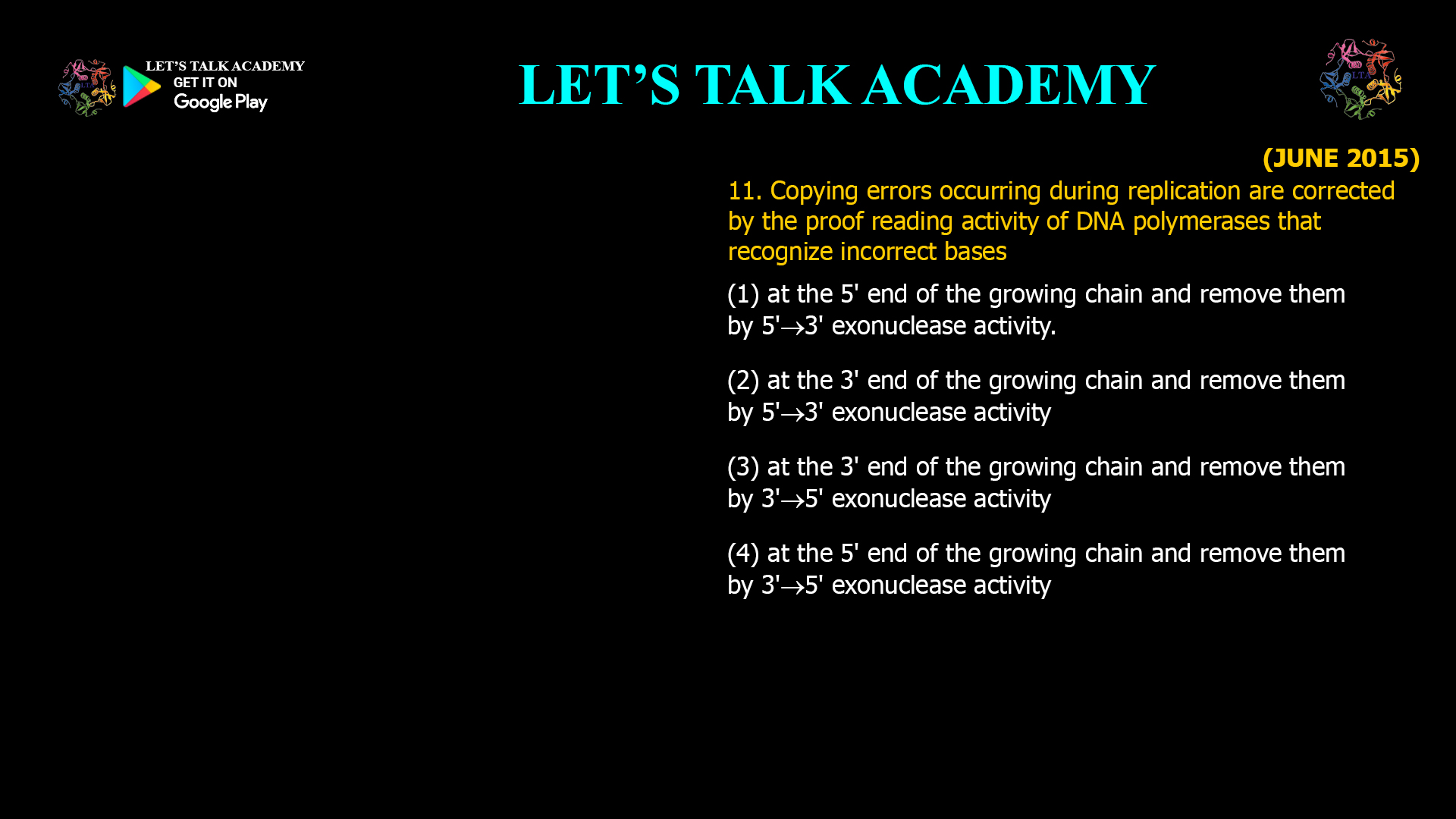
11. Copying errors occurring during replication are corrected by the proof reading activity of DNA polymerases that recognize incorrect bases (1) at the 5' end of the growing chain and remove them by 5'3'exonuclease activity. (2) at the 3' end of the growing chain and remove them by 5'3'exonuclease activity (3) at the 3' end of the growing chain and remove them by 3'5'exonuclease activity (4) at the 5' end of the growing chain and remove them by 3'5'exonuclease activity

How DNA Polymerases Correct Replication Errors Using 3′→5′ Exonuclease Proofreading Activity

10. In E. coli, the major DNA unwinding protein helicase, DnaBtranslocate in (1) 5'3' direction along the lagging strand template. (2) 3'5 'direction along the lagging strand template. (3) 5'3' direction along the leading strand template. (4) 3'5' direction along the leading strand template.

Direction of DnaB Helicase Translocation During E. coli DNA Replication

9. Which statement is correct regarding functioning of topoisomerase II? (1) Separate double stranded DNA (2) Act as primer (3) Renature the SS DNA (4) Attach to super coiled DNA and relax it

Functioning of Topoisomerase II: How It Relaxes Supercoiled DNA by Cutting Both Strands

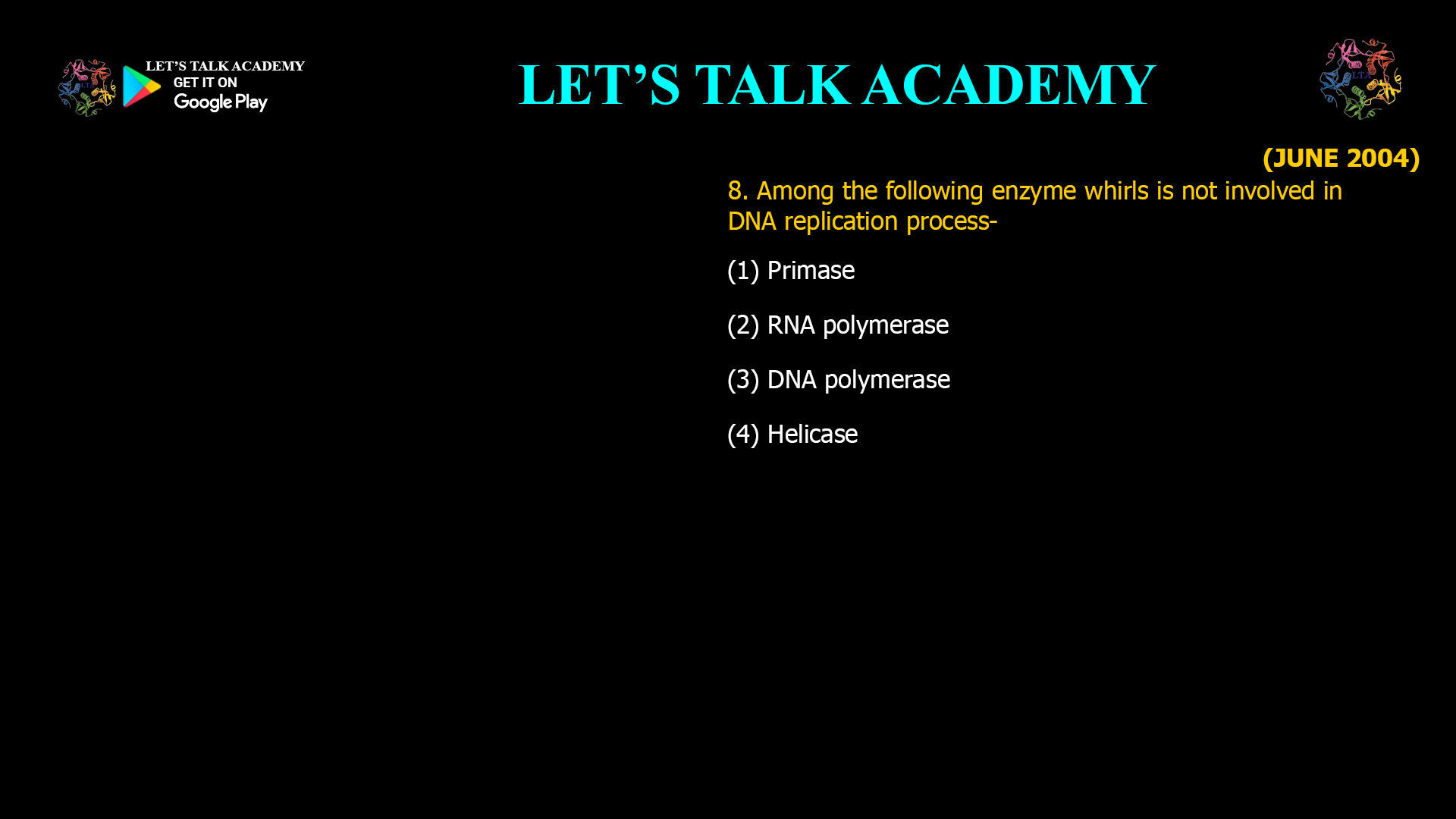
8. Among the following enzyme whirls is not involved in DNA replication process- (1) Primase (2) RNA polymerase (3) DNA polymerase (4) Helicase

Which Enzyme Is Not Involved in DNA Replication? Understanding the Roles of Primase, RNA Polymerase, DNA Polymerase, and Helicase

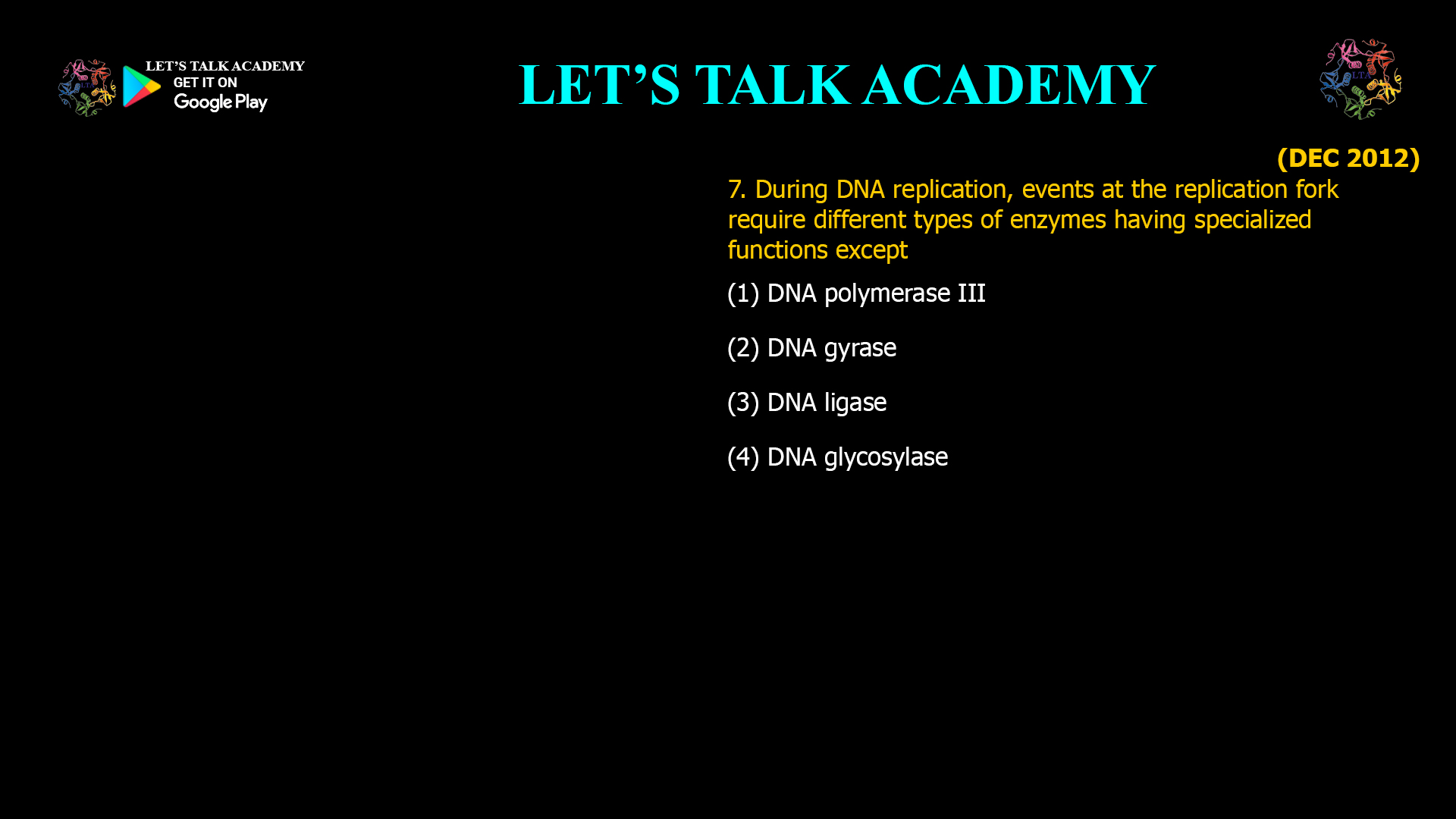
7. During DNA replication, events at the replication fork require different types of enzymes having specialized functions except (1) DNA polymerase III (2) DNA gyrase (3) DNA ligase (4) DNA glycosylase

Which Enzyme Is Not Directly Involved at the DNA Replication Fork?

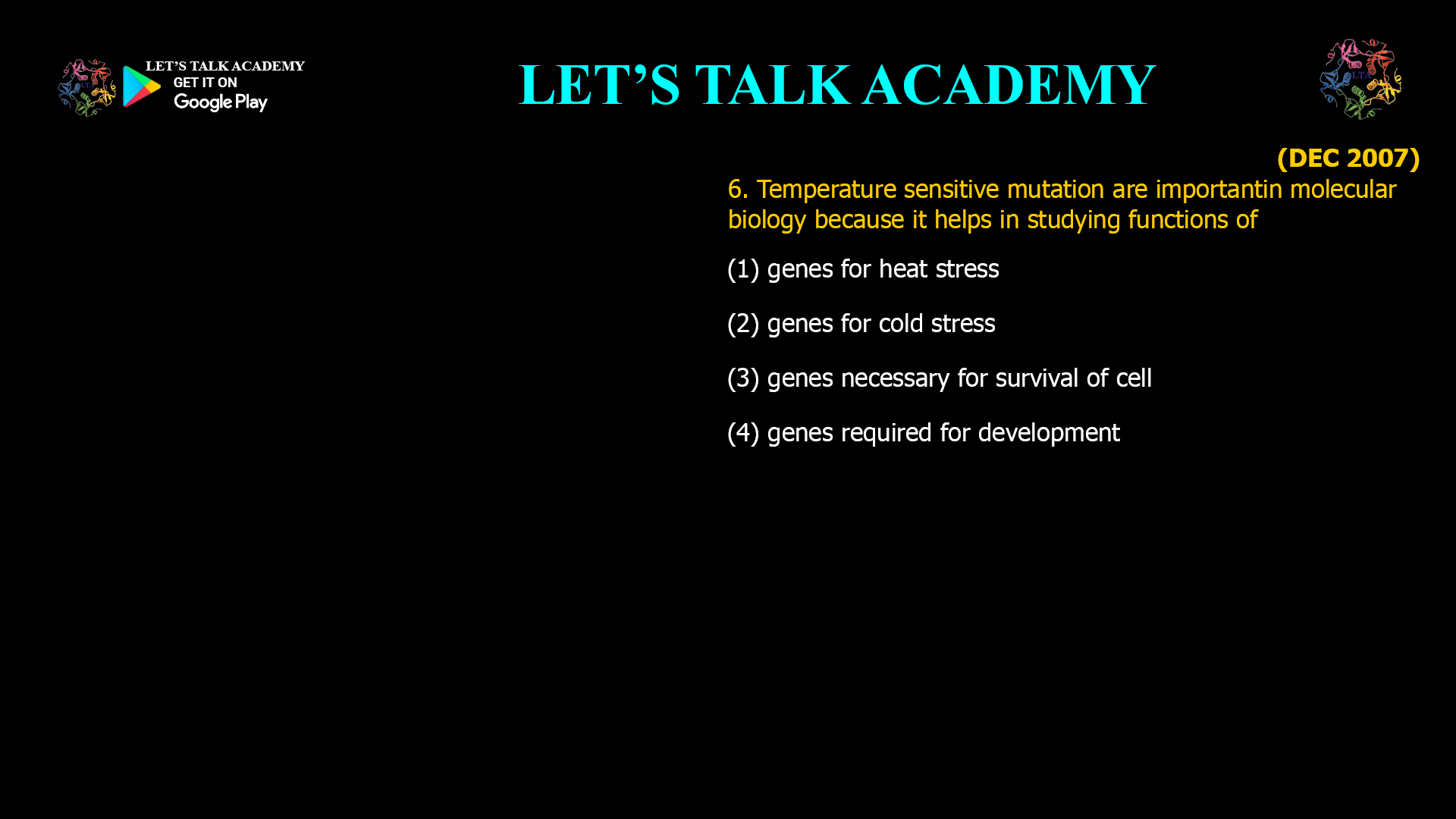
Title: Why Temperature-Sensitive Mutations Are Crucial for Studying Essential Genes in Molecular Biology Meta Description: Explore how temperature-sensitive mutations enable researchers to study genes essential for cell survival by controlling gene function under different temperature conditions, providing insights into vital cellular processes. Slug: temperature-sensitive-mutations-study-essential-genes Introduction Temperature-sensitive (TS) mutations are invaluable tools in molecular biology that allow scientists to study essential genes—those necessary for cell survival—without causing immediate lethality. By enabling conditional inactivation of gene function at non-permissive temperatures, TS mutations facilitate detailed analysis of gene roles in vital cellular processes. This article explains why TS mutations are particularly important for studying genes necessary for survival of the cell. What Are Temperature-Sensitive Mutations? TS mutations produce proteins that function normally at a permissive (lower) temperature but become nonfunctional or unstable at a restrictive (higher) temperature. This temperature-dependent behavior allows researchers to toggle gene function on or off by simply changing the incubation temperature. TS mutations often affect protein folding or stability, causing loss of function only under stress conditions (e.g., heat). Why Are TS Mutations Important for Studying Essential Genes? 1. Avoiding Lethality Many essential genes cannot be studied by traditional loss-of-function mutations because their inactivation kills the cell. TS mutations circumvent this by allowing normal gene function at permissive temperatures, enabling cell growth and viability. Researchers can then shift cells to restrictive temperatures to temporarily inactivate the gene, observing immediate effects on cellular processes. 2. Temporal Control TS mutants provide precise temporal control over gene activity. This is critical for studying dynamic processes like DNA replication, cell division, and protein synthesis, where timing is crucial. 3. Functional Dissection By observing phenotypes at restrictive temperatures, scientists can dissect the specific roles of essential proteins in various pathways. TS mutations help differentiate between structural and regulatory functions of proteins. 4. Reversibility Shifting back to permissive temperature can restore protein function, allowing reversible studies of gene activity and recovery. Applications of TS Mutations Studying DNA replication machinery components in yeast and bacteria. Dissecting cell cycle regulators and checkpoints. Investigating protein folding and stability mechanisms. Modeling disease-related mutations in essential genes. Why Other Mutation Types Are Less Suitable Mutation Type Limitations for Studying Essential Genes Gain of Function May cause non-physiological effects, lacks conditionality Loss of Function Often lethal if gene is essential, no temporal control Suppressor Mutation Indirect, depends on secondary mutations Conditional Mutation (TS) Allows controlled, reversible inactivation of essential genes Summary Table Feature Temperature-Sensitive Mutation Gene Function at Permissive Normal Gene Function at Restrictive Impaired or lost Study of Essential Genes Enabled via conditional inactivation Temporal Control Yes Reversibility Yes Conclusion Temperature-sensitive mutations are uniquely suited for studying genes necessary for the survival of the cell because they allow controlled, reversible inactivation of essential gene functions. This conditional approach enables detailed functional analysis without causing immediate lethality, making TS mutations indispensable in molecular biology research. Answer: Temperature-sensitive mutations are important because they help in studying (3) genes necessary for survival of cell.

Why Temperature-Sensitive Mutations Are Crucial for Studying Essential Genes in Molecular Biology

5. Which of the following mutation is most suitable for study of regulation important molecular phenomenon of cell like DNA replication? (1) Gain of function (2) Loss of function (3) Suppressor mutation (4) Conditional mutation

Why Conditional Mutations Are Most Suitable for Studying Regulation of DNA Replication and Other Molecular Phenomena

4. Which radioisotope isgenerally incorporated in thymine to studyDNA replication process? (1) 32p (2) 35S (3)3H (4) 14C

Which Radioisotope Is Used to Label Thymine in DNA Replication Studies?

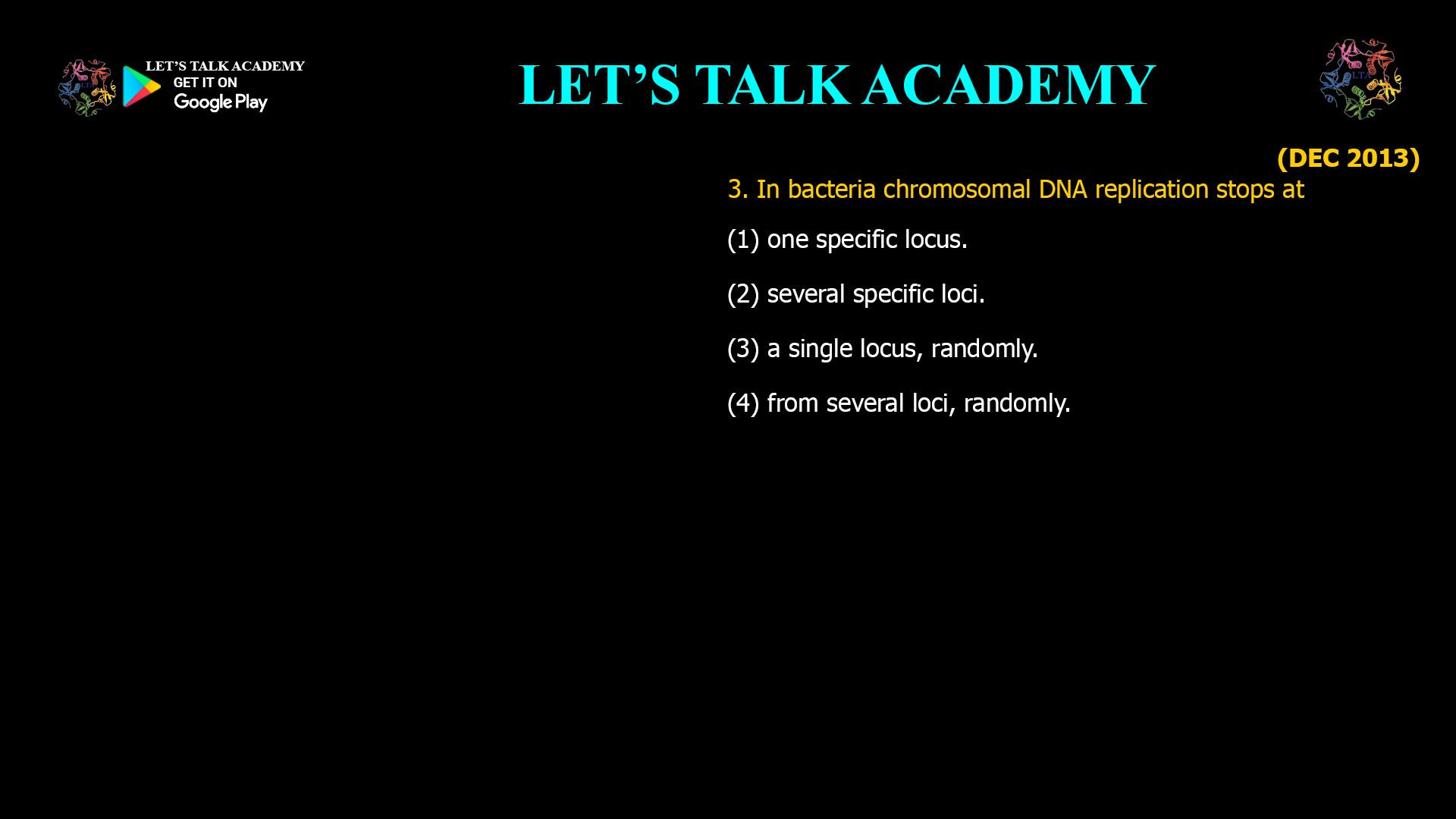
3. In bacteria chromosomal DNA replication stops at (1) one specific locus. (2) several specific loci. (3) a single locus, randomly. (4) from several loci, randomly.

Termination of Bacterial Chromosomal DNA Replication Occurs at Several Specific Loci

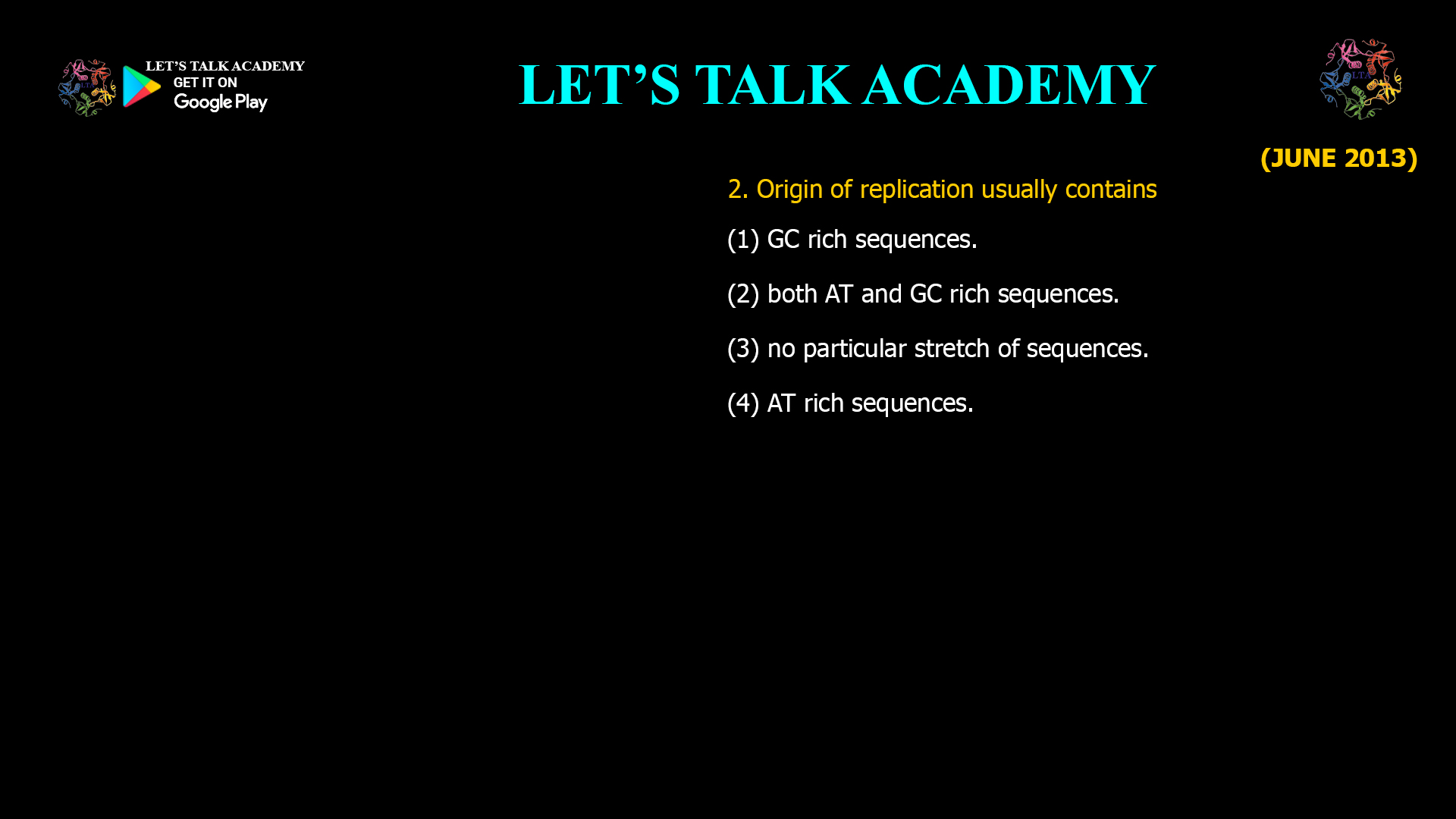
2. Origin of replication usually contains (1) GC rich sequences. (2) both AT and GC rich sequences. (3) no particular stretch of sequences. (4) AT rich sequences.

Why Origins of Replication Are Typically AT-Rich Sequences: Understanding DNA Replication Initiation

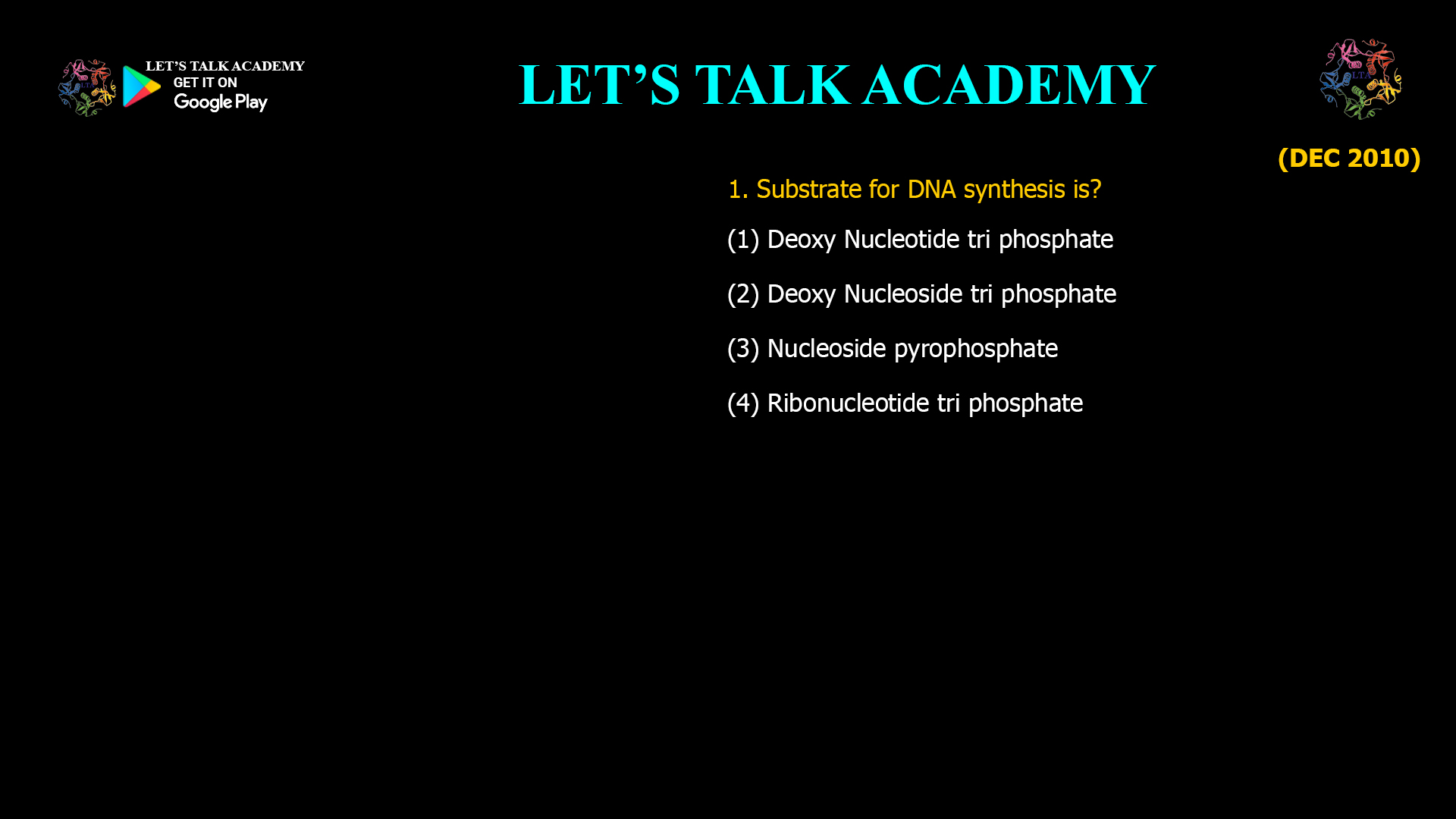
1. Substrate for DNA synthesis is? (1) Deoxy Nucleotide tri phosphate (2) Deoxy Nucleoside tri phosphate (3) Nucleoside pyrophosphate (4) Ribonucleotide tri phosphate

Substrate for DNA Synthesis: Why Deoxynucleoside Triphosphates (dNTPs) Are Essential

Latest Courses