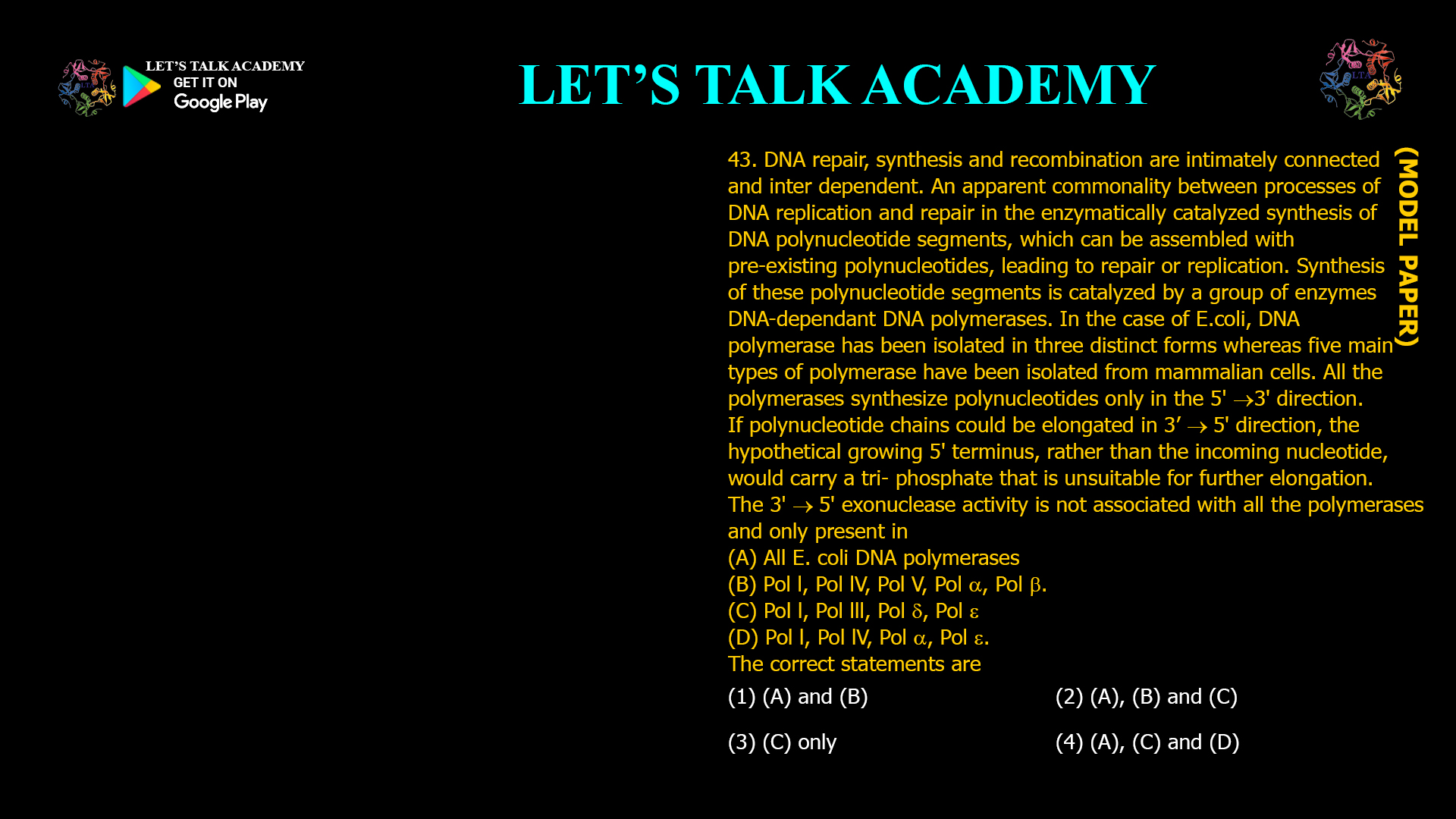
- DNA repair, synthesis and recombination are intimately connected and inter dependent. An apparent commonality between processes of DNA replication
and repair in the enzymatically catalyzed synthesis of DNA polynucleotide segments, which can be assembled with pre-existing polynucleotides, leading to repair or replication. Synthesis of these polynucleotide segments is catalyzed by a group of enzymes DNA-dependantDNA polymerases. In the case of E.coli, DNA polymerase has been isolated in three distinct forms whereas five
main types of polymerase have been isolated from mammalian cells. All the polymerases synthesize polynucleotides only in the 5’à3′ direction. If polynucleotide chains could be elongated in 3’à5′ direction, the hypothetical growing 5′ terminus, rather than the incoming nucleotide, would carry a tri- phosphate that is unsuitable for further elongation. The 3’à5′ exonuclease activity is not associated with all the polymerases and only present in
(A) All E. coli DNA polymerases
(B) Pol l, Pol IV, Pol V, Pol α, Polβ.
(C) Pol l, Pol III, Poi Ꟙ, Poi ϵ
(D) Pol l, Pol IV, POlα, Poi ϵ.
The correct statements are
(1) (A) and (B) (2) (A), (B) and (C)
(3) (C) only (4) (A), (C) and (D)
Introduction
DNA polymerases synthesize DNA in the 5′→3′ direction but many also possess a 3′→5′ exonuclease activity that serves as a proofreading function, removing incorrectly incorporated nucleotides to ensure high fidelity during replication. This exonuclease activity is not universal to all polymerases but is present in specific types critical for accurate DNA synthesis.
DNA Polymerases in E. coli
-
E. coli has three main DNA polymerases: Pol I, Pol II, and Pol III.
-
Pol I: Possesses both 5′→3′ exonuclease (for primer removal) and 3′→5′ exonuclease (proofreading) activities.
-
Pol II: Has 3′→5′ exonuclease proofreading activity.
-
Pol III: The primary replicative polymerase, also has 3′→5′ exonuclease activity for proofreading.
Thus, all three E. coli DNA polymerases (I, II, III) have 3′→5′ exonuclease activity.
DNA Polymerases in Mammalian Cells
Mammalian cells have at least five main DNA polymerases involved in replication and repair:
-
Pol α (alpha): Initiates DNA synthesis; lacks 3′→5′ exonuclease proofreading activity.
-
Pol β (beta): Involved in base excision repair; lacks 3′→5′ exonuclease activity.
-
Pol γ (gamma): Mitochondrial polymerase; has 3′→5′ exonuclease activity.
-
Pol δ (delta): Main lagging strand polymerase; possesses 3′→5′ exonuclease proofreading activity.
-
Pol ε (epsilon): Main leading strand polymerase; has 3′→5′ exonuclease proofreading activity.
Evaluating the Given Options
| Option | Description | Correctness |
|---|---|---|
| (A) | All E. coli DNA polymerases have 3′→5′ exonuclease activity | True |
| (B) | Pol I, Pol IV, Pol V, Pol α, Pol β have 3′→5′ exonuclease activity | False; Pol IV and V lack proofreading; Pol α and β lack 3′→5′ exonuclease |
| (C) | Pol I, Pol III, Pol γ, Pol ε have 3′→5′ exonuclease activity | True; these polymerases have proofreading activity |
| (D) | Pol I, Pol IV, Pol α, Pol ε have 3′→5′ exonuclease activity | False; Pol IV and α lack 3′→5′ exonuclease |
Correct Statements
-
(A) All E. coli DNA polymerases have 3′→5′ exonuclease activity
-
(C) Pol I, Pol III, Pol γ, Pol ε have 3′→5′ exonuclease activity
Final Answer
(4) (A), (C), and (D) is not fully correct because (D) is false.
(3) (C) only is partly correct but ignores E. coli polymerases.
(2) (A), (B), and (C) is incorrect because (B) is false.
(1) (A) and (B) is incorrect because (B) is false.
The best fit based on the data is:
(4) (A), (C), and (D) — but since (D) is false, the correct choice is:
(3) (C) only
Summary
-
All E. coli DNA polymerases (I, II, III) have 3′→5′ exonuclease proofreading activity.
-
In mammals, Pol I, Pol III (mitochondrial Pol γ), and Pol ε have 3′→5′ exonuclease activity.
-
Pol IV, Pol V (in E. coli), Pol α, and Pol β (in mammals) lack 3′→5′ exonuclease activity.


17 Comments
Manisha choudhary
July 29, 2025Done sir 👍🏻😀
Surbhi Rajawat
July 29, 2025The most appropriate answer is 3rd. Though POL 1, 2, 3 all have proof reading activity
Priya Khandal
July 29, 2025She is correct answer because Proofe readind activity Polymers first second and third ke pass hi hoti hai
Priti Khandal
July 29, 2025Answer c is right because proof reading activity polymerase 1 2 3 ke pass present hoti hm
Pratibha
July 30, 2025Correct option is option (C)
Pol. I, II , III have proof reading activity
Pol. Gamma , epsilon, delte also gave a proofreading activity
shruti sharma
July 30, 2025CORRECT IS C
Aafreen
July 31, 2025Ans-3 polymerase 1,2,3 have proof reading activity
Soniya Shekhawat
July 31, 2025Among these option C is more correct option bcz in prokaryotes in which DNA polymerase 1,2,3 have proofreading activity and in eukaryotes is present in DNA polymerase delta and eplison hence C is most correct option.
Santosh Saini
July 31, 2025Option C is correct ( in prokaryotes pol. 1 , 2 and 3rd has proofreading activity)
Khushi Vaishnav
July 31, 2025Option C is correct
Kajal
July 31, 2025Both A and C is right
Diksha Chhipa
July 31, 2025E. coli have 3 dna pol which is all 3 have 3 to 5 prime exonuclease activity while mammalian cell have 5 dna pol which is dna poly alpha and beta lack this activity but gamma delta and episilone have this activity
Dipti Sharma
August 1, 2025Correct answer is 3
Dp
August 1, 2025Dna polymerase 1.2.3and pol.gamma & epsilon have 3′ to 5′ proofreading activity
Dp
August 1, 2025Dna polymerase 1.2.3and pol.gamma & epsilon have 3′ to 5′ proofreading activity
Varsha Tatla
August 3, 2025In ecoli. Pol 1 2 3 have proofreading activity whereas in Ekes only pol delta n pol£ have this activity
Deepika Sheoran
November 6, 2025Polymerase 1 st 2nd 3 rd have proof reading activity.polymerase gamma , epsilon,delta also gave a proof reading activity.