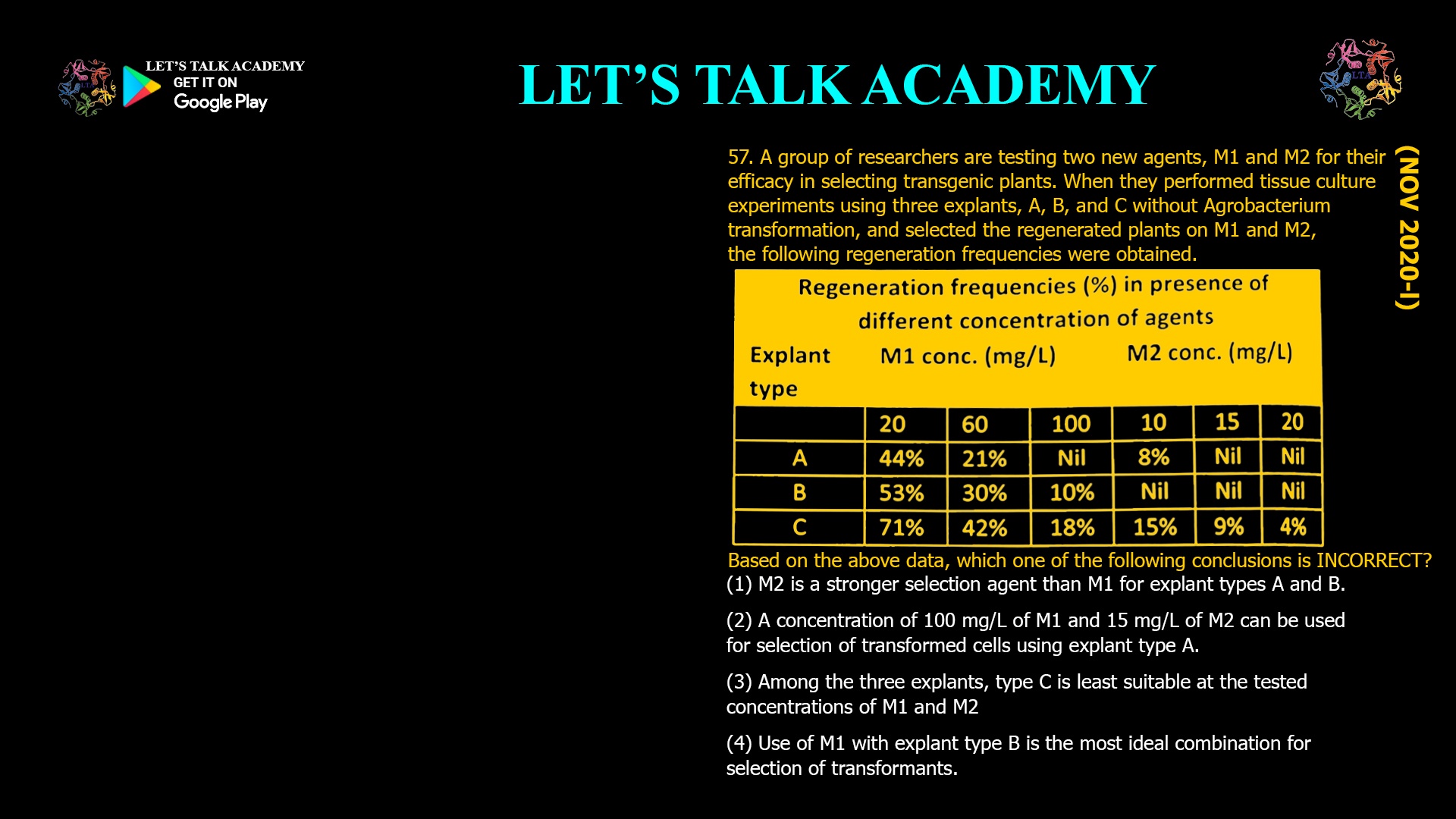
57. A group of researchers are testing two new agents, M1 and M2 for their efficacy in selecting transgenic plants. When they performed tissue culture experiments using three explants, A, B, and C without Agrobacterium transformation, and selected the regenerated plants on M1 and M2, the following regeneration frequencies were obtained. Based on the above data, which one of the following conclusions is INCORRECT? (1) M2 is a stronger selection agent than M1 for explant types A and B. (2) A concentration of 100 mg/L of M1 and 15 mg/L of M2 can be used for selection of transformed cells using explant type A. (3) Among the three explants, type C is least suitable at the tested concentrations of M1 and M2 (4) Use of M1 with explant type B is the most ideal combination for selection of transformants.

Interpreting selection-agent efficacy and explant suitability from regeneration data

56. RNA silencing is an important strategy to control viral infection in plants. The following statements were made regarding RNA silencing. A. It is driven by small interfering RNA (SiRNA) derived from double-stranded form of viral RNA. B. siRNA requires RISC for it function. C. Many plant viruses encode proteins that act as suppressors of RNA silencing. D. Viral P19 protein activates RNA induced silencing complex Which one of the following combination of statements is correct? (1) A, B and C (2) B, C and D (3) A, C and D (4) A, B and D

How RNA silencing controls plant viruses and the role of P19

55. In an attempt to increase the yield of a commercially important enzyme from natural isolate several strategies were adopted as follows: (A) Genome was selectively modified to increase yield. (B) Reappraisal of culture requirements of the modified organism to increase yield. (C) Induced mutants were screened and selected for organism synthesizing improved levels of the enzyme. (D) Organism was genetically modified, so that it produces a factor that enhances stability of the enzyme. Which one of the following options represents strategies that are appropriate for the purpose? (1) A, B, C and D (2) B and C only (3) A, C and D only (4) A and B only

Strategies to increase yield of a commercially important enzyme from a natural isolate

54. The figure below depicts a hypothetical scheme for synthesizing a target product in plants. A, B, and C are the precursors of a target product D, whereas E is a by-product. The key enzymes of the pathway are indicated as E1—E6. To enhance the levels of target product D, following strategies were tested: (A) Enhancing the activity of the enzyme E5 by over- expression and/or protein engineering. (B) Enhancing the activity of the enzyme E4 by over- expression and/or protein engineering. (C) Enhancing the levels of C. (D) Blocking the activity of E6 by RNA-interference or CRISPR/Cas-mediated knockout. Which of the above mentioned strategies are likely to provide the maximum enhancement of the target product compared to the by-product, if no feedback regulation exists for any of the enzymes in the pathway? (1) A and B (2) B and C (3) C and D (4) A and D

Metabolic engineering strategies to maximize target product over by‑product

53. Engineering of metabolic pathways in plants can be achieved by introduction and overexpression of appropriate candidate gene(s) using transgenic technology. The figure given below represents a biochemical pathway in plants where a precursor molecule 'A' is converted in to products 'T' and 'X' through a series of enzymatic reactions. Enzymes 1-5 are involved in this pathway. Scientists attempted to increase the levels of 'X' by introducing additional copy of the gene for enzyme '5' under transcriptional control of a strong constitutive promoter. However, the developed transgenic plants did not display a proportionate increase in the level of 'X'. The following statements were proposed for explaining the above results: (A) Enzyme '4' has greater affinity for D than enzyme '3' (B) Feedback inhibition of enzyme '5' by compound X (C) Substrate limitation for enzyme '5' Which of the above statement could represent probable reasons for NOT obtaining proportionate increase in the amount of 'X' in the transgenic plants? (1) Only C (2) Only A and B (3) Only A (4) A, B and C

Why does overexpressing a pathway enzyme not give proportional product increase?

52. Given below are a few statements on technologies/concepts related to development of transgenic plants: A. Frequency of genetic transformation is influenced only by the genes of Agrobacterium and not by those of the host plants. B. Transgenic plants containing a single copy of the transgene are preferred over those that contain multiple transgene copies for subsequent genetic analysis. C. Super virulent strains of Agrobacterium can be generated by increasing the copy number of virulence genes. D. A non conditional negative selection marker has to be necessarily used with a strong constitutive promoter for the development of transgenic plants. Which one of the following options represents a combination of all INCORRECT statements? (1) A and D only (2) C only (3) B and C only (4) D only

Identifying incorrect statements about transgenic plant development

51. Following statements were given regarding factors influencing variation in expression levels of transgene in transgenic plants: A. Difference in restriction enzyme sites within the T- DNA. B. Difference in copy number of the transgene. C. Variations in site of integration of the T- DNA within the plant genome. D. Presence of multiple promoters within the T-DNA region. Which one of the following options represents a combinations of statements that would NOT lead to variations in transgene expression levels in transgenic plants generated using the same T-DNA/ binary vector? (1) A and C only (2) B only (3) C and D only (4) A and D only

Which factors do not change transgene expression when using the same T‑DNA vector?

50. An experiment was performed to introduce a transgenic trait in a crop plant by Agrobacterium - mediated transformation using a transgene construct in which the transgene was expressed using the CaMV 355 promoter. It was observed that expression levels of the transgenic protein were very low in all transgenic plants while transgene mRNA levels were high and variable among different plants. Further, different transgenic lines contained different numbers of the T- DNA insert. The following statements were made to explain the above observation: (A) Variations in the number of T-DNA inserts in different transgenic plants is due to more number of host cells getting infected with the T- DNA (A) Low expression levels of the transgenic protein in all transgenic plants could be due to codon usage variations between the host plant and the heterologous source of the transgene (B) The coding sequence of the transgene contained sequences that destabilized the transgene mRNA (C) Variation in copy number of T-DNA in different transgenic plants is due to variation in the promoter used to express the transgene. Which one of the following options represents all correct statements? (1) A only (2) B and C (3) A and D (4) B only

Why can a CaMV 35S-driven transgene show high mRNA but low protein?

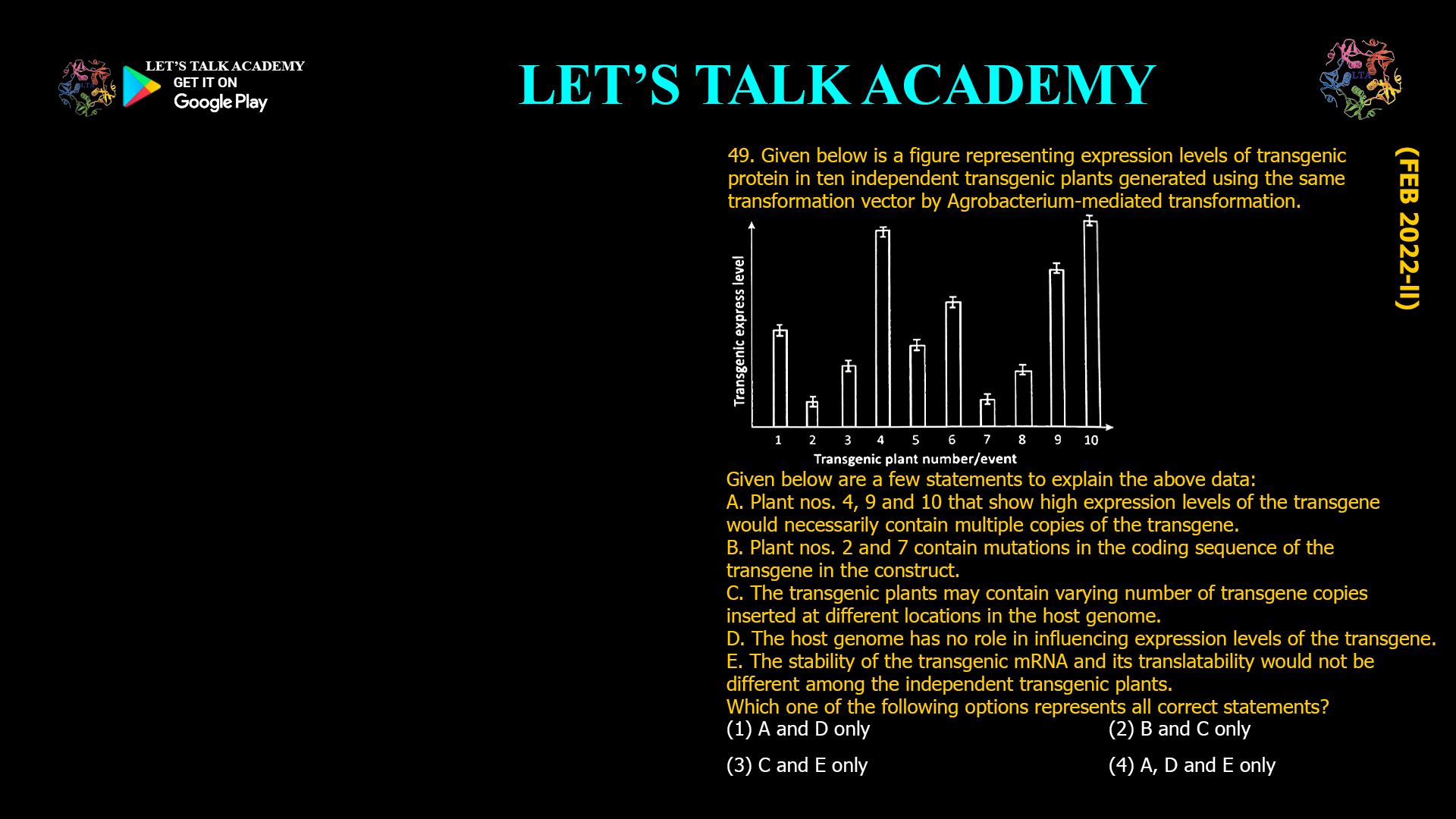
49. Given below is a figure representing expression levels of transgenic protein in ten independent transgenic plants generated using the same transformation vector by Agrobacterium-mediated transformation. Given below are a few statements to explain the above data: A. Plant nos. 4, 9 and 10 that show high expression levels of the transgene would necessarily contain multiple copies of the transgene. B. Plant nos. 2 and 7 contain mutations in the coding sequence of the transgene in the construct. C. The transgenic plants may contain varying number of transgene copies inserted at different locations in the host genome. D. The host genome has no role in influencing expression levels of the transgene. E. The stability of the transgenic mRNA and its translatability would not be different among the independent transgenic plants. Which one of the following options represents all correct statements? (1) A and D only (2) B and C only (3) C and E only (4) A, D and E only

Why do independent transgenic events show different expression levels?

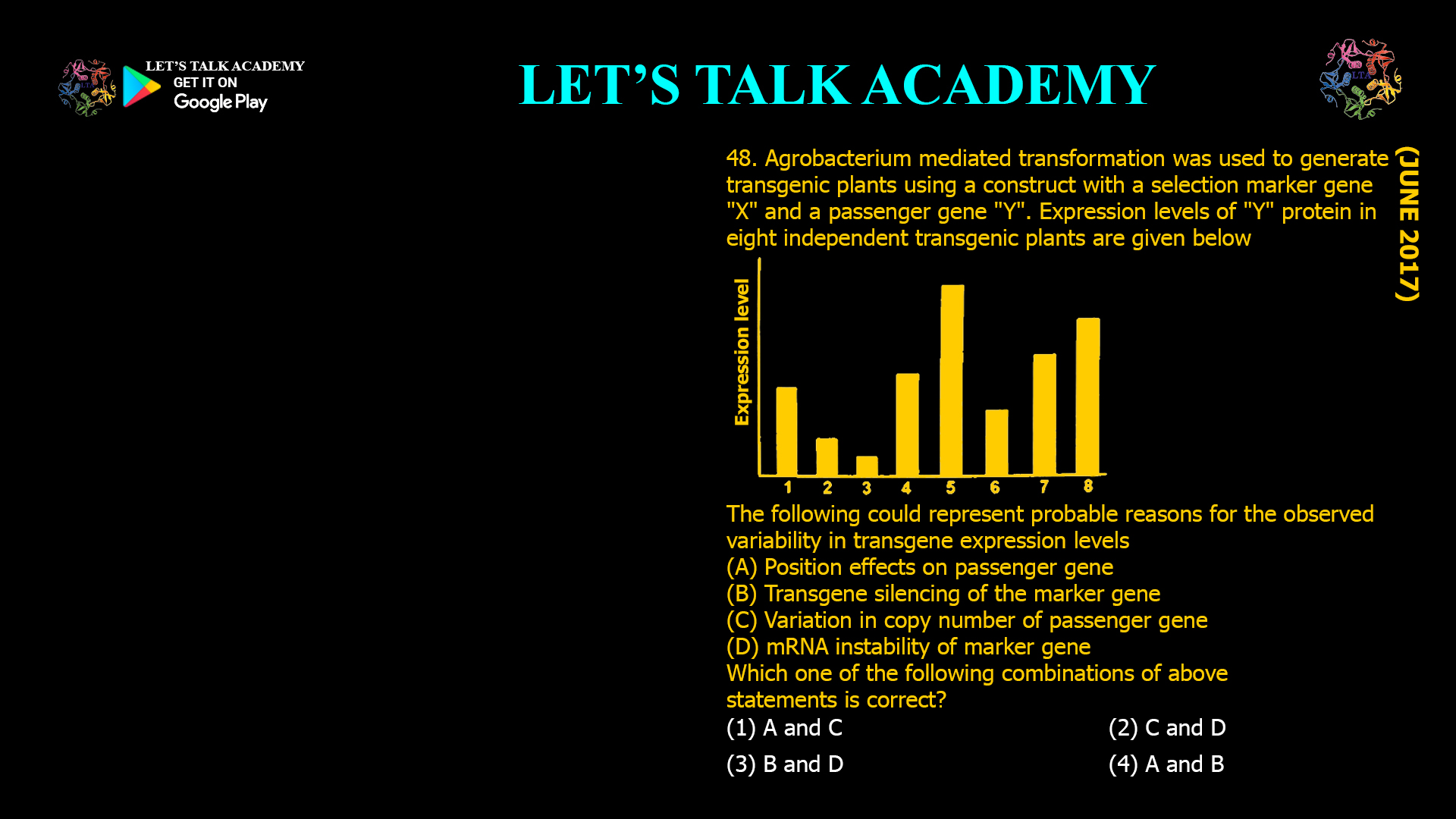
48. Agrobacterium mediated transformation was used to generate transgenic plants using a construct with a selection marker gene "X" and a passenger gene "Y". Expression levels of "Y" protein in eight independent transgenic plants are given below The following could represent probable reasons for the observed variability in transgene expression levels (A) Position effects on passenger gene (B) Transgene silencing of the marker gene (C) Variation in copy number of passenger gene (D) mRNA instability of marker gene Which one of the following combinations of above statements is correct? (1) A and C (2) C and D (3) B and D (4) A and B

Why do independent transgenic plants show variable transgene expression?

47. For the generation of transgenic plant in crop improvement, one important regulatory gene 'X' was overexpressed in a crop plant. Out of 30 transgenic rice plants generated, 22 showed high levels of gene 'X' expression. However, rest 8 lines displayed low level of expression. One explanation of such observation may be: (1) Suppression effect of the transgene (2) Knock down effect of gene X (3) Gene silencing effect (4) Co-suppression effect of transgene

Why some overexpression lines show low expression of gene X in transgenic rice

46. Which of the following genes was engineered in the "Flavr Savr" transgenic tomato variety? (1) 1-Amino cyclopropane-1-carboxylic acid synthase. (2) 1-Amino cyclopropane-1-carboxylic acid oxidase. (3) Expansin (4) Polygalacturonase.

Which gene was engineered in the Flavr Savr tomato?

45. Which of the following transgenic crops have been approved for commercial cultivation in India? (1) Cotton (2) Brinjal (3) Cotton and Brinjal (4) Cotton, Brassica, Brinjal

Approved transgenic crop for commercial cultivation in India

44. Neomycin phospho-transferase gene, frequently used as a selection marker during plant transformation, inactivates which one of the following antibiotics? (1) Hygromycin (2) Ampicillin (3) Streptomycin (4) Kanamycin 44. Neomycin phospho-transferase gene, frequently used as a selection marker during plant transformation, inactivates which one of the following antibiotics? (1) Hygromycin (2) Ampicillin (3) Streptomycin (4) Kanamycin

Neomycin phosphotransferase (NPT II) as a selectable marker in plant transformation

43. The following genes have been genetically engineered to develop herbicide resistance in plants: A. Resistance to glyphosate using the 5-enolpyruyl shikimate-3-phosphate synthase gene B. Bialaphos resistance using the bar gene C. Sulfonyl urea resistance using the acetolactate synthase D. Atrazine resistance using the glutathione S- transferase gene. In which of the above two cases the mechanism is based on abolition of herbicide binding to the enzyme? (1) A and D (2) B and C (3) C and D (4) A and C

Which herbicide-resistance genes work by preventing herbicide binding to the target enzyme?

42. Which genes have been introduced in Bollgard II cotton to get resistance against cotton bollworm, tobacco bollworm and pink bollworm? (1) cry 1Ab + cry 1Ac (2) cry 1Ac + cry 2 Ab (3) cry 1Ab + cry 2 Ab (4) cry9 C cry 1Ab

Which Bt genes are used in Bollgard II cotton?

41. Which of the following features is NOT shown by glyphosate, a broad spectrum herbicide? (1) Little residual soil activity (2) Ready translocation in phloem (3) Inhibition of a chloroplast enzyme catalyzing the synthesis of aromatic amino acids (4) Inhibition of early steps in the biosynthesis of branched chain amino acids

Key features and mode of action of glyphosate herbicide

40. Which one of the following is the most appropriate definition of 'Gene Pyramiding' in plants? (1) Introducing different genes for resistance to a specific pest in different genotypes. (2) Introducing a single gene for resistance to a particular pest in different genotypes. (3) Introducing different genes for resistance to a single pest in a single genotype. (4) Introducing a single gene for resistance to multiple pests in different genotypes

What is gene pyramiding in plant breeding?

39. Which of the following methods of plant transformation can be used to introduce a gene into chloroplast genome? (1) Agrobacterium-mediated transformation (2) Particle delivery system (3) Permeabilization (4) Electroporation

Which method is used to introduce genes into the chloroplast genome?

38. Which of the following GM crops is the most widely cultivated globally? (1) Herbicide resistant soybean. (2) Insect resistant cotton. (3) Insect resistant brinjal. (4) delayed ripening tomato

Most widely cultivated GM crop worldwide

37. World wide maximum cultivated transgenic crop is? (1) Insect resistance cotton (2) Herbicide resistance soybeans (3) Growing plant for desired molecules (4) Edible vaccines

Most widely cultivated transgenic crop in the world

36. Which selectable marker gene is routinely used for selection of transgenic plant? (1) Amphicillin (2) Tetracyclin (3) Hygromycin (4) Carbenicillin

Which selectable marker gene is routinely used in plant transformation?

35. Polygalacatourinidase (PG) antisense RNA is used in reference to which phenomenon (1) Seed setting (2) Herbicide resistance (3) Viral resistance (4) Fruit Ripening

Polygalacturonase antisense RNA and its role in fruit ripening

34. In Agrobacterium mediated transformation, which one of the following approaches is more likely to generate transgenic plants with IMCOMPLETE transfer of the passenger gene? (1) Placement of selection marker gene towards left border and passenger gene towards right border of T-DNA (2) Expression of selection marker gene under constitutive promoter and passenger gene under tissue-specific promoter (3) Placement of passenger gene towards left border and marker gene towards right border of T-DNA (4) Expression of both selection marker gene and passenger gene under constitutive promoters.

How T-DNA border position affects incomplete transfer of passenger genes

33. Which one of the following types of promoters would NOT be used within the T-DNA for expression of a negative selection marker gene for generation of transgenic plants by Agrobacterium-mediated transformation? (1) strong constitutive promoter (2) tissue-specific promoter (3) substrate-inducible promoter (4) stress-inducible promoter

Promoter choice and T-DNA behavior in Agrobacterium-mediated transformation

32. "In Agrobacterium-mediated transformation of a plant using a binary vector construct," Complete the above statement with the correct option. (1) All transgenic plants generated would show similar levels of transgenic expression" (2) The Agrobacterium cells lose the binary vector after the transfer of T-DNA" (3) Some transgenic plants generated may contain partial or truncated versions of the T-DNA". (4) Proteins of the host plant do not play any role"

Outcomes of Agrobacterium-mediated transformation using binary vectors

30. Following are some statements about Agrobacterium — plant interactions (A) Agrobacterium transfers a part of its chromosome into plant cell. (B) Agrobacterium transfers a part of one of its plasmid DNA into plant cell. (C) All the virulence genes of Agrobacterium are inducible. (D) All the virulence genes product of Agrobacterium are functional only inside the bacterial cells. (E) Some of the virulence genes of Agrobacterium are inducible. (F) Some of the virulence genes products of Agrobacterium are functional both in bacterial and plant cells. Which of the following combination of statements is true? (1) (A), (C) and (D) (2) (B), (D) and (E) (3) (C), (D) and (E) (4) (B), (E) and (F)

True statements about Agrobacterium–plant interaction

29. A transposon carrying a promoterless ß-galactosidase (lac Z) was used to create insertional mutation in the vir region of Ti-plasmid of Agrobacterium tumefaciens. All the mutants in which lac Z fusion was in frame were divided into the following three groups: A. The virulence of the bacteria was completely lost and the lac Z was induced by acetosyringone. B. The virulence of the bacteria was reduced and the lac Z was induced by acetosyringone. C. The virulence of the bacteria was completely lost and lac Z was not induced by acetosyringone. Which of the following assumptions are valid about these mutants? (1) In group A, the insertion could be in vir B, or D; in group B the insertion could be in virC orE; and in group C the insertion could be in virA or G. (2) In group A, the insertion could be in virA, B, C or D; in group B, the insertion could be in either virC or D; and in group C the insertion could be in virG. (3) In group A, the insertion could be in virA; in group B, the insertion could be in vir B; and in group C, the insertion could be in vir C. (4) In group A, the insertion could be in virG; in group B, the insertion could be in virB, D and E; in group C, the insertion could be in virA.

Interpreting vir mutants using lacZ fusions in Agrobacterium

28. Which of the following statement is NOT true during infection of plant cell by Agrobacterium? (1) The protein products of virulence genes Vir A and VirG perceives acetosyringone (2) The VirB protein forms a connection between Agrobacterium and the plant cell and facilitates T- DNA transfer into the plant (3) The T-DNA is excised and bound to VirD2 protein (4) The T-DNA, after becoming coated with VirF binds to phosphorylated VIP1, which allows the complex to enter the plant's nucleus

Identifying the incorrect step in Agrobacterium infection of plant cells

27. To increase the shelf-life of tomato, which of the following genes should be silenced? (1) ACC synthase (2) EPSP synthase (3) PEP carboxylase (4) ABC transporter

Which gene should be silenced to increase tomato shelf‑life?

26. Agrobacterium Ti plasmid vectors are used to generate transgenic plants. The following are examples of vir gene encoded proteins that are important for transfer of T-DNA in to plants. A- vir E, single stranded DNA binding protein B- virD2 that generates T-strands C- vir A that sense plant phenolic compounds D- vir F which directs T complex proteins for destruction in proteasome Which one of the following combination of the proteins functions inside the plant cell? (1) Only A and C (2) A, B and C (3) only B and C (4) A, B and D

Which Agrobacterium Vir proteins act inside plant cells?

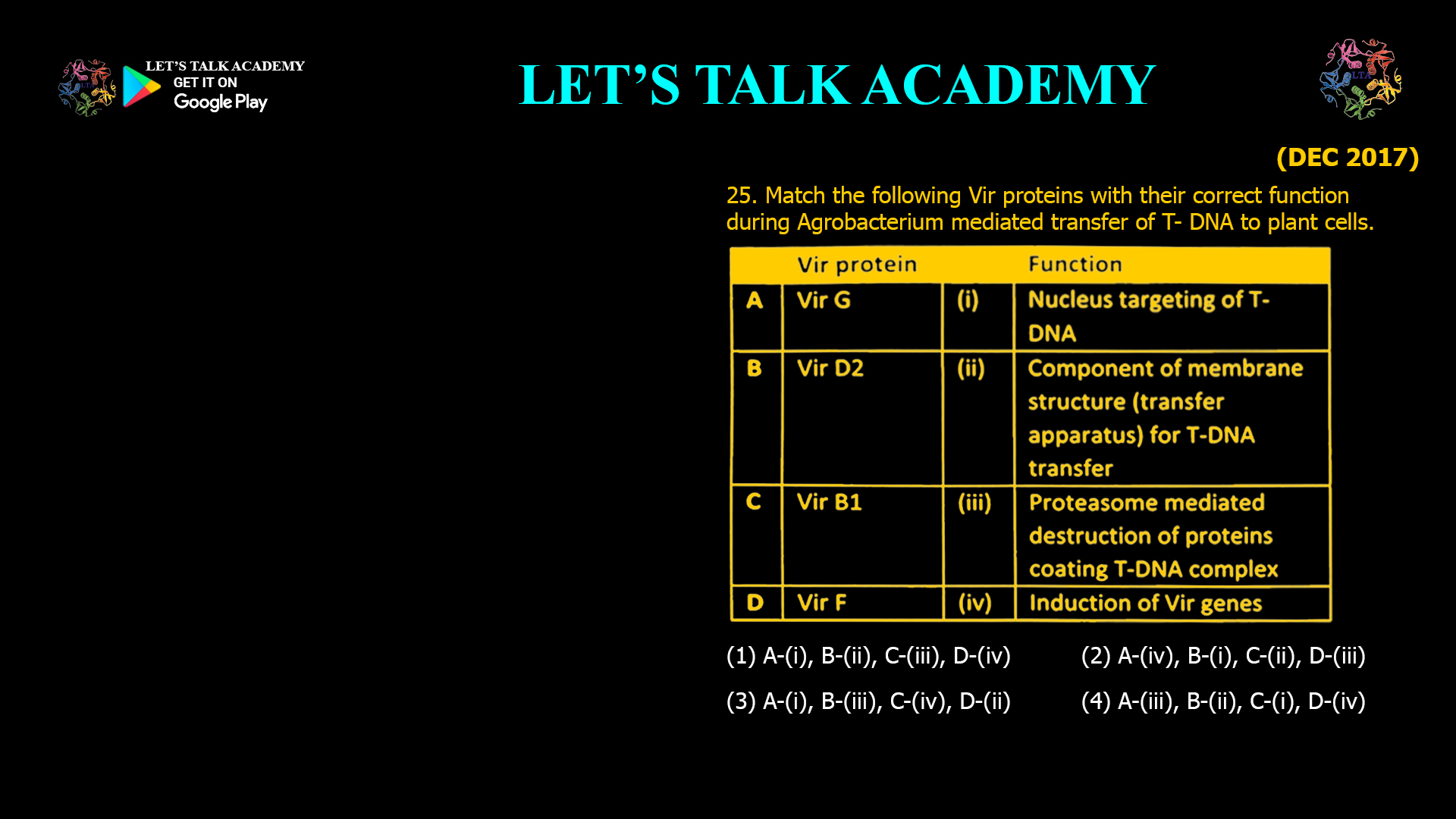
25. Match the following Vir proteins with their correct function during Agrobacterium mediated transfer of T- DNA to plant cells. (1) A-(i), B-(ii), C-(iii), D-(iv) (2) A-(iv). B-(i). C-(ii), D-(iii) (3) A-(i), B-(iii), C-(iv), D-(ii) (4) A-(iii); B-(ii), C-(i), D-(iv)

Functions of Vir proteins during Agrobacterium T-DNA transfer

24. Given below are four statements related to Agrobacterium-mediated transfer of T-DNA into plant cells: A. Production of single-stranded T-DNA by VirD1 and VirD2 proteins. B. Interaction of VirE2 with VIP1 and VirE3. C. Use of VirB/VirD4 type IV secretion system. D. Activation of VirA-VirG complex. The correct sequence of events (from earliest to latest) is: (1) A-B-D-C (2) B-C-A-D (3) C-A-B-D (4) D-A-C-B

Sequence of events in Agrobacterium T-DNA transfer

23. Agrobacterium tumefaciens, also known as natural genetic engineers, causes crown-gall disease in plants. However, when the same bacteria are used to raise transgenic plants with improved agronomic traits, no such tumor (disease) is observed. This is due to: A. Vir D2 gene is mutated in Ti plasmid. B. Disarmed Ti plasmid is generally used. C. Heat-shock during transformation destroys virulence. D. Oncogenes have been removed. Which one of the following combination of above statements is correct? (1) A and C (2) A and D (3) B and C (4) B and D

Why Agrobacterium-based transgenic plants do not form tumors

22. Following are some statements related to raising transgenic plants A. T-DNA of Agrobacterium contains oncogenes and opine synthesis genes B. All 8 operons present in vir region of Agrobacterium is essential for virulence C. The CaMV 35S RNA promoter is a very strong constitutive promoter used in plant transformation D. Conjugative transfer (oriT or tra) region functions in conjugative transfer of the Ti-plasmids Which one of the following combinations of above statements is correct? (1) B, C and D (2) A, C and D (3) A, B and D (4) A, B and C

Key genetic elements in Agrobacterium-mediated plant transformation

21. While designing an experiment for Agrobacterium mediated plant transformation, a student noted down the following points: A. Ti and Ri plasmids induce crown gall and hairy root disease, respectively B. Enzymes octopine synthase and nopaline synthase involved in the synthesis of octopine and nopaline, respectively are encoded by T-DNA. C. All the six vir genes, vir A, vir B, vir C, vir D, vir E and vir G are absolutely required for virulence. D. Almost perfect 25 bp direct repeat sequences flanking all Ti and Ri plasmids in the T-DNA region is essential for T-DNA transfer. Which one of the following combinations of the above statement is correct? (1) A, B and C (2) B, C and D (3) A, C and D (4) A, B and D

Key facts for designing Agrobacterium-mediated plant transformation experiments

20. Following are certain statements regarding the use of Agrobacterium in plant transformation. A. A. tumefaciens causes crown gall disease and A. rhizogenes causes hairy root disease. B. Region A in Ti plasmid is responsible for replication. C. Region D in Ti plasmid is responsible for virulence. D. Oncogenic (one) region in T-DNA is responsible for unusual amino acid synthesis. Which one of the following combinations of above statements is correct? (1) A and B (2) C and D (3) A and C (4) B and D

Understanding Ti plasmid regions and Agrobacterium diseases in plant transformation

Key facts about Agrobacterium tumefaciens, opines and crown gall callus

18. Which one of the following statements is correct? (1) None of the virulence genes of Agrobacterium tumefaciens are expressed constitutively. (2) Integration of T-DNA with the nuclear genome of plant cells occurs only by homologous recombination. (3) Host plant genes do not play any role in Agrobacterium-mediated transfer of T-DNA into plant cells. (4) Opines are a source of nitrogen for Agrobacterium cells.

Opines and Agrobacterium virulence

17. Agrobacterium tumefaciens is frequently used as a vector to create transgenic plants. Under laboratory conditions Agrobacterium - mediated plant transformation does not require (1) host plant genes (2) bacterial type IV secretion system (3) vir genes (4) opine catabolism genes

Essential and non‑essential genes for Agrobacterium‑mediated plant transformation

16. The T-DNA region of the Ti plasmid of Agrobacterium tumefaciens harbors two genes: X and Y. Mutation of gene 'X' produces a rooty tumour while mutation of gene 'Y' produces shoots in the tumor. Based on the above information, which one of the following statements is correct? (1) Gene 'X' encodes auxins and gene 'Y' encodes cytokinins (2) Gene 'X' encodes cytokinins and gene 'Y' encodes auxins (3) Gene 'X' and gene 'Y' both encode auxins (4) Gene 'X' encodes opines while gene 'Y' encodes cytokinins 16. The T-DNA region of the Ti plasmid of Agrobacterium tumefaciens harbors two genes: X and Y. Mutation of gene 'X' produces a rooty tumour while mutation of gene 'Y' produces shoots in the tumor. Based on the above information, which one of the following statements is correct? (1) Gene 'X' encodes auxins and gene 'Y' encodes cytokinins (2) Gene 'X' encodes cytokinins and gene 'Y' encodes auxins (3) Gene 'X' and gene 'Y' both encode auxins (4) Gene 'X' encodes opines while gene 'Y' encodes cytokinins

Interpreting T‑DNA hormone genes in Agrobacterium tumefaciens

15. A set of virulence genes (vir genes), located in the Agrobacterium Ti-plasmid, is activated by (1) octopine (2) nopaline (3) acetosyringone (4) auxin

Which molecule activates Agrobacterium vir genes?

14. Treatment of acetosyringone is given during transfer of transgene using Agrobacterium as vector. The rationale behind this is that acetosyringone (1) Helps in anchorage of bacteria to plant cell wall (2) Activates vir operon of bacteria (3) Helps in integration of T-DNA in plant genome (4) Promotes bacterial growth by activating genes in plant

Why acetosyringone is used in Agrobacterium‑mediated plant transformation

13. Which microbe has been used against insect plant pathogens? (1) Agrobacterium tumefaciens (2) Agrobacterium rhizogenes (3) Bacillus thuringenesis (4) Fusarium nudum

Bacillus thuringiensis as a biocontrol agent against insect pests

12. Which of the following organism have been extensively used in generation of transgenic plants? (1) Agrobacterium tumfaciens (2) Bacilus thuringensis (3) Baculo viruses (4) Erwinia carotovora

Agrobacterium tumefaciens as the primary tool for generating transgenic plants

11. Arabidopsis thaliana seeds were planted on Murashige Skoog (MS) plates with or without a hormone added to the medium. Seeds were found to germinate late in the hormone containing MS plates as compared to Ms plates without hormone. Identity the hormone. (1) Jasmonic acid (2) Cytokinin (3) Auxin (4) Abscisic acid

Which hormone delays Arabidopsis seed germination on MS medium?

10. Protoplast fusion is used in plant tissue culture for various applications. In protoplast fusion: A. naked plant cells are used. B. transfer of organelles is not possible. C. partial genome transfer is involved. D. cells from two different plants can be mixed together and forced to fuse. Which one of the following combinations of the above statements is correct? (1) (A), (B) and (C) (2) (A), (C) and (D) (3) (A), (B) and (D) (4) (B), (C) and (D)

Key facts about protoplast fusion in plant tissue culture

9. Following are certain statements regarding somatic hybridization, a technique used for plant improvement. A. Protoplasts of only sexually compatible plant species can be fused. B. Hybrids are produced with variable and asymmetric amounts of genetic material of parental species C. Protoplast fusion permits transfer of gene block or chromosomes. D. Genes to be transferred need to be identified and isolated. Which one of the following combinations of the above statements is correct? (1) A and C (2) B and C (3) A and D (4) B and D

Somatic hybridization

8. The following statements are related to plant tissue culture A. Friable callus provides the inoculum to form cell- suspension cultures. B. The process known as 'habituation' refers to the property of callus loosing the requirement of auxin and/or cytokinin during long term culture. C. Cellulase and pectinase enzymes are usually used for generating protoplast cultures. D. During somatic embryo development, torpedo stage embryo is formed before heart stage embryo. Which one of the following combinations of above statements is correct? (1) A, B and C (2) A, B and D (3) A, C and D (4) B, C and D

Key concepts in plant tissue culture

7. Encasing of which of the following plant eel in a gelatinous matrix is referred as artificial seed? (1) Microcalli (2) Somatic embryos (3) Root tips (4) Shoot tips

Artificial seed in plant tissue culture

6. Somatic embryogenesis is an important exercise in micropropagation and genetic engineering of plants. The following steps are considered as critical for achieving somatic embryogenesis: A. Reducing the concentration of sucrose in the medium by half. B. Addition of the hormone, 2,4-dichlorophenoxyacetic acid to induce somatic embryos. C. Reduce agar concentration to 0.6% (w/v) D. Use maltose in place of sucrose as a carbon source Which one of the following combinations is correct? (1) A and C (2) B and D (3) A and B (4) C and D

Key medium modifications for successful somatic embryogenesis

5. Given below is a table comprising various terms associated with plant tissue culture in Column A and Column B. Which of the following represents the most appropriate match between all the terms of Column A and Column B? (1) A-ii; B-i; C-iv; D-iii (2) A-iv; B-iii; C-ii; D-i (3) A-ii; B-iv; C-i; D-iii (4) A-iv; B-i; C-ii; D-iii

Matching auxin, cytokinin, protoplast and microspore culture terms in plant tissue culture

4. Following are few statements for regeneration of plants from explants/tissues. (A) Cytokinin is required for shoot development. (B) Auxin is required for shoot development. (C) Auxin to cytokinin ratio is very important. (D) Jasmonic acid is required for both root and shoot development. Which of the following combinations of above statements is true? (1) (A) and (C) (2) (B) and (D) (3) (A) and (D) (4) (B) and (C)

Hormone requirements for plant regeneration from explants

3. Which one of the following will be observed when auxin to cytokinin ratio is increased in the culture medium during organogenesis from tobacco pith callus? (1) Adventitious roots will form. (2) Adventitious shoot will form. (3) There will be no root formation. (4) There will be no shoot formation.

Effect of increased auxin–cytokinin ratio on tobacco callus organogenesis

2. In tissue culture experiment to initiated shoots from undifferentiated mass of cell the medium must contain (1) low auxin and high cytokinin (2) High auxin and high cytokinin (3) High auxin and low cytokinin (4) low auxin and low cytokinin

Auxin–cytokinin ratio for shoot initiation from callus

1. Ideal Aseptic condition means (1) No microorganisms (2) Controlled fungi and bacteria (3) No endospores of fungi (4) Bacteria lesser then 200

What is an ideal aseptic condition?

Latest Courses