6.An antibiotic that resembles the 3' end of a charged tRNA molecule is: (1) Streptomycin(2) Sporsomycin (3) Puromycin     (4) Tetracycline   

1. Chloramphenicol is a "broad-spectrum" antibiotic which inhibits protein synthesis in prokaryotes. Given below are a few statements regarding the mode of action of chloramphenicol. A. Chloramphenicol inhibits the peptidyl-transferase activity of ribosomes. B. Chloramphenicol can be used to treat moderate to severe infections, because mitochondrial ribosomes are not sensitive to chloramphenicol. C. Chloramphenicol binds to one of the domains of 23S rRNA D. Chloramphenicol competes for binding with the E- sitetRNA Which of the following options describes correctly the mechanism of action of chloramphenicol? (1) B and D only (2) A and C only (3) A, C and D (4) B, C and D

 Chloramphenicol: Mechanism of Action, Ribosomal Binding, and Clinical Implications

All of the following statements about bacterial transcription termination are true EXCEPT (1) some terminator sequences require Rho protein for termination. (2) inverted repeat and ‘T’ rich non-template strand define intrinsic terminators. (3) Rho-dependent terminators may possess inverted repeat elements. Rho (4) Nus A is necessary for intrinsic transcription termination.

Bacterial Transcription Termination Role of NusA

15. Rho factor is involved in termination of transcription in prokaryotes. Genetic manipulations indicate that Rho-dependent termination requires the presence of a specific recognition sequence on the newly synthesized RNA upstream of the termination site. The recognition sequence must be on the necent RNA rather then the DNA, as demonstrated by Rho’s inability to terminate transcription in the presence of pancreatic RNAse. The essential features of this termination site have not been fully elucidated. Construction of synthetic termination sites indicates that it consists of 80 to 100 nts that lack a stable secondary structure and contain multiple regions that are rich in C and poor in G. Which of the following is/ are suggested by the above observation? (1) Rho factor attaches to nascent RNA at its recognition sequence and then migrates along the RNA in the 5'-->3. direction until it encounters an RNAP paused at the termination site and disrupts the transcriptional complex by acting as an RNA-DNA helicase. (2) Rho unwinds the RNA-DNA duplex forming the transcription bubble, thereby releasing the RNA transcript. (3) Rho factor attaches to the RNA at its recognition sequence while RNA is in the RNA-DNA hybrid condition. (4) There may be other factors and hence Rho factor does not need to unwind the RNA-DNA hybrid to release the transcript.

Rho-Dependent Termination | hexameric ATP-dependent RNA helicase Rho

14. Actinomycin D inhibits the process of transcription in both prokaryotic and eukaryotic organisms. The following statements are made about actinomycin D-mediated inhibition of transcription: (1) Actinomycin D inhibits transcription from a double stranded DNA template by either E. coil or yeast RNA polymerases. (2) Actinomycin D inhibits transcription from a single stranded RNA template by eukaryotic viral RNA (3) Actinomycin D inhibits transcription from single stranded Φ x 174 DNA template by E. coli RNA polymerase, immediately after viral DNA entry. (4) Actinomycin D inhibits transcription from double stranded RNA template by eukaryotic RNA polymerase II. Which of the combinations of the above statements is a true representation mediated inhibition ? of the mechanism of actinomycin D (1) A only (2) A, B and D (3) A, B and C (4) A and D only

Actinomycin D inhibits transcription in both prokaryotic and eukaryotic

13. Which one of the following statements is NOT a correct feature of Escherichia coli RNA polymerase? (1) Presence of the σ subunit along with α2ββ’ω core RNA polymerase is required for its promoter specific binding. (2) Presence of the σ subunit along with α2ββ’ω core RNA polymerase is not necessary for the core RNA polymerase  α2ββ’ω to bind to the DNA template. (3) Mutations in β subunit in its rifampicin resistance defining region (RRDR) confer rifampicin resistance phenotype. (4) Mutations in σ subunit in its rifampicin resistance defining region (RRDR) confer rifampicin resistance phenotype.

Escherichia coli RNA polymerase α2ββ’ω Components rifampicin

12. One of the mechanism is used by bacteria for adaptation to changed environment is altering transcription of their genes. In this regard, which one of the following responses is NOT found in bacteria? (1) A gene with two different promoters for expression in different conditions (2) use of different sigma factors for transcription of genes (3) Expression of alternate α,β and β’ subunits (4) Expression of anti-sigma factors

How Bacteria Adapt to Environmental Changes: Mechanisms of Gene Regulation Explained”

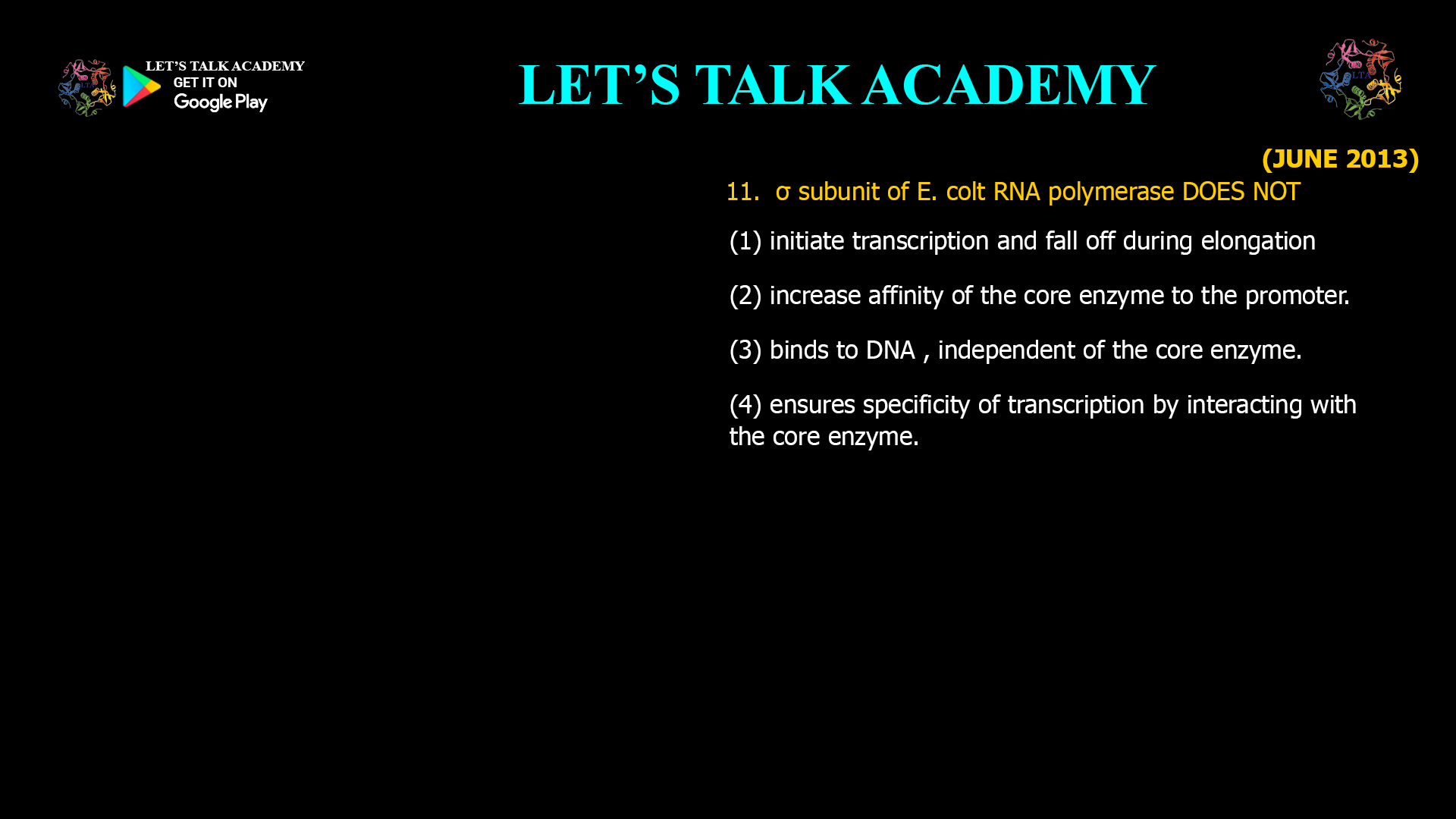
σ subunit of E. colt RNA polymerase DOES NOT (1) initiate transcription and fall off during elongation (2) increase affinity of the core enzyme to the promoter. (3) binds to DNA , independent of the core enzyme. (4) ensures specificity of transcription by interacting with the core enzyme.

Role of Sigma (σ) Subunit in E. coli RNA Polymerase: Function, Mechanism

10. In prokaryotes which subunit of RNA polymerase is released after transcription initiation process? (1) α (2) β (3) β’ (4) σ

Which RNA Polymerase Subunit Is Released After Transcription Initiation in Prokaryotes? | CSIR NET Life Science MCQ

9. Mutation in which subunit of RNA polymerase holoenzyme would have defect in correct initiation of transcription? (1) α subunit (2) β subunit (3) β' subunit (4) σ-subunit

Which RNA Polymerase Subunit Is Essential for Transcription Initiation? | CSIR NET Life Science MCQ

Which one of the following ensures stable binding of RNA polymerase at the promoter site? (1) DNA photolyase      (2) Sigma factor (3) DNA glycosylase (4) Rec A

Which Factor Ensures Stable Binding of RNA Polymerase to the Promoter? | CSIR NET Life Science MCQ

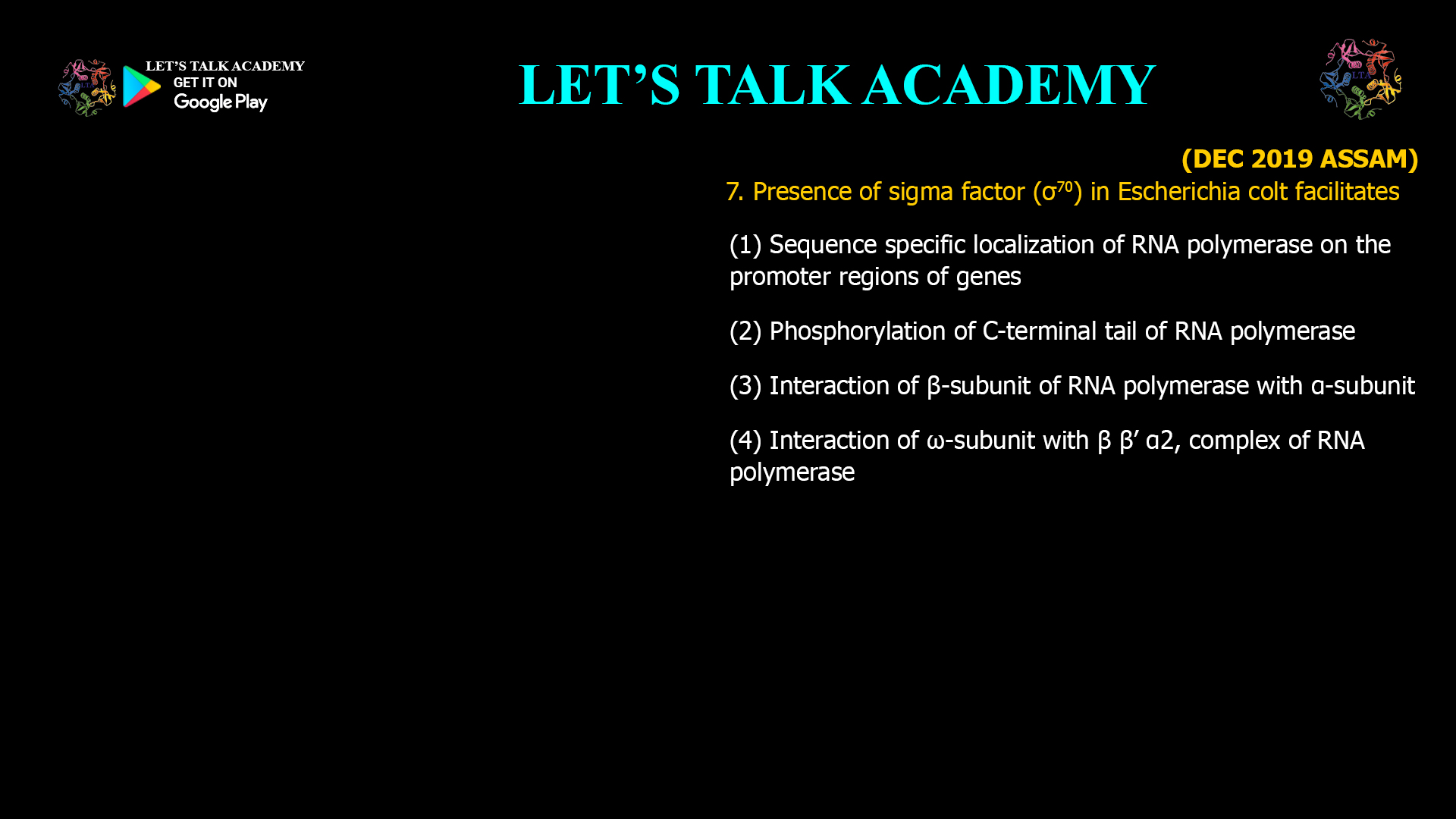
7. Presence of sigma factor (σ70) in Escherichia colt facilitates (1) Sequence specific localization of RNA polymerase on the promoter regions of genes (2) Phosphorylation of C-terminal tail of RNA polymerase (3) Interaction of β-subunit of RNA polymerase with α-subunit (4) Interaction of ω-subunit with β β’ α2, complex of RNA polymerase

What Is the Role of Sigma Factor σ⁷⁰ in E. coli? | CSIR NET Life Science MCQ Explained

Sigma Factor Mutation Affects Thermal Stress Adaptation | CSIR

Which Sigma Factor Mutation Affects Thermal Stress Adaptation in E. coli? | CSIR NET Life Science MCQ

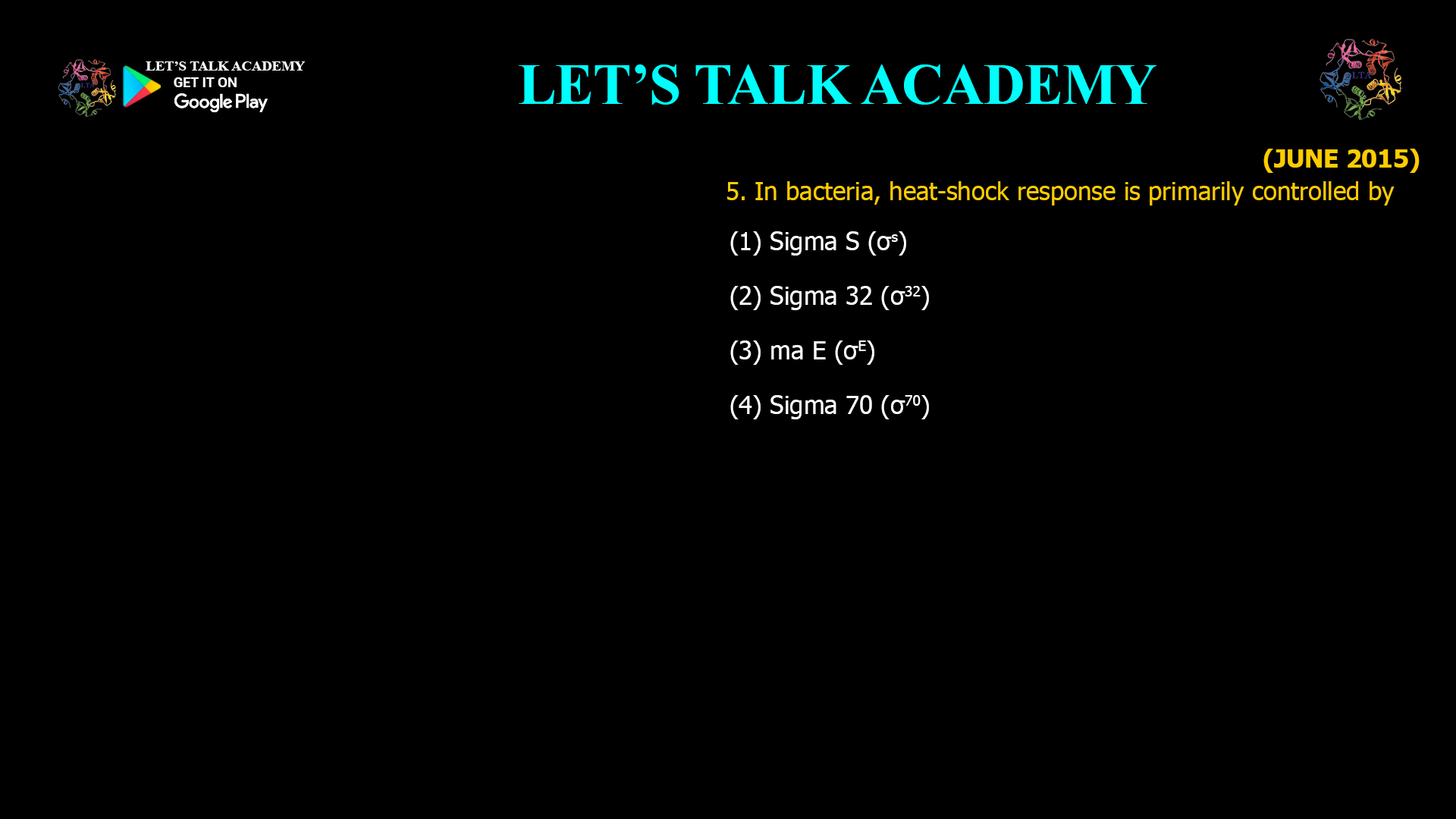
Which Sigma Factor Controls the Heat-Shock Response in Bacteria? | CSIR NET Life Science MCQ Explained

Which Sigma Factor Controls the Heat-Shock Response in Bacteria? | CSIR NET Life Science MCQ Explained

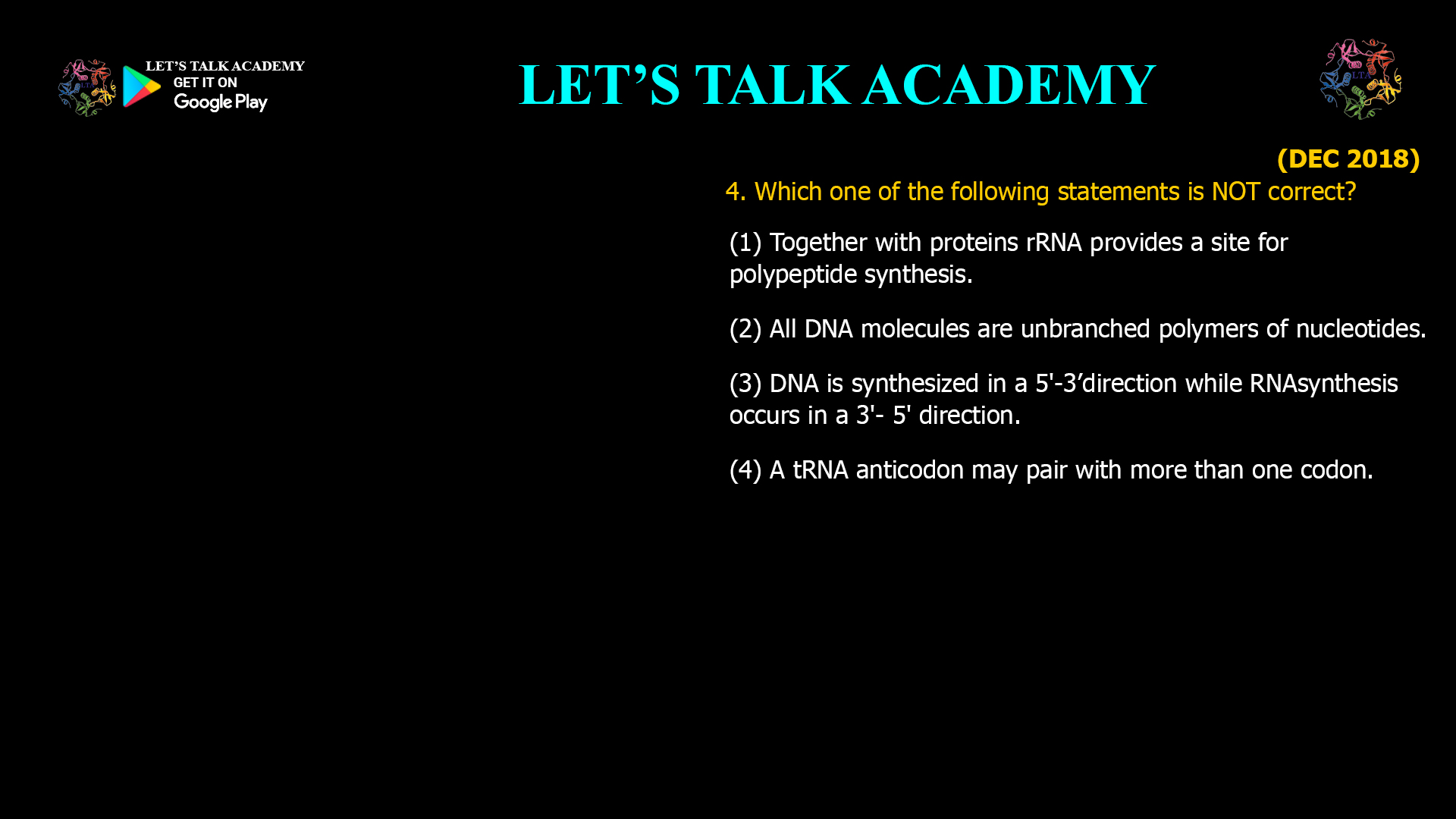
Which one of the following statements is NOT correct? (1) Together with proteins rRNA provides a site for polypeptide synthesis. (2) All DNA molecules are unbranched polymers of nucleotides. (3) DNA is synthesized in a 5'-3’ direction while RNA synthesis occurs in a 3'- 5' direction. (4) A tRNA anticodon may pair with more than one codon.

Which of the Following Statements Is NOT Correct? | DNA vs RNA Synthesis MCQ Explained for CSIR NET Life Science

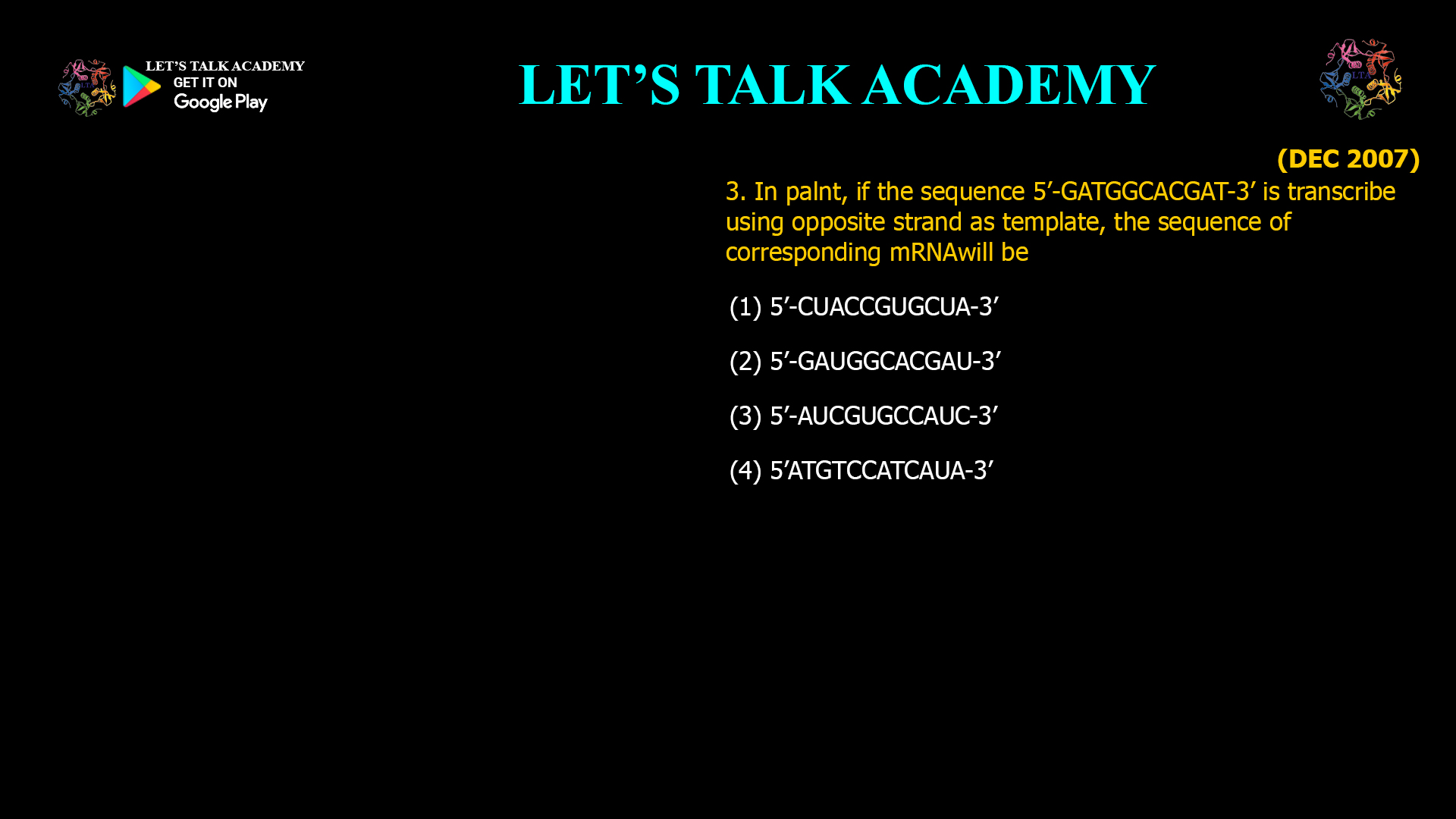
mRNA Sequence from DNA in Plants | CSIR Transcription MCQ

mRNA Sequence from DNA in Plants – Transcription MCQ Explained for CSIR NET Life Science

Which Statement Is NOT True for DNA Transcription

Which Statement Is NOT True for DNA Transcription

Latest Courses