42. Contents in Column I and II are with respect to bacterial transcriptional regulation. Column I Column II i. Positive regulation by Camp a. Ara operon ii. Short abortive b. Lac operon iii. DNA looping iv. FMN synthesis c. Riboswitch d. Transcription initiation Which one of the options below correctly matches contents in column I and Column II? (1) (i) – (b); (ii) – (d); (iii) – (a); (iv) - (c) (2) (i) – (c); (ii) – (b); (iii) – (a); (iv) - (d) (3) (i) – (b); (ii) – (a); (iii) – (d); (iv) - (c) (4) (i) – (d); (ii) – (c); (iii) – (b); (iv) - (a)

Bacterial Transcriptional Regulation Mechanisms to Operons and Processes

36. E.coli are growing in a medium with glucose as the sole carbon source. Tryptophan suddenly added. The cells continue to grow, and divide every 30 minutes. What will be the status of tryptophan synthase activity in the cells over time if the trp mRNA remains stable (1) Low (3) No change (2) High (4) No activity

Tryptophan Synthase Activity in E. coli: Regulation When Glucose and Tryptophan Are Present

35. Deletion of the leader sequence of trp operon of E. coli would result in (1) decreased transcription of trp operon. (2) increased transcription of trp operon. (3) no effect on transcription. (4) decreased transcription of trp operon in the presence of tryptophan.

Deletion of the Leader Sequence in the trp Operon: Effects on Tryptophan Biosynthesis in E. coli

34. The tryptophan operon in E. coli is an example of (1) inducible operon, controlled by a repressor protein and attenuation. (2) repressible operon, controlled by a repressor protein and attenuation. (3) inducible operon, controlled by an activator protein and aporepressor protein. (4) repressible operon, controlled by a repressor protein and anti-termination

The trp Operon in E. coli: A Model of Repressible Gene Regulation with Double Controls

33. During regulation of trp operon by attenuation there is (1) Pre-mature termination of translation (2) pre-mature termination of transcription (3) Termination of replication (4) Ribosome fails to read transcript

Attenuation in the Trp Operon: How Bacteria Fine-Tune Tryptophan Synthesis

32. When tryptophan in excess most of times RNA polymerase dismount after transcription of first 150 nt in trp operon. This is termed as (1) Anti-termination (2) Attenuation (3) Catabolite repression (4) Feedback inhibition

 Attenuation in the trp Operon: The Molecular Mechanism Behind Early Transcription Termination in E. coli

31. You have created a fusion between the trp operon, which encodes the enzymes for trptophan biosynthesis, under the regulatory control of the lac operator. Under which of the following conditions will trptophan synthase be induced in the strain that carries the chimeric operator fused operons? (1) Only when both lactose and glucose are absent. (2) Only when both lactose and glucose are present. (3) Only when lactose is absent and glucose is present. (4) Only when lactose is present and glucose is absent.

 When Is Tryptophan Synthase Induced in a trp-lac Chimeric Operon? Understanding the Role of Lactose and Glucose

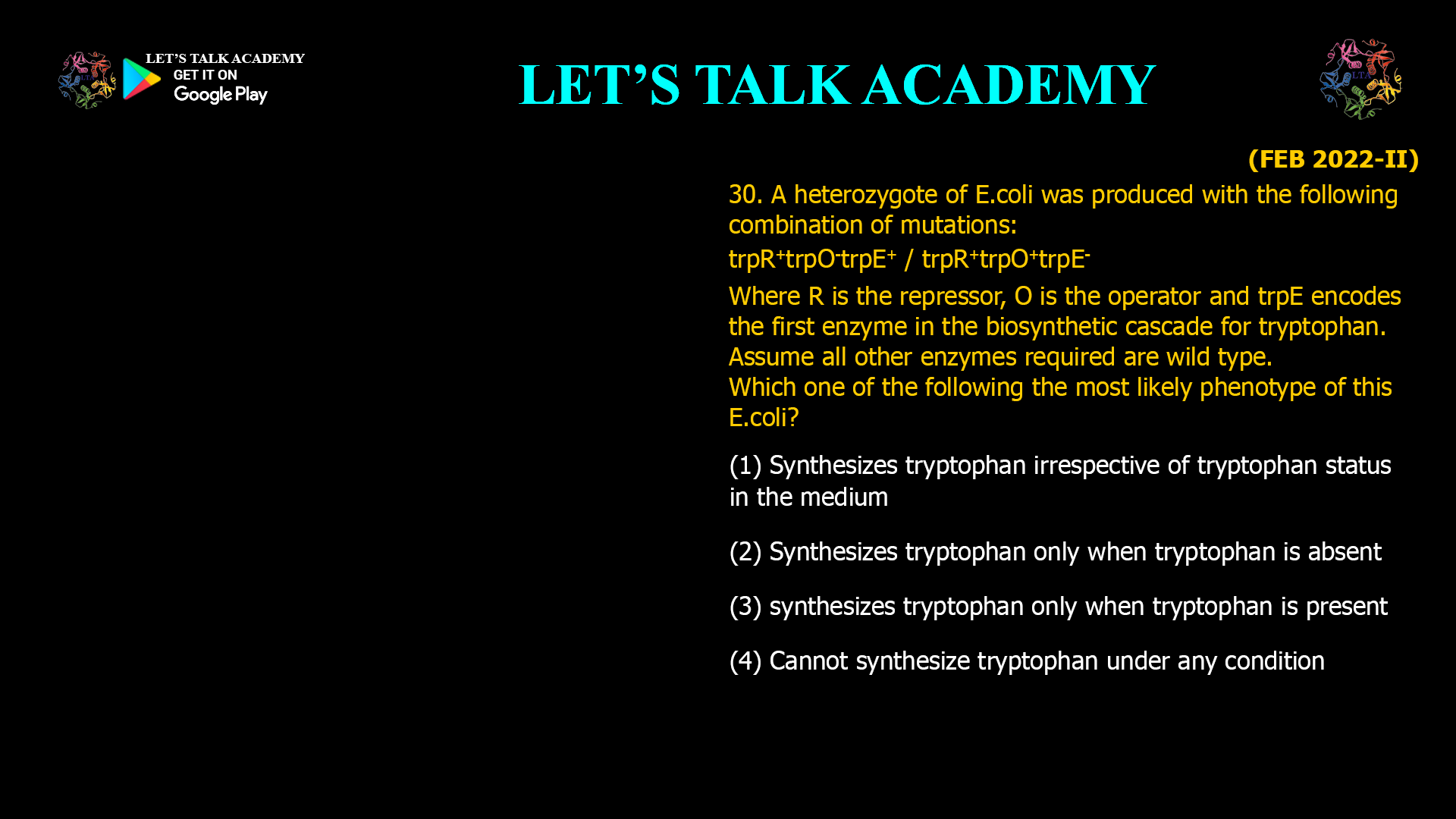
A heterozygote of E.coli was produced with the following combination of mutations: trpR+ trpO- trpE+ / trpR+ trpO+ trpE- Where R is the repressor, O is the operator and trpE encodes the first enzyme in the biosynthetic cascade for tryptophan. Assume all other enzymes required are wild type. Which one of the following the most likely phenotype of this E.coli? (1) Synthesizes tryptophan irrespective of tryptophan status in the medium (2) Synthesizes tryptophan only when tryptophan is absent (3) synthesizes tryptophan only when tryptophan is present (4) Cannot synthesize tryptophan under any condition

 How Operator and Structural Gene Mutations Affect Tryptophan Synthesis in E. coli: The trpR+ trpO- trpE+ / trpR+ trpO+ trpE- Case

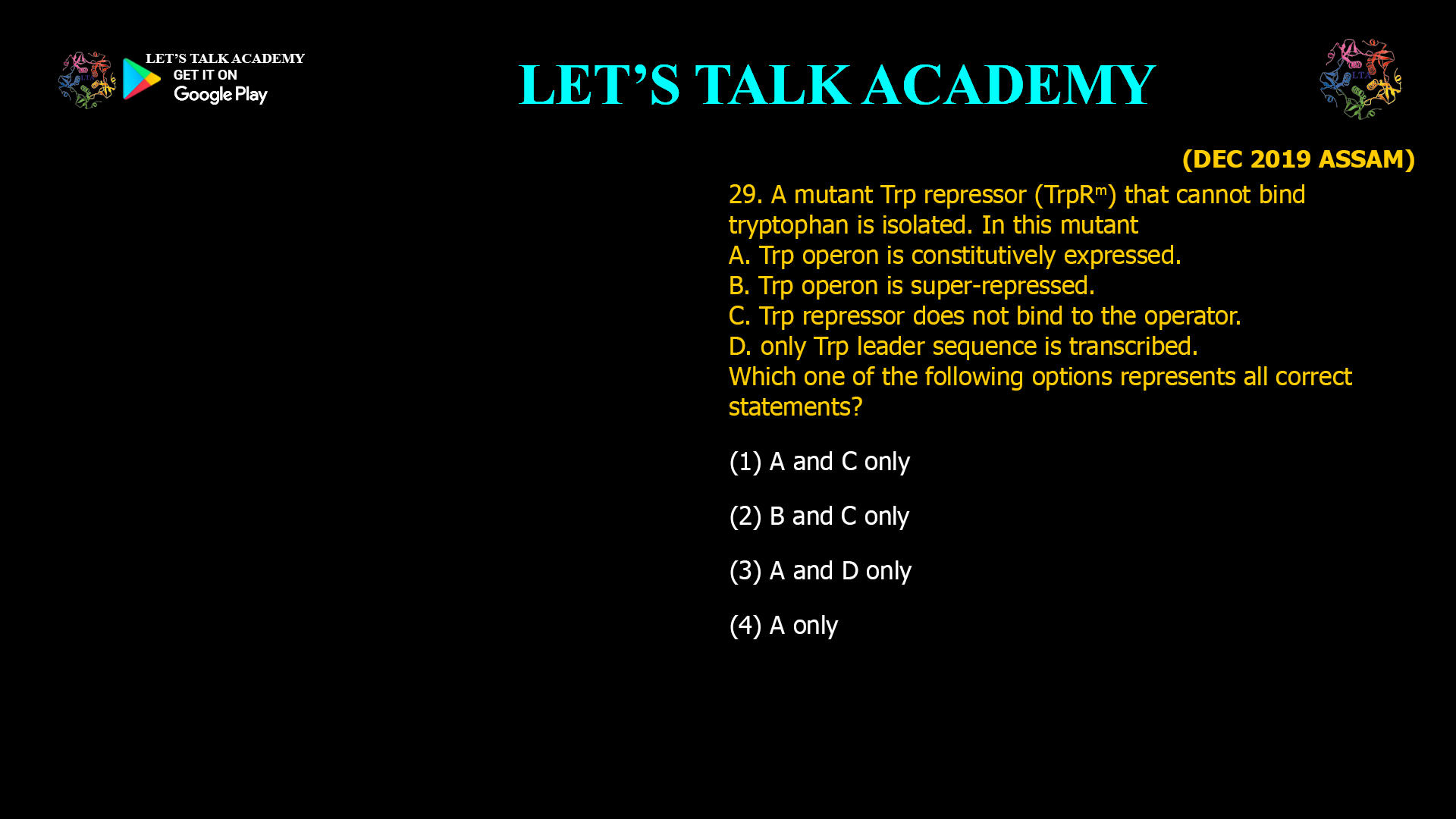
29. A mutant Trp repressor (TrpRm) that cannot bind tryptophan is isolated. In this mutant A. Trp operon is constitutively expressed. B. Trp operon is super-repressed. C. Trp repressor does not bind to the operator. D. only Trp leader sequence is transcribed. Which one of the following options represents all correct statements? (1) A and C only         (2) B and C only (3) A and D only         (4) A only

What Happens When the Trp Repressor Cannot Bind Tryptophan? Insights into trp Operon Regulation

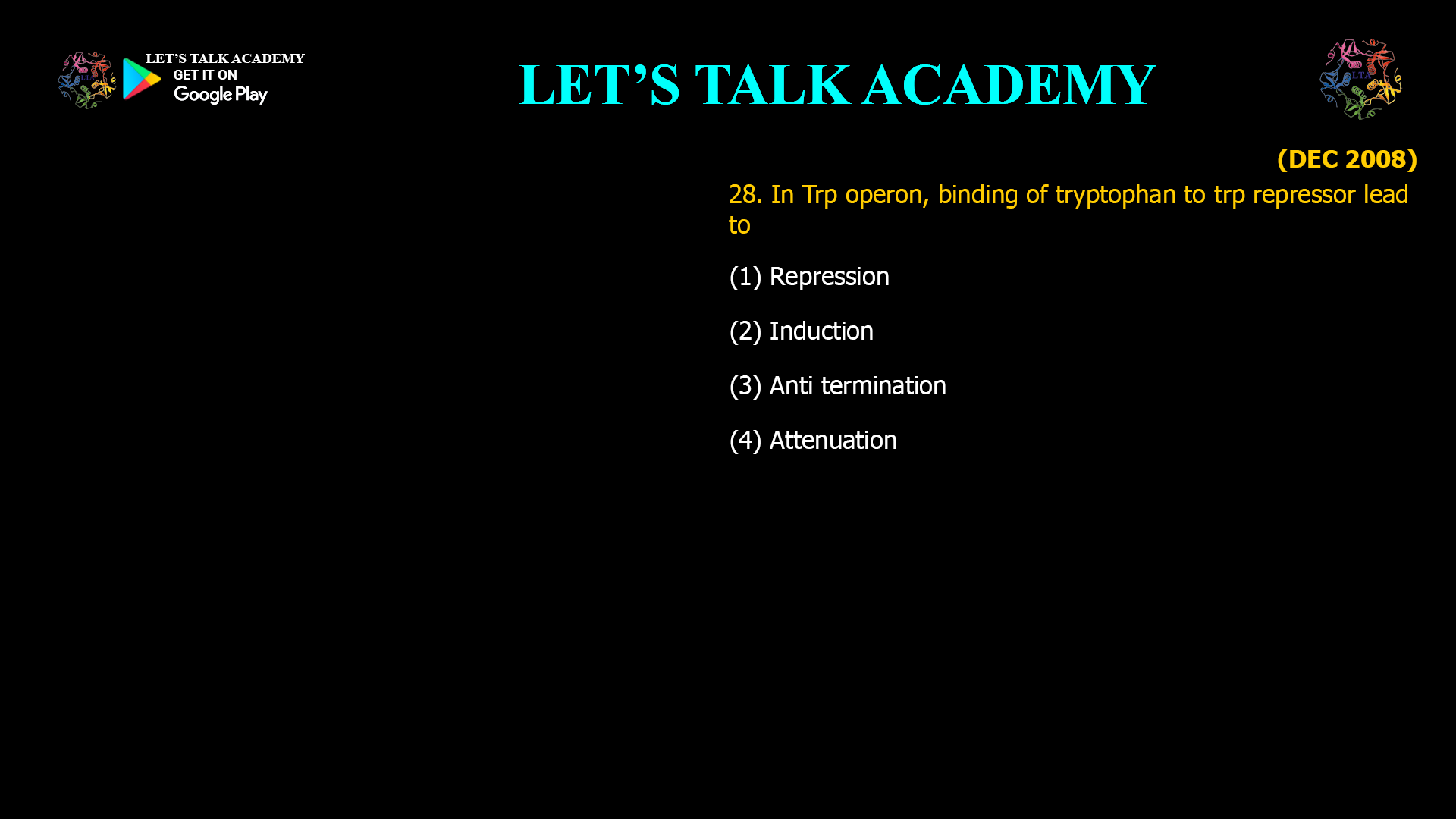
In Trp operon, binding of tryptophan to trp repressor lead to (1) Repression (2) Induction (3) Anti termination (4) Attenuation

How Tryptophan Binding to the trp Repressor Leads to Repression in the trp Operon

Which of the following is negative regulator of trp operon (1) Lactose (2) Allolactose (3) C-AMP (4) Tryptophan

Tryptophan as the Negative Regulator of the trp Operon in E. coli

26. In trp operon regulation excess tryptophan act as (1) Inducer (2) Activator (3) Repressor (4) Co-repressor

The Role of Excess Tryptophan as a Co-repressor in trp Operon Regulation

25. The Lac I and TrpR repressors bind With their ligands allolactose and tryptophan respectively, resulting in alteration of their DNA binding properties. The following statements are made about the mechanism of LacI and TrpR binding with DNA (operator) and regulation of gene expression jn E.coli. A. Allolactose binding to LacI leads to its poor binding to the lac operator whereas tryptophan binding to TrpR leads to its better binding to the trp operator. B Allolactose binding to LacI leads to induction of lac operon, whereas tryptophan binding to TrpR leads to repression of trp operon. C. Binding of allolactose and tryptophan to Lacl and TrpR respectively, leads to repression of their corresponding operons. D. Binding of allolactose and tryptophan to LacI and TrpR respectively, leads to activation of their corresponding operons. However, in trp operon regulation, availability of tryptophan also results in attenuation-mediate transcriptional termination leading to an overall effect of trp operon. Which one of the following options represents a combination of all correct statements ? (1) A and B only (2) B and C (3) c and D (4) A, B and D

LacI vs. TrpR: How Repressors and Their Ligands Control Gene Expression in E. coli

24. E. coli mutants isolated from a genetic screen showed following classes of mutations A. Point mutations in lacI B. Deletions immediately downstream of the transcription start site of the lac Z Y A mRNA C. Duplications of part or whole of lac Y D. Duplications of part or whole of Lac A Choose the option which is likely to result in constitutive expression of the lac operon? (1) Both A and B (2) Both B and C (3) Both C and D (4) Only A

Mutations Leading to Constitutive Expression of the lac Operon in E. coli: A Genetic Analysis

23. In an experimental approach regulatory sequences of trp operon were fused with structural genes of lac operon. Under what condition there would be expression Of β-galactosidase? (1) Low lactose and glucose (2) High lactose and glucose (3) Low tryptophan (4) High tryptophan

 When Is β-Galactosidase Expressed in a trp-lac Operon Fusion? Understanding the Impact of Tryptophan Levels

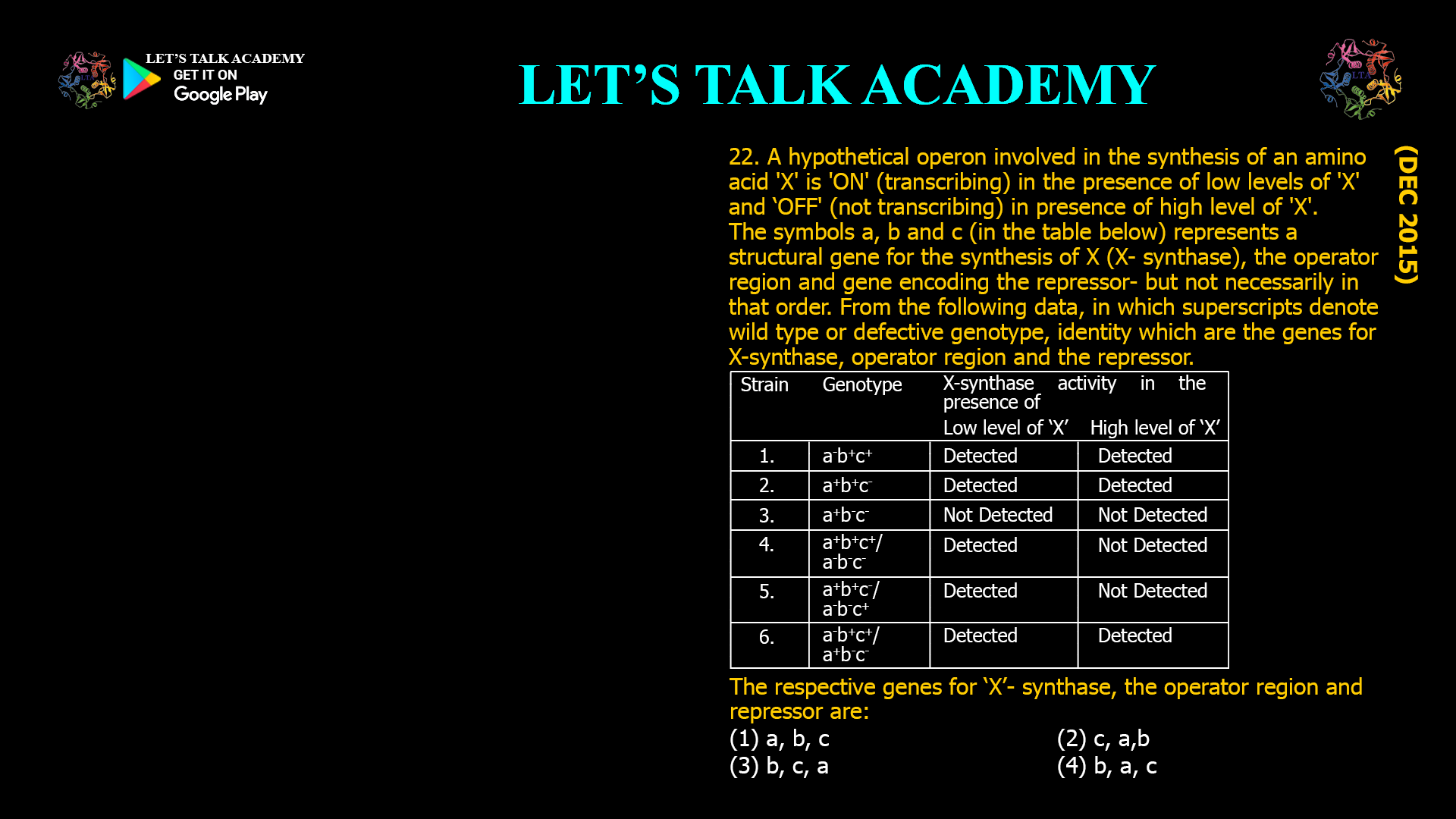
22. A hypothetical operon involved in the synthesis of an amino acid 'X' is ‘ON' (transcribing) in the presence of low levels of 'X' and ‘Off' (not transcribing) in presence of high level of 'X'. The symbols a, b and c (in the table below) represents a structural gene for the synthesis of X (X- synthase), the operator region and gene encoding the repressor- but not necessarily in that order. From the following data, in which superscripts denote wide type or defective genotype, identity which are the genes for X-svnthase, operator region and the repressor. Strain Genotype X-synthase activity in the presence of Low level High level of ‘X’ of ‘X’ 1. a- b+ c+ Detected Detected 2. a+ b+ c- Detected Detected 3. a+ b- c- Not Detected Not Detected 4. a+ b+ c+ / Detected Not Detected a- b- c- 5. a+ b+ c- / Detected Not Detected a- b- c+ 6. a- b+ c+ / Detected Detected a+ b- c- The respective genes for ‘X’- synthase, the operator region and repressor are: (1) a, b, c (2) c, a, b (3) b, c, a (4) b, a, c

How to Identify Structural, Operator, and Repressor Genes in a Hypothetical Amino Acid Operon

19. Which one of the following statements relating to the mechanism of color development in response to LacZ expression in Escherichia coli is INCORRECT? (1) E. coli growth on LB agar with X-gal results in blue colored colonies because LacZ produced in the cell hydrolyses X-gal present in the medium into a blue colored product. (2) When the membranes of the cells harboring LacZ are permeabilized and cells incubated in a buffer with ONPG, the solution turns yellow because LacZ encoded protein hydrolyzes (3) E. coli growth on MacConkey agar results in pink colored colonies because LacZ encoded protein produced in the cell hydrolyzes the neutral red dye present in the medium into a pink colored product. (4) E. coli growth on MacConkey agar results in pink colored colonies due to shift in pH of the medium MacConkey

The Science of Color Development in E. coli: LacZ, X-gal, ONPG, and MacConkey Agar Explained

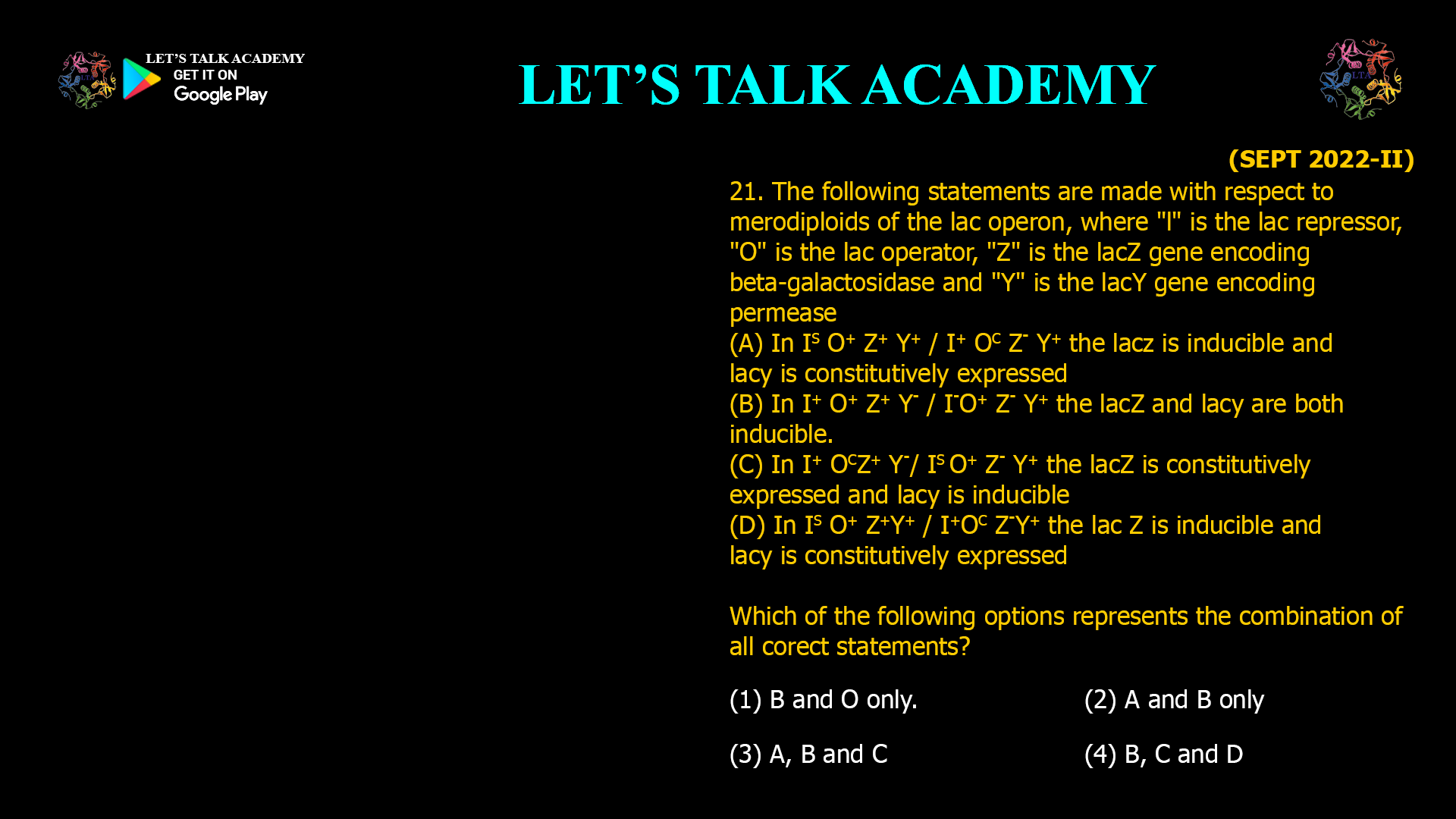
21. The following statements are made with respect to merodiploids of the lac operon, where "I" is the lac repressor, "O" is the lac operator, "Z" is the lacZ gene encoding beta-galactosidase and "Y" is the lacY gene encoding permease (A) In IS O+ Z+ Y+ / I+ OC Z- Y+ the lacz is inducible and lac Y is constitutively expressed (B) In I+ O+ Z+ Y- / I- O+ Z- Y+ the lacZ and lac Y are both inducible. (C) In I+ OC Z+ Y- / IS O+ Z- Y+ the lacZ is constitutively expressed and lac Y is inducible (D) In IS O+ Z+Y+ / I+OC Z-Y+ the lac Z is inducible and lac Y is constitutively expressed Which of the following options represents the combination of all corect statements? (1) B and O only. (2) A and B only (3) A, B and C (4) B, C and D

Decoding lac Operon Merodiploid Expression: Which Combinations of I, O, Z, and Y Mutations Are Correct?

20. With reference to lac operon, what will be the phenotype of an E. coli strain having a genotype I- O+ Z+ Y- /F’ I+ OC Z- Y+ ? (1) Constitutive for both β-galactosidase and lac permease (2) Inducible for both β-galactosidase and lac permease. (3) Inducible for β-galactosidase and constitutive for lac permease. (4) Constitutive for β-galactosidase and inducible for lac permease.

Phenotype of E. coli I– O+ Z+ Y– / F’ I+ OC Z– Y+ Merodiploid: Constitutive or Inducible?

19. Which one of the following statements relating to the mechanism of color development in response to LacZ expression in Escherichia coli is INCORRECT? (1) E. coli growth on LB agar with X-gal results in blue colored colonies because LacZ produced in the cell hydrolyses X-gal present in the medium into a blue colored product. (2) When the membranes of the cells harboring LacZ are permeabilized and cells incubated in a buffer with ONPG, the solution turns yellow because LacZ encoded protein hydrolyzes (3) E. coli growth on MacConkey agar results in pink colored colonies because LacZ encoded protein produced in the cell hydrolyzes the neutral red dye present in the medium into a pink colored product. (4) E. coli growth on MacConkey agar results in pink colored colonies due to shift in pH of the medium MacConkey

LacZ Expression in E. coli Detection by X-gal, ONPG, and MacConkey Agar

18. Mutants of lac Y (Y-) gene of E. coli do not synthesize the lactose permease protein. The following statements refer to the behaviour of lac mutants under different experimental conditions. A. No synthesis of β- galactosidase when Y- cells are induced with lactose. B. Synthesis of β- galactosidase when cells are induced with lactose. C. No synthesb of β-galactosidase when cells are induced with IPTG. D. Synthesis of β- galactosidase when cells are induced with IPTG. E. The cells induced with IPTG cannot grow in the presence of TONPG (TONPG is a compound whose uptake is mediated bv lactose permease and cleaved bv galactosidase to release toxic compound). F. Cells induced with IPTG Can grow in the presence of TONPG. Which combination of the above statements is correct? (1) A. D and F (2) B, C and E (3) A, C and F (4) A, C and E

 Understanding lacY Mutants in E. coli: β-Galactosidase Synthesis and Lactose Permease Function

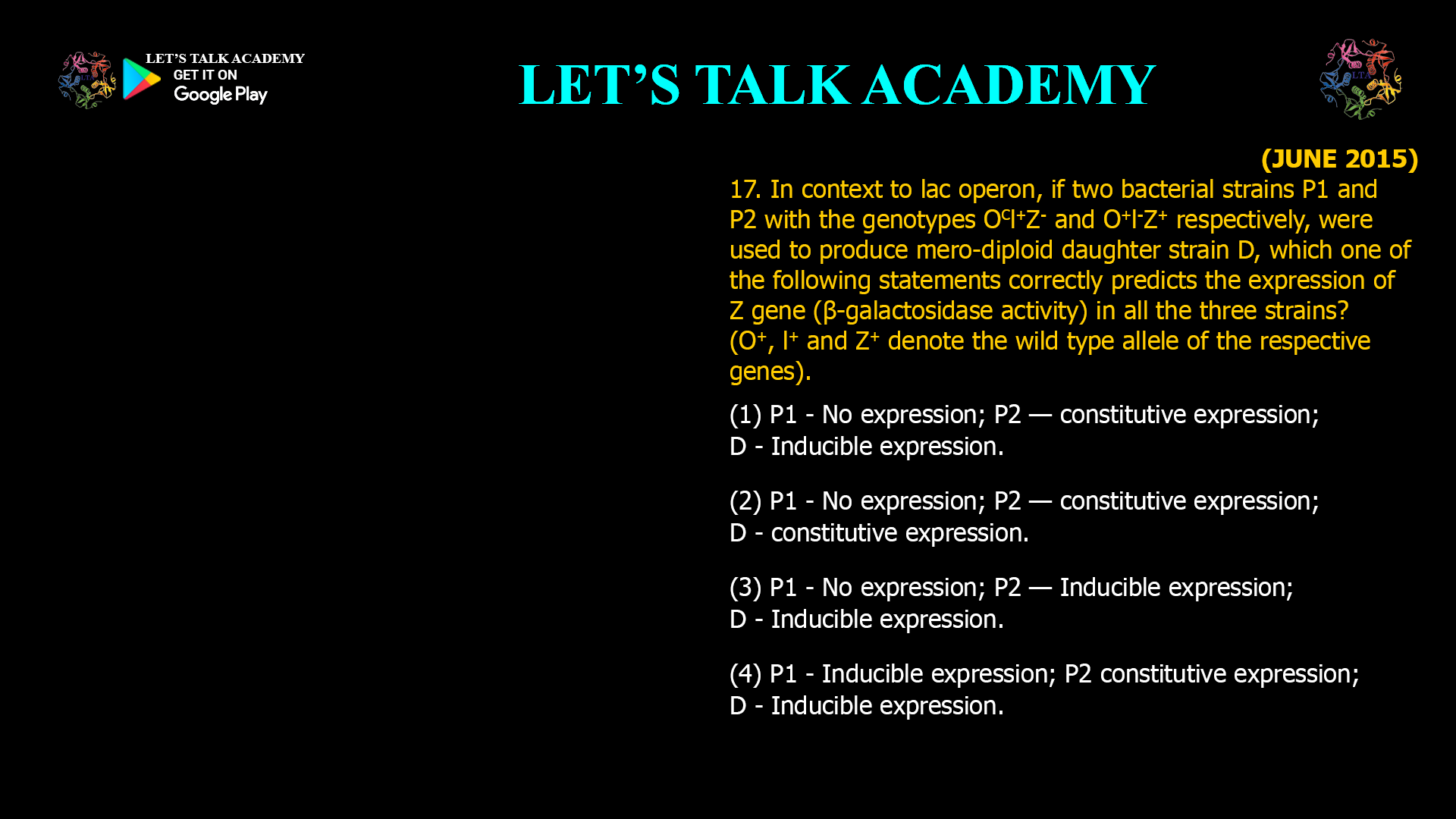
17. In context to lac operon. if two bacterial strains P1 and P2 with the genotypes OCI+Z- and O+I-Z+ respectively, were used to produce mero-diploid daughter strain D, which one of the following statements correctly predicts the expression of Z gene (β-galactosidase activity) in all the three strains? ) O+, I+ and Z+ denote the wild type allele of the respective genes). (1) P1 - No expression; P2 — constitutive expression; D - Inducible expression. (2) P1 - No expression; P2 — constitutive expression; D — constitutive expression. (3) P1 - No expression; P2 — Inducible expression; D - Inducible expression. (4) P1 - Inducible expression; P2 constitutive expression; D — Inducible expression.

 β-Galactosidase Expression in lac Operon Mutants and Merodiploid E. coli: Understanding OCI+Z– and O+I–Z+ Genotypes

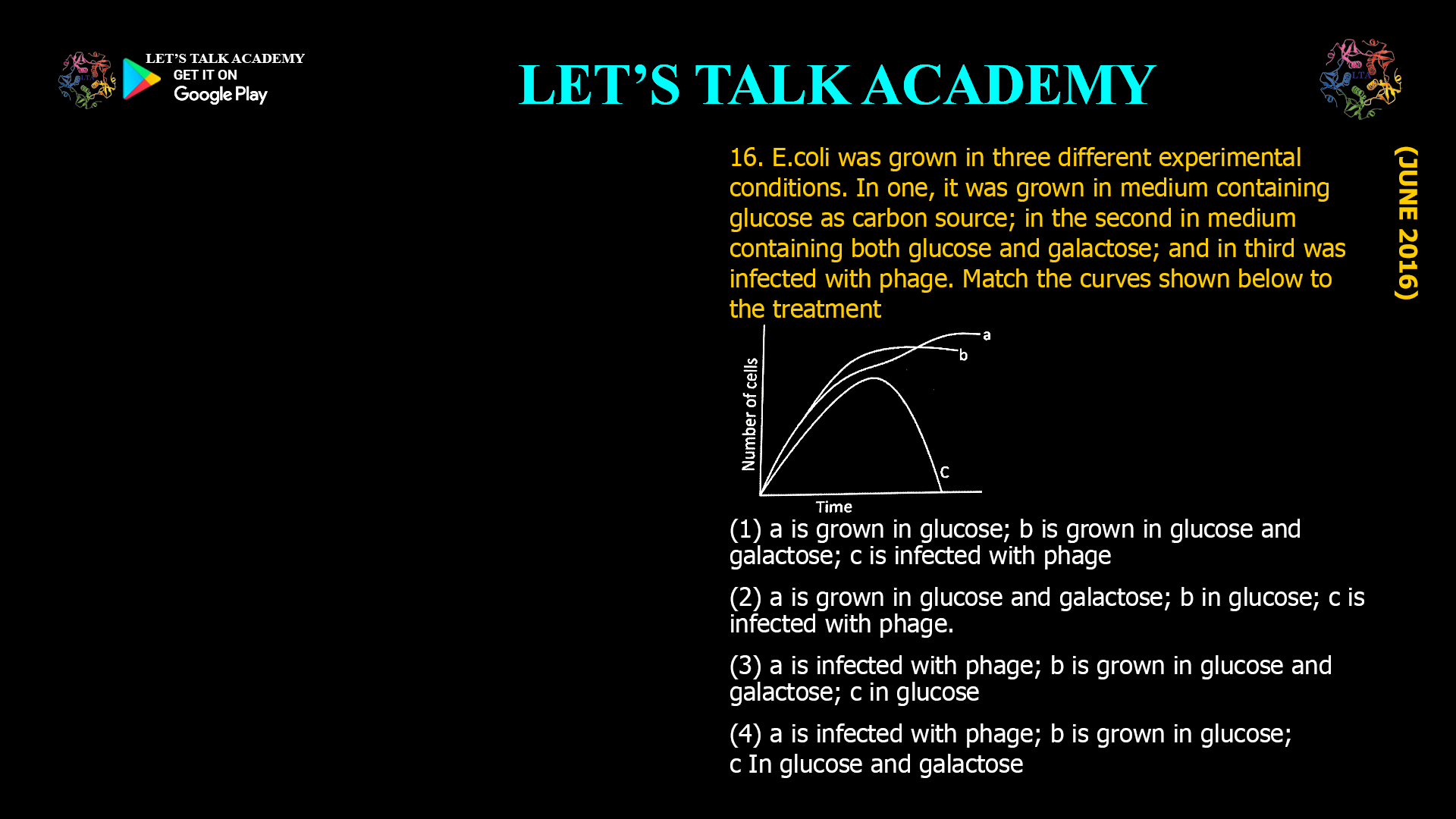
16. E.coli was grown in three different experimental conditions. In one, it was grown in medium Containing as carbon source; in the second in medium containing both glucose and galactose; and third was infected With phage. Match the curves shown below to the treatment (1) a is grown in glucose; b is grown in glucose and galactose; c is infected with phage (2) a is grown in glucose and galactose; b in glucose; c is infected with phage. (3) a is infected with phage; b is grown in glucose and galactose; c in glucose (4) a is infected with phage; b is grown in glucose; c In glucose and galactose

Decoding E. coli Growth Curves: Glucose, Galactose, and Phage Infection Dynamics

15. Lac repressor inhibits expression of genes lac-operon whereas purine biosynthesis is repressed by the Pur repressor. The two sequences and have Similar three dimensional The gene regulatory properties of these proteins differ in relation to (A) binding Of small molecules to the repressor. (B) presence of recognition Sites on the genome (C) oligomeric nature of the repressor. (D) DNA binding property. The correct statements s (1) A and B (2) A, B and C (3) A and C (4) B,C and D

Lac Repressor vs. Pur Repressor: Key Differences in Gene Regulatory Mechanisms

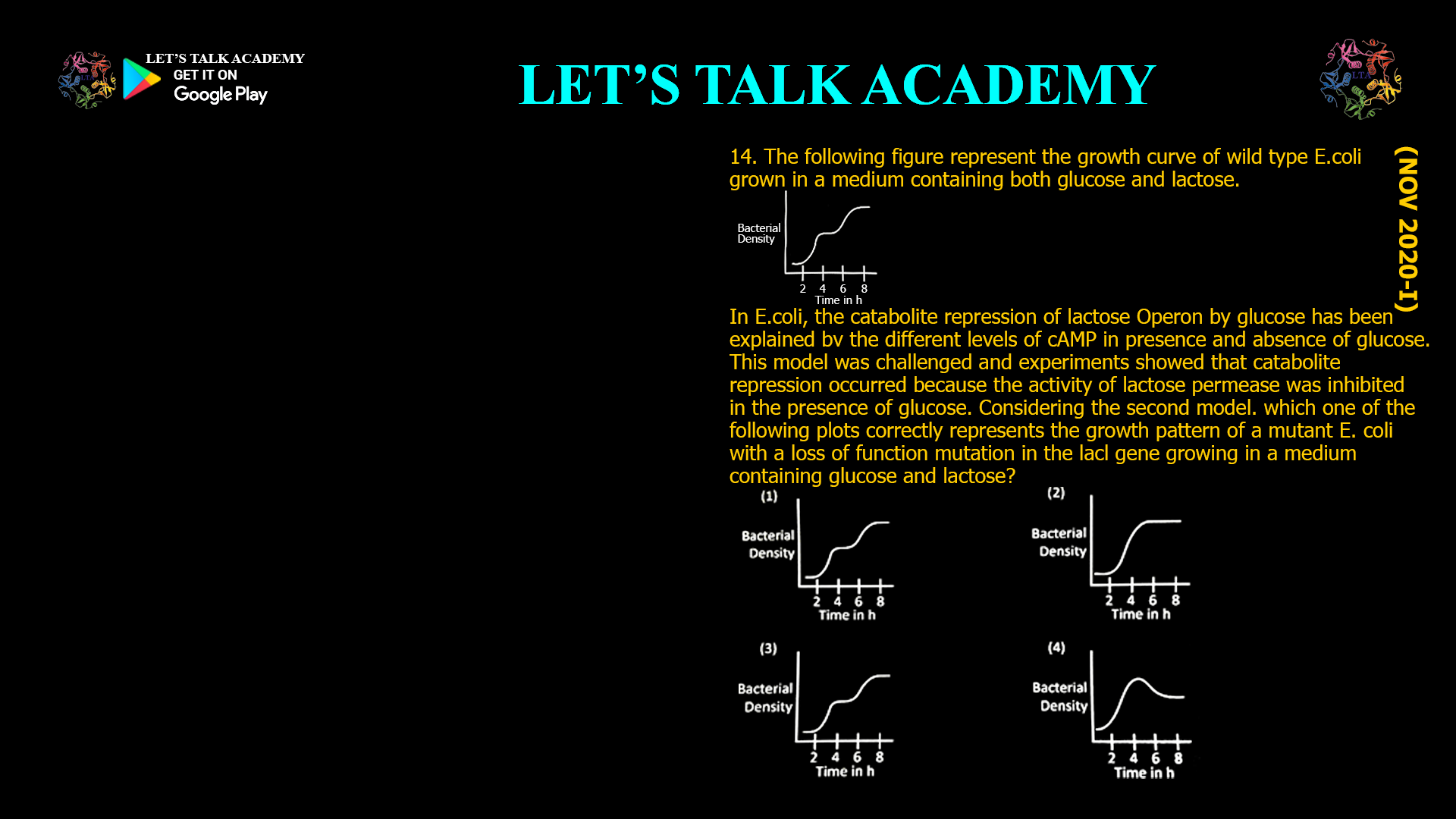
14. The following figure represent the growth curve of wild type E.coli grown in a medium containing both glucose and lactose. In E.coli, the catabolite repression of lactose Operon by glucose has been explained bv the different levels Of cAMP in presence and absence of glucose. This model was challenged and experiments showed that catabolite repression occurred because the activity Of lactose permease was inhibited in the presence of glucose. Considering the second model. which one of the following plots correctly represents the growth pattern of a mutant E. coli With a loss of function mutation in the lacI gene growing in a medium containing glucose and lactose?

 Growth Curve of lacI Mutant E. coli in Glucose and Lactose

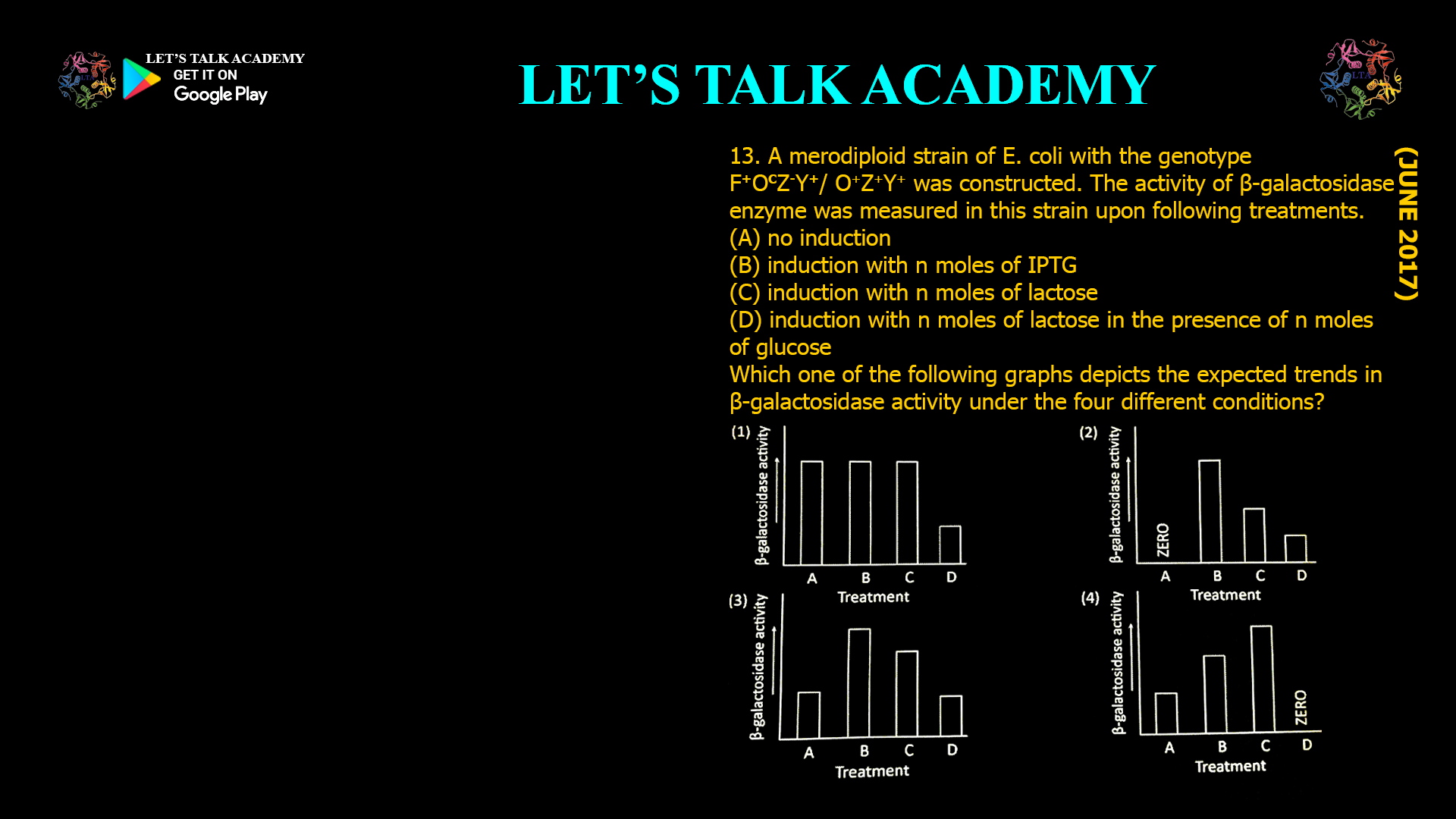
13. A merodiploid strain of E. coli with the genotype F+OCZ-Y+/ O+Z+Y+was constructed. The activity of β-galactosidase enzyme was measured in this strain upon following treatments. (A) no induction (B) induction with n moles of IPTG (C) induction with n moles of lactose (D) induction with n moles of lactose in the presence of n moles of glucose Which one of the following graphs depicts the expected trends in ß-galactosidase activity under the four different conditions?

 β-Galactosidase Activity in Merodiploid E. coli

12. A bacterial stra•n can use carbohydrates and hydrocarbons as growth substrates. The strain uses glucose following a minimal lag period after inoculation, regardless of the other carbohydrates and hydrocarbons in the growth medium, The following observations were also made. A. the absence of glucose, lactose is used after a lag period of about three times as long as the lag period for glucose utilization. B. The presence of hydrocarbons does not affect the lag period for the utilization Of lactose. C. The utilization pattern for all hydrocarbons is similar to that of lactose. D. Branched hydrocarbons are not immediately utilized if straight chain hydrocarbons are Initially present. Which one of the following specific regulatory mechanisms is consistent with the above observations related to carbohydrate and hydrocarbon utilization? (1) Diauxie (2) End point repression (3) Catabolite repression (4) Transcription attenuation

Catabolite Repression in Bacteria

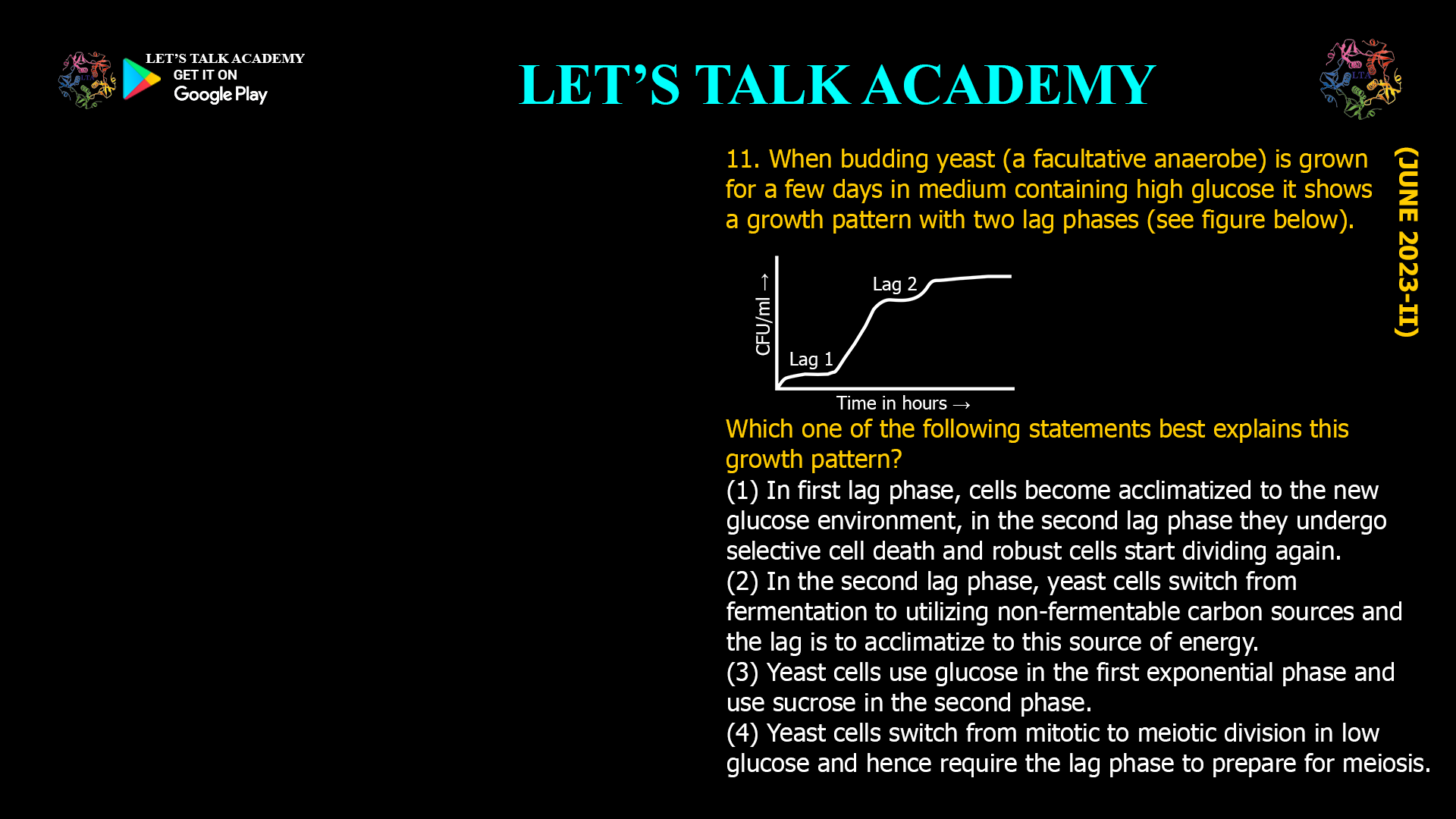
11. When budding yeast (a facultative anaerobe) is grown for a few days in medium containing high glucose it shows a growth pattern with two lag phases (see figure below). Which one of the following statements best explains this growth pattern? (1) In first lag phase, cells become acclimatized to the new glucose environment, in the second lag phase they undergo selective cell death and robust cells start dividing again. (2) In the second lag phase, yeast cells switch from fermentation to utilizing non-fermentable carbon sources and the lag is to acclimatize to this source of energy. (3) Yeast cells use glucose in the first exponential phase and use sucrose in the second phase. (4) Yeast cells switch from mitotic to meiotic division in low glucose and hence require the lag phase to prepare for meiosis.

Budding Yeast Show Two Lag Phases When Grown on High Glucose

10 Two E.coli Culture A and B are taken. Culture A was earlier grown in the presence of optimum concentration of gratuitous inducer IPTG. Both the cultures are now used to inoculate fresh medium containing suboptimal concentration of gratuitous inducer. It was observed that culture B was unable to utilize lactose, whereas culture A did so efficiently. The reason behind this is (1) pretreatment With IPTG has resulted in a mutation as a result of which lac operon is constitutively expressed (2) IPTG has made the cell membrane more porous to small molecules and so lactose taken up more efficiently by A as compared to B. (3) In culture A, lactose permease was induced to a high level, during pretreatment With IPTG. Which allowed the preferential uptake Of lactose. (4) in culture A, IPTG activated a receptor which bound lactose more efficiently. thereby triggering a signal.

The Role of Lactose Permease and the Lac Operon

9. A culture medium contains two carbon sources, one is preferred carbon source (glucose) and the second is a non-preferred source (lactose). Which one below is correct regarding the nature of growth curve of E. coli cultured in this medium? (1) Growth curve will be same as when grown in presence of only glucose. (2) Growth curve will be same as when grown in presence of only lactose. (3) A lag phase will be observed between the two exponential phases. (4) Two lag phases will be observed between the two exponential phases.

Diauxic Growth in E. coli: How Glucose and Lactose Shape the Bacterial Growth Curve

8. E. coli cells are growing in a medium containing lactose but no glucose. Indicate the expression status of the lac operon if glucose is added to the culture. (1) Decreased expression (2) Increased expression (3) No changes in expression level, (4) Initial rapid increase followed by sharp drop

Glucose Addition and Lac Operon Expression

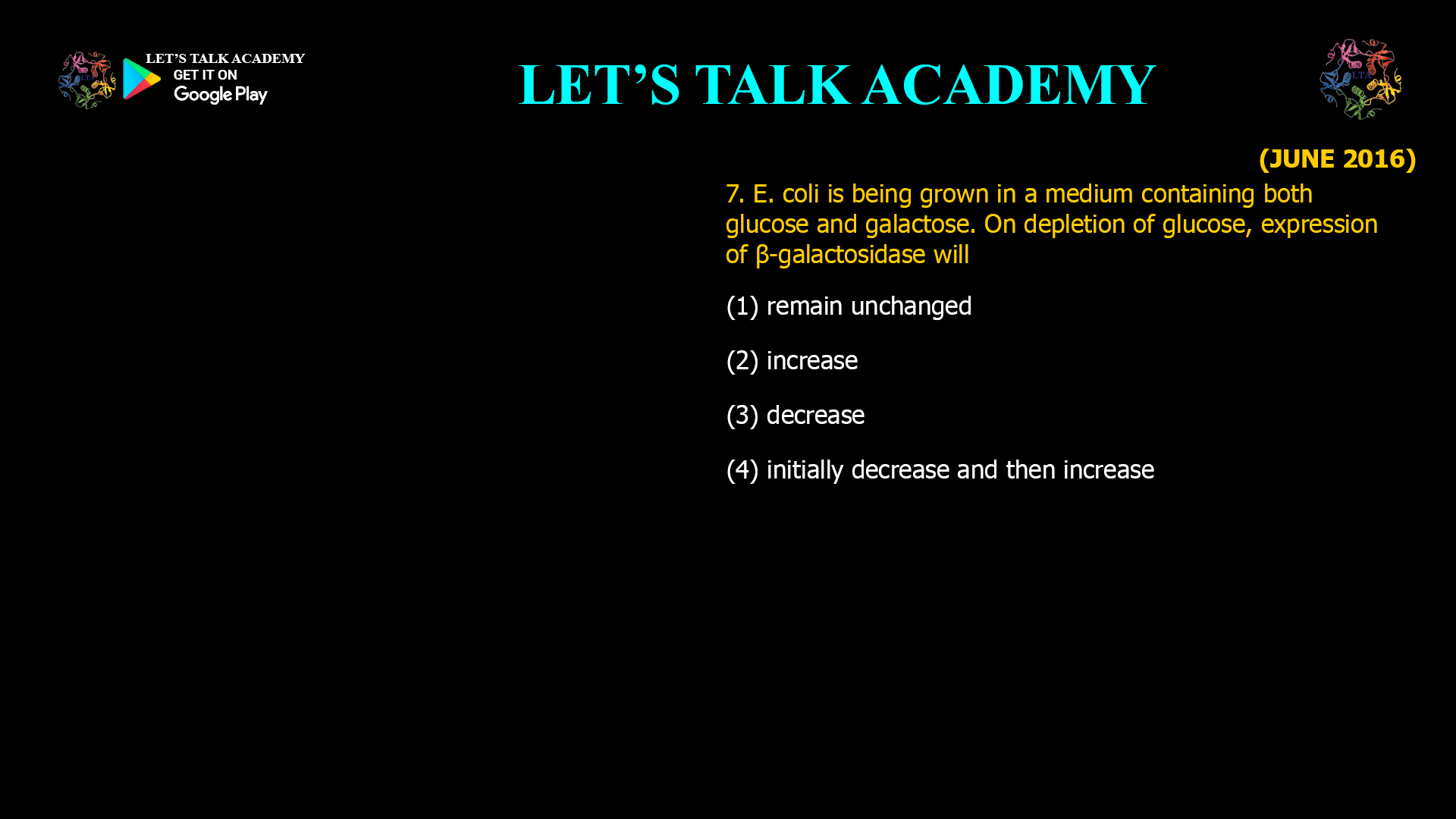
7. E. coli is being grown in a medium containing both glucose and galactose. On depletion of glucose, expression of β-galactosidase will (1) remain unchanged (2) increase (3) decrease (4) initially decrease and then increase

How β-Galactosidase Expression in E. coli Changes After Glucose Depletion in a Galactose Medium

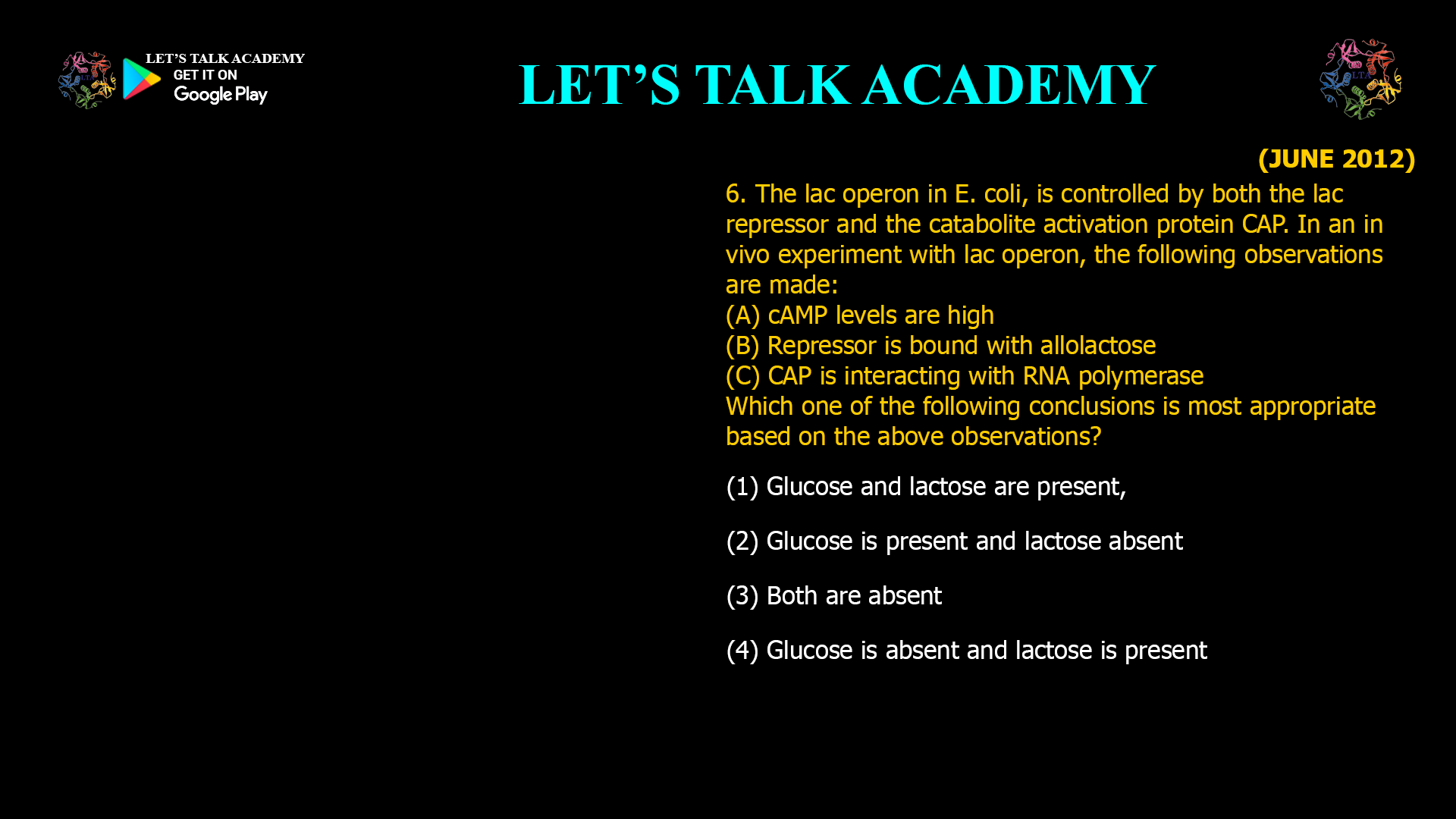
6. The lac operon in E. coli. is controlled by both the lac repressor and the catabolite activation protein CAP. In an in vivo experiment with lac operon, the following observations are made: (A) cAMP levels are high (B) Repressor is bound With allolactose (C) CAP is interacting With RNA polymerase Which one of the following conclusions is most appropriate based on the above observations? (1) Glucose and lactose are present, (2) Glucose is present and lactose absent (3) Both are absent (4) Glucose is absent and lactose is present

Lac Operon Regulation By High cAMP, Allolactose and CAP Activity

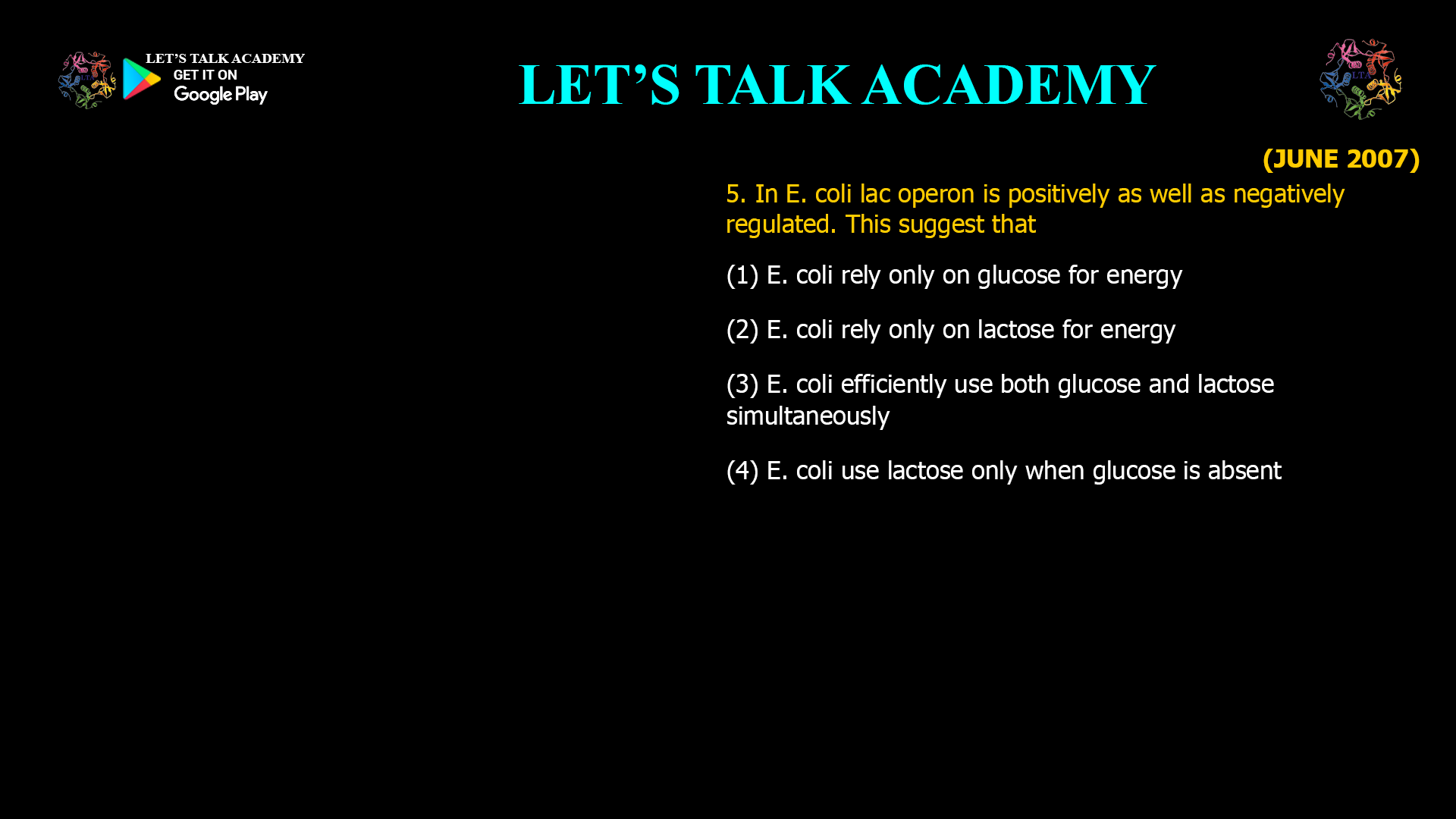
5. In E. coli lac operon is positively as well as negatively regulated. This suggest that (1) E. coli rely only on glucose for energy (2) E. coli rely only on lactose for energy (3) E. coli effioently use both glucose and lactose simultaneously (4) E. coli use lactose only when glucose absent

E. coli Lac Operon Both Positively and Negatively Regulated

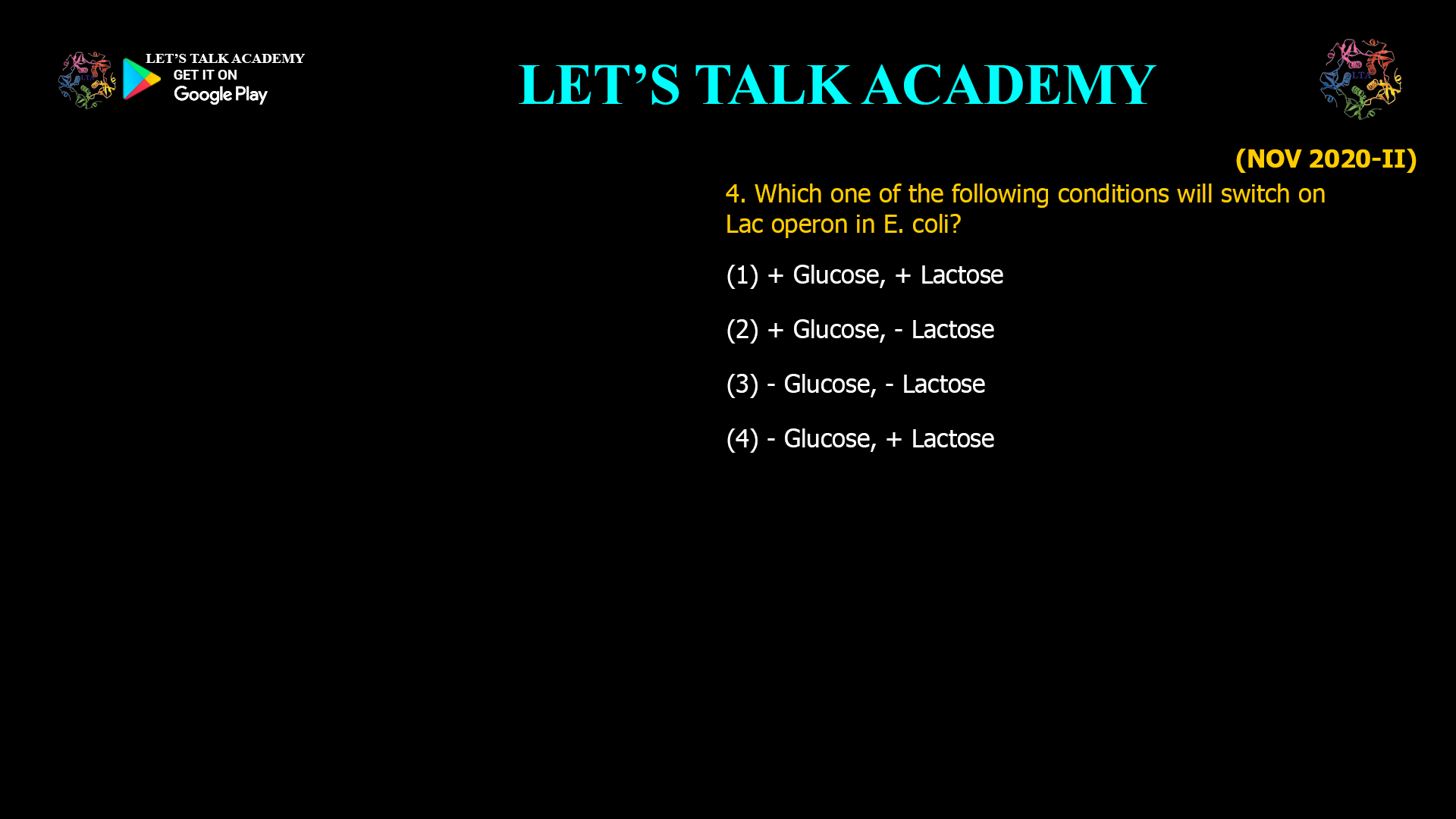
Which one of the following conditions will switch on Lac operon in E. coli? (1) + Glucose, + Lactose (2) + Glucose, - Lactose (3) - Glucose, - Lactos (4) –Glucose, + Lactose

Glucose and Lactose Regulation in the Lac Operon in E. coli

3. In Lac operon, if lac repressor binds to operator it will lead to (1) Switch on transcription (2) Switch off transcription (3) Enhanced transcription (4) Differential gene expression

Lac Repressor Binding to Operator in the Lac Operon

2. If inducer binds to repressor, it will prevent (1) Transcription (2) Binding of RNA polymerase to promoter (3) Binding of repressor to operator (4) Binding of repressor to promoter

 What Happens When an Inducer Binds to a Repressor

. If mutation in regulatory gene increases 1000 fold operator binding efficiency of repressor protein, under such condition, which is true for operon? (1) No expression of operon genes (2) Basal expression of operon genes (3) Normal expression of operon genes (4) Increased expression of operon genes

Operator Binding Efficiency of Repressor Protein and Operon Gene Expression

Latest Courses