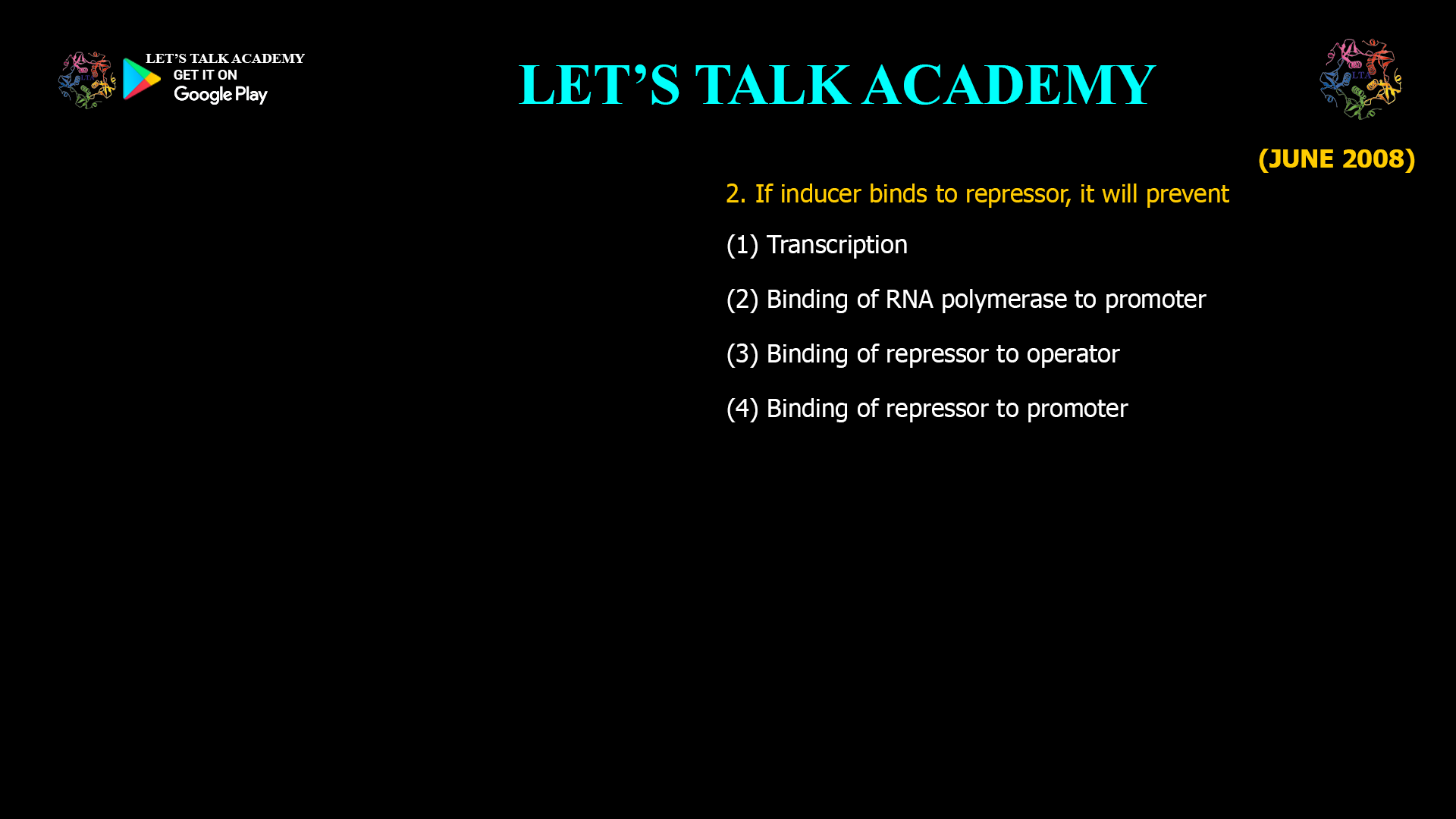
- If inducer binds to repressor, it will prevent
(1) Transcription
(2) Binding of RNA polymerase to promoter
(3) Binding of repressor to operator
(4) Binding of repressor to promoter
Gene expression is a tightly regulated process, ensuring that genes are turned on or off as needed. One of the most fundamental mechanisms in prokaryotic gene regulation is the interaction between repressors, inducers, and DNA elements like operators and promoters. This article explores what happens when an inducer binds to a repressor, how it affects transcription, and why this process is crucial in molecular biology.
Understanding the Basics: Key Players in Gene Regulation
-
Repressor: A protein that binds to specific DNA sequences (operators) to block transcription.
-
Inducer: A small molecule that can bind to a repressor and alter its activity.
-
Operator: A DNA sequence where the repressor binds to inhibit gene expression.
-
Promoter: The DNA region where RNA polymerase binds to initiate transcription.
The Mechanism: Inducer Binding to Repressor
In many prokaryotic systems, such as the lac operon in Escherichia coli, gene expression is controlled by a repressor protein that binds to the operator region of DNA. When the repressor is bound to the operator, it physically blocks RNA polymerase from transcribing the downstream genes, thus preventing gene expression.
When an inducer molecule becomes available in the cell, it binds to the repressor protein. This binding causes a conformational change in the repressor, reducing its affinity for the operator DNA. As a result, the repressor detaches from the operator, freeing the DNA for RNA polymerase to bind to the promoter and initiate transcription. This process is known as induction.
Key Point:
When an inducer binds to a repressor, it prevents the repressor from binding to the operator, thereby allowing transcription to proceed1258.
Step-by-Step: How Inducer-Repressor Binding Affects Transcription
-
In the Absence of Inducer:
-
The repressor binds tightly to the operator.
-
RNA polymerase cannot access the promoter or transcribe the gene.
-
Gene expression is repressed.
-
-
In the Presence of Inducer:
-
The inducer binds to the repressor, causing a structural change.
-
The repressor can no longer bind to the operator.
-
RNA polymerase binds to the promoter and initiates transcription.
-
The gene is expressed.
-
Why Does This Matter? Biological Significance
Efficient Resource Use:
Cells avoid wasting energy by only expressing certain genes when their products are needed. For example, the lac operon is only activated when lactose is present, ensuring enzymes for lactose metabolism are produced only when required.Rapid Response:
This mechanism allows bacteria to quickly adapt to changes in their environment by switching genes on or off in response to the presence or absence of specific molecules.Regulation of Metabolic Pathways:
Inducer-repressor systems are central to the regulation of many metabolic pathways, enabling cells to fine-tune their internal processes for survival and growth.
Applications in Biotechnology and Research
-
Genetic Engineering:
Inducible promoters are widely used in biotechnology to control gene expression in engineered organisms. By adding or removing inducers, researchers can precisely control when and how much of a protein is produced. -
Synthetic Biology:
Synthetic gene circuits often use repressor-inducer systems to create logic gates, switches, and oscillators for complex biological computations. -
Drug Development:
Understanding these mechanisms helps in designing antibiotics and other drugs that target bacterial gene regulation.
Common Examples: The Lac Operon
The lac operon is the classic example of an inducible system. Here’s how it works:
-
Repressor: The lac repressor binds to the operator, blocking transcription.
-
Inducer: When lactose is present, it is converted to allolactose (the inducer), which binds to the repressor.
-
Effect: The repressor changes shape and releases the operator, allowing RNA polymerase to transcribe the genes needed for lactose metabolism
-


33 Comments
Rekha Jat
June 12, 2025Binding of RNA polymerase to permoter
Rekha Jat
June 12, 2025Binding of RNA polymerase to permoter because the inducer inactivate The repressors protin
Arushi
June 14, 2025👍✅
Suman bhakar
June 12, 2025✅✅
Anita choudhary
June 13, 2025Done sir 👍
Krishana
June 13, 2025👍👍
Krishana
June 13, 2025Sir isme binding of repressor to oprator hoga na ,kyuki inducer(allolactose) bind to repressor and inactive repressor protein ,,or inactive repressor protein can’t able to bind operator
Kajal
November 3, 2025Binding of Rna polymerase to promotor
Sakshi Kanwar
November 10, 2025When an inducer binds to a repressor, it prevents the repressor from binding to the operator
Divya rani
November 4, 2025If inducer binds with Repressor protein then R.P become inactive so Inducer prevent the binding of repressor with operator.
Kirti Agarwal
November 4, 2025Binding of repressor to operator
anjani sharma
November 5, 2025Binding of repressor to operator
Santosh Saini
November 5, 2025When an inducer binds to A repressor, it prevents the repressor from binding to the operator
Neha Yadav
November 6, 2025Prevent Binding of repressor to operator
Roopal Sharma
November 6, 2025Prevent binding of repressor to operator
Heena Mahlawat
November 6, 2025Prevent binding of repressor to operator
Sonal Nagar
November 6, 2025Option 3rd
Neelam Sharma
November 6, 2025Binding of repressor to operator
Neeraj Sharma
November 6, 2025If inducer binds with repressor then the repressor will not able to bind with the operator
Deepika Sheoran
November 6, 2025Binding of repressor to operator.
Anisha Beniwal
November 6, 2025Binding of repressor to operator
Dipti Sharma
November 6, 2025When an inducer binds to a repressor, it prevents the repressor from binding to the operator and rna polymerase can bind to the promoter .
Sonam Saini
November 7, 2025Binding preparation to operator
Sonam Saini
November 7, 2025Binding of repressor to opreter
Aman Choudhary
November 7, 2025Binding of repressor to opreter bcz inducer alters it’s activity
Bhawna Choudhary
November 8, 2025Binding of repressor to operator
Anurag Giri
November 8, 2025When an inducer binds to A repressor, it prevents the repressor from binding to the operator
Mansukh Kapoor
November 8, 2025It prevents the binding of repressor to the operator
Mohd juber Ali
November 9, 2025When a inducer such as allolactose binds with RP so RP is inactive not able to bind at operator so gene is on
Sakshi Kanwar
November 10, 2025When an inducer binds to a repressor, it prevents the repressor from binding to the operator
Manisha choudhary
November 12, 2025Binding repressor to operator
Nilofarkhan
March 30, 2026Binding of RNA polymerase to permoter because the inducer inactivate The repressors protin
Juber Khan
June 14, 2026When inducer bind with repressor, repressor detaches from operator and now Rna poly able to bind at promotor now gene on