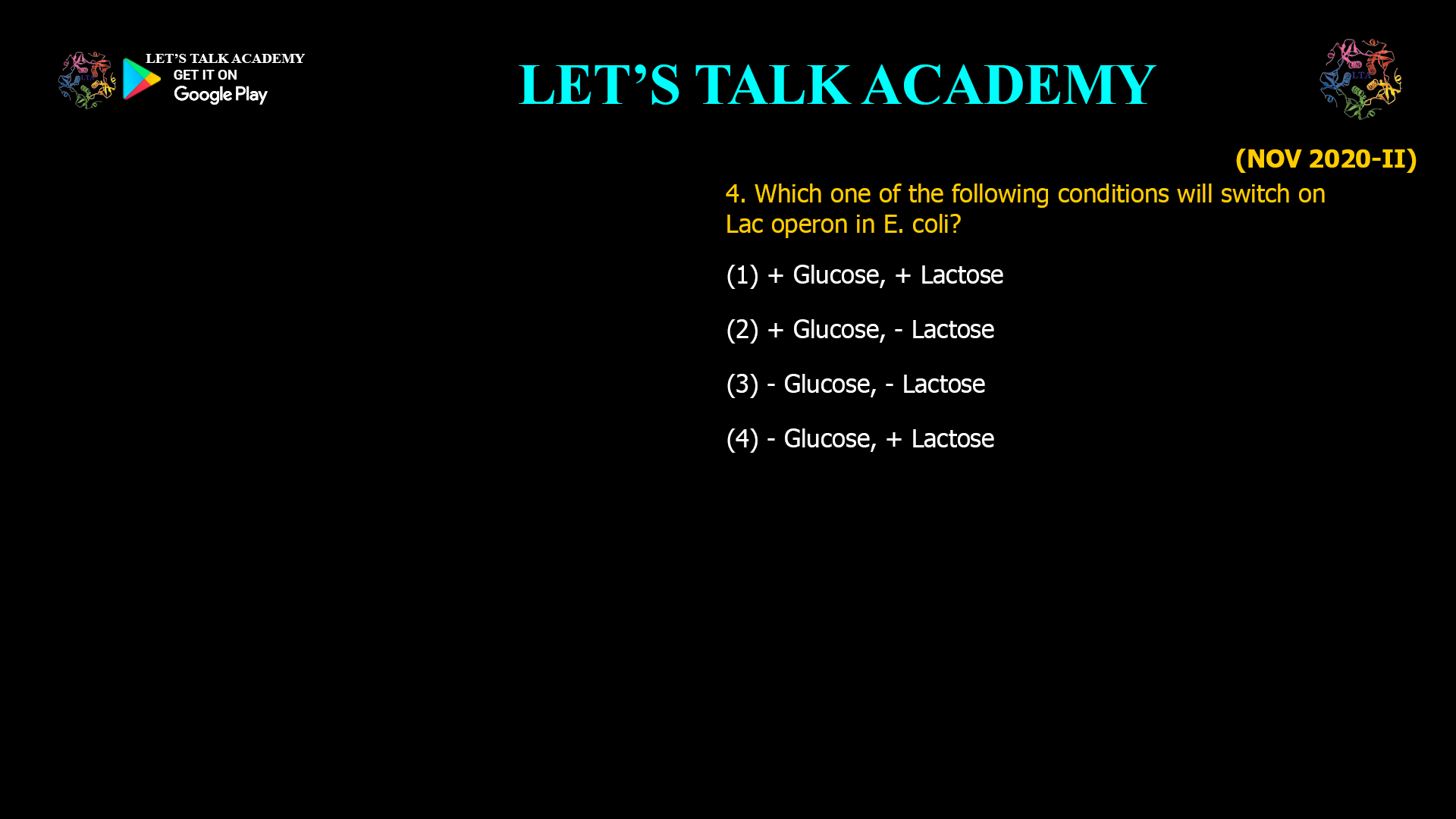
Which one of the following conditions will switch on Lac operon in E. coli?
(1) + Glucose, + Lactose
(2) + Glucose, – Lactose
(3) – Glucose, – Lactos
(4) –Glucose, + Lactose
Efficient gene regulation is vital for bacterial survival, especially in fluctuating environments. The lac operon in Escherichia coli is a classic example of how bacteria optimize energy use by switching genes on or off depending on nutrient availability. Understanding the precise condition that activates the lac operon reveals the intricate balance between glucose and lactose metabolism in E. coli.
What is the Lac Operon?
The lac operon is a set of genes in E. coli responsible for the uptake and breakdown of lactose, a sugar found in milk. These genes include:
-
lacZ: Encodes β-galactosidase, which splits lactose into glucose and galactose.
-
lacY: Encodes permease, which transports lactose into the cell.
-
lacA: Encodes transacetylase, involved in lactose metabolism.
These genes are controlled by a single promoter and operator, working together as a unit to ensure coordinated expression.
Regulation of the Lac Operon
The lac operon is regulated by two main factors:
-
Lac Repressor: A protein that binds to the operator region, blocking transcription when lactose is absent.
-
Catabolite Activator Protein (CAP): A positive regulator that enhances transcription when glucose is absent.
The interplay between these regulators ensures the operon is only active when it benefits the cell.
Role of Glucose and Lactose
E. coli prefers glucose as its primary energy source. When glucose is available, the lac operon remains mostly off, even if lactose is present. Only when glucose is scarce and lactose is available does the operon switch on fully, allowing the cell to metabolize lactose efficiently.
How Do Glucose and Lactose Levels Affect the Lac Operon?
Let’s examine each possible condition:
1. Glucose Present, Lactose Present (+ Glucose, + Lactose)
-
Effect: Low-level, “leaky” transcription of the lac operon.
-
Reason: The presence of glucose keeps cAMP levels low, so CAP is inactive and cannot enhance transcription. Lactose inactivates the repressor, so some transcription occurs, but it is not robust6.
2. Glucose Present, Lactose Absent (+ Glucose, – Lactose)
-
Effect: No transcription of the lac operon.
-
Reason: The lac repressor remains bound to the operator, blocking RNA polymerase. Glucose also keeps cAMP low, so CAP is inactive.
3. Glucose Absent, Lactose Absent (- Glucose, – Lactose)
-
Effect: No transcription of the lac operon.
-
Reason: Even though glucose is absent (which would activate CAP), the lack of lactose means the repressor stays bound to the operator, preventing transcription.
4. Glucose Absent, Lactose Present (- Glucose, + Lactose)
-
Effect: Strong transcription of the lac operon.
-
Reason: The absence of glucose increases cAMP levels, activating CAP, which enhances RNA polymerase binding. The presence of lactose inactivates the repressor, freeing the operator. This combination leads to maximal expression of the lac operon.
Why Is This Regulation Important?
This dual control ensures that E. coli only expends energy to metabolize lactose when it is the only available sugar. If glucose is present, the cell prioritizes its use because it is more energy-efficient. Only when glucose is depleted does the cell fully activate the lac operon to utilize lactose.
Molecular Mechanism: Step-by-Step Activation
-
Low Glucose: cAMP levels rise, activating CAP.
-
CAP Binds Promoter: CAP-cAMP complex binds near the lac promoter, enhancing RNA polymerase binding.
-
Lactose Present: Lactose (converted to allolactose) binds the lac repressor, causing it to release from the operator.
-
Transcription Initiation: RNA polymerase binds efficiently, leading to high-level transcription of lacZ, lacY, and lacA.
Summary Table: Lac Operon Activation
| Glucose | Lactose | CAP Active | Repressor Bound | Transcription Level |
|---|---|---|---|---|
| + | – | No | Yes | None |
| + | + | No | No | Low |
| – | – | Yes | Yes | None |
| – | + | Yes | No | High (ON) |
Frequently Asked Questions
Q: Why doesn’t the lac operon turn on when both glucose and lactose are present?
A: When glucose is present, cAMP levels are low, so CAP is inactive. Although the repressor is removed by lactose, the lack of CAP activation means transcription is minimal.
Q: What is the role of allolactose in this system?
A: Allolactose, a derivative of lactose, binds to the lac repressor and inactivates it, allowing transcription to proceed if other conditions are met.
Q: Can the lac operon be partially active?
A: Yes, in the presence of both glucose and lactose, the operon is transcribed at a low level due to the absence of CAP activation.
Conclusion
The lac operon in E. coli is a finely tuned system that responds to environmental nutrient levels. It is switched on—meaning strong transcription occurs—only when glucose is absent and lactose is present. This ensures that the cell efficiently manages its energy resources and only produces lactose-metabolizing enzymes when absolutely necessary.
Correct Condition to Switch On the Lac Operon:
(- Glucose, + Lactose)
Keywords: lac operon, E. coli, glucose, lactose, gene regulation, lac repressor, CAP, cAMP, transcription, operon activation, allolactose, β-galactosidase, permease, metabolic regulation, gene expression, bacterial operon, molecular biology, lactose metabolism, promoter, operator, RNA polymerase, inducible operon.


27 Comments
Suman bhakar
June 12, 2025✅✅
Anita choudhary
June 13, 2025✅👍
Arushi
June 14, 2025Done sir✅
Kabeer narwal
June 18, 2025☑️☑️
Niharika Rajotiya
June 19, 2025Amazing explanation
Kajal
November 3, 2025– glucose and + lactose switch on lac operon
Divya rani
November 4, 2025In the absence of glucose and in the presence of lactose the gene is ON so transcription occurs. Because allolactose inactivates the R.P so RNA pol. can bind at promotor so transcription start .
Kirti Agarwal
November 4, 2025In the absence of glucose and in the presence of lactose the gene is on so transcription occur
anjani sharma
November 5, 2025-glucose and + lactose switch on lac operon.
Santosh Saini
November 5, 2025– Glucose ,+ Lactose switch on lac operon bcz absence of glucose increases cAMP levels , activating Cap, which enhance RNA polymerase binding and the presence of lactose inactivates the repressor, freeing the operator , transcription occur
Neha Yadav
November 6, 2025– Glucose , + lactose = switch on lac operon
Roopal Sharma
November 6, 2025Glucose absent lactose present
Heena Mahlawat
November 6, 2025Option 4
Sonal Nagar
November 6, 2025Option 4th
Deepika Sheoran
November 6, 2025Glucose absent lactose present
Switch on lac operon.
Anisha Beniwal
November 6, 2025–Glucose, + Lactose
Neeraj Sharma
November 6, 2025Presence of lactose and absence of glucose will switch on the lac operon
Neelam Sharma
November 6, 2025Glucose absent lactose present
Switch on lac operon.
Dipti Sharma
November 6, 2025-glucose and + lactose switch on lac operon.
Sonam Saini
November 7, 2025Glucose ki absent and lactose ki present me Rp protein ko.allo lactose ki help se inactive kiya jata h aur operater pr bind kr ke tc kiya jata hai
Aman Choudhary
November 7, 2025-Glucose and + lactose switch on lac operon in absence of glucose lactose convert into allo-lactose and bind on Repressor protein results inactive Repressor protein so RNA polymerase bind on promoter leads transcription
Anurag Giri
November 8, 2025-glucose and + lactose switch on lac operon
Bhawna Choudhary
November 8, 2025– Glucose & + lactose
Mansukh Kapoor
November 8, 2025-Glucose &+lactose
Mohd juber Ali
November 9, 2025Abscent of glucose and present of lactose bcz glucose block adinylate cyclase so no formn of camp so inactive AP not able to at promotor but presence of lactose switch on expression
Sakshi Kanwar
November 10, 2025– Glucose, + Lactose
Manisha choudhary
November 12, 2025Glucose absent, lactose present