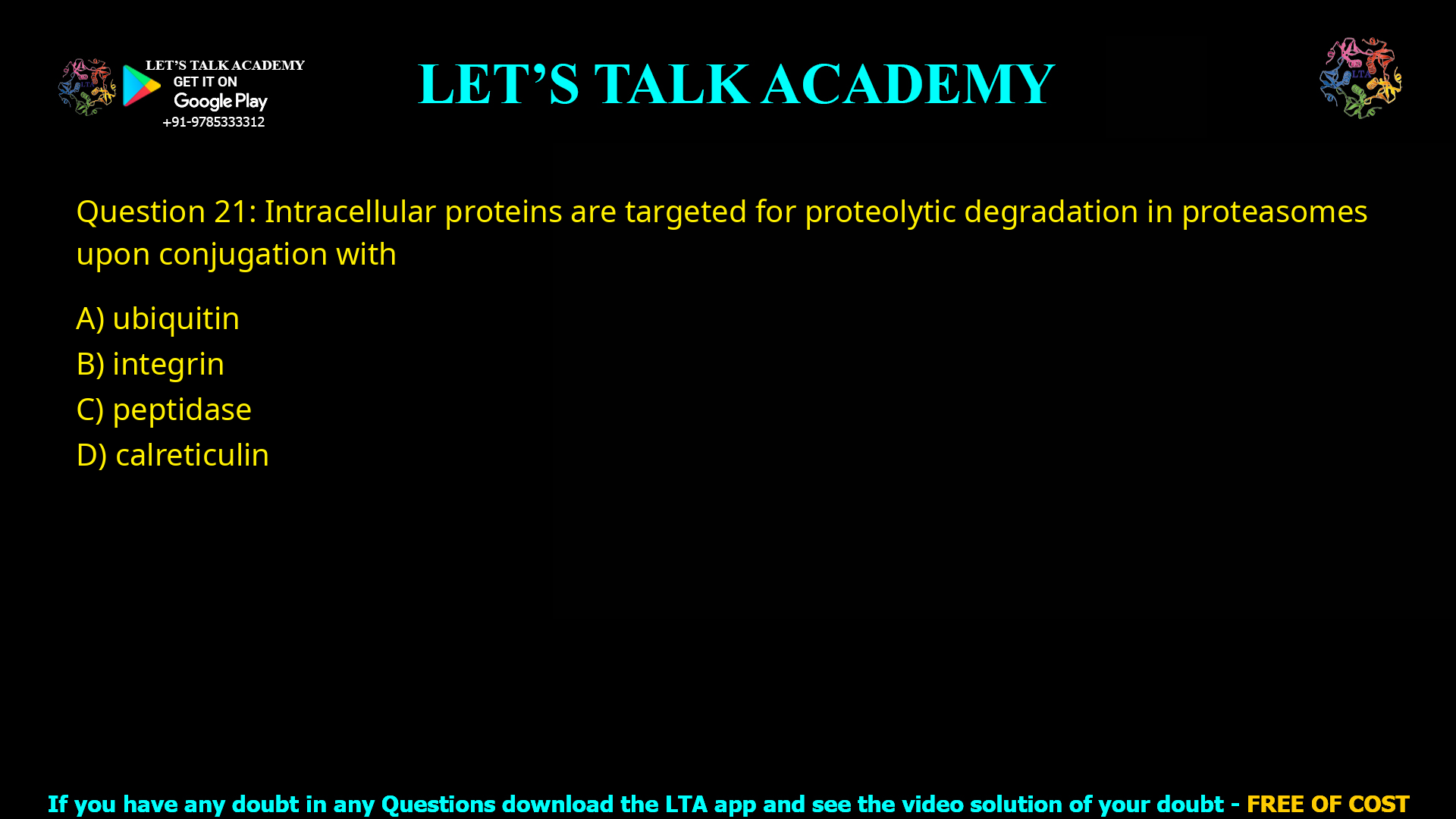
Q.21 Intracellular proteins are targeted for proteolytic degradation in proteasomes upon
conjugation with
(A) ubiquitin
(B) integrin
(C) peptidase
(D) calreticulin
Answer: (A) ubiquitin
Intracellular proteins undergo proteolytic degradation in proteasomes after conjugation with ubiquitin, a key step in the ubiquitin-proteasome system (UPS) that regulates protein turnover.
Option Analysis
Ubiquitin (A): This small regulatory protein tags damaged or regulatory proteins via a three-enzyme cascade (E1, E2, E3 ligases), forming polyubiquitin chains (typically K48-linked) that signal recognition by the 26S proteasome for ATP-dependent unfolding and hydrolysis. This process maintains cellular homeostasis by clearing misfolded proteins and short-lived regulators like p53.
Integrin (B): Integrins function as transmembrane receptors mediating cell-cell and cell-extracellular matrix adhesion, activating signaling pathways like FAK and Rho GTPases, unrelated to intracellular proteasomal targeting. [ from context]
Peptidase (C): Peptidases (proteases) cleave peptide bonds but do not conjugate to proteins for targeting; they act directly in degradation, such as within the proteasome’s catalytic core, not as upstream signals.
Calreticulin (D): This ER chaperone assists in protein folding and calcium homeostasis, also aiding antigen presentation, but plays no role in ubiquitination or proteasomal degradation signals. [ from context]
Proteins inside cells constantly turn over to maintain balance, and intracellular proteins targeted for proteolytic degradation in proteasomes upon ubiquitin conjugation form the core of this process via the ubiquitin-proteasome system (UPS). This pathway handles 80-90% of cytosolic protein breakdown, crucial for exams like IIT JAM Biotechnology.
Ubiquitin Conjugation Mechanism
E1 activates ubiquitin using ATP, passing it to E2, then E3 ligases attach it to lysine residues on target proteins, building K48-polyubiquitin chains for proteasome docking. The 19S cap unfolds and feeds these into the 20S core for hydrolysis into peptides.
-
Targets misfolded, damaged, or regulatory proteins like cyclins and p53.
-
Regulated by deubiquitinases (DUBs) for reversibility until polyubiquitination commits to degradation.
Why Not Other Options?
While ubiquitin is the standard tag, exceptions exist for ubiquitin-independent degradation (e.g., Rpn4), but the question specifies “conjugation,” pointing directly to ubiquitin over integrins (adhesion), peptidases (enzymes), or calreticulin (chaperone).
Relevance to Competitive Exams
For IIT JAM, understanding proteolytic degradation in proteasomes links to cell biology, biochemistry scoring sections—ubiquitin defects tie to diseases like Parkinson’s. Practice similar MCQs to master enzyme kinetics alongside.


1 Comment
Ankita Pareek
April 19, 2026Intracellular protein proteolytic degradation takes place in proteosome after conjunction with ubiquitine