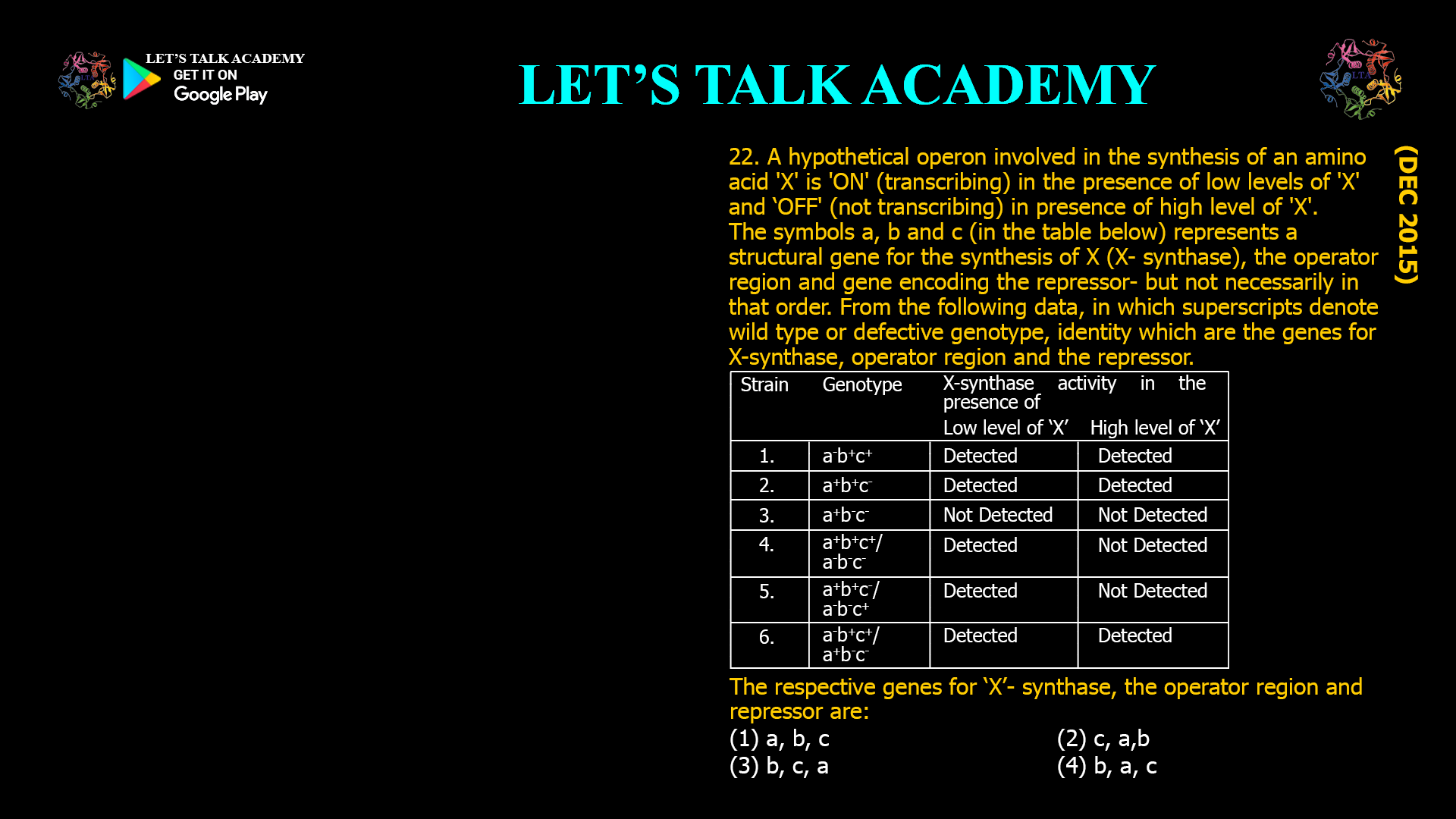
- A hypothetical operon involved in the synthesis of an amino acid ‘X’ is ‘ON’ (transcribing) in the presence of low levels of ‘X’ and ‘Off’ (not transcribing) in presence of high level of ‘X’. The symbols a, b and c (in the table below) represents a structural gene for the synthesis of X (X- synthase), the operator region and gene encoding the repressor- but not necessarily in that order. From the following data, in which superscripts denote wide type or defective genotype, identity which are the genes for X-svnthase, operator region and the repressor.
Strain Genotype X-synthase activity in
the presence of
Low level High level
of ‘X’ of ‘X’
1. a– b+ c+ Detected Detected
2. a+ b+ c– Detected Detected
3. a+ b– c– Not Detected Not Detected
4. a+ b+ c+ / Detected Not Detected
a– b– c–
5. a+ b+ c– / Detected Not Detected
a– b– c+
6. a– b+ c+ / Detected Detected
a+ b– c–
The respective genes for ‘X’- synthase, the operator region and repressor are:
(1) a, b, c (2) c, a, b
(3) b, c, a (4) b, a, c
Understanding the genetic architecture and regulation of bacterial operons is fundamental in molecular biology. Operons involved in amino acid biosynthesis, like the well-known trp operon, are classic examples of how cells coordinate gene expression in response to metabolite levels56. In this article, we analyze a hypothetical operon responsible for synthesizing amino acid ‘X’, using mutant and merodiploid data to identify which gene symbols (a, b, c) correspond to the structural gene (X-synthase), the operator region, and the repressor gene.
Operon Regulation: The Basics
A typical repressible operon for amino acid biosynthesis includes:
-
Structural gene: Encodes the biosynthetic enzyme (e.g., X-synthase).
-
Operator: DNA region where a repressor binds to regulate transcription.
-
Repressor gene: Encodes a regulatory protein that responds to amino acid levels, repressing the operon when the amino acid is abundant56.
When the amino acid is scarce, the operon is ON (transcribing). When the amino acid is plentiful, the operon is OFF (not transcribing).
Analyzing the Mutant and Merodiploid Data
1. a- b+ c+ : Detected (low X), Detected (high X)
-
Mutation in “a” does not prevent X-synthase activity.
-
Suggests “a” is not the structural gene.
2. a+ b+ c- : Detected (low X), Detected (high X)
-
Mutation in “c” leads to constitutive expression (always ON).
-
This is characteristic of a repressor gene mutation: without a functional repressor, the operon cannot be turned off.
3. a+ b- c- : Not detected (low X), Not detected (high X)
-
Mutation in “b” abolishes X-synthase activity, regardless of X levels.
-
This is characteristic of a structural gene mutation.
4. a+ b+ c+ / a- b- c- : Detected (low X), Not detected (high X)
-
Merodiploid with one wild-type and one triple mutant copy.
-
Normal regulation restored, indicating dominance of wild-type alleles.
5. a+ b+ c- / a- b- c+ : Detected (low X), Not detected (high X)
-
Merodiploid with one wild-type and one mutant copy (structural gene and operator defective, repressor wild-type).
-
Normal regulation restored, again showing wild-type dominance.
6. a- b+ c+ / a+ b- c- : Detected (low X), Detected (high X)
-
Merodiploid with one copy defective in “a” and one defective in “b” and “c”.
-
Constitutive expression, indicating that the presence of c- (repressor–) leads to loss of repression.
Assigning Gene Functions
-
b = Structural gene (X-synthase):
Mutations in “b” (b-) abolish X-synthase activity completely (Strain 3), which is the hallmark of a structural gene mutation. -
a = Operator region:
Mutations in “a” alone do not affect X-synthase activity (Strain 1), and in merodiploid combinations, “a” behaves as expected for a cis-acting regulatory element. -
c = Repressor gene:
Mutations in “c” (c-) result in constitutive expression (Strain 2), a classic repressor mutant phenotype.
Correct Option
The correct assignment is:
(4) b, a, c
-
b: X-synthase (structural gene)
-
a: Operator region
-
c: Repressor gene
Summary Table
| Strain | Genotype | X-synthase Activity (Low X) | X-synthase Activity (High X) | Interpretation |
|---|---|---|---|---|
| 1 | a- b+ c+ | Detected | Detected | a ≠ structural gene |
| 2 | a+ b+ c- | Detected | Detected | c = repressor gene |
| 3 | a+ b- c- | Not Detected | Not Detected | b = structural gene |
| 4 | a+ b+ c+ / a- b- c- | Detected | Not Detected | Wild-type dominance |
| 5 | a+ b+ c- / a- b- c+ | Detected | Not Detected | Wild-type dominance |
| 6 | a- b+ c+ / a+ b- c- | Detected | Detected | c- leads to constitutive |
Biological Significance
This analysis mirrors the logic used to dissect classic operons like the trp operon in E. coli, where mutations in the structural gene abolish enzyme activity, operator mutations alter regulation in cis, and repressor mutations cause loss of repression in trans56. Understanding these relationships is crucial for genetic engineering, synthetic biology, and fundamental bacterial genetics.
Conclusion
In this hypothetical operon for amino acid X biosynthesis, b encodes the X-synthase (structural gene), a is the operator region, and c encodes the repressor. This genetic architecture allows precise regulation of biosynthetic pathways in response to metabolite levels, ensuring efficient resource use and cellular adaptation.
Keywords: operon, structural gene, operator region, repressor gene, amino acid biosynthesis, gene regulation, mutant analysis, merodiploid, X-synthase, bacterial genetics, trp operon, E. coli.


6 Comments
Shreeji Charan
June 12, 2025Thanks a lot sir for such awesome explanation
Suman bhakar
June 13, 2025👍👍
Anita choudhary
June 14, 2025✅👍
Kajal
November 3, 2025The correct answer is (4) b, a, c
Komal Sharma
November 5, 2025Done
Neeraj Sharma
November 9, 2025B,a and C