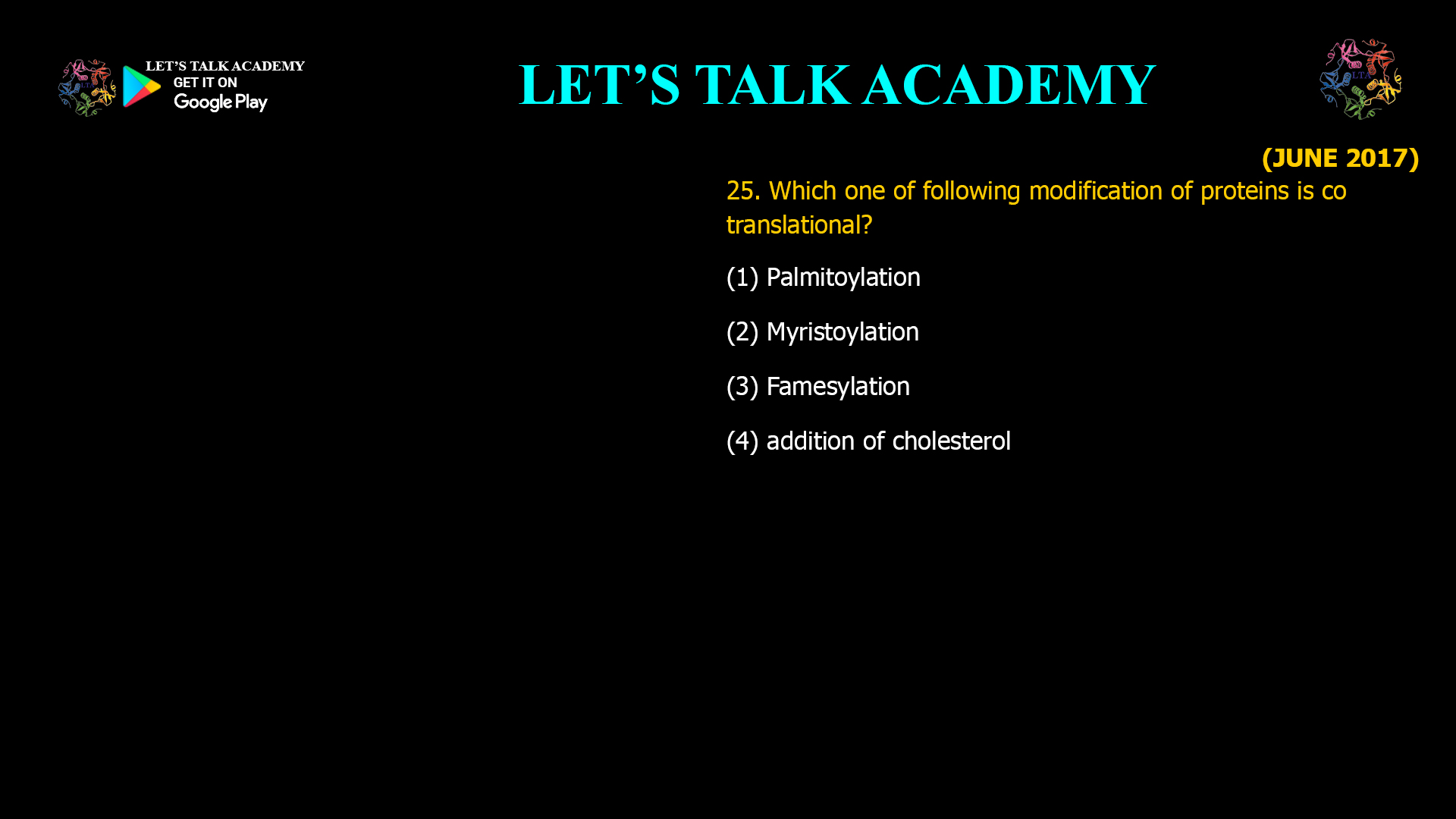
- Which one of following modification of proteins is co translational?
(1) Palmitoylation
(2) Myristoylation
(3) Famesylation
(4) addition of cholesterol
Introduction to Protein Modification
Proteins undergo a variety of modifications that are essential for their function, stability, localization, and interaction with other molecules. These modifications can occur either during translation (co-translational) or after translation is complete (post-translational). Understanding the timing and mechanisms of these modifications is crucial for unraveling the complexities of protein biology, signaling pathways, and disease mechanisms.
Co-Translational vs. Post-Translational Modifications
Co-translational modifications are those that take place while the protein is still being synthesized on the ribosome. Examples include signal peptide cleavage, glycosylation (in certain contexts), and myristoylation17. These modifications often play a role in protein targeting, folding, and initial processing.
Post-translational modifications occur after the protein has been fully synthesized and released from the ribosome. Common post-translational modifications include phosphorylation, ubiquitination, acetylation, palmitoylation, farnesylation, and cholesterol addition28. These modifications can regulate protein activity, stability, localization, and interactions.
Key Protein Modifications and Their Timing
Let’s examine the modifications mentioned in the question:
1. Palmitoylation
Definition:
Palmitoylation is the covalent attachment of palmitic acid (a 16-carbon fatty acid) to cysteine residues of proteins.Timing:
Palmitoylation is a reversible post-translational modification. It occurs after the protein has been fully synthesized and is often used to anchor proteins to cell membranes or regulate their trafficking and signaling.2. Myristoylation
Definition:
Myristoylation is the covalent attachment of myristic acid (a 14-carbon fatty acid) to the N-terminal glycine residue of proteins.Timing:
Myristoylation is a co-translational modification. It occurs while the protein is still being synthesized, typically after the removal of the initiator methionine and exposure of the N-terminal glycine. Myristoylation is important for membrane targeting and protein-protein interactions17.3. Farnesylation
Definition:
Farnesylation is the addition of a farnesyl group (a 15-carbon isoprenoid) to cysteine residues near the C-terminus of proteins, often as part of a CAAX motif.Timing:
Farnesylation is a post-translational modification. It occurs after the protein has been fully synthesized and is important for membrane association and signaling.4. Addition of Cholesterol
Definition:
Cholesterol can be covalently attached to certain proteins, a process known as cholesterol addition or cholesterylation.Timing:
Cholesterol addition is a post-translational modification. It occurs after protein synthesis and is involved in membrane localization and signaling.Detailed Comparison of Modifications
Modification Type Timing Substrate/Residue Function/Importance Palmitoylation Lipid modification Post-translational Cysteine Membrane anchoring, signaling Myristoylation Lipid modification Co-translational N-terminal glycine Membrane targeting, protein-protein binding Farnesylation Lipid modification Post-translational Cysteine (CAAX motif) Membrane association, signaling Cholesterol Lipid modification Post-translational Cysteine or other residues Membrane localization, signaling Why Is Myristoylation Co-Translational?
Myristoylation is unique among the listed modifications because it occurs co-translationally. Here’s why:
-
N-terminal Exposure:
Myristoylation requires the N-terminal glycine to be exposed. This happens after the initiator methionine is removed, which can occur before translation is complete. -
Enzyme Timing:
The enzyme responsible for myristoylation, N-myristoyltransferase, can access the nascent polypeptide as it emerges from the ribosome, allowing the modification to occur during translation17. -
Functional Implications:
Co-translational myristoylation ensures that the protein is immediately targeted to membranes or protein complexes, which is critical for its function.
Other Co-Translational Modifications
While myristoylation is a classic example, other co-translational modifications include:
-
Signal Peptide Cleavage:
Removes the signal sequence from nascent polypeptides, often in the endoplasmic reticulum. -
N-linked Glycosylation:
In eukaryotes, N-linked glycosylation begins co-translationally in the endoplasmic reticulum47.
The Role of Chaperones and Folding
Co-translational modifications are closely linked to protein folding and quality control. Chaperones such as Prefoldin and TRiC/CCT assist in the folding of nascent polypeptides as they emerge from the ribosome, ensuring proper structure and function3. These processes are tightly regulated and can influence the efficiency and fidelity of protein synthesis.
Clinical and Biological Significance
Understanding the timing and mechanisms of protein modifications is important for:
-
Drug Development:
Targeting enzymes involved in co- or post-translational modifications can lead to new therapies for cancer, neurodegenerative diseases, and infections. -
Disease Mechanisms:
Defects in protein modification pathways can lead to diseases such as cancer, diabetes, and immune disorders. -
Protein Engineering:
Manipulating modification pathways can be used to produce therapeutic proteins with improved stability and activity.
Summary of Key Concepts
-
Co-translational modifications occur during protein synthesis and are essential for proper protein function and localization.
-
Myristoylation is a co-translational modification that attaches myristic acid to the N-terminal glycine of proteins.
-
Palmitoylation, farnesylation, and cholesterol addition are post-translational modifications that occur after protein synthesis.
-
Chaperones and other factors assist in co-translational folding and quality control.
Frequently Asked Questions
Q: What is the difference between co-translational and post-translational modifications?
A: Co-translational modifications occur while the protein is being synthesized, whereas post-translational modifications occur after synthesis is complete.Q: Why is myristoylation co-translational?
A: Myristoylation occurs when the N-terminal glycine is exposed during translation, allowing the enzyme to modify the nascent polypeptide.Q: Can palmitoylation or farnesylation occur co-translationally?
A: No, these modifications are post-translational and occur after the protein has been fully synthesized.Q: What is the function of myristoylation?
A: Myristoylation targets proteins to membranes and facilitates protein-protein interactions.Q: Are there other co-translational modifications besides myristoylation?
A: Yes, signal peptide cleavage and N-linked glycosylation (in eukaryotes) are also co-translational modifications.Conclusion
Among the modifications listed—palmitoylation, myristoylation, farnesylation, and cholesterol addition—only myristoylation is a co-translational modification. This distinction is important for understanding how proteins are processed, targeted, and regulated within the cell.
Correct Answer:
(2) Myristoylation -


5 Comments
Suman bhakar
June 12, 2025Got it sir 👍
Arushi
June 12, 2025Easy explanation sir👍
Kirti Agarwal
November 3, 2025Myristoylation
Santosh Saini
November 8, 2025Myristoylation 30
Santosh Saini
November 8, 2025Myristoylation