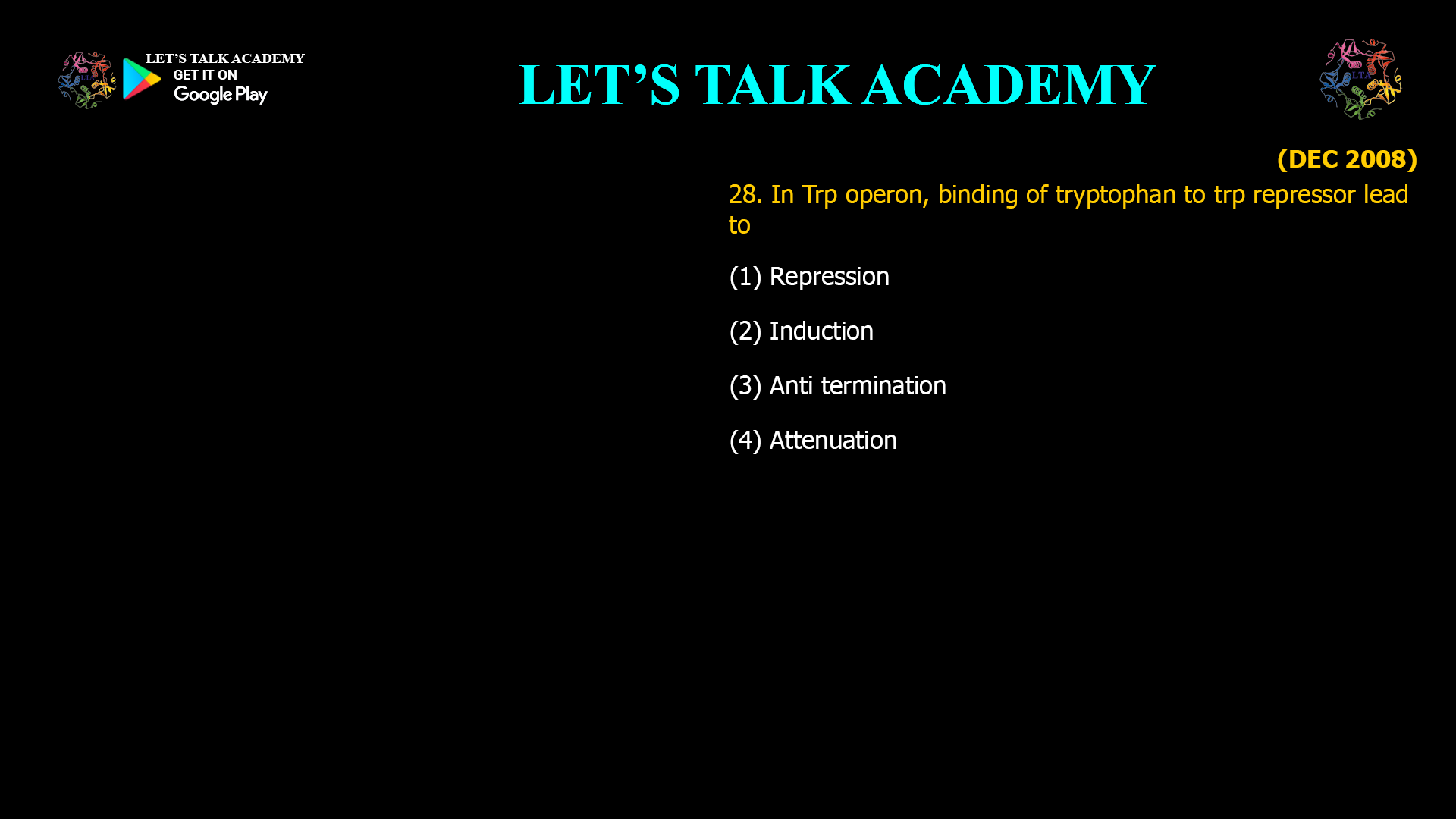
- In Trp operon, binding of tryptophan to trp repressor lead to
(1) Repression (2) Induction
(3) Anti termination (4) Attenuation
Introduction
The trp operon in Escherichia coli is a classic model for understanding negative feedback regulation in bacterial gene expression. This operon enables the cell to synthesize tryptophan only when it is scarce, efficiently conserving resources when the amino acid is abundant. Central to this regulation is the interaction between tryptophan and the trp repressor protein, which determines whether the operon is active or repressed.
Mechanism: Tryptophan as a Co-repressor
-
Inactive Repressor:
The trp repressor protein, encoded by the trpR gene, is synthesized in an inactive form. On its own, it cannot bind to the operator region of the trp operon, so the operon remains ON and the genes for tryptophan biosynthesis are transcribed when tryptophan is scarce1234678. -
Binding of Tryptophan:
When tryptophan levels in the cell rise, tryptophan molecules bind to the trp repressor. This binding changes the repressor’s shape, activating it and enabling it to bind tightly to the operator DNA sequence1234678. -
Repression of the Operon:
The tryptophan-repressor complex attaches to the operator, physically blocking RNA polymerase from transcribing the operon’s genes. As a result, the synthesis of tryptophan biosynthetic enzymes halts—this is known as repression1234678.
Why Is This Regulation Important?
This feedback mechanism ensures that E. coli does not waste energy and resources producing tryptophan when it is already plentiful. The system is a prime example of a repressible operon, where the end product (tryptophan) acts as a signal to shut down its own synthesis pathway.
Distinguishing Repression from Other Regulatory Mechanisms
-
Induction:
Induction refers to the activation of gene expression, as seen in the lac operon when lactose is present. In the trp operon, tryptophan binding leads to repression, not induction. -
Anti-termination and Attenuation:
While the trp operon also uses attenuation as a secondary regulatory mechanism, the direct result of tryptophan binding to the trp repressor is repression. Attenuation involves the formation of specific mRNA structures that can terminate transcription prematurely, but this is a separate layer of regulation45.
Correct Answer
(1) Repression
When tryptophan binds to the trp repressor, it enables the repressor to bind the operator region of the trp operon, blocking transcription and repressing the operon1234678.
Summary Table: Tryptophan’s Effect on the trp Operon
Tryptophan Level Repressor Status Operon Status Outcome Low Inactive (cannot bind) ON Tryptophan biosynthesis genes transcribed High Active (binds operator) OFF Genes repressed, no unnecessary tryptophan synthesis
Conclusion
The binding of tryptophan to the trp repressor is a textbook example of negative feedback in gene regulation. This interaction leads to repression of the trp operon, preventing wasteful synthesis of tryptophan when it is already abundant. Understanding this mechanism is fundamental to molecular biology and highlights the elegance of bacterial regulatory systems.
Keywords: trp operon, tryptophan, trp repressor, repression, gene regulation, E. coli, operator binding, co-repressor, negative feedback, biosynthetic pathway
In summary:
Binding of tryptophan to the trp repressor leads to repression of the trp operon. -


28 Comments
Shreeji Charan
June 12, 2025Best explanation sir
Shubhi Gargg
June 13, 2025Suraj sir is great and his explanation is ultimate
Manisha
June 13, 2025Nice explanation 👍
Manisha
June 13, 2025Nice explanation 👍
Thank you sir 😊
Suman bhakar
June 13, 2025👍👍
Rohittt
June 13, 2025Best explanation 👍🏻
Rohit
June 13, 2025👍🏻💯
Kajal
November 3, 2025Repression
Kirti Agarwal
November 4, 2025Repression
Komal Sharma
November 5, 2025When tryptophan binds to the trp repressor, it enables the repressor to bind the operator region of the trp operon, blocking transcription and repressing the operon
Santosh Saini
November 5, 2025( Repression ) when tryptophan binds to the trp repressor to bind the operator region of the tryptophan , blocking transcription and repressing the operon.
Neelam Sharma
November 5, 2025Repression
Neha Yadav
November 6, 2025Repression
Heena Mahlawat
November 6, 2025Repression
Deepika Sheoran
November 6, 2025Repression.
Sonal Nagar
November 6, 2025Option 1st
Roopal Sharma
November 6, 2025Repression
Priti khandal
November 6, 2025Repression
Dipti Sharma
November 7, 2025(1) Repression
Rishita
November 8, 2025Repression
Bhawna Choudhary
November 9, 2025Repression
Anurag Giri
November 9, 2025Repression
Hanshika Bansal
November 9, 2025Repression
Neeraj Sharma
November 9, 2025Binding of tryptophan to repressor protein results in activation of the repressor protein hence results in repression
Mohd juber Ali
November 9, 2025Blocking tc and repressing operon
Manisha choudhary
November 15, 2025Repression
Sakshi yadav
November 30, 2025Repression
Nilofar khan
April 1, 2026Correct option is (1)Repression