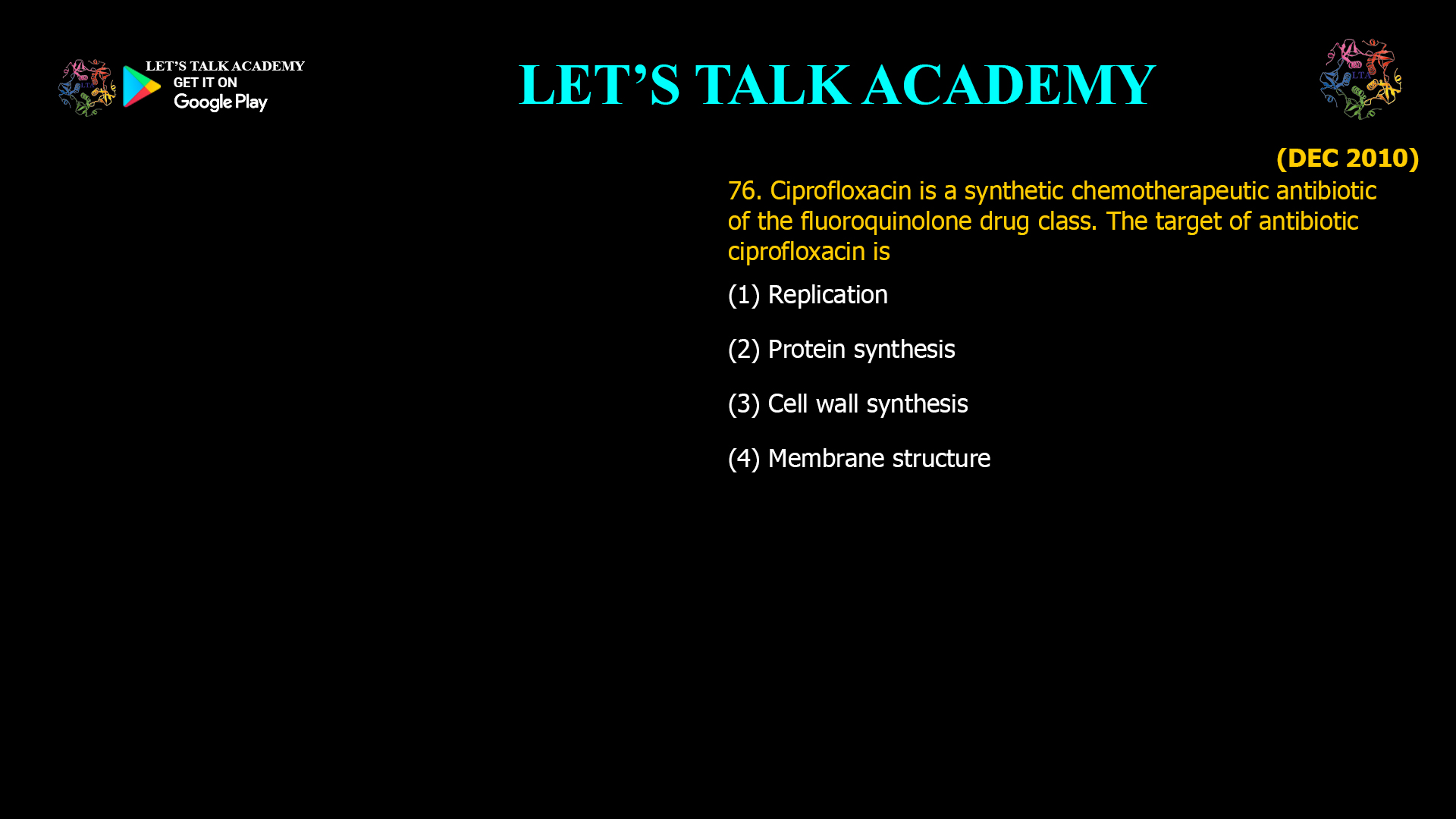
- Ciprofloxacin is a synthetic chemotherapeutic antibiotic of the fluoroquinolone drug class. The target of antibiotic ciprofloxacin is
(1) Replication
(2) Protein synthesis
(3) Cell wall synthesis
(4) Membrane structure
Introduction
Ciprofloxacin is a widely used synthetic antibiotic belonging to the fluoroquinolone class. It exhibits broad-spectrum antibacterial activity against both Gram-negative and Gram-positive bacteria. The primary mechanism by which ciprofloxacin exerts its bactericidal effect is through inhibition of bacterial enzymes essential for DNA replication—DNA gyrase (topoisomerase II) and topoisomerase IV.
Mechanism of Action: Targeting DNA Replication
-
Inhibition of DNA Gyrase:
DNA gyrase introduces negative supercoils into bacterial DNA, which is critical for relieving torsional strain during replication and transcription. Ciprofloxacin binds to the DNA gyrase-DNA complex, stabilizing it and preventing the resealing of DNA strands after cleavage. This leads to accumulation of double-strand breaks and halts DNA replication. -
Inhibition of Topoisomerase IV:
Topoisomerase IV is involved in decatenation (separation) of replicated daughter chromosomes. Ciprofloxacin also targets this enzyme, preventing proper chromosome segregation. -
Resulting Effects:
By inhibiting these enzymes, ciprofloxacin disrupts DNA replication and transcription processes, leading to bacterial cell death.
Why Ciprofloxacin Does Not Target Other Cellular Processes
-
Protein Synthesis:
Ciprofloxacin does not interfere with ribosomal function or protein synthesis machinery. -
Cell Wall Synthesis:
Unlike beta-lactams or glycopeptides, ciprofloxacin does not inhibit peptidoglycan synthesis. -
Membrane Structure:
Ciprofloxacin does not disrupt bacterial membrane integrity directly.
Summary Table
| Target | Effect of Ciprofloxacin |
|---|---|
| DNA gyrase (Topoisomerase II) | Inhibits DNA supercoiling and replication |
| Topoisomerase IV | Prevents chromosome decatenation |
| Protein synthesis | Not targeted |
| Cell wall synthesis | Not targeted |
| Membrane structure | Not targeted |
Final Answer
(1) Replication
Keywords
ciprofloxacin, fluoroquinolone antibiotic, DNA gyrase inhibition, topoisomerase IV inhibition, bacterial DNA replication, antibacterial mechanism, DNA supercoiling, bacterial chromosome segregation, antibiotic targets
Conclusion
Ciprofloxacin targets bacterial DNA replication by inhibiting DNA gyrase and topoisomerase IV, enzymes essential for DNA supercoiling and chromosome segregation. This disruption leads to DNA damage and bacterial cell death, making ciprofloxacin a potent antibiotic against a broad range of bacterial pathogens.
Correct option:
(1) Replication


26 Comments
Surbhi Rajawat
July 29, 2025Crystal clear explanation💯
Divyanshi Vaishnav
July 29, 2025I understood it very well. You are the best sir. You have explained everything very easily. I understood it after reading it once 😄
Mitali Saini
July 29, 2025I understand
Akshita
July 29, 20251 correct ans replication
Soniya Shekhawat
July 29, 2025Very informative with step by step explanation is too amazing sir
Sonam Saini
July 29, 2025Sir Right answer is replication because Ciprofloxacin synthetic chemotherapeutic ek antibiotic h jo fluoroquinolone madiciyan class se releted h and yah antibiotic bacteriya h jo ki dna replication ko ban krne ka work krta h
Alec Joseph
July 29, 2025Nice detailed explanation sir.
Anisha jakhar
July 29, 2025Correct answer is Replication. Ciprofloxacin by inhibitions DNA gyrase and topoisomerase
Priyanka choudhary
July 29, 2025The right answer is replication
Priyanka choudhary
July 29, 2025The right answer is replication because Ciprofloxacin ak synthetic chimotherepyotic antibody h jo fluoroquinolone k meicine class m aata h and DNA k replication m helpfull hote h
Dipti Sharma
July 29, 2025Very informative.
Feeling positivity and confident while attempting questions.
Santosh Saini
July 30, 2025Replication is correct because it is explained in detail so I can understand it well
Swati Choudhary
July 30, 2025Understood sir!!
Ajay Sharma
July 30, 2025all clear
Shivani panwar
July 30, 2025Correct answer is replication…👍
Ruchika
July 31, 2025Option 1 is right 👍
Komal Sharma
July 31, 2025Option 1 replication is correct bcz Ciprofloxacin targets bacterial DNA replication by inhibiting DNA gyrase and topoisomerase IV enzymes essential for DNA supercoiling and chromosome segregation. This leads to DNA damage and bacterial cell death making ciprofloxacin a antibiotic against bacterial pathogens.
Manisha choudhary
August 1, 2025Done sir 👍🏻
sir meri taraf s bs y 🫡🫡🫡🫡🫡🫡🫡🫡🫡🫡🫡🫡🫡🫡🫡🫡🫡🫡🫡🫡🫡🫡🫡🫡🫡🫡🫡🫡🫡🫡🫡🫡🫡🫡🫡🫡🫡🫡🫡🔥🔥🔥🔥🔥🔥🔥🔥🔥🔥🔥🔥🔥🔥🔥🔥🔥🔥🔥🔥🔥🔥🔥🔥🔥🔥🔥🔥🔥🔥🔥🔥🔥🔥🔥🔥🔥🔥🔥🔥🔥🔥🔥🔥🔥🔥
Word nhi h …..🔥
Ciprofloxacin,fluroqunolone class kaa broad spectrum antibacterial antibiotics drug h
Jo dna replication ko inhibit krta h
DNA replication m essential enzyme ko block kr k
DNA replication m essential gyrase ( topoisomerase -2 ) enzyme jo negative supercoiling ko relive krta h inhibit kr k
Topoisomerase -2 DNA double helix ko break and ligase dono krta h break krne k baad Ciprofloxacin ligase nhi hone deta inhibit krta h jis s replication nhi hoga
And topoisomerase -4 chromosomes segregation m help krta h Ciprofloxacin ise bhi inhibit kr deta h
And replication nhi hone dega
Shivani
August 1, 2025This explanation is very informative and easy to understand .
Varsha Tatla
August 3, 2025Ciproflaxcin affect replication so, correct option is 1st
Deepika sheoran
August 7, 2025Correct answer is Replication
Aafreen Khan
August 23, 2025Replication understand by explanation
Nilofar Khan
August 23, 2025Correct answer is replication
Komal Sharma
October 10, 2025Ciprofloxacin targets bacterial DNA replication by inhibiting DNA gyrase and topoisomerase IV, enzymes essential for DNA supercoiling and chromosome segregation. This disruption leads to DNA damage and bacterial cell death, making ciprofloxacin a potent antibiotic against a broad range of bacterial pathogens.
Deepika Sheoran
November 7, 2025Replication
Rishu
April 9, 2026Ciprofloxacin targets bacterial DNA replication by inhibiting DNA gyrase and topoisomerase IV, enzymes essential for DNA supercoiling and chromosome segregation. This disruption leads to DNA damage and bacterial cell death, making ciprofloxacin a potent antibiotic against a broad range of bacterial pathogens.