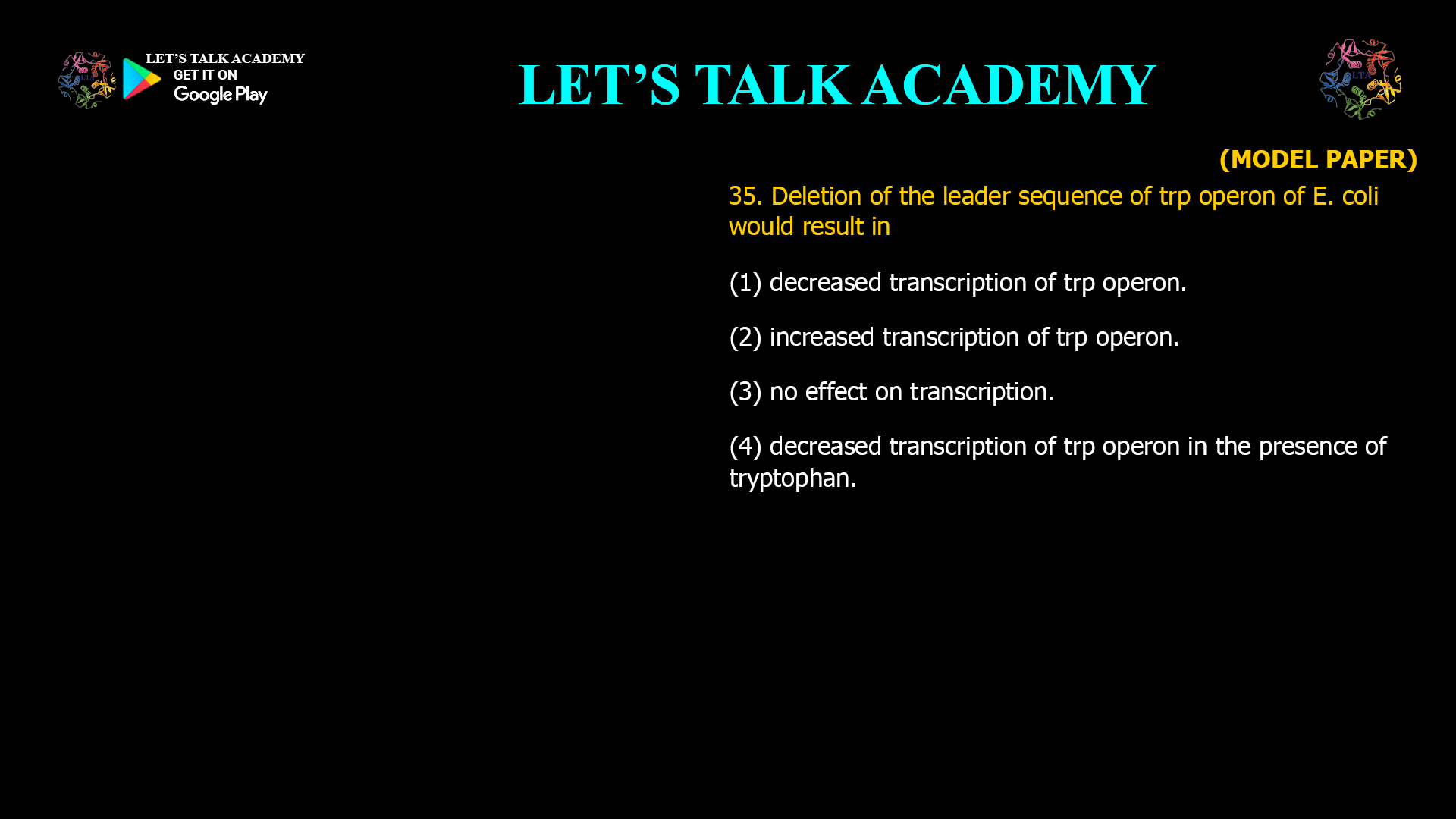
35. Deletion of the leader sequence of trp
operon of E. coli would result in
(1) decreased transcription of trp operon.
(2) increased transcription of trp operon.
(3) no effect on transcription.
(4) decreased transcription of trp operon in
the presence of tryptophan.
The tryptophan (trp) operon in Escherichia coli is a well-studied example of gene regulation in bacteria. It consists of five structural genes responsible for the biosynthesis of the essential amino acid tryptophan. The operon is regulated at multiple levels, most notably by a repressor protein and a unique mechanism called attenuation, which is mediated by the leader sequence. This article explores what happens when the leader sequence of the trp operon is deleted, its implications for transcription, and why this region is so important for the operon’s function.
Structure and Function of the trp Operon
The trp operon is composed of five genes—trpE, trpD, trpC, trpB, and trpA—that encode enzymes required for tryptophan biosynthesis. These genes are transcribed together as a single mRNA molecule under the control of a promoter and an operator region. The operator is the binding site for the trp repressor protein, which, when bound to tryptophan, can block transcription by preventing RNA polymerase from initiating transcription of the operon156.
Upstream of the first structural gene (trpE), the trp operon contains a leader sequence. This leader sequence is about 160 base pairs long and plays a crucial role in the attenuation mechanism, which fine-tunes the expression of the operon based on the availability of tryptophan inside the cell28.
The Role of the Leader Sequence in Attenuation
Attenuation is a regulatory process that allows the cell to adjust the expression of the trp operon in response to the intracellular concentration of tryptophan. The leader sequence contains four domains that can form different hairpin (stem-loop) structures in the mRNA. The formation of these hairpins depends on whether the ribosome can quickly translate a short leader peptide encoded by the leader sequence.
When tryptophan is abundant, the ribosome rapidly translates the leader peptide, leading to the formation of a terminator hairpin (stem-loop between domains 3 and 4), which causes premature termination of transcription. This results in a truncated mRNA and prevents the synthesis of the full set of tryptophan biosynthesis enzymes.
When tryptophan is scarce, the ribosome stalls at tryptophan codons in the leader peptide, allowing the formation of an antiterminator hairpin (stem-loop between domains 2 and 3), which permits RNA polymerase to continue transcription into the structural genes. This mechanism allows the cell to further reduce tryptophan synthesis when tryptophan is already present, providing an additional layer of control beyond simple repression28.
Consequences of Deleting the Leader Sequence
If the leader sequence of the trp operon is deleted, the attenuation mechanism is eliminated. Without the leader sequence, the mRNA cannot form the regulatory hairpin structures that control premature termination of transcription. As a result, the cell loses the ability to fine-tune trp operon expression in response to tryptophan availability.
Effect on Transcription
In the absence of the leader sequence, RNA polymerase will transcribe the trp operon regardless of the intracellular tryptophan concentration, provided that the repressor is not bound to the operator. This means that the operon will be transcribed unless tryptophan is present at high enough levels to activate the repressor protein, which can still block transcription initiation at the operator.
However, the attenuation mechanism, which normally reduces transcription when tryptophan is present (even if the repressor does not completely block transcription), is lost. Therefore, in the presence of tryptophan, the operon would be transcribed at a higher level than normal because the attenuation-mediated reduction in transcription is absent.
Implications for Gene Regulation
Deletion of the leader sequence disrupts the delicate balance of trp operon regulation. The cell can still respond to high tryptophan levels through the repressor protein, but it loses the ability to make subtle adjustments to transcription via attenuation. This can lead to inefficient use of cellular resources, as the cell may produce more tryptophan biosynthesis enzymes than necessary when tryptophan is already present.
Answering the Question
The question asks:
“Deletion of the leader sequence of trp operon of E. coli would result in
(1) decreased transcription of trp operon.
(2) increased transcription of trp operon.
(3) no effect on transcription.
(4) decreased transcription of trp operon in the presence of tryptophan.”
The correct answer is (2) increased transcription of trp operon. This is because the deletion of the leader sequence removes the attenuation mechanism, which normally reduces transcription in the presence of tryptophan. Without attenuation, transcription of the trp operon is no longer fine-tuned and is therefore increased compared to the wild-type operon, especially when tryptophan is present.
It is important to note that the repressor mechanism is still intact, so if tryptophan is present at high levels, the repressor can still block transcription initiation. However, in situations where the repressor is not fully active or when tryptophan levels are moderate, the loss of attenuation leads to increased transcription.
Biological Significance
The leader sequence and attenuation mechanism are essential for the efficient regulation of tryptophan biosynthesis. By allowing the cell to respond to subtle changes in tryptophan availability, attenuation ensures that the cell does not waste energy producing unnecessary enzymes. The deletion of the leader sequence disrupts this fine-tuning, leading to less efficient regulation and potentially wasteful gene expression.
Practical Applications
Understanding the role of the leader sequence and attenuation is important for genetic engineering and synthetic biology. By manipulating the leader sequence, scientists can control the expression of genes in bacteria, optimizing the production of desired proteins or metabolic products. The principles learned from the trp operon have also inspired the design of synthetic gene circuits for industrial and medical applications.
Conclusion
The leader sequence of the trp operon in E. coli is crucial for the attenuation mechanism, which fine-tunes the expression of the operon in response to tryptophan availability. Deletion of the leader sequence removes this regulatory layer, resulting in increased transcription of the trp operon, especially in the presence of tryptophan. This highlights the importance of the leader sequence for efficient and precise gene regulation in bacteria.
In summary, deletion of the leader sequence of the trp operon would result in increased transcription of the trp operon, making option (2) the correct answer. This finding underscores the critical role of the leader sequence in the sophisticated regulation of tryptophan biosynthesis in E. coli.


19 Comments
Rohittt
June 13, 2025👍🏻👍🏻
Kajal
November 3, 2025The correct answer is (2) increased transcription of trp operon.
Kirti Agarwal
November 4, 2025The leaders sequence of trpl terminate the transcription so if it is deleted then transcription is increased
Dharmpal Swami
November 5, 2025Increase transcription of trp operon
Komal Sharma
November 5, 2025The leader sequence of the trp operon in E. coli is crucial for the attenuation mechanism, which fine-tunes the expression of the operon in response to tryptophan availability. Deletion of the leader sequence removes this regulatory layer, resulting in increased transcription of the trp operon, especially in the presence of tryptophan. This highlights the importance of the leader sequence for efficient and precise gene regulation in bacteria.
Neelam Sharma
November 5, 2025increased transcription of trp operon.
Neha Yadav
November 6, 2025Increased transcription of trp operon
Heena Mahlawat
November 6, 2025Increased tc of trp operon
Deepika Sheoran
November 6, 2025Increase transcription of trp. Operon.
Sonal Nagar
November 6, 2025Option 2nd
Roopal Sharma
November 6, 2025Increase the tc
Priti khandal
November 6, 2025Increased the transcription
Rishita
November 7, 2025The leaders sequence of trpl terminate the transcription so if it is deleted then transcription is increased
Dipti Sharma
November 7, 2025Deletion of the leader sequence removes the attenuation mechanism which reduces transcription in the presence of high levels of tryptophan so rate of transcription increases
Hanshika Bansal
November 8, 2025Increase Tc of the trp operon
Bhawna Choudhary
November 9, 2025increased transcription of trp operon
Neeraj Sharma
November 9, 2025Deletion of trpl results in increased transcription of trp operon
Manisha choudhary
November 15, 2025Increase transcription of tryptophan operon
Attenuation nhi ho paayega
Sakshi yadav
November 30, 2025Increase Tc of trp operon