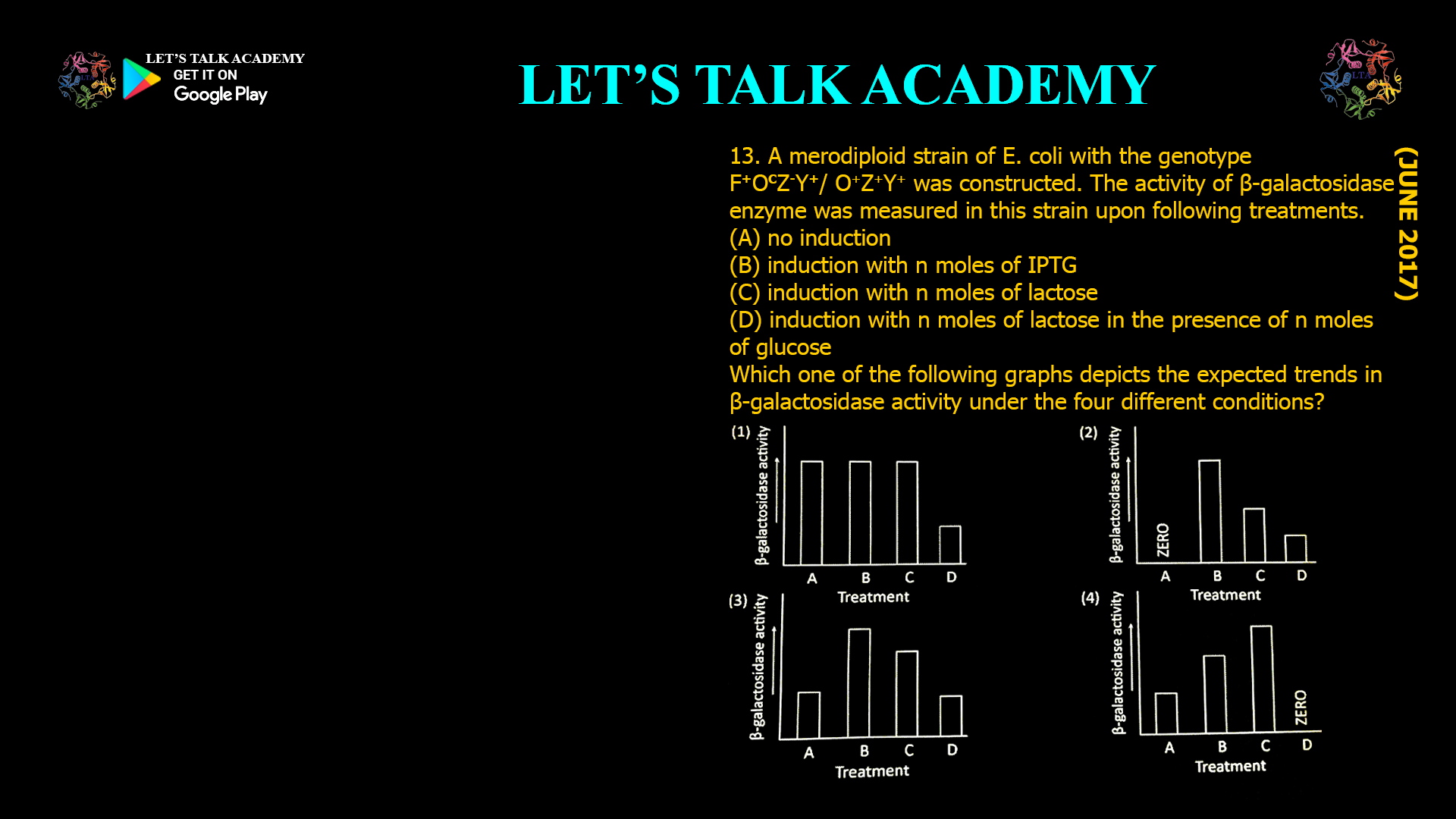
13. A merodiploid strain of E. coli with the genotype F+OCZ–Y+/ O+Z+Y+was constructed. The activity of β-galactosidase enzyme was measured in this strain upon following treatments.
(A) no induction
(B) induction with n moles of IPTG
(C) induction with n moles of lactose
(D) induction with n moles of lactose in the presence of n moles of glucose
Which one of the following graphs depicts the expected trends in ß-galactosidase activity under the four different conditions?
A merodiploid E. coli strain with the genotype F+OCZ–Y+/O+Z+Y+ contains two copies of the lac operon: one with an operator-constitutive mutation (OC) and one wild-type. Understanding how β-galactosidase activity responds to different inducers and the presence of glucose reveals the logic of operon regulation and catabolite repression.
Genotype Breakdown
-
F+OCZ–Y+: F’ plasmid with operator-constitutive (OC, non-repressible) mutation, lacZ– (no functional β-galactosidase), lacY+ (functional permease).
-
O+Z+Y+: Chromosomal wild-type operator, functional lacZ+ (β-galactosidase), lacY+ (permease).
Expected β-Galactosidase Activity in Each Condition
(A) No Induction
-
The OC mutation on the F’ plasmid means the operon is always ON, even without inducer.
-
The chromosomal wild-type operon is OFF without inducer.
-
Result: Basal β-galactosidase activity from the OC operon, but since F’ carries Z–, only the chromosomal Z+ produces enzyme. Thus, activity is low but above zero.
(B) Induction with IPTG
-
IPTG induces the wild-type operon fully.
-
OC operon remains ON (but Z–, so no additional enzyme from F’).
-
Result: High β-galactosidase activity due to full induction of chromosomal Z+.
(C) Induction with Lactose
-
Lactose induces the wild-type operon, but induction may be slightly less than with IPTG due to lactose transport limitations.
-
OC operon remains ON (but Z–).
-
Result: High β-galactosidase activity, slightly less than with IPTG if transport is limiting.
(D) Induction with Lactose + Glucose
-
Glucose causes catabolite repression, lowering cAMP and reducing CAP activation.
-
Wild-type operon induction is suppressed.
-
OC operon remains ON (but Z–).
-
Result: Activity drops compared to (B) and (C), but is still above (A) due to constitutive OC expression.
Graphical Trend (Relative Activity)
-
(A) No induction: Moderate (constitutive from OC, but only chromosomal Z+ produces enzyme)
-
(B) IPTG: Highest (full induction of wild-type Z+)
-
(C) Lactose: High (induction of wild-type Z+, but possibly less than IPTG)
-
(D) Lactose + Glucose: Lower than (B) and (C), but above (A) due to OC constitutive expression
Order: (B) > (C) > (D) > (A)
Visual Representation
| Condition | β-Galactosidase Activity (Relative) |
|---|---|
| (A) No induction | Low-Moderate |
| (B) IPTG | Highest |
| (C) Lactose | High |
| (D) Lactose + Glucose | Moderate |
Conclusion
The correct graph will show the highest β-galactosidase activity with IPTG, slightly lower with lactose, a further drop with lactose plus glucose, and the lowest (but nonzero) activity with no induction. This pattern reflects constitutive expression from the OC operator and inducible, glucose-repressible expression from the wild-type operon.
Keywords: β-galactosidase activity, merodiploid E. coli, lac operon, OC mutation, IPTG induction, lactose induction, glucose repression, catabolite repression, gene regulation, F’ plasmid, operon model, molecular biology.


20 Comments
Suman bhakar
June 12, 2025👍👍
Anita choudhary
June 14, 2025👍👍
Anita choudhary
June 14, 2025✅✅
Arushi
June 14, 2025👍✅
Komal Sharma
June 17, 2025Great 👍
Kajal
November 4, 2025Correct Order is : (B) > (C) > (D) > (A)
Kirti Agarwal
November 4, 2025Graph B
Roopal Sharma
November 6, 20253rd option is correct
Heena Mahlawat
November 6, 2025Graph 3
Neha Yadav
November 6, 2025Graph 3 : B >C >D >A
Sonal Nagar
November 6, 2025Option 2nd
Neeraj Sharma
November 6, 2025Graph 3
Dipti Sharma
November 6, 2025Graph 3(B) > (C) > (D) > (A)
Neelam Sharma
November 7, 2025Graph 2 (B) > (C) > (D) > (A)
Bhawna Choudhary
November 8, 2025Graph 2 is correct
Mansukh Kapoor
November 8, 2025The correct answer is option 2nd
Anurag Giri
November 9, 2025Graph 2 is correct
Mohd juber Ali
November 9, 2025No induction A = zero
Option 2nd
Manisha choudhary
November 12, 2025Graph 3 is correct answer
Nilofar khan
April 1, 2026Correct answer is (2)
A= zero and B>C>D