
Principles of Biophysical Chemistry: Thermodynamics
1. Introduction to Thermodynamics
Thermodynamics is the branch of physical chemistry that deals with energy, heat, work, temperature, and the transformations of energy occurring in physical and chemical systems. Although thermodynamics was initially developed to understand heat engines and physical processes, its principles have become fundamental to chemistry, biochemistry, molecular biology, biotechnology, and physiology.
In biological systems, almost every process involves an energy transformation. Cells must continuously obtain energy from nutrients or light, convert that energy into biologically useful forms, and utilize it to perform chemical, mechanical, and transport-related work.
Processes such as protein folding, DNA hybridization, membrane formation, ATP hydrolysis, active transport, oxidative phosphorylation, photosynthesis, muscle contraction, and biosynthesis can all be interpreted using thermodynamic principles.
A major advantage of thermodynamics is that it allows us to determine whether a process is thermodynamically favorable under a particular set of conditions. It therefore provides an energetic framework for understanding the direction of biochemical reactions.
However, thermodynamics does not tell us how rapidly a reaction occurs. The rate of a reaction belongs to the field of chemical kinetics.
This distinction is fundamental:
Thermodynamics determines the energetic favorability of a process, whereas kinetics determines the rate at which the process occurs.
For example, a reaction may have a negative Gibbs free-energy change and therefore be thermodynamically favorable, yet it may occur extremely slowly because the molecules must cross a large activation-energy barrier.
This distinction becomes particularly important in biology because enzymes can dramatically accelerate biochemical reactions without changing their overall Gibbs free-energy change or equilibrium constant.
2. Importance of Thermodynamics in Biological Systems
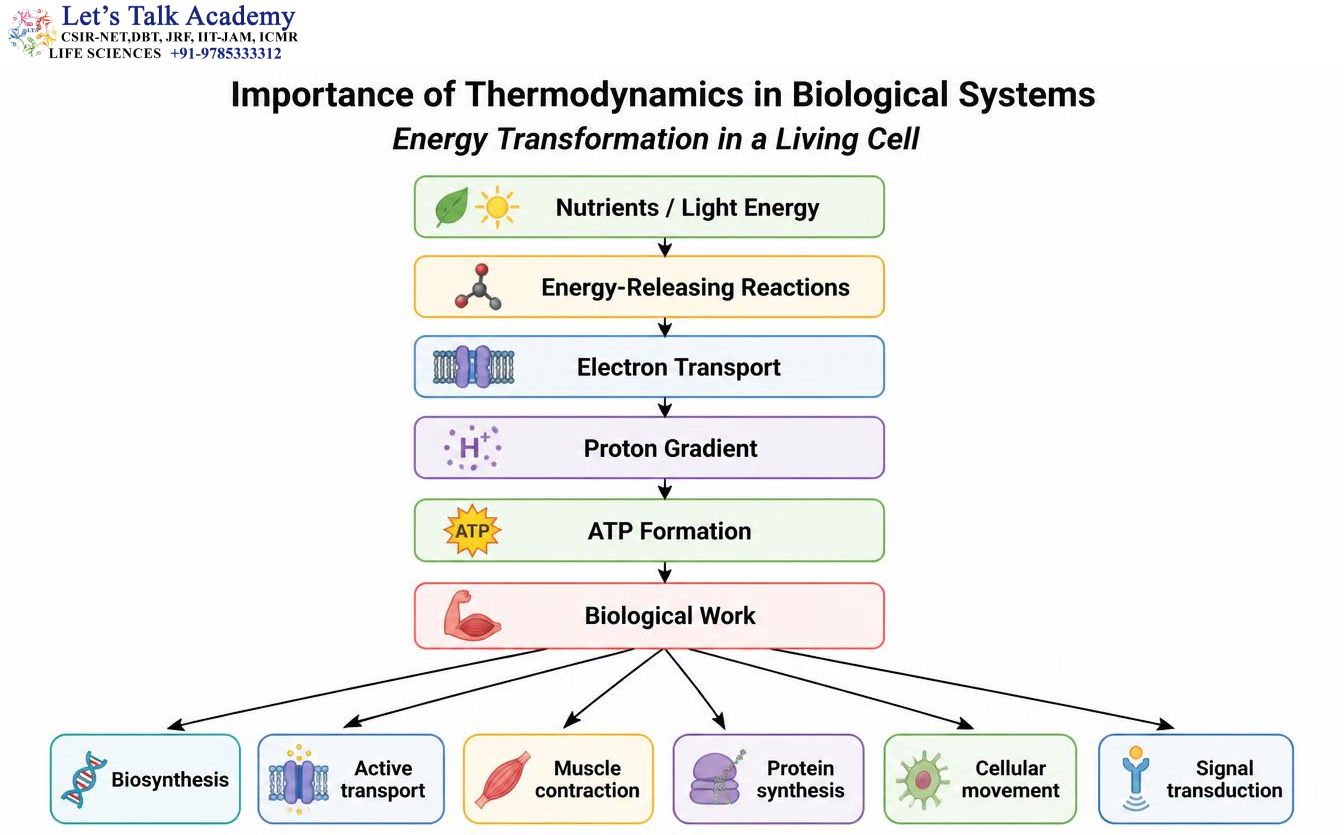
A living cell is not simply a collection of chemical reactions. It is a highly organized system in which thousands of reactions occur simultaneously and are interconnected through energy transfer.
Thermodynamics therefore acts as a bridge between molecular structure and biological function.
This topic is particularly important because thermodynamics connects several major areas, including:
- Biomolecules
- Enzymology
- Bioenergetics
- Membrane biology
- Cell signaling
- Metabolism
- Molecular interactions
- Protein structure
- Nucleic-acid structure
- Transport mechanisms
3. Thermodynamic System, Surroundings, and Universe
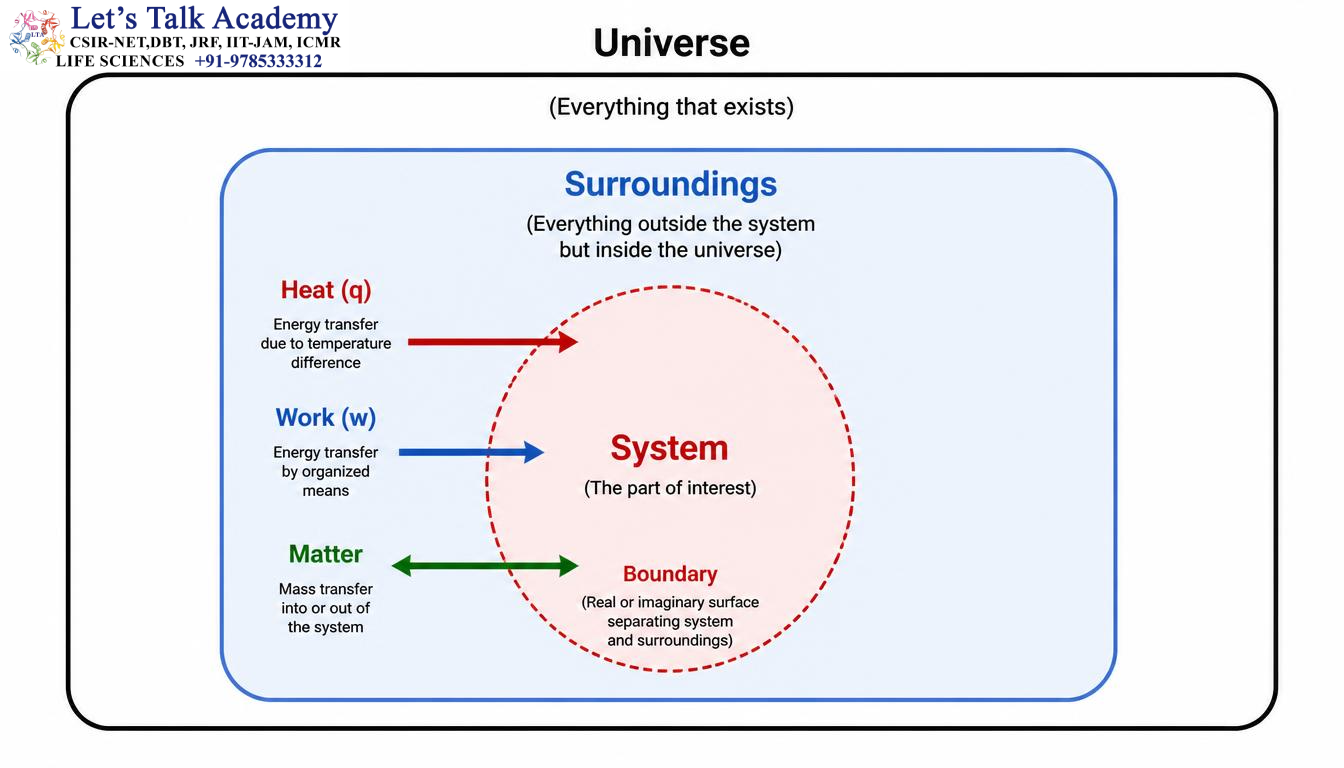
Before studying any thermodynamic process, it is necessary to define the portion of the universe being studied.
The part selected for investigation is called the system.
Everything outside the system that can interact with it is called the surroundings.
The system and surroundings together constitute the universe.
Therefore:
Universe = System + Surroundings
For example, suppose we are studying ATP hydrolysis in a reaction tube. The reaction mixture may be defined as the system, while the reaction tube and the surrounding environment constitute the surroundings.
The definition of the system is important because heat, work, and matter may cross the boundary separating the system from its surroundings.
4. Types of Thermodynamic Systems
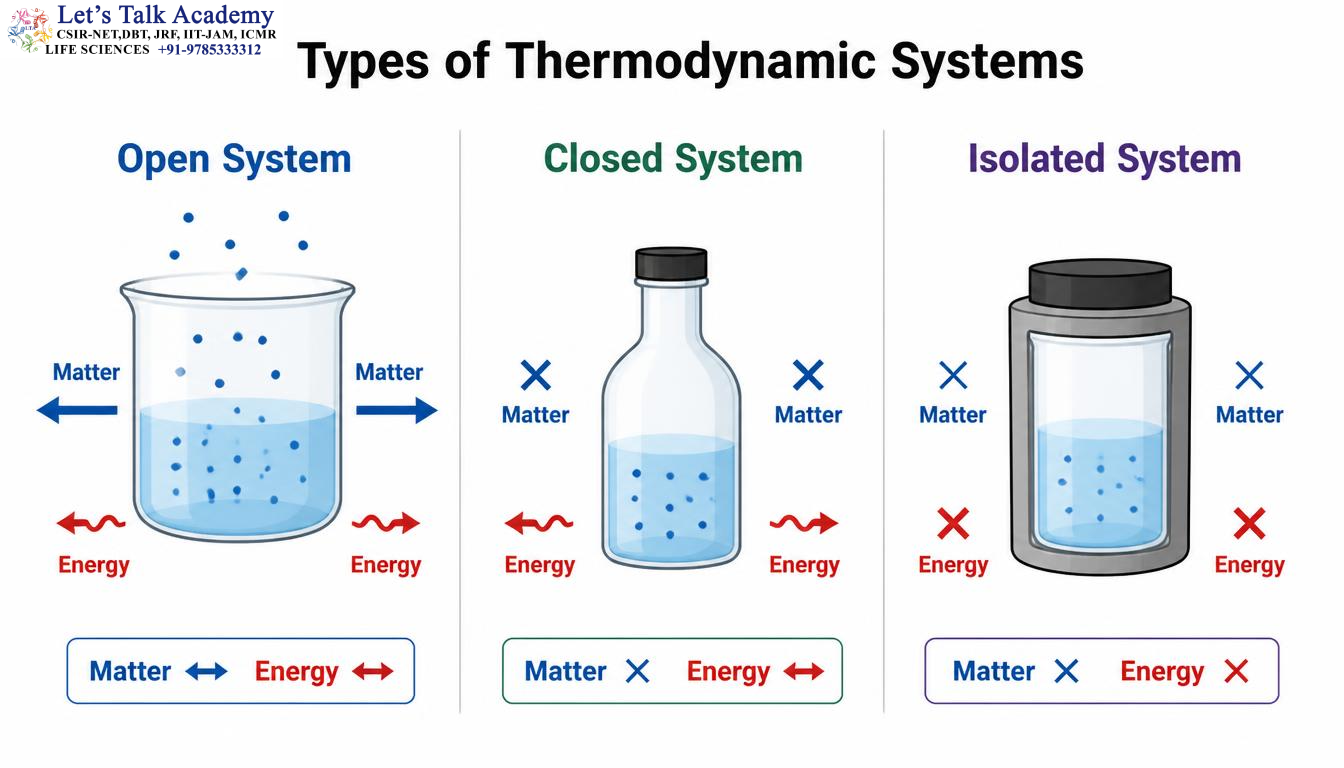
Thermodynamic systems are classified according to whether they exchange matter and energy with their surroundings.
4.1 Open System
An open system can exchange both matter and energy with its surroundings.
Living organisms are open thermodynamic systems.
A cell continuously exchanges materials and energy with its environment. It may take up nutrients and ions, release metabolic products, exchange gases, and dissipate heat.
Examples include:
- A living cell
- A human body
- A plant
- A bacterial culture
The fact that living organisms are open systems is particularly important when considering entropy and biological organization.
4.2 Closed System
A closed system can exchange energy but not matter with its surroundings.
For example, a sealed reaction vessel that does not allow matter to cross its boundary but permits heat exchange can be treated as a closed system.
The amount of matter remains constant, although the energy of the system may change.
4.3 Isolated System
An isolated system exchanges neither matter nor energy with its surroundings.
A perfectly isolated system is largely an idealized concept.
An isolated system is particularly useful in explaining the second law because the entropy change of an isolated universe provides a criterion for spontaneity.
5. Thermodynamic State and State Variables
The condition of a thermodynamic system at a particular time is called its state.
A thermodynamic state can be described by measurable variables such as temperature, pressure, volume, and composition.
Important state variables include:
- Temperature (T)
- Pressure (P)
- Volume (V)
- Number of moles (n)
- Internal energy (U)
- Enthalpy (H)
- Entropy (S)
- Gibbs free energy (G)
A state variable has a definite value for a particular state of the system.
For example, if a particular protein solution is maintained at a specific temperature, pressure, concentration, and volume, these variables collectively describe its thermodynamic state.
6. State Functions

A state function is a thermodynamic property whose value depends only on the current state of the system.
Its change depends only on the initial and final states and does not depend on the pathway followed.
Important state functions include:
- Internal energy (U)
- Enthalpy (H)
- Entropy (S)
- Gibbs free energy (G)
- Pressure (P)
- Volume (V)
- Temperature (T)
For a state function X:
ΔX = Xfinal − Xinitial
For example:
ΔU = Ufinal − Uinitial
If a system moves from state A to state B through two different pathways, the value of ΔU will be identical for both pathways.
This property is extremely useful because it allows thermodynamic changes to be calculated even when the actual pathway is complicated.
7. Path Functions
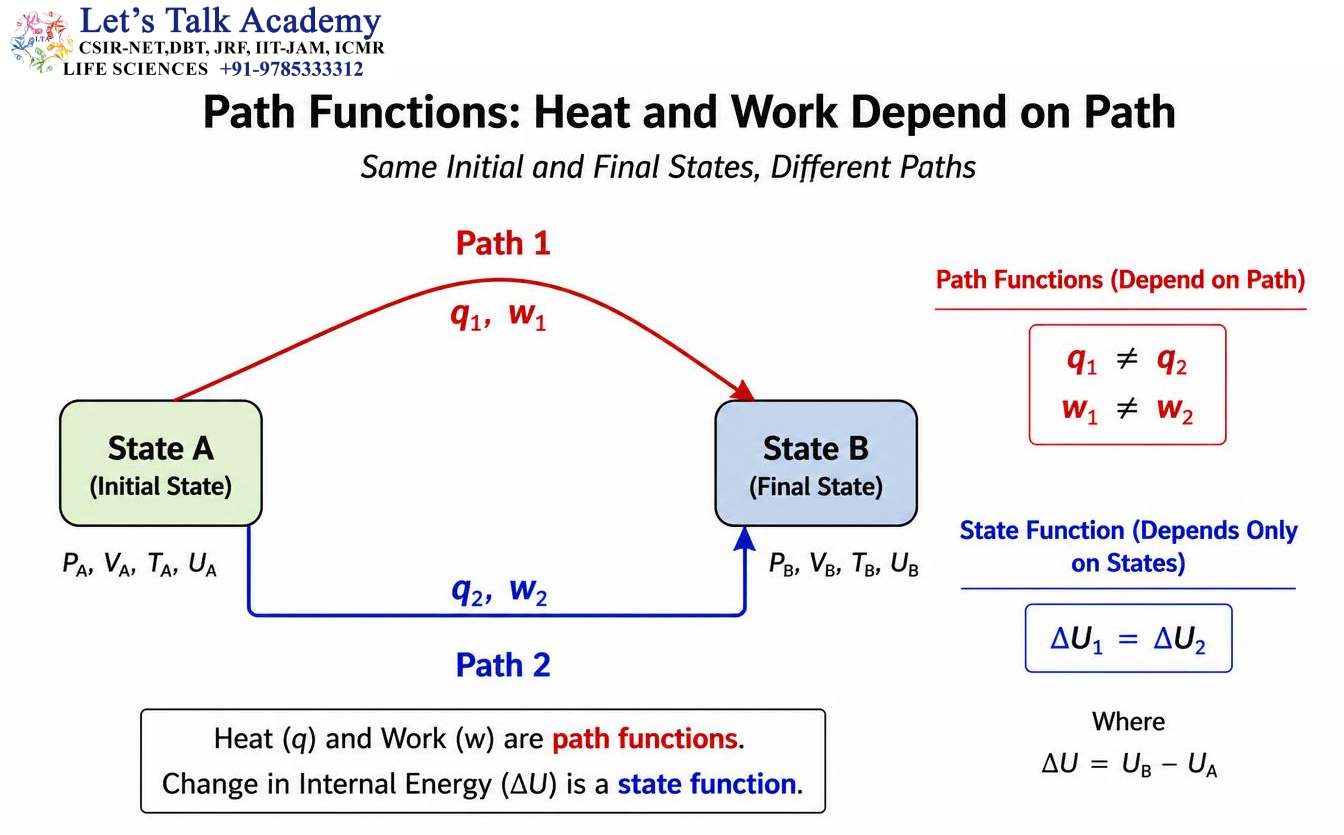
A path function depends on the particular pathway through which a system changes from one state to another.
The two major path functions are:
- Heat (q)
- Work (w)
Heat and work are not properties stored in a system in the same way as internal energy or entropy.
The same initial and final states can be reached through different pathways involving different amounts of heat and work.
Thus:
U, H, S, and G are state functions.
q and w are path functions.
The correct examples are heat and work.
8. Thermodynamic Processes
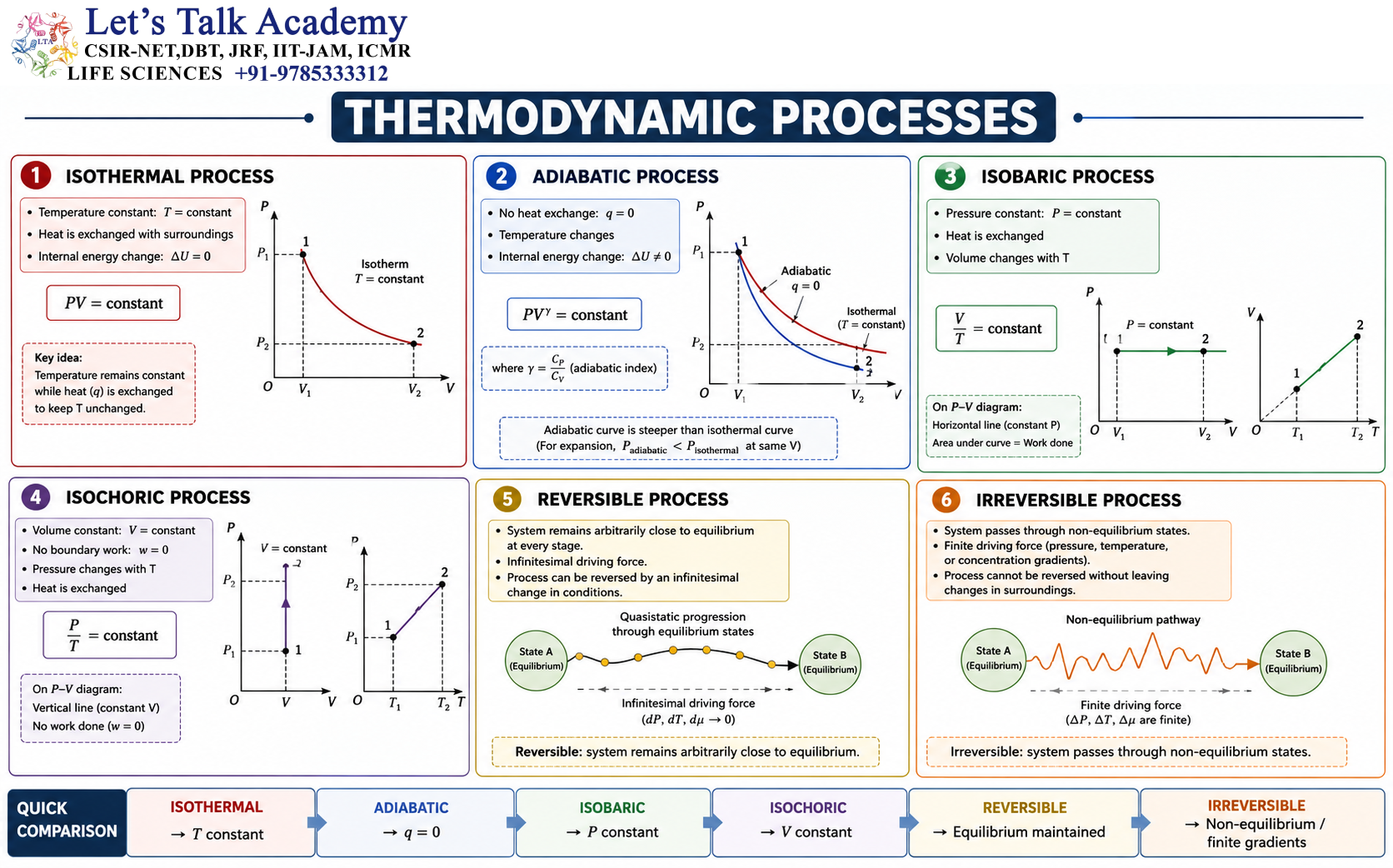
A thermodynamic process describes the transition of a system from one state to another.
The process may be classified according to the variable that remains constant.
8.1 Isothermal Process
An isothermal process occurs at constant temperature.
T = constant
Heat may be exchanged during an isothermal process even though temperature remains constant.
8.2 Isobaric Process
An isobaric process occurs at constant pressure.
P = constant
Many biochemical processes occurring under approximately atmospheric pressure can be considered under constant-pressure conditions.
8.3 Isochoric Process
An isochoric process occurs at constant volume.
V = constant
Therefore:
ΔV = 0
For pressure–volume work:
w = −PₑₓₜΔV
and therefore:
w = 0
when only pressure–volume work is considered.
8.4 Adiabatic Process
In an adiabatic process, no heat is exchanged with the surroundings.
q = 0
From the first law:
ΔU = q + w
Therefore:
ΔU = w
8.5 Reversible Process
A reversible process is an idealized process that occurs through a continuous series of states infinitesimally close to equilibrium.
The process can theoretically be reversed without leaving a net change in the system and surroundings.
A perfectly reversible biological process does not occur in practice, but the concept is essential for deriving thermodynamic relationships.
8.6 Irreversible Process
An irreversible process cannot be perfectly reversed without producing a net change in the system or surroundings.
Most biological processes are effectively irreversible under physiological conditions.
9. Internal Energy
The total microscopic energy contained within a thermodynamic system is called internal energy.
It is represented by: U
Internal energy includes contributions from molecular motion and molecular interactions.
These may include:
- Translational energy
- Rotational energy
- Vibrational energy
- Electronic energy
- Bond energy
- Intermolecular interaction energy
The change in internal energy is:
ΔU = Ufinal − Uinitial
Internal energy is a state function.
Therefore, the value of ΔU depends only on the initial and final states.
The first law of thermodynamics establishes the relationship between internal energy, heat, and work.
10. Heat
Heat is energy transferred between a system and its surroundings because of a temperature difference.
Heat is represented by:
q
Using the conventional thermodynamic sign convention:
When heat enters the system:
q > 0
When heat leaves the system:
q < 0
Heat is a path function.
The amount of heat transferred depends on how the process occurs.
11. Work
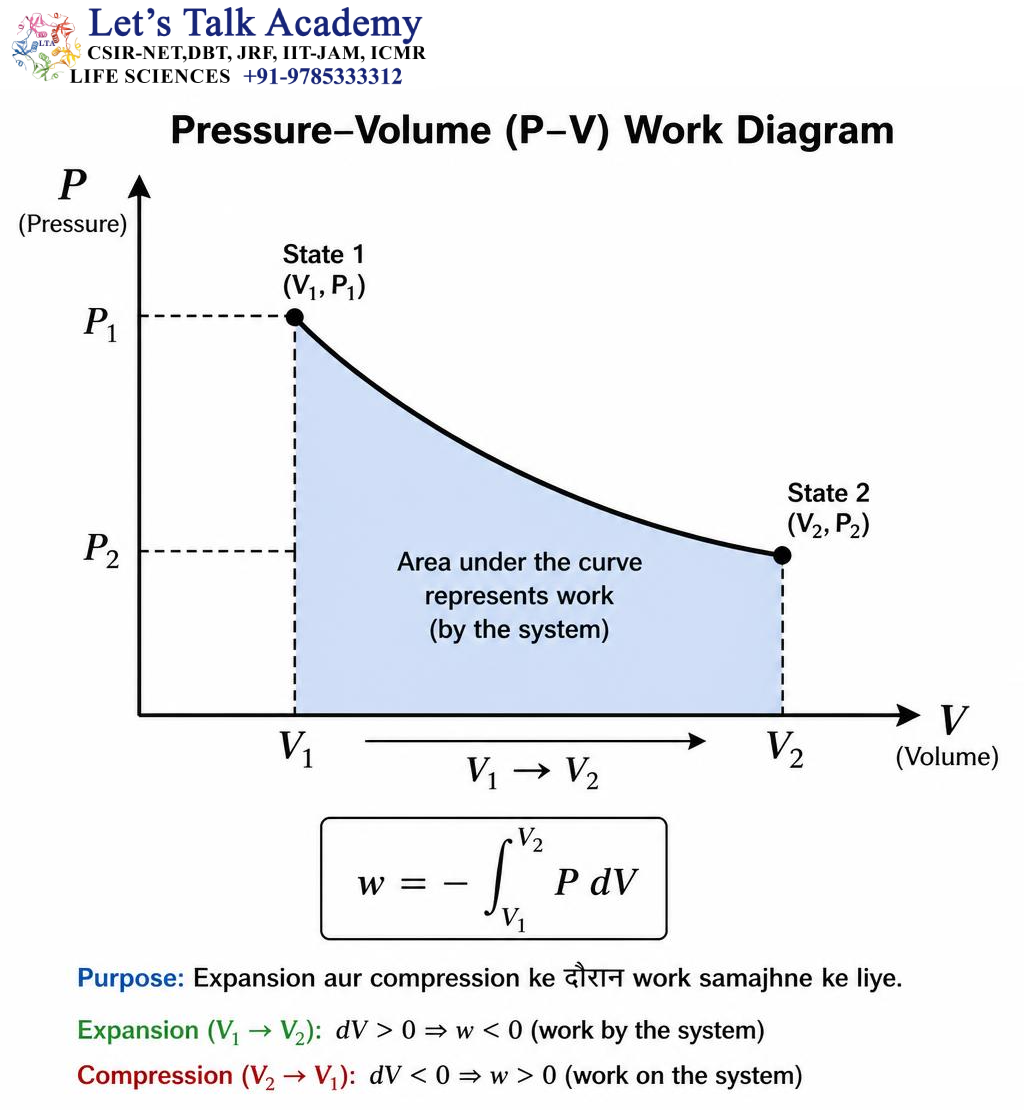
Work is another form of energy transfer between a system and its surroundings.
For pressure–volume work:
w = −PₑₓₜΔV
where:
- Pₑₓₜ = external pressure
- ΔV = change in volume
During expansion:
ΔV > 0
Therefore:
w < 0
The system performs work on the surroundings.
During compression:
ΔV < 0
Therefore:
w > 0
Work is performed on the system.
The sign convention is important for correctly applying the first law of thermodynamics.
12. First Law of Thermodynamics
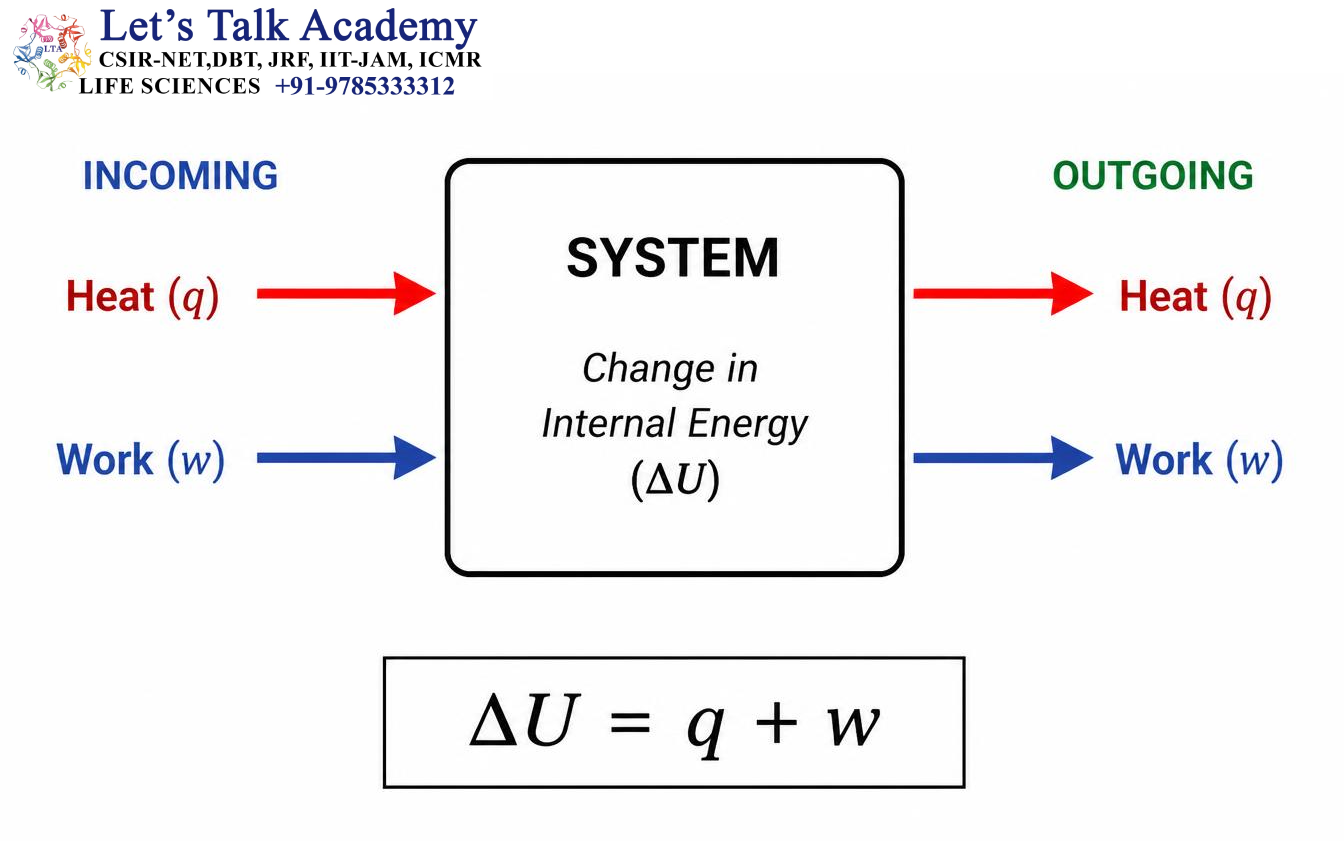
The first law of thermodynamics is a statement of the conservation of energy.
It states that energy cannot be created or destroyed. Energy can only be transferred or transformed from one form to another.
The mathematical expression is:
ΔU = q + w
where:
- ΔU = change in internal energy
- q = heat supplied to the system
- w = work done on the system
Suppose a system absorbs 100 J of heat and performs 40 J of work on the surroundings.
Then:
q = +100 J
and:
w = −40 J
Therefore:
ΔU = +100 J − 40 J
ΔU = +60 J
The internal energy therefore increases by 60 J.
13. Biological Significance of the First Law
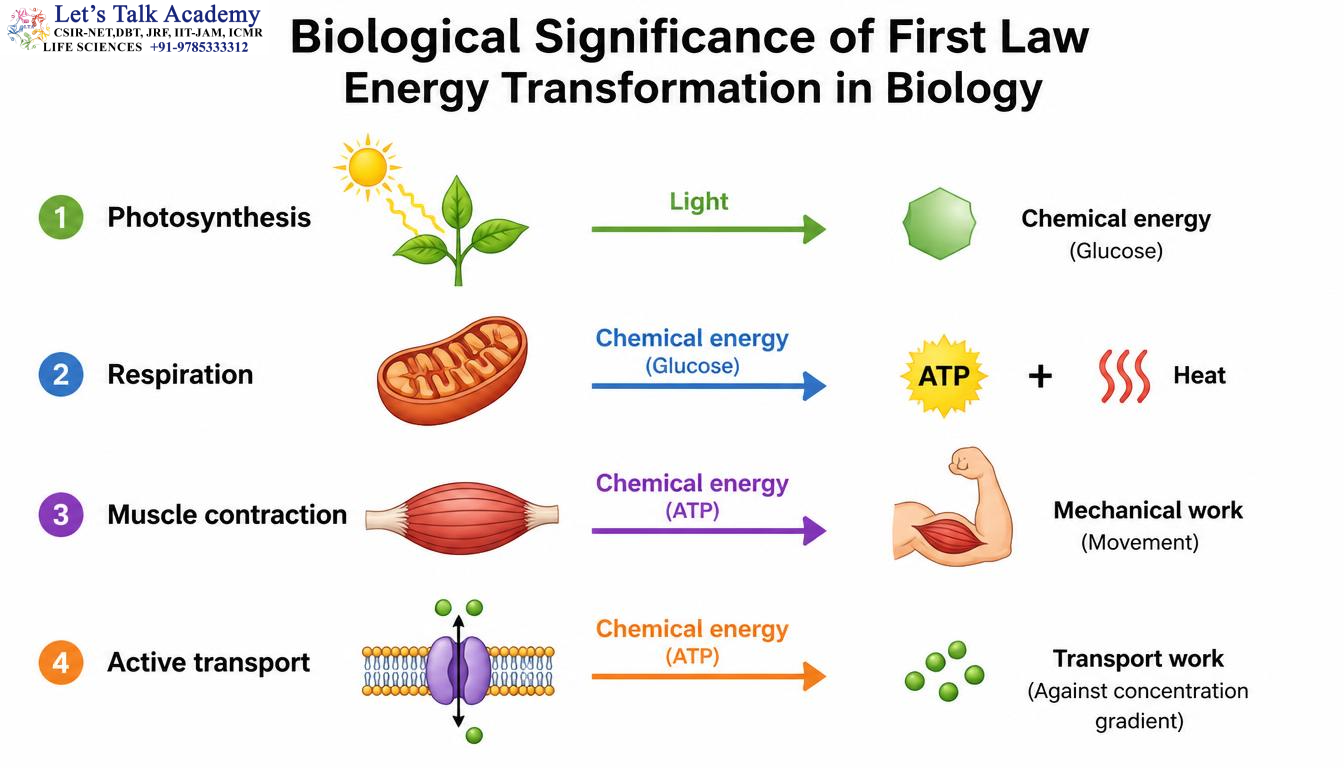
The first law is fundamental to biology because living organisms continuously transform energy.
During photosynthesis:
Light energy → Chemical energy
During cellular respiration:
Chemical energy → ATP + Electrochemical energy + Heat
During muscle contraction:
Chemical energy → Mechanical work + Heat
During active transport:
Chemical energy → Electrochemical work
The energy is not created by the cell. Instead, it is transformed into forms that can be used for biological work.
This concept is particularly important in bioenergetics, where the central question is how cells capture and distribute energy.
14. Enthalpy
Enthalpy is a thermodynamic state function represented by:
H
It is defined as:
H = U + PV
Therefore:
ΔH = ΔU + Δ(PV)
At constant pressure, when only pressure–volume work is involved:
ΔH = qₚ
where qₚ is heat exchanged at constant pressure.
Because many biochemical processes occur approximately at constant pressure, enthalpy is an important quantity in biological thermodynamics.
15. Exothermic and Endothermic Processes
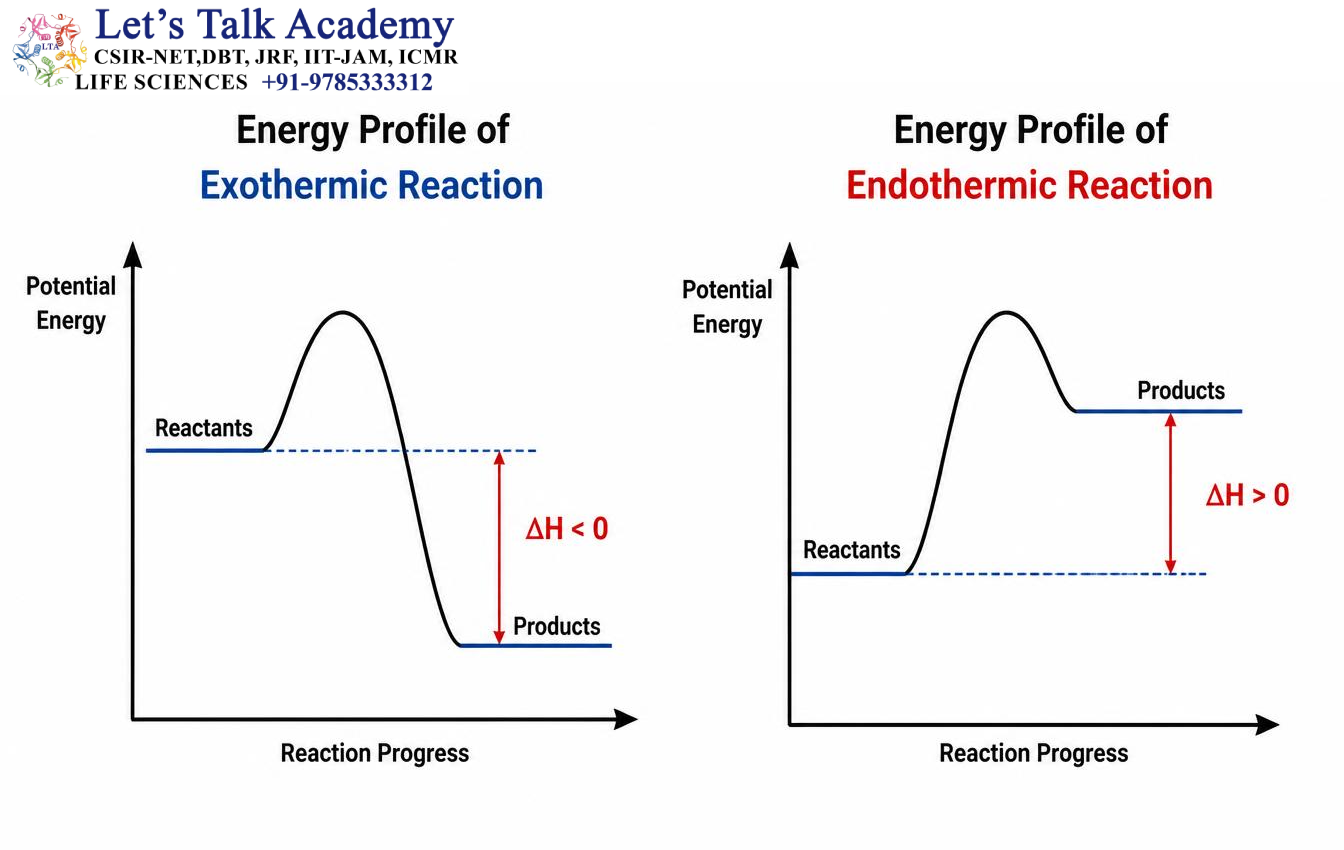
An exothermic process releases heat to the surroundings.
Therefore:
ΔH < 0
An endothermic process absorbs heat from the surroundings.
Therefore:
ΔH > 0
However, enthalpy alone does not determine whether a process is spontaneous.
For example, a reaction can have:
ΔH < 0
but still have:
ΔG > 0
if the entropy contribution is sufficiently unfavorable.
Therefore, spontaneity must be determined using Gibbs free energy rather than enthalpy alone.
16. Entropy
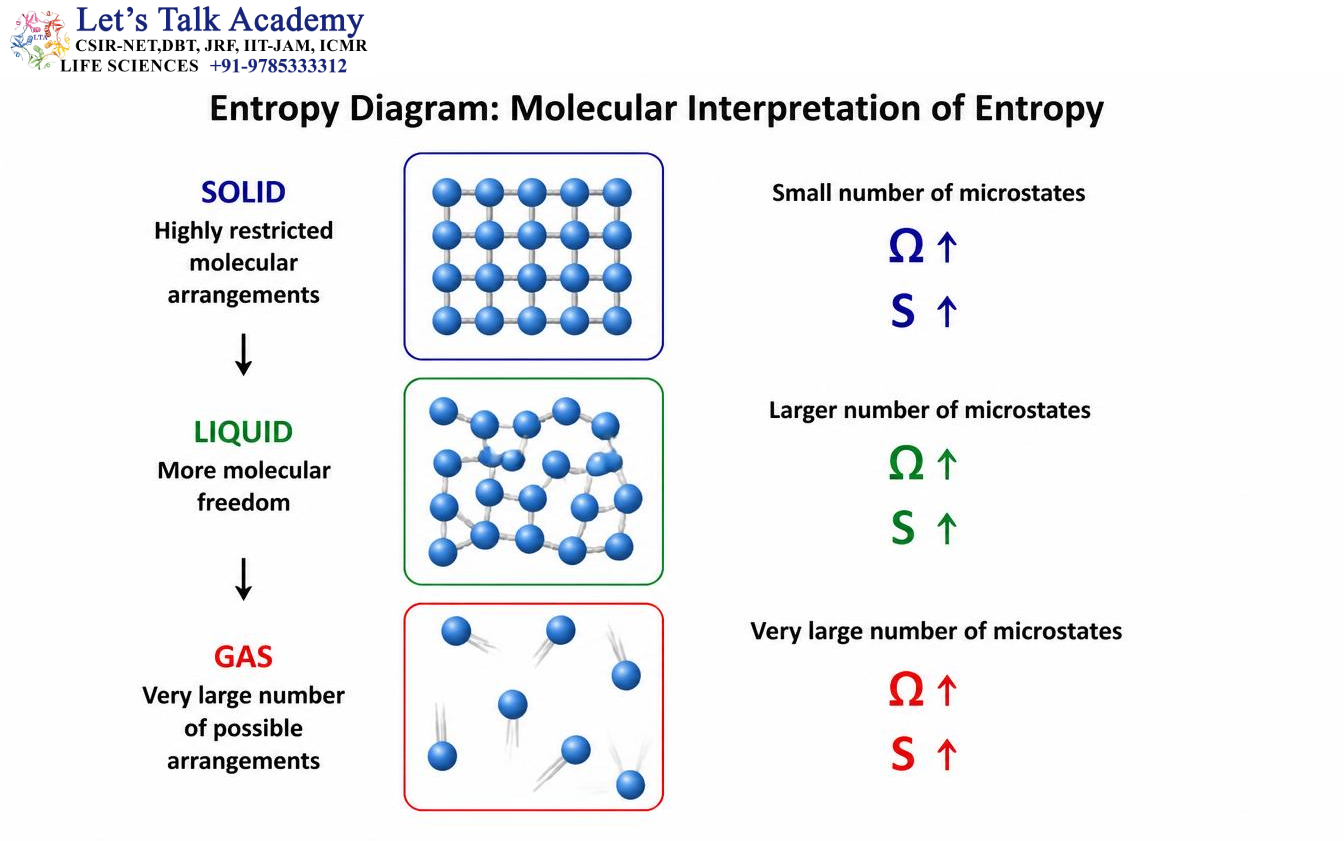
Entropy is represented by: S
Entropy is a thermodynamic state function associated with the dispersal of energy and the number of accessible microscopic states.
For a reversible process:
dS = δqᵣₑᵥ / T
For a reversible process at constant temperature:
ΔS = qᵣₑᵥ / T
Entropy is commonly expressed in:
J mol⁻¹ K⁻¹
The statistical interpretation of entropy is given by the Boltzmann equation:
S = kᴮ ln Ω
where:
- S = entropy
- kᴮ = Boltzmann constant
- Ω = number of accessible microstates
The Boltzmann relationship provides a molecular interpretation of entropy.
As the number of accessible microstates increases, entropy generally increases.
17. Entropy and Molecular Organization
It is common to describe entropy simply as “disorder,” but this description is incomplete.
A more useful interpretation is that entropy is related to the number of possible microscopic arrangements available to a system.
For example, a gas has a large number of possible molecular positions and energy distributions. A solid, in contrast, has a much more restricted set of molecular arrangements.
Therefore, in general:
Ssolid < Sliquid < Sgas
The molecular interpretation of entropy is especially useful in biology because biological molecules can undergo large changes in conformational freedom.
18. Entropy in Protein Folding
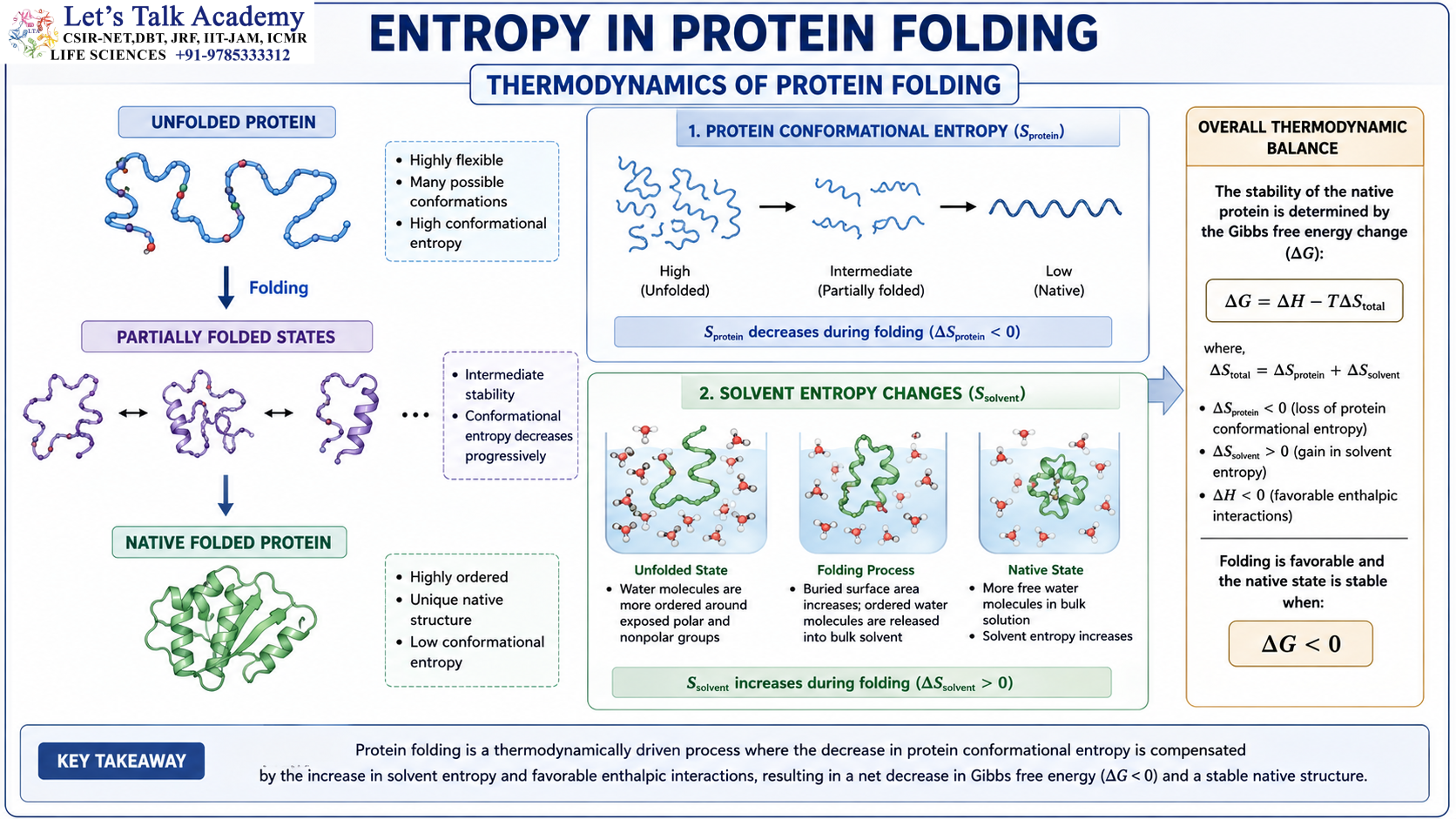
Protein folding provides an excellent example of competing entropic and enthalpic effects.
An unfolded polypeptide can adopt many conformations. When it folds, the conformational freedom of the protein decreases.
This produces an unfavorable entropic contribution for the protein itself.
However, folding also changes interactions with water. Hydrophobic groups become buried inside the protein, while the solvent organization around these groups changes.
Therefore, the overall free-energy change depends on the combined effects of:
- Protein conformational entropy
- Solvent entropy
- Hydrogen bonding
- Hydrophobic interactions
- Electrostatic interactions
- van der Waals interactions
A folded state is thermodynamically favored when the overall free-energy change is favorable.
19. Second Law of Thermodynamics
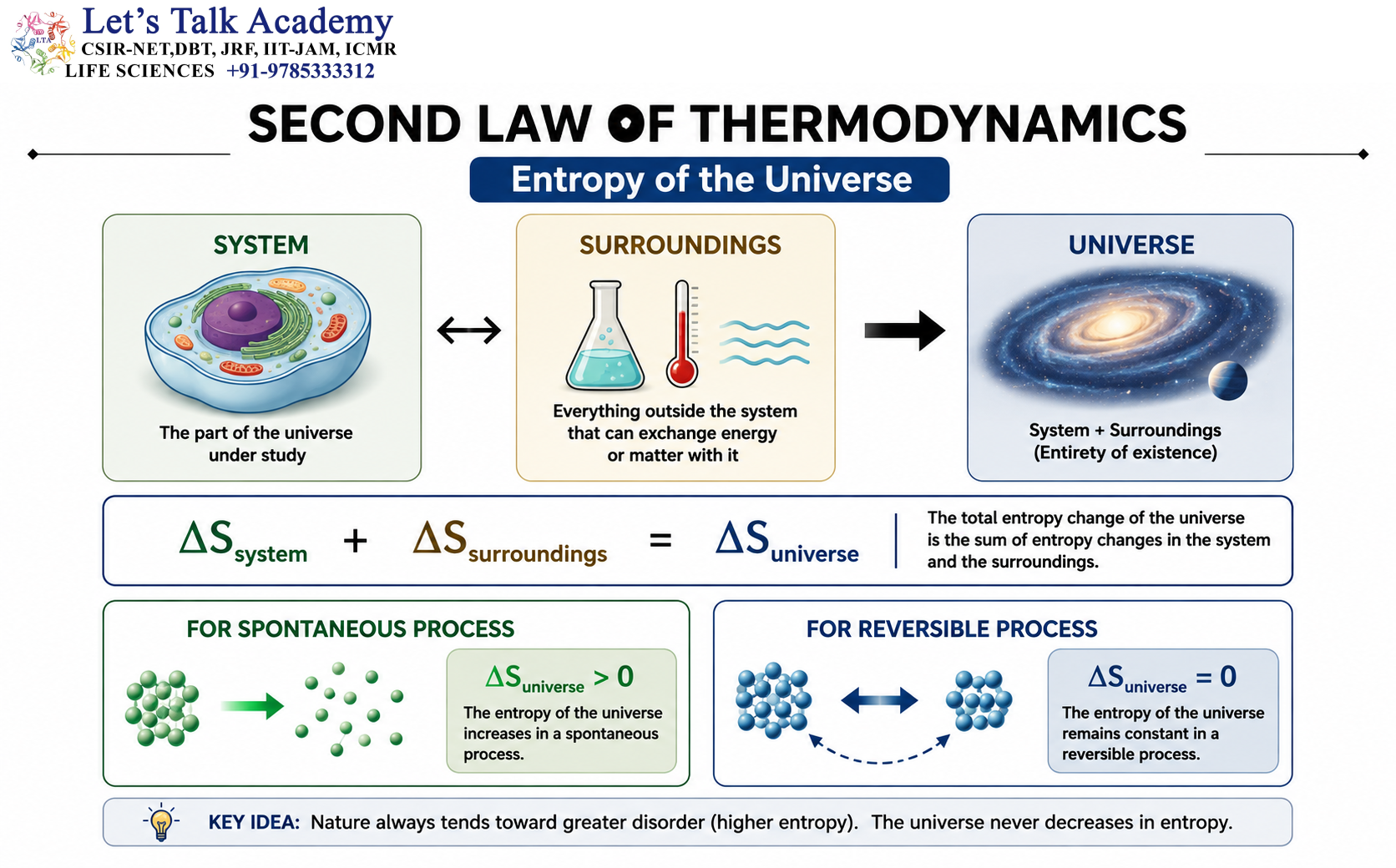
The second law determines the direction of spontaneous processes.
For an isolated system:
ΔSᵤₙᵢᵥₑᵣₛₑ ≥ 0
For a spontaneous irreversible process:
ΔSᵤₙᵢᵥₑᵣₛₑ > 0
For a reversible process:
ΔSᵤₙᵢᵥₑᵣₛₑ = 0
The entropy change of the universe can be written as:
ΔSᵤₙᵢᵥₑᵣₛₑ = ΔSₛᵧₛₜₑₘ + ΔSₛᵤᵣᵣₒᵤₙdᵢₙgₛ
This equation is particularly important for understanding biological organization.
A local decrease in entropy is possible if the entropy increase in the surroundings is sufficiently large.
20. Why Living Organisms Do Not Violate the Second Law
Living organisms are highly organized. Cells contain membranes, proteins, nucleic acids, organelles, and complex molecular machinery.
At first glance, the formation and maintenance of such organization may appear inconsistent with the second law.
However, an organism is an open system.
It continuously exchanges energy and matter with its environment.
A cell can use energy from nutrients or light to maintain highly organized structures while releasing heat and metabolic products into the surroundings.
Therefore, even if:
ΔSsystem < 0
the overall process can remain thermodynamically permissible if:
ΔSsurroundings > |ΔSsystem|
so that:
ΔSuniverse > 0
This is a fundamental concept in biological thermodynamics.
21. Gibbs Free Energy
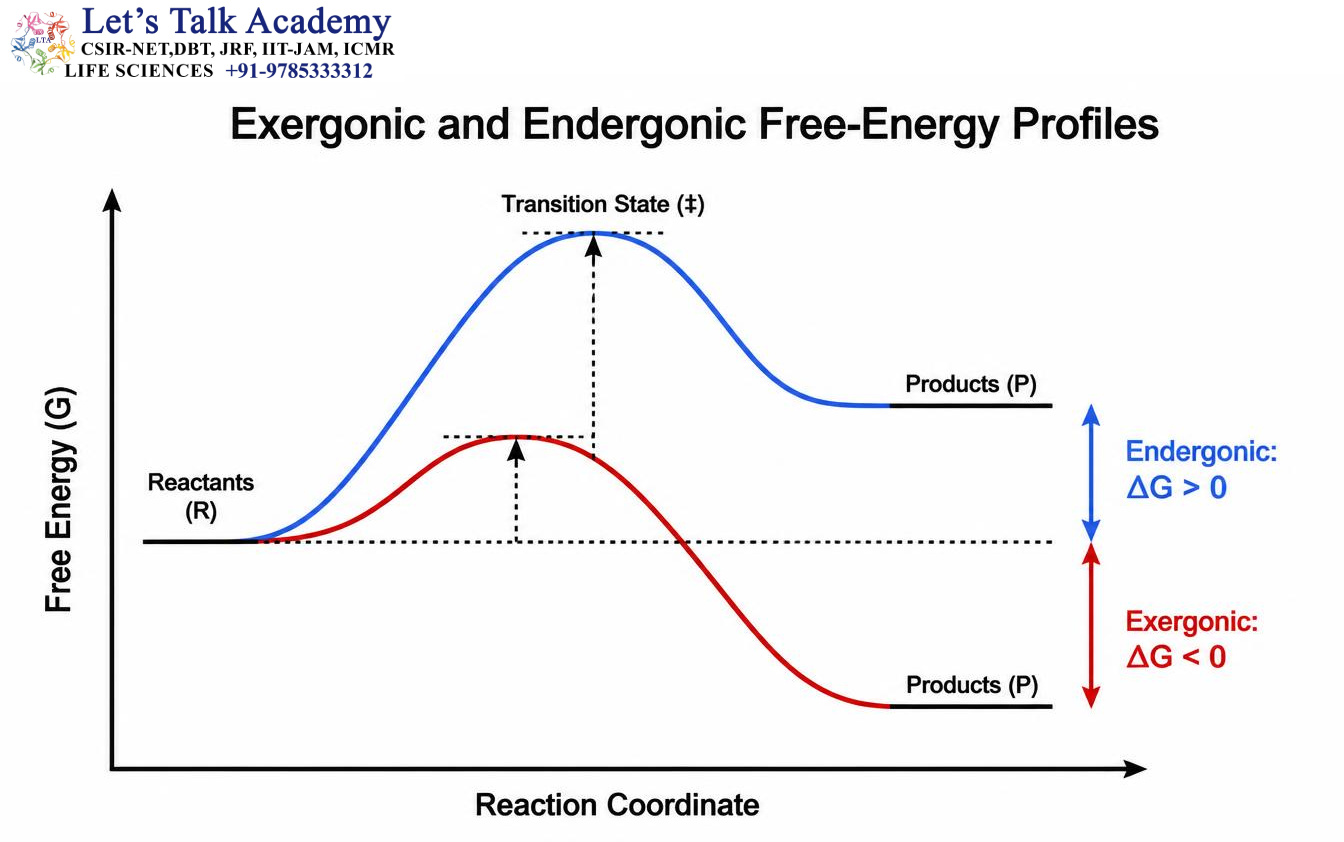
For processes occurring at constant temperature and pressure, Gibbs free energy is the most useful thermodynamic quantity for determining spontaneity.
Gibbs free energy is represented by: G
and is defined as:
G = H − TS
Therefore:
ΔG = ΔH − TΔS
where:
- ΔG = Gibbs free-energy change
- ΔH = enthalpy change
- T = absolute temperature
- ΔS = entropy change
This equation is one of the most important equations in biochemical thermodynamics.
22. Physical Meaning of Gibbs Free Energy
Gibbs free energy can be thought of as the thermodynamic energy available to drive processes under conditions of constant temperature and pressure.
The sign of ΔG determines the thermodynamic direction of a process.
When:
ΔG < 0 the forward reaction is thermodynamically favorable.
When:
ΔG > 0 the forward reaction is thermodynamically unfavorable.
When:
ΔG = 0 the system is at equilibrium.
It is important to understand that these statements apply to the specified conditions. Because biological concentrations continuously change, the actual ΔG of a biochemical reaction can also change.
23. Exergonic Reactions
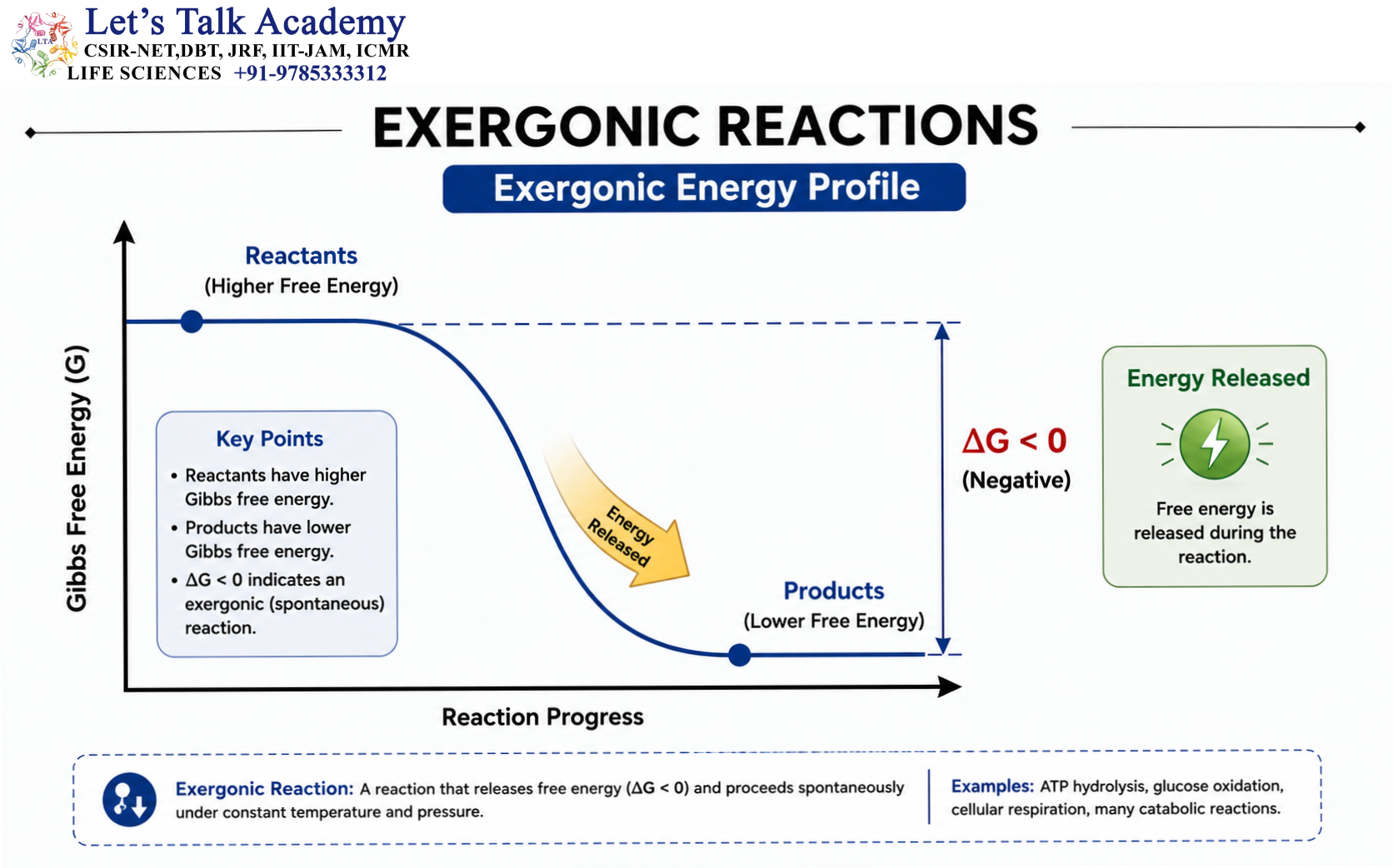
A reaction with: ΔG < 0 is called an exergonic reaction.
The products have lower Gibbs free energy than the reactants under the specified conditions.
A biologically important example is ATP hydrolysis:
ATP + H₂O → ADP + Pᵢ
ATP hydrolysis is thermodynamically favorable under typical cellular conditions.
The free energy released can be coupled to other processes.
For example, ATP-dependent processes include:
- Biosynthetic reactions
- Active transport
- Muscle contraction
- Protein remodeling
- Signal transduction
- Macromolecular assembly
24. Endergonic Reactions
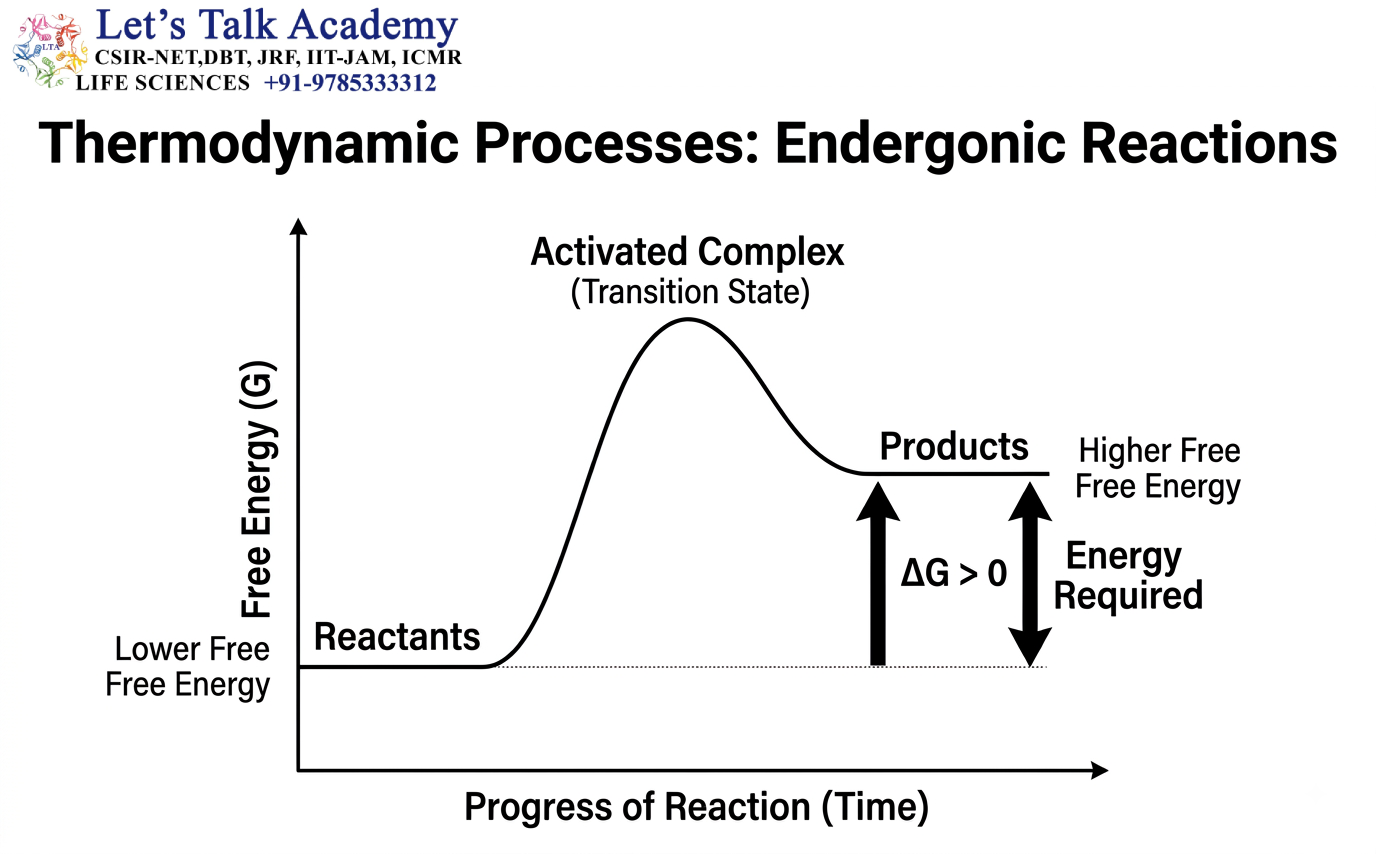
A reaction with:
ΔG > 0
is called an endergonic reaction.
The products have higher Gibbs free energy than the reactants under the specified conditions.
Many anabolic processes are endergonic because the cell must build relatively complex molecules from simpler molecules.
Examples include:
- Protein synthesis
- DNA synthesis
- RNA synthesis
- Polysaccharide synthesis
- Lipid biosynthesis
These processes are made possible by coupling them to sufficiently favorable reactions.
25. Relationship Between ΔH, ΔS, and ΔG
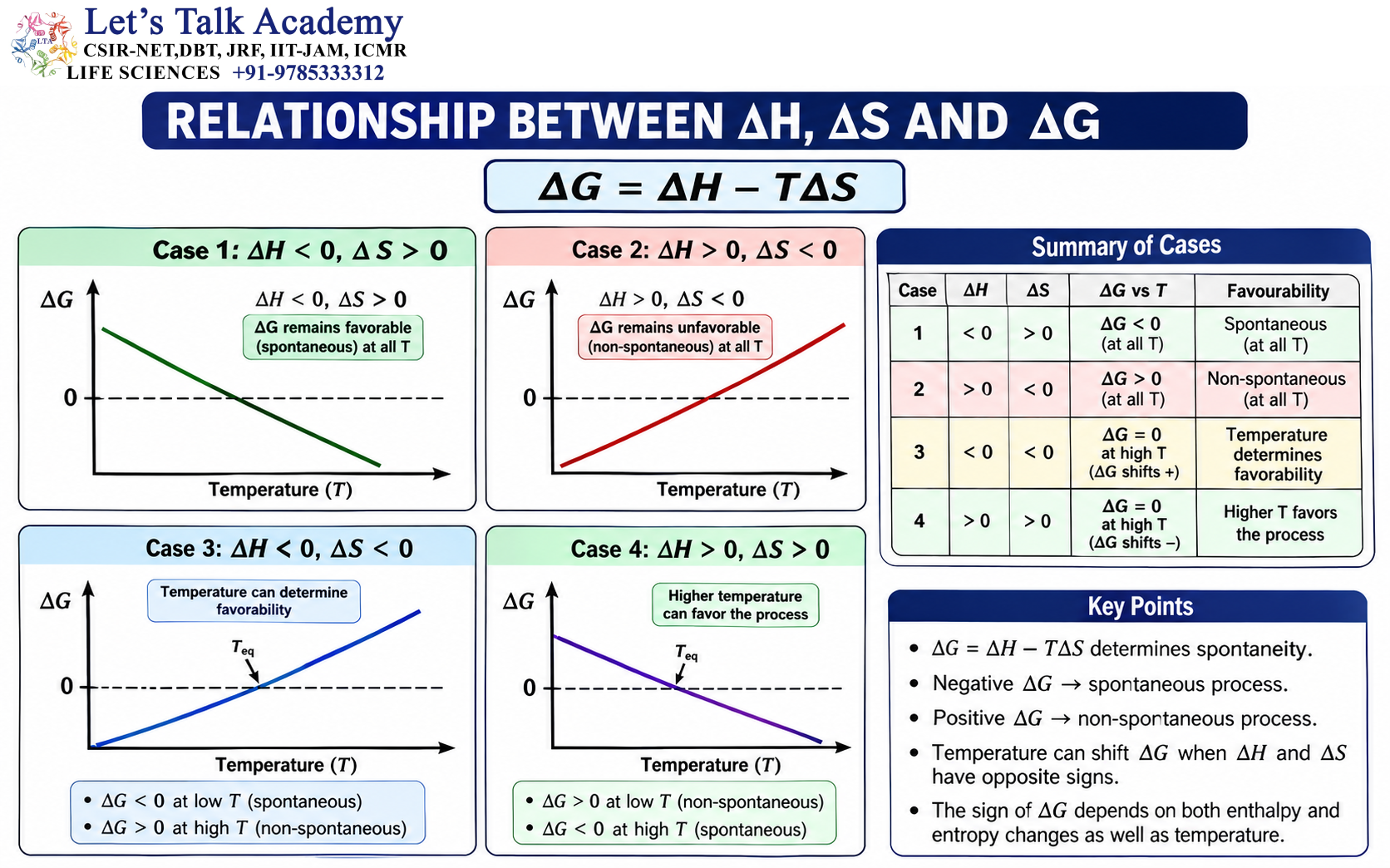
The equation:
ΔG = ΔH − TΔS shows that enthalpy and entropy jointly determine Gibbs free energy.
Consider a process with:
ΔH < 0 and: ΔS > 0 Both terms favor a negative ΔG. Therefore, the reaction is generally thermodynamically favorable over a wide temperature range, assuming ΔH and ΔS remain approximately constant.
Now consider:
ΔH > 0 and: ΔS < 0 Both terms oppose spontaneity.
The most interesting cases occur when ΔH and ΔS have the same sign.
If:
ΔH < 0 and: ΔS < 0 the enthalpy contribution favors the reaction, while the entropy contribution opposes it.
If:
ΔH > 0 and: ΔS > 0 the entropy contribution favors the reaction, especially as temperature increases.
This is why temperature can influence whether certain processes are thermodynamically favorable.
26. Standard Gibbs Free Energy
The Gibbs free-energy change under standard-state conditions is represented by: ΔG°
For biochemical reactions, the biochemical standard Gibbs free-energy change is represented by: ΔG°′
The prime indicates a biochemical standard state that commonly uses a reference pH near 7.
The standard Gibbs free-energy change is useful for comparing reactions under defined reference conditions.
However, biological reactions rarely occur under standard conditions.
Therefore, the actual Gibbs free energy is usually more relevant to cellular physiology.
27. Actual Gibbs Free Energy
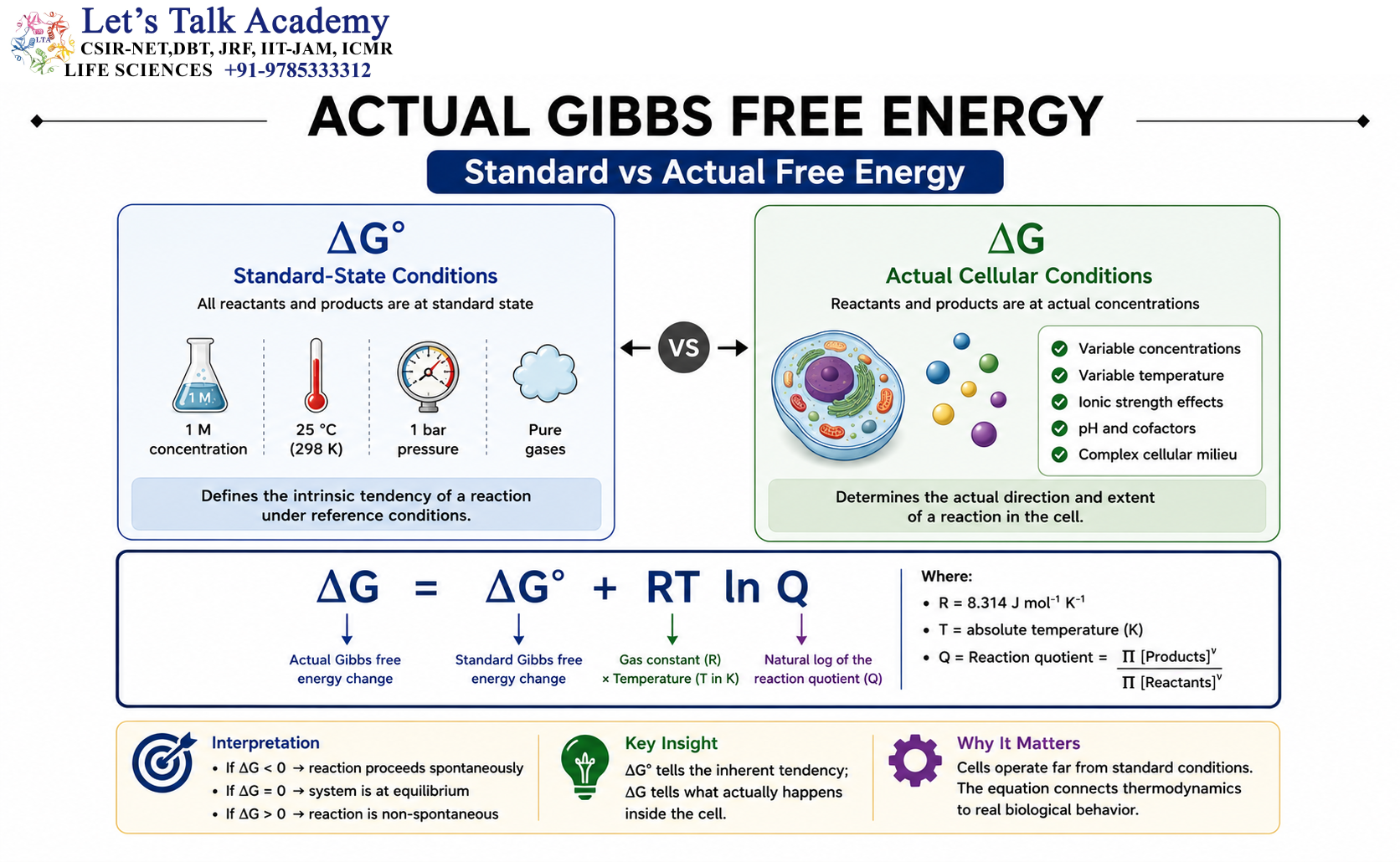
The actual Gibbs free-energy change is:
ΔG = ΔG° + RT ln Q
For biochemical reactions:
ΔG = ΔG°′ + RT ln Q
where:
- R = gas constant
- T = absolute temperature
- Q = reaction quotient
This equation is extremely important because Q changes as the concentrations of reactants and products change.
Therefore, the same biochemical reaction may have different ΔG values in different cells or even at different times within the same cell.
28. Reaction Quotient
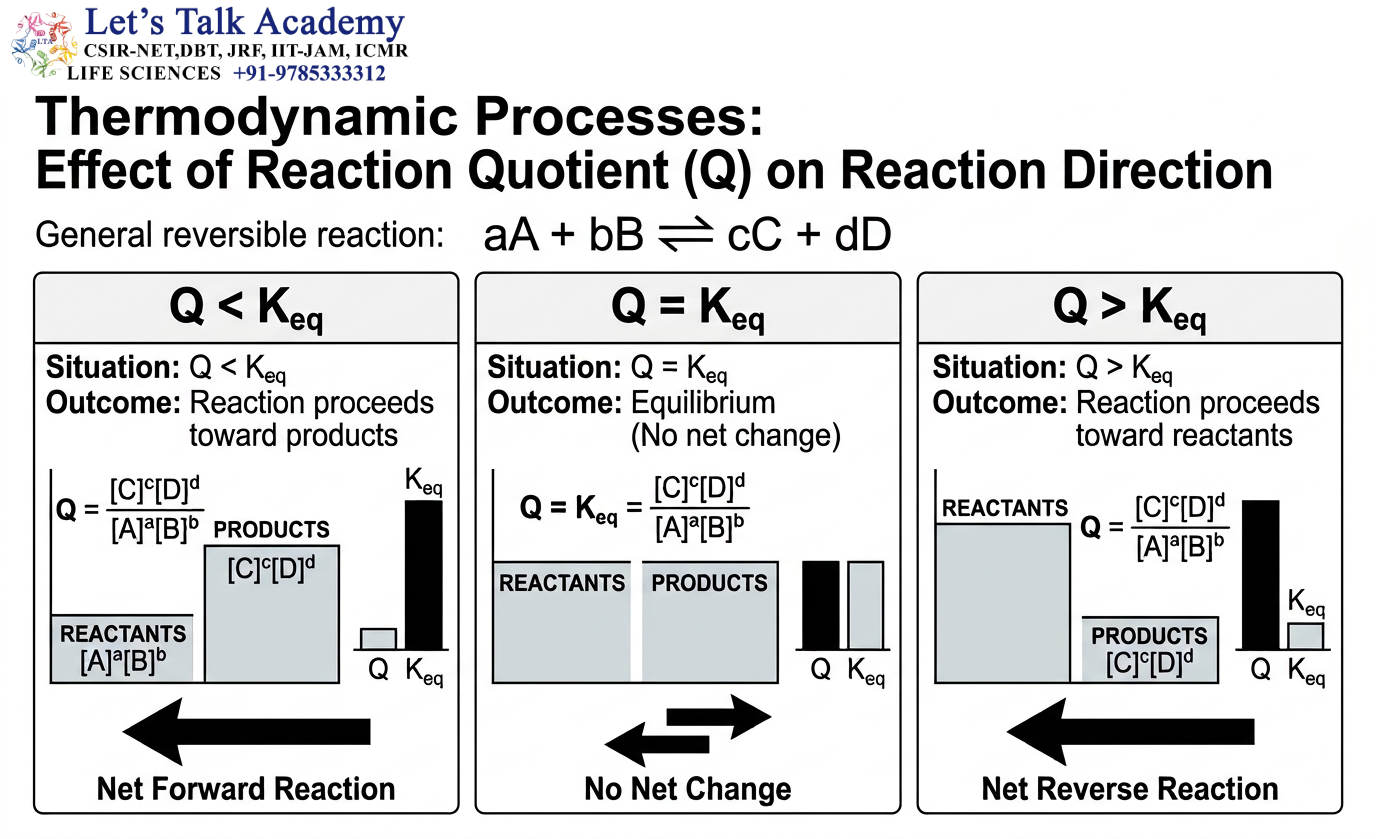
Consider the general reaction:
aA + bB ⇌ cC + dD
The reaction quotient is:
Q = [C]ᶜ[D]ᵈ / [A]ᵃ[B]ᵇ
In rigorous thermodynamics, activities rather than raw concentrations are used, but concentrations are commonly used as approximations in biochemical calculations.
The reaction quotient provides information about the current composition of the reaction mixture.
When Q is small, the reaction is generally driven toward products.
When Q is large, the reaction is generally driven toward reactants.
At equilibrium:
Q = Kₑq and: ΔG = 0
29. Equilibrium Constant and Gibbs Free Energy
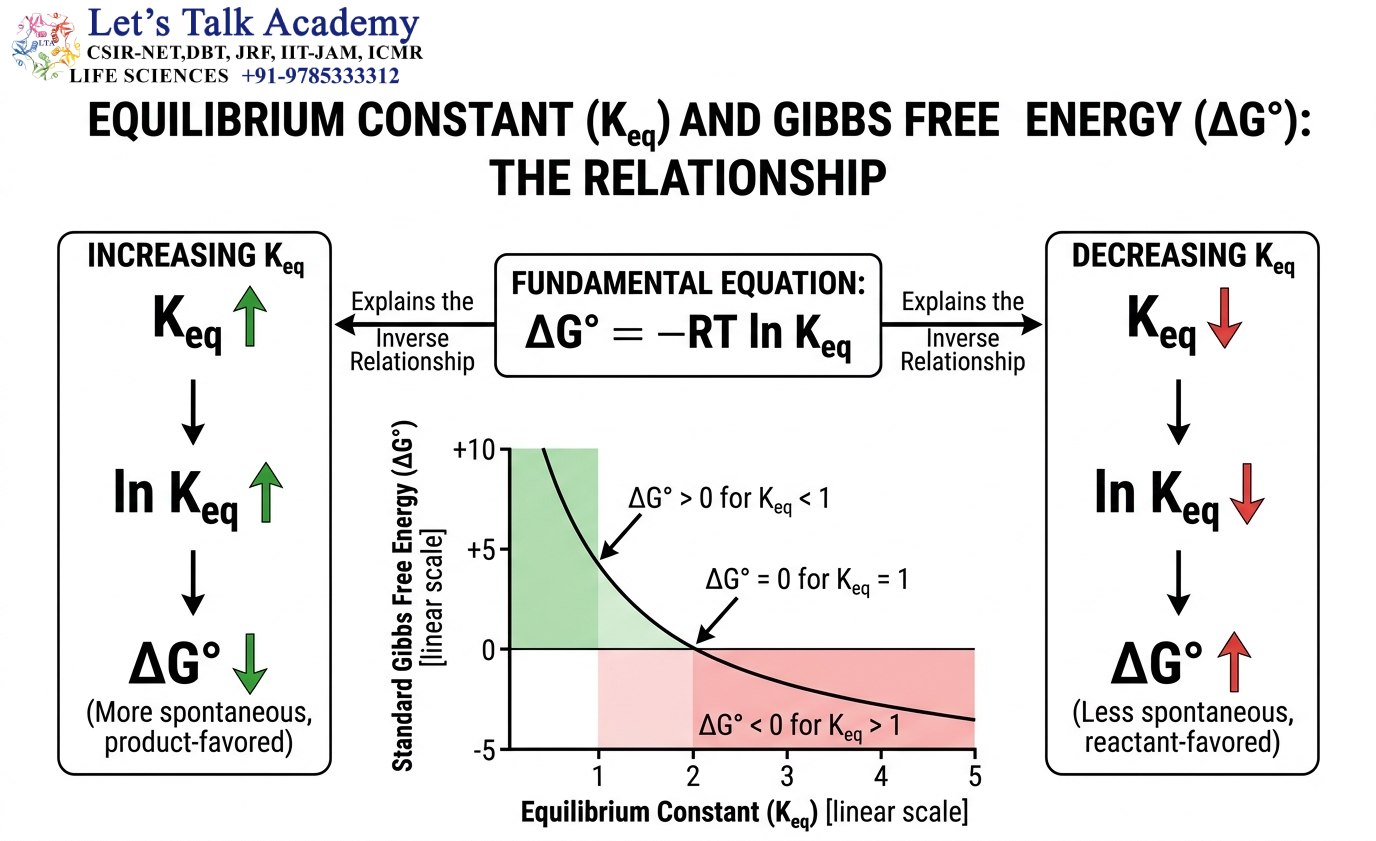
At equilibrium:
ΔG = 0 and: Q = Kₑq
Starting from:
ΔG = ΔG° + RT ln Q
we obtain:
0 = ΔG° + RT ln Kₑq
Therefore:
ΔG° = −RT ln Kₑq
It shows that the equilibrium constant and standard free-energy change contain equivalent thermodynamic information.
If:
Kₑq > 1 then: ΔG° < 0
If:
Kₑq < 1 then: ΔG° > 0
If:
Kₑq = 1 then: ΔG° = 0
30. ΔG° and ΔG Are Not the Same
This distinction should be clearly understood.
ΔG° represents the free-energy change under standard-state conditions.
ΔG represents the free-energy change under the actual conditions of the system.
Their relationship is:
ΔG = ΔG° + RT ln Q
Therefore, a reaction with:
ΔG° > 0
can still have:
ΔG < 0
if Q is sufficiently small.
This is highly relevant to metabolism because cellular concentrations are controlled and are usually far from standard-state concentrations.
31. Thermodynamic Equilibrium
At equilibrium:
ΔG = 0 and: Q = Kₑq
Equilibrium is a dynamic condition rather than a state in which molecular reactions stop.
At equilibrium:
Rateforward = Ratereverse
There is therefore no net change in the concentrations of reactants and products.
This concept is important when interpreting biochemical pathways.
A reaction can be close to equilibrium and therefore readily respond to changes in substrate or product concentration.
In contrast, a strongly favorable reaction far from equilibrium is often more suitable for controlling the direction of a metabolic pathway.
32. Thermodynamic Coupling
A cell frequently needs to perform a reaction with:
ΔG > 0
To accomplish this, the reaction can be coupled to another reaction with:
ΔG < 0
For two coupled reactions:
ΔGtotal = ΔG₁ + ΔG₂
If:
ΔGtotal < 0
the overall coupled process is thermodynamically favorable.
This is one of the central principles of bioenergetics.
The cell therefore does not make an unfavorable reaction spontaneously favorable by itself. Instead, it links the reaction to another reaction that releases enough free energy to drive the combined process.
33. ATP Hydrolysis and Energy Coupling
ATP is a major molecule involved in cellular energy coupling.
Its hydrolysis can be represented as:
ATP + H₂O → ADP + Pᵢ
ATP hydrolysis is exergonic under cellular conditions.
The released free energy can be used to drive reactions that would otherwise be thermodynamically unfavorable.
A classic example is the coupling of ATP hydrolysis to phosphorylation reactions.
The overall principle can be represented as:
ATP hydrolysis + Endergonic reaction → Thermodynamically favorable coupled process
The exact mechanism of coupling is important. Merely placing two reactions in the same solution does not guarantee thermodynamic coupling. The reactions must be mechanistically linked so that free-energy transfer can occur.
34. ATP/ADP Ratio and Cellular Energy State
The relative concentrations of ATP and ADP provide important information about the energetic state of a cell.
The free energy available from ATP hydrolysis depends strongly on the ATP/ADP ratio and the concentration of inorganic phosphate.
For:
ATP + H₂O → ADP + Pᵢ
the reaction quotient is approximately:
Q = [ADP][Pᵢ] / [ATP]
Therefore:
ΔG = ΔG°′ + RT ln([ADP][Pᵢ] / [ATP])
A high ATP/ADP ratio can contribute to a more negative free-energy change for ATP hydrolysis under cellular conditions.
This is one reason why ATP concentration alone does not completely describe the energetic state of a cell.
35. Hess’s Law
Hess’s law follows from the state-function nature of enthalpy.
It states that the total enthalpy change of a reaction is independent of the pathway through which the reaction occurs.
Suppose:
A → B has: ΔH₁ and B → C has: ΔH₂
Then:
A → C has:
ΔHtotal = ΔH₁ + ΔH₂
The same additive principle applies to Gibbs free energy:
ΔGtotal = ΔG₁ + ΔG₂ + ΔG₃ + …
This principle is particularly useful in metabolism because metabolic pathways contain multiple connected reactions.
36. Thermodynamics of Metabolic Pathways
A metabolic pathway can be represented as:
A → B → C → D
Each step has its own Gibbs free-energy change.
The overall change is:
ΔGtotal = ΔG₁ + ΔG₂ + ΔG₃
A reaction with positive ΔG can sometimes occur as part of a pathway if another reaction provides sufficient negative ΔG.
This principle explains why metabolic pathways frequently involve coupling with:
- ATP hydrolysis
- Redox reactions
- Phosphoryl-transfer reactions
- Ion gradients
The overall thermodynamic behavior of the pathway is determined by the combined free-energy changes.
37. Thermodynamics and Enzyme Catalysis
Enzymes are biological catalysts that increase reaction rates.
They do this by lowering the activation-energy barrier.
The uncatalyzed reaction may have a high activation energy:
Eₐ,uncatalyzed
while the enzyme-catalyzed reaction has:
Eₐ,catalyzed < Eₐ,uncatalyzed
However, the enzyme does not change the difference in Gibbs free energy between reactants and products.
Therefore:
ΔG remains unchanged and: Kₑq remains unchanged
The enzyme simply allows the system to reach equilibrium more rapidly.
38. Thermodynamics Versus Kinetics
Thermodynamics answers:
Is the reaction energetically favorable?
Kinetics answers:
How quickly does the reaction occur?
These are fundamentally different questions.
For example, a biochemical reaction may have:
ΔG < 0
but still occur very slowly because the activation-energy barrier is high.
An enzyme can accelerate the reaction by lowering this barrier without changing ΔG.
Therefore:
Thermodynamically favorable ≠ kinetically rapid
This distinction is among the highest-yield concepts in biochemical thermodynamics.
39. Activation Energy and Transition State
The activation-energy barrier is associated with reaching the transition state of a reaction.
The transition state is a high-energy configuration through which the reaction must pass.
Enzymes stabilize the transition state and therefore lower the activation-energy barrier.
This is fundamentally different from changing the free-energy difference between reactants and products.
Thus:
Activation energy → Kinetics
ΔG → Thermodynamics
40. Third Law of Thermodynamics
The third law of thermodynamics states that the entropy of a perfect crystalline substance approaches zero as the temperature approaches absolute zero.
Thus:
T → 0 K and S → 0
for a perfect crystal.
The third law provides an important reference point for determining absolute entropy.
Although it is not as frequently applied to biological processes as the first and second laws, it completes the fundamental framework of classical thermodynamics.
41. Heat Capacity
Heat capacity represents the amount of heat required to increase the temperature of a substance by one degree.
It can be expressed as:
C = dq / dT
Two important forms are:
Cᵥ = Heat capacity at constant volume
Cₚ = Heat capacity at constant pressure
For an ideal gas:
Cₚ − Cᵥ = R
Heat capacity can also provide information about structural transitions in biomolecules.
For example, protein unfolding can produce measurable changes in heat capacity. Differential scanning calorimetry exploits such thermodynamic properties to study protein stability and molecular transitions.
42. Chemical Potential
Chemical potential is an important thermodynamic quantity used to describe the tendency of a component to undergo chemical transformation or movement.
For component i:
μᵢ = (∂G / ∂nᵢ)ₜ,ₚ,nⱼ
Chemical potential is essentially the partial molar Gibbs free energy.
For an ideal solution:
μᵢ = μᵢ° + RT ln aᵢ
where aᵢ represents the activity of component i.
Chemical potential is particularly important for understanding:
- Diffusion
- Osmosis
- Membrane transport
- Chemical equilibrium
- Ion distribution
- Cellular compartmentalization
43. Chemical Potential and Diffusion
A molecule tends to move in a direction that lowers its chemical potential when no other force opposes the movement.
For an uncharged molecule, concentration contributes strongly to chemical potential.
This provides a thermodynamic explanation for diffusion.
The familiar statement that molecules move from “high concentration to low concentration” is therefore a simplified description of movement down a chemical-potential gradient.
For ions, concentration alone is not sufficient because electrical potential also contributes to the thermodynamic driving force.
44. Electrochemical Potential
For charged molecules, the electrical component must be added to the chemical potential.
The electrochemical potential is:
μ̃ᵢ = μᵢ + zᵢFψ
Substituting:
μᵢ = μᵢ° + RT ln aᵢ
gives:
μ̃ᵢ = μᵢ° + RT ln aᵢ + zᵢFψ
where:
- μ̃ᵢ = electrochemical potential
- μᵢ° = standard chemical potential
- aᵢ = activity
- zᵢ = ionic charge
- F = Faraday constant
- ψ = electrical potential
This equation is fundamental to membrane biophysics.
45. Electrochemical Gradients
Biological membranes maintain gradients of ions such as:
- Na⁺
- K⁺
- Ca²⁺
- H⁺
- Cl⁻
These gradients contain stored free energy.
The movement of an ion down its electrochemical gradient can release free energy.
Cells exploit this energy for processes such as:
- ATP synthesis
- Secondary active transport
- Nutrient uptake
- Ion homeostasis
- Signal transduction
The electrochemical gradient therefore acts as a form of stored biological energy.
46. Membrane Potential
The electrical potential difference across a biological membrane contributes to the electrochemical potential of ions.
For example, the movement of a positively charged ion is influenced by both:
Concentration gradient and Electrical potential gradient
The balance of these forces determines whether an ion has a thermodynamic tendency to enter or leave the cell.
This principle is fundamental to:
- Neuronal signaling
- Muscle physiology
- Ion-channel function
- Mitochondrial energy transduction
- Active transport
47. Proton-Motive Force
The proton-motive force is a major form of stored energy in mitochondria and chloroplasts.
During electron transport, energy from redox reactions is used to move protons across a membrane.
This produces:
A proton concentration gradient and An electrical potential difference
Together these create the proton-motive force.
The energy stored in the proton gradient can then be used by ATP synthase.
The overall sequence is:
Electron transport → Proton pumping → Proton-motive force → Proton flow through ATP synthase → ATP synthesis
This is one of the clearest examples of thermodynamic coupling in biology.
48. Thermodynamics of Protein Folding
Protein folding is a complex thermodynamic process.
A polypeptide chain contains many possible conformations. Folding reduces the number of accessible conformations and produces a specific three-dimensional structure.
The stability of the folded protein depends on the balance between different energetic and entropic contributions.
Important contributors include:
- Hydrophobic effect
- Hydrogen bonding
- Electrostatic interactions
- van der Waals interactions
- Disulfide bonds
- Solvent interactions
- Conformational entropy
The folded state is thermodynamically favored when:
ΔGfolding < 0
However, protein stability is not simply determined by one type of bond.
Instead, the overall free-energy landscape determines which conformations are populated.
49. Free-Energy Landscape of Protein Folding
Protein folding can be visualized as movement through a multidimensional free-energy landscape.
The unfolded ensemble contains many possible conformations.
As the protein folds, it moves toward regions of lower free energy.
The native state is often associated with a low-free-energy basin.
However, proteins do not necessarily follow a single rigid pathway. Multiple folding pathways may exist, and intermediate states can appear.
This concept is important for understanding:
- Protein stability
- Protein misfolding
- Aggregation
- Denaturation
- Molecular chaperones
50. Protein Denaturation
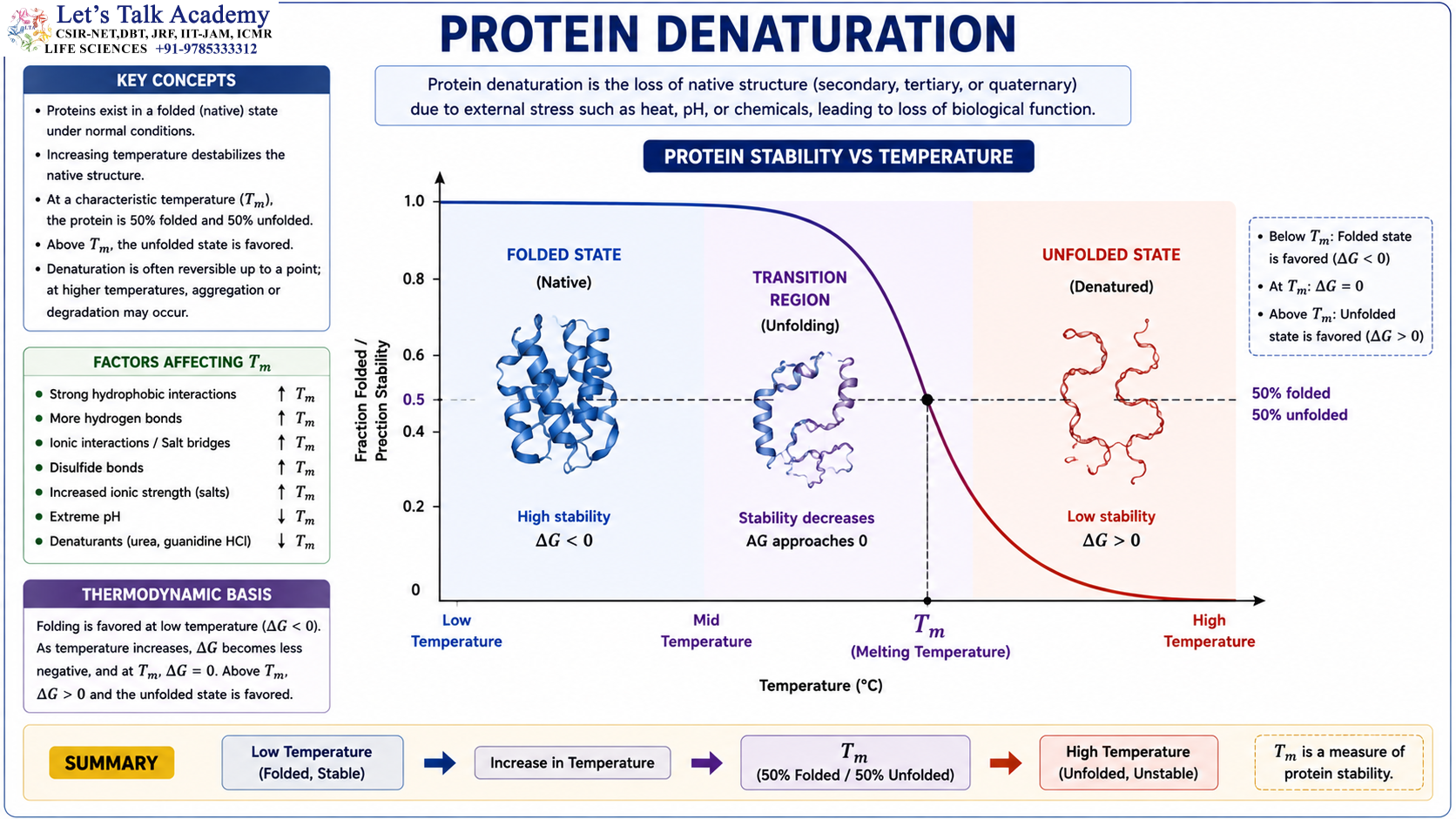
Protein denaturation involves disruption of the native three-dimensional structure without necessarily breaking all covalent peptide bonds.
Denaturation can be caused by:
- High temperature
- Extreme pH
- Organic solvents
- Detergents
- Chaotropic agents
- Heavy metals
- High ionic strength
Denaturation changes the balance of thermodynamic interactions stabilizing the native state.
For example, increasing temperature can alter both enthalpic and entropic contributions and eventually favor the unfolded state.
Thus, protein denaturation is fundamentally connected to thermodynamics.
51. Hydrophobic Effect
The hydrophobic effect is one of the most important thermodynamic phenomena in biological systems.
Nonpolar surfaces interact differently with water than polar or charged surfaces.
Water molecules surrounding a hydrophobic surface can become more constrained in their orientations.
When hydrophobic surfaces come together, the total hydrophobic surface exposed to water can decrease, and some water molecules can return to the bulk solvent.
This change in solvent organization can contribute significantly to the free-energy change.
The hydrophobic effect is therefore important in:
- Protein folding
- Membrane formation
- Protein–protein association
- Ligand binding
- Formation of hydrophobic protein cores
It is important to understand that the hydrophobic effect is not simply the result of a strong attraction between nonpolar molecules. The behavior of water is central to the thermodynamic explanation.
52. Thermodynamics of Membrane Formation
Phospholipids are amphipathic molecules containing both hydrophilic and hydrophobic regions.
When phospholipids are placed in water, their molecular organization minimizes unfavorable exposure of hydrophobic groups to the aqueous environment.
Depending on their molecular geometry and environmental conditions, amphipathic lipids can form:
- Micelles
- Bilayers
- Vesicles
The formation of biological membranes is strongly influenced by the hydrophobic effect and free-energy minimization.
The resulting membrane creates a controlled boundary between cellular compartments.
This allows cells to maintain:
- Ion gradients
- Chemical gradients
- Membrane potential
- Selective permeability
- Compartmentalization
- Signal-transduction systems
53. Thermodynamics of Ligand Binding
Ligand binding can be represented as:
P + L ⇌ PL
where P is the protein, L is the ligand, and PL is the complex.
The thermodynamic favorability of binding depends on:
ΔGbinding
A favorable binding reaction has:
ΔGbinding < 0
The free-energy change can be expressed as:
ΔGbinding = ΔHbinding − TΔSbinding
Several interactions may contribute to binding:
- Hydrogen bonds
- Electrostatic interactions
- Hydrophobic interactions
- van der Waals interactions
- π–π interactions
- Cation–π interactions
- Conformational changes
- Desolvation effects
The overall binding free energy is the combined result of these contributions.
54. Enthalpy–Entropy Compensation
A particularly important concept in molecular recognition is enthalpy–entropy compensation.
A favorable enthalpic contribution may sometimes be accompanied by an unfavorable entropy change.
For example, formation of several hydrogen bonds may lower ΔH, but restricting molecular motion may decrease entropy.
Similarly, a process may have a favorable entropy contribution but an unfavorable enthalpic contribution.
The overall thermodynamic effect is determined by:
ΔG = ΔH − TΔS
Therefore, strong molecular interactions cannot be evaluated by considering enthalpy alone.
55. Thermodynamics of DNA and RNA Structure
Nucleic-acid structure is strongly influenced by thermodynamic forces.
DNA duplex stability results from a combination of:
- Hydrogen bonding between complementary bases
- Base-stacking interactions
- Electrostatic interactions
- Solvent effects
- Counterion interactions
The stability of nucleic-acid structures can therefore be described through enthalpy, entropy, and free energy.
For a nucleic-acid transition:
ΔG = ΔH − TΔS
This relationship is relevant to:
- DNA hybridization
- RNA folding
- PCR primer design
- Melting-temperature analysis
- Nucleic-acid structure prediction
- Molecular recognition
56. Thermodynamics of Nucleic-Acid Melting
When a DNA duplex is heated, the two strands may separate.
This process is often called DNA melting or denaturation.
The transition is associated with changes in enthalpy and entropy.
At the melting temperature, the thermodynamic balance between the associated and dissociated states becomes particularly important.
Factors influencing nucleic-acid stability include:
- Base composition
- Sequence
- Salt concentration
- Strand concentration
- Mismatches
- Temperature
- Solvent conditions
This is why GC-rich DNA generally exhibits greater thermal stability than otherwise comparable AT-rich sequences.
57. Thermodynamics of Membrane Transport
Transport across biological membranes is fundamentally thermodynamic.
A molecule moving across a membrane experiences a difference in chemical potential.
For an ion, the relevant quantity is electrochemical potential.
Transport can therefore be divided broadly into processes that are favorable down a gradient and processes that require energy input.
Passive movement generally occurs down the electrochemical gradient.
Active transport can move molecules against their gradients by coupling transport to an energy-releasing process.
58. Primary and Secondary Active Transport
In primary active transport, the energy required for transport is supplied directly by an energy-releasing reaction, frequently ATP hydrolysis.
A classic example is the Na⁺/K⁺-ATPase.
ATP hydrolysis provides energy that allows the pump to move ions against their electrochemical gradients.
In secondary active transport, the transporter does not directly hydrolyze ATP for each transport event. Instead, it uses the free energy stored in an ion gradient.
For example, the sodium gradient can drive glucose uptake through a sodium–glucose cotransporter.
Thus:
ATP hydrolysis → Ion gradient
and then:
Ion gradient → Transport of another molecule
This is another example of thermodynamic energy coupling.
59. Factors That Influence the Actual Free Energy of Cellular Reactions
The thermodynamic behavior of a biochemical reaction inside a cell is influenced by the actual cellular environment.
Important factors include:
- Substrate concentration
- Product concentration
- Enzyme activity
- Compartmentalization
- ATP/ADP ratio
- Redox state
- Ion gradients
- pH
These factors influence reaction direction, reaction coupling, metabolic flux, or the actual free-energy change under cellular conditions.
59.1 Substrate Concentration
The concentration of substrates directly influences the reaction quotient.
An increase in substrate concentration can shift the thermodynamic driving force toward product formation for many reactions.
For example, for:
A ⇌ B
the reaction quotient is:
Q = [B] / [A]
Therefore:
ΔG = ΔG° + RT ln([B] / [A])
Changing the ratio of B to A changes the actual ΔG.
59.2 Product Concentration
Product accumulation can oppose forward reaction by increasing Q.
In many metabolic pathways, rapid removal of a product can help maintain a favorable reaction direction.
This is one reason metabolic pathways are often interconnected rather than operating as isolated reactions.
59.3 Enzyme Activity
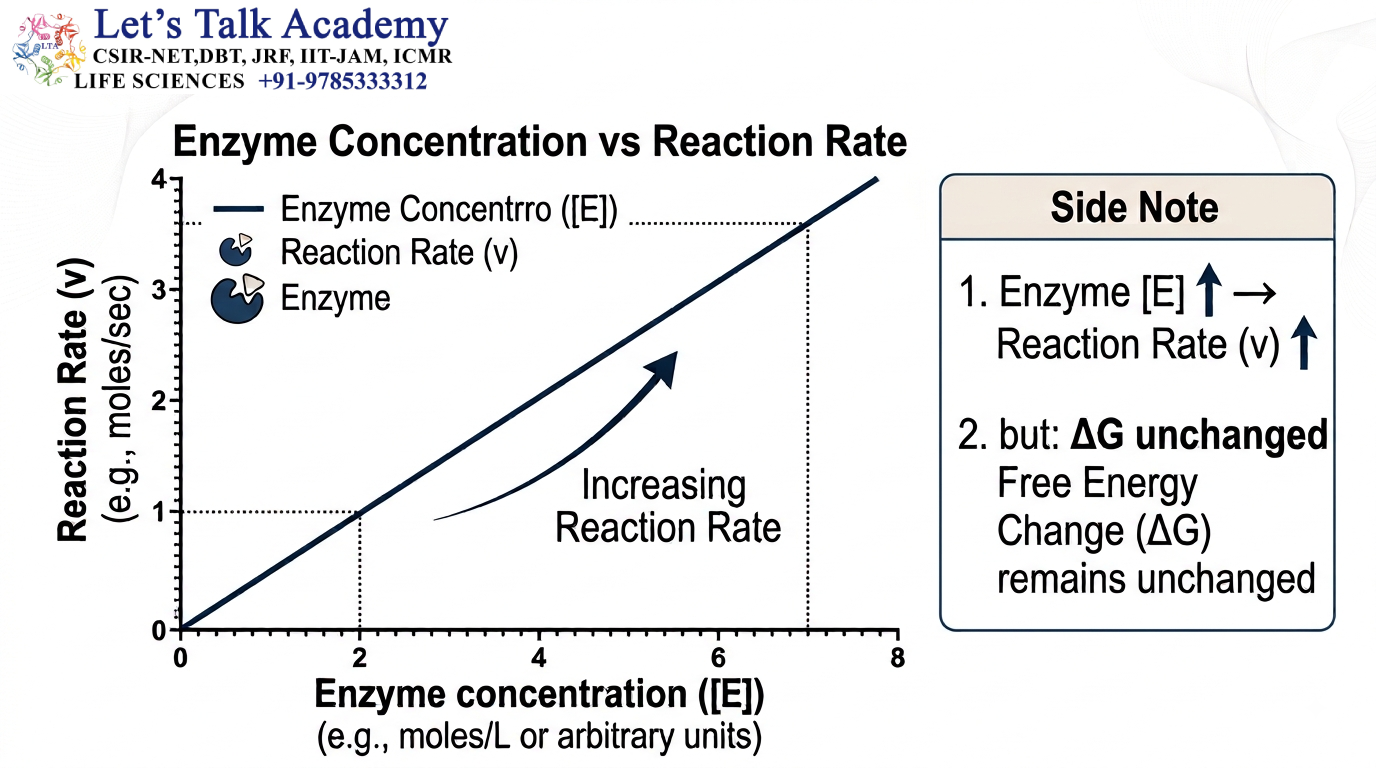
Enzyme activity primarily affects reaction rate, not the fundamental thermodynamic ΔG between reactants and products.
However, enzymes can strongly influence the rate at which a system approaches equilibrium and can help establish mechanistically coupled pathways.
An enzyme does not make an inherently unfavorable reaction favorable simply by being present.
59.4 Compartmentalization
Cells divide biochemical processes among different compartments.
Examples include:
- Cytosol
- Mitochondrial matrix
- Intermembrane space
- Endoplasmic reticulum
- Lysosome
- Chloroplast
- Thylakoid lumen
Compartmentalization can maintain different concentrations, pH values, and electrochemical potentials in different regions.
These differences can create thermodynamic driving forces that would not exist in a homogeneous system.
59.5 ATP/ADP Ratio
The ATP/ADP ratio provides information about cellular energy status.
A high ATP/ADP ratio generally indicates a relatively energy-rich state, whereas a lower ratio is associated with increased energy demand.
Because ATP hydrolysis depends on ATP, ADP, and phosphate concentrations, changes in their ratios affect the actual ΔG of ATP hydrolysis.
59.6 Redox State
Many biological energy transformations involve oxidation–reduction reactions.
The thermodynamic driving force of redox reactions depends on the relative concentrations of oxidized and reduced species.
Important biological redox couples include:
- NAD⁺/NADH
- NADP⁺/NADPH
- FAD/FADH₂
- Oxidized/reduced glutathione
The cellular redox state therefore influences metabolic reactions, antioxidant systems, and electron transport.
59.7 Ion Gradients
Ion gradients store electrochemical free energy.
Important gradients include:
- Na⁺ gradient
- K⁺ gradient
- Ca²⁺ gradient
- H⁺ gradient
These gradients can drive transport and energy conversion.
For example, the proton gradient across the inner mitochondrial membrane drives ATP synthesis.
59.8 pH
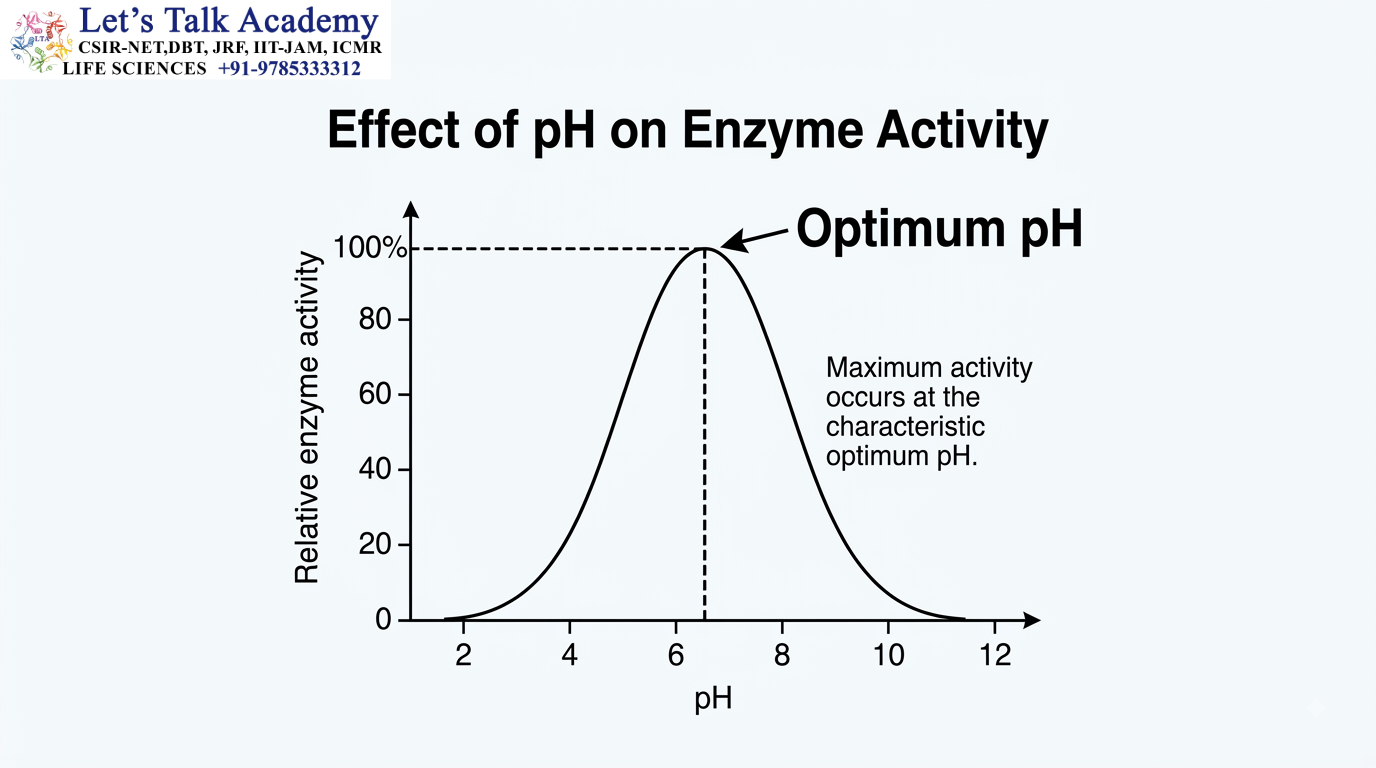
pH strongly affects biochemical thermodynamics because many biological molecules contain ionizable groups.
Changes in pH can alter:
- Protein charge
- Enzyme activity
- Ligand binding
- Protonation states
- Membrane transport
- Reaction equilibria
Therefore, biochemical standard free-energy values often use a defined reference pH, commonly reflected in the notation ΔG°′.
60. Redox Thermodynamics
Oxidation–reduction reactions are central to biological energy metabolism.
An oxidation reaction involves loss of electrons, whereas reduction involves gain of electrons.
A useful mnemonic is:
OIL RIG
Oxidation Is Loss
Reduction Is Gain
Biological energy production depends heavily on electron transfer.
During cellular respiration, electrons move through a series of carriers with progressively favorable redox potentials.
The resulting free-energy changes are used to pump protons and generate an electrochemical gradient.
61. Relationship Between Redox Potential and Free Energy
For an electrochemical process involving n electrons:
ΔG = −nFΔE
where:
- ΔG = Gibbs free-energy change
- n = number of electrons transferred
- F = Faraday constant
- ΔE = difference in reduction potential
A positive ΔE corresponds to a negative ΔG under the conventional reaction direction.
This relationship provides an important connection between electrochemistry and bioenergetics.
It explains how electron-transfer reactions can release free energy that is subsequently used for ATP production.
62. Oxidative Phosphorylation and Thermodynamics
Oxidative phosphorylation is one of the best examples of biological energy conversion.
Electrons derived from metabolic substrates enter the electron transport chain.
As electrons move through the chain, free energy is released.
This energy is used to pump protons across the inner mitochondrial membrane.
The resulting proton gradient stores free energy.
Protons then flow back through ATP synthase, driving ATP formation.
Thus:
Nutrient oxidation
↓
Electron transfer
↓
Proton pumping
↓
Electrochemical gradient
↓
ATP synthesis
The process demonstrates how several thermodynamic transformations can be coupled in a controlled biological system.
63. Thermodynamics of Photosynthesis
Photosynthesis provides another major example of energy transformation.
Plants and other photosynthetic organisms capture light energy and convert it into chemical energy.
The simplified process can be represented as:
Light energy → Electron excitation → Electron transport → Proton gradient → ATP and NADPH → Chemical energy
The energy captured from photons ultimately supports carbon fixation and biosynthesis.
Thus, photosynthesis demonstrates how biological systems can use an external energy source to drive thermodynamically demanding reactions.
64. Free Energy and Metabolic Regulation
Metabolic pathways are regulated not only by enzyme concentration but also by thermodynamic conditions.
The actual free-energy change of a reaction depends on substrate and product concentrations.
Therefore, cellular metabolism is influenced by:
- Substrate availability
- Product removal
- ATP/ADP ratio
- NADH/NAD⁺ ratio
- NADPH/NADP⁺ ratio
- Ion concentrations
- pH
- Cellular compartment
A reaction far from equilibrium may respond strongly to changes in substrate or product concentration and can often contribute substantially to pathway directionality.
Near-equilibrium reactions, in contrast, may rapidly adjust according to changes in metabolite concentrations.
65. Thermodynamic Control Points in Metabolism
Some metabolic reactions have strongly negative ΔG under cellular conditions and are therefore effectively irreversible.
Such reactions can function as important control points.
Examples include strongly exergonic steps in pathways such as:
- Glycolysis
- Citric acid cycle
- Fatty-acid metabolism
However, the exact thermodynamic state of a reaction depends on cellular conditions.
This is why metabolic regulation cannot be understood solely from standard free-energy values.
66. Thermodynamics of Cellular Organization
Cells maintain highly organized structures despite continuous molecular motion and energy dissipation.
This organization is possible because the cell continuously consumes free energy.
Examples include:
Maintenance of ion gradients
Protein synthesis
DNA replication
Membrane assembly
Cytoskeletal organization
Macromolecular transport
Vesicle trafficking
All these processes require energy and are connected to thermodynamic coupling.
Thus, the ordered state of a living cell is a dynamic, energy-dependent state, not a static equilibrium structure.
67. Equilibrium Versus Steady State in Biology
This distinction is important.
A system at thermodynamic equilibrium has no net driving force and satisfies:
ΔG = 0
However, living organisms generally do not exist at thermodynamic equilibrium.
Instead, they maintain a steady state through continuous energy and matter exchange.
For example, a cell can maintain a relatively constant ATP concentration while ATP is continuously being synthesized and consumed.
Thus:
Equilibrium ≠ Steady state
A steady state requires continuous flux, whereas equilibrium has no net thermodynamic driving force.
This is a very important concept in systems biology and metabolism.
68. Thermodynamic Stability Versus Kinetic Stability
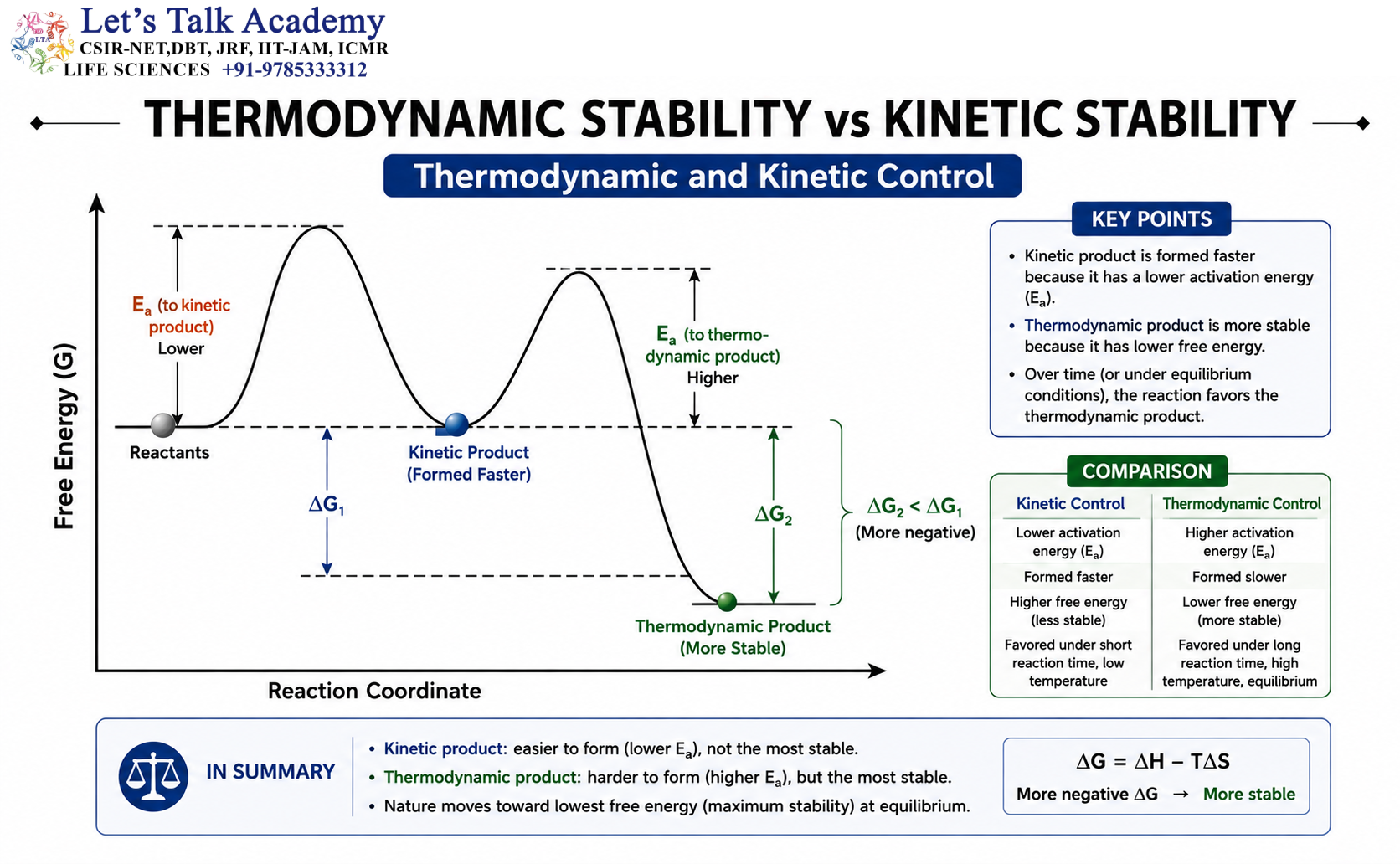
A molecule can be thermodynamically stable but kinetically trapped.
Thermodynamic stability refers to the relative free energy of a state.
Kinetic stability refers to the difficulty of reaching another state because of an activation-energy barrier.
This distinction explains why certain biomolecules can persist for long periods even when another state may be thermodynamically more favorable.
Biological systems frequently exploit kinetic barriers to maintain functional molecular structures.
69. Third-Law Perspective on Biological Thermodynamics
The third law is less directly visible in cellular processes, but it establishes the reference from which absolute entropy can be understood.
As temperature approaches absolute zero:
T → 0 K
the entropy of a perfect crystal approaches:
S → 0
This provides a theoretical reference for calculating absolute entropy values.
The first, second, and third laws therefore form a connected framework:
First law → Conservation of energy
Second law → Direction of spontaneous processes
Third law → Entropy reference at absolute zero
70. Important Relationship Table
Concept |
Important Relationship |
|---|---|
| First law | ΔU = q + w |
| Expansion work | w = −PₑₓₜΔV |
| Enthalpy | H = U + PV |
| Entropy | dS = δqᵣₑᵥ / T |
| Boltzmann equation | S = kᴮ ln Ω |
| Gibbs free energy | G = H − TS |
| Gibbs equation | ΔG = ΔH − TΔS |
| Spontaneous forward process | ΔG < 0 |
| Unfavorable forward process | ΔG > 0 |
| Equilibrium | ΔG = 0 |
| Actual free energy | ΔG = ΔG° + RT ln Q |
| Biochemical free energy | ΔG = ΔG°′ + RT ln Q |
| Equilibrium relationship | ΔG° = −RT ln Kₑq |
| Chemical potential | μᵢ = μᵢ° + RT ln aᵢ |
| Electrochemical potential | μ̃ᵢ = μᵢ° + RT ln aᵢ + zᵢFψ |
| Redox relationship | ΔG = −nFΔE |
| Enzyme effect | Lowers activation energy |
| Effect of enzyme on ΔG | No change |
| Effect of enzyme on Kₑq | No change |
| Second law | ΔSᵤₙᵢᵥₑᵣₛₑ ≥ 0 |
| Third law | S → 0 as T → 0 K for a perfect crystal |


