
Principles of Biophysical Chemistry: Colligative Properties
1. Introduction to Colligative Properties
1.1 Definition of Colligative Properties
Colligative properties are properties of dilute solutions that depend primarily on the number of dissolved solute particles rather than on the chemical identity of those particles.
The important point is the number of particles.
For example, glucose and sucrose are chemically different molecules. However, if equal numbers of intact glucose and sucrose particles are present in otherwise comparable ideal dilute solutions, they produce comparable colligative effects.
The chemical identity becomes important indirectly when it determines whether the solute dissociates, associates, or otherwise changes the number of effective particles.
Therefore, the central principle can be expressed as:
Number of solute particles ↑ → Magnitude of colligative effect ↑
1.2 The Four Major Colligative Properties
There are four classical colligative properties:
1. Relative lowering of vapor pressure
2. Elevation of boiling point
3. Depression of freezing point
4. Osmotic pressure
Although these four properties appear different, they arise from a common thermodynamic principle: the presence of solute changes the chemical potential and escaping tendency of the solvent.
The first three properties involve phase changes of the solvent, whereas osmotic pressure involves the movement of solvent through a semipermeable membrane.
Among them, osmotic pressure has the greatest direct biological relevance because living cells are surrounded by selectively permeable membranes and contain complex aqueous solutions.
2. Common Principle Behind Colligative Properties
Consider pure water in a closed container.
At a given temperature, some water molecules escape from the liquid surface into the vapor phase. At equilibrium, evaporation and condensation occur at equal rates.
Now suppose a non-volatile solute is dissolved in the water.
The solute particles reduce the mole fraction of water and decrease the tendency of water molecules to escape from the liquid phase. Consequently, the vapor pressure of water decreases.
Because the vapor pressure has decreased, a higher temperature is required to make the vapor pressure equal to atmospheric pressure. Therefore, the boiling point increases.
At the same time, the thermodynamic conditions required for crystallization change, causing the freezing point to decrease.
If the solution is separated from pure solvent by a semipermeable membrane, the difference in solvent chemical potential produces osmotic pressure.
Thus, all four properties are connected.
3. RELATIVE LOWERING OF VAPOR PRESSURE
3.1 Concept of Vapor Pressure
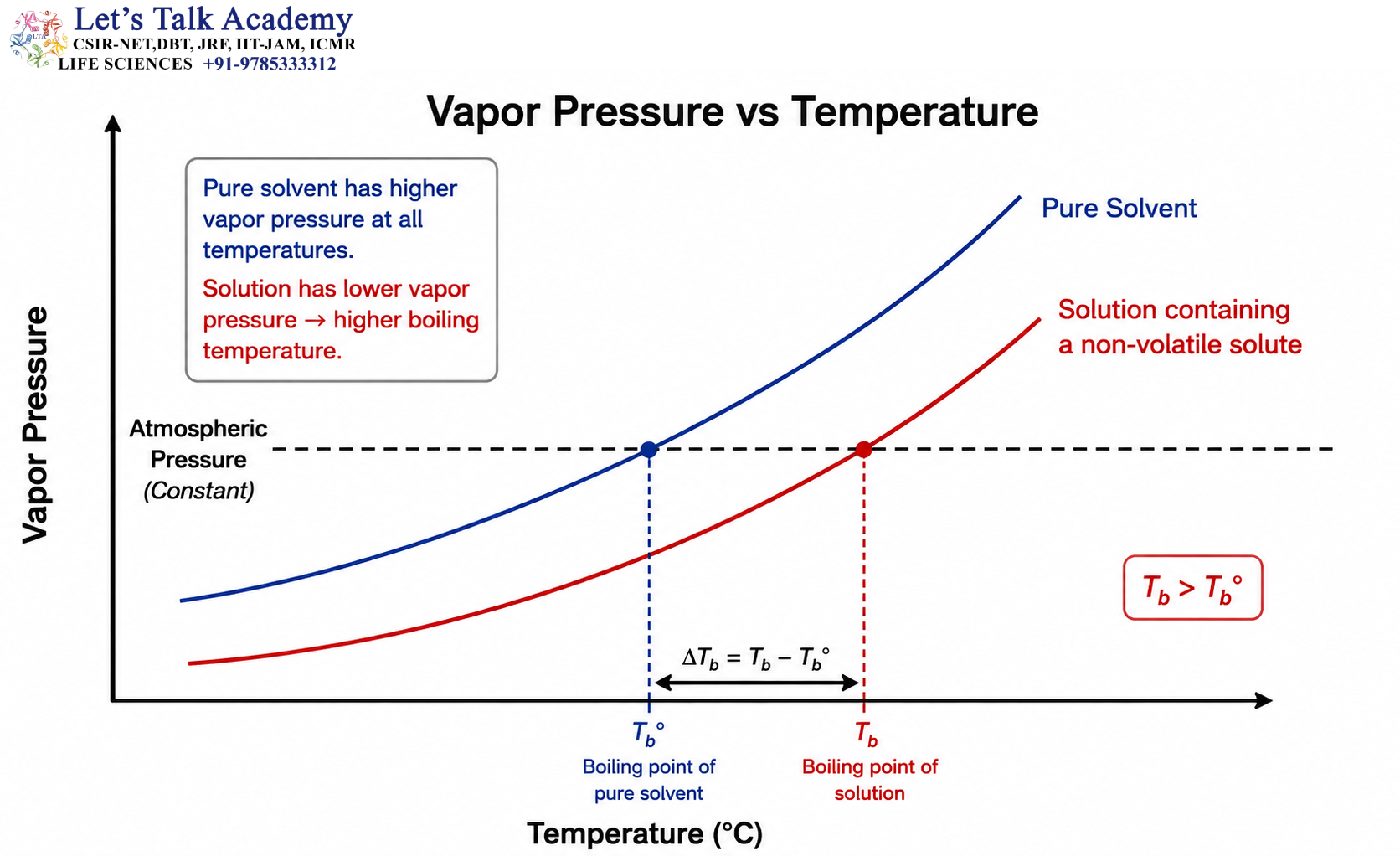
All liquids contain molecules that are continuously moving. Some molecules at the surface possess enough kinetic energy to escape from the liquid phase and enter the gas phase.
When a liquid is placed in a closed container, molecules continuously evaporate and condense. Eventually, a dynamic equilibrium is established.
The pressure exerted by the vapor at this equilibrium is called vapor pressure.
The vapor pressure depends strongly on temperature. As temperature increases, more molecules acquire sufficient energy to escape, and vapor pressure increases.
A liquid with a high vapor pressure is generally more volatile than a liquid with a low vapor pressure.
3.2 Effect of Adding a Non-Volatile Solute
When a non-volatile solute is added to a solvent, the solute does not significantly contribute to the vapor phase.
The fraction of solvent molecules at the surface decreases, and the escaping tendency of the solvent decreases.
Therefore:
Vapor pressure of solution < Vapor pressure of pure solvent
This decrease is known as the lowering of vapor pressure.
For an ideal solution, the relationship is described by Raoult’s law.
3.3 Raoult’s Law
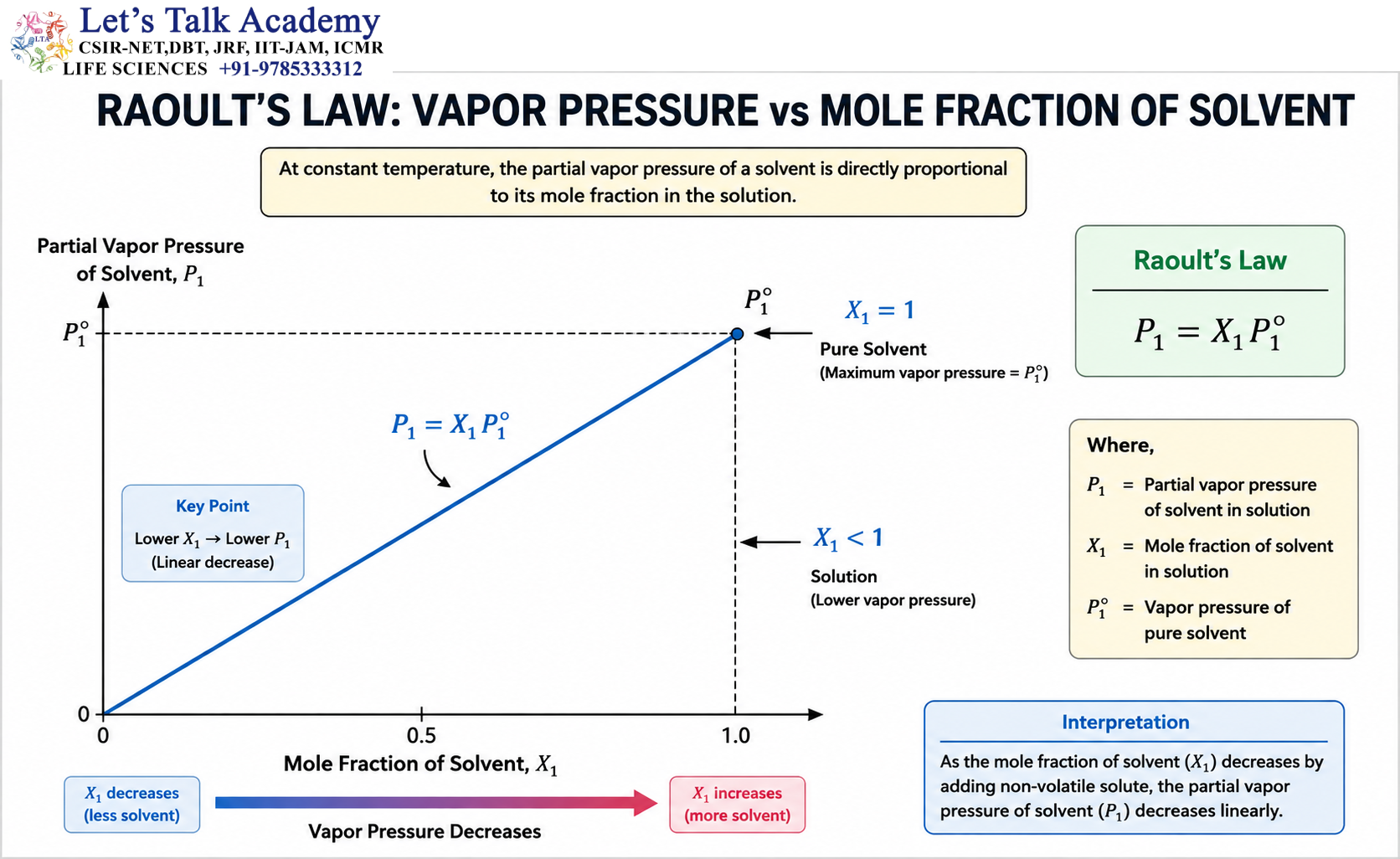
For a solution containing a volatile solvent and a non-volatile solute:
P₁ = X₁P₁°
where:
P₁ = vapor pressure of the solvent in solution
X₁ = mole fraction of the solvent
P₁° = vapor pressure of the pure solvent
Because the mole fraction of the solvent is less than one:
X₁ < 1
therefore:
P₁ < P₁°
The lowering of vapor pressure is:
ΔP = P₁° − P₁
Dividing by the vapor pressure of the pure solvent gives the relative lowering:
ΔP/P₁° = X₂
where X₂ represents the mole fraction of the solute.
Thus, the relative lowering of vapor pressure is directly related to the fraction of solute particles present.
3.4 Physical Interpretation of Raoult’s Law
Raoult’s law is more than an equation. It provides a molecular explanation of why adding solute changes the behavior of the solvent.
Suppose a surface initially contains only water molecules. A certain fraction of these molecules can escape into the vapor phase.
After adding a non-volatile solute, the surface contains both water and solute particles. Because the solute does not readily enter the vapor phase, fewer water molecules are available to escape.
The result is a lower vapor pressure.
This interpretation is useful because it connects the mathematical relationship to the molecular behavior of the solution.
4. ELEVATION OF BOILING POINT
4.1 What Is the Boiling Point?
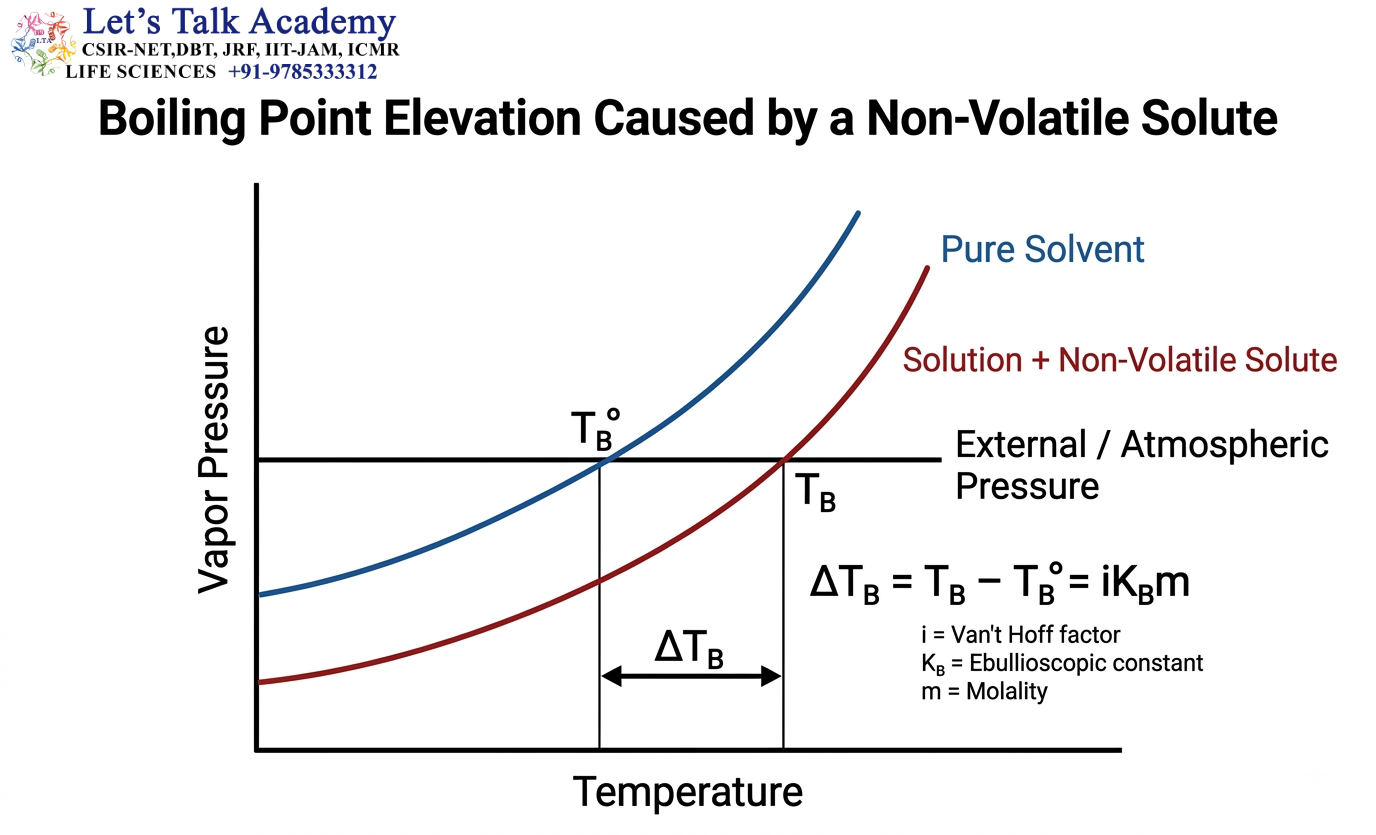
A liquid boils when its vapor pressure becomes equal to the pressure exerted by the surroundings.
Under atmospheric conditions, boiling occurs when:
Vapor pressure = Atmospheric pressure
If a non-volatile solute is added to the solvent, the vapor pressure decreases at a given temperature.
Therefore, the solution must be heated to a higher temperature before its vapor pressure becomes equal to atmospheric pressure.
Consequently:
Boiling point of solution > Boiling point of pure solvent
This increase is called elevation of boiling point.
4.2 Mathematical Expression
The elevation in boiling point is represented by:
ΔTᵦ = Tᵦ − Tᵦ°
For a dilute solution:
ΔTᵦ = Kᵦm
where:
ΔTᵦ = elevation in boiling point
Kᵦ = ebullioscopic constant of the solvent
m = molality of the solution
For solutions in which dissociation or association must be considered:
ΔTᵦ = iKᵦm
Here, i is the van’t Hoff factor.
4.3 Why Molality Is Used
Molality is defined as the number of moles of solute per kilogram of solvent:
m = moles of solute / kilograms of solvent
Molality is preferred in equations involving boiling-point elevation and freezing-point depression because it is based on the mass of solvent rather than solution volume.
Volume can change with temperature, whereas mass remains essentially independent of temperature.
Therefore, thermodynamic relationships involving changes in boiling and freezing points are conveniently expressed using molality.
4.4 Biological Significance
Boiling-point elevation is less directly relevant to living cells than osmotic pressure, but it illustrates an important physical principle: dissolved particles alter the thermodynamic properties of water.
The same general principle becomes biologically important when dissolved solutes modify the behavior of water inside and outside cells.
Thus, studying boiling-point elevation helps build the conceptual foundation needed to understand osmotic phenomena.
5. DEPRESSION OF FREEZING POINT
5.1 Concept of Freezing Point
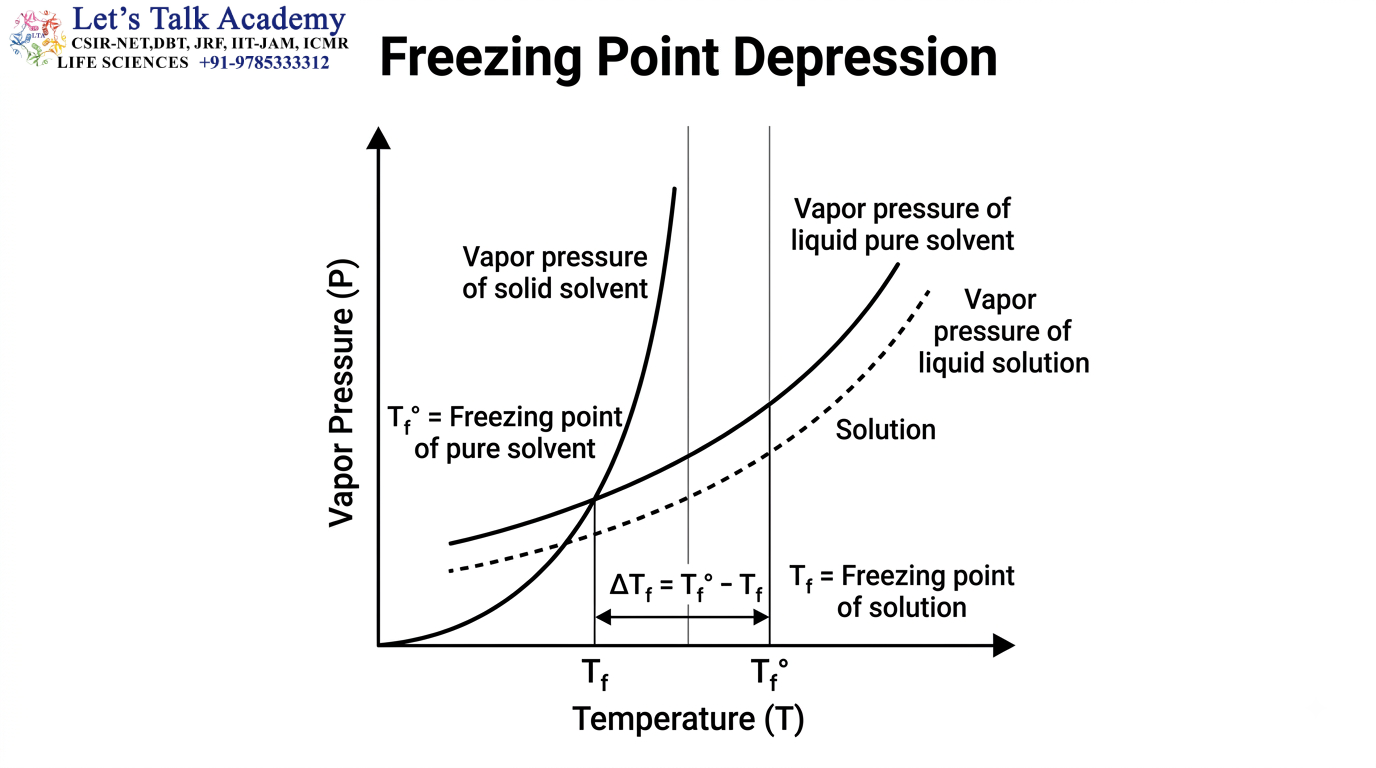
The freezing point of a pure solvent is the temperature at which the liquid and solid phases are in equilibrium.
When a non-volatile solute is added to a solvent, the freezing point of the solution becomes lower than that of the pure solvent.
Therefore:
Freezing point of solution < Freezing point of pure solvent
This phenomenon is called depression of freezing point.
The decrease in freezing point is:
ΔT𝒇 = T𝒇° − T𝒇
For a dilute solution:
ΔT𝒇 = K𝒇m
For electrolytes or solutions showing particle-number changes:
ΔT𝒇 = iK𝒇m
5.2 Molecular Explanation of Freezing-Point Depression
Freezing requires solvent molecules to organize into an ordered solid structure.
When solute particles are introduced, they interfere with the formation of the pure solvent’s solid phase.
From a thermodynamic perspective, the chemical potential of the solvent in the solution is lower than that of the pure solvent.
Therefore, the temperature must be reduced further before the solid and liquid phases reach equilibrium.
This results in a lower freezing point.
The phenomenon therefore reflects a change in the thermodynamic state of the solvent rather than simply a mechanical obstruction to crystal formation.
5.3 Biological Importance
Biological fluids contain many dissolved substances. These include inorganic ions, sugars, amino acids, metabolites, and macromolecules.
As a result, their freezing behavior differs from that of pure water.
Freezing-point depression is relevant to:
- biological sample preservation,
- cryobiology,
- cryopreservation,
- tissue storage,
- and understanding the physical properties of biological fluids.
The principle also demonstrates why the concentration of dissolved particles is an important determinant of the physical behavior of biological solutions.
6. VAN’T HOFF FACTOR
6.1 Why the van’t Hoff Factor Is Necessary
The simplest colligative equations assume that every dissolved molecule remains as one particle.
This assumption is not valid for many electrolytes.
For example:
NaCl → Na⁺ + Cl⁻
One formula unit of NaCl can produce two particles in an ideal dilute solution.
Similarly:
CaCl₂ → Ca²⁺ + 2Cl⁻
One formula unit can produce three particles.
Therefore, the actual colligative effect can be greater than expected if the solute dissociates.
The van’t Hoff factor, represented by i, accounts for this change in the number of particles.
6.2 Definition
The van’t Hoff factor can be expressed as:
i = Number of particles actually present / Number of particles expected if no association or dissociation occurred
For an ideal non-electrolyte:
i = 1
For ideal NaCl:
i ≈ 2
For ideal CaCl₂:
i ≈ 3
These values represent ideal complete dissociation. Real solutions may show different values because ions can interact with each other.
6.3 Association of Solute Molecules
The number of particles can also decrease when molecules associate.
Consider:
2A ⇌ A₂
If two molecules of A combine to form one A₂ molecule, the number of particles decreases.
Consequently, the observed colligative effect becomes smaller than the ideal value.
Thus:
Dissociation → particle number increases → i increases
Association → particle number decreases → i decreases
This is an important conceptual point for numerical and assertion-reasoning questions.
7. OSMOTIC PRESSURE
7.1 Introduction to Osmosis
Among the four colligative properties, osmotic pressure has exceptional importance in biology.
Living cells are surrounded by membranes that regulate the movement of water and solutes. Water movement across these membranes is closely associated with differences in the concentration of osmotically active particles.
Osmosis refers to the net movement of solvent through a selectively permeable membrane driven by a difference in solvent chemical potential.
In a simplified biological description, water tends to move toward the side having a greater effective concentration of impermeable solute particles.
7.2 Semipermeable and Selectively Permeable Membranes
A membrane involved in osmosis allows solvent molecules to pass more readily than certain solute particles.
The term semipermeable membrane is commonly used in physical chemistry, whereas biological membranes are more accurately described as selectively permeable because they regulate the movement of different substances through channels, transporters, carriers, and the lipid bilayer.
This distinction is important in advanced biological systems.
A biological membrane is not simply an inert barrier. Its permeability depends on:
- lipid solubility,
- molecular size,
- charge,
- transport proteins,
- ion channels,
- membrane potential,
- and specific transport mechanisms.
Therefore, biological osmosis must be understood in the context of membrane permeability.
8. OSMOTIC PRESSURE AND VAN’T HOFF EQUATION
8.1 Definition of Osmotic Pressure
The osmotic pressure of a solution is the pressure that must be applied to the solution to prevent net movement of solvent across a semipermeable membrane.
Osmotic pressure is represented by:
π
For a dilute ideal solution:
π = CRT
For an electrolyte:
π = iCRT
where:
π = osmotic pressure
i = van’t Hoff factor
C = molar concentration
R = gas constant
T = absolute temperature
8.2 Molecular Interpretation of Osmotic Pressure
Osmotic pressure can be understood in terms of the chemical potential of the solvent.
Pure water has a particular chemical potential.
When solute particles are added, the chemical potential of water decreases.
If pure solvent and solution are separated by a membrane that permits solvent but not the relevant solute to cross, water moves toward the solution.
Applying external pressure to the solution can oppose this movement.
The pressure required to completely prevent the net movement is the osmotic pressure.
Therefore, osmotic pressure is a measurable consequence of the difference in the thermodynamic state of the solvent.
8.3 Osmotic Pressure as a Colligative Property
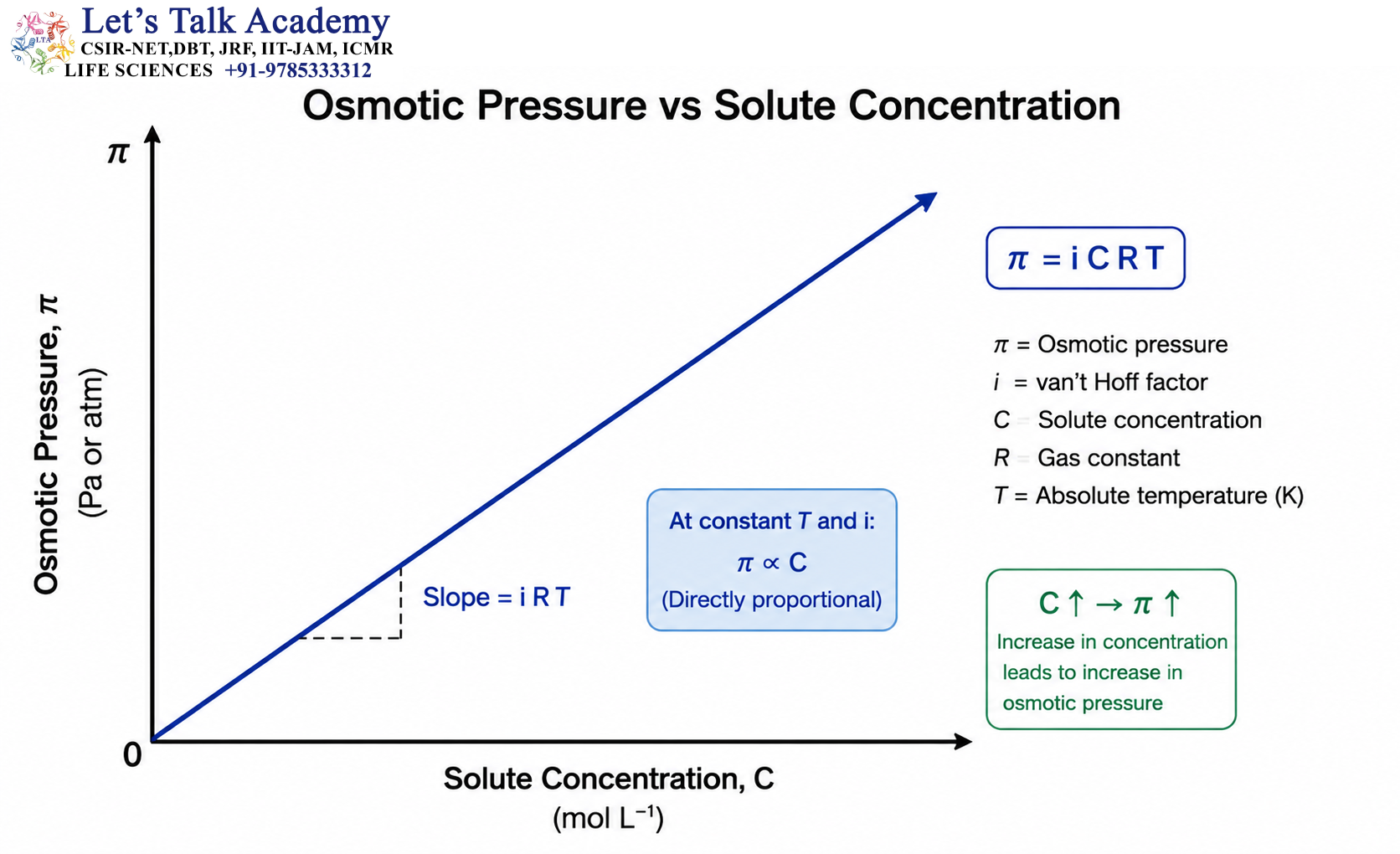
Osmotic pressure is a colligative property because, for a dilute ideal solution, it depends on the number of solute particles.
From:
π = iCRT
it is clear that osmotic pressure depends on:
- particle concentration,
- temperature,
- and the degree of dissociation or association.
It does not directly depend on the chemical identity of the solute.
This makes osmotic pressure extremely useful for studying biological solutions.
9. OSMOLARITY AND OSMOLALITY
9.1 Osmolarity
Osmolarity is the total concentration of osmotically active particles per litre of solution.
Its unit is:
Osm/L
For example, if a solution contains particles that contribute to an effective concentration of 1 osmole per litre, its osmolarity is approximately:
1 Osm/L
9.2 Osmolality
Osmolality is the total concentration of osmotically active particles per kilogram of solvent.
Its unit is:
Osm/kg
Osmolality is often preferred for physiological measurements because it is based on the mass of solvent and is therefore less affected by temperature-dependent changes in solution volume.
9.3 Difference Between Osmolarity and Osmolality
The two terms are related but should not be treated as identical.
Osmolarity → osmoles per litre of solution
Osmolality → osmoles per kilogram of solvent
For dilute aqueous solutions, their numerical values may be close, but conceptually they represent different quantities.
This distinction is a common source of conceptual questions.
10. OSMOSIS IN BIOLOGICAL CELLS
10.1 General Principle
Cells contain numerous dissolved substances, while the extracellular environment also contains ions and other solutes.
If the effective concentration of osmotically active impermeable solutes differs across the plasma membrane, water movement can occur.
The direction and magnitude of water movement depend not simply on total solute concentration but also on membrane permeability.
This is particularly important because a solute that can freely cross a membrane may not produce a sustained osmotic gradient in the same way as an impermeable solute.
10.2 Hypotonic Solution
A hypotonic extracellular solution has a lower effective concentration of impermeable solutes than the cell interior.
Water tends to enter the cell.
In animal cells, excessive water entry can cause swelling and eventually cell lysis.
This is why maintaining an appropriate extracellular osmotic environment is essential for animal cell survival.
10.3 Hypertonic Solution
A hypertonic extracellular solution has a higher effective concentration of impermeable solutes than the cell interior.
Water tends to leave the cell.
As a result, the cell shrinks.
In red blood cells, this process is called crenation.
10.4 Isotonic Solution
An isotonic extracellular solution produces no sustained net water movement that changes cell volume.
Under idealized conditions:
Water entering ≈ Water leaving
Therefore, the cell maintains approximately constant volume.
The term isotonic is fundamentally related to the effect of a solution on cell volume, not merely to a numerical concentration value.
11. OSMOSIS AND AQUAPORINS
11.1 Role of Aquaporins
Water can cross biological membranes through the lipid bilayer, but in many cells its movement is greatly facilitated by specialized membrane proteins called aquaporins.
Aquaporins form highly selective water channels.
They allow rapid movement of water while restricting the passage of ions and many solutes.
The presence and regulation of aquaporins therefore strongly influence the rate at which water can move across a membrane.
11.2 Importance in Physiology
Aquaporins are particularly important in tissues where rapid water transport is required.
They play major roles in:
- kidney water reabsorption,
- maintenance of body-fluid balance,
- epithelial water transport,
- plant water transport,
- and cellular volume regulation.
Thus, the physical chemistry of osmosis is directly connected with membrane biology and physiology.
12. OSMOTIC PRESSURE AND MACROMOLECULES
12.1 Osmotic Pressure as a Tool for Molecular Mass Determination
Osmotic pressure can be used to determine the molecular mass of macromolecules.
Suppose a mass w of a macromolecule with molecular mass M is dissolved in volume V.
The number of moles is:
n = w/M
The molar concentration is:
C = n/V
Therefore:
C = w/MV
Substituting into the van’t Hoff equation:
π = CRT
gives:
π = wRT/MV
Rearranging:
M = wRT/πV
This relationship can be used to determine the molecular mass of a dissolved substance.
12.2 Why Osmotic Pressure Is Useful for Proteins
Proteins and other macromolecules have very high molecular masses.
Therefore, even a relatively small mass concentration corresponds to a relatively small molar concentration.
Osmotic pressure measurements can detect the effects of these particles in solution and can therefore be used to estimate molecular mass.
This application is historically important in physical biochemistry and helps connect colligative properties with the study of biological macromolecules.
13. COLLIGATIVE PROPERTIES AND THERMODYNAMICS
13.1 Chemical Potential of the Solvent
A deeper understanding of colligative properties requires the concept of chemical potential.
Chemical potential represents the partial molar Gibbs free energy of a component in a system.
For a solvent in an ideal solution:
μ₁ = μ₁° + RT ln X₁
where:
μ₁ = chemical potential of solvent in solution
μ₁° = chemical potential of pure solvent
R = gas constant
T = absolute temperature
X₁ = mole fraction of solvent
Since:
X₁ < 1
then:
ln X₁ < 0
Therefore:
μ₁ < μ₁°
Thus, the presence of solute lowers the chemical potential of the solvent.
This single thermodynamic concept provides a deeper explanation for several colligative properties.
13.2 Connection Between Chemical Potential and Vapor Pressure
The lower chemical potential of the solvent in a solution corresponds to a lower equilibrium vapor pressure.
Therefore:
Solute added → solvent chemical potential decreases → vapor pressure decreases
This is the thermodynamic basis of vapor-pressure lowering.
13.3 Connection With Boiling Point
Because the vapor pressure of the solution is lower, a higher temperature is required to reach the external pressure.
Therefore:
Solute added → vapor pressure decreases → higher temperature required → boiling point increases
13.4 Connection With Freezing Point
The lower chemical potential of the solvent changes the temperature at which the liquid and solid phases are in equilibrium.
Therefore, the solution freezes at a lower temperature than the pure solvent.
Thus:
Solute added → chemical potential of solvent decreases → freezing point decreases
13.5 Connection With Osmotic Pressure
When pure solvent and solution are separated by a membrane that allows solvent movement but excludes the solute, there is a chemical-potential difference.
Solvent moves toward the solution.
The pressure needed to eliminate this difference is the osmotic pressure.
Therefore, osmotic pressure is also a thermodynamic consequence of the reduced chemical potential of the solvent.
14. IDEAL AND NON-IDEAL SOLUTIONS
14.1 Ideal Solutions
An ideal solution is an approximation in which the interactions between unlike molecules are sufficiently similar to the interactions between like molecules.
For an ideal dilute solution, the classical colligative equations work particularly well.
However, biological solutions are rarely perfectly ideal.
14.2 Non-Ideal Biological Solutions
Biological fluids contain many interacting components.
Examples include:
- ions,
- proteins,
- metabolites,
- carbohydrates,
- nucleic acids,
- charged macromolecules,
- and buffer components.
These substances can interact through:
- electrostatic forces,
- hydrogen bonding,
- van der Waals interactions,
- hydrophobic interactions,
- ion pairing,
- and other molecular interactions.
Therefore, real biological systems may deviate from ideal behavior.
15. COLLIGATIVE PROPERTIES OF ELECTROLYTES
15.1 Electrolytes and Non-Electrolytes
A non-electrolyte generally remains as intact molecules when dissolved.
For example:
Glucose → Glucose
Thus, one glucose molecule contributes approximately one solute particle.
An electrolyte, in contrast, dissociates into ions.
For example:
NaCl → Na⁺ + Cl⁻
The number of particles therefore increases.
This is why electrolyte solutions show greater colligative effects at comparable formal concentrations.
15.2 Degree of Dissociation

Complete dissociation is an idealized condition.
In real solutions, the degree of dissociation may be less than 100%.
Therefore, the actual number of particles may be lower than the theoretical maximum.
This causes the experimentally measured van’t Hoff factor to differ from the ideal value.
Consequently, questions involving electrolytes should always be analyzed in terms of the actual number of osmotically active particles.
16. BIOLOGICAL IMPORTANCE OF COLLIGATIVE PROPERTIES
16.1 Maintenance of Cell Volume
Cell volume is highly sensitive to water movement.
If the extracellular environment becomes hypotonic, water enters many animal cells.
If the environment becomes hypertonic, water leaves.
Therefore, osmotic balance is essential for maintaining cellular structure and function.
16.2 Blood and Extracellular Fluid
Blood plasma contains many dissolved particles.
The osmotic behavior of plasma influences the distribution of water between blood vessels and tissues.
Changes in the concentration of osmotically active substances can therefore affect body-fluid balance.
This is one reason why physiological solutions must have carefully controlled solute concentrations.
16.3 Kidney Function
The kidney regulates the composition and concentration of body fluids.
Osmotic gradients within the kidney contribute to the movement and retention of water.
The principles of osmosis and osmotic pressure are therefore closely connected with renal physiology.
16.4 Plant Water Relations
Osmotic principles are fundamental to plant physiology.
Water movement into plant cells contributes to turgor pressure.
Changes in solute concentration influence water potential and therefore influence:
- water uptake,
- cell expansion,
- stomatal movement,
- and overall plant water balance.
17. OSMOSIS AND WATER POTENTIAL
17.1 Water Potential
In plant physiology, water movement is commonly described using water potential (Ψw).
Water moves spontaneously from a region of higher water potential toward a region of lower water potential.
Water potential can be expressed as:
Ψw = Ψs + Ψp
where:
Ψw = water potential
Ψs = solute potential
Ψp = pressure potential
The solute potential is generally negative because dissolved solutes lower the chemical potential of water.
For an ideal dilute solution:
Ψs = −iCRT
This equation establishes a direct connection between colligative properties, osmotic pressure, and plant water relations.
18. COLLIGATIVE PROPERTIES AND CRYOPRESERVATION
18.1 Basic Principle
Cells and biological tissues can be damaged during freezing because ice formation can disrupt cellular structures.
The addition of suitable solutes or cryoprotective substances can modify the physical behavior of water and reduce freezing-related damage.
The principle of freezing-point depression is therefore relevant to cryobiology.
However, biological cryopreservation is more complex than simple freezing-point depression because factors such as:
- ice nucleation,
- intracellular ice formation,
- membrane damage,
- osmotic stress,
- dehydration,
- and cryoprotectant toxicity
also influence cell survival.
Thus, colligative properties provide only one part of the physical framework underlying cryopreservation.
19. COMPARISON OF THE FOUR COLLIGATIVE PROPERTIES
Property |
Effect of Adding Solute |
Major Equation |
Important Concept |
|---|---|---|---|
| Relative lowering of vapor pressure | Decreases vapor pressure | P₁ = X₁P₁° | Reduced escaping tendency |
| Elevation of boiling point | Increases boiling point | ΔTᵦ = iKᵦm | Higher temperature required for boiling |
| Depression of freezing point | Decreases freezing point | ΔT𝒇 = iK𝒇m | Liquid remains stable at lower temperature |
| Osmotic pressure | Increases osmotic pressure | π = iCRT | Solvent movement across membrane |
The four properties can be remembered as a connected sequence:
Solute addition → Vapor pressure decreases → Boiling point increases → Freezing point decreases → Osmotic pressure develops
20. IMPORTANT EQUATIONS
20.1 Raoult’s Law
P₁ = X₁P₁°
20.2 Relative Lowering of Vapor Pressure
ΔP/P₁° = X₂
20.3 Elevation of Boiling Point
ΔTᵦ = Kᵦm
For electrolytes:
ΔTᵦ = iKᵦm
20.4 Depression of Freezing Point
ΔT𝒇 = K𝒇m
For electrolytes:
ΔT𝒇 = iK𝒇m
20.5 Osmotic Pressure
π = CRT
For electrolytes:
π = iCRT
20.6 Molecular Mass From Osmotic Pressure
M = wRT/πV
20.7 Solute Potential
Ψs = −iCRT
21. CONCEPTUAL RELATIONSHIPS TO REMEMBER
The most important conceptual relationships are:
Solute particle concentration ↑ → Vapor pressure ↓
Solute particle concentration ↑ → Boiling point ↑
Solute particle concentration ↑ → Freezing point ↓
Solute particle concentration ↑ → Osmotic pressure ↑
For dissociation:
Dissociation ↑ → Number of particles ↑ → Colligative effect ↑
For association:
Association ↑ → Number of particles ↓ → Colligative effect ↓
For osmotic pressure:
π ∝ C
and, at constant concentration:
π ∝ T
22. THERMODYNAMIC BASIS OF COLLIGATIVE PROPERTIES
22.1 Colligative Properties and Chemical Potential
The behavior of colligative properties can be understood more deeply through the concept of chemical potential. Chemical potential is one of the most important thermodynamic quantities used to describe the tendency of a substance to move, react, or undergo a phase transition.
For a component in a system, chemical potential represents its partial molar Gibbs free energy. It provides a measure of the escaping tendency or thermodynamic availability of that component.
For a pure solvent, the chemical potential is relatively high compared with that of the same solvent in a solution containing dissolved solute.
When a solute is added to a solvent, the chemical potential of the solvent decreases.
For an ideal solution:
μ₁ = μ₁° + RT ln X₁
where:
μ₁ = chemical potential of solvent in solution
μ₁° = chemical potential of pure solvent
R = gas constant
T = absolute temperature
X₁ = mole fraction of solvent
Because the mole fraction of the solvent is less than one:
X₁ < 1
and therefore:
ln X₁ < 0
Thus:
μ₁ < μ₁°
This decrease in solvent chemical potential provides the thermodynamic foundation for colligative properties.
22.2 Why Does the Chemical Potential Decrease?
The addition of solute increases the number of possible arrangements of molecules in the solution. In thermodynamic terms, mixing increases the entropy of the system.
The free energy of mixing can be expressed as:
ΔGmix = ΔHmix − TΔSmix
For an ideal solution:
ΔHmix ≈ 0
while:
ΔSmix > 0
Therefore:
ΔGmix < 0
Mixing is thermodynamically favorable.
The increased entropy associated with mixing lowers the chemical potential of the solvent. Consequently, the solvent has a reduced tendency to leave the solution.
This molecular interpretation helps explain why the vapor pressure of a solution is lower than that of the pure solvent.
22.3 Chemical Potential and Osmosis
Suppose pure water and a solution are separated by a membrane that allows water molecules to pass but prevents the solute from crossing.
The chemical potential of water is higher on the pure-water side and lower on the solution side.
Therefore, water tends to move toward the solution.
At equilibrium, the chemical potential of water must become equal on both sides.
This can occur if pressure is applied to the solution side.
The pressure required to prevent the net movement of water is the osmotic pressure.
Thus, osmotic pressure is fundamentally a thermodynamic consequence of a difference in chemical potential.
23. DERIVATION OF THE VAN’T HOFF OSMOTIC PRESSURE EQUATION
23.1 Importance of the van’t Hoff Equation
The equation:
π = CRT
is one of the most important equations in solution chemistry and biophysical chemistry.
The similarity is not accidental. In a dilute ideal solution, the osmotic behavior of solute particles can be treated mathematically in a way analogous to the pressure behavior of gas particles.
23.2 Analogy With the Ideal Gas Equation
The ideal gas equation is:
PV = nRT
For a dilute ideal solution, osmotic pressure behaves according to:
πV = nRT
Therefore:
π = nRT/V
Since:
n/V = C
we obtain:
π = CRT
where:
π = osmotic pressure
C = molar concentration
R = gas constant
T = absolute temperature
This equation is known as the van’t Hoff equation for osmotic pressure.
23.3 Inclusion of the van’t Hoff Factor
If the solute dissociates or associates, the effective number of particles changes.
The equation therefore becomes:
π = iCRT
For an ideal non-electrolyte:
i = 1
For ideal NaCl:
i ≈ 2
For ideal CaCl₂:
i ≈ 3
Thus, the van’t Hoff factor allows the equation to account for changes in particle number.
23.4 Osmotic Pressure as a Number-Dependent Property
The equation clearly demonstrates the colligative nature of osmotic pressure.
At constant temperature:
π ∝ C
Therefore, increasing the concentration of osmotically active particles increases osmotic pressure.
At constant concentration:
π ∝ T
Therefore, osmotic pressure increases with absolute temperature.
24. OSMOTIC PRESSURE AND GIBBS FREE ENERGY
24.1 Relationship Between Osmosis and Free Energy
Water movement across a membrane is spontaneous when it results in a decrease in Gibbs free energy.
A difference in water chemical potential provides the thermodynamic driving force for water movement.
The system continues to move toward equilibrium until the chemical potentials of the permeable component become equal.
Therefore, osmosis is not simply a passive movement caused by a concentration difference. It is fundamentally a process driven by a difference in chemical potential.
24.2 Free Energy and Equilibrium
At equilibrium:
ΔG = 0
For solvent movement across a membrane, equilibrium is reached when the chemical potential of the solvent is equal on both sides.
If an external pressure is applied to the solution, it increases the chemical potential of the solvent on that side.
At the osmotic equilibrium point:
Chemical potential of solvent on side 1 = Chemical potential of solvent on side 2
The applied pressure at this point corresponds to the osmotic pressure.
24.3 Biological Significance
This thermodynamic explanation is particularly important because biological membranes rarely behave as simple physical barriers.
The movement of water depends on:
- concentration of solutes,
- membrane permeability,
- hydrostatic pressure,
- temperature,
- and the chemical potential of water.
Therefore, understanding osmotic pressure at the thermodynamic level provides a foundation for understanding cell volume regulation and physiological fluid balance.
25. WATER ACTIVITY AND COLLIGATIVE PROPERTIES
25.1 What Is Water Activity?
In real solutions, concentration alone may not adequately describe the thermodynamic behavior of water.
The concept of activity is therefore used.
Water activity represents the effective thermodynamic availability of water.
For an ideal solution, water activity can be approximated by its mole fraction:
aᵥ ≈ Xᵥ
where aᵥ represents water activity.
In real biological systems, activity may differ from mole fraction because molecules interact with one another.
25.2 Why Water Activity Is Important
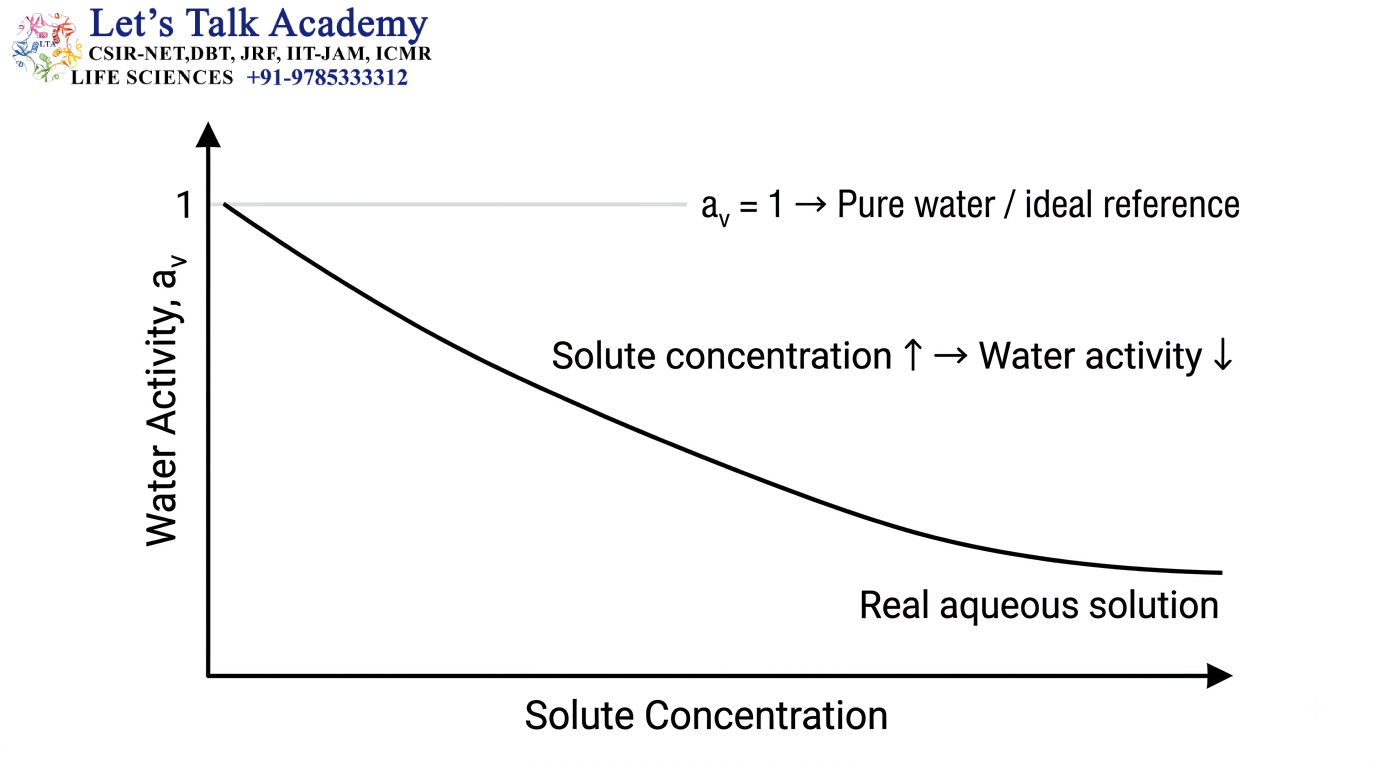
A solution may contain a large amount of water, yet the water may not be equally available for biological or chemical processes.
Dissolved solutes reduce the effective activity of water.
This is important in:
- protein stability,
- enzyme activity,
- food preservation,
- microbial growth,
- dehydration,
- and biological storage.
Thus, water activity provides a more thermodynamically accurate description than simply stating the percentage of water present.
25.3 Water Activity and Biological Stability
Microorganisms require water for metabolic processes.
Reducing water activity can inhibit microbial growth even when substantial water remains physically present.
This principle is used in food preservation and biological sample storage.
The addition of solutes such as sugars or salts lowers water activity and changes the thermodynamic environment available to microorganisms.
Therefore, water activity connects the principles of biophysical chemistry with biotechnology and food science.
26. TONICITY, OSMOLARITY AND OSMOLALITY
26.1 Why These Terms Are Confused
Osmolarity, osmolality, and tonicity are related concepts, but they are not interchangeable.
Osmolarity describes the concentration of osmotically active particles per litre of solution.
Osmolality describes the concentration of osmotically active particles per kilogram of solvent.
Tonicity describes the effect of a solution on the volume of a cell.
26.2 Osmolarity
Osmolarity is:
Osmolarity = Osmoles / litre of solution
Its unit is:
Osm/L
It measures the total concentration of dissolved particles capable of contributing to osmotic pressure.
However, osmolarity alone does not always predict whether a cell will swell or shrink.
26.3 Osmolality
Osmolality is:
Osmolality = Osmoles / kilogram of solvent
Its unit is:
Osm/kg
Because it is based on mass rather than volume, osmolality is particularly useful in physiological measurements.
26.4 Tonicity
Tonicity depends on the behavior of solutes across a biological membrane.
A solute that cannot readily cross the membrane contributes strongly to sustained tonicity.
A solute that rapidly crosses the membrane may contribute much less to long-term changes in cell volume.
Therefore:
Tonicity depends on effective, non-penetrating solutes.
This is a critical distinction.
26.5 Example of Tonicity
Consider two solutions with the same osmolarity.
If one solution contains a solute that cannot cross the cell membrane while the other contains a solute that readily enters the cell, they may produce very different effects on cell volume.
Therefore:
Same osmolarity does not necessarily mean same tonicity.
27. DONNAN EQUILIBRIUM
27.1 Introduction
The Donnan equilibrium, also called the Gibbs-Donnan equilibrium, describes the distribution of ions across a selectively permeable membrane when some charged species cannot cross the membrane.
This phenomenon is especially important in biological systems because cells contain many impermeable charged macromolecules, particularly proteins and nucleic acids.
27.2 Basic Concept
Imagine two compartments separated by a membrane.
The membrane permits certain ions to cross but prevents a large negatively charged protein from crossing.
The fixed negative charge influences the distribution of permeable ions.
Positive ions tend to accumulate near the side containing the fixed negative charges, while permeable negative ions are distributed differently.
The system eventually reaches an electrochemical equilibrium.
27.3 Donnan Equilibrium and Cells
Inside cells, negatively charged proteins and other macromolecules cannot freely cross the plasma membrane.
These fixed charges influence the distribution of ions such as:
K⁺, Na⁺ and Cl⁻
The resulting ion distribution contributes to:
- membrane potential,
- osmotic balance,
- cell volume,
- and ionic homeostasis.
However, living cells are not passive Donnan systems. Ion pumps such as the Na⁺/K⁺-ATPase continuously consume energy to maintain ion gradients and prevent uncontrolled osmotic swelling.
27.4 Biological Importance
Donnan effects help explain why charged macromolecules can influence the distribution of small ions.
They are important in understanding:
- intracellular ionic composition,
- membrane potentials,
- cell volume,
- protein solutions,
- and electrochemical equilibrium.
This provides an important bridge between physical chemistry and cell physiology.
28. OSMOTIC PRESSURE OF CHARGED MACROMOLECULES
28.1 Proteins as Charged Particles
Proteins contain ionizable groups and therefore can carry a net positive or negative charge depending on pH.
A protein molecule in solution is therefore not simply a neutral macromolecule.
Its charge influences interactions with:
- counterions,
- co-ions,
- solvent molecules,
- and other proteins.
Consequently, the osmotic behavior of protein solutions can be more complicated than that predicted by a simple ideal-solution equation.
28.2 Counterions and Osmotic Effects
A charged protein requires counterions to maintain electroneutrality.
For example, a negatively charged protein may be associated with positively charged counterions.
Therefore, the effective number of osmotically active particles includes not only the protein molecules but also the associated ionic environment.
This is one reason why the osmotic properties of charged macromolecules may deviate significantly from simple ideal predictions.
28.3 Importance in Biochemistry
The behavior of proteins in solution is influenced by:
- pH,
- ionic strength,
- net charge,
- protein concentration,
- salt concentration,
- and intermolecular interactions.
These factors influence protein solubility, aggregation, stability, and molecular interactions.
Thus, the study of osmotic properties of macromolecules is directly relevant to biochemical and biophysical research.
29. REFLECTION COEFFICIENT
29.1 Concept
In real biological membranes, solutes may not be completely impermeable or completely permeable.
The reflection coefficient, represented by σ, describes how effectively a membrane prevents a solute from crossing.
It ranges approximately from:
0 to 1
A value close to:
σ = 1
indicates that the membrane effectively prevents the solute from crossing.
A value close to:
σ = 0
indicates that the solute can cross the membrane relatively freely.
29.2 Relation to Osmotic Pressure
For a membrane separating a solution from another compartment, the effective osmotic pressure contribution of a solute can be represented conceptually as:
πeffective = σCRT
For a solute that is completely reflected:
σ ≈ 1
and it produces its full osmotic effect.
For a freely permeable solute:
σ ≈ 0
and its sustained osmotic contribution across that membrane is minimal.
29.3 Biological Importance
The reflection coefficient is particularly useful when discussing capillary exchange and physiological membranes.
It demonstrates why the ability of a solute to cross the membrane must be considered when predicting water movement.
This reinforces the distinction between:
osmolarity
and
tonicity.
30. STARLING FORCES AND OSMOTIC PRESSURE
30.1 Fluid Movement Across Capillaries
Water movement between blood plasma and interstitial fluid is influenced by several forces.
These include:
- capillary hydrostatic pressure,
- interstitial hydrostatic pressure,
- plasma colloid osmotic pressure,
- and interstitial colloid osmotic pressure.
Together, these are commonly discussed as Starling forces.
30.2 Hydrostatic Pressure
Hydrostatic pressure tends to push water out of a compartment.
In capillaries, blood pressure can promote movement of fluid from the vascular compartment toward the interstitial space.
30.3 Colloid Osmotic Pressure
Plasma proteins, particularly albumin, contribute significantly to plasma colloid osmotic pressure.
Because these proteins are relatively large and are largely retained within the circulation, they exert an osmotic effect that favors retention of water within the vascular compartment.
Thus:
Hydrostatic pressure tends to promote filtration
while:
Plasma colloid osmotic pressure tends to oppose excessive filtration.
30.4 Biological Importance
The balance between these forces is important for maintaining normal tissue fluid levels.
Disturbance of this balance can contribute to excessive accumulation of fluid in tissues, known as edema.
This provides a direct physiological application of osmotic principles.
31. COLLOID OSMOTIC PRESSURE AND ONCOTIC PRESSURE
31.1 Definition
The osmotic pressure generated by large colloidal particles, particularly plasma proteins, is commonly called colloid osmotic pressure or oncotic pressure.
Although proteins are present at relatively low molar concentrations, they have an important influence on water distribution because many plasma proteins are retained within blood vessels.
31.2 Role of Albumin
Albumin is the major contributor to plasma oncotic pressure.
Its importance arises from:
- relatively high concentration in plasma,
- substantial molecular charge,
- retention within the vascular compartment,
- and its interaction with surrounding ions.
Albumin therefore plays a major role in maintaining the distribution of water between blood and tissues.
31.3 Low Albumin and Fluid Balance
If plasma albumin concentration decreases substantially, plasma oncotic pressure can decrease.
As a consequence, the balance between filtration and reabsorption of fluid can be altered.
This can contribute to fluid accumulation in tissues.
Thus, the physical chemistry of macromolecular solutions has a direct connection with human physiology.
32. OSMOTIC PRESSURE AND RED BLOOD CELLS
32.1 Red Blood Cells as an Experimental Model
Red blood cells are excellent biological models for understanding osmosis because their plasma membrane regulates water and solute movement.
When the extracellular osmotic environment changes, water movement changes cell volume.
32.2 Hypotonic Conditions
In a hypotonic environment, water enters the red blood cell.
The cell swells.
If water entry becomes excessive, the plasma membrane can rupture.
This process is known as:
Hemolysis
32.3 Hypertonic Conditions
In a hypertonic environment, water leaves the red blood cell.
The cell shrinks and develops an irregular appearance.
This is called:
Crenation
32.4 Isotonic Conditions
In an isotonic environment, there is no sustained net water movement sufficient to alter cell volume.
The cell maintains its normal shape and volume.
This is why solutions used for certain physiological and clinical purposes must have carefully controlled osmotic properties.
32.5 Osmotic Fragility
The susceptibility of red blood cells to hemolysis under hypotonic conditions can be assessed through osmotic fragility.
Cells with altered membrane properties or unusual surface-area-to-volume relationships may show different osmotic responses.
Therefore, osmotic behavior can also provide information about cellular membrane properties.
33. OSMOSIS IN PLANT CELLS
33.1 Plant Cells and the Cell Wall
Plant cells differ from animal cells because they possess a rigid cell wall.
When water enters a plant cell, the cell does not normally burst because the cell wall provides mechanical resistance.
Instead, the cell develops turgor pressure.
33.2 Turgor Pressure
Water entering the cell increases internal pressure against the cell wall.
This pressure is called:
Turgor pressure
Turgor is essential for:
- maintaining plant rigidity,
- supporting leaves and stems,
- cell expansion,
- and regulating stomatal movement.
Therefore, osmotic phenomena are fundamental to plant structure.
33.3 Plasmolysis
When a plant cell is placed in a sufficiently hypertonic solution, water leaves the cell.
The plasma membrane and cytoplasm shrink away from the cell wall.
This process is called:
Plasmolysis
If the cell is returned to a suitable dilute environment, water can re-enter and the cell may recover.
This recovery is called:
Deplasmolysis
33.4 Incipient Plasmolysis
The condition in which the plasma membrane has just begun to separate from the cell wall is called incipient plasmolysis.
At this point, the cell has lost enough water for the beginning of plasmolysis but has not undergone extensive contraction.
This concept is useful for experimentally estimating osmotic conditions of plant cells.
34. REVERSE OSMOSIS
34.1 Basic Principle
Normally, osmosis involves movement of water toward the side having a higher effective concentration of impermeable solutes.
In reverse osmosis, an external pressure greater than the osmotic pressure is applied to the solution side.
This forces water to move in the opposite direction.
The membrane permits water to pass while restricting many dissolved solutes.
34.2 Requirement of External Pressure
If:
Applied pressure > Osmotic pressure
water can be forced from the concentrated solution toward the less concentrated side.
Therefore, reverse osmosis is a pressure-driven separation process.
34.3 Applications
Reverse osmosis is widely used for:
- desalination,
- purification of drinking water,
- removal of dissolved salts,
- laboratory water purification,
- and industrial biotechnology.
This is an important example of how a fundamental physical chemistry principle can be converted into a practical technology.
35. DIALYSIS AND OSMOSIS
35.1 What Is Dialysis?
Dialysis is a membrane-based separation process in which small molecules and ions can pass through a semipermeable membrane while larger macromolecules such as proteins are retained.
Dialysis depends primarily on differences in membrane permeability and diffusion.
It should therefore not be confused with osmosis.
35.2 Osmosis Versus Dialysis
In osmosis:
Solvent movement is the central phenomenon.
In dialysis:
Separation of solutes based on membrane permeability and diffusion is the primary purpose.
However, osmotic effects can influence dialysis because water and solute distributions across the membrane are thermodynamically coupled.
35.3 Biological and Biochemical Applications
Dialysis is widely used to:
- remove salts from protein solutions,
- exchange buffers,
- remove small metabolites,
- purify macromolecules,
- and prepare biological samples for experiments.
For example, a protein solution containing excess salt can be placed inside dialysis tubing and immersed in a large volume of appropriate buffer.
Small ions diffuse through the membrane, while the protein remains largely inside.
36. ULTRAFILTRATION AND OSMOTIC EFFECTS
36.1 Principle of Ultrafiltration
Ultrafiltration is a membrane-based separation technique in which pressure is applied to force solvent and small solutes through a membrane while larger macromolecules are retained.
Unlike osmosis, ultrafiltration is primarily pressure-driven.
36.2 Difference Between Filtration and Osmosis
In ordinary filtration, hydrostatic pressure drives fluid through a membrane.
In osmosis, a difference in chemical potential drives solvent movement.
In reverse osmosis, external pressure is deliberately applied to overcome osmotic pressure.
Thus, pressure-driven and concentration-driven membrane processes are related but mechanistically distinct.
36.3 Biological Applications
Ultrafiltration is commonly used in biochemical laboratories for:
- concentrating proteins,
- removing small molecules,
- buffer exchange,
- sample preparation,
- and macromolecule purification.
It is particularly useful because proteins and other macromolecules can be retained while water and smaller molecules pass through the membrane.
37. COLLIGATIVE PROPERTIES IN PROTEIN CHEMISTRY
37.1 Proteins as Macromolecular Solutes
Proteins are large biological molecules with molecular masses ranging from thousands to hundreds of thousands of daltons or more.
Because their molecular mass is high, a given mass concentration of protein corresponds to a relatively low molar concentration.
Therefore, the osmotic pressure generated by proteins is generally much smaller than that generated by an equivalent mass concentration of small molecules.
37.2 Molecular-Mass Determination
Osmotic pressure can be used to estimate molecular mass.
Starting with:
π = CRT
and:
C = w/MV
we obtain:
π = wRT/MV
Therefore:
M = wRT/πV
This relationship historically provided an important method for determining the molecular masses of proteins and other macromolecules.
37.3 Protein Association
If protein molecules associate:
2P ⇌ P₂
the number of particles decreases.
Therefore, the measured colligative property may be smaller than expected for completely independent protein molecules.
This provides a possible approach for investigating molecular association.
However, real protein solutions can be affected by charge, ionic strength, non-ideal interactions, and conformational changes.
38. ASSOCIATION OF BIOMOLECULES IN SOLUTION
38.1 General Concept
Biological molecules frequently interact with one another.
For example:
A + A ⇌ A₂
or:
A + B ⇌ AB
When separate molecules associate to form complexes, the number of independently moving particles decreases.
Since colligative properties depend on particle number, association can alter the observed colligative behavior.
38.2 Effect on van’t Hoff Factor
For an ideal non-associating solute:
i ≈ 1
If association occurs, fewer particles are present than expected.
Therefore:
i < 1
for appropriate association models.
The exact value depends on the degree of association.
38.3 Biological Examples
Association is common in biological systems.
Examples include:
- protein dimerization,
- protein oligomerization,
- receptor-ligand complex formation,
- nucleic acid hybridization,
- and macromolecular assembly.
Therefore, the study of colligative properties can provide insight into molecular association in solution.
39. ELECTROLYTES AND ACTIVITY COEFFICIENTS
39.1 Why Concentration Is Not Always Enough
The simplest equations of solution chemistry often use concentration.
However, in real solutions, the behavior of ions depends not only on their concentration but also on interactions with surrounding ions and solvent molecules.
Therefore, thermodynamic calculations often use activity rather than concentration.
Activity can be written conceptually as:
a = γc
where:
a = activity
γ = activity coefficient
c = concentration
For an ideal solution:
γ ≈ 1
Therefore:
a ≈ c
For real solutions:
γ ≠ 1
and concentration alone does not completely describe thermodynamic behavior.
39.2 Why Biological Solutions Are Non-Ideal
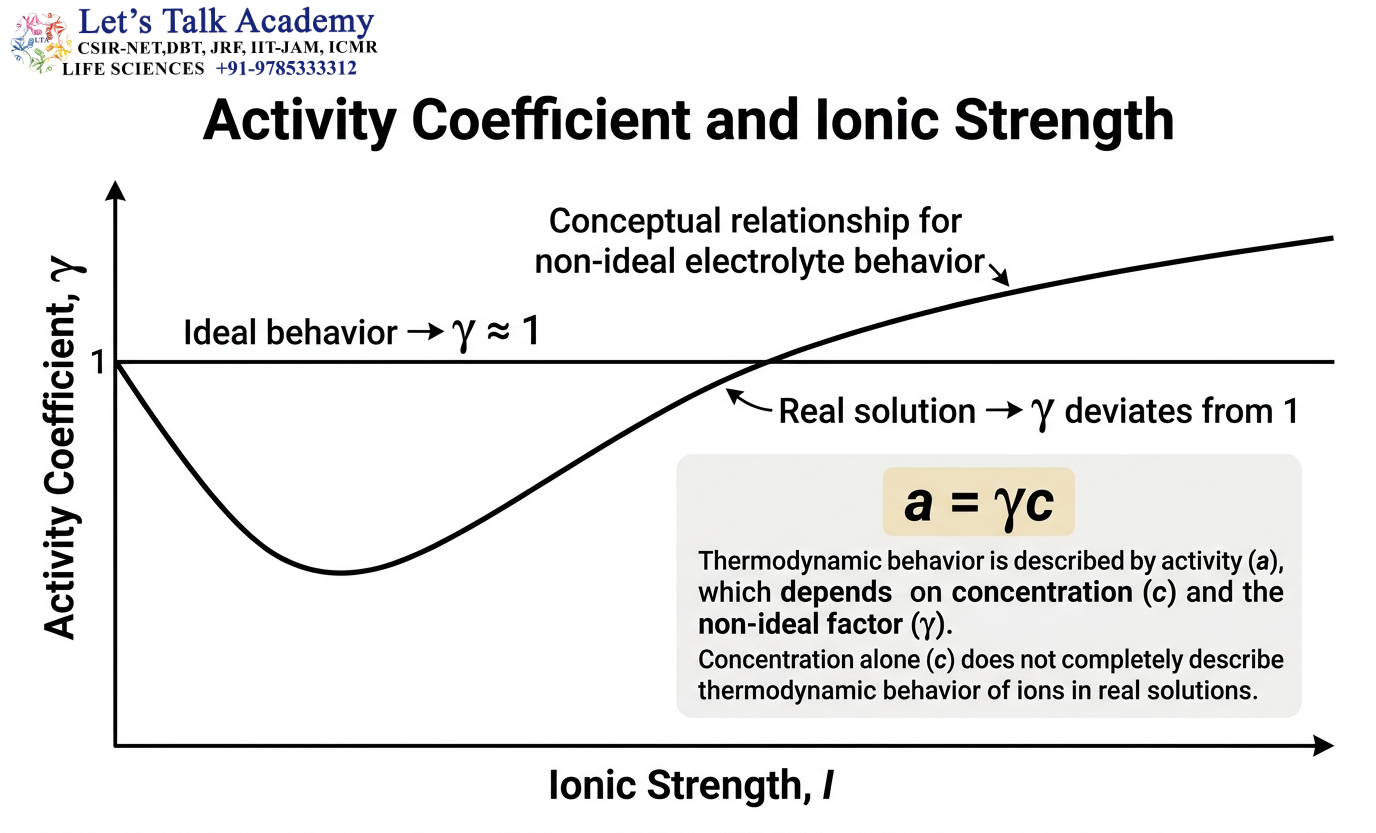
Biological fluids contain charged particles at significant concentrations.
Ions interact electrostatically with one another.
These interactions modify their effective thermodynamic behavior.
As ionic concentration increases, deviations from ideality generally become more important.
Therefore, equations such as:
π = iCRT
are best regarded as dilute ideal-solution approximations.
40. IONIC STRENGTH
40.1 Definition
Ionic strength is a quantitative measure of the ionic environment of a solution.
It is represented as:
I = ½ Σcᵢzᵢ²
where:
I = ionic strength
cᵢ = concentration of ion i
zᵢ = charge of ion i
The square of the ionic charge is particularly important.
Thus, a divalent ion contributes much more strongly to ionic strength than a monovalent ion at the same concentration.
40.2 Example
Consider two ions present at equal concentration:
Na⁺ has: z = +1
Therefore: z² = 1
whereas:
Ca²⁺ has: z = +2
Therefore: z² = 4
Thus, Ca²⁺ contributes four times as much to ionic strength as Na⁺ at the same concentration, before accounting for the overall summation and factor of one-half.
40.3 Biological Importance of Ionic Strength
Ionic strength affects:
- protein solubility,
- protein-protein interactions,
- electrostatic attraction and repulsion,
- nucleic acid interactions,
- enzyme activity,
- and molecular stability.
For example, increasing salt concentration can screen electrostatic interactions between charged groups on proteins.
Therefore, ionic strength is an important parameter in biochemical experiments.
41. DEBYE–HÜCKEL CONCEPT
41.1 Introduction
The Debye–Hückel theory provides a theoretical framework for understanding the non-ideal behavior of ions in dilute electrolyte solutions.
An ion in solution does not exist completely independently.
Its electric field influences surrounding ions, creating an ionic atmosphere.
This ionic environment affects the effective thermodynamic behavior of the ion.
41.2 Ionic Atmosphere
A positively charged ion tends to attract surrounding negative ions and repel positive ions.
Similarly, a negatively charged ion attracts positive ions and repels negative ions.
As a result, each ion is surrounded statistically by an atmosphere containing an excess of oppositely charged ions.
This reduces the effective behavior of the individual ion compared with an ideal solution.
41.3 Importance for Biological Systems
Biological systems contain many charged molecules.
Proteins, nucleic acids, phospholipids, and ions all participate in electrostatic interactions.
Therefore, ionic strength and ionic screening can influence:
- protein folding,
- protein-protein interactions,
- DNA stability,
- enzyme-substrate interactions,
- and macromolecular assembly.
This is why biochemical experiments often use carefully controlled salt concentrations and buffers.
42. FREEZE CONCENTRATION AND BIOLOGICAL SYSTEMS
42.1 What Happens During Freezing?
When an aqueous biological solution begins to freeze, water molecules preferentially enter the ice phase.
Many dissolved solutes are excluded from the growing ice crystals.
As a result, the remaining unfrozen solution becomes progressively more concentrated.
Thus:
Ice formation → Water removed from solution → Remaining solutes become concentrated
This phenomenon is called freeze concentration.
42.2 Consequences for Cells
As the extracellular solution becomes concentrated during freezing, its osmolarity can increase substantially.
This can cause water to leave cells.
Cells may therefore undergo:
- dehydration,
- membrane stress,
- changes in protein concentration,
- ionic imbalance,
- and structural damage.
If intracellular ice forms, mechanical disruption can be severe.
Therefore, freezing is not simply a reduction in temperature; it produces major changes in the chemical environment of cells.
42.3 Relevance to Cryobiology
Understanding freeze concentration is essential for explaining why biological samples can be damaged during freezing.
The combination of:
osmotic stress + ice formation + solute concentration + membrane damage
determines whether a cell survives a freezing process.
43. CRYOPROTECTANTS AND COLLIGATIVE EFFECTS
43.1 What Are Cryoprotectants?
Cryoprotectants are substances used to reduce cellular damage during freezing and thawing.
Commonly studied cryoprotective agents include:
Glycerol
and
Dimethyl sulfoxide (DMSO)
Other specialized cryoprotective formulations are also used depending on the biological material.
43.2 Physical Basis of Cryoprotection
Cryoprotectants can alter the physical properties of water and influence ice formation.
They can reduce the tendency of water to form damaging ice structures and modify osmotic conditions during freezing.
However, cryoprotection is not simply a consequence of freezing-point depression.
The process also involves:
- changes in water mobility,
- vitrification,
- reduction of intracellular ice formation,
- membrane interactions,
- osmotic dehydration,
- and cryoprotectant permeability.
43.3 Osmotic Stress During Cryopreservation
Cryoprotectants themselves can alter extracellular and intracellular osmolarity.
If their concentration changes too rapidly, cells can experience substantial osmotic stress.
Therefore, cryoprotectant addition and removal are often carefully controlled.
This is a good example of how colligative properties must be considered together with membrane permeability and cell physiology.
44. PRACTICAL APPLICATIONS OF COLLIGATIVE PROPERTIES
44.1 Physiological Solutions
The principles of osmotic pressure are important in preparing solutions that are compatible with biological cells.
Solutions used for biological and medical applications must often be formulated to avoid excessive water movement into or out of cells.
The concept of isotonicity is therefore essential in understanding physiological solutions.
44.2 Intravenous Solutions
Intravenous fluids interact directly with blood plasma.
If their effective osmotic properties are inappropriate, they can alter water movement between the extracellular fluid and cells.
Therefore, understanding osmotic behavior is important in the formulation and use of intravenous solutions.
44.3 Water Purification
Reverse osmosis is widely used for water purification and desalination.
External pressure is applied to overcome the natural osmotic tendency and force water through a selective membrane.
This allows many dissolved salts and contaminants to be retained.
44.4 Molecular-Mass Determination
Osmotic pressure can be used to estimate the molecular mass of macromolecules.
The relationship:
M = wRT/πV
provides a quantitative connection between a measurable physical property and molecular size.
44.5 Protein and Macromolecule Research
Changes in osmotic pressure can provide information about:
- molecular mass,
- association,
- dissociation,
- concentration,
- and interactions of macromolecules.
Therefore, colligative properties have applications in biochemical research.
44.6 Cryopreservation
Freezing-point depression, osmotic behavior, and water activity are relevant to the preservation of:
- cells,
- tissues,
- microorganisms,
- gametes,
- embryos,
- and biological samples.
However, successful cryopreservation requires consideration of many additional physical and biological factors.
44.7 Food Preservation
Increasing the concentration of sugars or salts lowers water activity.
This reduces the availability of water for microbial growth and can therefore help preserve food.
Examples include:
- high-sugar preparations,
- salted foods,
- concentrated biological products,
- and other low-water-activity systems.
Thus, the physical chemistry of solutions has important applications beyond laboratory biology.
44.8 Biotechnology
Colligative and osmotic principles are relevant to several biotechnology processes, including:
- membrane filtration,
- protein concentration,
- buffer exchange,
- dialysis,
- ultrafiltration,
- reverse osmosis,
- cryopreservation,
- and formulation of biological products.
These applications demonstrate that principles originally developed in physical chemistry have direct practical importance in modern biotechnology.


