
1. Introduction
Induction is one of the fundamental mechanisms of developmental biology through which one group of cells influences the developmental fate or behavior of another group of cells.
During embryonic development, cells do not develop independently. Cells communicate continuously with neighboring cells and with their surrounding environment. This communication helps determine:
- What type of cell a cell will become
- Where a particular tissue will develop
- When cells should divide
- When cells should differentiate
- How organs should be formed
- How tissues should be organized
In induction, one group of cells provides a signal that changes the developmental behavior of another group of cells.
The signaling cells are called the inducing tissue or inducer, while the cells receiving and responding to the signal are called the responding tissue or responder.
Basic concept
Inducer → Signal → Receptor/Response in target cells → Change in gene expression → New cell fate or behavior
Thus, induction is essentially a form of cell-cell communication during development.
2. Definition of Induction
Induction can be defined as:
The developmental process in which one group of cells influences the fate, differentiation, proliferation, migration, or behavior of another group of cells through specific signals.
The inducing cells do not necessarily become the same cell type as the responding cells. Instead, they provide information that causes the responding cells to follow a particular developmental pathway.
3. Important Components of Induction
Induction generally involves two major cellular populations.
| Component | Function |
|---|---|
| Inducer | Produces developmental signals |
| Responder | Receives the signal and changes its developmental behavior |
The process also requires:
- Signaling molecule
- Receptor
- Intracellular signaling pathway
- Transcription factors
- Changes in gene expression
- Appropriate cellular competence
General mechanism
Inducer cell
↓
Produces signaling molecule
↓
Signal reaches responder
↓
Signal binds receptor
↓
Intracellular signaling pathway activated
↓
Transcription factors activated/inhibited
↓
Gene expression changes
↓
Cell fate or cellular behavior changes
4. Inducer and Responder
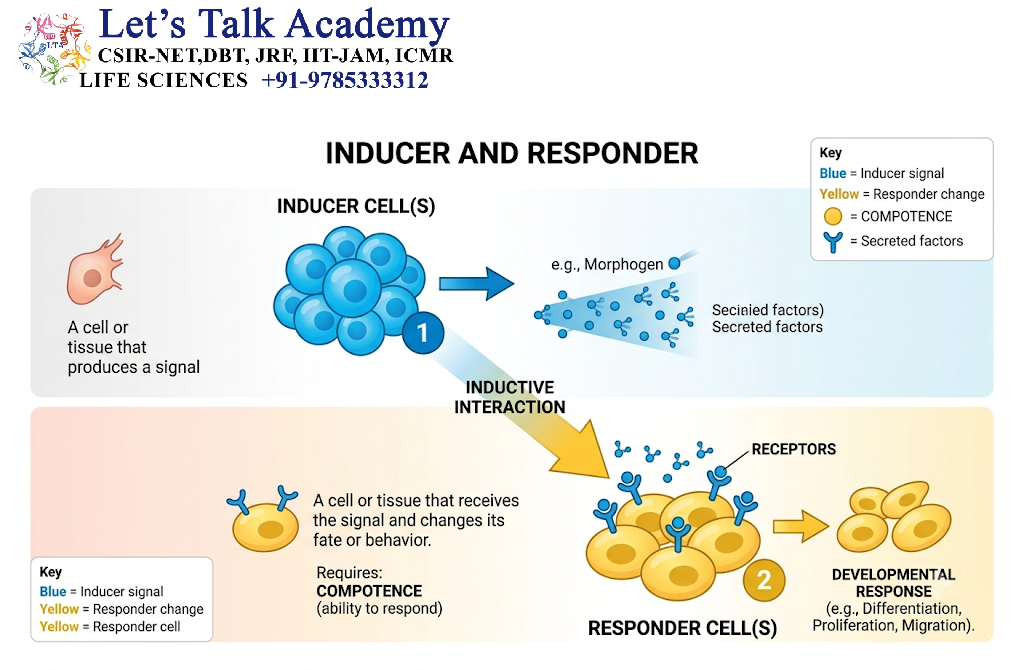
4.1 Inducer
An inducer is a group of cells that produces a signal capable of influencing nearby or distant cells.
The signal may be:
- A secreted protein
- A growth factor
- A morphogen
- A membrane-bound ligand
- An extracellular matrix-associated signal
4.2 Responder
The responder is the cell or tissue that receives the signal.
However, not every cell exposed to an inducer necessarily responds.
The responder must possess the appropriate:
- Receptor
- Signaling machinery
- Transcription factors
- Cellular competence
Therefore:
Signal alone is not sufficient.
The target cell must be capable of interpreting that signal.
5. Cellular Competence
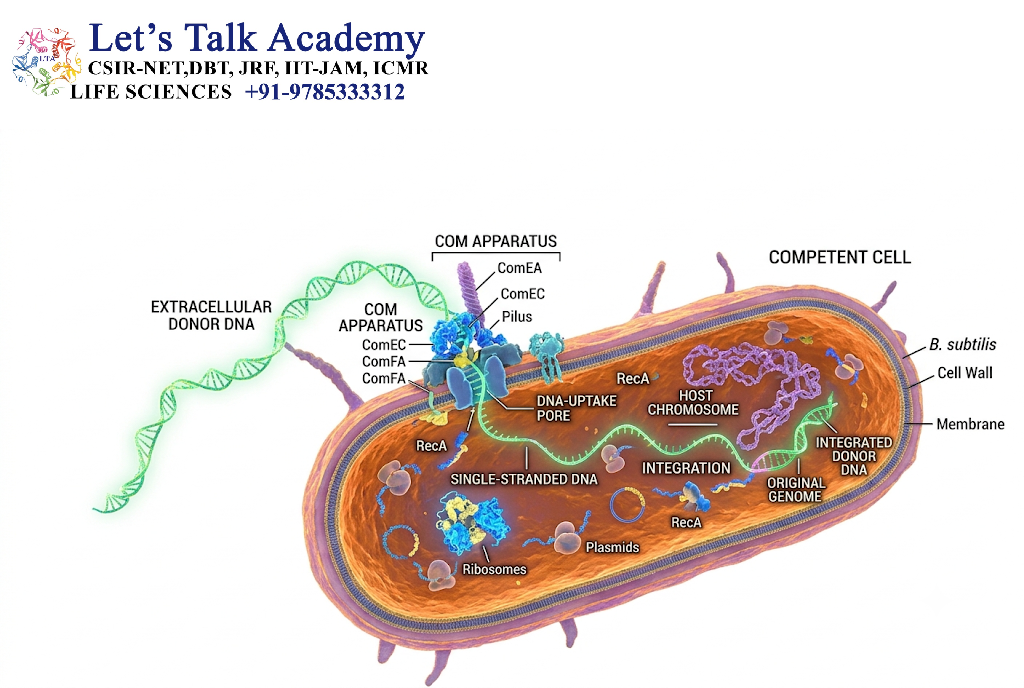
Competence refers to the ability of a cell or tissue to respond to a particular inductive signal.
This is extremely important in developmental biology.
For example, an inducer may release a signaling molecule, but only cells expressing the appropriate receptor and intracellular machinery may respond.
Example
Suppose an inducer produces signal X.
If Cell A has the receptor for X:
Signal X → Cell A responds
If Cell B does not have the receptor:
Signal X → Cell B does not respond
Therefore:
Induction = Signal + Competent responder
6. Types of Induction
Induction can be classified in several ways depending on the source, direction, and nature of signaling.
Major types
- Embryonic induction
- Primary induction
- Secondary induction
- Reciprocal induction
- Sequential induction
- Paracrine induction
- Juxtacrine/contact-dependent induction
7. Embryonic Induction
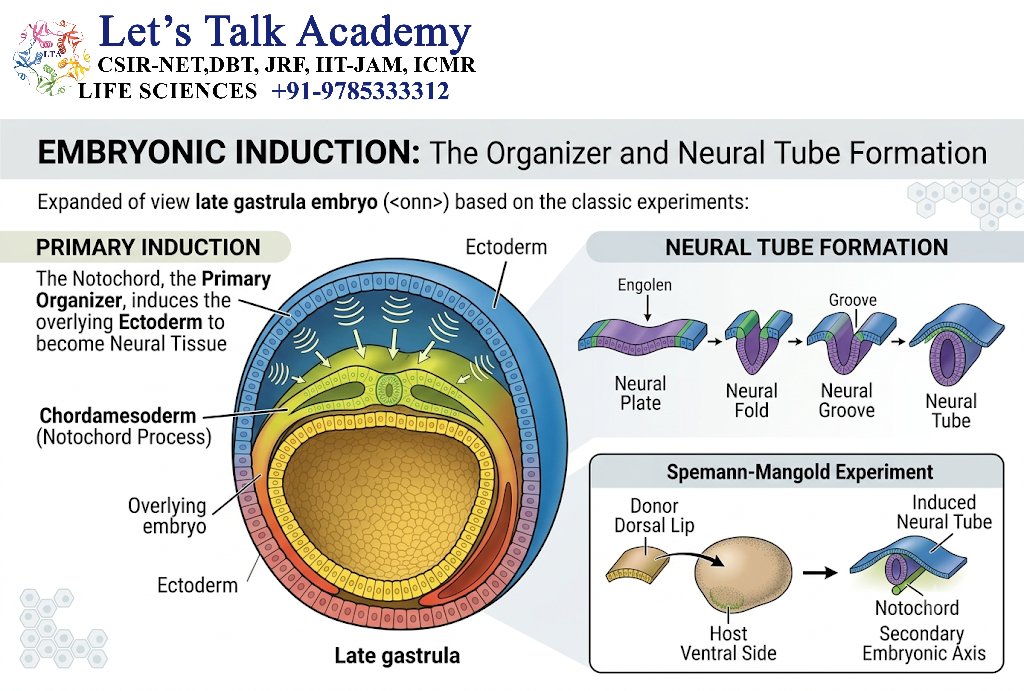
Embryonic induction refers to inductive interactions occurring during embryonic development.
It is responsible for coordinating the development of different tissues and organs.
During embryogenesis, one developing tissue can influence the developmental fate of another tissue.
Examples include:
- Neural induction
- Lens induction
- Limb development
- Kidney development
- Tooth development
- Heart development
8. Primary Induction
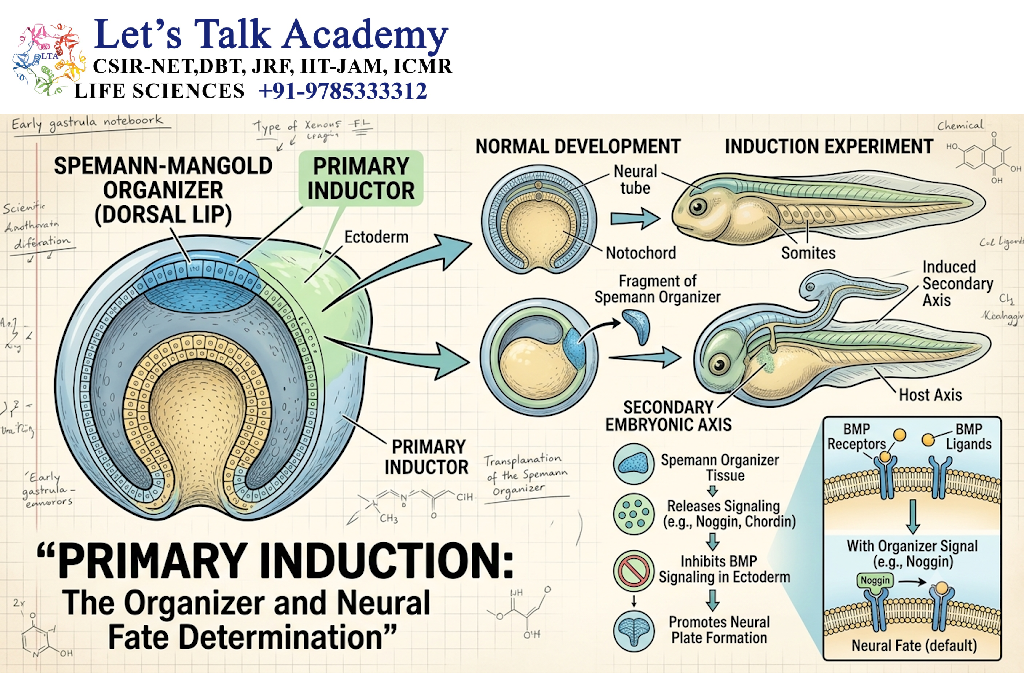
Primary induction refers to an early inductive interaction that initiates the development of a major tissue or developmental structure.
A classical example is neural induction during vertebrate embryonic development.
Signals from the developing axial mesoderm influence the overlying ectoderm and promote neural development.
Simplified mechanism
Axial mesoderm
↓
Signals to overlying ectoderm
↓
Neural-promoting signals
↓
Ectoderm changes gene expression
↓
Neural plate formation
↓
Neural tube development
Thus, the fate of the responding ectoderm is influenced by signals from another tissue.
9. Secondary Induction
In secondary induction, a tissue that has already been induced subsequently acts as an inducer for another tissue.
Therefore, induction can occur in a sequence.
Example
Tissue A
↓ induces
Tissue B
↓
Tissue B becomes an inducer
↓
induces Tissue C
This creates a developmental cascade.
10. Reciprocal Induction
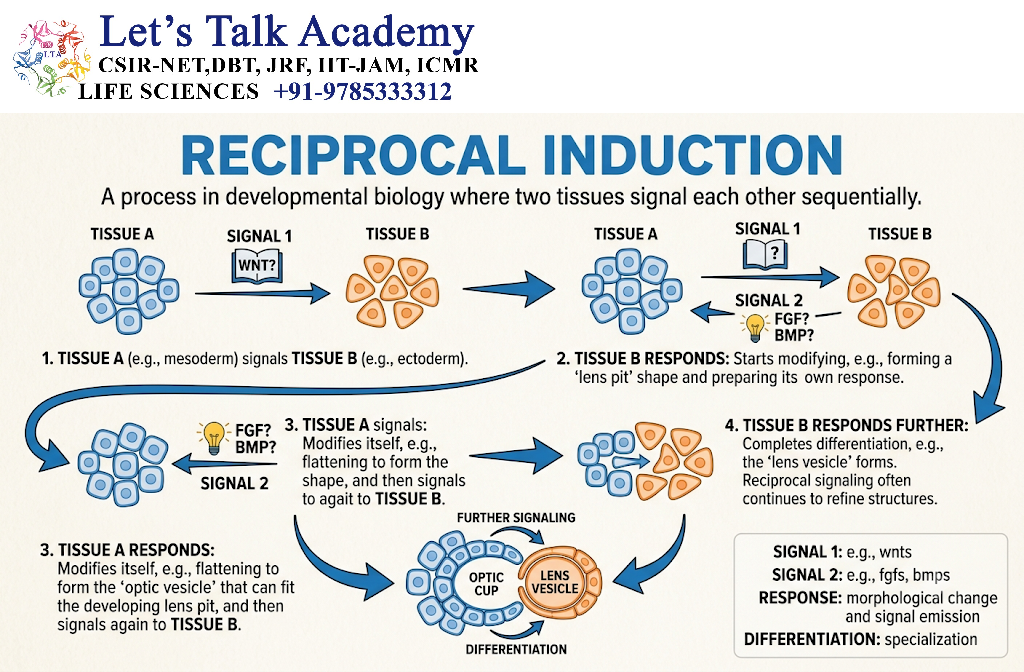
In reciprocal induction, two tissues influence each other’s development.
One tissue sends signals to another, and the second tissue sends signals back.
General mechanism
Tissue A
↓ Signal
Tissue B
↓ Signal
Tissue A
This reciprocal communication allows coordinated development.
It is particularly important in the development of organs such as:
- Kidney
- Tooth
- Hair follicle
- Certain epithelial organs
11. Sequential Induction
Sometimes development occurs through a series of inductive interactions.
For example:
Tissue A → Tissue B → Tissue C → Tissue D
Each newly developing tissue may influence the next developmental stage.
This is called sequential induction.
It allows development to proceed in an organized sequence rather than occurring randomly.
12. Paracrine Induction
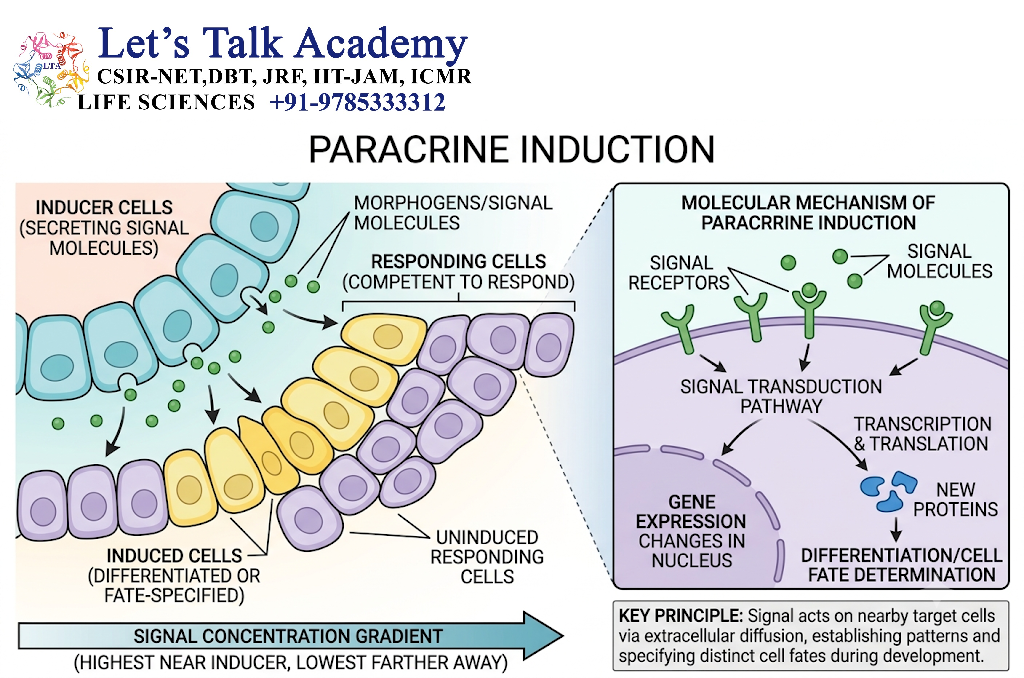
In paracrine signaling, the inducing cell releases signaling molecules into the extracellular environment.
These molecules travel a short distance and act on nearby cells.
Common developmental signaling molecules include:
- FGF
- BMP
- WNT
- Hedgehog
- TGF-β family members
Mechanism
Inducer
↓
Secretes signaling molecule
↓
Signal diffuses through extracellular space
↓
Binds receptor on nearby responder
↓
Intracellular signaling
↓
Gene expression changes
↓
Developmental response
13. Juxtacrine or Contact-Dependent Induction
In some cases, cells must be in direct contact.
The signaling molecule remains associated with the membrane of one cell and interacts with a receptor on an adjacent cell.
A classic example is:
Notch–Delta signaling
Mechanism
Cell A:
Delta ligand
↓
Direct cell-cell contact
↓
Notch receptor on Cell B
↓
Notch signaling pathway
↓
Changes in gene expression
↓
Altered cell fate
This mechanism is important in processes such as:
- Nervous system development
- Cell differentiation
- Lateral inhibition
- Tissue patterning
14. Morphogens and Induction
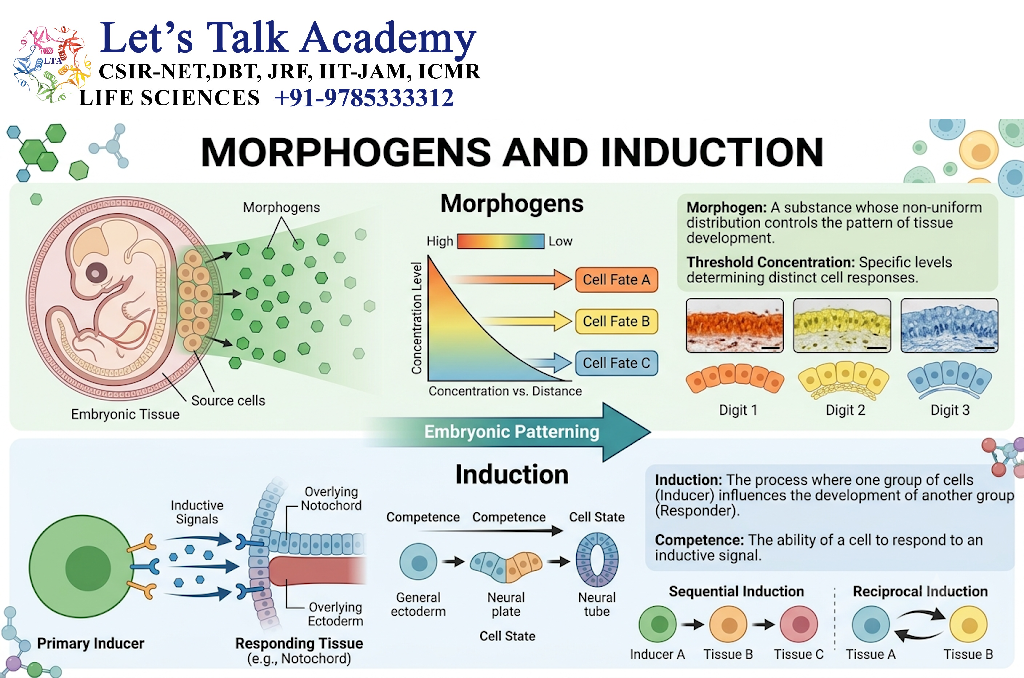
A morphogen is a signaling molecule that can provide positional information through concentration-dependent effects.
A morphogen may be produced by a localized group of cells and spread through a developing tissue.
Different concentrations can activate different target genes.
Example
Suppose morphogen concentration decreases with distance:
High concentration → Fate A
Medium concentration → Fate B
Low concentration → Fate C
Thus, one signaling molecule can help generate several different cell fates.
15. Induction and Signal Transduction
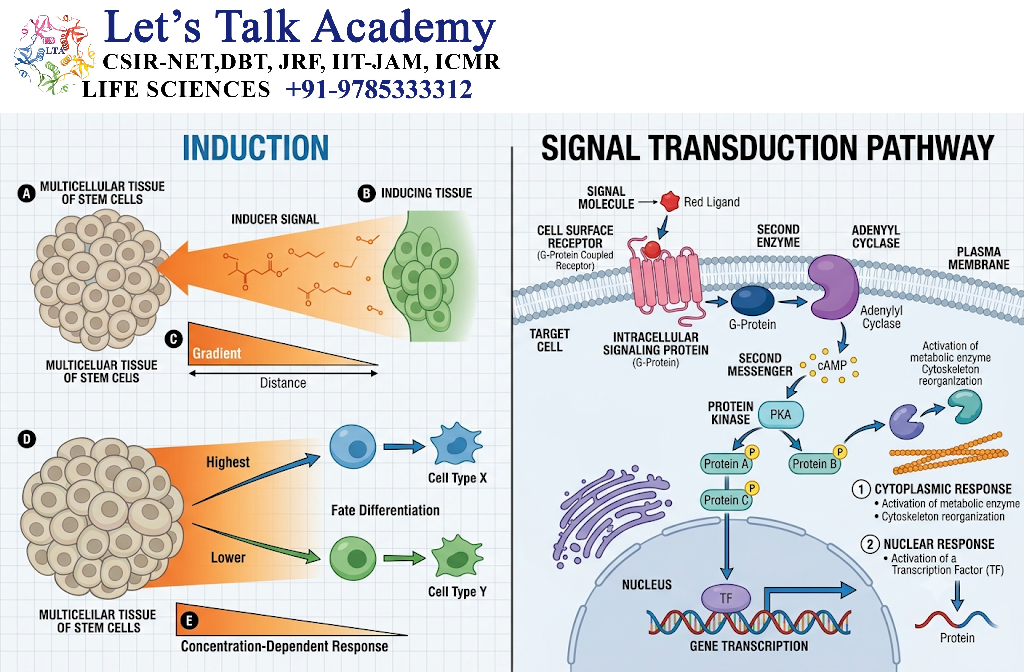
Induction requires conversion of an extracellular signal into an intracellular response.
General pathway
Signal
↓
Receptor
↓
Signal transduction pathway
↓
Intracellular signaling proteins
↓
Transcription factors
↓
Target genes
↓
Cellular response
The final response may include:
- Differentiation
- Cell division
- Cell migration
- Cell survival
- Cell death
- Changes in cell shape
- Changes in gene expression
16. Major Signaling Pathways Involved in Induction
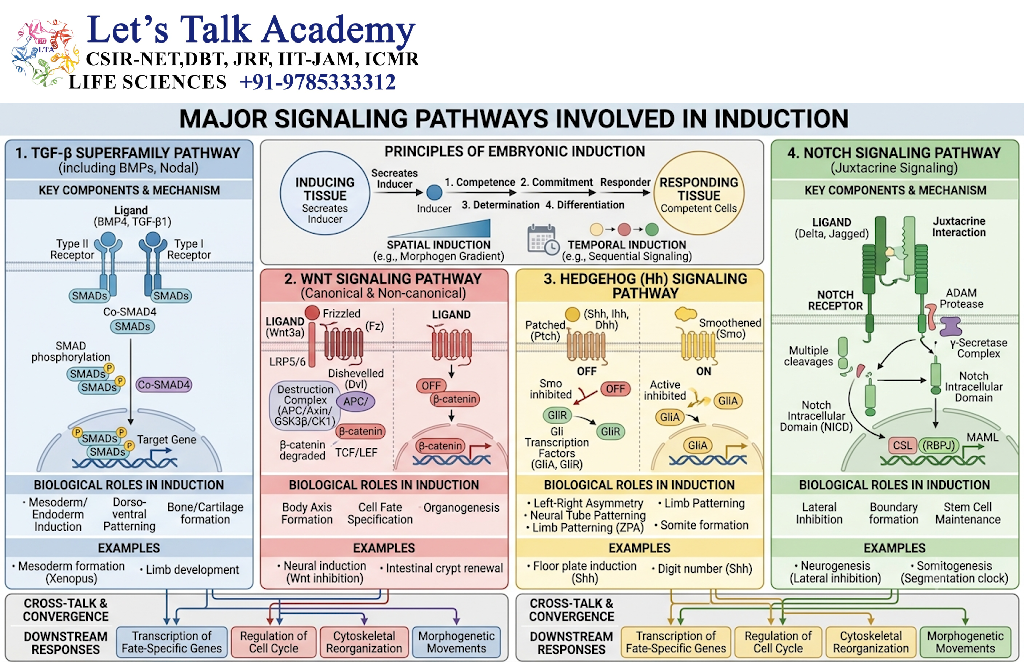
16.1 WNT Signaling
WNT signaling plays important roles in:
- Embryonic patterning
- Cell fate specification
- Stem-cell maintenance
- Organ development
- Tissue regeneration
WNT signaling can influence transcriptional programs that determine developmental fate.
16.2 BMP Signaling
BMPs belong to the TGF-β superfamily.
They participate in:
- Bone formation
- Epithelial development
- Neural patterning
- Mesodermal development
- Organ formation
BMP signaling commonly involves SMAD proteins.
16.3 FGF Signaling
Fibroblast growth factors (FGFs) are important developmental signals.
They regulate:
- Cell proliferation
- Differentiation
- Migration
- Limb development
- Organogenesis
FGFs commonly signal through receptor tyrosine kinases and downstream pathways such as RAS-MAPK.
16.4 Hedgehog Signaling
Hedgehog signaling is important for:
- Body patterning
- Neural development
- Limb development
- Organogenesis
A major developmental ligand is Sonic Hedgehog (SHH).
16.5 Notch Signaling
Notch signaling usually requires direct cell-cell contact.
It is involved in:
- Cell fate decisions
- Nervous system development
- Lateral inhibition
- Tissue differentiation
17. Neural Induction
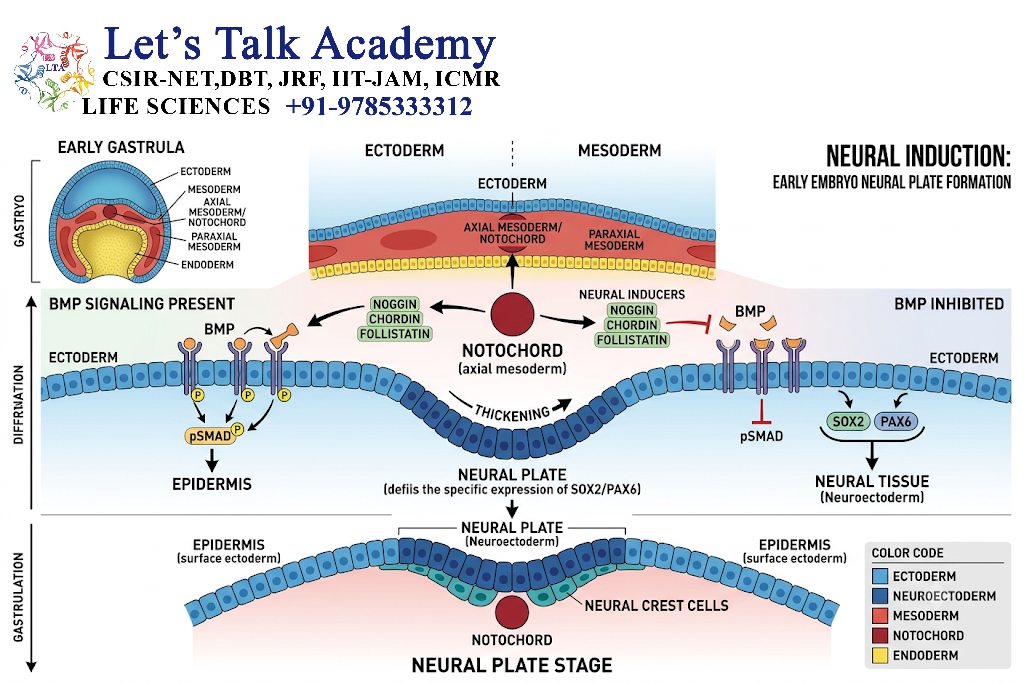
Neural induction is one of the classical examples of developmental induction.
During vertebrate development, interactions between the developing axial mesoderm and overlying ectoderm promote formation of neural tissue.
Simplified mechanism
Developing axial mesoderm
↓
Produces developmental signals
↓
Changes signaling environment of ectoderm
↓
Neural-promoting transcriptional program
↓
Ectoderm becomes neural ectoderm
↓
Neural plate
↓
Neural folds
↓
Neural tube
↓
Central nervous system
Important concept
Neural induction demonstrates that the fate of a developing tissue can be influenced by signals from another tissue.
18. Lens Induction
Lens development provides another important example of induction.
During eye development, interactions between developing tissues influence the formation of the lens.
A simplified sequence is:
Optic vesicle
↓
Interaction with surface ectoderm
↓
Changes in gene expression
↓
Lens placode formation
↓
Lens vesicle
↓
Lens differentiation
The process involves several signaling pathways, including interactions involving FGF, BMP, WNT and other developmental signals.
19. Kidney Development
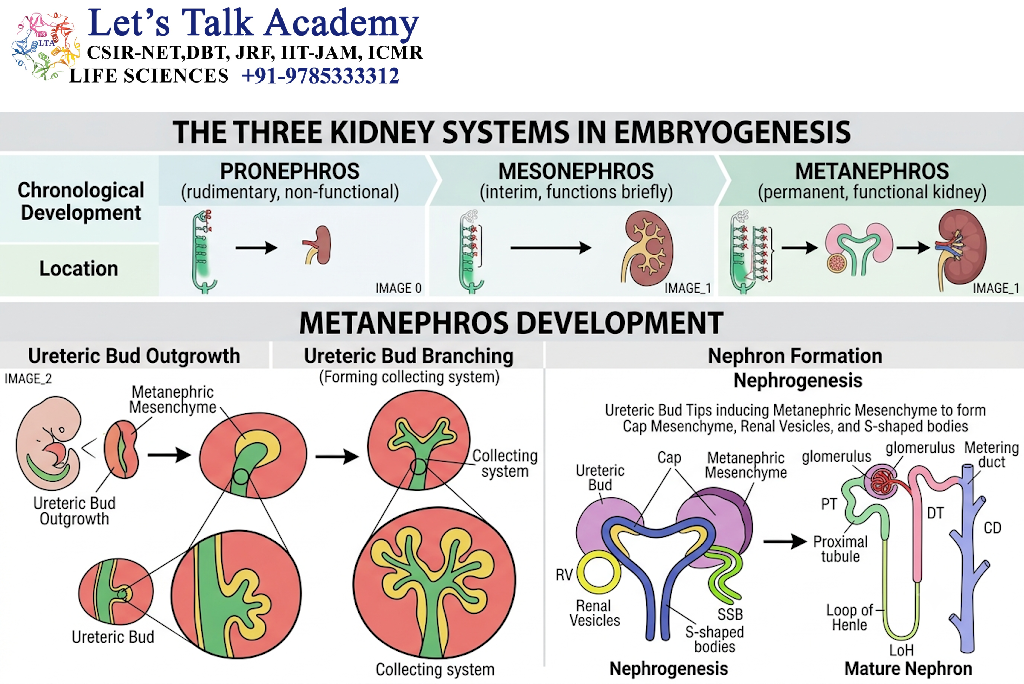
Kidney development involves extensive reciprocal signaling between different tissue components.
Two important components are:
- Ureteric bud
- Metanephric mesenchyme
Signals pass between these tissues.
Simplified mechanism
Metanephric mesenchyme
↔ signaling ↔
Ureteric bud
↓
Reciprocal developmental interactions
↓
Branching
↓
Cell differentiation
↓
Nephron and collecting-system development
This is an example of reciprocal induction.
20. Tooth Development
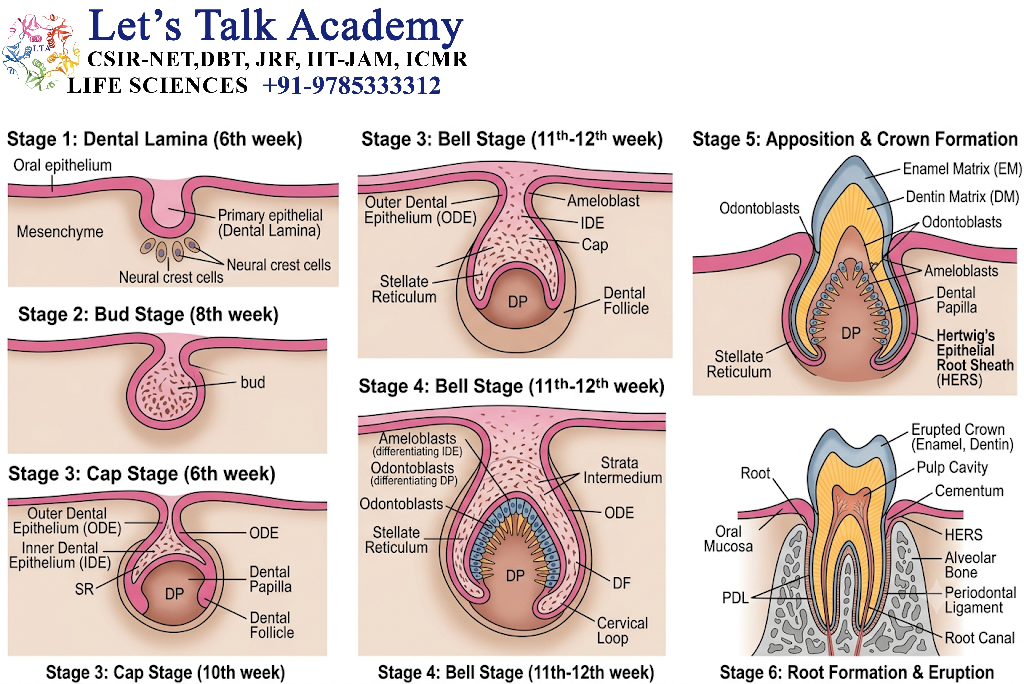
Tooth development is also based on interactions between epithelial and mesenchymal tissues.
Simplified sequence
Oral epithelium
↔
Mesenchyme
↓
Reciprocal signaling
↓
Cell proliferation and differentiation
↓
Tooth bud
↓
Tooth development
↓
Differentiation of specialized dental tissues
Therefore, tooth formation is not controlled by one cell population alone.
21. Induction in Limb Development
Limb development requires communication between different embryonic regions.
Important signaling centers include:
- Apical ectodermal ridge (AER)
- Zone of polarizing activity (ZPA)
FGF signaling from the AER and SHH signaling from the ZPA contribute to limb growth and patterning.
Simplified mechanism
AER
↓
FGF signaling
↓
Limb bud growth and patterning
ZPA
↓
SHH signaling
↓
Anterior-posterior patterning
Thus, coordinated signaling establishes the size, position and pattern of the developing limb.
22. Induction and Gene Expression
The ultimate effect of induction is often a change in gene expression.
A signaling molecule does not directly create a new tissue.
Instead:
Signal → receptor → intracellular pathway → transcription factor → target genes
The altered gene expression then changes the properties of the cell.
For example, genes controlling:
- Cell adhesion
- Cytoskeleton
- Cell division
- Extracellular matrix
- Tissue-specific proteins
may become activated or repressed.
23. Transcription Factors in Induction
Transcription factors translate developmental signals into gene-expression programs.
Examples include:
| Transcription factor | Major developmental association |
|---|---|
| SOX family | Neural and other tissue development |
| PAX family | Eye, nervous system and organ development |
| MYOD1 | Muscle differentiation |
| GATA family | Blood and other developmental programs |
| RUNX family | Bone and hematopoietic development |
| NEUROD | Neural differentiation |
The exact response depends on the tissue, developmental stage and combination of signals.
24. Induction and Cell Fate
Induction can change the developmental fate of responding cells.
For example:
Uncommitted/competent cell
↓
Receives developmental signal
↓
Specific transcription factors activated
↓
Gene-expression pattern changes
↓
Cell becomes biased toward a particular fate
↓
Commitment
↓
Differentiation
Therefore, induction can contribute to cell-fate determination and differentiation.
25. Induction and Specification
Induction and specification are related but not identical.
Specification
Specification describes a state in which a cell or tissue is biased toward a particular developmental fate.
Induction
Induction describes the interaction or signaling process through which one tissue influences another.
Therefore:
Induction = developmental interaction
Specification = resulting developmental state
An inductive signal may cause specification of the responding cells.
26. Induction and Determination
Determination refers to a more stable stage of developmental commitment.
A typical sequence may be:
Inductive signal
↓
Specification
↓
Commitment
↓
Determination
↓
Differentiation
However, developmental processes are often overlapping rather than perfectly linear.
27. Induction and Differentiation
Induction can initiate or regulate differentiation, but the two terms are not synonymous.
| Induction | Differentiation |
|---|---|
| Interaction between cells/tissues | Process of acquiring specialized characteristics |
| Usually involves signaling | Involves changes in gene expression and cell structure |
| Can influence cell fate | Produces specialized phenotype |
| Often occurs before or during differentiation | Represents progression toward specialized function |
28. Role of Induction in Organogenesis
Organogenesis is the formation of organs during embryonic development.
Inductive interactions are essential because organs usually develop through interactions between multiple tissues.
Examples include:
- Kidney
- Eye
- Tooth
- Heart
- Lung
- Liver
- Pancreas
- Nervous system
General mechanism
Different tissues
↓
Exchange developmental signals
↓
Coordinate proliferation
↓
Coordinate differentiation
↓
Organ patterning
↓
Functional organ formation
29. Induction and Tissue Patterning
Induction does not simply determine whether a cell differentiates.
It can also determine where and when differentiation occurs.
This produces spatial organization within tissues.
For example:
Signal source → gradient → different signal concentrations → different gene expression → different cell fates
This allows an embryo to develop organized structures rather than an unstructured collection of cells.
30. Induction and Inhibition
Development frequently depends on both activating and inhibitory signals.
One tissue may release a signal that promotes a developmental pathway, while another signal suppresses it.
Therefore:
Development = balance of positive and negative signals
Examples include:
- BMP and BMP inhibitors
- WNT and WNT antagonists
- Notch-mediated lateral inhibition
This balance helps establish precise tissue boundaries.
31. Lateral Inhibition
Lateral inhibition is a mechanism in which one cell adopting a particular fate prevents neighboring cells from adopting the same fate.
Notch signaling is a classic example.
Mechanism
Cell A begins a particular fate
↓
Cell A increases Delta signaling
↓
Delta activates Notch in neighboring Cell B
↓
Cell B’s alternative developmental program is altered
↓
Cell B adopts a different fate
This helps create organized patterns of different cell types.
32. Induction and Epigenetic Regulation
Developmental signals can influence epigenetic states.
These changes may involve:
- DNA methylation
- Histone modification
- Chromatin remodeling
- Enhancer activity
- Non-coding RNAs
These mechanisms help maintain or stabilize developmental gene-expression programs.
Thus:
Inductive signal → signaling pathway → transcription factors → chromatin/gene regulation → developmental phenotype
33. Induction Is Dependent on Developmental Timing
The same signal may produce different effects at different developmental stages.
This occurs because cells change their:
- Receptor expression
- Transcription-factor levels
- Chromatin state
- Signaling machinery
- Competence
Therefore:
Same signal + different developmental stage → potentially different response
This is an important principle of developmental biology.
34. Induction Is Dependent on Signal Concentration
Some developmental signals show concentration-dependent effects.
For example:
| Signal concentration | Possible response |
|---|---|
| High | Fate A |
| Intermediate | Fate B |
| Low | Fate C |
| None | Fate D |
This is particularly important in morphogen-mediated pattern formation.
35. Induction Can Be Short-Range or Long-Range
Short-range induction
The signal acts on neighboring cells.
Examples:
- Notch-Delta signaling
- Local paracrine signaling
Long-range signaling
Some developmental signals can influence cells located farther away through gradients or other transport mechanisms.
Therefore, developmental communication can occur over different spatial scales.
36. Experimental Demonstration of Induction
Developmental biologists have demonstrated induction using classical embryological experiments.
Important experimental approaches
- Tissue transplantation
- Tissue recombination
- Embryonic tissue isolation
- Grafting experiments
- Lineage tracing
- Genetic manipulation
- Knockout experiments
- Gain-of-function experiments
Basic transplantation experiment
Tissue A + Tissue B
↓
Observe development
Then:
Tissue B without Tissue A
↓
Compare development
If Tissue B develops differently in the absence of Tissue A, this can provide evidence that Tissue A influences Tissue B.
37. Induction and Developmental Plasticity
Cells can sometimes respond differently depending on their environment.
Therefore, cell fate is not always determined solely by its original position.
Changes in:
- Signaling environment
- Neighboring cells
- Growth factors
- Extracellular matrix
can alter developmental behavior.
This property contributes to developmental plasticity.
38. Induction and Regenerative Biology
Inductive signaling is also important after embryonic development.
During tissue repair and regeneration, cells communicate through developmental signaling pathways.
Important pathways include:
- WNT
- Notch
- Hedgehog
- FGF
- TGF-β/BMP
These pathways can regulate:
- Stem-cell behavior
- Tissue repair
- Cell proliferation
- Differentiation
However, abnormal reactivation of developmental pathways can also contribute to disease, including cancer.


