
PRINCIPLES OF BIOPHYSICAL CHEMISTRY: REACTION KINETICS
1. Introduction to Reaction Kinetics
Reaction kinetics is the branch of chemistry that deals with the rate of chemical reactions, the factors that influence reaction rates, and the mechanisms through which reactants are converted into products.
In biological systems, chemical reactions occur continuously. Cells synthesize and degrade biomolecules, generate energy, replicate DNA, synthesize RNA and proteins, transport molecules, transmit signals, and regulate metabolism through thousands of chemical reactions.
The fact that a reaction is chemically possible does not tell us how rapidly it will occur. Some reactions occur almost instantaneously, whereas others may take seconds, minutes, hours, or even years.
For example, the oxidation of glucose is thermodynamically favorable, but the controlled breakdown of glucose inside a cell occurs through a sequence of enzyme-catalyzed reactions rather than by direct uncontrolled oxidation.
1.1 Reaction Kinetics in Biophysical Chemistry
Biophysical chemistry applies physical and chemical principles to biological molecules and biological processes.
Reaction kinetics is an important part of biophysical chemistry because biological function depends not only on whether a reaction can occur but also on how rapidly it occurs under physiological conditions.
For example:
Substrate → Product
The conversion may be thermodynamically possible, but the rate may be extremely low without an enzyme.
Therefore:
Thermodynamic possibility ≠ reaction speed
This distinction is fundamental to understanding biological catalysis.
1.2 Importance of Reaction Kinetics in Biology
Reaction kinetics helps explain many biological processes, including:
- Enzyme catalysis
- Metabolic pathways
- DNA replication
- RNA synthesis
- Protein synthesis
- Ligand binding
- Signal transduction
- Protein folding
- Nucleic-acid hybridization
- Drug–enzyme interactions
- Cellular metabolism
A small change in the rate of a key enzyme reaction can significantly affect the concentration of metabolites and the overall behavior of a metabolic pathway.
Thus, reaction kinetics connects molecular events with cellular physiology.
2. Reaction Rate
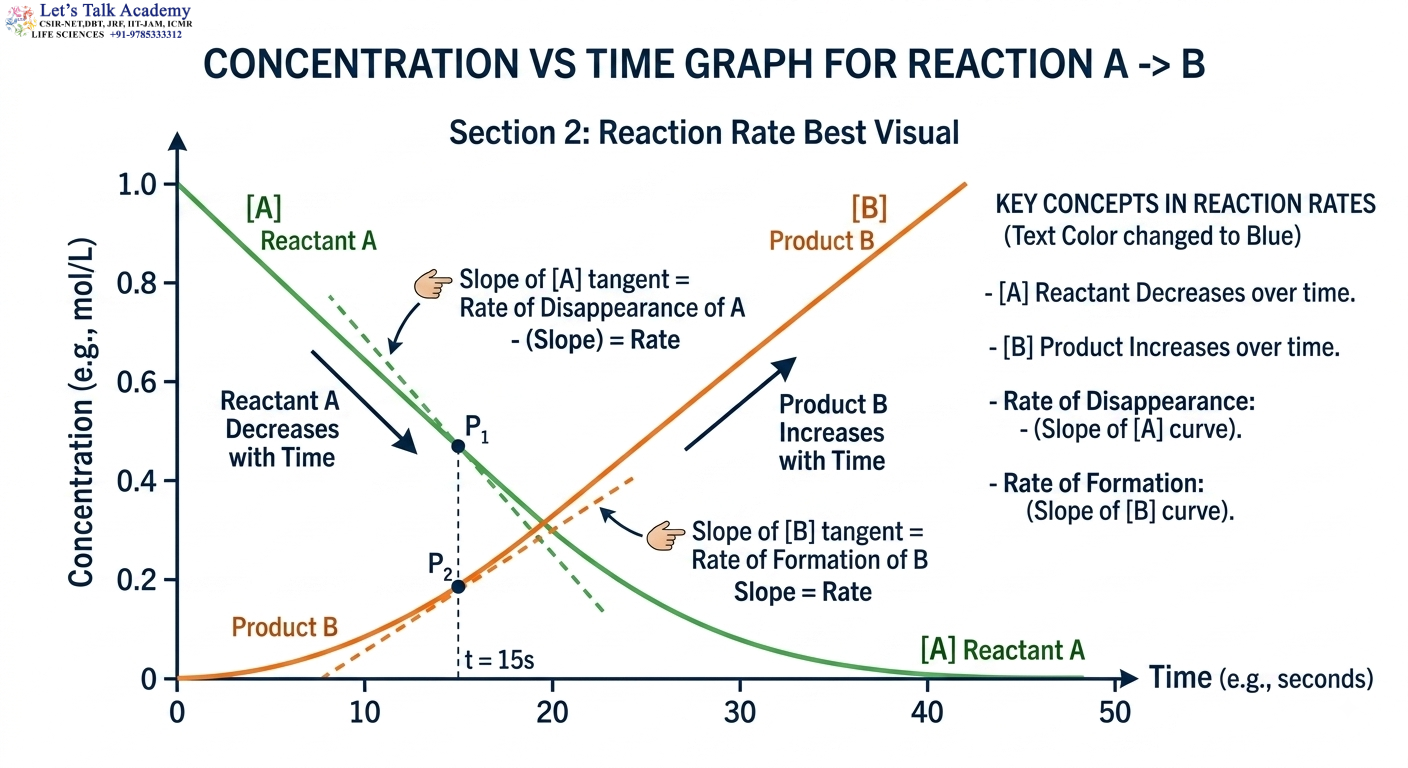
The reaction rate is the change in concentration of a reactant or product per unit time.
Consider the simple reaction:
A → B
As the reaction proceeds:
[A] decreases
and:
[B] increases
Therefore, the rate can be expressed as:
Rate = −Δ[A] / Δt
or:
Rate = Δ[B] / Δt
The negative sign is used for the reactant because its concentration decreases with time.
For a product, concentration increases with time, so the rate is positive.
2.1 Differential Expression of Reaction Rate
When very small changes in concentration and time are considered, the rate can be written as:
Rate = −d[A] / dt
or:
Rate = d[B] / dt
This differential form is particularly useful in mathematical descriptions of reaction kinetics.
2.2 Rate of a General Reaction
Consider:
aA + bB → cC + dD
The reaction rate can be defined consistently by dividing the concentration change of each species by its stoichiometric coefficient:
Rate = −1/a · d[A]/dt
Rate = −1/b · d[B]/dt
Rate = 1/c · d[C]/dt
Rate = 1/d · d[D]/dt
This ensures that all expressions represent the same overall reaction rate.
3. Rate Law
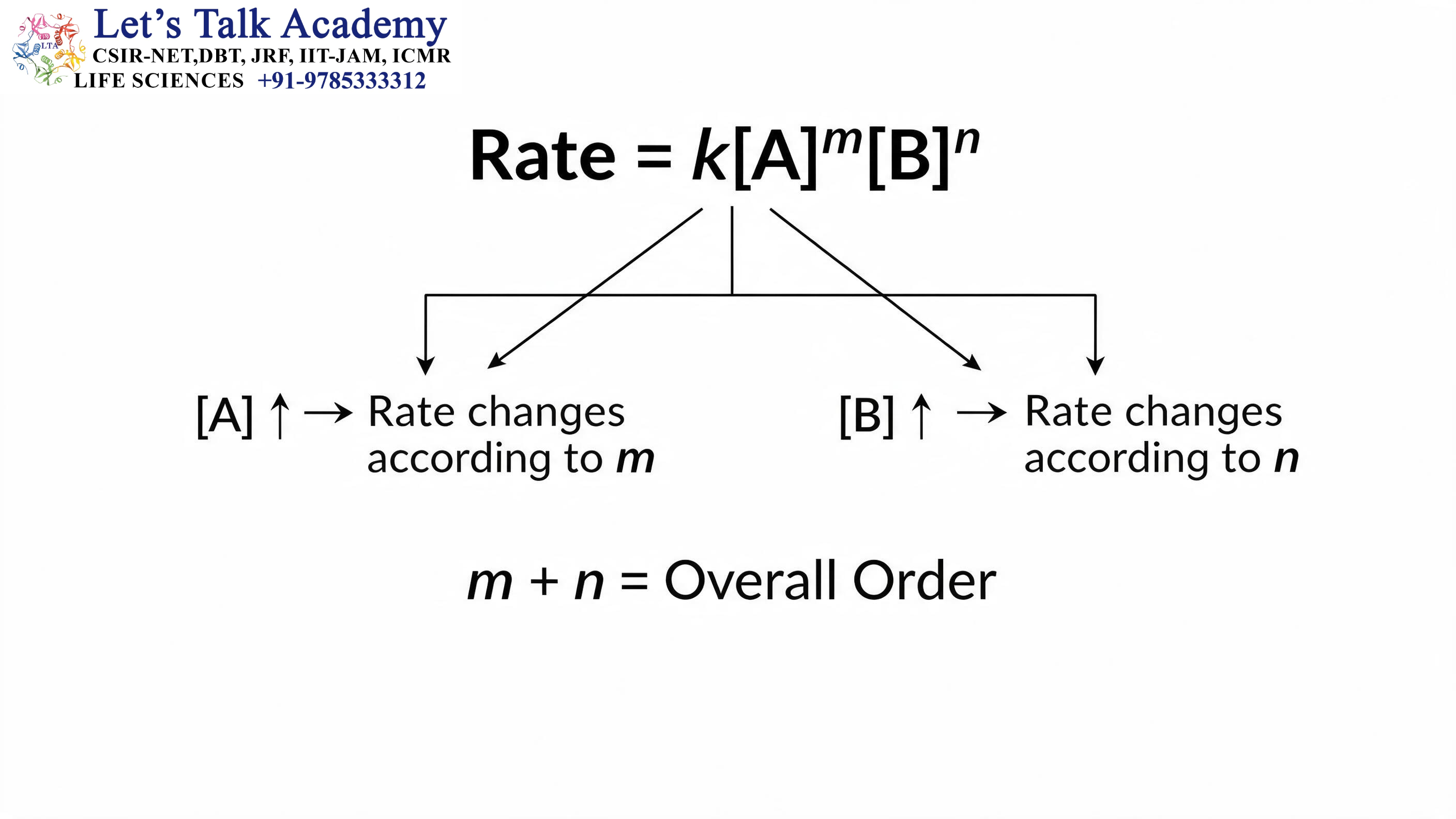
A rate law is a mathematical expression that describes the relationship between reaction rate and the concentrations of reactants.
For a general reaction involving A and B:
Rate = k[A]ᵐ[B]ⁿ
Here:
k = rate constant
[A] = concentration of reactant A
[B] = concentration of reactant B
m = order with respect to A
n = order with respect to B
The overall reaction order is:
Overall order = m + n
The values of m and n are generally determined experimentally for an overall reaction.
3.1 Meaning of the Exponents in a Rate Law
The exponents are extremely important because they determine how changes in concentration influence the reaction rate.
For example:
Rate = k[A]
The reaction is first order with respect to A.
If [A] is doubled:
Rate becomes 2 times
For:
Rate = k[A]²
doubling [A] gives:
New rate = k(2[A])²
Therefore:
New rate = 4k[A]²
Hence:
Rate becomes 4 times
For:
Rate = k[A][B]
doubling both A and B gives:
New rate = k(2[A])(2[B])
Therefore:
New rate = 4k[A][B]
Thus, the reaction rate becomes four times greater.
4. Rate Constant
The proportionality constant in a rate law is called the rate constant, represented by k.
For:
Rate = k[A]ᵐ[B]ⁿ
the value of k depends on the reaction and experimental conditions.
Important factors influencing k include:
- Temperature
- Solvent
- Ionic strength
- Presence of catalysts
- Nature of the reactants
- Reaction environment
The rate constant should not be confused with reaction rate.
The reaction rate changes when reactant concentrations change, whereas the value of k is characteristic of the reaction under specified conditions.
5. Order of Reaction
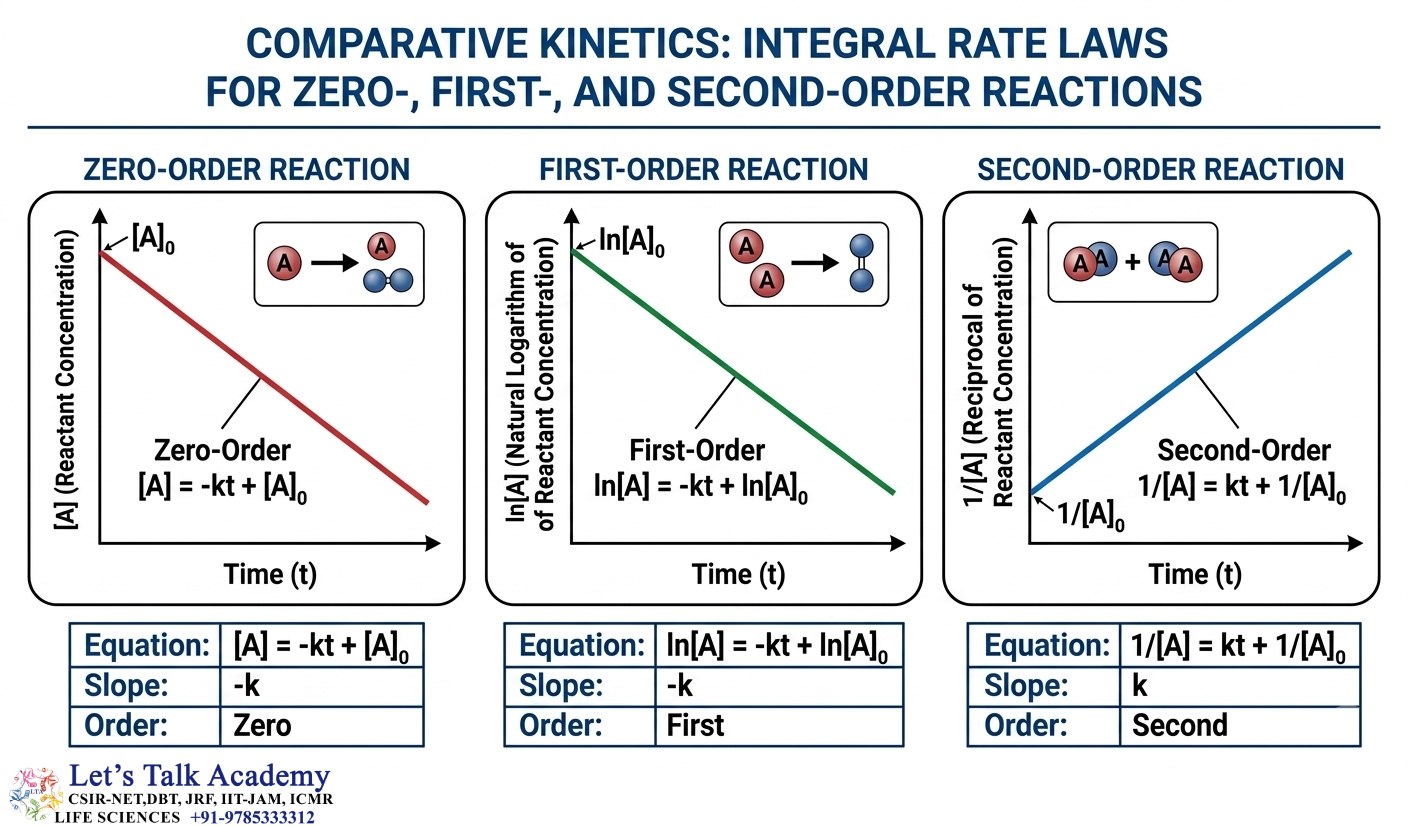
The order of a reaction is determined by the sum of the powers of concentration terms in the experimentally determined rate law.
For:
Rate = k[A]
Order = 1
For:
Rate = k[A]²
Order = 2
For:
Rate = k[A][B]
Order with respect to A = 1
Order with respect to B = 1
Overall order:
1 + 1 = 2
For:
Rate = k[A]²[B]³
Order with respect to A = 2
Order with respect to B = 3
Overall order:
2 + 3 = 5
6. Zero-Order Reaction
A zero-order reaction is one in which the rate is independent of reactant concentration.
For:
A → P
the rate law is:
Rate = k
Therefore:
−d[A]/dt = k
Integrating:
[A]ₜ = [A]₀ − kt
Where:
[A]₀ = initial concentration
[A]ₜ = concentration at time t
k = zero-order rate constant
t = time
6.1 Half-Life of a Zero-Order Reaction
At half-life:
[A]ₜ = [A]₀/2
Substituting into:
[A]ₜ = [A]₀ − kt
gives:
[A]₀/2 = [A]₀ − kt₁/₂
Therefore:
kt₁/₂ = [A]₀/2
Hence:
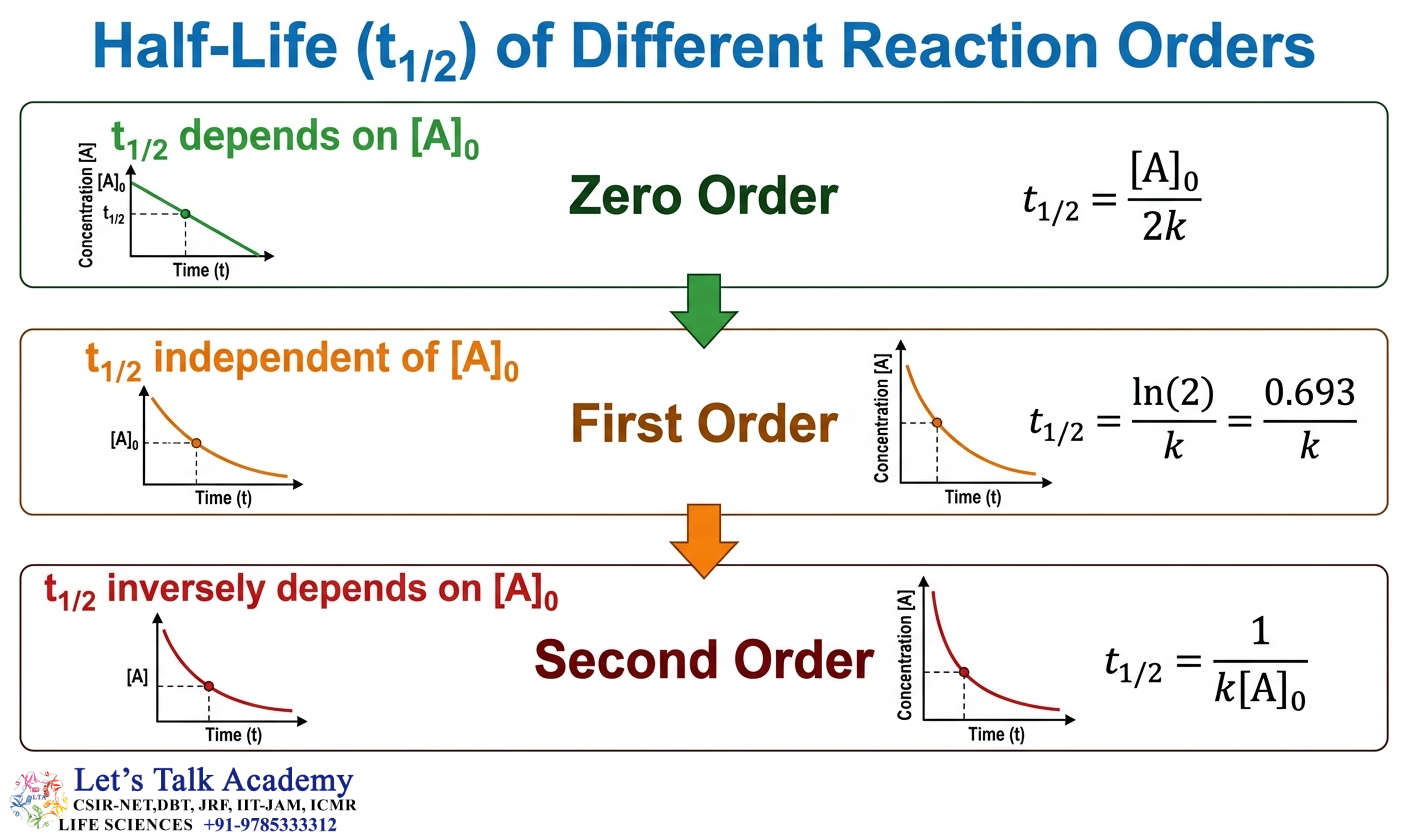
t₁/₂ = [A]₀ / 2k
Therefore, the half-life of a zero-order reaction depends on the initial concentration.
7. First-Order Reaction
In a first-order reaction, the rate is directly proportional to the concentration of one reactant.
For:
A → P
the rate law is:
Rate = k[A]
Therefore:
−d[A]/dt = k[A]
After integration:
ln([A]₀/[A]ₜ) = kt
The equation can also be written as:
ln[A]ₜ = ln[A]₀ − kt
Using common logarithms:
log([A]₀/[A]ₜ) = kt / 2.303
7.1 Half-Life of a First-Order Reaction
At half-life:
[A]ₜ = [A]₀/2
Therefore:
ln([A]₀/([A]₀/2)) = kt₁/₂
Thus:
ln 2 = kt₁/₂
Since:
ln 2 = 0.693
we obtain:
t₁/₂ = 0.693 / k
A major characteristic of a first-order reaction is:
Half-life is independent of initial concentration.
8. Second-Order Reaction
For a simple second-order reaction:
A → P
the rate law may be:
Rate = k[A]²
Therefore:
−d[A]/dt = k[A]²
After integration:
1/[A]ₜ = 1/[A]₀ + kt
8.1 Half-Life of a Second-Order Reaction
At half-life:
[A]ₜ = [A]₀/2
Substituting:
1/([A]₀/2) = 1/[A]₀ + kt₁/₂
Therefore:
2/[A]₀ = 1/[A]₀ + kt₁/₂
Hence:
1/[A]₀ = kt₁/₂
Therefore:
t₁/₂ = 1 / k[A]₀
Thus, the half-life of a second-order reaction depends on the initial concentration.
9. Comparison of Reaction Orders
Property |
Zero Order |
First Order |
Second Order |
|---|---|---|---|
| Rate law | Rate = k | Rate = k[A] | Rate = k[A]² |
| Integrated equation | [A]ₜ = [A]₀ − kt | ln([A]₀/[A]ₜ) = kt | 1/[A]ₜ = 1/[A]₀ + kt |
| Half-life | [A]₀/2k | 0.693/k | 1/k[A]₀ |
| Dependence of half-life on [A]₀ | Direct | Independent | Inverse |
| Unit of k | M s⁻¹ | s⁻¹ | M⁻¹ s⁻¹ |
10. Units of the Rate Constant
The unit of k depends on the overall reaction order.
For an overall reaction of order n:
Unit of k = concentration¹⁻ⁿ time⁻¹
For a zero-order reaction:
Unit of k = M s⁻¹
For a first-order reaction:
Unit of k = s⁻¹
For a second-order reaction:
Unit of k = M⁻¹ s⁻¹
This is a useful relationship for numerical questions.
11. Molecularity
Molecularity is the number of reacting molecular species involved in a single elementary reaction step.
For example:
A → P
Molecularity = 1
This is a unimolecular reaction.
For:
A + B → P
Molecularity = 2
This is a bimolecular reaction.
For:
A + B + C → P
Molecularity = 3
This is a termolecular elementary reaction.
11.1 Important Property of Molecularity
Molecularity is defined only for an elementary reaction step.
It is always a positive integer:
1, 2, 3, …
It is not normally zero or fractional.
12. Molecularity Versus Reaction Order
These two terms are often confused.
Molecularity
Molecularity is a mechanistic concept.
It tells us how many reacting species participate in one elementary step.
Reaction Order
Reaction order is a kinetic concept.
It is determined from the experimentally observed rate law.
Reaction order can be:
- Zero
- One
- Two
- Fractional
- Other experimentally determined values
Therefore:
Molecularity and reaction order are not necessarily the same.
They may be identical for an elementary reaction, but an overall multistep reaction can have an experimentally determined order that differs from the molecularity of individual elementary steps.
13. Reaction Mechanism
A reaction mechanism describes the sequence of elementary steps through which reactants are converted into products.
Consider:
A → I → P
Here:
A = reactant
I = reaction intermediate
P = product
The overall reaction is:
A → P
but it occurs through an intermediate.
13.1 Reaction Intermediate
An intermediate is a species that:
- Forms during one elementary step
- Is consumed in another step
- Does not appear in the overall balanced equation
For example:
A → I
I → P
The species I is an intermediate.
13.2 Rate-Determining Step
In some multistep mechanisms, one step is considerably slower than the others.
This step can strongly influence the observed rate.
For example:
A → I — slow
I → P — fast
The first step may exert major control over the observed rate.
However, real biochemical pathways can involve complex mechanisms in which multiple steps influence the overall rate. Therefore, the phrase “rate-determining step” should be applied carefully.
14. Factors Affecting Reaction Rate
The rate of a chemical reaction can be influenced by several factors.
Important factors include:
- Concentration of reactants
- Temperature
- Activation energy
- Catalysts
- Nature of reactants
- Solvent
- Ionic strength
- pH
- Pressure in gaseous systems
- Enzyme concentration in biochemical reactions
14.1 Effect of Reactant Concentration
Increasing reactant concentration may increase the reaction rate.
The magnitude of this effect depends on the order of the reaction.
For a first-order reaction:
Rate = k[A]
Doubling [A] doubles the rate.
For a second-order reaction:
Rate = k[A]²
Doubling [A] increases the rate fourfold.
Thus, reaction order determines the concentration dependence of reaction rate.
15. Collision Theory
Collision theory provides a simple physical explanation for reaction rates.
According to collision theory, molecules must collide in order to react.
However, not every collision produces a reaction.
For a collision to be successful, molecules must have:
- Appropriate orientation
- Sufficient energy
- Suitable molecular configuration
Therefore:
Effective collision → successful reaction
The number of effective collisions increases when more molecules possess sufficient energy to overcome the activation barrier.
16. Activation Energy
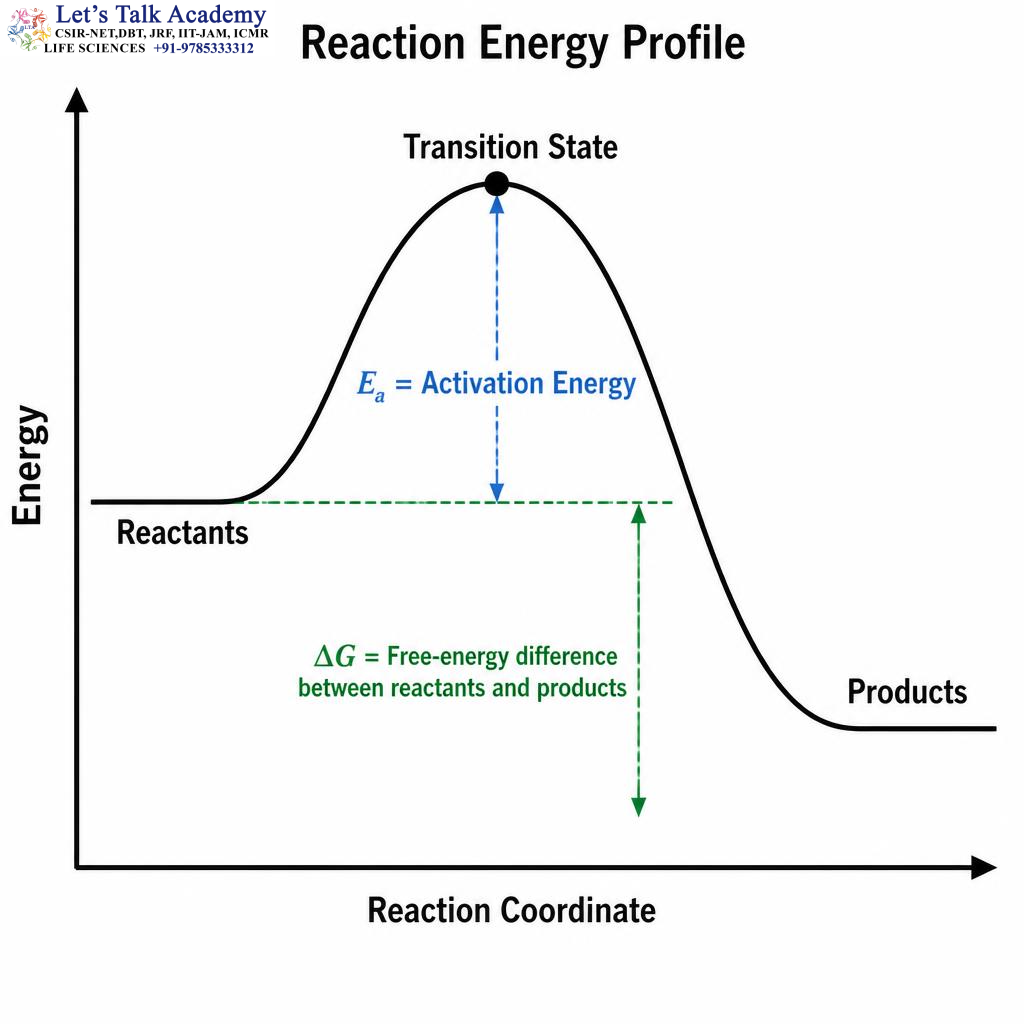
The minimum energy barrier that reactant molecules must overcome to reach the transition state is called the activation energy, represented by Eₐ.
A simplified energy pathway can be represented as:
Reactants → Transition state → Products
The activation energy is:
Eₐ = Energy of transition state − Energy of reactants
A larger activation-energy barrier generally corresponds to a slower reaction under otherwise comparable conditions.
17. Transition State
The transition state is a high-energy molecular configuration located near the maximum of the energy barrier.
It is represented conceptually as:
Reactants → [Transition State] → Products
The transition state is extremely short-lived and is not normally isolated as a stable intermediate.
It is important to distinguish:
Transition state ≠ reaction intermediate
An intermediate corresponds to a local energy minimum between two transition states, whereas a transition state corresponds to an energy maximum along the reaction coordinate.
18. Arrhenius Equation
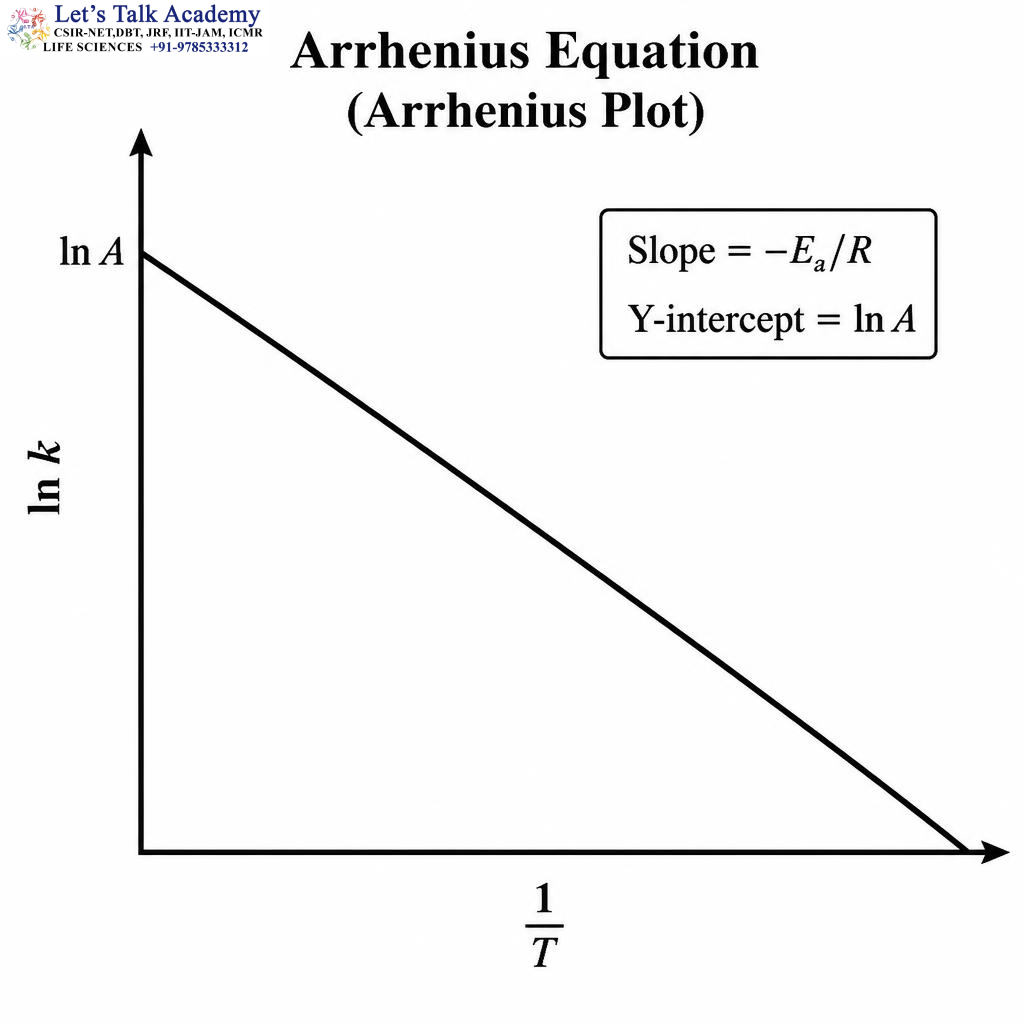
The dependence of the rate constant on temperature can be described by the Arrhenius equation:
k = A e⁻ᴱᵃ/ᴿᵀ
Where:
k = rate constant
A = pre-exponential factor
Eₐ = activation energy
R = gas constant
T = absolute temperature in Kelvin
This equation demonstrates that increasing temperature generally increases the rate constant.
18.1 Logarithmic Form of Arrhenius Equation
Taking natural logarithms:
ln k = ln A − Eₐ/RT
This can be rearranged as:
ln k = −(Eₐ/R)(1/T) + ln A
This has the form:
y = mx + c
Therefore, for a plot of:
ln k versus 1/T
the:
Slope = −Eₐ/R
and:
Y-intercept = ln A
19. Two-Temperature Arrhenius Equation
When rate constants at two different temperatures are known, the following equation can be used:
ln(k₂/k₁) = −Eₐ/R (1/T₂ − 1/T₁)
Where:
k₁ = rate constant at temperature T₁
k₂ = rate constant at temperature T₂
Eₐ = activation energy
R = gas constant
T₁ and T₂ = absolute temperatures
Temperatures must be expressed in Kelvin.
20. Effect of Temperature on Biological Reactions
Increasing temperature generally increases chemical reaction rates because a greater fraction of molecules can overcome the activation-energy barrier.
However, biological reactions involve proteins and other macromolecules that have structural stability limits.
Therefore, enzyme-catalyzed reactions often show:
Low temperature → low reaction rate
Increasing temperature → increasing reaction rate
Optimum temperature → maximum observed activity
Excessive temperature → protein denaturation → reduced activity
This illustrates an important relationship between reaction kinetics and protein stability.
21. Catalysts
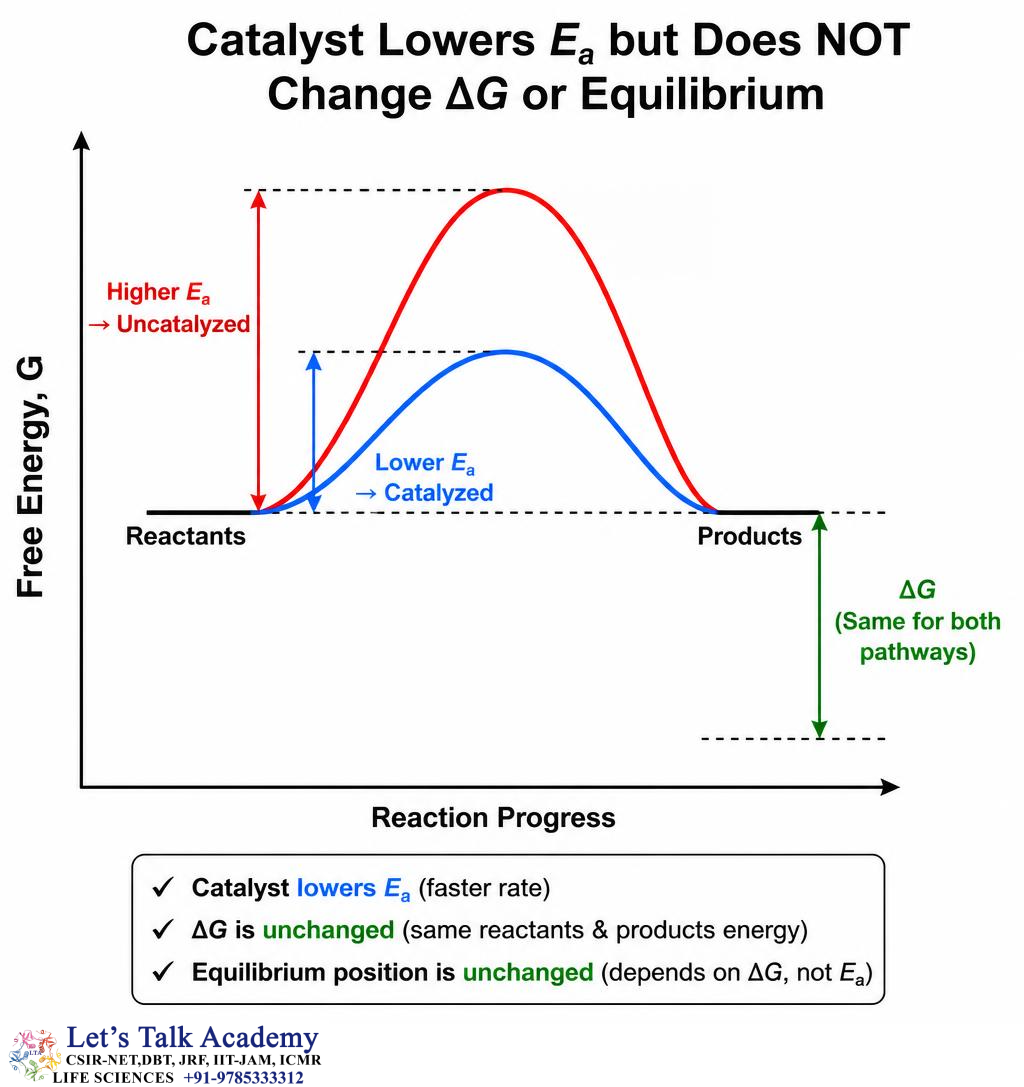
A catalyst is a substance that increases the rate of a chemical reaction without being consumed in the overall reaction.
A catalyst provides an alternative pathway with a lower activation-energy barrier.
Therefore:
Catalyst → lower Eₐ → faster reaction
A catalyst does not change the overall thermodynamic equilibrium of the reaction.
It allows the system to reach equilibrium more rapidly.
21.1 What a Catalyst Does Not Change
A catalyst does not change:
Overall ΔG of the reaction
Equilibrium constant Kₑq
Final equilibrium composition
Instead, it changes:
Rate of approach to equilibrium
This distinction between kinetics and thermodynamics is extremely important.
22. Enzymes as Biological Catalysts
Enzymes are biological catalysts.
Most enzymes are proteins, although certain RNA molecules also possess catalytic activity and are called ribozymes.
Enzymes accelerate reactions by lowering the activation-energy barrier through formation of specific molecular interactions with substrates and stabilization of the transition state.
A simplified enzyme reaction is:
E + S ⇌ ES → E + P
Where:
E = enzyme
S = substrate
ES = enzyme–substrate complex
P = product
The enzyme is regenerated after product formation.
23. Enzyme–Substrate Complex
The substrate binds to a specific region of the enzyme called the active site.
The active site provides a suitable chemical environment for:
- Substrate recognition
- Substrate orientation
- Transition-state stabilization
- Catalysis
- Product release
The initial binding reaction is:
E + S ⇌ ES
The enzyme–substrate complex then proceeds toward product formation:
ES → E + P
24. Michaelis–Menten Kinetics
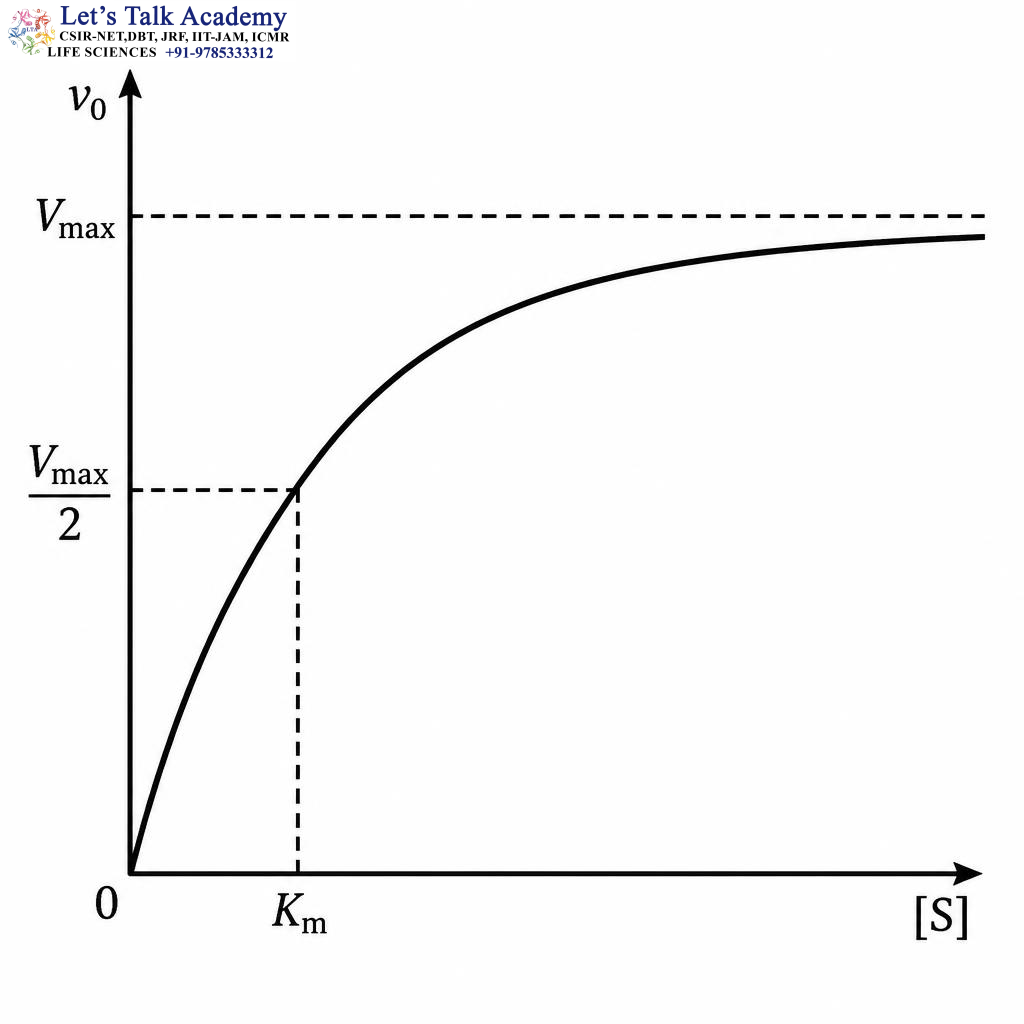
The Michaelis–Menten model describes the kinetics of many simple enzyme-catalyzed reactions.
The simplified mechanism is:
E + S ⇌ ES → E + P
The Michaelis–Menten equation is:
v₀ = Vₘₐₓ[S] / (Kₘ + [S])
Where:
v₀ = initial reaction velocity
Vₘₐₓ = maximum reaction velocity
[S] = substrate concentration
Kₘ = Michaelis constant
25. Michaelis Constant
The Michaelis constant, Kₘ, is the substrate concentration at which the initial reaction velocity is half of the maximum velocity.
Therefore:
When [S] = Kₘ
then:
v₀ = Vₘₐₓ/2
The unit of Kₘ is concentration, such as:
M, mM, or µM
A lower Kₘ means that half-maximal velocity is achieved at a lower substrate concentration.
However, Kₘ should not automatically be equated with binding affinity in every enzyme system.
Under the simple Michaelis–Menten mechanism, Kₘ is:
Kₘ = (k₋₁ + k₂) / k₁
Therefore, Kₘ reflects both substrate dissociation and catalytic conversion in the simple model.
26. Maximum Velocity
Vₘₐₓ is the maximum initial reaction velocity reached when the enzyme is saturated with substrate under the specified conditions.
At very high substrate concentration:
[S] ≫ Kₘ
Therefore:
Kₘ + [S] ≈ [S]
and:
v₀ ≈ Vₘₐₓ
At this stage, adding more substrate produces little additional increase in reaction velocity because most enzyme molecules are already present as enzyme–substrate complexes.
27. Enzyme Saturation
Enzyme saturation explains the characteristic shape of the Michaelis–Menten curve.
At low substrate concentration:
[S] ≪ Kₘ
The equation becomes approximately:
v₀ ≈ (Vₘₐₓ/Kₘ)[S]
Therefore, the rate increases approximately proportionally with substrate concentration.
At high substrate concentration:
[S] ≫ Kₘ
The rate approaches:
v₀ ≈ Vₘₐₓ
Thus:
Low [S] → approximately first-order behavior
High [S] → approximately zero-order behavior with respect to substrate
28. Michaelis–Menten Curve
A plot of:
Initial velocity (v₀) versus substrate concentration [S]
produces a hyperbolic curve for a simple Michaelis–Menten enzyme.
The curve has three important regions.
Low Substrate Concentration
The rate increases almost linearly with [S].
Intermediate Substrate Concentration
The enzyme begins to approach saturation.
High Substrate Concentration
The velocity approaches Vₘₐₓ.
The substrate concentration corresponding to:
v₀ = Vₘₐₓ/2
is:
[S] = Kₘ
29. Derivation of the Michaelis–Menten Equation
Consider:
E + S ⇌ ES → E + P
The rate constants are:
k₁ = rate constant for ES formation
k₋₁ = rate constant for ES dissociation
k₂ = catalytic rate constant for product formation
Under the steady-state approximation:
Rate of ES formation = Rate of ES breakdown
Therefore:
k₁[E][S] = k₋₁[ES] + k₂[ES]
Thus:
k₁[E][S] = (k₋₁ + k₂)[ES]
Rearranging:
[ES] = k₁[E][S] / (k₋₁ + k₂)
The Michaelis constant is defined as:
Kₘ = (k₋₁ + k₂) / k₁
Therefore:
[ES] = [E][S] / Kₘ
Considering total enzyme:
[E]ₜ = [E] + [ES]
and:
Vₘₐₓ = kcat[E]ₜ
the Michaelis–Menten equation becomes:
v₀ = Vₘₐₓ[S] / (Kₘ + [S])
30. Turnover Number
The turnover number, represented by kcat, describes the number of substrate molecules converted into product per enzyme molecule per unit time when the enzyme is operating under substrate-saturating conditions.
The relationship is:
kcat = Vₘₐₓ / [E]ₜ
Where:
kcat = turnover number
Vₘₐₓ = maximum velocity
[E]ₜ = total enzyme concentration
The unit of kcat is generally:
s⁻¹
A higher kcat indicates a greater catalytic turnover under the specified conditions.
31. Catalytic Efficiency
Catalytic efficiency is commonly represented by:
kcat / Kₘ
This combines the catalytic turnover and substrate concentration dependence of an enzyme.
A higher value of:
kcat/Kₘ
generally indicates more efficient catalytic performance under low-substrate conditions.
This parameter is especially useful when comparing different substrates or enzymes.
32. Effect of Enzyme Concentration
Under substrate-saturating conditions:
Vₘₐₓ = kcat[E]ₜ
Therefore:
Increasing enzyme concentration → increasing Vₘₐₓ
provided that all other conditions remain constant.
For example, doubling enzyme concentration approximately doubles Vₘₐₓ.
However:
Kₘ does not normally change simply because enzyme concentration changes.
33. Effect of Substrate Concentration
At low substrate concentration:
v₀ increases approximately proportionally with [S]
At high substrate concentration:
v₀ approaches Vₘₐₓ
Therefore, increasing substrate concentration has diminishing effects once the enzyme becomes saturated.
The overall relationship is:
Substrate concentration ↑ → reaction rate ↑ → enzyme saturation → Vₘₐₓ
34. Enzyme Inhibition
An enzyme inhibitor is a molecule that decreases enzyme activity.
Inhibitors may act by:
- Competing with substrate
- Binding to free enzyme
- Binding to the enzyme–substrate complex
- Binding to regulatory sites
- Modifying catalytic residues
- Producing irreversible enzyme inactivation
Important reversible inhibition models include:
- Competitive inhibition
- Pure noncompetitive inhibition
- Uncompetitive inhibition
- Mixed inhibition
35. Competitive Inhibition
In competitive inhibition, the inhibitor competes with substrate for the free enzyme.
The simplified reaction is:
E + I ⇌ EI
The inhibitor reduces productive substrate binding.
In classical competitive inhibition:
Vₘₐₓ remains unchanged
Apparent Kₘ increases
A sufficiently high concentration of substrate can overcome the inhibition because substrate and inhibitor compete for the same enzyme population.
Therefore:
Competitive inhibition → Kₘ ↑, Vₘₐₓ unchanged
36. Pure Noncompetitive Inhibition
In pure noncompetitive inhibition, the inhibitor binds to the free enzyme and enzyme–substrate complex with equal affinity.
The classical result is:
Vₘₐₓ decreases
Kₘ remains unchanged
Increasing substrate concentration does not restore the original Vₘₐₓ.
Therefore:
Pure noncompetitive inhibition → Kₘ unchanged, Vₘₐₓ ↓
37. Uncompetitive Inhibition
In uncompetitive inhibition, the inhibitor binds preferentially to the enzyme–substrate complex.
The classical result is:
Kₘ decreases
Vₘₐₓ decreases
Both decrease by the same factor in the idealized model.
Therefore:
Uncompetitive inhibition → Kₘ ↓, Vₘₐₓ ↓
38. Mixed Inhibition
In mixed inhibition, the inhibitor can bind both free enzyme and enzyme–substrate complex but with different affinities.
Therefore:
Vₘₐₓ decreases
while:
Kₘ may increase or decrease
depending on the relative affinity of the inhibitor for E and ES.
Pure noncompetitive inhibition is a special case of mixed inhibition in which the inhibitor has equal affinity for E and ES.
39. Comparison of Enzyme Inhibition
Inhibition |
Kₘ |
Vₘₐₓ |
|---|---|---|
| Competitive | ↑ | Unchanged |
| Pure noncompetitive | Unchanged | ↓ |
| Uncompetitive | ↓ | ↓ |
| Mixed | ↑ or ↓ | ↓ |
40. Lineweaver–Burk Equation
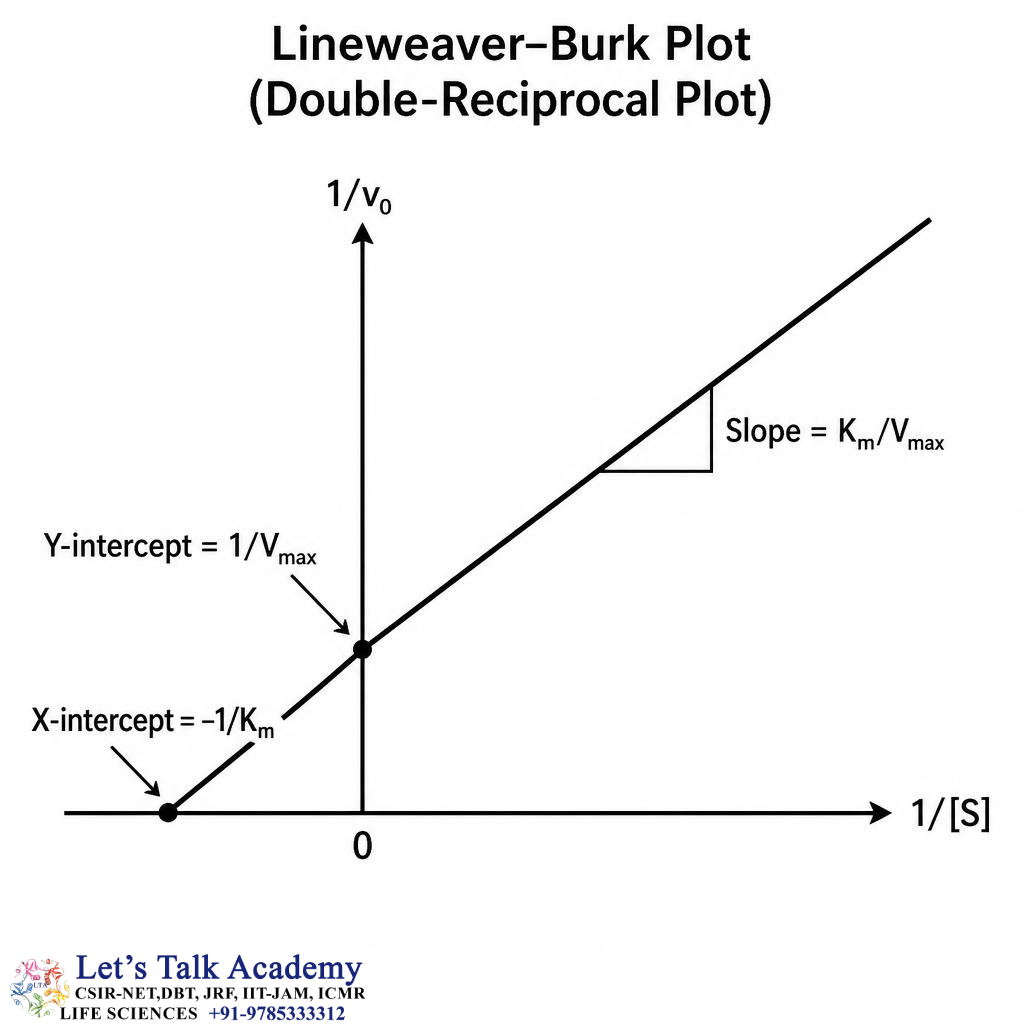
The Michaelis–Menten equation:
v₀ = Vₘₐₓ[S] / (Kₘ + [S])
can be converted into a double-reciprocal form.
Taking reciprocals:
1/v₀ = (Kₘ/Vₘₐₓ)(1/[S]) + 1/Vₘₐₓ
This follows the general linear equation:
y = mx + c
Therefore:
Y-axis = 1/v₀
X-axis = 1/[S]
Slope = Kₘ/Vₘₐₓ
Y-intercept = 1/Vₘₐₓ
X-intercept = −1/Kₘ
The Lineweaver–Burk plot is useful for visualizing enzyme inhibition, although modern kinetic analysis generally prefers nonlinear fitting of the original Michaelis–Menten equation because reciprocal transformations can magnify experimental errors at low substrate concentrations.
41. Eadie–Hofstee Equation
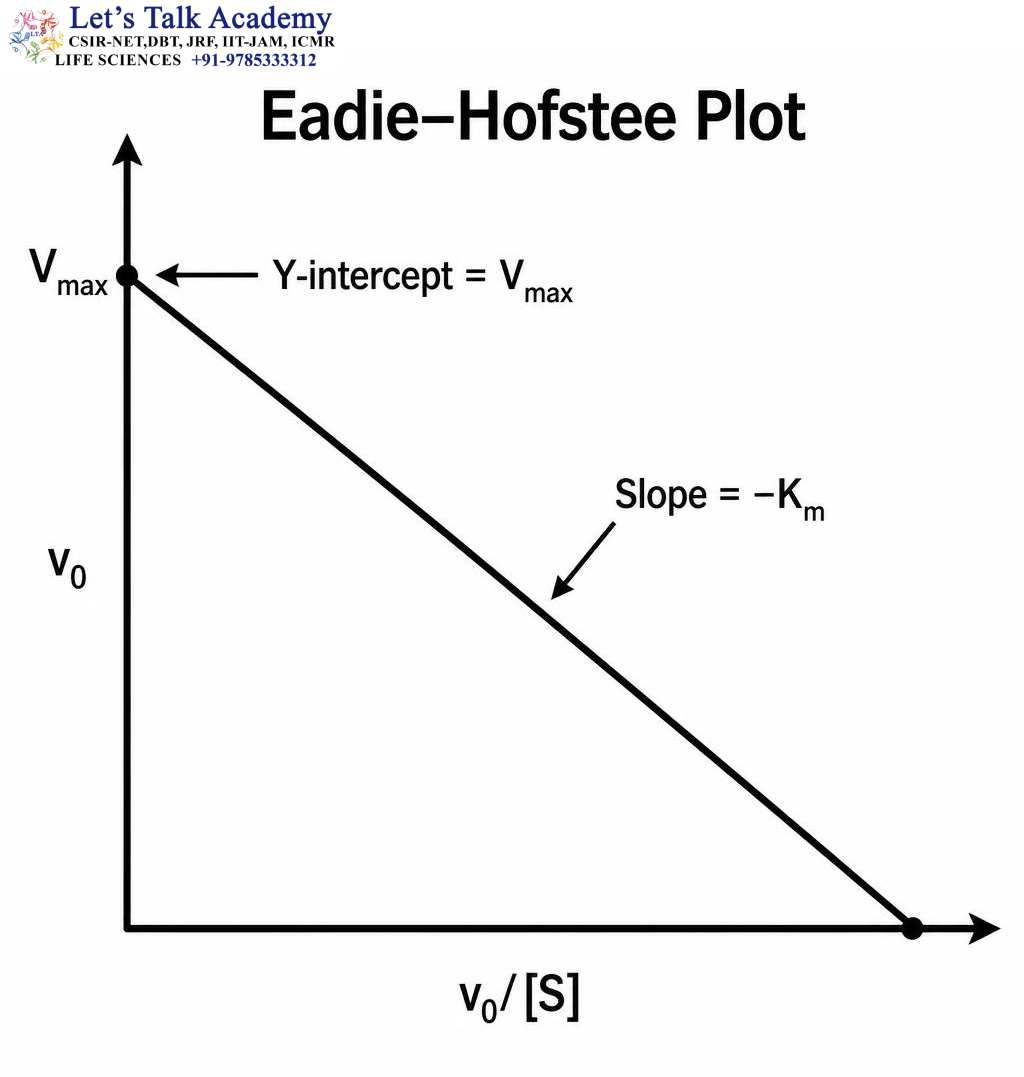
Another linear representation of Michaelis–Menten kinetics is the Eadie–Hofstee equation:
v₀ = Vₘₐₓ − Kₘ(v₀/[S])
For a plot of:
v₀ versus v₀/[S]
the:
Slope = −Kₘ
and:
Y-intercept = Vₘₐₓ
42. Hanes–Woolf Equation
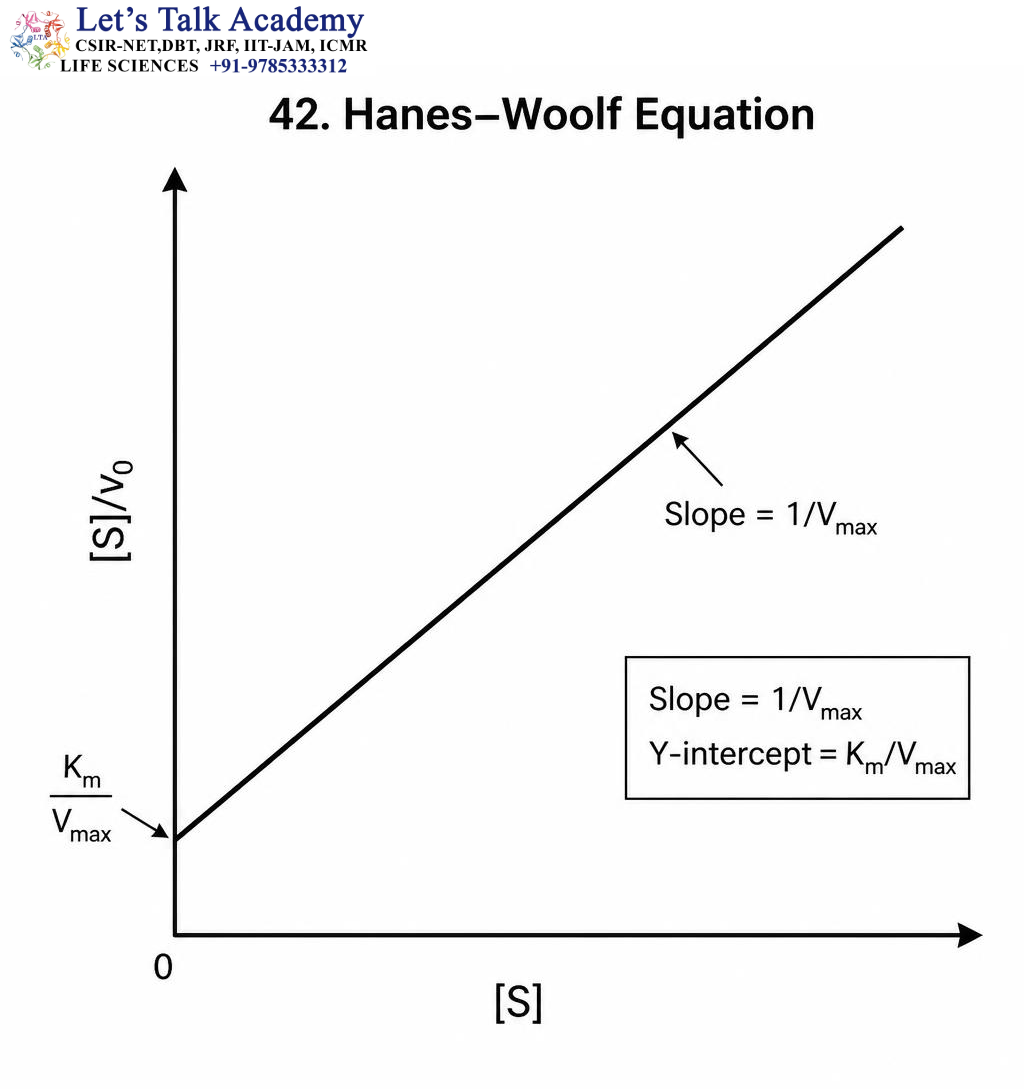
The Hanes–Woolf representation is:
[S]/v₀ = [S]/Vₘₐₓ + Kₘ/Vₘₐₓ
For a plot of:
[S]/v₀ versus [S]
the:
Slope = 1/Vₘₐₓ
and:
Y-intercept = Kₘ/Vₘₐₓ
These graphical transformations are useful for understanding enzyme kinetics and interpreting older biochemical literature.
43. Allosteric Enzymes
Not all enzymes follow simple Michaelis–Menten kinetics.
Allosteric enzymes often contain multiple interacting sites and can undergo conformational changes following ligand binding.
The binding of a molecule at one site can influence the activity or affinity of another site.
Therefore, allosteric enzymes frequently show a sigmoidal rather than hyperbolic relationship between substrate concentration and reaction velocity.
44. Cooperativity
Cooperativity occurs when binding at one site affects binding at another site.
Positive Cooperativity
Binding of one ligand increases the tendency for additional ligand molecules to bind.
This produces a steeper, sigmoidal response.
Negative Cooperativity
Binding of one ligand decreases the tendency for additional ligand molecules to bind.
The response becomes less steep than expected for independent binding.
Cooperativity is an important principle in biological regulation.
45. Hill Equation
Cooperative binding can be described using the Hill equation.
For fractional saturation:
θ = [L]ⁿ / (Kᴅ + [L]ⁿ)
Where:
θ = fractional saturation
[L] = ligand concentration
n = Hill coefficient
Kᴅ = apparent dissociation-related parameter in the Hill formulation
The Hill coefficient is used as an empirical measure of cooperativity.
Generally:
n > 1 → positive cooperativity
n = 1 → no apparent cooperativity
n < 1 → negative cooperativity
The Hill coefficient should not automatically be interpreted as the exact number of ligand-binding sites.
46. Factors Affecting Enzyme Activity
Enzyme-catalyzed reaction rates depend on several factors.
Important factors include:
- Enzyme concentration
- Substrate concentration
- Temperature
- pH
- Ionic strength
- Inhibitors
- Activators
- Cofactors
- Coenzymes
- Allosteric regulators
Changes in these parameters can alter either the catalytic rate or the structural and chemical state of the enzyme.
47. Effect of pH on Enzyme Activity
pH strongly influences enzyme activity because amino acid side chains can gain or lose protons.
For example:
COOH ⇌ COO⁻ + H⁺
and:
NH₃⁺ ⇌ NH₂ + H⁺
Changing pH changes the protonation state of these groups.
This can alter:
- Active-site charge
- Substrate binding
- Catalytic residue function
- Electrostatic interactions
- Protein structure
Therefore, enzymes usually have a characteristic pH range in which their activity is highest.
48. Effect of Temperature on Enzyme Activity
Temperature has two opposing effects on enzyme-catalyzed reactions.
At moderate temperatures:
Temperature ↑ → molecular motion ↑ → reaction rate ↑
At excessive temperatures:
Temperature ↑ → protein instability ↑ → denaturation ↑ → enzyme activity ↓
Therefore, enzyme activity commonly reaches an optimum at a particular temperature.
The exact optimum depends on the enzyme and its biological environment.
49. Cofactors and Coenzymes
Some enzymes require additional chemical components for catalytic activity.
These components are called cofactors.
Cofactors may be:
- Metal ions
- Organic molecules
Examples of metal-ion cofactors include:
Mg²⁺, Zn²⁺, Fe²⁺, Mn²⁺
Organic cofactors are often called coenzymes.
Examples include:
NAD⁺, FAD, Coenzyme A
49.1 Apoenzyme and Holoenzyme
The protein portion of an enzyme without its required cofactor is called the:
Apoenzyme
The complete catalytically active enzyme containing the required cofactor is called the:
Holoenzyme
Therefore:
Apoenzyme + Cofactor = Holoenzyme
50. Reaction Kinetics in Metabolic Pathways
Metabolic pathways contain multiple enzyme-catalyzed reactions.
A simplified pathway can be represented as:
A → B → C → D
Each step may be catalyzed by a different enzyme.
The rate of each step influences:
- Concentration of intermediates
- Product formation
- Metabolic flux
- Energy production
- Cellular responses
Therefore, kinetics provides a quantitative basis for understanding metabolic regulation.
51. Feedback Inhibition
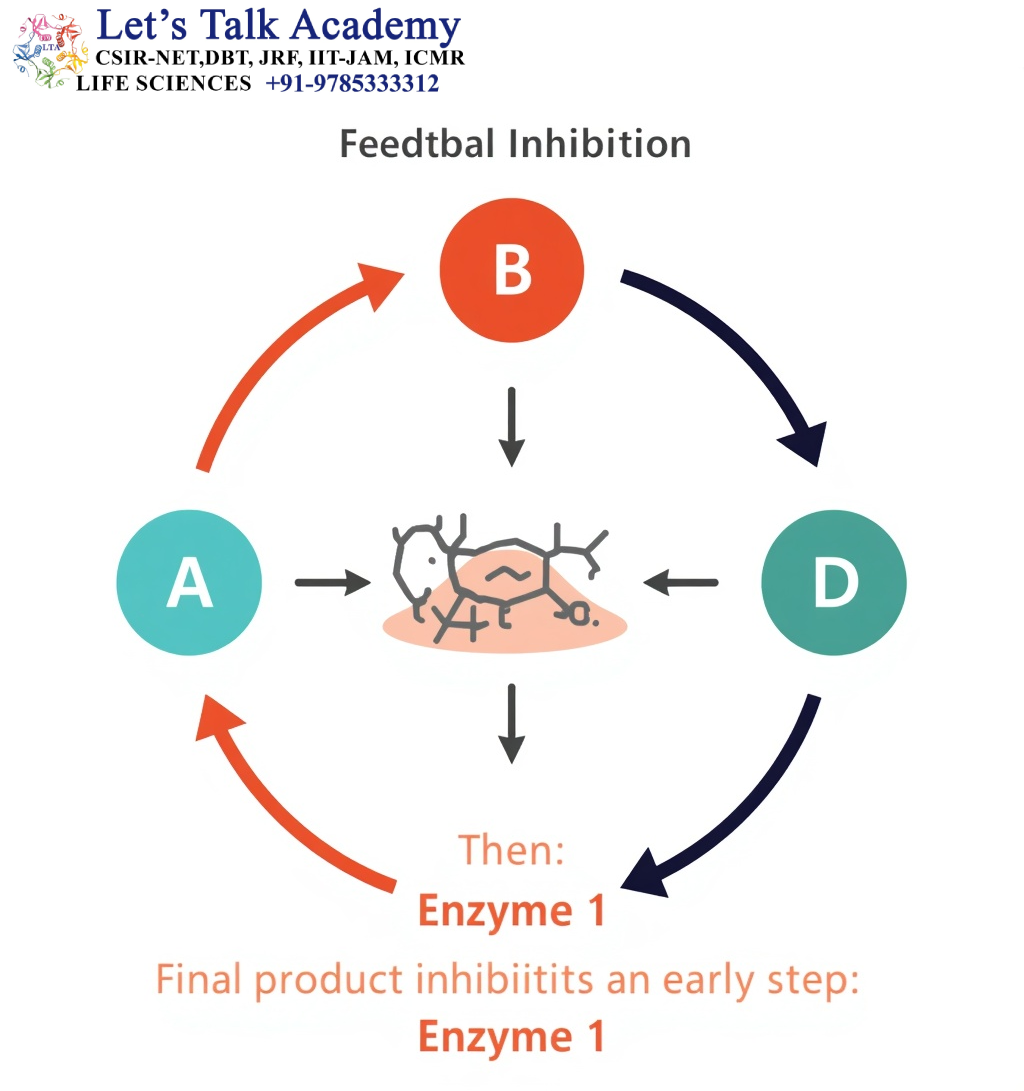
In feedback inhibition, the final product of a metabolic pathway inhibits an enzyme that acts earlier in the pathway.
For example:
A → B → C → D
If D inhibits the enzyme responsible for:
A → B
then accumulation of D decreases further production of D.
This prevents unnecessary consumption of cellular resources.
Feedback inhibition is therefore an important mechanism of metabolic homeostasis.
52. Product Inhibition
A reaction product may inhibit the enzyme that produces it.
This can occur when the product binds to the enzyme or alters its activity.
Product inhibition helps prevent excessive accumulation of metabolic products and can contribute to pathway regulation.
53. Reaction Kinetics and Thermodynamics
Kinetics and thermodynamics must be clearly distinguished.
Thermodynamics
Thermodynamics determines whether a reaction is energetically favorable.
The Gibbs free-energy change is:
ΔG = ΔH − TΔS
For a spontaneous process under the specified conditions:
ΔG < 0
Kinetics
Kinetics determines how rapidly the reaction occurs.
Therefore:
ΔG → thermodynamic driving force
Eₐ → kinetic barrier
A reaction may have a negative ΔG but still proceed slowly if its activation-energy barrier is high.
54. Activation Energy Versus ΔG
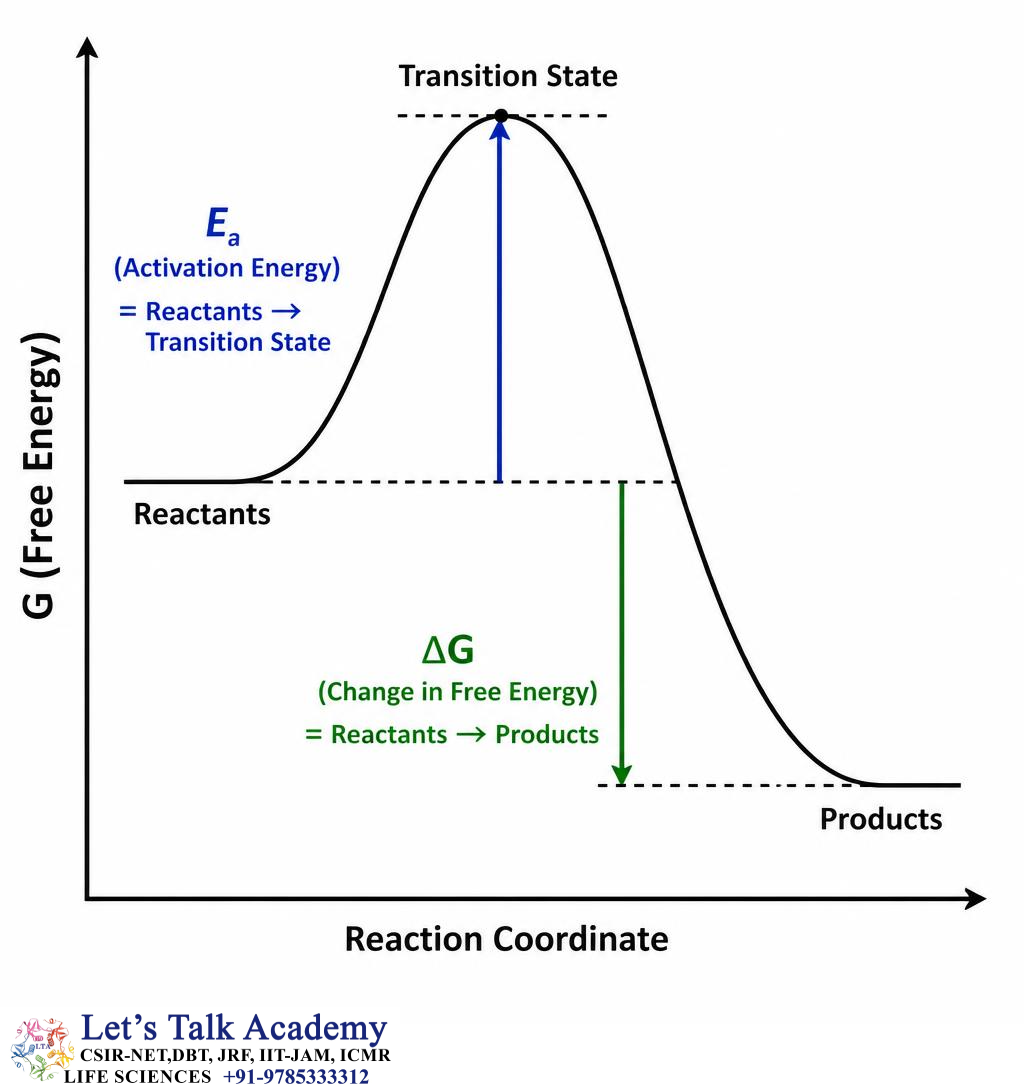
These two concepts are frequently confused.
Activation energy (Eₐ) represents the energy barrier between reactants and the transition state.
ΔG represents the free-energy difference between reactants and products.
Therefore:
Eₐ determines reaction rate
whereas:
ΔG determines thermodynamic favorability
An enzyme lowers the activation-energy barrier but does not change the overall ΔG of the reaction.
55. Enzyme Catalysis and Transition-State Stabilization
Enzymes accelerate reactions by providing a favorable microenvironment that can stabilize the transition state.
The conceptual energy pathway is:
Uncatalyzed reaction:
Reactants → High transition-state barrier → Products
Enzyme-catalyzed reaction:
Reactants → Lower transition-state barrier → Products
Therefore:
Enzyme binding → transition-state stabilization → lower Eₐ → faster reaction
This is one of the central principles of biological catalysis.
56. Initial Velocity in Enzyme Kinetics
The initial velocity, represented as v₀, is the rate measured near the beginning of an enzyme reaction.
Initial velocity measurements are useful because:
- Product concentration is initially low.
- Reverse reaction is minimized.
- Product inhibition is minimized.
- Substrate concentration has changed very little.
- The enzyme remains under relatively controlled conditions.
Therefore, Michaelis–Menten analysis generally uses initial reaction velocities.
57. Integrated View of Reaction Kinetics
Reaction kinetics can be understood as a continuous chain of molecular events:
Reactants
↓
Molecular collisions
↓
Proper orientation
↓
Transition state formation
↓
Activation-energy barrier
↓
Product formation
The presence of an enzyme changes this pathway:
Enzyme + Substrate
↓
Enzyme–Substrate Complex
↓
Transition-State Stabilization
↓
Lower Activation Energy
↓
Faster Product Formation
This molecular mechanism explains why enzymes are such powerful biological catalysts.
58. Reaction Kinetics in Cellular Regulation
Cells must carefully regulate reaction rates.
If an enzyme works too slowly, a required metabolite may become deficient.
If it works too rapidly, a metabolite may accumulate or cellular resources may be depleted.
Cells therefore regulate enzymes through:
- Allosteric regulation
- Covalent modification
- Feedback inhibition
- Substrate availability
- Product inhibition
- Protein degradation
- Gene expression
- Compartmentalization
Thus, reaction kinetics is directly connected with cellular homeostasis.
59. Reaction Kinetics and Drug Development
Reaction kinetics is also important in pharmaceutical and biomedical research.
A drug may interact with an enzyme or receptor and alter its activity.
Kinetic studies can determine:
- How strongly a molecule interacts with its target
- Whether inhibition is competitive or noncompetitive
- Whether inhibition is reversible
- How rapidly inhibition occurs
- How rapidly the inhibitor dissociates
- Whether catalytic activity can be restored
Therefore, biochemical kinetics forms an important foundation for understanding drug action.


