
PRINCIPLES OF BIOPHYSICAL CHEMISTRY: BUFFERS
1. Introduction to Biophysical Chemistry
Biophysical chemistry is an interdisciplinary area that applies the principles of physical chemistry, physics, and mathematics to biological systems. It helps explain how biological molecules behave in aqueous environments and how physical and chemical factors influence their structure, stability, interactions, and functions.
Living organisms operate under highly controlled chemical conditions. Parameters such as pH, temperature, ionic strength, osmotic pressure, molecular concentration, and redox state must remain within suitable ranges for cellular processes to function efficiently.
Among these parameters, pH is particularly important because most biological molecules contain ionizable chemical groups whose charge depends on the surrounding hydrogen-ion concentration.
Proteins, nucleic acids, carbohydrates, lipids, metabolites, and many cofactors interact with water and dissolved ions. Therefore, understanding acid–base chemistry and buffering is essential for understanding biological systems.
The principles of biophysical chemistry are particularly important because they are connected with biomolecular structure, enzyme activity, protein stability, nucleic-acid chemistry, metabolism, membrane processes, and experimental biochemistry.
1.1 Importance of Biophysical Chemistry in Biology
Biophysical chemistry provides a quantitative framework for understanding biological phenomena.
1.2 Why pH Control Is Essential in Biological Systems
Cells cannot function efficiently if their internal pH changes dramatically.
The activity of an enzyme depends partly on the ionization state of amino acid residues present in or near its active site. If the pH changes, these residues may gain or lose protons.
This can alter:
Protein charge → electrostatic interactions → protein conformation → substrate binding → catalytic activity
Therefore, maintaining a relatively stable pH is an essential component of cellular homeostasis.
Buffers provide one of the major chemical mechanisms for resisting rapid changes in pH.
2. Basic Concept of Acids and Bases
Before studying buffers, the concepts of acids and bases must be understood clearly.
Several theories have been developed to describe acids and bases. The most relevant theories for biochemical systems are the Arrhenius, Brønsted–Lowry, and Lewis concepts.
2.1 Arrhenius Concept
According to the Arrhenius concept, an acid produces hydrogen ions in aqueous solution, whereas a base produces hydroxide ions.
For example:
HCl → H⁺ + Cl⁻
Hydrochloric acid increases the concentration of hydrogen ions in water.
Similarly:
NaOH → Na⁺ + OH⁻
Sodium hydroxide increases the hydroxide-ion concentration.
Although useful, the Arrhenius concept is limited because it mainly applies to aqueous systems.
2.2 Brønsted–Lowry Concept
The Brønsted–Lowry concept is particularly useful for biological chemistry.
According to this concept:
An acid is a proton donor.
A base is a proton acceptor.
For example:
HA ⇌ H⁺ + A⁻
Here:
- HA acts as the acid because it donates H⁺.
- A⁻ is the conjugate base because it can accept H⁺.
This acid–base pair is called a conjugate acid–base pair.
2.3 Conjugate Acid–Base Pairs
When an acid loses a proton, it forms its conjugate base.
For example:
CH₃COOH ⇌ H⁺ + CH₃COO⁻
Therefore:
CH₃COOH = acid
CH₃COO⁻ = conjugate base
Similarly:
NH₄⁺ ⇌ H⁺ + NH₃
Here:
NH₄⁺ = conjugate acid
NH₃ = conjugate base
Understanding conjugate pairs is essential for understanding how buffers function.
3. Weak Acids and Weak Bases
Buffers generally depend on the equilibrium behavior of weak acids and weak bases.
3.1 Strong Acids
Strong acids undergo extensive dissociation in aqueous solution.
Examples include:
- HCl
- HNO₃
- HClO₄
For example:
HCl → H⁺ + Cl⁻
Because dissociation is nearly complete, strong acids are generally not used alone as buffer components.
3.2 Weak Acids
Weak acids undergo only partial ionization in solution.
A general weak acid can be represented as:
HA ⇌ H⁺ + A⁻
Examples include:
- Acetic acid
- Carbonic acid
- Phosphoric acid
- Many ionizable groups present in biomolecules
The equilibrium between HA, H⁺, and A⁻ is central to buffer chemistry.
3.3 Acid Dissociation Constant
The strength of a weak acid can be described using its acid dissociation constant, Ka.
For:
HA ⇌ H⁺ + A⁻
the equilibrium expression is:
Ka = [H⁺][A⁻] / [HA]
A larger Ka generally indicates greater acid dissociation and therefore a stronger acid.
A smaller Ka indicates weaker dissociation.
3.4 pKa
Because Ka values can vary over many orders of magnitude, the logarithmic quantity pKa is commonly used.
The relationship is:
pKa = −log Ka
Therefore:
Lower pKa → stronger acid
Higher pKa → weaker acid
The pKa is extremely important in biological chemistry because it helps predict the protonation state of ionizable groups at a particular pH.
4. Ionization of Water
Water itself undergoes a small degree of ionization.
The reaction can be represented as:
2H₂O ⇌ H₃O⁺ + OH⁻
For simplicity, hydrogen ions are often represented as H⁺.
Therefore: H₂O ⇌ H⁺ + OH⁻
The equilibrium constant associated with water ionization is expressed as:
Kw = [H⁺][OH⁻]
At 25°C: Kw ≈ 1 × 10⁻¹⁴
In pure water: [H⁺] = [OH⁻] = 1 × 10⁻⁷ M
Therefore: pH = 7 at 25°C.
4.1 pH
The pH of a solution is defined as: pH = −log[H⁺]
Thus, pH provides a logarithmic representation of hydrogen-ion concentration.
For example:
If: [H⁺] = 10⁻⁷ M then: pH = 7
If: [H⁺] = 10⁻³ M then: pH = 3
Therefore, a lower pH indicates a higher hydrogen-ion concentration.
4.2 pOH
Similarly: pOH = −log[OH⁻]
At 25°C: pH + pOH = 14
This relationship is frequently used in quantitative acid–base problems.
5. What Is a Buffer?
A buffer is a solution that resists significant changes in pH when relatively small amounts of acid or base are added.
A typical buffer consists of either:
Weak acid + conjugate base
or:
Weak base + conjugate acid
For example: CH₃COOH / CH₃COO⁻ is an acid–conjugate base buffer system.
The important feature is that both members of the conjugate pair are present in appreciable concentrations.
5.1 Why Does a Buffer Resist pH Change?
Consider the acetate buffer: CH₃COOH ⇌ H⁺ + CH₃COO⁻
Suppose a small amount of strong acid is added.
The additional H⁺ is consumed by acetate ions: CH₃COO⁻ + H⁺ → CH₃COOH
Therefore, most of the added hydrogen ions do not remain freely available in solution.
As a result, the pH does not decrease dramatically.
5.2 Buffer Action Against Added Base
Now consider the addition of a strong base such as NaOH.
The OH⁻ ions react with the weak acid: CH₃COOH + OH⁻ → CH₃COO⁻ + H₂O
The weak acid therefore removes much of the added hydroxide.
Consequently, the pH does not increase dramatically.
This is the fundamental mechanism through which a buffer resists both acid and base.
6. Components of a Buffer
A buffer requires two chemically related components.
6.1 Weak Acid–Conjugate Base Buffer
This system contains:
Weak acid + conjugate base
Example: CH₃COOH + CH₃COO⁻
The weak acid can donate H⁺, while the conjugate base can accept H⁺.
This allows the system to respond to both added acid and added base.
6.2 Weak Base–Conjugate Acid Buffer
A weak base can also form a buffer with its conjugate acid.
Example: NH₃ / NH₄⁺
The equilibrium is: NH₄⁺ ⇌ H⁺ + NH₃
When acid is added, NH₃ can accept H⁺.
When base is added, NH₄⁺ can donate H⁺.
Thus, the pair can resist changes in pH.
7. Henderson–Hasselbalch Equation
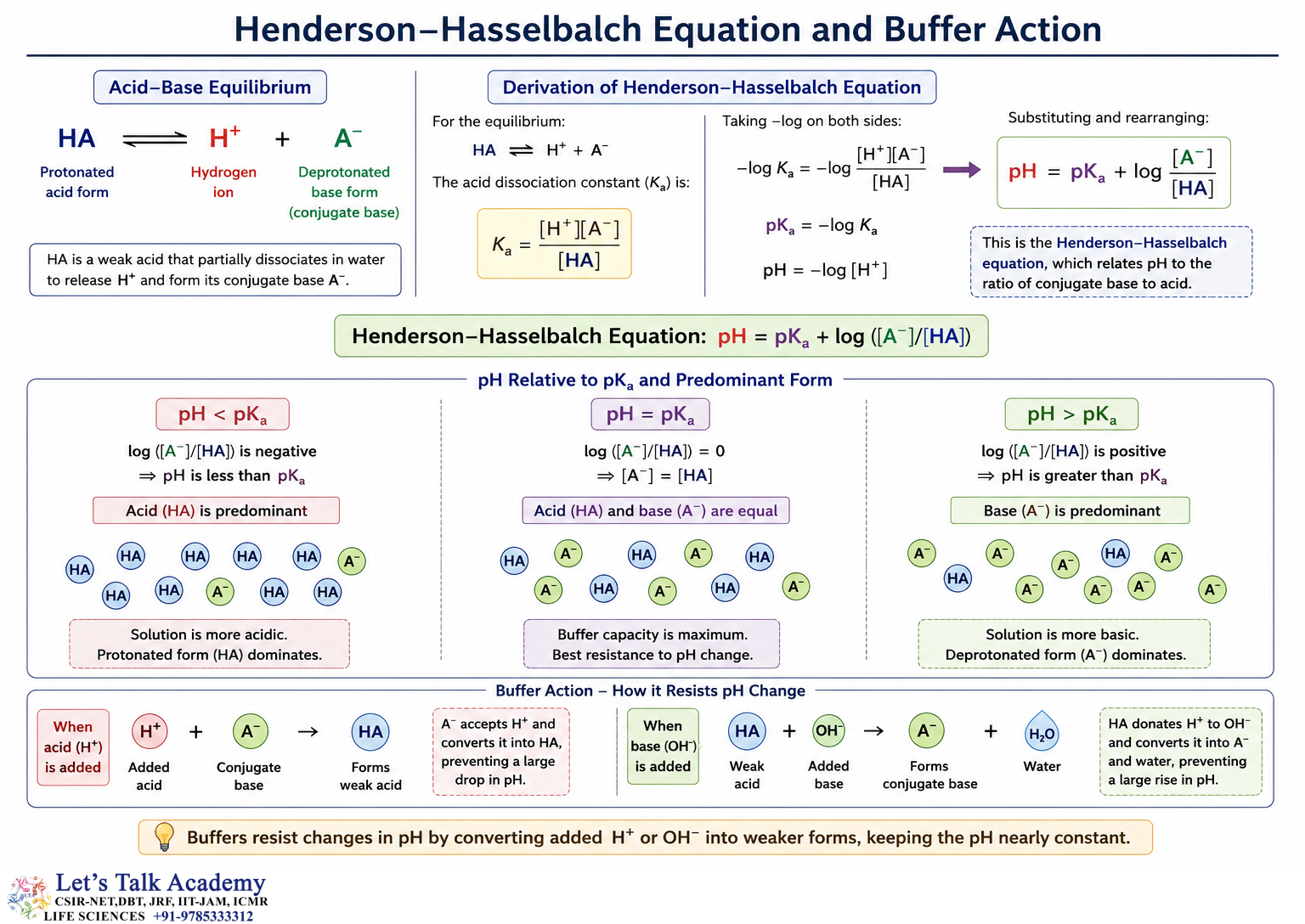
The Henderson–Hasselbalch equation is one of the most important equations in buffer chemistry.
For a weak acid: HA ⇌ H⁺ + A⁻
the equation is: pH = pKa + log([A⁻]/[HA])
Where:
pH = hydrogen-ion concentration expressed logarithmically
pKa = negative logarithm of acid dissociation constant
[A⁻] = concentration of conjugate base
[HA] = concentration of weak acid
This equation allows the pH of many buffer systems to be estimated from the pKa and relative concentrations of the buffer components.
7.1 Derivation of the Henderson–Hasselbalch Equation
For: HA ⇌ H⁺ + A⁻
the dissociation constant is: Ka = [H⁺][A⁻] / [HA]
Rearranging: [H⁺] = Ka[HA]/[A⁻]
Taking negative logarithms: −log[H⁺] = −logKa − log([HA]/[A⁻])
Since: pH = −log[H⁺] and: pKa = −logKa
we obtain: pH = pKa − log([HA]/[A⁻])
Using the logarithmic identity: −log([HA]/[A⁻]) = log([A⁻]/[HA])
Therefore:
pH = pKa + log([A⁻]/[HA])
This is the Henderson–Hasselbalch equation.
8. Relationship Between pH and pKa
The relationship between pH and pKa provides important information about the relative amounts of protonated and deprotonated forms.
8.1 When pH = pKa
If: pH = pKa
then: log([A⁻]/[HA]) = 0
Therefore: [A⁻]/[HA] = 1
Thus: [A⁻] = [HA]
This means that the weak acid and its conjugate base are present in equal concentrations.
8.2 When pH > pKa
If: pH > pKa
the solution favors the deprotonated form.
Therefore, the concentration of: A⁻ > HA
The higher the pH relative to pKa, the greater the proportion of the deprotonated form.
8.3 When pH < pKa
If: pH < pKa
the protonated form is favored.
Therefore: HA > A⁻
This relationship is useful when predicting the charge state of ionizable groups in biomolecules.
9. Buffering Range
A buffer is not equally effective at every pH.
The most effective buffering occurs near the pKa of the weak acid.
A practical buffering range is approximately: pKa ± 1 pH unit
For example, if: pKa = 6.5
the effective buffering range is approximately: pH 5.5–7.5
Maximum buffering effectiveness occurs near: pH = 6.5
9.1 Why Is the pKa Important?
When the pH is close to the pKa, both the protonated and deprotonated forms are present in substantial amounts.
This is important because:
- The protonated form can neutralize added base.
- The deprotonated form can neutralize added acid.
Therefore, the system can respond efficiently in either direction.
If almost all molecules are present in only one form, the ability to neutralize an additional acid or base becomes limited.
10. Buffer Capacity
Buffer capacity is the quantitative measure of the ability of a buffer to resist changes in pH.
A buffer with high capacity can absorb more added acid or base before its pH changes substantially.
Buffer capacity depends on several factors.
10.1 Effect of Total Buffer Concentration
Increasing the total concentration of the buffer generally increases its buffering capacity.
For example, a 0.1 M buffer generally has greater capacity than a 0.01 M buffer at a similar pH and composition.
The more buffer molecules available, the greater the amount of acid or base that can be neutralized.
10.2 Effect of pH Relative to pKa
Buffer capacity is greatest when: pH ≈ pKa
At this point: [HA] ≈ [A⁻]
Both forms are available in substantial amounts.
10.3 Buffer Capacity and Dilution
Suppose a buffer is diluted tenfold.
If both components are diluted equally: [A⁻]/[HA]
remains approximately unchanged.
Therefore, according to the Henderson–Hasselbalch equation, the pH may remain approximately the same.
However, the total concentration decreases.
Therefore:
Dilution → little change in pH but lower buffer capacity
11. Buffer Action Against Acid and Base
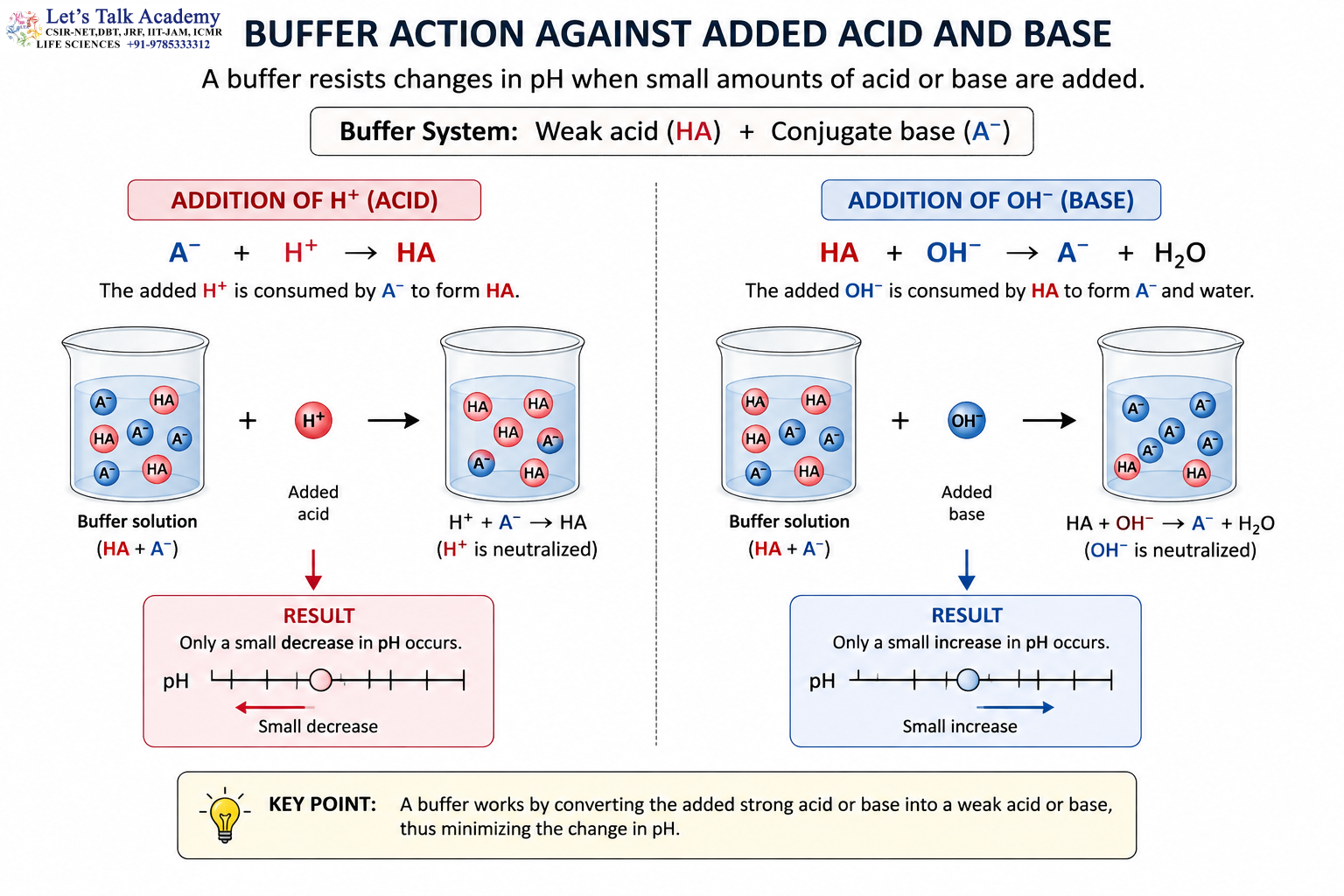
Understanding buffer action mechanistically is more useful than simply memorizing the definition.
11.1 Addition of Strong Acid
Consider: HA ⇌ H⁺ + A⁻
When H⁺ is added: A⁻ + H⁺ → HA
The conjugate base consumes the added H⁺.
Therefore, the free H⁺ concentration increases only moderately.
Consequently, the pH decreases only slightly.
11.2 Addition of Strong Base
When OH⁻ is added: HA + OH⁻ → A⁻ + H₂O
The weak acid consumes the added hydroxide.
Therefore, the free OH⁻ concentration does not increase as much as it would in an unbuffered solution.
Consequently, the pH increases only slightly.
12. Titration Curves and Buffer Systems
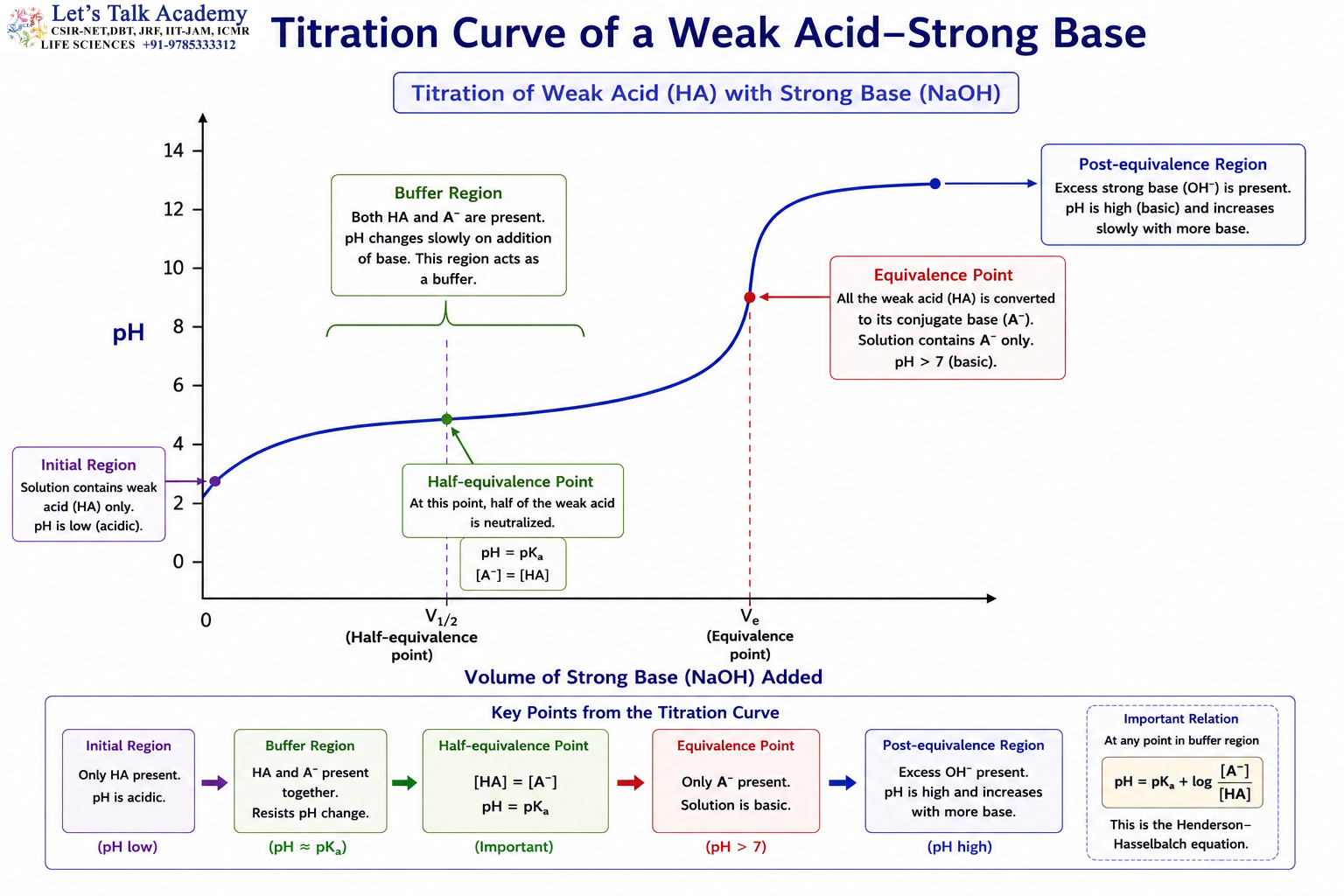
A titration curve represents the change in pH as a strong acid or base is progressively added to a solution.
Titration curves are especially useful for studying weak acids and weak bases.
12.1 Weak Acid–Strong Base Titration
During titration of a weak acid with a strong base, the solution passes through several characteristic regions.
These include:
- Initial weak-acid region
- Buffer region
- Half-equivalence point
- Equivalence point
- Post-equivalence region
The buffer region occurs because both the weak acid and conjugate base are present.
12.2 Half-Equivalence Point
At the half-equivalence point: [HA] = [A⁻]
Therefore: pH = pKa
This provides an experimental method for determining the pKa of a weak acid.
Half-equivalence point → pH = pKa
12.3 Equivalence Point
At the equivalence point, the amount of strong base added is stoichiometrically sufficient to neutralize the original weak acid.
For a weak acid–strong base titration, the conjugate base dominates the solution at the equivalence point.
Therefore, the equivalence-point pH is generally greater than 7 at 25°C.
This differs from the equivalence point of a strong acid–strong base titration, which is approximately pH 7 under ideal conditions.
13. Biological Buffer Systems
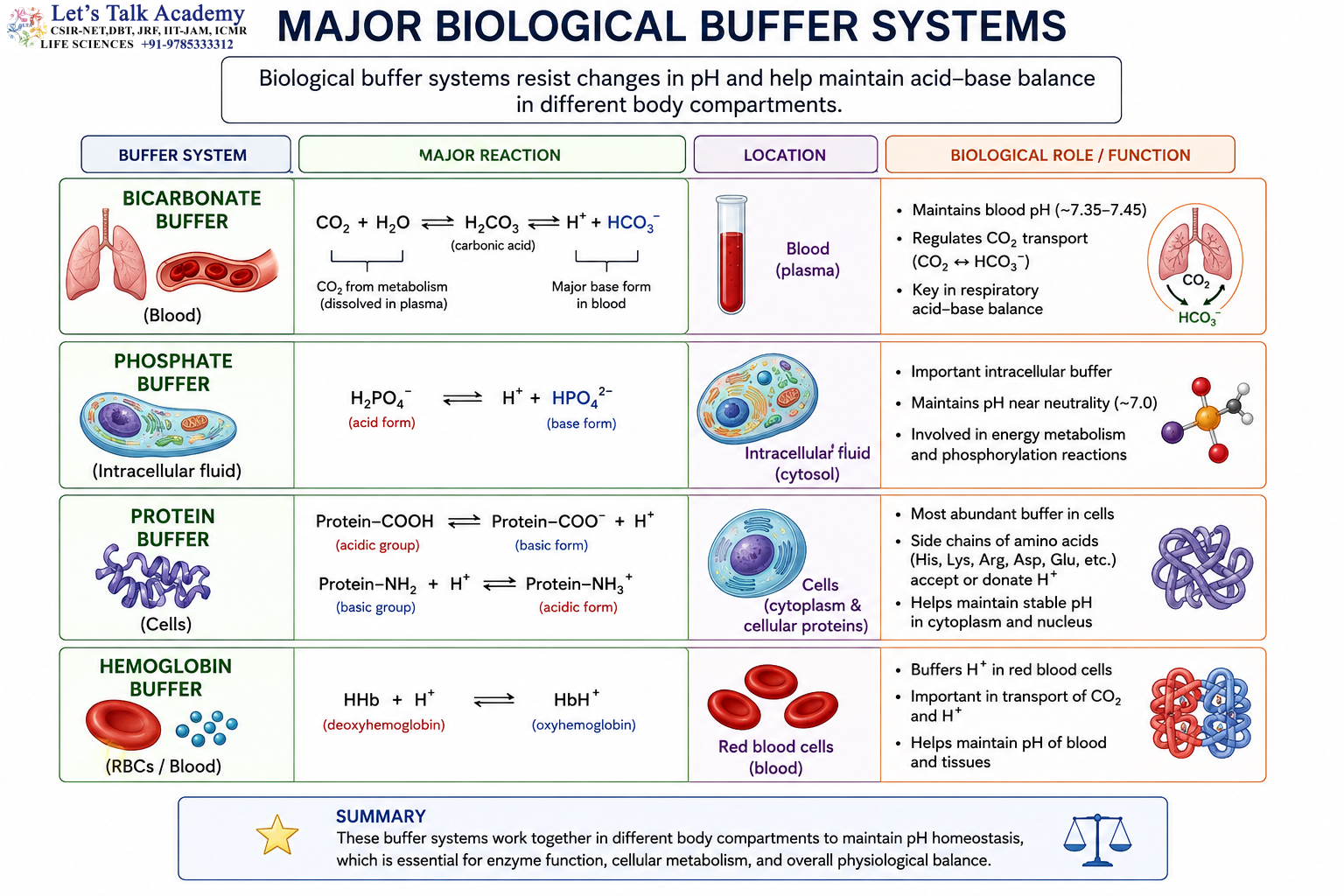
Buffering is essential for maintaining physiological conditions.
Major biological buffer systems include:
- Bicarbonate buffer
- Phosphate buffer
- Protein buffers
- Hemoglobin buffer
These systems operate in different biological compartments and contribute to acid–base homeostasis.
14. Bicarbonate Buffer System
The bicarbonate buffer system is one of the most important extracellular buffer systems in animals.
The central equilibrium is:
CO₂ + H₂O ⇌ H₂CO₃ ⇌ H⁺ + HCO₃⁻
The system connects:
Carbon dioxide ↔ Carbonic acid ↔ Hydrogen ions ↔ Bicarbonate
This makes the bicarbonate system particularly important for maintaining blood pH.
14.1 Role of Carbonic Anhydrase
The conversion between CO₂ and H₂CO₃ is relatively slow without enzymatic catalysis.
The enzyme carbonic anhydrase greatly accelerates this reaction.
This is especially important in red blood cells, where rapid conversion of CO₂ and bicarbonate is necessary for efficient carbon dioxide transport.
14.2 Bicarbonate and Respiratory Regulation
The bicarbonate buffer system is closely connected with respiration.
The lungs regulate the amount of CO₂ in the blood.
Increasing ventilation can remove CO₂ more rapidly.
Decreasing ventilation can cause CO₂ to accumulate.
Because CO₂ participates in the carbonic acid equilibrium, changes in respiratory activity can influence blood pH.
Therefore:
Respiration → CO₂ regulation → carbonic acid equilibrium → H⁺ concentration → blood pH
14.3 Renal Contribution
The kidneys also contribute to acid–base homeostasis.
They regulate:
- Bicarbonate reabsorption
- Hydrogen-ion secretion
- Acid excretion
- Generation and conservation of bicarbonate
Thus, the bicarbonate system is supported by coordinated action of the lungs and kidneys.
15. Phosphate Buffer System
The phosphate buffer system is especially important intracellularly and in renal tubular fluid.
A major equilibrium is: H₂PO₄⁻ ⇌ H⁺ + HPO₄²⁻
Here:
H₂PO₄⁻ = protonated form
HPO₄²⁻ = deprotonated form
The pair can accept or donate protons depending on the surrounding pH.
15.1 Importance of Phosphate Buffer
Phosphate buffering is important because phosphate compounds are abundant inside cells and have acid–base properties suitable for buffering around biologically relevant pH values.
The phosphate system contributes to:
- Intracellular pH regulation
- Renal acid–base regulation
- Biochemical reactions
- Laboratory buffer systems
16. Protein Buffers
Proteins can act as buffers because they contain numerous ionizable groups.
Amino acids contain functional groups that can gain or lose protons.
The buffering behavior of proteins depends on the pKa values of their ionizable groups and the local chemical environment.
16.1 Ionizable Amino Acid Side Chains
Important ionizable amino acid residues include:
- Aspartate
- Glutamate
- Histidine
- Lysine
- Arginine
- Cysteine
- Tyrosine
The amino and carboxyl groups of proteins can also participate in proton exchange.
16.2 Histidine as a Buffer
Histidine is particularly important in biological buffering.
Its side chain contains an imidazole group that can accept or donate protons.
Because its pKa can be close to physiologically relevant pH values in many protein environments, histidine residues can participate effectively in proton transfer.
This property is particularly important in:
- Enzyme active sites
- Protein structure
- Proton-transfer reactions
- Catalytic mechanisms
17. Hemoglobin as a Biological Buffer
Hemoglobin is an important buffer inside red blood cells.
The protonation state of hemoglobin changes during oxygen transport and carbon dioxide transport.
Deoxygenated hemoglobin has a greater tendency to bind H⁺ than oxygenated hemoglobin.
This contributes to the ability of blood to transport CO₂ and maintain acid–base balance.
Therefore, hemoglobin is not simply an oxygen-carrying protein; it also participates in acid–base homeostasis.
18. Buffers and Enzyme Activity
Enzyme activity is strongly influenced by pH.
An enzyme generally shows a characteristic relationship between activity and pH, often with an optimum pH.
18.1 Why Does pH Affect Enzyme Activity?
Many amino acid residues involved in catalysis can be protonated or deprotonated.
Changing pH changes their protonation states.
This can affect:
- Active-site charge
- Substrate binding
- Catalytic activity
- Protein conformation
- Electrostatic interactions
Therefore, enzyme activity can change significantly when the pH moves away from the optimum range.
18.2 Optimum pH
The optimum pH is the pH at which an enzyme exhibits maximum activity under specified experimental conditions.
It is important to understand that:
Optimum pH ≠ necessarily the pH of maximum protein stability
An enzyme may remain structurally stable over a wider pH range than the range in which it exhibits maximum catalytic activity.
19. Buffers and Protein Structure
Protein structure depends on multiple interactions.
These include:
- Hydrogen bonds
- Ionic interactions
- Hydrophobic interactions
- van der Waals interactions
- Disulfide bonds
Changes in pH can alter the charge state of ionizable residues.
For example, changing the protonation state of acidic or basic amino acid residues can disrupt ionic interactions.
This may lead to changes in protein conformation and, under extreme conditions, denaturation.
Therefore, appropriate buffer selection is essential in protein purification and biochemical experiments.
20. Buffers and Nucleic Acids
DNA and RNA also contain ionizable chemical groups and interact strongly with their aqueous environment.
pH can influence the protonation state of nucleobases.
Changes in protonation can influence:
- Hydrogen bonding
- Base pairing
- Nucleic-acid structure
- Stability
- Folding
- Protein–nucleic acid interactions
Therefore, maintaining an appropriate pH is important during DNA and RNA isolation, purification, electrophoresis, hybridization, and other molecular biology procedures.
21. Buffers Used in Biochemical Laboratories
Different buffers are selected according to the desired pH range and experimental requirements.
21.1 Phosphate Buffer
Phosphate buffers are widely used in biochemical experiments.
They are useful because phosphate species can participate in proton exchange over biologically relevant pH ranges.
However, phosphate can interact with certain metal ions and may not be appropriate for every biochemical application.
21.2 Tris Buffer
Tris is widely used in molecular biology and protein chemistry.
It is commonly encountered in:
- Electrophoresis
- Protein purification
- Molecular biology protocols
- Biochemical assays
An important experimental consideration is that the pH of Tris-containing solutions is relatively temperature-dependent.
21.3 HEPES Buffer
HEPES is widely used in biological and biochemical applications.
It is particularly useful when a relatively stable buffering environment is required near physiological pH.
It is commonly encountered in cell-related and biochemical experiments.
21.4 MOPS and MES
MOPS and MES are examples of biological buffers selected for particular pH ranges.
The selection of a buffer should be based on its pKa, desired working pH, stability, and compatibility with the experimental system.
22. Buffer Selection in Biological Experiments
Selecting a buffer is not simply a matter of choosing a solution with the correct pH.
Several factors must be considered.
22.1 pKa of the Buffer
The pKa should ideally be close to the desired experimental pH.
A buffer whose pKa is far from the required pH will generally have poor buffering effectiveness.
22.2 Buffer Concentration
The concentration should be high enough to provide adequate buffering capacity.
However, excessively high concentrations may interfere with some biochemical processes.
Therefore, an appropriate balance is required.
22.3 Temperature
Temperature can influence pKa and therefore buffer pH.
This is particularly important when experiments are conducted at temperatures different from the temperature at which the buffer was prepared or calibrated.
22.4 Chemical Compatibility
The buffer should not adversely interact with:
- Proteins
- Enzymes
- Metal ions
- Substrates
- Cofactors
- Membranes
- Nucleic acids
Therefore, buffer selection is an important part of experimental design.
23. Effect of Temperature on Buffer Systems
Temperature can change equilibrium constants.
Because: pKa = −log Ka
a change in Ka can produce a change in pKa.
Therefore, buffer pH can change with temperature.
This is one reason why biochemical experiments should be performed under controlled temperature conditions.
For accurate work, the pH should be measured under the actual experimental conditions whenever necessary.
24. Effect of Ionic Strength
Ionic strength represents the total influence of dissolved ions in a solution.
Changes in ionic strength can influence electrostatic interactions and the effective behavior of charged chemical species.
Since biomolecules contain many charged groups, ionic strength can influence:
- Protein solubility
- Protein–protein interactions
- Protein–nucleic acid interactions
- Enzyme activity
- Nucleic-acid behavior
Therefore, pH alone does not completely define the chemical environment of a biological system.
25. Buffers and Biomolecular Charge
The charge of a biomolecule depends strongly on pH.
For proteins, ionizable groups can exist in different protonation states.
For example: COOH ⇌ COO⁻ + H⁺
At lower pH, the protonated form becomes more abundant.
At higher pH, the deprotonated form becomes more abundant.
Similarly: NH₃⁺ ⇌ NH₂ + H⁺
As pH increases, deprotonation becomes more favorable.
Thus:
pH → protonation state → molecular charge → molecular interactions
This relationship is fundamental to understanding protein chemistry.
26. Buffers and Isoelectric Point
The isoelectric point (pI) is the pH at which a molecule has a net electrical charge of approximately zero.
For proteins, pH relative to pI influences their net charge.
When: pH < pI the protein tends to have a greater positive character.
When: pH > pI the protein tends to have a greater negative character.
At: pH ≈ pI the net charge is approximately zero.
This concept is particularly important in protein purification, electrophoresis, solubility, and separation techniques.
27. Henderson–Hasselbalch Numerical Concepts
The Henderson–Hasselbalch equation can be used rapidly.
Consider: pH = pKa + log([A⁻]/[HA])
27.1 Equal Concentrations
If: [A⁻] = [HA]
then: [A⁻]/[HA] = 1 and: log 1 = 0
Therefore: pH = pKa
27.2 Tenfold Excess of Conjugate Base
If: [A⁻]/[HA] = 10
then: log 10 = 1
Therefore: pH = pKa + 1
27.3 Tenfold Excess of Weak Acid
If: [A⁻]/[HA] = 0.1
then: log 0.1 = −1
Therefore: pH = pKa − 1
27.4 Hundredfold Excess of Conjugate Base
If: [A⁻]/[HA] = 100
then: log 100 = 2
Therefore: pH = pKa + 2
This illustrates how the ratio of the conjugate pair determines the pH relative to the pKa.
28. Important Relationship Between pH, pKa and Protonation
For many biological molecules, the pKa can be used to predict the predominant protonation state.
The general principle is:
pH < pKa → protonated form predominates
pH > pKa → deprotonated form predominates
pH = pKa → approximately equal protonated and deprotonated forms
This principle is extremely useful for predicting the charge of amino acids and proteins.
29. Buffer Capacity Versus Buffer Range
These two concepts must be clearly distinguished.
Buffer Range
The buffer range describes the range of pH over which a buffer effectively resists changes in pH.
It is approximately: pKa ± 1
Buffer Capacity
The buffer capacity describes how much acid or base the buffer can absorb before its pH changes significantly.
Therefore:
Buffer range = pH region of effective buffering
Buffer capacity = amount of acid/base that can be neutralized
A common CSIR NET conceptual question may ask students to distinguish these two properties.
30. Important Factors Affecting Buffer Capacity
Buffer capacity depends mainly on:
30.1 Total Concentration
Higher total buffer concentration generally produces greater capacity.
30.2 pH Relative to pKa
Capacity is greatest when:
pH = pKa
30.3 Ratio of Buffer Components
Extremely unequal concentrations of acid and conjugate base reduce the ability of the system to respond effectively in one direction.
Therefore, a balanced mixture is generally most effective.
31. Buffering in Cellular Homeostasis
Cells continuously produce acidic and basic metabolic products.
For example, metabolism can influence the production of:
- CO₂
- Organic acids
- Protons
- Reduced and oxidized metabolites
If these products were allowed to cause unrestricted changes in intracellular pH, cellular processes would be severely affected.
Cells therefore use:
- Chemical buffers
- Membrane transport systems
- Proton pumps
- Ion exchangers
- Respiratory regulation
- Renal regulation in multicellular organisms
Together, these mechanisms maintain acid–base homeostasis.
32. Physiological Importance of Buffer Systems
Buffer systems are not isolated chemical reactions. They are integrated into physiological regulation.
For example:
Cellular metabolism
↓
CO₂ and acid production
↓
Changes in proton concentration
↓
Buffering reactions
↓
Respiratory and renal compensation
↓
Maintenance of physiological pH
This demonstrates why buffering is essential for life.
33. Buffers in Protein Purification
Buffers are extensively used during protein purification.
A suitable buffer can help maintain:
- Protein solubility
- Protein conformation
- Enzyme activity
- Appropriate charge state
- Stability during purification
During procedures such as chromatography, dialysis, centrifugation, and electrophoresis, the buffer composition can strongly influence protein behavior.
Therefore, buffer selection is a fundamental aspect of biochemical laboratory work.
34. Buffers in Electrophoresis
Electrophoresis requires a controlled ionic and pH environment.
The buffer helps:
- Maintain pH
- Provide ions for electrical conductivity
- Maintain biomolecular charge states
- Support reproducible migration
For example, electrophoretic systems commonly use carefully selected buffer combinations to ensure consistent separation of proteins or nucleic acids.
Therefore, understanding buffers also supports the interpretation of molecular biology techniques.
35. Buffers and Enzyme Kinetics
Buffer conditions can influence enzyme kinetics.
Changes in pH may alter:
- Km
- Vmax
- Catalytic residue ionization
- Substrate charge
- Enzyme conformation
Therefore, when enzyme activity is measured experimentally, the buffer and pH must be carefully controlled.
An apparent change in enzyme activity may otherwise reflect a change in pH rather than a genuine change in the intrinsic catalytic properties of the enzyme.


