
Principles of Biophysical Chemistry – pH
1. Introduction
Biophysical chemistry applies the principles of physical chemistry to biological systems. It helps us understand how biomolecules such as proteins, nucleic acids, carbohydrates, and lipids behave under different physical and chemical conditions.
Among the most important concepts in biophysical chemistry is pH. pH is essential for understanding enzyme activity, protein structure, membrane transport, cellular metabolism, acid–base balance, and many biochemical reactions.
1.2. What Is pH?

The term pH describes the acidity or basicity of an aqueous solution. In a simplified treatment, pH is defined as the negative logarithm of the hydrogen ion concentration.
More rigorously, pH is defined in terms of the activity of hydrogen ions rather than simply their concentration. However, for many dilute aqueous biological solutions, concentration is commonly used as an approximation.
Because the logarithm is used, pH is a logarithmic measure. This means that a difference of one pH unit represents a tenfold difference in hydrogen ion concentration.
pH |
[H+] in mol/L |
Nature of Solution |
|---|---|---|
| 2 | 10−2 | Strongly acidic |
| 4 | 10−4 | Acidic |
| 7 | 10−7 | Approximately neutral at 25°C |
| 9 | 10−9 | Basic |
| 12 | 10−12 | Strongly basic |
1.3. Why Is the pH Scale Logarithmic?
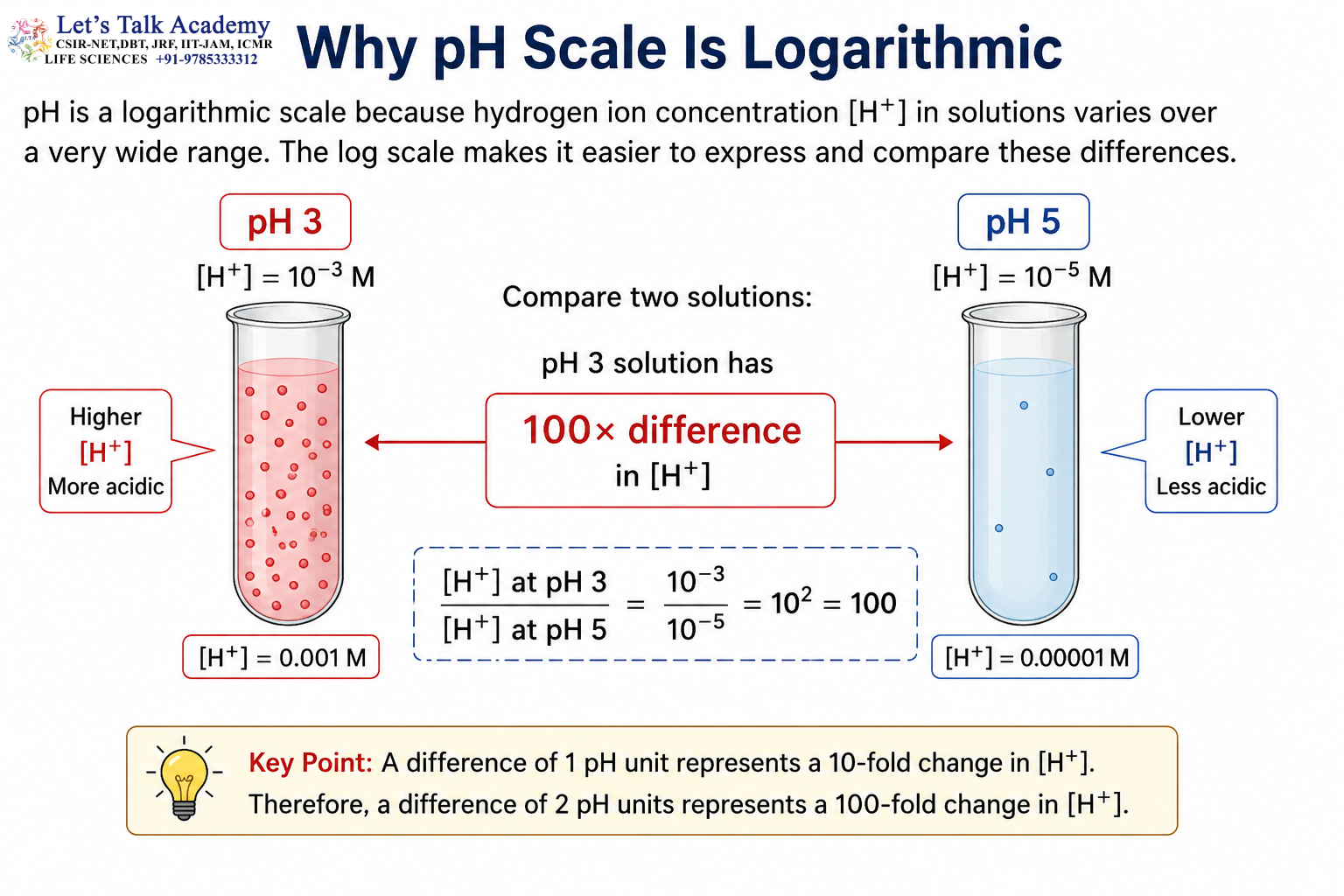
Hydrogen ion concentrations in biological systems can vary over many orders of magnitude. Expressing these concentrations directly can therefore become inconvenient. The logarithmic pH scale provides a convenient way of representing these large changes.
Consider two solutions with pH values of 3 and 5.
Therefore: 10−3 / 10−5 = 100
The solution at pH 3 therefore contains 100 times more hydrogen ions than the solution at pH 5.
1.4. Acids and Bases
The concepts of acids and bases form the chemical foundation of pH. Different theories have been developed to describe acid-base behavior.
The three important approaches are the Arrhenius concept, the Brønsted–Lowry concept, and the Lewis concept.
1.5. Pure Water Is Slightly Ionized
Water molecules have a slight tendency to undergo reversible ionization to yield a hydrogen ion (a proton) and a hydroxide ion, giving the equilibrium:
H2O ⇌ H+ + OH−
(2–1)
Although we commonly show the dissociation product of water as H+, free protons do not exist in solution; hydrogen ions form an immediate association with water to produce hydronium ions (H3O+). Hydrogen bonding between water molecules makes the hydration of dissociating protons virtually instantaneous:
H–O···H–O ⇌ H–O–H + H+ + OH−
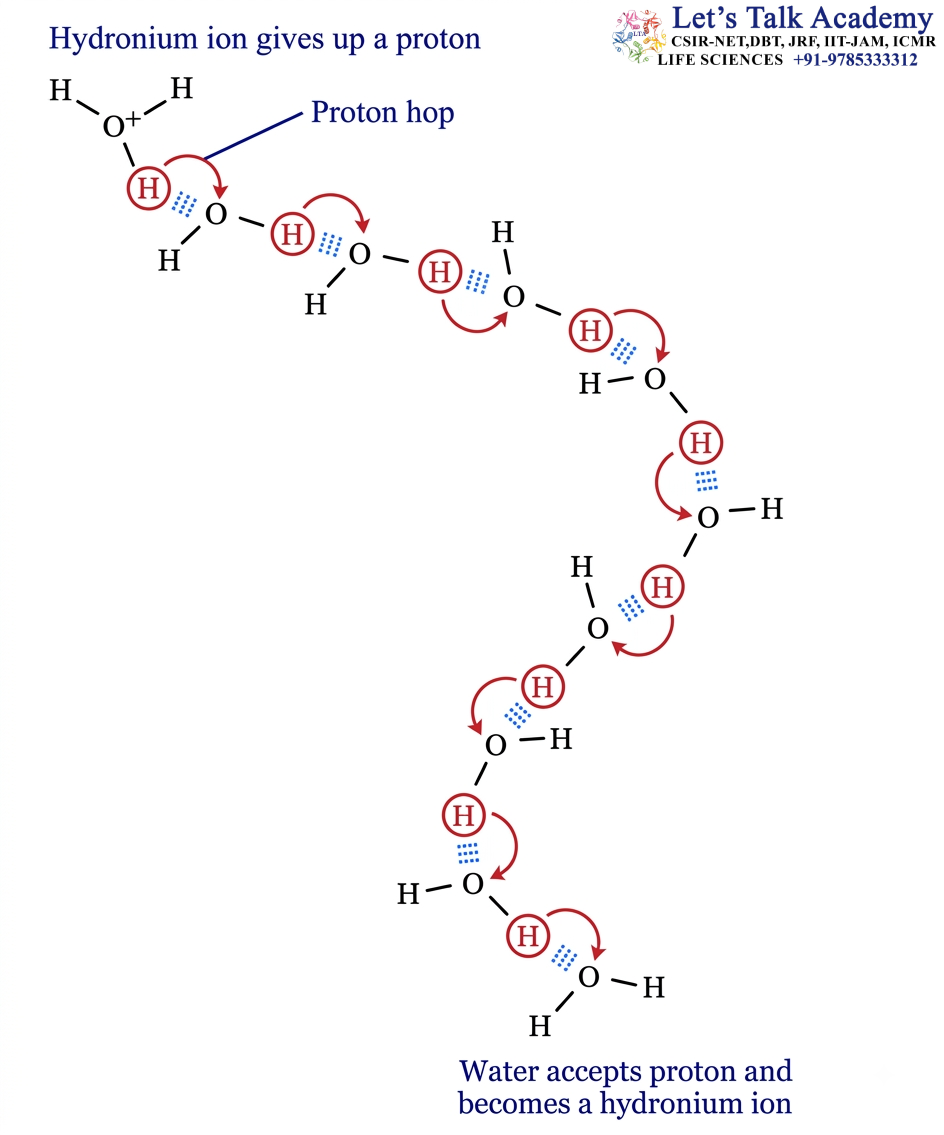
The ionization of water can be measured by its electrical conductivity; pure water carries electrical current as H+ migrates toward the cathode and OH− toward the anode. The movement of hydronium and hydroxide ions in the electric field is anomalously fast compared with that of other ions such as Na+, K+, and Cl−. This high ionic mobility results from the kind of “proton hopping” shown in Figure 2–14.
No individual proton moves very far through the bulk solution, but a series of proton hops between hydrogen-bonded water molecules causes the net movement of a proton over a long distance in a remarkably short time. As a result of the high ionic mobility of H+ and OH−, which also move rapidly by proton hopping, acid–base reactions in aqueous solutions are frequently exceptionally fast.
As noted above, proton hopping very likely also plays a role in biological proton-transfer reactions (Fig. 2–10; see also Fig. 19–XX).
Because reversible ionization is crucial to the role of water in cellular function, we must have a means of expressing the extent of ionization of water in quantitative terms. A brief review of some properties of reversible chemical reactions shows how this can be done.
The position of equilibrium of any chemical reaction is given by its equilibrium constant, Keq (sometimes expressed simply as K). For the generalized reaction
A + B ⇌ C + D
(2–2)
an equilibrium can be defined in terms of the concentrations of reactants (A and B) and products (C and D) at equilibrium:
Keq =[C][D]
[A][B]
Strictly speaking, the concentration terms should be the activities, or effective concentrations in nonideal solutions, of each species. Except in very accurate work, however, the equilibrium constant may be approximated by measuring the concentrations at equilibrium.
For reasons beyond the scope of this discussion, equilibrium constants are dimensionless. Nonetheless, we have generally retained the concentration units (M) in the equilibrium expressions used in this book to remind you that molarity is the unit of concentration used in calculating Keq.
The equilibrium constant is fixed and characteristic for any given chemical reaction at a specified temperature. It defines the composition of the final equilibrium mixture, regardless of the starting amounts of reactants and products. Conversely, we can calculate the equilibrium constant for a given reaction at a given temperature if the equilibrium concentrations of all its reactants and products are known. As we will show in Chapter 13, the standard free-energy change (ΔG°) is directly related to Keq.
2. Proton Hopping in Water
Water is not simply a passive solvent in biological systems. It actively participates in many biochemical reactions and provides a dynamic hydrogen-bonded environment through which protonsvcan move rapidly.
One of the most important properties of water is its ability to facilitate the rapid movement of protons through a network of hydrogen-bonded water molecules. This process is known as proton hopping or proton transfer through a hydrogen-bond network.
In conventional movement, a particle travels physically from one location to another. Proton hopping is different. A proton can be transferred from one water molecule to a neighboring water molecule, which then transfers another proton to the next molecule. In this way, the net movement of a proton occurs over a considerable distance even though individual water molecules do not move appreciably over that distance.
This unusual mechanism is highly important in biological systems because proton transfer is involved in:
- Acid-base reactions
- Water ionization
- Enzyme catalysis
- Cellular respiration
- Photosynthesis
- Proton gradients
- ATP synthesis
- Membrane-associated electron transport
- Acid-base homeostasis
- Proton transport across biological membranes
2.1. Proton Hopping: Basic Concept
The basic idea of proton hopping can be understood by considering a chain of water molecules
connected through hydrogen bonds.
A proton can be transferred from one water molecule to a neighboring water molecule through
the hydrogen-bond network.
The hydronium ion initially contains an additional proton. When this proton is transferred to a neighboring water molecule, the neighboring molecule becomes hydronium.
The original hydronium ion, after donating its proton, becomes ordinary water.
Thus, the identity of the hydronium ion can continuously shift from one water molecule to another. This produces rapid apparent proton movement through the liquid.
2.2. Hydronium Ion Gives a Proton
In aqueous solution, a free proton does not normally exist as an isolated H+ ion. Because protons strongly interact with water molecules, they become associated with water.
The resulting species is called the hydronium ion.
The hydronium ion can subsequently donate a proton to another water molecule:
Although the chemical formula appears unchanged overall, the proton has effectively moved from one water molecule to another.
This repeated transfer produces proton hopping.
2.3. Hydrogen-Bonded Network of Water
The ability of water to support proton hopping depends strongly on its extensive hydrogen-bonding network.
Each water molecule can interact with neighboring water molecules through hydrogen bonds.
The dotted line represents a hydrogen bond.
In liquid water, these hydrogen bonds are continuously forming, breaking, and reorganizing. Therefore, the hydrogen-bond network is dynamic rather than rigid.
This dynamic network provides pathways through which proton transfer can occur.
Important Concept:
Hydrogen bonding provides the structural pathway, while proton transfer produces the apparent movement of the proton.
Therefore, proton hopping is closely associated with the unique hydrogen-bonding properties of water.
2.4. The Mechanism of Proton Hopping
Consider a sequence of water molecules:
2.4.1 Step 1: Hydronium Ion
The first molecule is hydronium: H3O+
It contains an additional proton relative to ordinary water.
2.4.2 Step 2: Proton Transfer
The proton is transferred toward a neighboring water molecule through the hydrogen-bond network.
2.4.3 Step 3: Formation of a New Hydronium Ion
The neighboring water molecule accepts the proton:
It therefore becomes the new hydronium ion.
2.4.4 Step 4: Repetition
The newly formed hydronium ion can donate a proton to the next water molecule. The process can continue repeatedly.
This repeated transfer is called proton hopping.
2.5. Proton Hopping Is Not Ordinary Molecular Diffusion
An important distinction should be made between proton hopping and ordinary diffusion.
In ordinary diffusion, a particle physically moves through the solution. Its movement depends largely on random molecular motion and collisions with surrounding molecules.
In proton hopping, the proton is transferred between neighboring molecules through a hydrogen-bond network.
Therefore, proton movement can occur much more rapidly than would be expected if the proton simply moved as an ordinary dissolved particle.
The exceptionally high mobility of H+ in water is associated with proton transfer through hydrogen-bonded water molecules, rather than only conventional diffusion.
2.6. Grotthuss-Type Proton Transfer
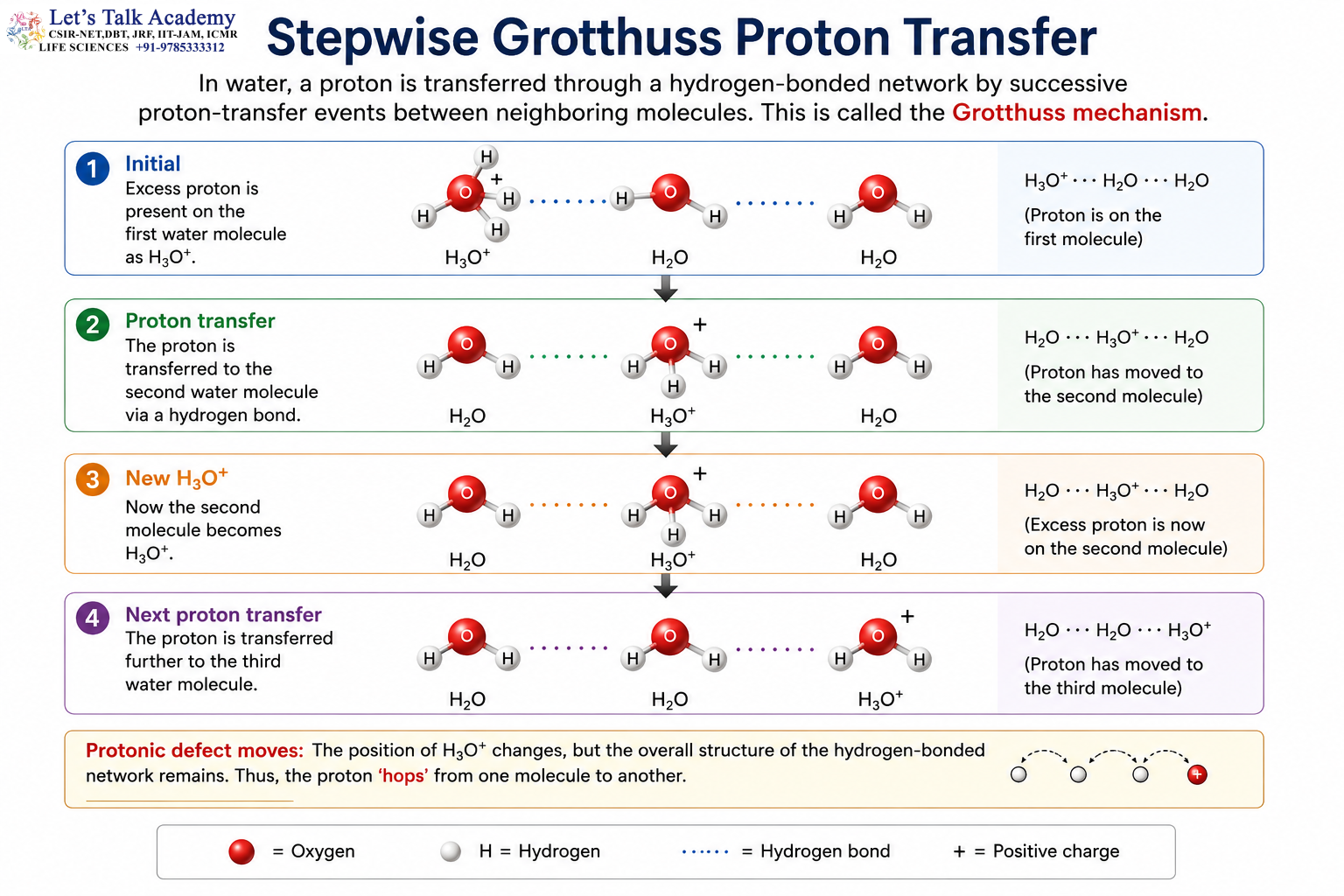
The mechanism of proton movement through a hydrogen-bonded network is commonly associated with the Grotthuss mechanism.
According to this concept, proton transport occurs through successive proton-transfer events between neighboring molecules.
The proton is effectively transferred along the network.
The water molecules themselves are not transported over the entire distance of proton movement. Instead, the protonic defect is transferred from one molecule to another.
This is why proton movement can appear extremely rapid.
2.7. What Happens During a Proton Hop?
The process can be understood by considering two neighboring water molecules.
2.7.1 Initial State
The hydronium ion acts as a proton donor.
2.7.2 After Proton Transfer
The neighboring water molecule has now become hydronium.
The proton has effectively shifted its position.
If another water molecule is present, the process can continue.
The process can produce successive hydronium formation along the water network.
2.8. Water Accepts a Proton and Becomes a Hydronium Ion
A central point illustrated by the figure is that water accepts a proton and becomes a hydronium ion.
Thus, water can act as a Brønsted–Lowry base because it can accept a proton.
Conversely, hydronium can act as a Brønsted–Lowry acid because it can donate a proton.
Important Relationship:
Water accepts a proton → hydronium is formed.
Hydronium donates a proton → water is regenerated.
2.9. Water as Both Proton Donor and Proton Acceptor
Water is amphoteric, meaning that it can behave as either an acid or a base depending on its reaction partner.
2.9.1 Water as a Base
When water accepts a proton:
Water acts as a base.
2.9.2 Water as an Acid
When water donates a proton:
Water acts as an acid.
This dual behavior is fundamental to the acid-base chemistry of biological systems.
2.10. Connection Between Proton Hopping and Water Ionization
Proton hopping is closely related to the self-ionization of water.
One water molecule transfers a proton to another water molecule.
The proton donor becomes hydroxide: H2O → OH−
while the proton acceptor becomes hydronium: H2O → H3O+
Therefore: 2H2O ⇔ H3O+ + OH−
The hydronium ion generated in this process can participate in subsequent proton-transfer events.
2.11. Proton Hopping and Ionic Mobility
One of the most remarkable properties of H+ in water is its unusually high ionic mobility.
The proton does not need to travel entirely as one physical particle through the liquid. Instead, proton transfer can occur successively through the hydrogen-bond network.
This helps explain why H+ has exceptionally high ionic mobility compared with many other monovalent ions.
For example, the mobility of H+ is much greater than that of ions such as Na+ or K+ under comparable conditions.
2.12. Proton Hopping Compared with Na+ and K+ Movement
Na+ and K+ generally move through aqueous solution primarily by conventional translational diffusion.
A proton has an additional mechanism available:
Therefore, proton transport can be particularly rapid.
Feature |
H+ |
Na+ / K+ |
|---|---|---|
| Major transport mechanism in water | Diffusion plus proton-transfer mechanisms | Mainly conventional diffusion |
| Hydrogen-bond-mediated hopping | Highly important | Not comparable |
| Apparent ionic mobility | Exceptionally high | Lower |
| Biological significance | Proton gradients, acid-base chemistry, energy transduction | Osmotic balance, membrane potential, signaling and transport |
2.13. Proton Hopping and Enzyme Catalysis
Proton transfer is a central component of many enzyme-catalyzed reactions.
Many enzymes contain amino acid residues capable of donating or accepting protons.
Examples include:
- Histidine
- Aspartate
- Glutamate
- Lysine
- Tyrosine
- Cysteine
During catalysis, a proton may be transferred between a substrate, catalytic residue, water molecule, or another component of the active site.
Water can therefore participate directly in catalytic proton-transfer reactions.
The ability of water to rapidly reorganize its hydrogen-bond network makes it particularly effective as a medium for proton transfer.
2.14. Proton Hopping in Biological Energy Transduction
Proton movement is fundamental to cellular energy metabolism.
In mitochondria, electron transport is coupled to the generation of a proton gradient across the inner mitochondrial membrane.
Similarly, photosynthetic electron transport contributes to proton-gradient formation across the thylakoid membrane.
The resulting electrochemical proton gradient provides energy for ATP synthesis.
Thus, the chemistry of proton transfer in water has direct relevance to cellular bioenergetics.
2.15. Proton Hopping and ATP Synthase
ATP synthase uses the energy stored in a proton electrochemical gradient to synthesize ATP.
Protons move through the membrane-associated ATP synthase complex, causing conformational and rotational changes that ultimately drive ATP formation.
Although proton movement through a protein channel is not identical to proton hopping in bulk water, efficient proton transfer within hydrated protein environments can involve hydrogen-bond networks and proton-transfer mechanisms.
This provides an important connection between biophysical chemistry and molecular bioenergetics.
2.16. Proton Hopping and Membrane Proteins
Several membrane proteins transport protons across biological membranes.
Examples include:
- Respiratory proton pumps
- Photosynthetic proton-transfer systems
- ATP synthase
- Proton channels
- Proton-coupled transport proteins
Within such proteins, water molecules and polar amino acid side chains can form pathways that facilitate proton transfer.
The local hydrogen-bond environment can therefore influence proton transport efficiency.
2.17. Proton Hopping and Acid-Base Reactions
Acid-base reactions frequently involve proton transfer.
For a general acid-base reaction:
The proton moves from the acid to the base.
In aqueous biological systems, water can participate in this process either directly or as part of the surrounding hydrogen-bond network.
Therefore, proton hopping provides a physical basis for rapid proton redistribution in aqueous environments.
2.18. Hydrogen Bond Rearrangement
Proton hopping should not be considered a completely rigid relay process.
The hydrogen-bond network of water is constantly changing.
Hydrogen bonds:
- Form
- Break
- Reorient
- Reform
These changes create transient pathways that facilitate proton transfer.
Therefore, proton transport depends not only on the presence of hydrogen bonds but also on the dynamic rearrangement of the hydrogen-bond network.
This dynamic nature is one reason why liquid water behaves differently from a rigid hydrogen-bonded solid.
2.19. Structural Diffusion of Protons
The rapid movement of protons through water is sometimes described as structural diffusion.
In conventional diffusion, the same physical particle moves through space.
In structural diffusion, the location of the excess proton effectively moves as proton transfer occurs between neighboring molecules.
can undergo sequential transfer:
followed by:
The protonic defect has therefore moved through the network.
2.20. Proton Hopping and the pH Scale
The pH of a solution depends on the effective concentration or activity of hydrogen ions.
In aqueous solution, the proton is strongly associated with water and is commonly represented
as hydronium:
Proton hopping allows protonic charge to redistribute rapidly through the aqueous medium.
Therefore, proton transfer and the hydrogen-bonded structure of water are closely connected
to acid-base chemistry.
2.21. Proton Hopping and the Hydronium Ion
The hydronium ion is central to understanding proton transfer in water. H3O+
The oxygen atom is bonded to three hydrogen atoms and carries a positive charge.
Hydronium can donate a proton to another water molecule:
Although the reactant and product contain the same chemical species, the proton has changed its molecular association.
This is the molecular basis of proton hopping.
3. Arrhenius Concept of Acids and Bases
3.1 Arrhenius Acid
According to the Arrhenius concept, an acid is a substance that increases the concentration of hydrogen ions in aqueous solution.
3.2 Arrhenius Base
An Arrhenius base is a substance that increases the concentration of hydroxide ions in aqueous solution.
Although useful, the Arrhenius definition is mainly applicable to aqueous solutions and does not completely explain proton transfer reactions occurring in biological systems.
4. Brønsted–Lowry Concept of Acids and Bases
According to the Brønsted–Lowry concept, an acid is a proton donor, whereas a base is a proton acceptor.
In this reaction, HA donates a proton and therefore acts as the acid. Water accepts the proton and acts as the base.
The species formed after proton donation or acceptance are called conjugate acid-base pairs.
- HA is the acid.
- A− is the conjugate base.
- H2O is the base.
- H3O+ is the conjugate acid.
This concept is especially important in biochemistry because proton transfer reactions occur frequently during enzyme catalysis and metabolic reactions.
5. Strong and Weak Acids
5.1 Strong Acids
Strong acids dissociate extensively, often essentially completely, in aqueous solution.
Examples include:
- Hydrochloric acid (HCl)
- Nitric acid (HNO3)
- Perchloric acid (HClO4)
5.2 Weak Acids
Weak acids undergo incomplete ionization and establish an equilibrium between the protonated and deprotonated forms.
Acetic acid is a classic example of a weak acid:
Many biologically important functional groups behave as weak acids or bases. Their partial ionization is fundamental to protein chemistry and enzyme catalysis.
6. Acid Dissociation Constant (Ka)
The strength of a weak acid can be quantitatively described by its acid dissociation constant, represented as Ka.
For the reaction:
The equilibrium expression is:
A larger Ka indicates greater dissociation and therefore a stronger acid. A smaller Ka indicates weaker dissociation.
Remember:
Higher Ka → stronger acid
Lower Ka → weaker acid
7. pKa
Because Ka values can be very small, acid strength is often expressed using pKa.
Therefore:
Because pKa is inversely related to Ka, the relationship between pKa and acid strength is opposite to that between Ka and acid strength.
Lower pKa = stronger acid.
Higher pKa = weaker acid.
For example, an acid with a pKa of 3 is stronger than an acid with a pKa of 6.
8. Relationship Between pH and pKa
The relationship between pH and pKa is one of the most important concepts in biochemical chemistry. It allows us to predict whether a weak acid will predominantly exist in its protonated or deprotonated form.
For: HA ⇌ H+ + A−
the Henderson–Hasselbalch equation gives:
The relationship can be interpreted qualitatively as follows:
Relationship |
Predominant Form |
Interpretation |
|---|---|---|
| pH < pKa | HA | Protonated form predominates |
| pH = pKa | HA = A− | Both forms are present equally |
| pH > pKa | A− | Deprotonated form predominates |
9. Henderson–Hasselbalch Equation
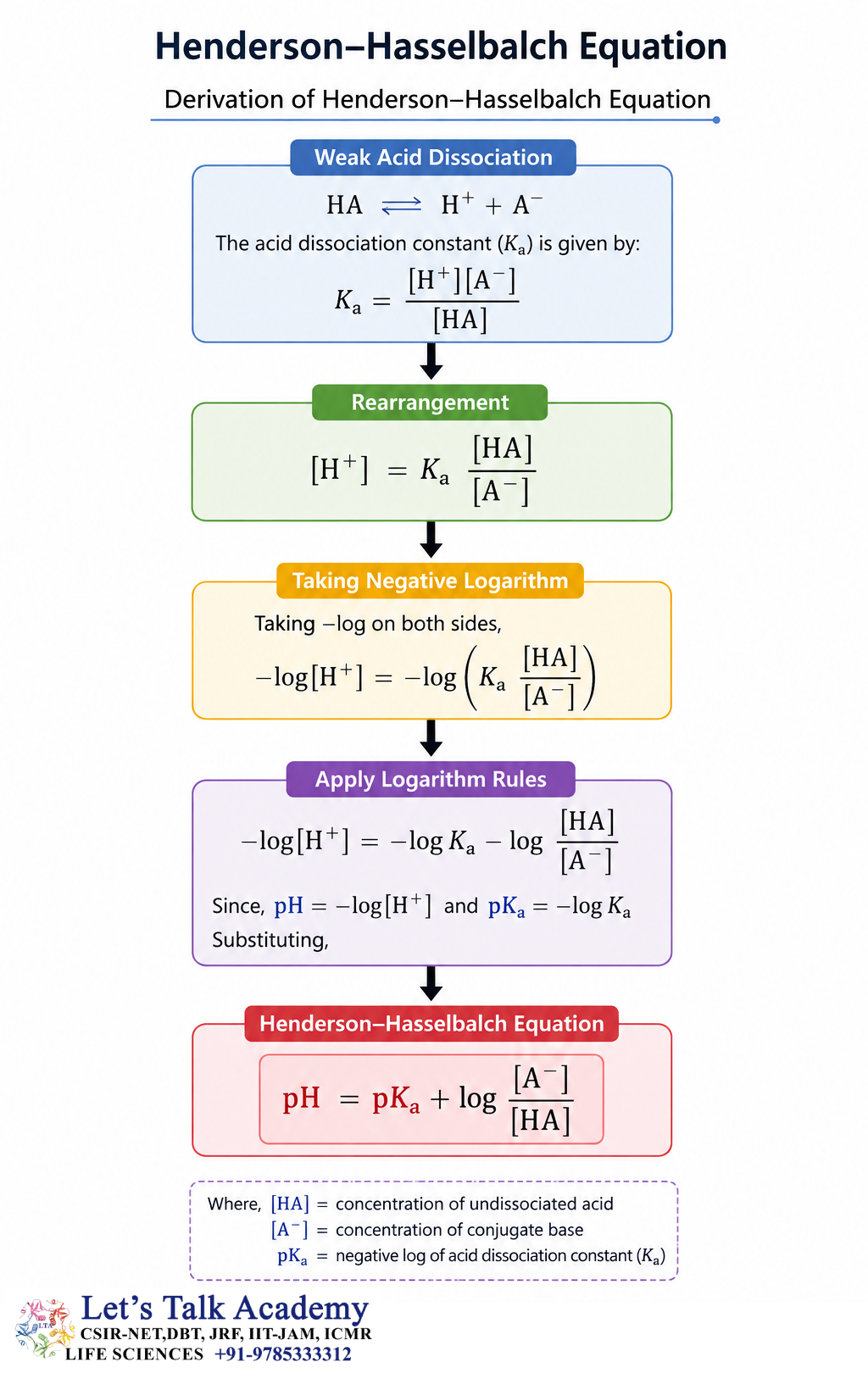
The Henderson–Hasselbalch equation is one of the most frequently used equations in biochemical calculations involving weak acids and buffers.
Here, HA represents the weak acid and A− represents its conjugate base.
9.1 Derivation
Starting with the acid dissociation equation:
Rearranging:
Taking the negative logarithm gives:
9.2 Special Case: pH = pKa
If the concentrations of the weak acid and conjugate base are equal:
then:
Therefore:
When pH = pKa, the weak acid and its conjugate base are present in equal concentrations.
10. Buffer Systems
A buffer is a solution that resists significant changes in pH when relatively small amounts of acid or base are added.
A typical buffer consists of a weak acid and its conjugate base or a weak base and its conjugate acid.
A common example is the acetic acid-acetate buffer:
Buffer systems are extremely important in living organisms because biochemical reactions generally operate within relatively narrow pH ranges.
Without effective buffering, relatively small additions of acidic or basic substances produced during metabolism could cause substantial pH changes and interfere with cellular function.
11. How Does a Buffer Resist pH Change?
11.1 When Acid Is Added
Consider an acetate buffer:
If additional H+ ions are introduced, the conjugate base consumes them:
Consequently, most of the added hydrogen ions are converted into the weak acid form rather than remaining freely in solution.
11.2 When Base Is Added
If OH− ions are added, they react with the weak acid:
The buffer therefore minimizes the change in hydrogen ion concentration and consequently minimizes the change in pH.
12. Buffer Capacity
Buffer capacity describes the ability of a buffer to resist a change in pH when acid or base is added.
Buffer capacity is influenced by both the total concentration of buffer components and their relative proportions.
A concentrated buffer generally has a greater capacity to neutralize added acid or base than a very dilute buffer containing the same acid-base pair.
The maximum buffering capacity of a weak acid-conjugate base system occurs approximately when:
At this point:
13. Effective Buffering Range
A buffer does not resist pH changes equally well at every pH. Its effectiveness is greatest near the pKa of the weak acid.
A commonly used approximate buffering range is:
For example, if a buffer has a pKa of 6.0, its useful buffering range is approximately pH 5.0 to pH 7.0.
Application:
When selecting a buffer for a biochemical experiment, scientists generally choose a buffer whose pKa is close to the desired experimental pH.
14. Ionization of Water

Water is not completely chemically inert. A small fraction of water molecules undergoes self-ionization.
For simplicity, H3O+ is frequently represented as H+ in biochemical equations.
The ionization constant of water is represented by Kw:
At approximately 25°C:
In pure water at this temperature:
Therefore: pH ≈ 7
15. Relationship Between pH and pOH
The pOH of a solution is defined as the negative logarithm of hydroxide ion concentration.
Since:
the logarithmic relationship is:
At approximately 25°C:
The value of Kw changes with temperature. Therefore, the numerical value of neutral pH is not exactly 7 at every temperature.
16. pH and Amino Acids
Amino acids are amphoteric molecules, meaning that they can behave as both acids and bases. Their ability to accept or donate protons depends on the pH of the surrounding solution.
A typical amino acid contains an amino group and a carboxyl group: NH2 − CH(R) − COOH
In aqueous solution, these groups can undergo protonation and deprotonation.
At relatively low pH, the amino group tends to remain protonated: NH3+
At higher pH, the carboxyl group tends to lose its proton: COO−
Thus, the net charge of an amino acid changes as the pH of the solution changes.
17. Zwitterions
A zwitterion is a molecule that contains both a positively charged group and a negatively charged group while having an overall net charge of zero.
Amino acids commonly exist in zwitterionic form in aqueous solution:
Although the molecule contains both positive and negative charges, the total charge is zero when the positive and negative charges balance each other.
The distribution of charge changes with pH. This is why amino acids behave differently under acidic, neutral, and alkaline conditions.
18. Isoelectric Point (pI)
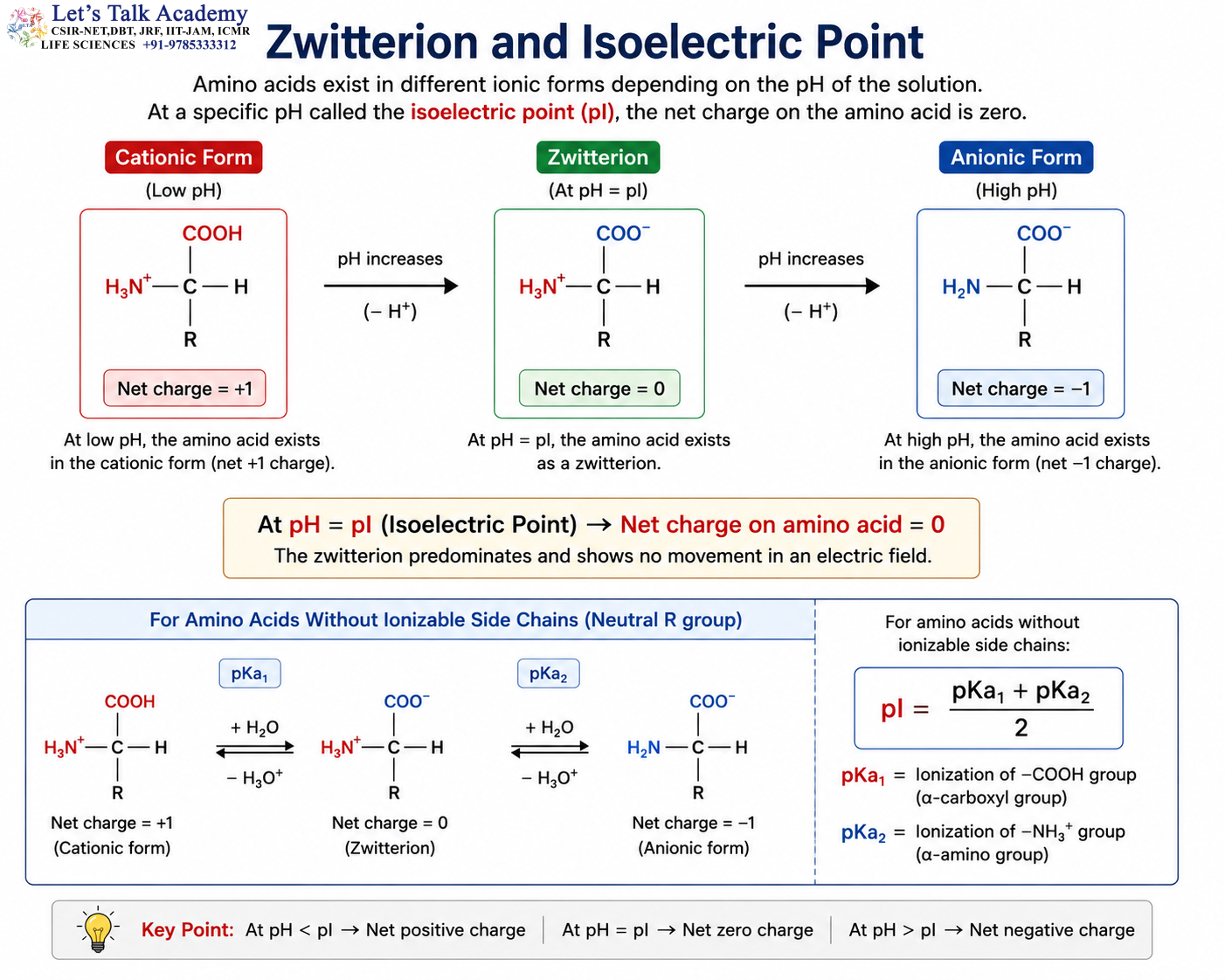
The isoelectric point (pI) is the pH at which a molecule has zero net electrical charge.
For an amino acid without an ionizable side chain:
For amino acids containing ionizable side chains, the two pKa values that surround the zero-net-charge species must be used.
Do not blindly average all pKa values of an amino acid. The correct pI calculation uses the two pKa values that bracket the electrically neutral species.
18.1 Protein Behavior Near pI
At or near the isoelectric point, proteins have little or no net charge. Consequently, electrostatic repulsion between protein molecules can decrease.
Reduced electrostatic repulsion can increase protein-protein interactions and may promote aggregation or precipitation.
19. pH and Protein Structure
Protein structure depends on a delicate balance of many non-covalent interactions. pH can influence several of these interactions by changing the protonation states of amino acid side chains.
Ionizable amino acid residues include residues such as:
- Aspartate
- Glutamate
- Histidine
- Lysine
- Arginine
- Cysteine
- Tyrosine
Changes in pH can alter ionic interactions and salt bridges within or between proteins.
As a consequence, extreme pH conditions may cause changes in protein conformation and, in some cases, protein denaturation.
Therefore, pH is not simply a measure of acidity; it is an important determinant of the chemical environment in which proteins exist and function.
20. pH and Enzyme Activity
Enzymes usually exhibit maximum activity within a characteristic pH range known as their optimal pH.
A change in pH can influence enzyme activity through several mechanisms.
- Changing the protonation state of catalytic residues.
- Changing substrate ionization.
- Changing enzyme-substrate interactions.
- Altering electrostatic interactions within the active site.
- Changing protein conformation.
- At extreme pH, causing partial or extensive denaturation.
Many enzyme active sites contain amino acid residues that must be protonated or deprotonated in a specific manner for catalysis to occur.
Therefore, understanding the pKa values of catalytic residues can help explain why an enzyme exhibits a particular pH optimum.
Example:
Pepsin functions efficiently in the strongly acidic environment of the stomach, whereas many intracellular enzymes operate most efficiently near neutral pH.
21. pH and Nucleic Acids
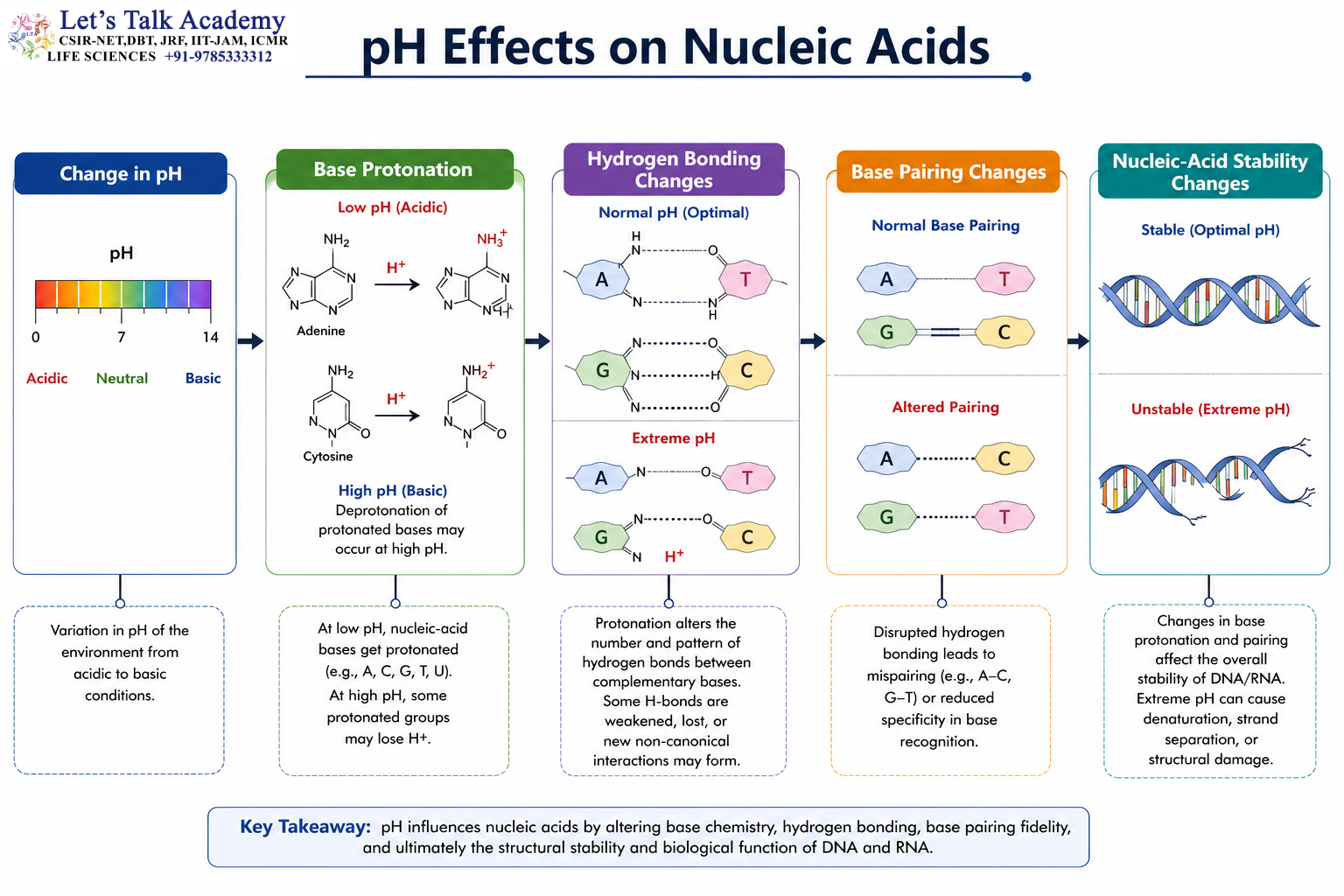
pH also affects DNA and RNA chemistry. Nucleic acids contain ionizable functional groups, and changes in pH can alter their protonation states.
Changes in pH can influence:
- Base protonation.
- Hydrogen bonding.
- Base pairing.
- Nucleic acid stability.
- Interactions between nucleic acids and proteins.
- Certain chemical degradation reactions.
Extreme acidic or alkaline conditions can disrupt the interactions responsible for maintaining normal nucleic acid structure.
22. Physiological Buffer Systems
Living organisms possess several buffer systems that help maintain appropriate pH conditions. Different biological compartments use different buffering systems according to their physiological requirements.
22.1 Bicarbonate Buffer System
The bicarbonate system is particularly important in extracellular fluids and blood.
The bicarbonate buffer is physiologically important because its components are connected with respiratory and renal mechanisms that regulate acid-base balance.
22.2 Phosphate Buffer System
The phosphate system can be represented as:
Phosphate buffering is particularly relevant in intracellular environments and other biological compartments.
22.3 Protein Buffer Systems
Proteins can function as buffers because several amino acid side chains can accept or donate protons.
Histidine residues are especially important because the imidazole side chain can participate in proton transfer near physiological pH.
23. Biological Importance of pH
The importance of pH extends across almost every level of biological organization.
23.1 Cellular Metabolism
Metabolic pathways involve numerous enzymes and chemical reactions whose rates depend on pH. Therefore, maintaining an appropriate intracellular pH is essential for efficient metabolism.
23.2 Protein Function
Protein charge and conformation can change with pH. These changes can affect molecular recognition, binding, transport, and catalytic activity.
23.3 Enzyme Catalysis
Proton transfer is frequently involved directly in enzyme mechanisms. Therefore, pH can determine whether catalytic residues are in the correct protonation state.
23.4 Membrane Processes
Proton gradients are important for energy transduction. For example, proton gradients across biological membranes contribute to ATP synthesis in mitochondria and chloroplasts.
23.5 Cellular Compartments
Different organelles can maintain different pH environments. This allows particular enzymes and biochemical pathways to operate under conditions suitable for their function.


