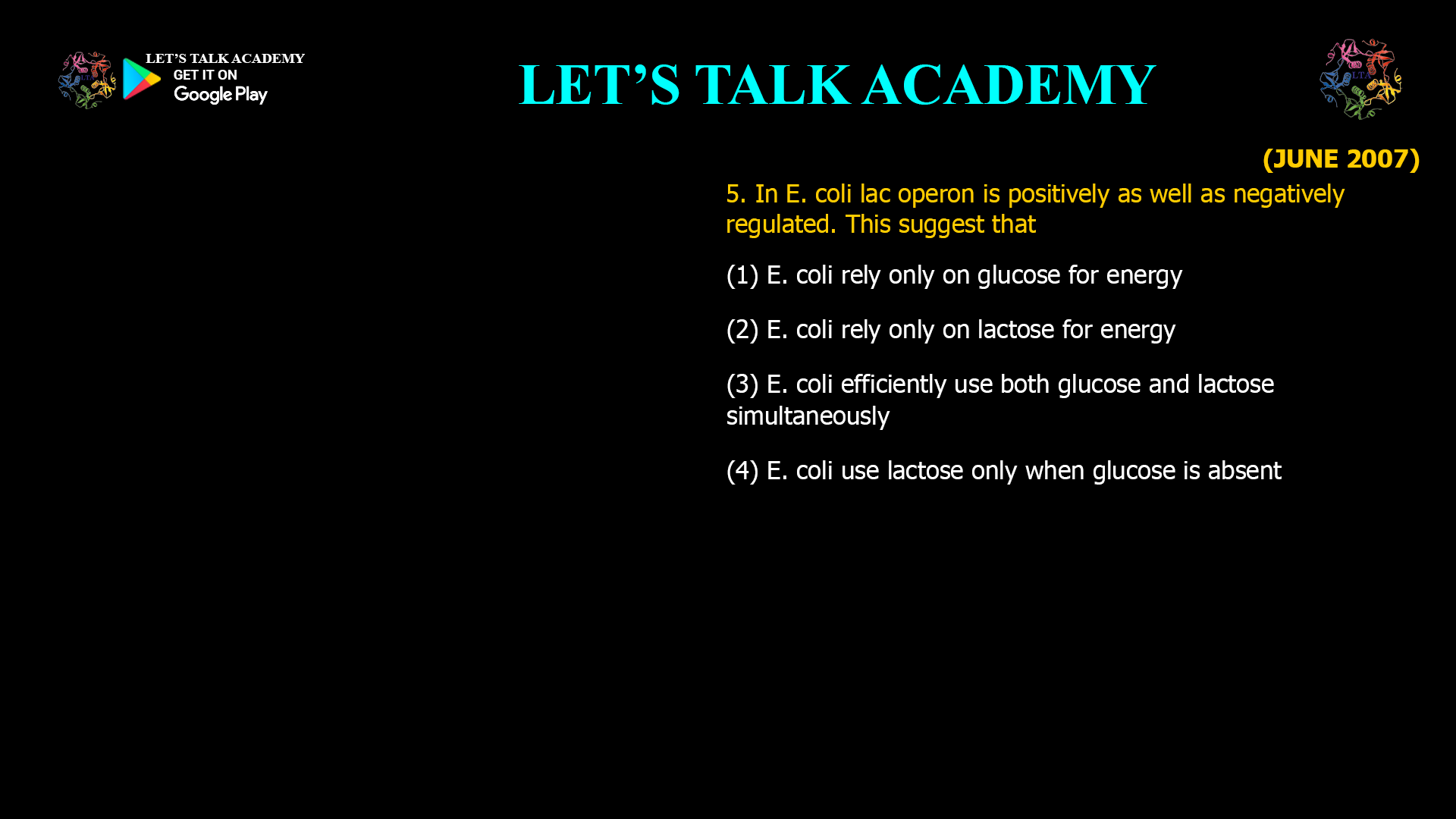
In E. coli lac operon is positively as well as negatively regulated. This suggest that
(1) E. coli rely only on glucose for energy
(2) E. coli rely only on lactose for energy
(3) E. coli effioently use both glucose and lactose simultaneously
(4) E. coli use lactose only when glucose absent
The lac operon in Escherichia coli is a classic example of gene regulation, showcasing how bacteria adapt to changing nutrient environments. The operon is both positively and negatively regulated, reflecting the bacterium’s need to efficiently manage energy sources like glucose and lactose. But what does this dual regulation mean for E. coli’s metabolism? Let’s explore the mechanism and its significance.
How the Lac Operon Works: The Basics
The lac operon is a group of genes responsible for the uptake and metabolism of lactose. It includes:
-
Structural genes (lacZ, lacY, lacA): Involved in lactose transport and breakdown.
-
Promoter and operator: Regulatory DNA sequences where proteins bind to control gene expression.
-
Lac repressor: A protein that blocks transcription in the absence of lactose.
-
CAP (catabolite activator protein): A protein that enhances transcription when glucose is absent.
Negative and Positive Regulation Explained
-
Negative regulation: The lac repressor binds to the operator, blocking transcription when lactose is absent. If lactose is present, it binds to the repressor, inactivating it and allowing transcription to proceed.
-
Positive regulation: When glucose is absent, cAMP levels rise, activating CAP. The CAP-cAMP complex binds near the promoter, enhancing RNA polymerase binding and increasing transcription rates.
Why Dual Regulation?
E. coli prefers glucose as its primary energy source because it is easier to metabolize. The lac operon is designed so that:
-
If glucose is present: Even if lactose is available, the operon remains mostly off because CAP is inactive and cannot enhance transcription. E. coli uses glucose first.
-
If glucose is absent and lactose is present: The lac operon is fully activated, allowing the bacterium to efficiently metabolize lactose as an alternative energy source.
Efficient Use of Both Sugars
The dual regulation of the lac operon means E. coli does not rely solely on glucose or lactose, nor does it use both sugars simultaneously with equal efficiency. Instead, it prioritizes glucose when available and switches to lactose only when glucose is depleted and lactose is present. This regulatory strategy ensures optimal energy utilization and survival in fluctuating environments.
Which Statement Is Correct?
Given the options:
-
E. coli rely only on glucose for energy
-
E. coli rely only on lactose for energy
-
E. coli efficiently use both glucose and lactose simultaneously
The correct interpretation is that E. coli efficiently use both glucose and lactose, but not simultaneously in equal measure. They prioritize glucose and switch to lactose only when glucose is unavailable, thanks to the positive and negative regulation of the lac operon.
Conclusion
The positive and negative regulation of the lac operon in E. coli demonstrates a sophisticated genetic strategy for energy management. This dual control enables the bacterium to preferentially use glucose and only activate lactose metabolism when necessary, ensuring survival and efficiency in diverse environments.
Keywords: lac operon, E. coli, positive regulation, negative regulation, glucose, lactose, gene expression, catabolite activator protein, CAP, cAMP, lac repressor, metabolic regulation, bacterial operon, energy utilization, gene regulation, operon model, molecular biology, lactose metabolism, transcriptional control, operator, promoter.


22 Comments
Suman bhakar
June 12, 2025✅✅
Anita choudhary
June 13, 2025Done sir 👍
Arushi
June 14, 2025Nice explanation sir
Kajal
November 3, 2025The correct interpretation is that E. coli efficiently use both glucose and lactose, but not simultaneously in equal measure. They prioritize glucose and switch to lactose only when glucose is unavailable, thanks to the positive and negative regulation of the lac operon.
Kirti Agarwal
November 4, 2025E coli use lactose only when glucose is absent
Divya rani
November 5, 2025E.coli use lactose when glucose is absent because if we add both in the medium then e.coli prefer the glucose as a direct energy source .
Neha Yadav
November 6, 2025E.coli use lactose when glucose is absent
Heena Mahlawat
November 6, 2025Both glucose and lactose
Roopal Sharma
November 6, 2025Both glucose and lactose.
Sonal Nagar
November 6, 2025Option 4th
Deepika Sheoran
November 6, 2025E coli use lactose only when glucose is absent.
Anisha Beniwal
November 6, 2025E. coli use lactose only when glucose absent
Neeraj Sharma
November 6, 2025E.coli will use lactose only when glucose is absent
Neelam Sharma
November 6, 2025E. coli use lactose only when glucose absent
Dipti Sharma
November 6, 2025Ecoli prefers glucose as its primary energy source and use lactose as secondary in the absence of glucose.
Sonam Saini
November 7, 2025Glucose ke apsence mein E colai lectose ka upyog karte Hain firstly E coli glucose ko prathmikta deti Hai
Aman Choudhary
November 7, 2025E.coli prioritize glucose in absence or presence of lactose but in absence of glucose lactose is used
Bhawna Choudhary
November 8, 2025E. coli efficiently use both glucose and lactose, but not simultaneously in equal measure
In the absence of glucose they use lactose.
Mansukh Kapoor
November 8, 2025It use glucose and lactose as source of energy simultaneously
Mohd juber Ali
November 9, 2025E. coli efficiently use both glucose and lactose, but not simultaneously in equal measure
Sakshi Kanwar
November 10, 2025E. coli use lactose only when glucose absent
Manisha choudhary
November 12, 20254 option bhi correct nhi h isme likha h ki lactose ko tb hi use krega jab Glucose nhi hogi
Kyoki sir n btaya tha ki glucose and lactose dono present hone p no doubt bacteria glucose ko preference dega pr vo thoda thoda lactose bhi lega nhi too bacteria continuous glucose uptake nhi kr paayega
3 option bhi partially correct h kyoki bacteria glucose and lactose dono ko efficiently use kr skta h pr simultaneously nhi medium p depend krega