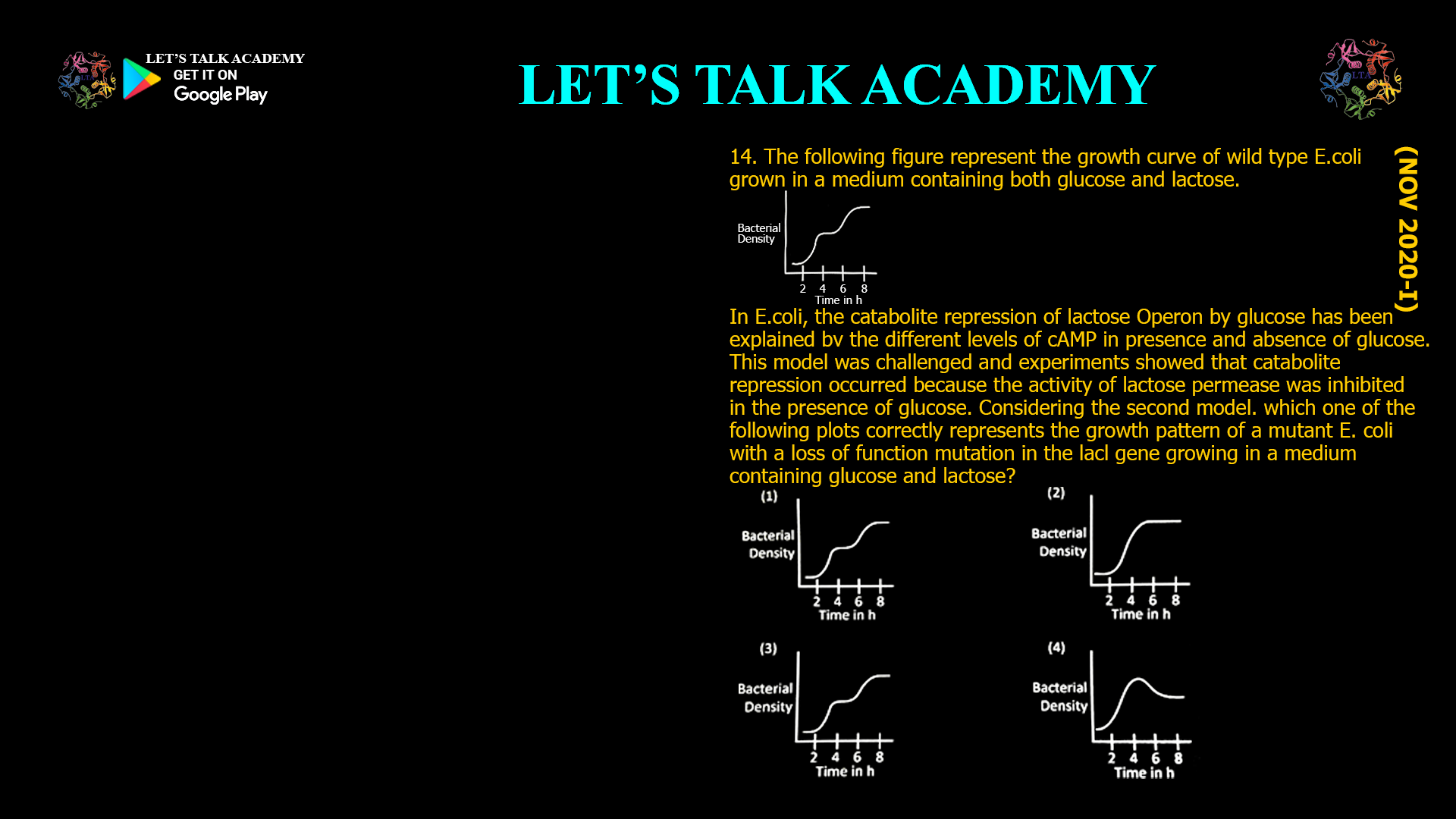
14. The following figure represent the growth curve of wild type E.coli grown in a medium containing both glucose and lactose.
In E.coli, the catabolite repression of lactose Operon by glucose has been explained bv the different levels Of cAMP in presence and absence of glucose. This model was challenged and experiments showed that catabolite repression occurred because the activity Of lactose permease was inhibited in the presence of glucose. Considering the second model. which one of the following plots correctly represents the growth pattern of a mutant E. coli With a loss of function mutation in the lacI gene growing in a medium containing glucose and lactose?
The lac operon of Escherichia coli is a classic example of gene regulation, illustrating how bacteria prioritize energy sources in their environment. Traditionally, catabolite repression was explained by changes in cAMP levels, but newer models highlight the direct inhibition of lactose permease by glucose. This article examines the expected growth pattern of a lacI loss-of-function mutant E. coli in a medium containing both glucose and lactose, focusing on the permease inhibition model.
The lacI Gene and Its Role in E. coli
The lacI gene encodes the lac repressor, which binds to the operator region of the lac operon and prevents transcription in the absence of lactose. A loss-of-function mutation in lacI means the repressor is nonfunctional, resulting in constitutive expression of the lac operon. This means enzymes for lactose metabolism, including β-galactosidase and lactose permease, are always produced, regardless of the presence or absence of lactose.
Catabolite Repression: From cAMP to Permease Inhibition
While the classic model attributes catabolite repression to low cAMP levels (and thus reduced CAP activity) in the presence of glucose, recent evidence shows that glucose can also directly inhibit the activity of lactose permease. This means that even if the lac operon is fully expressed (as in a lacI mutant), lactose cannot be efficiently transported into the cell while glucose is present, due to permease inhibition.
Growth Curve in Glucose and Lactose: What to Expect in a lacI Mutant
Wild-Type E. coli:
-
Grows rapidly on glucose (preferred carbon source).
-
After glucose is depleted, a lag phase occurs as the cells induce the lac operon and switch to lactose metabolism.
-
This results in a diauxic growth curve: two exponential phases separated by a lag.
lacI Mutant E. coli:
-
The lac operon is always ON, so all lactose metabolism enzymes are present from the start.
-
However, glucose still inhibits lactose permease activity, so lactose cannot be used efficiently until glucose is depleted.
-
After glucose is consumed, permease inhibition is relieved, and the cells can utilize lactose, leading to a second exponential growth phase.
-
The result is still a diauxic growth curve with a lag phase between the two exponential phases, not because of gene induction, but because of permease inhibition by glucose.
Analyzing the Growth Curves
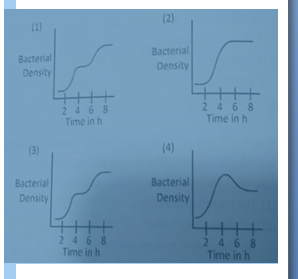
Given the four plots in the image:
-
Plot (1): Shows a single exponential phase, then stationary phase.
-
Plot (2): Shows a short lag, then a single exponential phase.
-
Plot (3): Shows two exponential phases separated by a lag phase (classic diauxic growth).
-
Plot (4): Shows a rise and then a decline, not typical for diauxic growth.
The correct plot is Plot (3):
This plot depicts two exponential growth phases separated by a lag phase, which matches the expected pattern for a lacI mutant in the presence of both glucose and lactose when permease activity is inhibited by glucose123.
Biological Significance
This growth pattern demonstrates that even with constitutive lac operon expression, E. coli cannot bypass the regulatory effect of glucose on lactose utilization if permease activity is directly inhibited. The cell’s ability to switch between carbon sources is thus governed not only by gene regulation but also by post-translational control of transport proteins.
Summary Table: Growth Patterns in Different E. coli Strains
| Strain Type | lac Operon Expression | Glucose Present | Lactose Utilization | Growth Curve Pattern |
|---|---|---|---|---|
| Wild-type | Inducible | Inhibited | After glucose | Diauxic (lag between phases) |
| lacI mutant | Constitutive | Inhibited (permease) | After glucose | Diauxic (lag between phases) |
Frequently Asked Questions
Q: Why does a lacI mutant still show diauxic growth?
A: Because glucose inhibits lactose permease activity, preventing lactose uptake until glucose is depleted, regardless of operon expression.
Q: Does constitutive expression of the lac operon eliminate the lag phase?
A: No, not if permease activity is still inhibited by glucose.
Q: What does this tell us about bacterial regulation?
A: Bacterial metabolic regulation involves both transcriptional and post-translational mechanisms to optimize resource use.
Conclusion
In a medium containing both glucose and lactose, a lacI mutant E. coli will display a diauxic growth curve with a lag phase between two exponential phases. This is due to glucose-mediated inhibition of lactose permease, not gene repression. The correct graphical representation is Plot (3), illustrating the fundamental principles of catabolite repression and metabolic regulation in bacteria.
Keywords: lacI mutant, E. coli, diauxic growth, glucose, lactose, catabolite repression, permease inhibition, lac operon, growth curve, bacterial metabolism, gene regulation, exponential phase, lag phase, molecular biology.


9 Comments
Suman bhakar
June 12, 2025👍👍
Komal Sharma
June 13, 2025Explanation is great
Arushi
June 14, 2025Suraj sir is great
kajal
November 4, 2025Correct answer is plot 3
Roopal Sharma
November 6, 2025Plot 3rd – diauxic growth
Dipti Sharma
November 7, 2025Plot 3 Shows two exponential phases separated by a lag phase.
Neelam Sharma
November 7, 20252 option correct
Neelam Sharma
November 12, 2025Option 3
Manisha choudhary
November 12, 2025Graph 3 is correct answer
Loss of mutation in lac I but still permease activity inhibit by glucose
two exponential phase k bich ek lag phase hogi diauxic growth curve bnega