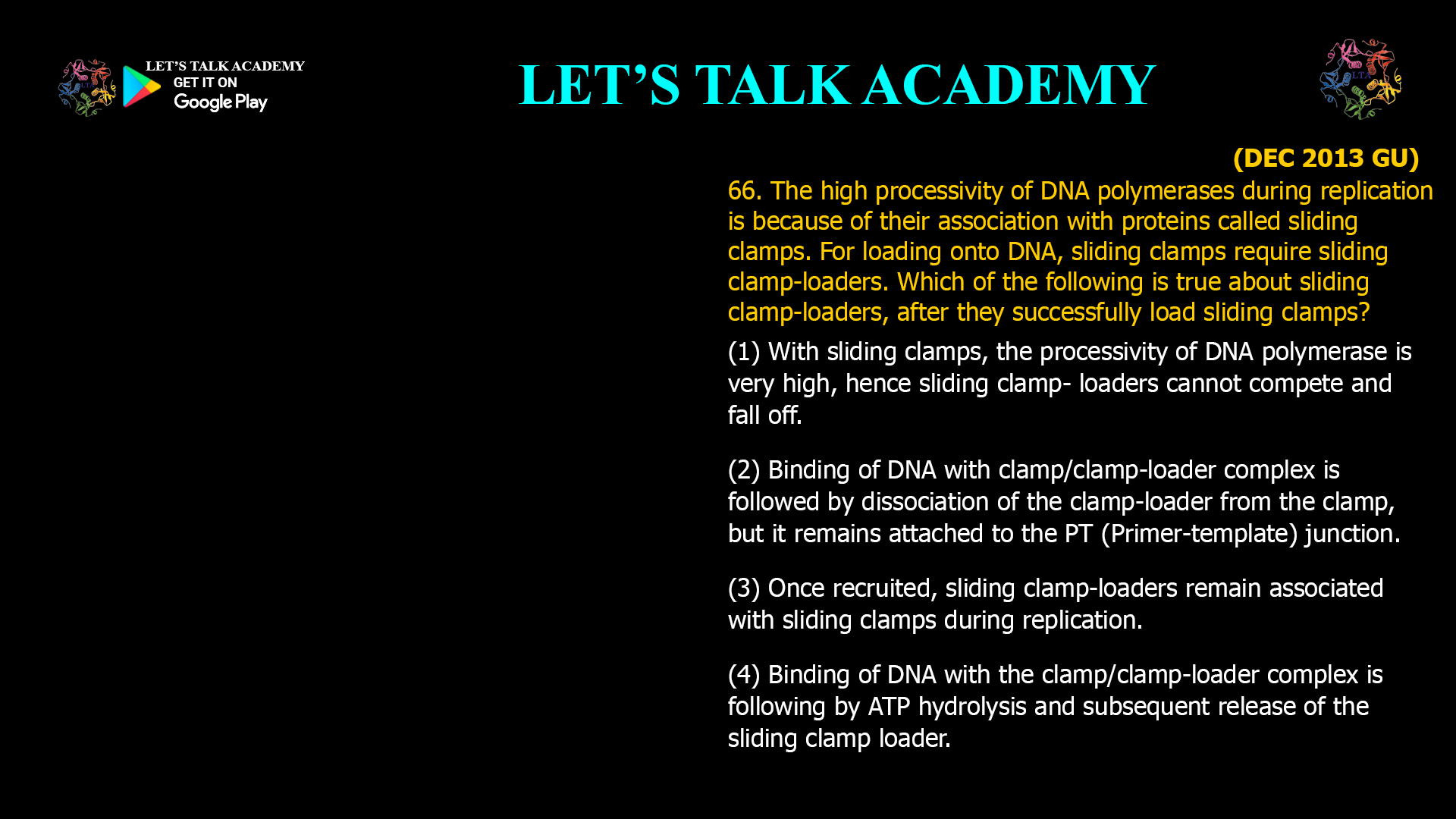
- The high processivity of DNA polymerases during replication is because of their association with proteins called sliding clamps. For loading onto DNA, sliding
clamps require sliding clamp-loaders. Which of the following is true about sliding clamp-loaders, after they successfully load sliding clamps?
(1) With sliding clamps, the processivity of DNA polymerase is very high, hence sliding clamp- loaders cannot compete and fall off.
(2) Binding of DNA with clamp/clamp-loader complex is followed by dissociation of the clamp-loader from the clamp, but it remains attached to the PT (Primer-template) junction.
(3) Once recruited, sliding clamp-loaders remain associated with sliding clamps during replication.
(4) Binding of DNA with the clamp/clamp-loader complex is following by ATP hydrolysis and subsequent release of the sliding clamp loader.
Background: Sliding Clamps and Clamp-Loaders
Sliding clamps are ring-shaped protein complexes that encircle DNA and tether DNA polymerases to the template, greatly increasing their processivity during replication. Because sliding clamps cannot open spontaneously around DNA, specialized ATP-dependent protein complexes called sliding clamp-loaders are required to open and load these clamps onto DNA at primer-template junctions.
What Happens After Sliding Clamp-Loaders Load the Clamp?
-
ATP Hydrolysis Drives Clamp Loading and Loader Release:
Clamp-loaders bind ATP to open the sliding clamp and position it around DNA at the primer-template junction. Upon proper placement, ATP hydrolysis occurs, triggering conformational changes that close the clamp around DNA. -
Dissociation of the Clamp-Loader:
Following clamp closure, the clamp-loader releases from the clamp and DNA, allowing the sliding clamp to freely slide along the DNA duplex. This release is essential for replication to proceed efficiently. -
Clamp-Loader Does Not Remain Bound:
The clamp-loader does not remain associated with the sliding clamp during replication. Instead, it cycles off to be reused for loading additional clamps as needed.
Evaluating the Options
-
Sliding clamp-loaders cannot compete and fall off because of high processivity of DNA polymerase:
-
Incorrect. The release is an active process driven by ATP hydrolysis, not passive competition.
-
-
Clamp-loader dissociates from the clamp but remains attached to the primer-template junction:
-
Incorrect. The clamp-loader fully dissociates from both clamp and DNA after loading.
-
-
Sliding clamp-loaders remain associated with sliding clamps during replication:
-
Incorrect. Clamp-loaders release after loading; they do not stay bound during replication.
-
-
Binding of DNA with clamp/clamp-loader complex is followed by ATP hydrolysis and subsequent release of the sliding clamp-loader:
-
Correct. ATP hydrolysis triggers clamp closure and clamp-loader release.
-
Final Answer
(4) Binding of DNA with the clamp/clamp-loader complex is followed by ATP hydrolysis and subsequent release of the sliding clamp loader.
Keywords
sliding clamp, clamp-loader, ATP hydrolysis, DNA replication, processivity, clamp loading mechanism, sliding clamp release, DNA polymerase processivity factor, primer-template junction
Summary
Sliding clamp-loaders are ATP-dependent enzymes that open and load sliding clamps onto DNA at primer-template junctions. After clamp placement, ATP hydrolysis induces conformational changes that close the clamp and cause the clamp-loader to dissociate from both the clamp and DNA. This release allows the sliding clamp to freely slide along DNA, tethering DNA polymerase for highly processive replication.
Correct option:
(4) Binding of DNA with the clamp/clamp-loader complex is followed by ATP hydrolysis and subsequent release of the sliding clamp loader.


20 Comments
Shivani .
July 29, 2025Yes ,option 4 is correct because ATP hydrolysis trigger clamp loading on dna and clamp loader dissociate from clamps after loading .
Surbhi Rajawat
July 29, 2025Clamp loader as the name suggests it loads the clamp on DNA template and itself gets completely dissociated. (Option 4)
anurag giri
July 29, 2025Ans 4 clamp loader are ATP dependent they load the clamp on dna and dissociate
Aman Choudhary
July 29, 2025Option 4 is correct aapne bataya tha Atp hydrolysis se he clamp loader open hota h
Soniya Shekhawat
July 30, 2025ATP hydrolysis trigger clamp loader and clamp closure then later completey dissociate so 4 is correct
Kajal
July 30, 2025Option 4 is right
Binding of beta clamp on dna is ATP hydrolised and released after the beta clamp binding
Santosh Saini
July 30, 2025ATP hydrolysis trigger clamp loading on DNA and then clamp loader dissociate itself , so 4th option is right
Anisha jakhar
July 30, 2025Option 4 is the right answer. Clamp loader gets completely dissociated and its loading depends on ATP hydrolysis.
Manisha choudhary
July 30, 2025Done sir 👍🏻
B(beta) clamp is just like clutch ( ring shape )
B clamp ko y ( gama ) clamp loader load krwata h DNA p
Delta recruite krta h beta clamp ko
ADP ki presence m beta clamp close hota h pr atp bind krne p open ho jata h
Gama clamp loader beta clamp ko primer template junction p load krwata h primer (rna) ki presence m beta clamp ki ATPase activity enhance ho jati h or load ho jata h load hone p loader ht jata and baaki or bhi beta clamp ko load krwata h
And beta clamp p DNA polymerase aakr bind krta h DNA polymerase k paas DNA binding domain nhi hota h
Beta clamp DNA duplex p freely move krta h
Payal Gaur
July 31, 2025ATP hydrolysis binding of clamp on DNA and after loading of clamp, clamp loader dissociate
Khushi Agarwal
July 31, 20254 is correct answer
Pehle clamp loader + ATP clamp ko DNa pe le jata hai. sliding DNA bind karne ke baad ATP hydrolysis hoti hai.
Fir clamp loader release ho jaata hai, aur sliding clamp DNA pol ke saath jud jaata hai.
Khushi Vaishnav
July 31, 2025Sliding clamp-loaders are ATP-dependent enzymes that open and load sliding clamps onto DNA at primer-template junctions
Vanshika Sharma
July 31, 2025Ans is 4 bcz clam loader are atp dependent enzyme that load clamp on dna and then dissociates
Dharmpal Swami
August 1, 2025Atp hydrolysis trigger the clamp and clamp loader release
shruti sharma
August 2, 2025ans 4 is correct
Mohini
August 3, 2025Option 4 is right answer. After successful loading of the clamp, the clamp loader dissociates. It is a ring-shaped structure, so it is an ATP-dependent process.
Varsha Tatla
August 3, 2025Option 4 will be correct
ATP hydrolysis trigger clamp binding and clamp loader dissociation
Deepika sheoran
August 4, 2025Option 4th is correct answer
Because ATP hydrolysis binding of triggers clamp on DNA & the loading of clamp,clamp loader dissociate.
Aafreen Khan
August 23, 2025Binding of DNA with the clamp/clamp-loader complex is followed by ATP hydrolysis and subsequent release of the sliding clamp loader.
Deepika Sheoran
November 7, 2025Option 4 th is correct