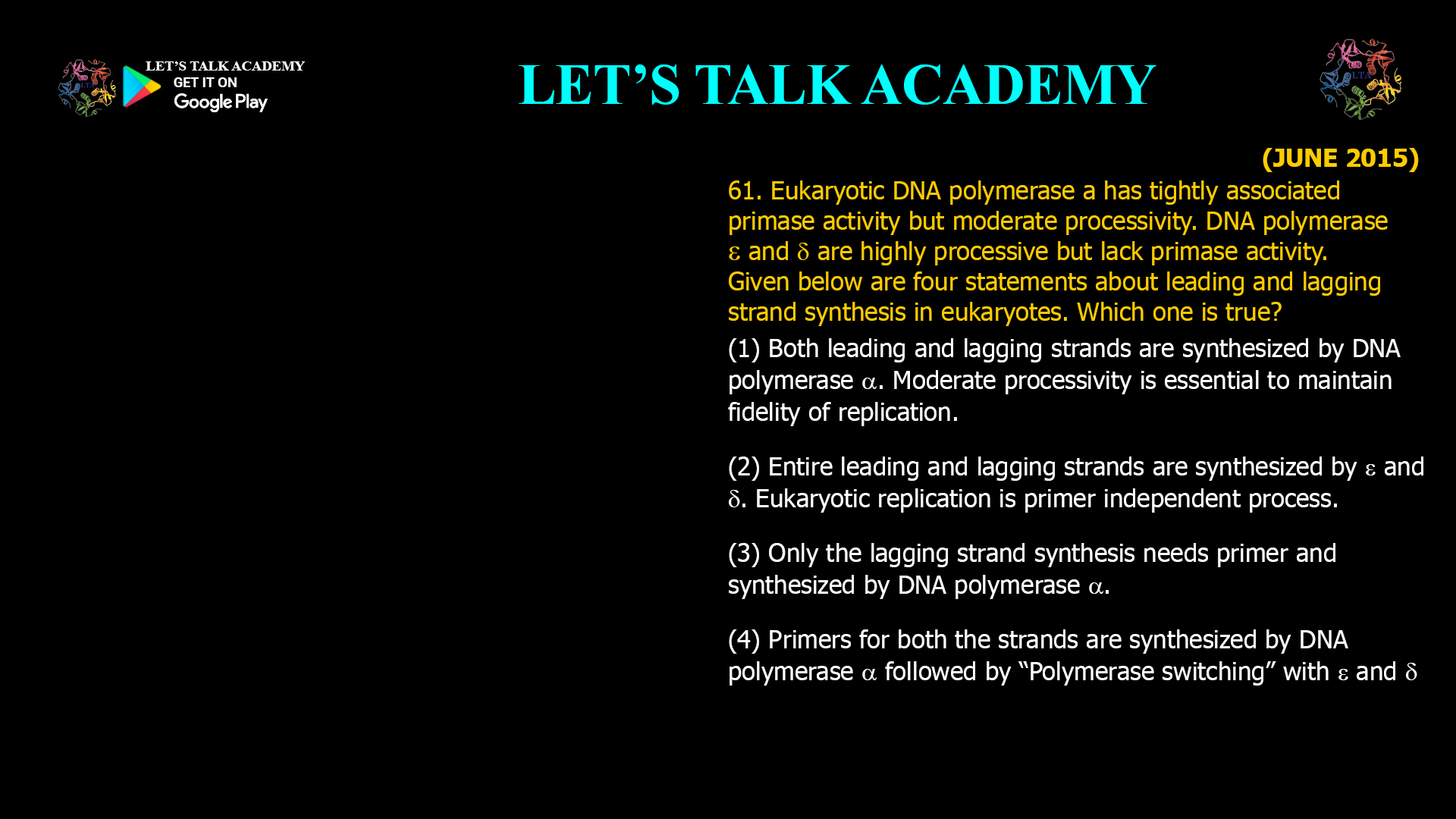
- Eukaryotic DNA polymerase a has tightly associated primase activity but moderate processivity. DNA polymerase ϵ and Ꟙ are highly processive but lack primase activity. Given below are four statements about leading and lagging strand synthesis in
eukaryotes. Which one is true?
(1) Both leading and lagging strands are synthesized by DNA polymerase α. Moderate processivity is essential to maintain fidelity of replication.
(2) Entire leading and lagging strands are synthesized by ϵ and Ꟙ. Eukaryotic replication is primer independent process.
(3) Only the lagging strand synthesis needs primer and synthesized by DNA polymerase α.
(4) Primers for both the strands are synthesized by DNA polymerase α followed by “Polymerase switching” with ϵ and Ꟙ
Introduction
Eukaryotic DNA replication involves coordinated activity of multiple DNA polymerases to ensure accurate and efficient genome duplication. DNA polymerase α (Pol α) has primase activity and initiates DNA synthesis by laying down RNA-DNA primers on both strands. The highly processive DNA polymerases ε (Pol ε) and δ (Pol δ) then take over synthesis of the leading and lagging strands, respectively. This process, known as polymerase switching, is essential for replication fork progression.
Roles of DNA Polymerases in Eukaryotic Replication
-
DNA Polymerase α (Pol α):
-
Possesses an associated primase activity.
-
Synthesizes a short RNA primer followed by a short stretch of DNA on both leading and lagging strands.
-
Has moderate processivity and lacks proofreading ability.
-
-
DNA Polymerase ε (Pol ε):
-
Highly processive with proofreading activity.
-
Primarily responsible for continuous synthesis of the leading strand.
-
-
DNA Polymerase δ (Pol δ):
-
Highly processive with proofreading activity.
-
Responsible for discontinuous synthesis of the lagging strand, synthesizing Okazaki fragments.
-
Polymerase Switching Mechanism
-
Primer Synthesis:
Pol α initiates synthesis by creating RNA-DNA primers on both strands. -
Switching to Processive Polymerases:
After primer synthesis, Pol α is replaced by Pol ε on the leading strand and Pol δ on the lagging strand.
This switch allows efficient and high-fidelity DNA synthesis. -
Lagging Strand Synthesis:
Pol δ synthesizes Okazaki fragments discontinuously, which are later processed and joined.
Why Other Options Are Incorrect
-
(1) Both strands synthesized by Pol α:
Incorrect; Pol α only initiates synthesis, not the entire strand. -
(2) Entire strands synthesized by Pol ε and δ, primer independent:
Incorrect; primer synthesis by Pol α is essential. -
(3) Only lagging strand needs primer and synthesized by Pol α:
Incorrect; both strands require primers synthesized by Pol α.
Correct Statement
(4) Primers for both strands are synthesized by DNA polymerase α followed by “polymerase switching” with ε and δ
Summary Table
| Polymerase | Function | Strand Synthesized | Processivity | Primase Activity |
|---|---|---|---|---|
| DNA Polymerase α | Primer synthesis (RNA-DNA hybrid) | Both leading and lagging (initiation) | Moderate | Yes |
| DNA Polymerase ε | Leading strand elongation | Leading strand | High | No |
| DNA Polymerase δ | Lagging strand elongation (Okazaki fragments) | Lagging strand | High | No |
Keywords
eukaryotic DNA replication, DNA polymerase α, DNA polymerase ε, DNA polymerase δ, primase activity, polymerase switching, leading strand synthesis, lagging strand synthesis, Okazaki fragments, replication fork
Conclusion
In eukaryotic DNA replication, DNA polymerase α synthesizes RNA-DNA primers on both leading and lagging strands. Following this, a critical polymerase switching event occurs where DNA polymerase ε takes over continuous synthesis on the leading strand, and DNA polymerase δ synthesizes the lagging strand discontinuously. This division of labor ensures high fidelity and efficient replication of the eukaryotic genome.
Correct answer:
(4) Primers for both the strands are synthesized by DNA polymerase α followed by “Polymerase switching” with ε and δ


23 Comments
Khushi agarwal
July 29, 2025Option 4 is correct
Manisha choudhary
July 29, 2025Done sir
Polymerase alpha initiation krta h replication primer and I dna ( initiator dna ) bnakr entire (whole ) dna nhi replicate krta
DNA polymerase alpha initiation k baad, pol. alpha ko polymerase epsilon on leading strand and polymerase delta on lagging strand replace kr diya jata h ise polymerization switching kahte h
Eukaryotic m
DNA polymerase alpha k paas proof reading activity nhi hoti , low processivity hoti h
And polymerase delta and polymerase epsilon k paas proof reading activity hoti h High processivity hoti h
anurag giri
July 29, 2025Ans 4 bcoz pol alpha synthesize primer for both dna strand and pol epsilon take continuous synthesis on leading strand and pol delta on lagging strand discontinuesly
Surbhi Rajawat
July 29, 2025Option 4 is correct. DNA polymerase alpha initiates the replication in eukaryotes and then further it is carried on by polymerase delta and epsilon
Mansukh Kapoor
July 30, 2025The correct answer is option 4th because pol alpha brings primer to both the strands and it is followed by pol.sie and delta for DNA switching
Juber Khan
July 30, 2025Ans (4) bcz dna polymerase.alpha synthesis rna primer on both strands lagging and leading after it dna polymerase alpha replaced by poly.§ and poly.€ this switch allow efficient and hi-fi dna synthesis
Mitali Saini
July 30, 2025Option 4 is correct because Primers for both the strands are synthesized by DNA polymerase α followed by “Polymerase switching” with ε and δ
Swati Choudhary
July 30, 2025Understood!!
Kajal
July 30, 2025Option 4 is correct
Because pol. Alpha have a dual function and their is pol. Switching of epsilon and delta
Soniya Shekhawat
July 30, 2025DNA polymerase Alpha is required to initiate replication in eukaryotes them further for leading stand DNA polymerase epsilon and for for lagging stand DNA polymerase delta is required in eukaryotes replication so option 4th is correct
Khushi Vaishnav
July 30, 2025Option 4 is correct
Primers for both the strands are synthesized by DNA polymerase α followed by Polymerase switching
Santosh Saini
July 30, 20254th option is right bcz pol. Alpha has dual activity RNA polymerization power and DNA polymerization power , so this enzyme form both RNA/ DNA primers
Anisha jakhar
July 30, 2025Option 4 is the correct answer because polymerase alpha forms primer and iDNA due to its dual activity but then it requires polymerase epsilon and delta for elongation.
Vanshika Sharma
July 31, 2025Ans is 4 bcz dna pol alpha initiates the replication and further carried out by dna pol delta and epsilon
Dharmpal Swami
August 1, 2025Dna pol.alpha -initiates replication in eukaryotes
Dna pol.delta & epsilon form strand
Dharmpal Swami
August 1, 2025Dna pol.alpha -initiates replication in eukaryotes
Dna pol.delta & epsilon form strand
Dharmpal Swami
August 1, 2025Dna pol.alpha -initiates replication in eukaryotes
Dna pol.delta & epsilon form strand
shruti sharma
August 1, 2025option 4 is correct
Mohini
August 3, 2025option 4: Pol alpha forms primers on the leading and lagging strands. After primer formation, the polymerase delta (for lagging strand) and epsilon (for leading strand) are recruited.
Mahima Sharma
August 3, 20254th is right
Anjani sharma
August 5, 2025Answer 4 because pol. Alpha has two activity RNA polymerization power and DNA polymerization power both
Anita choudhary
August 23, 2025Option 4 is correct because DNAplo.alpha initiate the replication in eukaryotes and then further it is carried on by polymerase delta and epsilon.
Deepika Sheoran
November 7, 2025DNA polymerase 2 nd initiates replication in Eukaryotes DNA polymerase delta and epsilon from started.