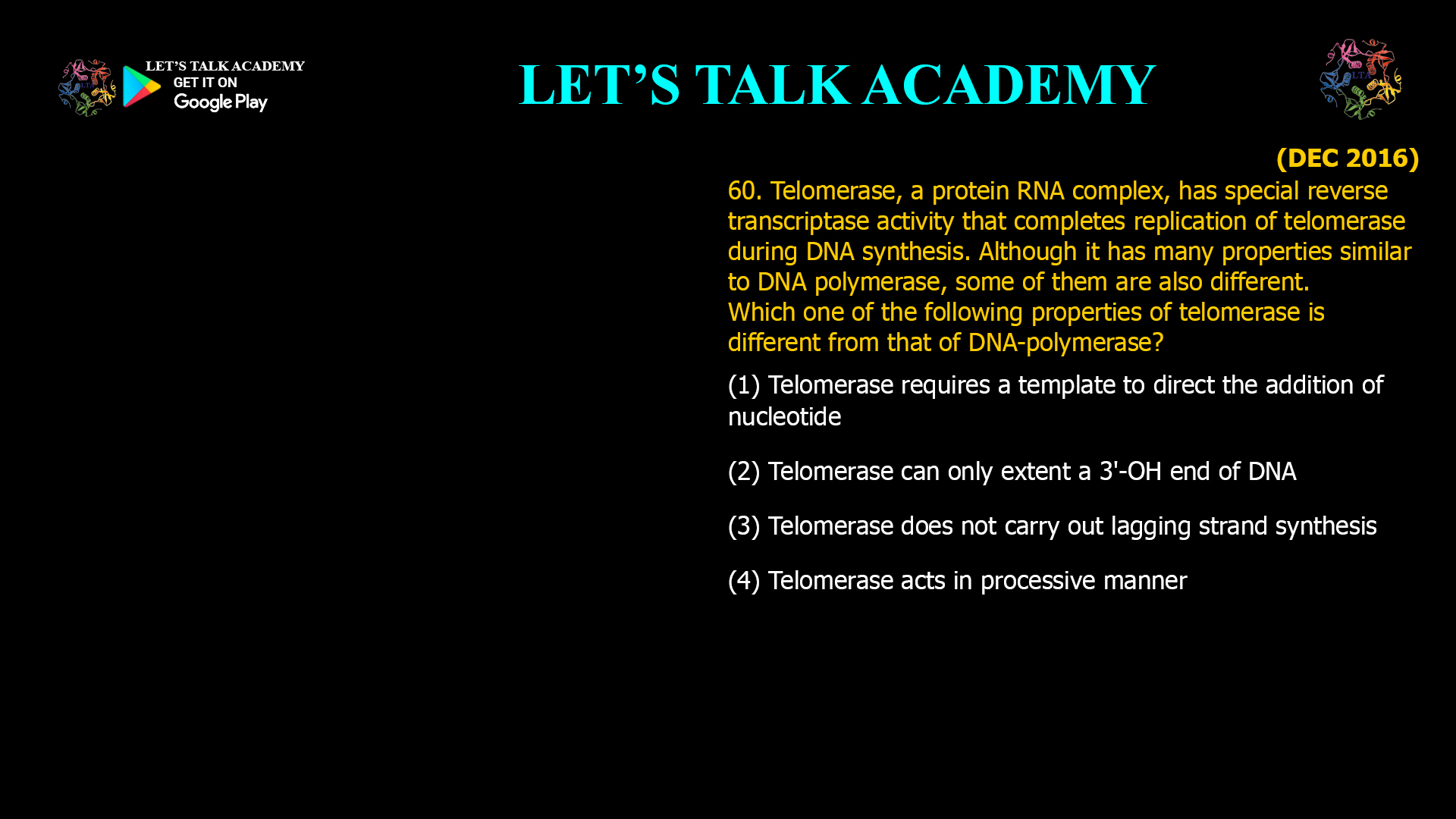
- Telomerase, a protein RNA complex, has special reverse transcriptase activity that completes replication of telomerase during DNA synthesis. Although it has many properties similar to DNA polymerase, some of them are also different. Which one of the following properties of telomerase is different from that of DNA-polymerase?
(1) Telomerase requires a template to direct the addition of nucleotide
(2) Telomerase can only extent a 3′-OH end of DNA
(3) Telomerase does not carry out lagging strand synthesis
(4) Telomerase acts in processive manner
Introduction
Telomerase is a specialized ribonucleoprotein enzyme complex that maintains chromosome ends (telomeres) in eukaryotic cells. While it shares many features with conventional DNA polymerases, such as extending DNA strands in a template-dependent manner, telomerase exhibits unique properties that set it apart. Understanding these differences is crucial for appreciating how telomerase solves the end-replication problem and contributes to cellular aging and cancer biology.
Key Differences Between Telomerase and DNA Polymerase
-
Template Requirement
-
Both telomerase and DNA polymerases require a template to direct nucleotide addition.
-
However, telomerase carries its own RNA template within the complex, which it uses to synthesize telomeric DNA repeats.
-
DNA polymerases use DNA templates exclusively.
-
-
Strand Extension Specificity
-
Both enzymes extend DNA strands at the 3′-OH end.
-
Telomerase specifically extends the 3′ end of the telomeric DNA strand, adding repetitive sequences.
-
-
Role in Lagging Strand Synthesis
-
DNA polymerases are involved in both leading and lagging strand synthesis during genome replication.
-
Telomerase does not participate in lagging strand synthesis; its function is restricted to elongating the 3′ overhang of the leading strand telomere.
-
-
Processivity
-
Telomerase acts in a processive manner, adding multiple telomeric repeats in a single binding event.
-
DNA polymerases also exhibit processivity but differ in mechanisms and accessory factors.
-
Which Property Is Different?
-
Option (3): Telomerase does not carry out lagging strand synthesis is the property that distinctly differs from DNA polymerases, which replicate both strands.
Explanation of Other Options
-
(1) Telomerase requires a template to direct nucleotide addition:
True for both telomerase (RNA template) and DNA polymerase (DNA template). -
(2) Telomerase can only extend a 3′-OH end of DNA:
True for both enzymes. -
(4) Telomerase acts in a processive manner:
Also true; telomerase adds multiple repeats before dissociating.
Final Answer
(3) Telomerase does not carry out lagging strand synthesis
Keywords
telomerase, DNA polymerase, RNA template, telomere extension, lagging strand synthesis, reverse transcriptase, telomere maintenance, processivity, end-replication problem
Conclusion
Telomerase shares many functional similarities with DNA polymerases, such as template-directed DNA synthesis and processive activity. However, a key distinguishing feature is that telomerase does not participate in lagging strand synthesis during DNA replication. Instead, it uniquely extends the 3′ end of telomeres using its intrinsic RNA template, thereby maintaining chromosome integrity and preventing shortening during cell division.


22 Comments
Manisha choudhary
July 29, 2025Done sir you are great sir 👍🏻 outstanding question and unka explanation
Godzilla of life science
Telomerase ribonucleoprotein h jo template dependent manner m kaam krta h pr iska khud kaa template hota h rna ki form h
Y reverse transcriptase hota h jo rna s dna bnata h
3′ end ko extend krta h pr y leading strand k 3′ overhang ko extend krne k restricted h
Lagging strand ko nhi krta h processive manner m kaam krta short dna repeates bnata h (mostly vertebrates m TTAGGG)
Surbhi Rajawat
July 29, 2025Option 3 is the difference between telomerase and DNA polymerase because there is nothing like lagging strand in case of telomerase
Mansukh Kapoor
July 30, 2025The correct answer is option 3rd because telomerase works on the both the strands lagging and leading strand
Soniya Shekhawat
July 30, 2025Telomerase does not participate in a lagging stand synthesis during DNA replication it is a main difference between DNA polymerase and telomerase so 3 is correct option
anurag giri
July 30, 2025Ans3 bcoz dna polymerase synthesis both dna strand but Telomerase does not participate in lagging strand synthesis
Kajal
July 30, 2025Option 3 is right
Telomerase don’t carry lagging strand synthesis
Santosh Saini
July 30, 2025Telomerase does not carry out lagging strand synthesis during DNA replication, this feature different from DNA polymerase which replicate both strands
Pratibha Sethiya
July 30, 2025Correct option is option (3)
Telomerase does not carry out lagging strand synthesis is the property that distinctly differs from DNA polymerases, which replicate both strands.
Anisha jakhar
July 30, 2025Option 3 is correct.
Vanshika Sharma
July 30, 2025Opt 3 is correct bcz telomerase does not carry out lagging strand and dna pol can carry out both the strand
Priya khandal
July 30, 20253 is right sir
Priti Khandal
July 30, 2025Option 3is correct
Khushi Agarwal
July 31, 2025Option 3 is different from dna pol
Statement 3 is right about telomerase it works only leading strand
But different from dna pol bcz dna pol works on lagging strand
Khushi Vaishnav
July 31, 2025Option 3 is correct because Telomerase does not participate in lagging strand synthesis. Its function is restricted to elongating the 3′ overhang of the leading strand telomere.
Aafreen
July 31, 2025Ans-3 bcoz Telomerase does not part in lagging strand
Alec Joseph
July 31, 2025correct ans is 3 because telomerase doesn’t carry out lagging strand synthesis whereas DNA polymerase carry out both strand synthesis.
Dharmpal Swami
August 1, 2025Telomerase do not synthesis legging strand
shruti sharma
August 1, 2025ans – 3
Mohini
August 3, 2025done sir
Varsha Tatla
August 3, 2025Correct answer is 3 bcz all giving information are correct instead of statement 3
Anita choudhary
August 23, 2025Option 3 is correct because
Telomerase doesn’t carry out lagging strand synthesis and dna pol can carry out both the strand
Deepika Sheoran
November 7, 2025Because telomerase doesn’t carry out lagging strand synthesis wherease DNA polymerase carry out both strand synthesis.