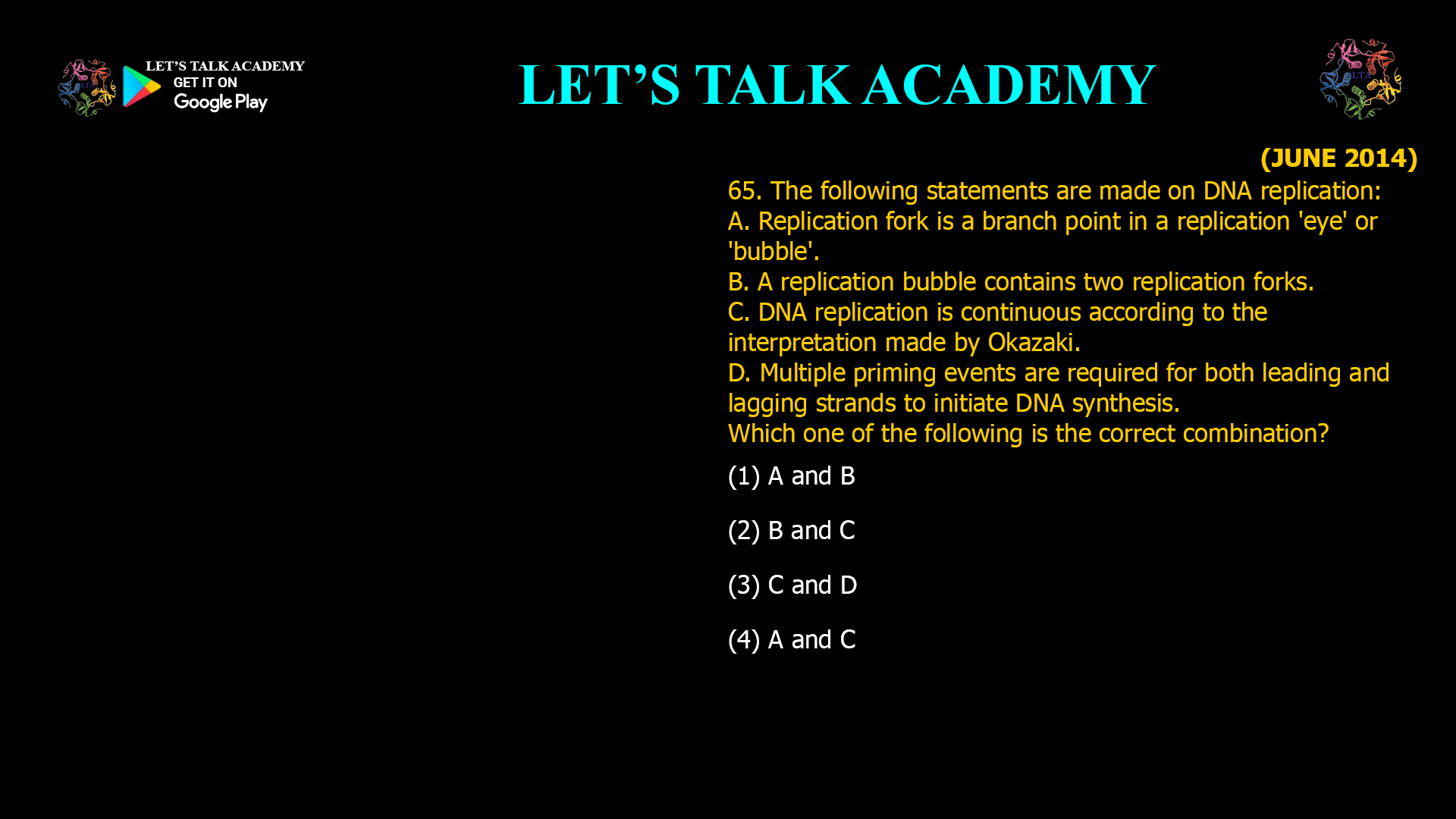
65. The following statements are made on DNA replication:
A. Replication fork is a branch point in a replication ‘eye’ or ‘bubble’.
B. A replication bubble contains two replication forks.
C. DNA replication is continuous according to the interpretation made by Okazaki.
D. Multiple priming events are required for both leading and lagging strands to initiate DNA synthesis.
Which one of the following is the correct combination?
(1) A and B
(2) B and C
(3) C and D
(4) A and C
Analysis of the Statements
A. Replication fork is a branch point in a replication ‘eye’ or ‘bubble’.
-
True. A replication bubble is formed when helicase unwinds DNA, creating two replication forks at each end of the bubble. The fork is the Y-shaped branch point where DNA synthesis occurs on both strands.
B. A replication bubble contains two replication forks.
-
True. Each replication bubble has two replication forks moving outward in opposite directions, enabling bidirectional replication.
C. DNA replication is continuous according to the interpretation made by Okazaki.
-
False. Okazaki’s work demonstrated that DNA replication is discontinuous on the lagging strand, occurring in short fragments (Okazaki fragments), while it is continuous on the leading strand.
D. Multiple priming events are required for both leading and lagging strands to initiate DNA synthesis.
-
False. Multiple priming events are required only for the lagging strand due to its discontinuous synthesis. The leading strand requires only a single priming event at the origin.
Correct Combination of Statements
-
(1) A and B
Supporting Details
-
Replication Bubble and Fork:
The replication bubble is the unwound region of DNA where replication occurs, and it contains two replication forks at its ends. These forks are sites where DNA polymerases and other replication proteins assemble and synthesize new DNA strands. -
Okazaki Fragments and Discontinuous Synthesis:
Okazaki fragments are short DNA segments synthesized discontinuously on the lagging strand, requiring repeated priming. The leading strand is synthesized continuously.
Keywords
replication fork, replication bubble, Okazaki fragments, DNA replication continuity, lagging strand synthesis, DNA priming, bidirectional replication, DNA helicase, DNA polymerase
Conclusion
The replication fork is the branch point of the replication bubble, and each bubble contains two forks, enabling bidirectional DNA replication. Okazaki’s interpretation clarified that DNA replication is continuous on the leading strand but discontinuous on the lagging strand. Multiple priming events are necessary only on the lagging strand, not both strands.
Final answer:
(1) A and B


30 Comments
Priya khandal
July 27, 2025Yes sir
Shivani .
July 29, 2025Option A and B are correct
Replication fork forms when helicase unwind the DNA and each bubble contains 2 forks .
Okazaki fragments forms on legging strand that is discontinuous so only legging strand needs multipal priming event …so option 3 and 4 are incorrect
Monika jangid
July 29, 2025Yes A and B statement are right bcoz helicase unwind dna and bubble makes 2 forks
Surbhi Rajawat
July 29, 2025Only option A and B are correct.
Ankita Pareek
July 29, 2025There is no requirement of multiple primers in leading strand synthesis and interpretation made by okazaki was..dna replication is discontinuous on lagging strand
Option a and b is correct
Sonam Saini
July 29, 2025A and B is Right answer because
A me dna replication ke time me dna double standard hota h and y structure made krta h jise raplicative frok kha jata h raplicative ya frok raplicative bubble ke end pr hote h
B in double direction hoti h raplicative bubble ke dono end’s pr two raplicative bubble frok par appositive direction me aage jata h so right answer a and b
Mitali
July 30, 2025Answer is (1) A and B
Ajay Sharma
July 30, 2025a and b are correct set of combination…
Juber Khan
July 30, 2025Statement a and b is right bcz leading strand requir only single priming event but statement c and d wrong bcs multiple priming event necessary only on lagging strand
Lagging strand= okazaki fragments= discontinuous
Mansukh Kapoor
July 30, 2025The correct answer is option 1st
That replication bubble have 2 replication forks and replication fork is the eye of bubble
anurag giri
July 30, 2025Ans 1 bcoz Replication fork is a branch point in a replication ‘eye’ or bubble and replication bubble contains two replication forks.
Khushi Vaishnav
July 30, 2025The replication bubble or eye is the unwound region of DNA and it contains 2 replication forks at its ends. So that’s why a and b are the correct combination
Soniya Shekhawat
July 30, 2025Aand B IS ONLY CORRECT
Kajal
July 30, 2025Option 1 st is right
Because a bubble is formed when Dna unwindes and a replication bubble contains two replication fork
Santosh Saini
July 30, 2025Statement A and B (option 1st) correct when helicase unwinds the DNA replication fork form and each bubble contain two fork for bidirectional DNA replication.
Anisha jakhar
July 30, 2025Correct statements are A and B as replication fork is a branch point in replication bubble and the bubble contains two forks.
Niti Tanwar
July 30, 2025A and B is correct
Manisha choudhary
July 30, 2025Done sir 👍🏻
Helicase DNA ko outward opposite direction m unwind krta h jis s bidirectional replication hota h
DNA unwinding se replication bubble banta h
Replication bubble m Y shape replication fork hoti h
Ek replication bubble m 2 fork hoti h
Leading strand p primase ek baar primer bna k jata h y continuous replicate hoti h
Lagging strand pr multiple times primase primer bna k jata h then DNA polymerase DNA bnata h lagging strand p okazaki fragments bante h jo ki discontinues replication ko btate h
Payal Gaur
July 31, 2025Option A and B in replication bubble two replication fork present.
Khushi Agarwal
July 31, 2025A and b statement are correct bcz rep fork is a branch point ,
B rep bubble contains 2 rep fork bcz replication is bidirectional
Vanshika Sharma
July 31, 2025Yes correct answer is 1 bcz rep fork is a bubble and bubble contains 2 rep fork that’swhy rep occur bidirectional
Alec Joseph
July 31, 2025correct ans is (1) – A and B because DNA replication is discontinuous in lagging strand and multiple priming events are required for lagging strand because it has discontinuous synthesis.
Dharmpal Swami
August 1, 2025Write answer a &b
Dharmpal Swami
August 1, 2025Write answer a &b
shruti sharma
August 2, 2025correct option a and b
Mohini
August 3, 2025A & B correct options. When DNA unwinds in bidirectional replication, it forms two replication forks (branch points). And in replication, two strands are formed.
1. leading strand (continuous strand)
2. lagging strand (discontinuous, Okazaki fragments)
Mahima Sharma
August 3, 20251st option (a and b)
Anjani sharma
August 5, 2025CORRECT OPTIONS WOULD BE A AND B ONLY
Aafreen Khan
August 23, 2025Only option A and B are correct
Deepika Sheoran
November 7, 2025Because replication bubble two replication fork present.