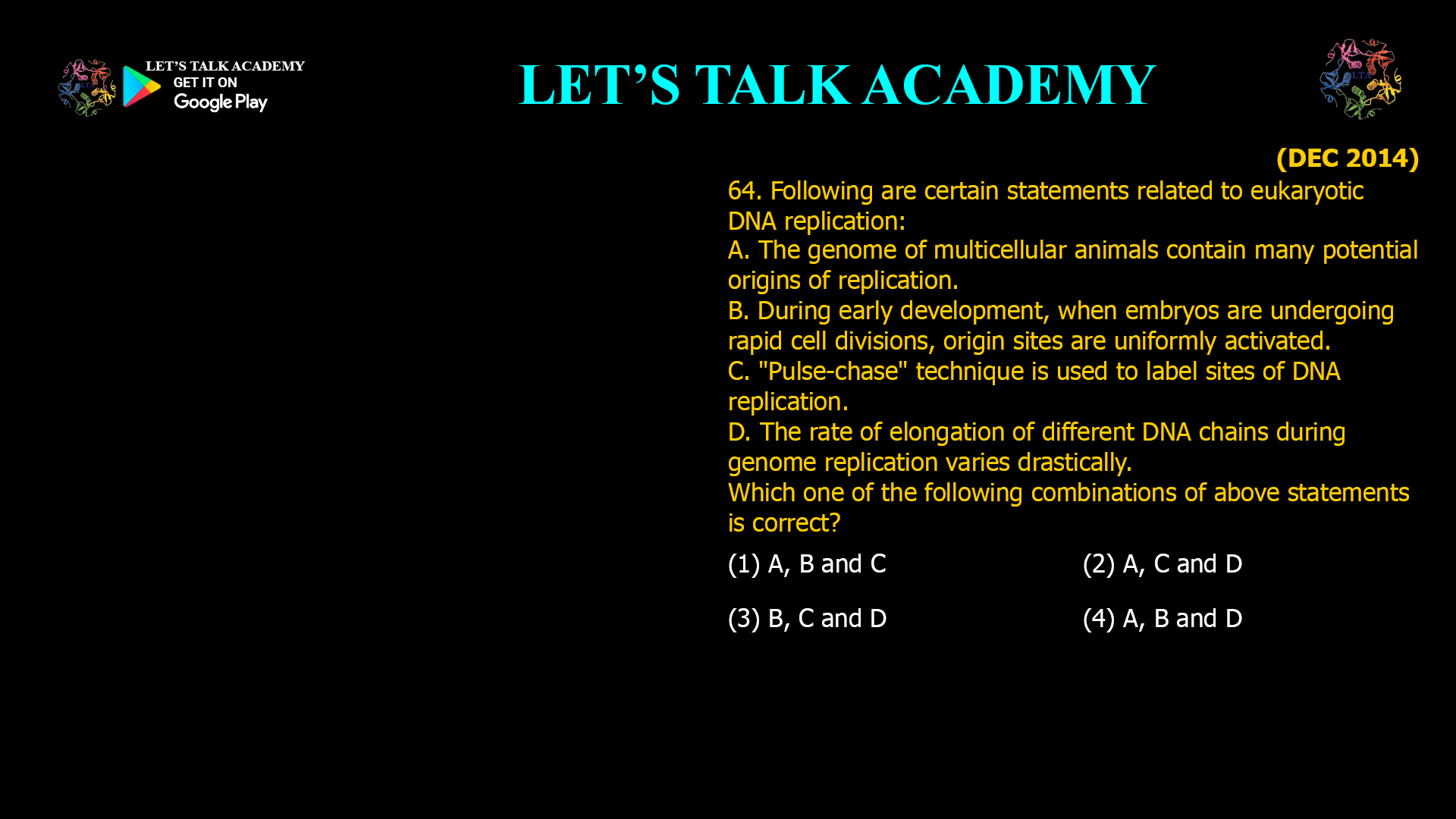
- Following are certain statements related to eukaryotic DNA replication:
- The genome of multicellular animals contain many potential origins of replication.
- During early development, when embryos are undergoing rapid cell divisions, origin sites are uniformly activated.
- “Pulse-chase” technique is used to label sites of DNA replication.
- The rate of elongation of different DNA chains during genome replication varies drastically.
Which one of the following combinations of above statements is correct?
(1) A, Band C (2) A, C and D
(3) B, c and D (4) A, B and D
Evaluation of Each Statement
A. The genome of multicellular animals contains many potential origins of replication.
-
True. Eukaryotic genomes, especially in multicellular organisms, have multiple potential replication origins distributed across chromosomes. These origins are often organized into large domains and can be activated in a regulated manner during S phase.
B. During early development, when embryos undergo rapid cell divisions, origin sites are uniformly activated.
-
True. In early embryonic cells, DNA replication origins tend to be activated more uniformly and frequently to accommodate rapid cell cycles with shortened gap phases.
C. “Pulse-chase” technique is used to label sites of DNA replication.
-
True. Pulse-chase experiments with labeled nucleotides are classical methods to study DNA replication dynamics, allowing visualization of replication forks and timing of replication.
D. The rate of elongation of different DNA chains during genome replication varies drastically.
-
False. While replication timing varies across the genome, the rate of elongation (fork progression speed) is generally consistent within a cell type and does not vary drastically between DNA chains. Variability is more in origin firing timing rather than elongation rate.
Correct Combination of Statements
(1) A, B and C
Summary Table
| Statement | Correctness | Explanation |
|---|---|---|
| A | True | Multiple potential origins exist in multicellular genomes |
| B | True | Uniform origin activation during rapid early embryonic divisions |
| C | True | Pulse-chase labeling is used to study replication sites |
| D | False | Elongation rates are relatively uniform, not drastically variable |
Keywords
eukaryotic DNA replication, replication origins, origin activation, pulse-chase labeling, replication fork elongation, embryonic cell cycles, replication timing, DNA synthesis dynamics
Conclusion
Eukaryotic DNA replication involves multiple potential origins per chromosome, with uniform origin activation during rapid early embryonic divisions. Pulse-chase labeling remains a key technique to study replication dynamics. However, the elongation rate of replication forks is generally consistent and does not vary drastically across different DNA chains. Therefore, statements A, B, and C are correct, while D is incorrect.
Final answer:
(1) A, B and C


11 Comments
Mitali Saini
July 30, 2025Answer is (1) A, B and C
Soniya Shekhawat
July 30, 2025In multicellular organism have a multiple ARS, in early embryo development uniform origin activation during rapid cell division and phase chase techniques is used to study replication so option A,B,C is correct
Swati Choudhary
July 30, 2025Read explanation sir!!
Kajal
July 30, 2025Option 1 is right
Santosh Saini
July 30, 2025Option 1st is right ( statement A, B, C)
Manisha choudhary
July 30, 2025Eukaryotes m multiple potential ARS present hote h
Embryonic stage m early development m rapid cell devision karwane k liye ori uniformly and frequently distributed hoti h
Pulse chase technique DNA replication k detection k liye hoti h
Is s replication timing and replication fork ko identify kr skte h
Elongation ( fork progression rate ) ki rate same hoti h
Origin firing ki rate vary kr skti h
Aafreen
July 31, 2025Ans -1 A,B and C are correct and D is incorrect
Dharmpal Swami
August 1, 2025A ,B And C are write
Mohini
August 3, 2025option 1: A, B, C
Varsha Tatla
August 3, 2025Ekes have multiple origin site
At early embryonic development for rapid cell division origin site of ekes is uniformly n frequently distributed
In replication, elongation rate remain same only origin firing or initiation rate varies
Deepika Sheoran
November 7, 2025Option 1st is correct