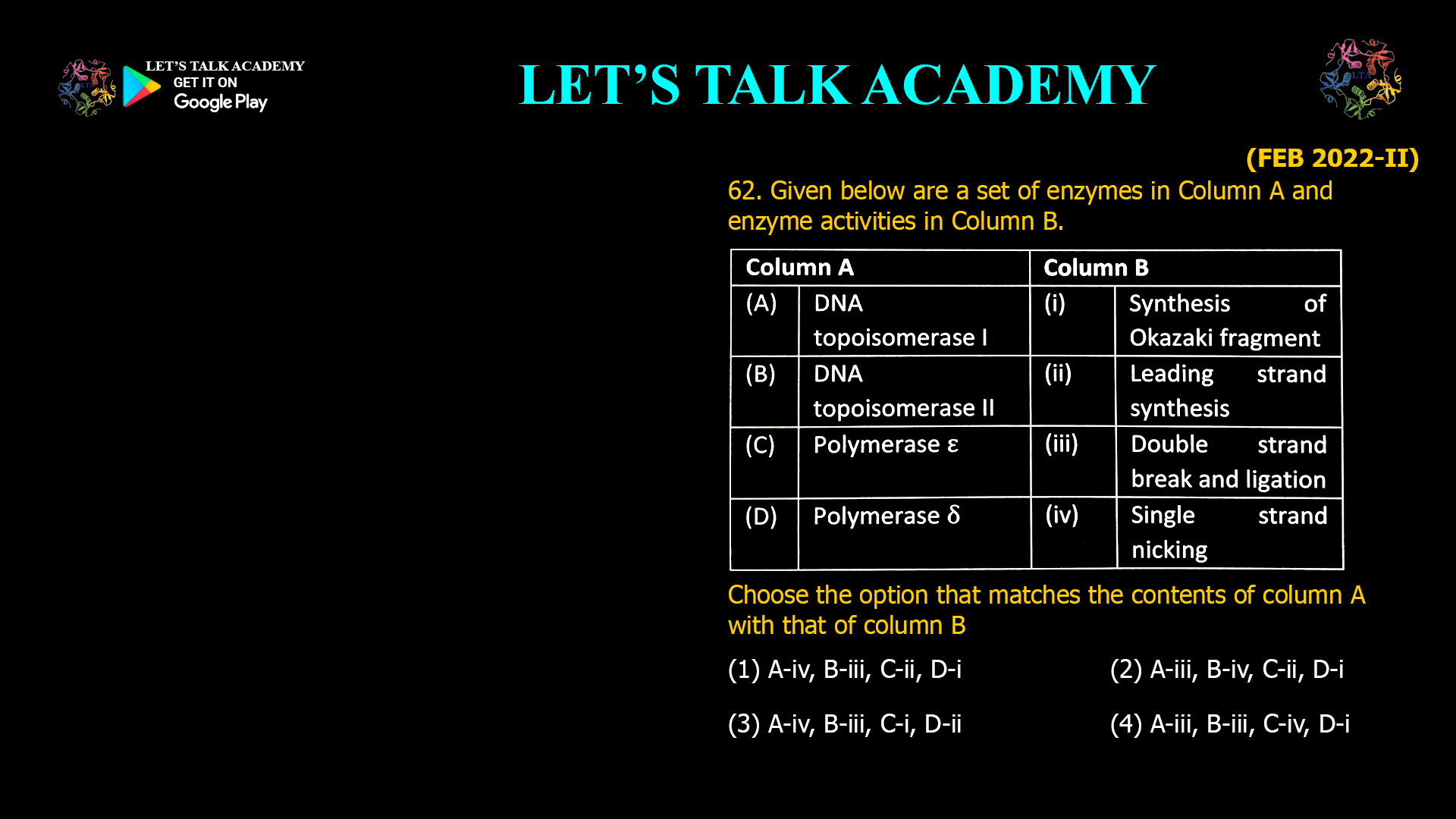
- Given below are a set of enzymes in Column A and enzyme activities in Column B.Column A Column B
(A) DNA (i) Synthesis of
topoisomerase I Okazakifragment
(B) DNA (ii) Leading strand
topoisomerase II synthesis
(C) Polymerase ϵ (iii) Double strand
break and ligation
(D) Polymerase Delta (iv) Single strand
(Ꟙ) nickingchoose the option that matches the contents of column A with that of column B
(1) A-iv, B-iii, C-ii, D-i (2) A-iii, B-iv, C-ii, D-i
(3) A-iv, B-iii, C-i, D-ii (4) A-iii, B-iii, C-iv, D-i
Overview of Enzymes and Their Activities
| Column A (Enzyme) | Column B (Activity) |
|---|---|
| (A) DNA Topoisomerase I | (iv) Single strand nicking |
| (B) DNA Topoisomerase II | (iii) Double strand break and ligation |
| (C) Polymerase ε | (ii) Leading strand synthesis |
| (D) Polymerase δ | (i) Synthesis of Okazaki fragments |
Explanation of Each Enzyme’s Function
-
DNA Topoisomerase I (A):
-
Introduces transient single-strand nicks in DNA to relieve supercoiling during replication and transcription.
-
Does not require ATP and acts by cutting one strand, allowing rotation, and re-ligating.
-
-
DNA Topoisomerase II (B):
-
Introduces double-strand breaks to manage DNA tangles and supercoils, especially during chromosome segregation.
-
Requires ATP and can decatenate intertwined DNA molecules.
-
-
DNA Polymerase ε (C):
-
Responsible for leading strand synthesis during eukaryotic DNA replication.
-
Highly processive and has proofreading activity.
-
-
DNA Polymerase δ (D):
-
Synthesizes the lagging strand by creating Okazaki fragments.
-
Also highly processive with proofreading function.
-
Correct Matching Option
(1) A-iv, B-iii, C-ii, D-i
Summary Table
| Enzyme | Activity |
|---|---|
| DNA Topoisomerase I | Single strand nicking (iv) |
| DNA Topoisomerase II | Double strand break and ligation (iii) |
| DNA Polymerase ε | Leading strand synthesis (ii) |
| DNA Polymerase δ | Synthesis of Okazaki fragments (i) |
Keywords
DNA topoisomerase I, DNA topoisomerase II, DNA polymerase epsilon, DNA polymerase delta, single strand nicking, double strand break, leading strand synthesis, Okazaki fragments, lagging strand synthesis, DNA replication enzymes
Conclusion
DNA topoisomerase I and II and DNA polymerases ε and δ have distinct and critical roles during DNA replication. Topoisomerase I relaxes supercoils by single-strand nicking, while topoisomerase II manages double-strand breaks and decatenation. Polymerase ε synthesizes the leading strand continuously, and polymerase δ synthesizes the lagging strand discontinuously via Okazaki fragments. The correct matching of these enzymes to their activities is:
(1) A-iv, B-iii, C-ii, D-i
Final Answer:
(1) A-iv, B-iii, C-ii, D-i


27 Comments
Khushi agarwal
July 29, 2025Option a is correct
Manisha choudhary
July 29, 2025Done sir 👍🏻
Topoisomerase -1 single strand m nick form krta h supercoiling ko relieve krne k liye
Y cut krta h dna ko rotate hone deta h and then ligate kr deta h
At
TP ki need nhi hoti h
Topoisomerase -2 ATP ki need hoti h
DNA tangled and supercoiling ko relive k liye hota h
Even y chromosome segregation k time p bhi hota h
Y kuch jagah p dna ke molecule jyada guthe ho too unhe vighatit
Kr deta h
DNA polymerase delta lagging strand bnata h
Leading strand DNA polymerase epsilon bnata h
anurag giri
July 29, 2025Option 1 is correct
Surbhi Rajawat
July 29, 2025Option 1 is the answer.
Mitali Saini
July 30, 2025Option A is correct
Mansukh Kapoor
July 30, 2025The correct answer is option 1st
Topo 1 —- leads to synthesis of nick in ss
Topo 2—- breaks strands and ligate’s it
Pol epsilon —leads the synthesis of leading strand
Pol delta —leads to synthesis of okazaki fragments
Juber Khan
July 30, 2025Option (1) right ans
Lagging strand= okazaki fragments= poly.§
Leading strand = poly.€
Topoisomerase 1 =function in single stand neaking
Khushi Vaishnav
July 30, 2025Option 1 is correct
Swati Choudhary
July 30, 2025It was easy answer is option 1st.
Swati Choudhary
July 30, 2025It was easy answer is option 1st.
Divya rani
July 30, 20251st is the right answer
Soniya Shekhawat
July 30, 2025Option 1 is correct
Kajal
July 30, 2025Option 1 is correct
Santosh Saini
July 30, 2025Option 1st is correct( topoisomerase 1 is responsible for nick formation in ss and 2nd cut both strands, polymerase delta for lagging strand discontinuous, pol. psilon for leading continuous strand synthesis
Anisha jakhar
July 30, 2025Option a is correct
Payal Gaur
July 31, 20251. Correct
Vanshika Sharma
July 31, 2025Option 1 is correct
Aafreen
July 31, 2025Ans-1
Alec Joseph
July 31, 2025correct ans is option 1.
Dharmpal Swami
August 1, 2025First option write
shruti sharma
August 1, 2025option 1 is right
Mohini
August 3, 2025The correct answer is 1.
Topoisomerase I forms a single-stranded nick
Topoisomerase II forms double double-strand nick
pol delta synthesizes lagging strand
pol epsilon synthesizes the leading strand
Mahima Sharma
August 3, 20251 is correct
Anjani sharma
August 5, 2025Answer 1 would be correct
Deepika sheoran
August 7, 2025Option 1st is correct answer.
Anita choudhary
August 23, 2025Topoisomerase l forms single strand nick
Topoisomerase ll forms double strand nick
Polymerase epsilon synthesis leading strand
Polymerase delta synthesis lagging strand
Deepika Sheoran
November 7, 2025Option 1st is correct