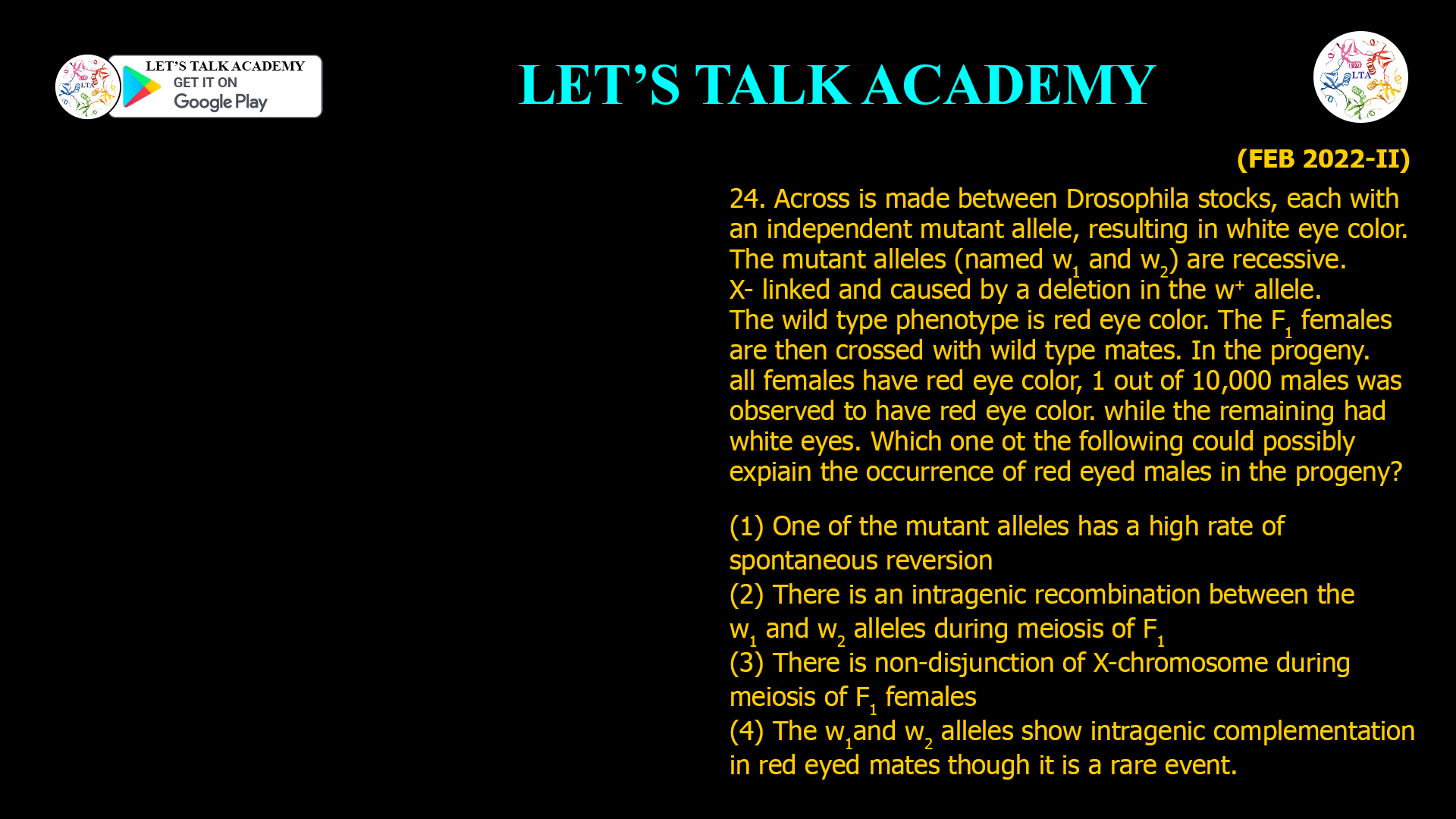
24. Across is made between Drosophila stocks, each with an independent mutant allele, resulting in white eye color. The mutant alleles (named w1 and w2) are recessive. X- linked and caused by a deletion in the w+ allele. The wild type phenotype is red eye color. The F1 females are then crossed with wild type mates. In the progeny. all females have red eye color, 1 out of 10,000 males was observed to have red eye color. while the remaining had white eyes. Which one ot the following could possibly expiainthe occurrence of red eyed males in the progeny?
(1) One of the mutant alleles has a high rate of spontaneous reversion
(2) There is an intragenic recombination between the w1 and w2 alleles during meiosis of F1
(3) There is non-disjunction of X-chromosome during meiosis of F1 females
(4) The w1and w2 alleles show intragenic complementation in red eyed mates though it is a rare event.
Genetic setup
-
Gene: w (white); wild type w+ = red eyes.
-
Two mutant alleles w1 and w2:
-
Recessive, X‑linked.
-
Each caused by a deletion in different parts of the w+ gene (non‑overlapping).
-
-
Cross: w1 stock × w2 stock → F₁ females w1/w2 (both mutant alleles on their two X chromosomes).
-
These F₁ females are then mated with wild‑type males w+/Y.
-
Progeny result:
-
All females are red (they all receive at least one w+ from the father).
-
Among males, almost all are white, but ~1 in 10,000 is red.
-
A male is hemizygous (X/Y). For a male to be red‑eyed, his X must carry a functional w+ allele. Since the mothers are w1/w2 and don’t carry a normal w+, the only way to get a red‑eyed son is to recreate a functional w+ by a rare event in the mother’s meiosis.
Why intragenic recombination explains it (option 2)
-
The two mutant alleles carry deletions in different parts of the w gene.
-
During meiosis in an F₁ female, crossing over within the w gene between the w1 and w2 chromosomes can exchange segments.
-
A reciprocal intragenic crossover can produce:
-
One recombinant chromosome carrying a complete functional w sequence (restored w+).
-
The other with a larger deletion (double mutant).
-
-
If the recombinant w+ chromosome is transmitted to a son (with Y from his father), he will be w+/Y → red‑eyed male.
-
Such intragenic recombination events are rare, matching the observed low frequency (~10⁻⁴).
Therefore, intragenic recombination between w1 and w2 in F₁ females best explains the rare red‑eyed males.
Why the other options are unlikely
-
One mutant has a high rate of spontaneous reversion
-
Deletion mutations have very low true reversion rates; restoring precisely deleted DNA is extremely improbable.
-
Even if one allele reverted, F₁ females would have more opportunities to pass w+ and the frequency of red‑eyed males would likely be different from a single rare intragenic crossover pattern. In classical white locus experiments, recombination between deletions, not reversion, explains such rare wild types.
-
Non‑disjunction of X‑chromosome in F₁ females
-
Non‑disjunction affects sex chromosome number (e.g., XXY, XO) and typically alters sex ratios or produces exceptional classes (e.g., metafemales or XO males).
-
It does not recreate a functional w+ allele; the X chromosomes still carry w1 or w2, so XO or XXY individuals would still show white eyes if they lack w+.
-
Thus it cannot explain specifically a rare red‑eyed male among otherwise normal broods.
-
Intragenic complementation between w1 and w2 in males
-
Intragenic complementation requires two different mutant polypeptides produced in the same cell to partially restore function.
-
A male has only one X chromosome, thus only one allele of w (either w1 or w2), so he cannot simultaneously express both mutant products; complementation cannot occur in hemizygous males.
-
Therefore, intragenic complementation cannot explain red‑eyed males.
Hence, the rare red‑eyed males are best explained by intragenic recombination between the w1 and w2 alleles in F₁ females (option 2).


