
1. Introduction
The eukaryotic genome is organized into chromatin, a complex composed primarily of DNA and associated proteins. Chromatin is not uniformly arranged throughout the nucleus. Some regions remain relatively open and accessible, whereas others exist in a more compact and less accessible state.
The compact form of chromatin is known as heterochromatin.
Heterochromatin is generally characterized by:
- High degree of chromatin compaction
- Reduced accessibility of DNA
- Low transcriptional activity
- Enrichment of repetitive DNA in many regions
- Specific histone modifications
- DNA methylation in many contexts
- Association with specialized chromatin proteins
However, heterochromatin is not simply “inactive DNA.” It performs important structural, regulatory, and genome-protective functions.
A simplified concept is:
DNA → Nucleosomes → Chromatin compaction → Heterochromatin → Gene regulation + Genome stability
2. Definition of Heterochromatin
Heterochromatin is a relatively condensed and transcriptionally restricted form of chromatin that remains more compact than euchromatin.
The term was introduced from cytological observations in which certain chromosome regions remained strongly stained and condensed compared with other regions.
Heterochromatin is particularly important in regions such as:
- Centromeres
- Pericentromeric regions
- Telomeres
- Repetitive DNA-rich regions
- Certain developmentally silenced genomic regions
3. Basic Properties of Heterochromatin
Important characteristics of heterochromatin include:
| Property | General characteristic |
|---|---|
| Compaction | High |
| DNA accessibility | Relatively low |
| Transcription | Generally reduced |
| Repetitive DNA | Often enriched |
| DNA methylation | Frequently associated |
| Histone modifications | Characteristic repressive marks |
| Replication timing | Often late |
| Nuclear organization | Often associated with specialized nuclear compartments |
These characteristics vary according to organism, cell type, developmental stage, and genomic location.
4. Heterochromatin and Euchromatin
Chromatin is commonly divided into two broad functional states:
- Euchromatin
- Heterochromatin
Euchromatin is generally more open and accessible, whereas heterochromatin is generally more compact.
| Feature | Euchromatin | Heterochromatin |
|---|---|---|
| Compaction | Relatively low | Relatively high |
| Accessibility | Higher | Lower |
| Transcription | Generally active | Generally restricted |
| Repetitive DNA | Usually less enriched | Often enriched |
| DNA methylation | Variable | Frequently high in many regions |
| Replication | Often earlier | Often later |
| Structural role | Regulatory | Strong structural role |
| Chromatin marks | Active-associated marks | Repressive-associated marks |
This distinction is useful but represents a simplified model because chromatin exists along a continuum of functional states.
5. Types of Heterochromatin
Heterochromatin is broadly divided into:
- Constitutive heterochromatin
- Facultative heterochromatin
These two forms differ in their stability, genomic distribution, and biological functions.
6. Constitutive Heterochromatin
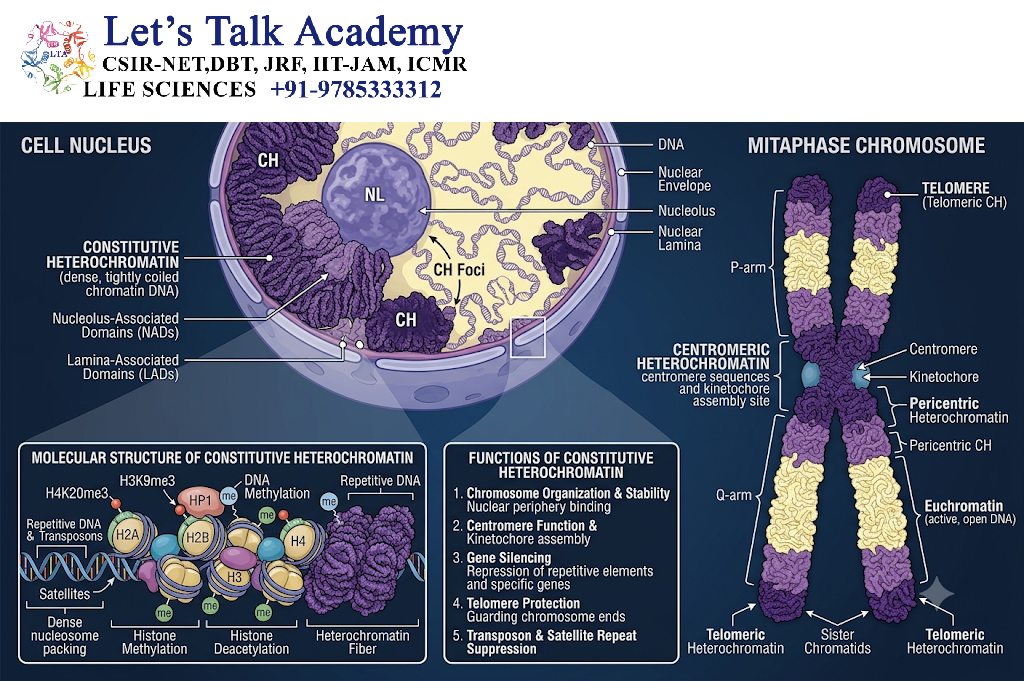
Constitutive heterochromatin remains relatively condensed in most cell types and developmental conditions.
It is generally associated with genomic regions that perform important structural functions rather than encoding large numbers of conventional protein-coding genes.
Common locations include:
- Centromeric regions
- Pericentromeric regions
- Telomeric and subtelomeric regions
- Repetitive DNA-rich regions
Constitutive heterochromatin is particularly important for chromosome structure and genome stability.
7. Molecular Features of Constitutive Heterochromatin
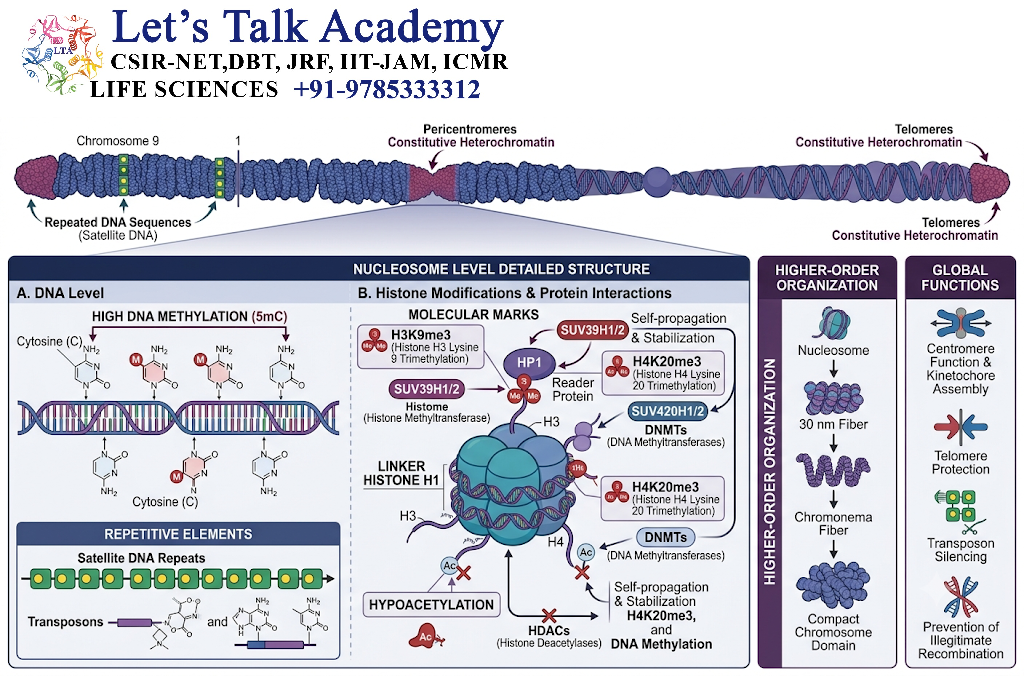
Constitutive heterochromatin commonly contains:
- Highly repetitive DNA
- Dense nucleosome organization
- DNA methylation
- Histone H3 lysine 9 methylation
- Heterochromatin protein 1
- Specialized chromatin-remodelling factors
A characteristic chromatin mark is H3K9me3, meaning trimethylation of lysine 9 on histone H3.
This modification is strongly associated with constitutive heterochromatin in many eukaryotic systems.
8. Facultative Heterochromatin

Facultative heterochromatin is chromatin that can switch between relatively inactive and active states.
Unlike constitutive heterochromatin, facultative heterochromatin is not necessarily permanently condensed.
Its formation may depend on:
- Developmental stage
- Cell type
- Gene regulatory requirements
- Environmental signals
- Epigenetic mechanisms
A classical example is the inactive X chromosome in female mammals.
9. X-Chromosome Inactivation
In female mammals, one of the two X chromosomes is largely transcriptionally silenced in somatic cells.
The inactive X chromosome undergoes extensive chromatin reorganization and forms a compact nuclear structure known as a Barr body.
The process involves several mechanisms, including:
- XIST long non-coding RNA
- Histone modifications
- DNA methylation
- Chromatin compaction
- Changes in three-dimensional chromosome organization
X-chromosome inactivation is therefore an important example of facultative heterochromatin formation.
10. Structural Organization of Heterochromatin
Heterochromatin organization occurs at several levels.
A simplified model is:
DNA
↓
Nucleosome formation
↓
Histone modification
↓
Recruitment of heterochromatin proteins
↓
Chromatin compaction
↓
Formation of heterochromatic domains
↓
Association with nuclear compartments
This organization restricts DNA accessibility and contributes to the functional identity of heterochromatic regions.
11. Nucleosomes in Heterochromatin
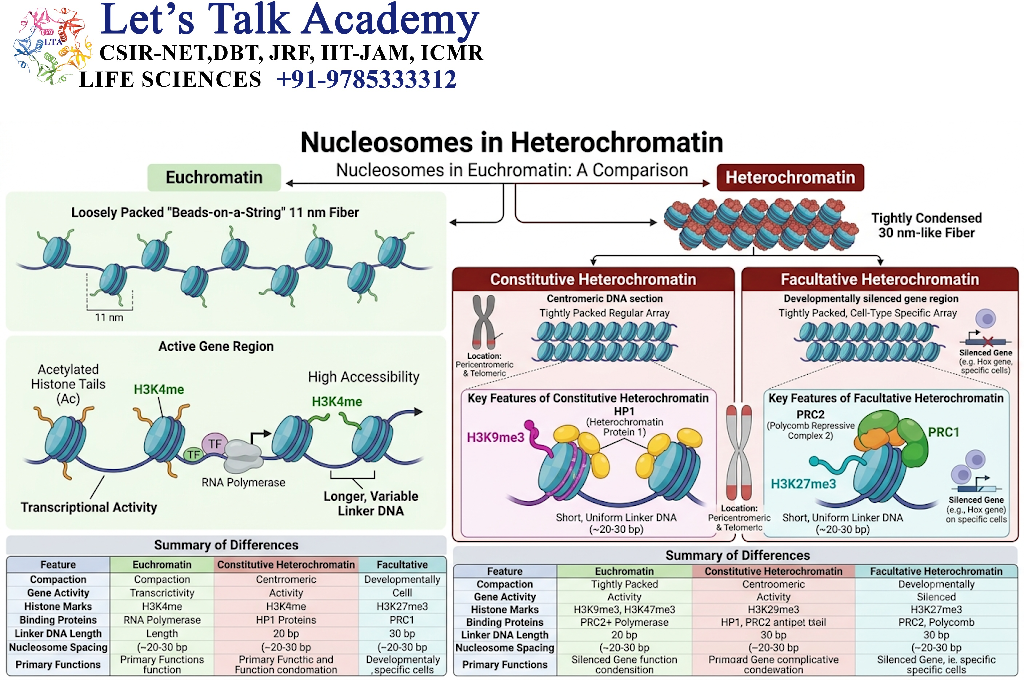
Nucleosomes are the fundamental units of chromatin.
In heterochromatic regions, nucleosome organization contributes to reduced DNA accessibility.
Nucleosome density and positioning can influence whether transcription factors and other DNA-binding proteins can interact with genomic DNA.
Therefore, nucleosome organization is an important component of heterochromatin-mediated regulation.
12. Histone Modifications in Heterochromatin
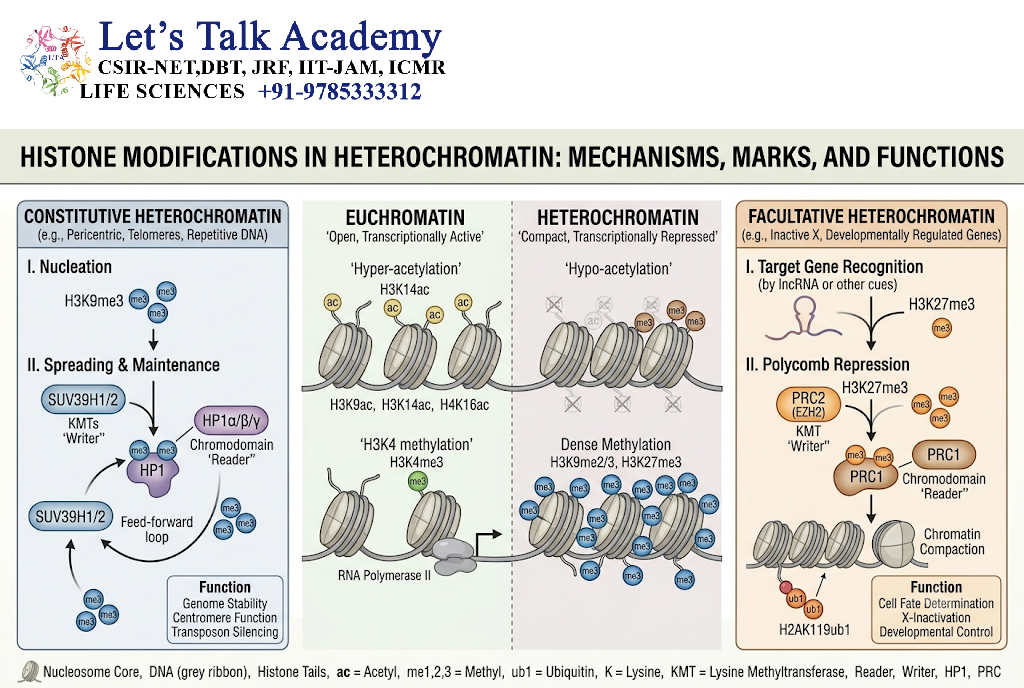
Histone modifications play a major role in establishing and maintaining heterochromatic states.
Important modifications include:
- H3K9me2
- H3K9me3
- H3K27me3
However, these modifications are associated with different types of repressive chromatin.
Among them, H3K9me3 is particularly characteristic of constitutive heterochromatin.
13. H3K9 Methylation

H3K9 methylation is one of the best-known molecular signatures of heterochromatin.
The lysine residue at position 9 of histone H3 can be:
- Monomethylated
- Dimethylated
- Trimethylated
H3K9me3 is strongly associated with compact heterochromatin.
This modification can be recognized by proteins containing chromodomain-related recognition modules, particularly HP1 proteins.
14. Heterochromatin Protein 1
Heterochromatin Protein 1 (HP1) is an important component of many heterochromatic regions.
HP1 can recognize H3K9 methylation and participate in the establishment and maintenance of compact chromatin.
HP1 proteins can interact with:
- Methylated histones
- Other chromatin proteins
- DNA-associated factors
- Nuclear structural components
Through these interactions, HP1 contributes to the organization and stability of heterochromatin.
15. DNA Methylation
DNA methylation is another important mechanism associated with heterochromatin.
In many eukaryotes, methyl groups are added primarily to cytosine residues.
DNA methylation can contribute to transcriptional repression through:
- Direct effects on DNA-binding proteins.
- Recruitment of methyl-DNA-binding proteins.
- Recruitment of chromatin-repressive complexes.
- Promotion of compact chromatin states.
DNA methylation therefore interacts with histone modifications to stabilize repressed genomic regions.
16. Interaction Between Histone Modification and DNA Methylation
Heterochromatin formation is usually not controlled by a single mechanism.
Instead, multiple molecular pathways cooperate.
A simplified model is:
DNA methylation
H3K9 methylation
HP1 recruitment
Chromatin compaction
↓
Stable heterochromatic state
These mechanisms can reinforce one another and maintain transcriptionally restricted regions.
17. Repetitive DNA and Heterochromatin
Heterochromatin is frequently enriched in repetitive DNA.
Examples include:
- Satellite DNA
- Tandem repeats
- Transposable-element-derived sequences
- Pericentromeric repeats
- Telomeric repeats
Repetitive sequences can potentially cause inappropriate recombination or genome instability. Their packaging into heterochromatin helps suppress unwanted activity and protects genome integrity.
18. Centromeric Heterochromatin
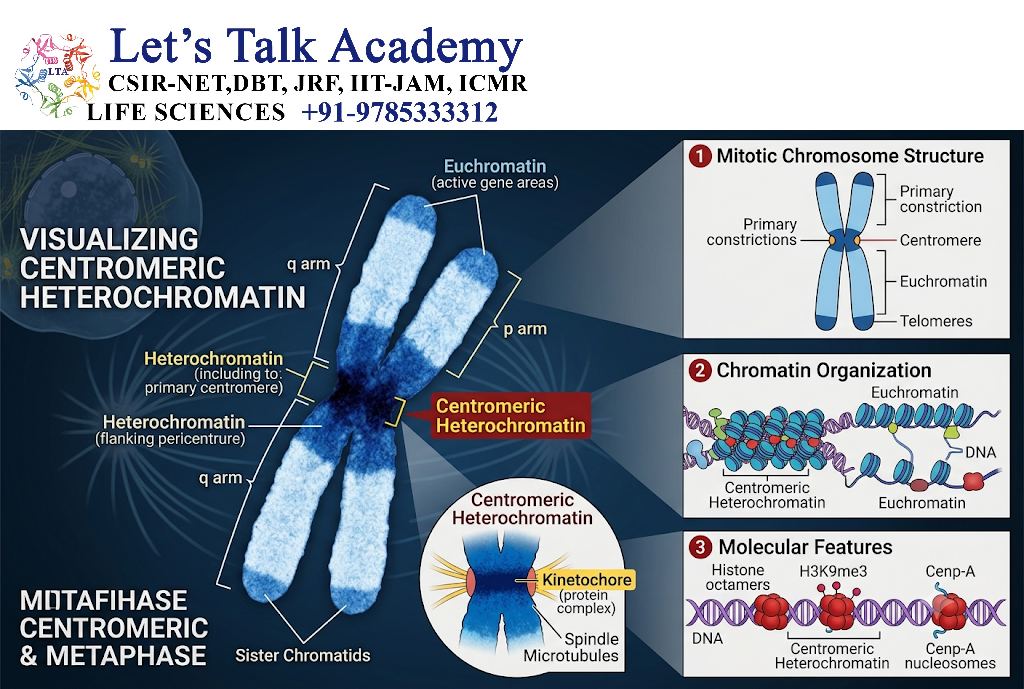
Centromeric regions contain specialized chromatin that is essential for chromosome segregation.
Pericentromeric regions are often rich in repetitive DNA and heterochromatic marks.
Centromeric chromatin interacts with specialized proteins and supports kinetochore assembly.
Thus, heterochromatin contributes directly to chromosome segregation and inheritance.
19. Pericentromeric Heterochromatin

Pericentromeric heterochromatin surrounds the centromere.
It is often enriched in repetitive DNA and repressive chromatin marks.
Its functions include:
- Maintaining chromosome architecture
- Supporting centromere function
- Suppressing inappropriate recombination
- Contributing to chromosome segregation
- Maintaining genome stability
20. Telomeric Heterochromatin

Telomeres are chromosome-end structures that protect chromosome termini.
Telomeric and subtelomeric regions can exhibit heterochromatic characteristics.
This compact organization helps:
- Protect chromosome ends
- Prevent inappropriate DNA repair responses
- Reduce chromosome-end fusion
- Maintain chromosome stability
21. Heterochromatin and Gene Silencing
One of the best-known functions of heterochromatin is transcriptional repression.
Compaction of chromatin can reduce access of:
- Transcription factors
- RNA polymerase-associated machinery
- Chromatin regulators
- Other DNA-binding proteins
Therefore:
Heterochromatin formation → reduced DNA accessibility → transcriptional restriction
However, not every heterochromatic region is completely transcriptionally silent.
22. Position Effect Variegation
Position effect variegation (PEV) is a phenomenon in which a normally active gene becomes variably silenced when positioned close to heterochromatin.
Some cells may express the gene, whereas others may silence it.
This creates a variegated pattern of gene expression.
PEV demonstrates that the chromatin environment surrounding a gene can strongly influence its activity.
23. Heterochromatin Spreading
Once heterochromatin is established, repressive chromatin features can sometimes spread into neighboring genomic regions.
A simplified model is:
Initial nucleation site
↓
Repressive histone modification
↓
Recruitment of chromatin proteins
↓
Modification of neighboring nucleosomes
↓
Propagation of heterochromatic state
This spreading is controlled by boundary elements and other regulatory mechanisms so that heterochromatin does not silence the entire genome.
24. Boundary Elements
Boundary or insulator elements can help separate heterochromatic and euchromatic regions.
They may prevent the inappropriate spread of repressive chromatin into active genomic regions.
These boundaries contribute to the maintenance of distinct chromatin domains.
25. Heterochromatin and Transposable Elements
Transposable elements can move or generate copies within genomes.
Uncontrolled transposable-element activity can cause:
- Mutations
- Genome rearrangements
- Insertional disruption
- Chromosome instability
Heterochromatin contributes to the silencing of many transposable elements.
This makes heterochromatin an important component of genome defense.
26. Heterochromatin and Genome Stability
Genome stability refers to the ability of cells to maintain the integrity of their genetic information.
Heterochromatin contributes to genome stability by:
- Suppressing repetitive DNA activity
- Restricting inappropriate recombination
- Stabilizing centromeric regions
- Supporting telomere function
- Reducing transposable-element activity
Thus, heterochromatin acts as a protective layer for the genome.
27. Heterochromatin and Recombination

Recombination is essential for genetic diversity and chromosome biology, but uncontrolled recombination between repetitive sequences can produce genomic abnormalities.
Heterochromatic organization can suppress inappropriate recombination between repeated sequences.
This helps reduce:
- Deletions
- Duplications
- Rearrangements
- Chromosomal instability
28. Heterochromatin and DNA Replication

Heterochromatin generally replicates later during S phase than many euchromatic regions.
This phenomenon is called late replication.
The delayed replication of heterochromatin is associated with its compact organization and specialized chromatin environment.
However, replication timing can vary depending on genomic region and cell type.
29. Heterochromatin and Nuclear Organization
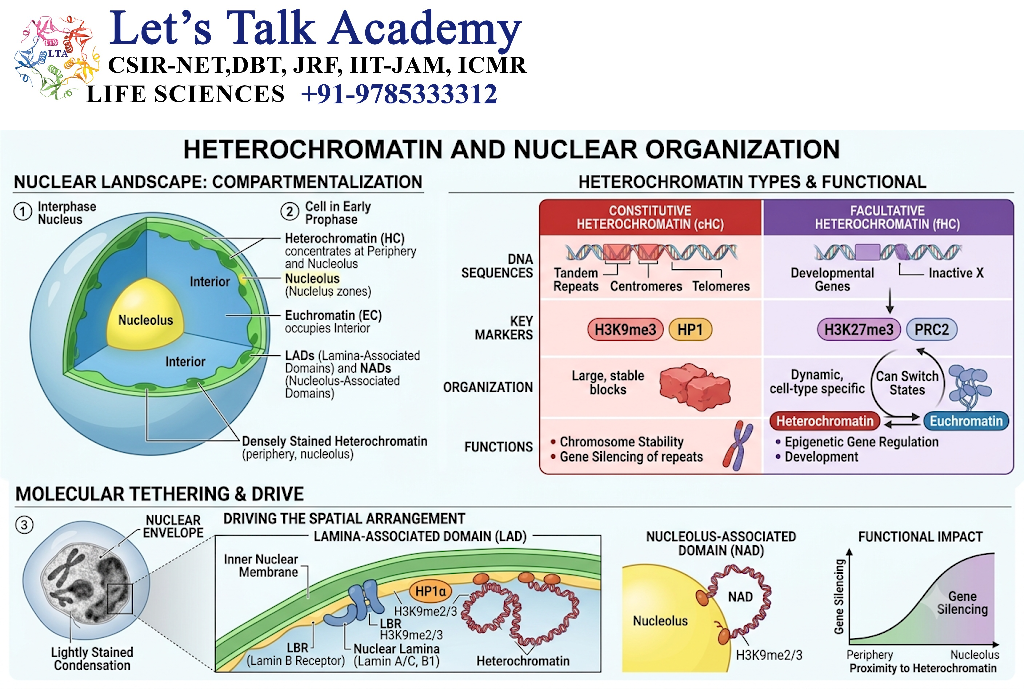
Heterochromatin is not distributed randomly within the nucleus.
Many heterochromatic regions associate with:
- Nuclear lamina
- Nuclear periphery
- Nucleolar-associated regions
- Other repressive nuclear compartments
These spatial associations contribute to the three-dimensional organization of the genome.
30. Lamina-Associated Domains
Some genomic regions interact with the nuclear lamina and are called lamina-associated domains (LADs).
Many LADs are relatively transcriptionally inactive and show heterochromatic characteristics.
They contribute to the spatial organization of chromosomes within the nucleus.
31. Heterochromatin and Epigenetics
Heterochromatin is closely connected with epigenetic regulation.
Epigenetic mechanisms can maintain a repressed chromatin state through cell divisions without changing the DNA sequence itself.
Important mechanisms include:
- Histone modifications
- DNA methylation
- Chromatin-remodelling complexes
- Non-coding RNAs
- Histone variant incorporation
Thus, heterochromatin represents an important example of epigenetic regulation.
32. Role of Non-Coding RNA
Non-coding RNAs can contribute to heterochromatin formation and maintenance.
They may:
- Recruit chromatin-modifying proteins.
- Guide regulatory complexes to particular genomic regions.
- Promote transcriptional repression.
- Participate in chromosome-wide silencing.
The XIST RNA involved in X-chromosome inactivation is a major example of non-coding RNA-mediated chromatin regulation.
33. Heterochromatin During Development
Chromatin states can change during development.
Genes required during one developmental stage may become silenced later, while previously inactive genes may become accessible.
Facultative heterochromatin therefore provides a mechanism for establishing cell-type-specific patterns of gene expression.
This contributes to cellular differentiation.
34. Heterochromatin in Differentiated Cells
Different cell types contain different patterns of chromatin organization despite sharing essentially the same genome.
For example, a neuron and a muscle cell possess largely the same DNA sequence but express different groups of genes.
Differences in heterochromatin and euchromatin organization contribute to these distinct expression patterns.
35. Heterochromatin and Aging
Chromatin organization can change during aging.
Changes may include:
- Altered heterochromatin distribution
- Changes in histone modifications
- Changes in DNA methylation
- Reduced genome stability
- Altered nuclear architecture
These changes are associated with progressive alterations in gene regulation and chromosome organization.
36. Heterochromatin and Disease
Disruption of chromatin organization can contribute to disease.
Abnormalities in heterochromatin regulation have been associated with:
- Cancer
- Developmental disorders
- Genome instability
- Chromosome abnormalities
- Certain neurological disorders
This occurs because altered chromatin states can influence gene expression, DNA repair, chromosome segregation, and genome stability.
37. Heterochromatin in Cancer
Cancer cells frequently exhibit abnormal epigenetic and chromatin organization.
Changes may involve:
- DNA methylation
- Histone modifications
- Chromatin-remodelling proteins
- Repetitive DNA regulation
- Nuclear organization
Such changes can lead to inappropriate activation or repression of genes and increased genomic instability.
38. Heterochromatin and Chromosome Condensation

Heterochromatin contributes to the structural organization of chromosomes.
During cell division, chromosomes become highly condensed. Although mitotic condensation involves specialized processes and proteins, pre-existing heterochromatic regions retain characteristic molecular properties.
Thus, heterochromatin contributes to the structural identity of chromosome regions.
39. Heterochromatin and Chromosome Segregation

Centromeric and pericentromeric heterochromatin contributes to proper chromosome segregation.
Its organization helps maintain:
- Centromere architecture
- Kinetochore function
- Sister chromatid organization
- Chromosome stability
Defects in these processes can result in chromosome missegregation.
40. Heterochromatin and Repetitive Sequence Silencing

Repetitive DNA can be particularly vulnerable to unwanted transcription and recombination.
Heterochromatin suppresses the activity of many repetitive elements through:
DNA methylation + histone modifications + chromatin compaction
This mechanism contributes to genome protection.
41. Heterochromatin Formation
Heterochromatin formation can be understood as a multistep process.
Step 1: Recognition
A genomic region is recognized as a potential repressive domain.
Step 2: Histone Modification
Specific histone residues become modified, such as methylation of H3K9.
Step 3: Protein Recruitment
Heterochromatin-associated proteins are recruited.
Step 4: Chromatin Compaction
Interactions among nucleosomes and chromatin proteins promote a compact state.
Step 5: Propagation
The heterochromatic state can spread across an appropriate genomic region.
Step 6: Maintenance
DNA methylation and histone modifications help maintain the state through cell divisions.
42. Simplified Mechanism of Heterochromatin Formation
Target genomic region
↓
H3K9 methylation
↓
Recognition by HP1 and associated proteins
↓
Recruitment of additional chromatin-modifying factors
↓
Nucleosome stabilization and chromatin compaction
↓
Reduced DNA accessibility
↓
Transcriptional repression and genome protection
This is a simplified model because different heterochromatic domains use different molecular pathways.
43. Heterochromatin and the Histone Code
The term histone code refers to the idea that combinations of histone modifications can provide regulatory information.
Heterochromatin-associated modifications can recruit specific proteins and influence chromatin organization.
For example:
H3K9 methylation → HP1 recruitment → chromatin compaction
The functional outcome depends on the combination and genomic context of chromatin modifications.
44. Constitutive and Facultative Heterochromatin: Comparison
| Feature | Constitutive | Facultative |
|---|---|---|
| Stability | Relatively stable | More reversible |
| Common location | Centromeric/pericentromeric and repetitive regions | Developmentally regulated regions |
| DNA content | Often repetitive | Often gene-rich |
| Gene expression | Generally restricted | Can switch between states |
| Example | Pericentromeric regions | Inactive X chromosome |
| Major role | Structural and genome protection | Developmental and regulatory silencing |
45. Heterochromatin and Chromatin Remodeling
Although heterochromatin is compact, it is not completely static.
Chromatin-remodelling complexes can alter nucleosome positioning and accessibility.
These processes allow cells to:
- Establish heterochromatic domains.
- Maintain silencing.
- Respond to DNA damage.
- Reorganize chromatin during development.
Therefore, heterochromatin is a dynamic regulatory structure.
46. Heterochromatin and DNA Damage Response
DNA damage occurring inside compact chromatin must still be detected and repaired.
Cells can temporarily modify chromatin structure around damaged DNA to allow repair proteins to gain access.
After repair, the original chromatin state can be restored.
This illustrates the balance between chromatin compaction and DNA accessibility.
47. Heterochromatin and Transcriptional Noise
Stable heterochromatic organization can help reduce inappropriate or random transcription from repetitive and normally silent genomic regions.
This contributes to reliable gene regulation and maintenance of cellular identity.
48. Heterochromatin as a Genome Defense System
Heterochromatin can be considered an important genome-defense mechanism.
It helps suppress:
- Transposable elements
- Repetitive DNA transcription
- Inappropriate recombination
- Chromosome instability
Thus, heterochromatin is not simply a passive storage form of DNA but an active protective system.
49. Major Molecular Components
Important components associated with heterochromatin include:
| Component | Major role |
|---|---|
| H3K9me3 | Repressive chromatin mark |
| H3K9 methyltransferases | Establish H3K9 methylation |
| HP1 | Recognizes H3K9 methylation and promotes heterochromatin organization |
| DNA methylation | Supports repression in many genomic contexts |
| DNA methyltransferases | Establish or maintain DNA methylation |
| Chromatin-remodelling complexes | Reorganize nucleosomes |
| Non-coding RNAs | Can recruit or guide chromatin regulators |
| Nuclear lamina | Provides a repressive nuclear environment for some domains |
50. Biological Functions of Heterochromatin
The major functions of heterochromatin can be summarized as follows:
50.1 Gene Silencing
It restricts transcription from selected genomic regions.
50.2 DNA Packaging
It provides compact organization of genomic DNA.
50.3 Genome Stability
It suppresses inappropriate recombination and repetitive-element activity.
50.4 Centromere Function
It contributes to chromosome segregation.
50.5 Telomere Protection
It contributes to the organization of chromosome-end regions.
50.6 Transposable Element Suppression
It limits activity of many mobile genetic elements.
50.7 Epigenetic Memory
It helps maintain stable patterns of gene repression through cell divisions.
51. Heterochromatin and Three-Dimensional Genome Organization
Modern genome studies show that heterochromatin participates in the three-dimensional organization of chromosomes.
Heterochromatic domains can cluster together and associate with particular nuclear compartments.
This organization can influence long-range gene regulation by controlling the physical environment surrounding genomic regions.
52. Heterochromatin and Nuclear Periphery
Many heterochromatic regions are found near the nuclear periphery.
The nuclear lamina can interact with chromatin and help maintain transcriptionally repressive environments.
This spatial organization demonstrates that genome regulation depends not only on DNA sequence and histone modifications but also on the physical location of DNA within the nucleus.
53. Heterochromatin and Nucleolus
Some heterochromatic regions associate with the nucleolus.
These regions, known as nucleolus-associated domains, contribute to the spatial organization of chromosomes and are often associated with transcriptional repression.
54. Experimental Identification of Heterochromatin
Heterochromatin can be studied using several approaches.
These include:
- Cytological staining
- Chromosome banding
- Immunofluorescence
- Chromatin immunoprecipitation
- DNA methylation analysis
- Sequencing-based chromatin profiling
- Microscopy
- Genome-wide chromosome conformation techniques
These methods allow researchers to study both the molecular composition and spatial organization of heterochromatin.
55. Heterochromatin in Microscopy
Heterochromatin is often visible as more densely stained regions under microscopy.
In interphase nuclei, condensed chromatin can appear as darkly staining structures.
During chromosome analysis, certain heterochromatic regions produce characteristic banding patterns.
Thus, heterochromatin has both molecular and cytological characteristics.


