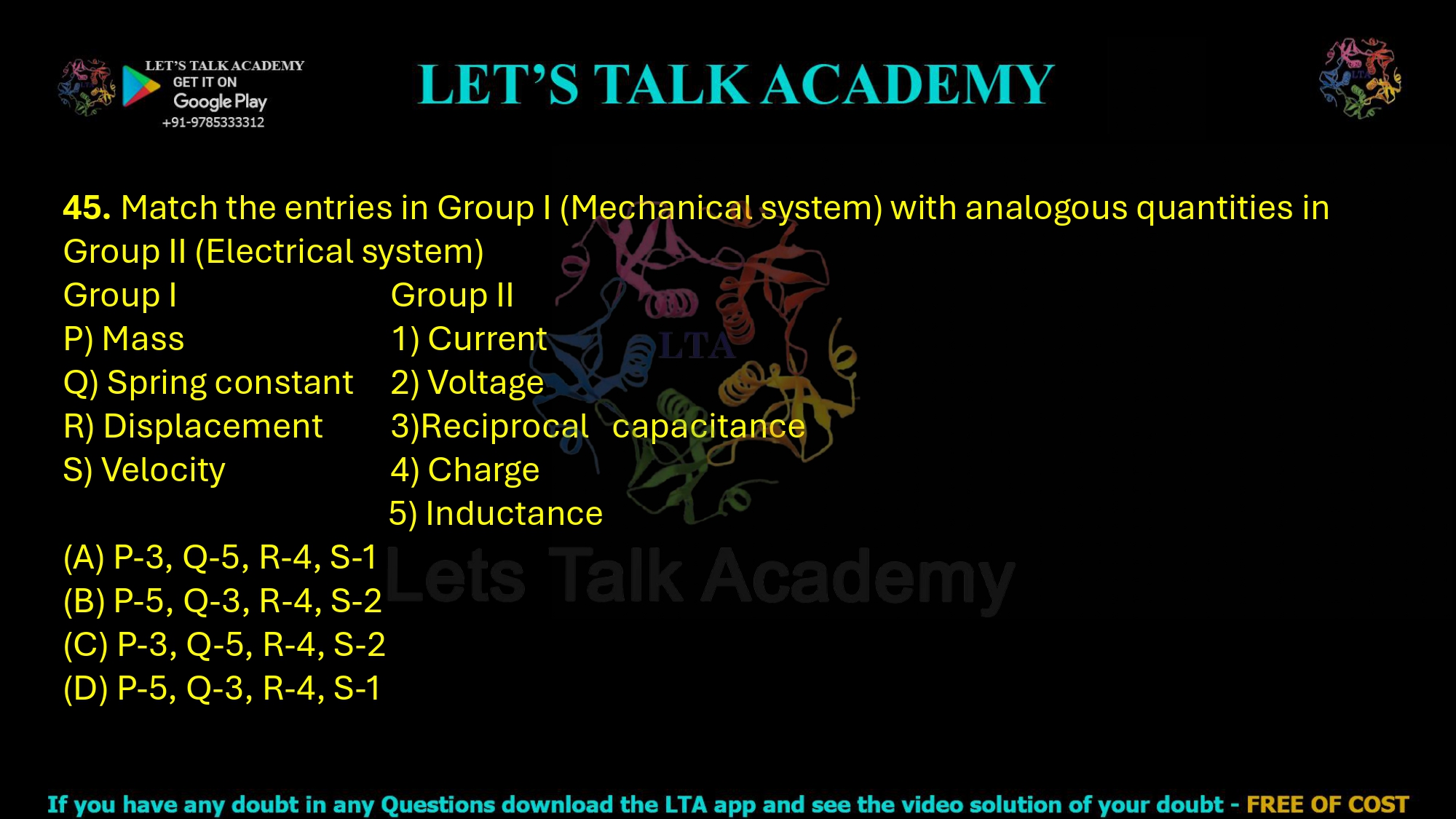
45. Match the entries in Group I (Mechanical system) with analogous quantities in Group II (Electrical system)
Group I Group II
P) Mass 1) Current
Q) Spring constant 2) Voltage
R) Displacement 3)Reciprocal capacitance
S) Velocity 4) Charge
5) Inductance
(A) P-3, Q-5, R-4, S-1
(B) P-5, Q-3, R-4, S-2
(C) P-3, Q-5, R-4, S-2
(D) P-5, Q-3, R-4, S-1
Mechanical and Electrical System Analogy: Correct Matching of Physical Quantities
Correct Answer: (D) P-5, Q-3, R-4, S-1
Understanding the Analogy Between Mechanical and Electrical Systems
This question is based on the mathematical analogy between a mechanical mass-spring system and an electrical LC or LCR circuit. Although these systems involve completely different physical quantities, their governing differential equations have the same mathematical form. This similarity allows mechanical quantities such as mass, spring constant, displacement, and velocity to be matched with corresponding electrical quantities such as inductance, reciprocal capacitance, charge, and current.
The analogy used in this question is commonly called the force-voltage analogy or impedance analogy. Under this analogy, force in the mechanical system corresponds to voltage in the electrical system.
The correct matching is:
Mass ↔ Inductance
Spring constant ↔ Reciprocal capacitance
Displacement ↔ Charge
Velocity ↔ Current
Therefore, the correct sequence is P-5, Q-3, R-4, S-1, which corresponds to Option (D).
Equation of a Mechanical Mass-Spring System
Consider an ideal mechanical system consisting of a mass attached to a spring. If the mass is displaced from its equilibrium position and released, it undergoes simple harmonic motion.
The restoring force produced by the spring is given by Hooke’s law:
F = −kx
where k is the spring constant and x is the displacement from equilibrium.
Using Newton’s second law, the equation of motion for the ideal mass-spring system can be written as:
m(d²x/dt²) + kx = 0
Here, m represents the mass and x represents the displacement of the mechanical system.
Equation of an Analogous Electrical LC Circuit
Now consider an ideal electrical circuit containing an inductor and a capacitor. Applying Kirchhoff’s voltage law to the LC circuit gives:
L(d²q/dt²) + q/C = 0
where L is the inductance, C is the capacitance, and q is the electric charge stored on the capacitor.
This equation can also be written as:
L(d²q/dt²) + (1/C)q = 0
Comparing this electrical equation with the mechanical equation:
m(d²x/dt²) + kx = 0
the corresponding quantities can be identified directly.
Comparison of the Mechanical and Electrical Equations
The mechanical equation contains mass m, while the corresponding position in the electrical equation contains inductance L. Therefore, mass is analogous to inductance.
The mechanical equation contains the spring constant k, while the corresponding electrical term contains 1/C. Therefore, the spring constant is analogous to reciprocal capacitance.
The mechanical variable is displacement x, while the corresponding electrical variable is charge q. Therefore, displacement is analogous to charge.
Since velocity is the rate of change of displacement and current is the rate of change of charge, velocity is analogous to electric current.
Matching P: Mass with Inductance
In the mechanical system, mass represents inertia. It resists any change in the state of motion of an object. A larger mass requires a greater force to produce the same acceleration.
In an electrical circuit, inductance plays an analogous role. An inductor opposes changes in electric current. Just as mass provides mechanical inertia, inductance provides electrical inertia.
Therefore:
Mass ↔ Inductance
Hence:
P → 5
Matching Q: Spring Constant with Reciprocal Capacitance
The spring constant k determines the restoring force developed by a spring for a given displacement. A larger spring constant means that the spring produces a greater restoring force for the same displacement.
In the analogous electrical equation, the corresponding quantity is 1/C, the reciprocal of capacitance. This can be seen directly by comparing the mechanical restoring term kx with the electrical capacitor term q/C.
Therefore:
Spring constant ↔ Reciprocal capacitance
Hence:
Q → 3
Matching R: Displacement with Charge
Displacement x describes the position of the mechanical system relative to its equilibrium position. In the analogous electrical system, the corresponding variable is the electric charge q.
This correspondence is clear from the two governing equations, where displacement appears in the mechanical equation in the same mathematical position as charge appears in the electrical equation.
Therefore:
Displacement ↔ Charge
Hence:
R → 4
Matching S: Velocity with Current
Velocity is defined as the rate of change of displacement with time:
v = dx/dt
Electric current is defined as the rate of flow of charge:
I = dq/dt
Since displacement corresponds to charge, the time derivative of displacement must correspond to the time derivative of charge. Therefore, velocity corresponds directly to electric current.
Thus:
Velocity ↔ Current
Hence:
S → 1
Complete Correct Matching
Combining all the mechanical and electrical analogies gives:
P) Mass → 5) Inductance
Q) Spring constant → 3) Reciprocal capacitance
R) Displacement → 4) Charge
S) Velocity → 1) Current
Therefore:
P-5, Q-3, R-4, S-1
Detailed Analysis of Each Option
Option (A): P-3, Q-5, R-4, S-1
Option (A) is incorrect. This option correctly matches displacement with charge and velocity with current, but it incorrectly interchanges the analogies for mass and spring constant. Mass corresponds to inductance, not reciprocal capacitance, while the spring constant corresponds to reciprocal capacitance, not inductance.
Option (B): P-5, Q-3, R-4, S-2
Option (B) is incorrect. The matches for mass, spring constant, and displacement are correct. However, velocity is incorrectly matched with voltage. Since velocity is the time derivative of displacement and current is the time derivative of charge, velocity must correspond to current.
Option (C): P-3, Q-5, R-4, S-2
Option (C) is incorrect. This option incorrectly matches mass with reciprocal capacitance, spring constant with inductance, and velocity with voltage. Only the correspondence between displacement and charge is correct.
Option (D): P-5, Q-3, R-4, S-1
Option (D) is correct. Mass corresponds to inductance, spring constant corresponds to reciprocal capacitance, displacement corresponds to charge, and velocity corresponds to current. All four matches are consistent with the mathematical analogy between a mechanical oscillator and an electrical LC circuit.
Energy-Based Explanation of the Mechanical-Electrical Analogy
The analogy can also be understood by comparing the energy stored in mechanical and electrical systems. The kinetic energy of a moving mass is:
Kinetic energy = (1/2)mv²
The magnetic energy stored in an inductor is:
Magnetic energy = (1/2)LI²
Comparing these expressions shows that mass corresponds to inductance and velocity corresponds to current.
Similarly, the potential energy stored in a spring is:
Spring potential energy = (1/2)kx²
The electrical energy stored in a capacitor is:
Capacitor energy = q²/(2C) = (1/2)(1/C)q²
Comparing these expressions confirms that the spring constant corresponds to reciprocal capacitance and displacement corresponds to charge.
Why Velocity Corresponds to Current
The velocity-current analogy is particularly important because it follows directly from the definitions of the two quantities. Velocity measures how rapidly displacement changes with time, while current measures how rapidly electric charge changes with time.
Since:
v = dx/dt
and:
I = dq/dt
the analogy x ↔ q automatically leads to the analogy v ↔ I. This provides a direct mathematical confirmation of the matching S-1.
Key Concept Behind the Question
The central idea is to compare the mathematical equations governing mechanical and electrical oscillations. The equation of an ideal mass-spring oscillator is:
m(d²x/dt²) + kx = 0
The equation of an ideal LC circuit is:
L(d²q/dt²) + (1/C)q = 0
Direct comparison gives m ↔ L, k ↔ 1/C, and x ↔ q. Taking the time derivatives of displacement and charge further gives v ↔ I.
Final Answer
The correct matching is P-5, Q-3, R-4, S-1.
Therefore, the correct answer is Option (D).
Conclusion
The mathematical similarity between a mechanical mass-spring system and an electrical LC circuit provides the correct analogy between their physical quantities. Mass behaves like inductance because both represent inertia, the spring constant corresponds to reciprocal capacitance, displacement corresponds to charge, and velocity corresponds to current. Therefore, the correct matching is P-5, Q-3, R-4, S-1, making Option (D) the correct answer.


