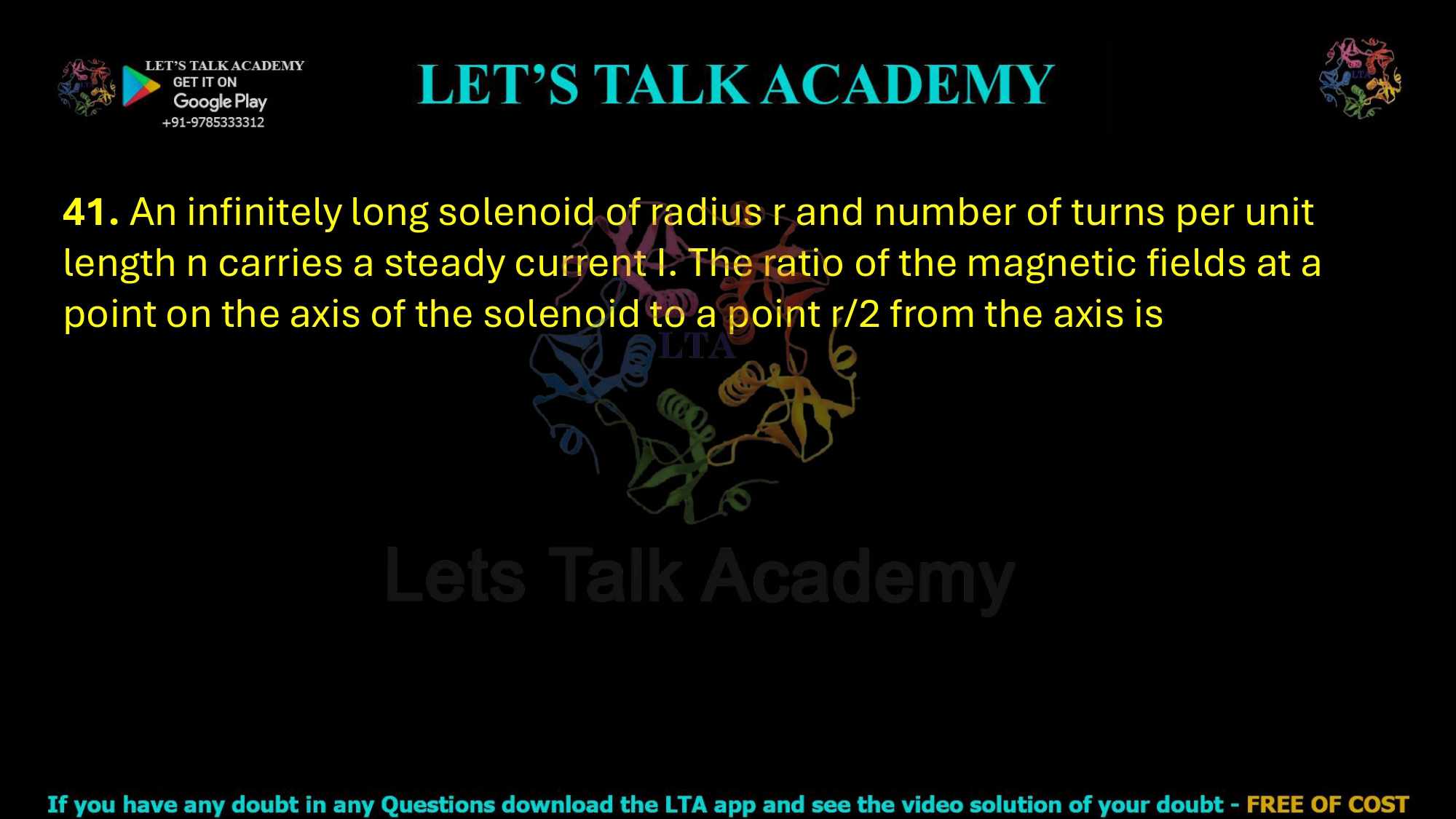
41. An infinitely long solenoid of radius r and number of turns per unit length n carries a steady current I. The ratio of the magnetic fields at a point on the axis of the solenoid to a point r/2 from the axis is
An Infinitely Long Solenoid of Radius r Carries a Steady Current I: Find the Ratio of Magnetic Fields
Correct Answer: 1 : 1
The correct ratio of the magnetic field at a point on the axis of the infinitely long solenoid to the magnetic field at a point located at a distance r/2 from the axis is 1 : 1. This is because the magnetic field inside an ideal infinitely long solenoid is uniform throughout its interior and does not depend on the radial distance from the axis.
Both points mentioned in the question lie inside the solenoid. The first point is located directly on the axis, while the second point is at a radial distance of r/2. Since the radius of the solenoid is r, the condition r/2 < r confirms that the second point is also inside the solenoid. Therefore, the magnetic field has the same magnitude at both points.
Understanding the Magnetic Field Inside an Infinitely Long Solenoid
A solenoid is a long cylindrical coil made by winding a conducting wire into a large number of closely spaced circular turns. When an electric current flows through the wire, each circular turn produces a magnetic field. Inside a sufficiently long solenoid, the magnetic fields produced by the individual turns combine to form a strong and nearly uniform magnetic field.
For an ideal infinitely long solenoid, end effects are completely absent. As a result, the magnetic field inside the solenoid is perfectly uniform, while the magnetic field outside is zero in the ideal approximation.
The magnitude of the magnetic field at any point inside an infinitely long solenoid is given by
B = μ0nI
where μ0 is the permeability of free space, n is the number of turns per unit length, and I is the steady current flowing through the solenoid.
An important observation is that the expression B = μ0nI contains no radial coordinate. Therefore, the magnetic field inside an ideal infinitely long solenoid does not depend on how far an interior point is located from the central axis.
Magnetic Field at the Axis of the Solenoid
Consider the first point located on the axis of the solenoid. The radial distance of this point from the axis is zero. Since the point lies inside the infinitely long solenoid, the magnetic field at this position is
Baxis = μ0nI
The direction of this magnetic field is parallel to the axis of the solenoid. Its direction can be determined using the right-hand grip rule.
Magnetic Field at a Distance r/2 from the Axis
Now consider the second point located at a radial distance r/2 from the axis. The radius of the solenoid is r, and therefore
r/2 < r
This means that the second point lies inside the solenoid rather than outside it. Since the magnetic field is uniform throughout the interior of an infinitely long solenoid, the magnetic field at this point is also
Br/2 = μ0nI
Thus, moving from the axis to a point halfway between the axis and the surface of the solenoid does not change the magnitude of the magnetic field.
Calculation of the Magnetic Field Ratio
The required ratio is the magnetic field at the axis divided by the magnetic field at a distance r/2 from the axis:
Baxis / Br/2 = (μ0nI) / (μ0nI)
Therefore,
Baxis / Br/2 = 1
Hence, the ratio of the two magnetic fields is
Baxis : Br/2 = 1 : 1
Why Is the Magnetic Field Uniform Inside an Infinite Solenoid?
The uniformity of the magnetic field can be understood from the symmetry of an infinitely long solenoid. Since the solenoid extends infinitely in both directions along its axis, there are no ends and therefore no edge effects. Every interior region of the solenoid has exactly the same electromagnetic environment.
The magnetic field lines inside the solenoid are straight, parallel, and equally spaced. Parallel and equally spaced magnetic field lines represent a uniform magnetic field. Therefore, the field has the same magnitude at the central axis and at every other interior point, including a point at a distance r/2 from the axis.
Explanation Using Ampere’s Circuital Law
Ampere’s circuital law provides a direct method for calculating the magnetic field of an infinitely long solenoid. According to this law, the line integral of the magnetic field around a closed path is proportional to the total current enclosed by that path.
For an infinitely long solenoid, applying Ampere’s law gives the magnetic field inside as
B = μ0nI
The result depends only on the number of turns per unit length and the current. It does not contain the radius of the observation point from the axis. This mathematical result confirms that the magnetic field is uniform throughout the interior of the ideal infinitely long solenoid.
Does the Radius r of the Solenoid Affect the Required Ratio?
The radius r is included in the question mainly to establish the location of the second point. Since the point is at a distance r/2 from the axis, it clearly lies inside the solenoid.
For an ideal infinitely long solenoid, the internal magnetic field is independent of the solenoid’s radial coordinate. Therefore, the value of r does not affect the ratio as long as both points being compared are inside the solenoid.
Difference Between an Infinite and a Finite Solenoid
The phrase infinitely long solenoid is essential to solving this question correctly. In a real finite solenoid, the magnetic field is not perfectly uniform everywhere. Near the ends of a finite solenoid, the magnetic field lines spread outward, producing end effects and reducing the field strength.
In an infinitely long solenoid, however, no ends exist. Therefore, there are no end effects, and the internal magnetic field is treated as perfectly uniform. This idealization allows the magnetic field at the axis and at the point r/2 from the axis to be exactly equal.
Final Answer
The magnetic field inside an infinitely long solenoid is uniform and has the magnitude B = μ0nI. Both the point on the axis and the point located at a distance r/2 from the axis lie inside the solenoid. Therefore, the magnetic fields at the two points are equal.
Hence, the required ratio is 1 : 1.


