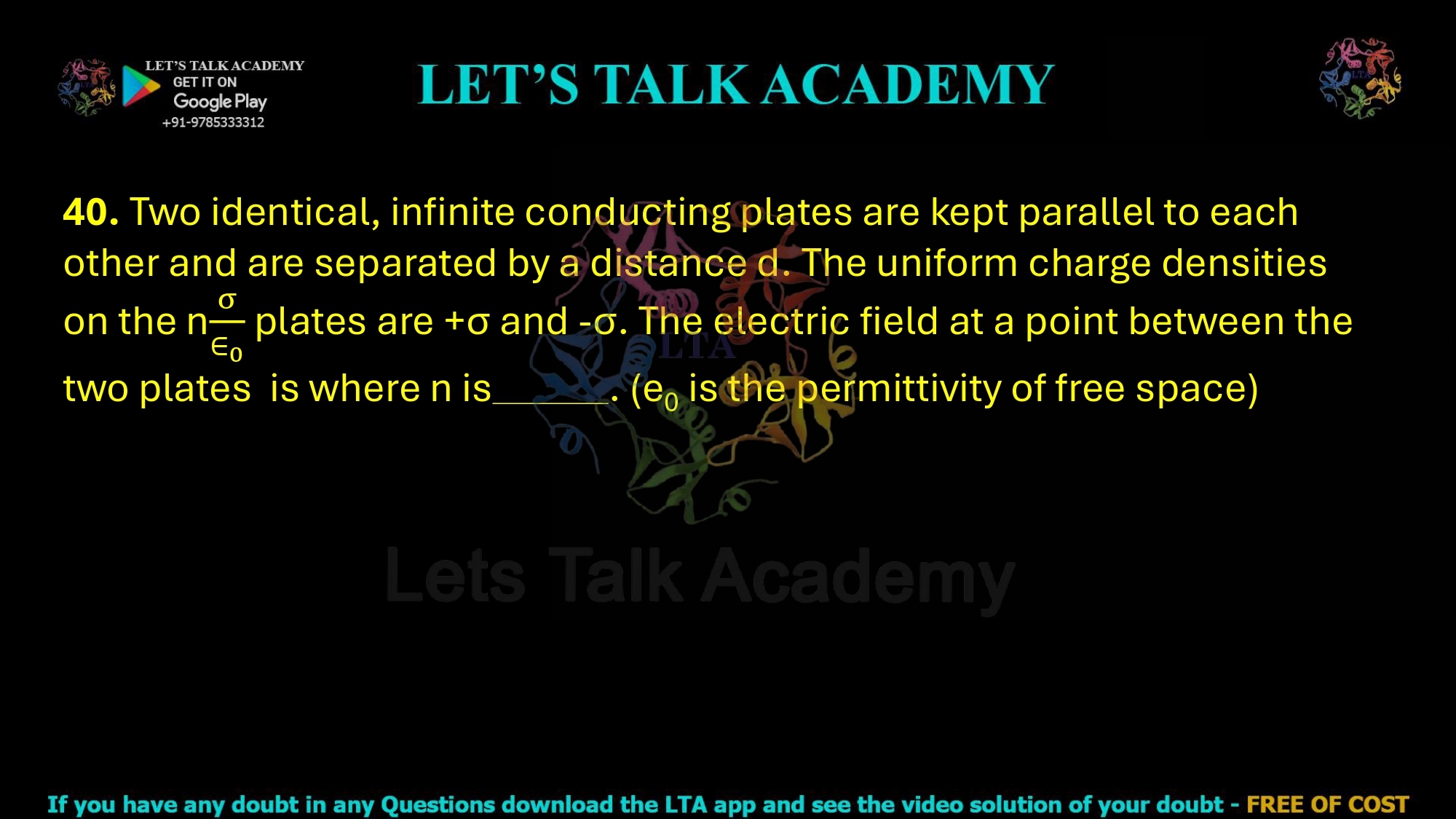
40. Two identical, infinite conducting plates are kept parallel to each other and are separated by a distance d. The uniform charge densities on the n plates are +σ and -σ. The electric field at a point between the two plates is where n is . (e0 is the permittivity of free space)
Electric Field Between Two Infinite Parallel Conducting Plates with Opposite Charges
Correct Answer: n = 1
Understanding the Electric Field Between Two Charged Plates
This question is based on the electric field produced by an infinite charged sheet and the principle of superposition. Two infinite parallel conducting plates carry equal and opposite uniform surface charge densities, +σ and −σ. To calculate the net electric field at a point between the plates, the electric fields produced by both plates must be considered.
An important feature of an infinite uniformly charged sheet is that the magnitude of its electric field does not depend on the distance from the sheet. Therefore, the separation d between the plates does not appear in the final expression for the electric field.
Each charged plate produces an electric field of magnitude:
E = σ/(2ε0)
Between the oppositely charged plates, the electric fields due to the two plates point in the same direction. Therefore, they add together.
Electric Field Due to a Single Infinite Charged Sheet
Consider an infinite sheet carrying a uniform surface charge density σ. Using Gauss’s law, the magnitude of the electric field on either side of the sheet is:
E = σ/(2ε0)
The electric field produced by a positively charged sheet is directed away from the sheet. In contrast, the electric field produced by a negatively charged sheet is directed toward the sheet.
Thus, the +σ plate produces a field directed away from itself, while the −σ plate produces a field directed toward itself.
Direction of Electric Fields Between the Plates
Consider a point located in the region between the two parallel plates. The positively charged plate produces an electric field directed from the positive plate toward the negative plate.
The negatively charged plate also produces an electric field directed toward itself. Therefore, at a point between the plates, its electric field is also directed from the positive plate toward the negative plate.
Hence, both electric fields have the same direction in the region between the plates. According to the principle of superposition, electric fields acting in the same direction are added.
Calculating the Net Electric Field Between the Plates
Electric Field Due to the Positive Plate
The magnitude of the electric field produced by the positively charged plate is:
E+ = σ/(2ε0)
Electric Field Due to the Negative Plate
The magnitude of the electric field produced by the negatively charged plate is:
E− = σ/(2ε0)
Since both electric fields point in the same direction between the plates, the net electric field is:
E = E+ + E−
Therefore:
E = σ/(2ε0) + σ/(2ε0)
Adding the two terms:
E = 2σ/(2ε0)
Hence:
E = σ/ε0
Finding the Value of n
The electric field given in the question is expressed as:
E = σ/(nε0)
From the calculation, the electric field between the plates is:
E = σ/ε0
Comparing the two expressions:
σ/(nε0) = σ/ε0
Therefore:
n = 1
Final Answer
The value of n is 1.
Therefore, the required answer is 1.
Why Do the Electric Fields Add Between the Plates?
The direction of an electric field is defined as the direction in which a positive test charge would move. A positive sheet repels a positive test charge, so its electric field points away from the sheet. A negative sheet attracts a positive test charge, so its electric field points toward the sheet.
In the space between the two plates, both effects produce an electric field directed from the positively charged plate toward the negatively charged plate. Since the directions are identical, the magnitudes add according to the superposition principle.
Thus, two fields of magnitude σ/(2ε0) combine to produce a net field of magnitude σ/ε0.
What Happens to the Electric Field Outside the Plates?
The behaviour of the electric field outside the two plates is different from that in the region between them. At a point outside the plates, the electric field produced by the positive plate and the electric field produced by the negative plate are equal in magnitude but opposite in direction.
Therefore, outside the plates:
Eoutside = σ/(2ε0) − σ/(2ε0) = 0
Hence, for ideal infinite parallel plates carrying equal and opposite charge densities, the electric field is zero outside the plates and uniform inside the region between them.
Why Is the Separation d Not Used?
The question states that the plates are separated by a distance d, but this distance does not appear in the final answer. This is because the electric field produced by an ideal infinite charged sheet is independent of the distance from the sheet.
Therefore, changing the separation between ideal infinite plates does not change the magnitude of the electric field between them as long as the surface charge densities remain fixed at +σ and −σ.
The distance d becomes important when calculating quantities such as the potential difference between the plates because the potential difference is related to the electric field and separation by V = Ed. However, it is not needed for calculating the electric field in this question.
Role of the Superposition Principle
The superposition principle states that the total electric field at any point is the vector sum of the electric fields produced independently by all charges.
Each plate produces an electric field of magnitude σ/(2ε0). Between the plates, the two fields have the same direction and therefore add. Outside the plates, they have opposite directions and therefore cancel.
This principle explains both the uniform electric field inside the two-plate system and the zero electric field outside it.
Physical Meaning of the Result
The final expression for the electric field between the plates is:
E = σ/ε0
This result shows that the electric field is directly proportional to the surface charge density. Increasing the magnitude of charge per unit area increases the electric field between the plates.
The field is also uniform, meaning that its magnitude and direction are the same at every point between ideal infinite plates. The direction of the electric field is always from the positively charged plate toward the negatively charged plate.
Key Concept Behind the Numerical
The central idea is that a single infinite charged sheet produces an electric field of magnitude σ/(2ε0) on each side. When two plates carry equal and opposite charge densities, the electric fields between them point in the same direction.
Therefore, the two contributions add to give:
E = σ/(2ε0) + σ/(2ε0) = σ/ε0
Comparing this result with the given expression σ/(nε0) gives n = 1.
Conclusion
Each infinite charged plate produces an electric field of magnitude σ/(2ε0). In the region between the +σ and −σ plates, both electric fields are directed from the positive plate toward the negative plate. Therefore, the fields add to produce a uniform net electric field of σ/ε0. Comparing this with σ/(nε0) gives n = 1.


